Loading themes...
Explore the best books about Society theme.


Two renowned investment advisors and authors of the best seller The Great Reckoning bring to light both currents of disaster and the potential for prosperity and renewal in the face of radical changes in human history as we move into the next century. The Sovereign Individual details strategies necessary for adapting financially to the next phase of Western civilization.Few observers of the late-20th century have their fingers so presciently on the pulse of the global political and economic realignment ushering in the new millennium as do James Dale Davidson and Lord William Rees-Mogg. Their bold prediction of disaster on Wall Street in Blood in the Streets was borne out by Black Tuesday. In their ensuing best sellar, The Great Reckoning, published just weeks before the coup attempt against Gorbachev, they analyzed the pending collapse of the Soviet Union and foretold the civil war in Yugoslavia and other events that have proved to be among the most searing developments of the past few years.In The Sovereign Individual, Davidson and Rees-Mogg explore the greatest economic and political transition in centuries - the shift from an industrial to an information-based society. This transition, which they have termed "the fourth stage of human society", will liberate individuals as never before, irrevocably altering the power of government. This outstanding book will replace false hopes and fictions with new understanding and clarified values.

21 Lessons For The 21st Century [Hardcover], Headspace Guide To Meditation And Mindfulness, Meditation For Fidgety Skeptics, 10% Happier 4 Books Collection Set. Description:- 21 Lessons for the 21st Century Yuval Noah Harari takes us on a thrilling journey through today’s most urgent issues. The golden thread running through his exhilarating new book is the challenge of maintaining our collective and individual focus in the face of constant and disorienting change. Are we still capable of understanding the world we have created? The Headspace Guide to Mindfulness & Meditation: 10 minutes can make the difference Demystifying meditation for the modern world: an accessible and practical route to improved health, happiness and well being, in as little as 10 minutes. Andy Puddicombe, founder of the celebrated Headspace, is on a mission: to get people to take 10 minutes out of their day to sit in the now. Here he shares his simple to learn, but highly effective techniques of meditation. Meditation For Fidgety Skeptics: A 10% Happier How-To Book ABC News anchor Dan Harris used to think that meditation was for people who collect crystals, play the pan pipes, and use the word namaste without irony. After he had a panic attack on live television, he went on a strange journey that ultimately led him to become one of meditation's most vocal public proponents. 10% Happier: How I Tamed the Voice in My Head, Reduced Stress Without Losing My Edge, and Found Self-Help That Actually Works After having a nationally televised panic attack, Harris knew he had to make some changes. A lifelong non-believer, he found himself on a bizarre adventure and realised that the sources of his problems was the very thing he always thought was his greatest asset.

Una suggestiva indagine dei meccanismi profondi che regolano la nostra esistenza, le decisioni che prendiamo e i valori che condividiamo o che rifiutiamo. Da vent’anni, lo psicologo morale e filosofo Jonathan Haidt indaga i meccanismi profondi che regolano la nostra esistenza, le decisioni che prendiamo, i valori che crediamo universali, che condividiamo o che rifiutiamo. Secondo Haidt il giudizio morale è la bussola che, dalle piccole scelte quotidiane ai grandi temi della politica e della religione, orienta la tendenza naturale dell’uomo a riunirsi in tribù e a dividersi su ciò che si ritiene essere giusto o sbagliato. Arrivato ai vertici della classifica del “New York Times”, Menti tribali è un libro che propone una via alla convivenza e al dialogo, partendo dalla comprensione dei processi biologici ancestrali da cui nasce la nostra ricerca del bene.

In this indispensable guide to navigating the twenty-first century, two visionary thinkers reveal the unexpected ways power is changing--and how "new power" is reshaping politics, business, and life.Why do some leap ahead while others fall behind in our chaotic, connected age? In New Power, Jeremy Heimans and Henry Timms confront the biggest stories of our time--the rise of mega-platforms like Facebook and Uber; the out-of-nowhere victories of Obama and Trump; the unexpected emergence of movements like #MeToo--and reveal what's really behind them: the rise of "new power." For most of human history, the rules of power were clear: power was something to be seized and then jealously guarded. This "old power" was out of reach for the vast majority of people. But our ubiquitous connectivity makes possible a different kind of power. "New power" is made by many. It is open, participatory, and peer-driven. It works like a current, not a currency--and it is most forceful when it surges. The battle between old and new power is determining who governs us, how we work, and even how we think and feel. New Power shines fresh light on the cultural phenomena of our day, from #BlackLivesMatter to the Ice Bucket Challenge to Airbnb, uncovering the new power forces that made them huge. Drawing on examples from business, activism, and pop culture, as well as the study of organizations like Lego, NASA, Reddit, and TED, Heimans and Timms explain how to build new power and channel it successfully. They also explore the dark side of these forces: the way ISIS has co-opted new power to monstrous ends, and the rise of the alt-right's "intensity machine."In an era increasingly shaped by new power, this groundbreaking book offers us a new way to understand the world--and our role in it.

An insider's groundbreaking investigation of how the global elite's efforts to "change the world" preserve the status quo and obscure their role in causing the problems they later seek to solve.Former New York Times columnist Anand Giridharadas takes us into the inner sanctums of a new gilded age, where the rich and powerful fight for equality and justice any way they can--except ways that threaten the social order and their position atop it. We see how they rebrand themselves as saviors of the poor; how they lavishly reward "thought leaders" who redefine "change" in winner-friendly ways; and how they constantly seek to do more good, but never less harm. We hear the limousine confessions of a celebrated foundation boss; witness an American president hem and haw about his plutocratic benefactors; and attend a cruise-ship conference where entrepreneurs celebrate their own self-interested magnanimity.Giridharadas asks hard questions: Why, for example, should our gravest problems be solved by the unelected upper crust instead of the public institutions it erodes by lobbying and dodging taxes? He also points toward an answer: Rather than rely on scraps from the winners, we must take on the grueling democratic work of building more robust, egalitarian institutions and truly changing the world. A call to action for elites and everyday citizens alike.

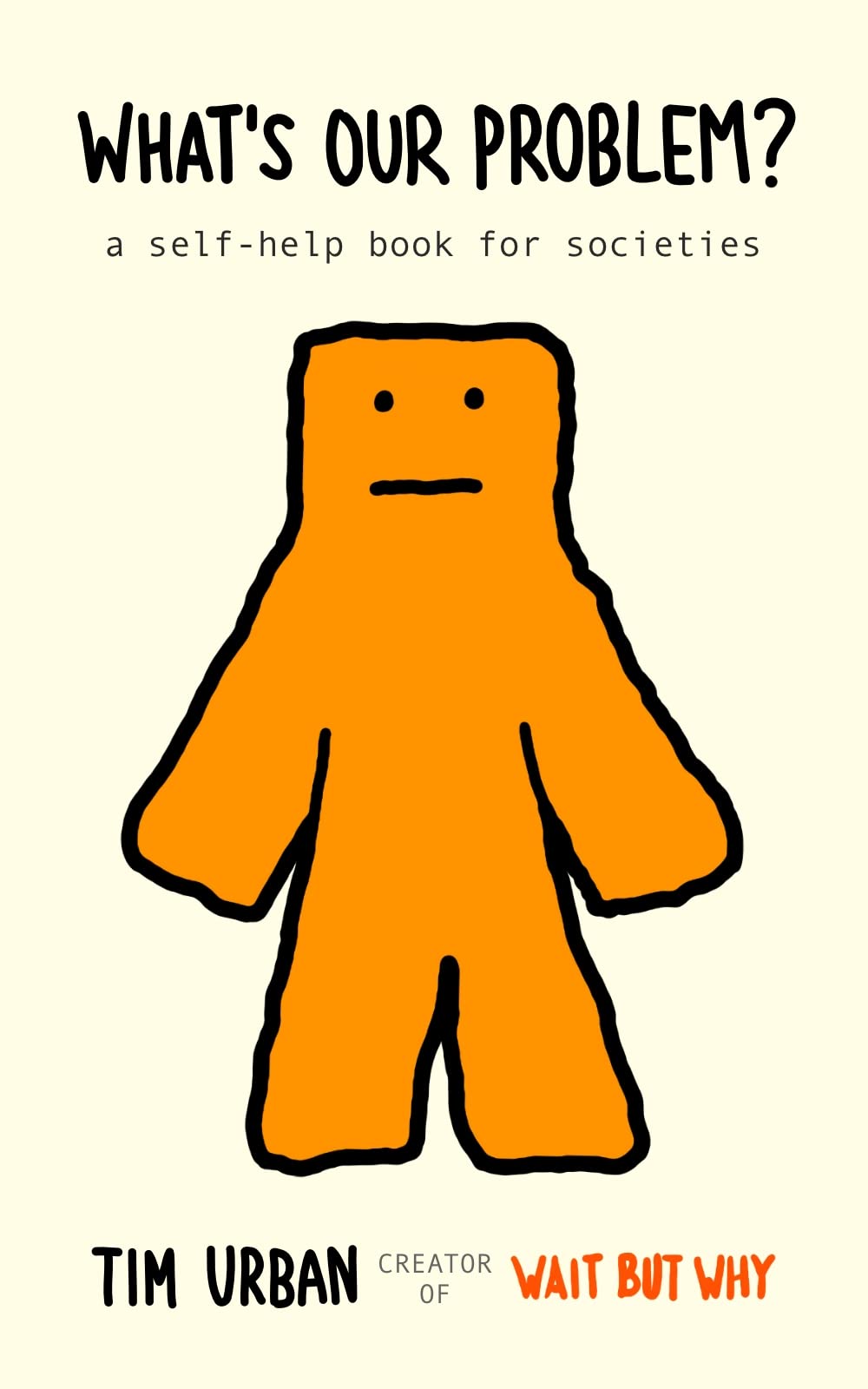
From the creator of the wildly popular blog Wait But Why, a fun and fascinating deep dive into what the hell is going on in our strange, unprecedented modern times.Between 2013 and 2016, Tim Urban became one of the world’s most popular bloggers, writing dozens of viral, long-form articlesabout everything from AI to colonizing Mars to procrastination. Then, he turned his attention to a new topic: the society around him. Why was everything such a mess? Why was everyone acting like such a baby? When did things get so tribal? Why do humans do this stuff?This massive topic sent Tim tumbling down his deepest rabbit hole yet, through mountains of history, evolutionary psychology, political theory, neuroscience, and modern-day political movements, as he tried to figure out the answer to a simple question: What’s our problem?Six years later, he emerged from the hole holding this book. What’s Our Problem? is a deep and expansive analysis of our modern times, in the classic style of Wait But Why, packed with original concepts, sticky metaphors, and 300 drawings. The book provides an entirely new framework and language for thinking and talking about today’s complex world. Instead of focusing on the usual left-center-right horizontal political axis, which is all about what we think, the book introduces a verticalaxis that explores how we think, as individuals and as groups. Readers will find themselves on a delightful and fascinating journey that will ultimately change the way they see the world around them.Anyway he wanted to say a lot more about all of this but there was a word limit on this book description so just go read the book.

"Verbalizing visceral feelings about technology, whether attraction or repulsion, Kelly explores the “technium,” his term for the globalized, interconnected stage of technological development. Arguing that the processes creating the technium are akin to those of biological evolution, Kelly devotes the opening sections of his exposition to that analogy, maintaining that the technium exhibits a similar tendency toward self-organizing complexity. Having defined the technium, Kelly addresses its discontents, as expressed by the Unabomber (although Kelly admits to trepidation in taking seriously the antitechnology screeds of a murderer) and then as lived by the allegedly technophobic Amish. From his observations and discussions with some Amish people, Kelly extracts some precepts of their attitudes toward gadgets, suggesting folk in the secular world can benefit from the Amish approach of treating tools as servants of self and society rather than as out-of-control masters. Exploring ramifications of technology on human welfare and achievement, Kelly arrives at an optimistic outlook that will interest many, coming, as it does, from the former editor of Wired magazine."Gilbert Taylor, Booklist

“Every adult life could be said to be defined by two great love stories. The first—the story of our quest for sexual love—is well known and well charted. . . . The second—the story of our quest for love from the world—is a more secret and shameful tale. And yet this second love story is no less intense than the first.”This is a book about an almost universal anxiety that rarely gets mentioned an anxiety about what others think of us, about whether we’re judged a success or a failure, a winner or a loser. This is a book about status anxiety.Alain de Botton, best-selling author of The Consolations of Philosophy and The Art of Travel , asks—with lucidity and charm—where our worries about status come from and what, if anything, we can do to surmount them. With the help of philosophers, artists and writers, he examines the origins of status anxiety (ranging from the consequences of the French Revolution to our secret dismay at the success of our friends) before revealing ingenious ways in which people have been able to overcome their worries in the search for happiness. We learn about sandal-less philosophers and topless bohemians, about the benefits of putting skulls on our sideboards, and about looking at ancient ruins.The result is a book that isn’t just highly entertaining and thought-provoking, but that is genuinely wise and helpful, too.

What are the grand dynamics that drive the accumulation and distribution of capital? Questions about the long-term evolution of inequality, the concentration of wealth, and the prospects for economic growth lie at the heart of political economy. But satisfactory answers have been hard to find for lack of adequate data and clear guiding theories. In Capital in the Twenty-First Century, Thomas Piketty analyzes a unique collection of data from twenty countries, ranging as far back as the eighteenth century, to uncover key economic and social patterns. His findings will transform debate and set the agenda for the next generation of thought about wealth and inequality.Piketty shows that modern economic growth and the diffusion of knowledge have allowed us to avoid inequalities on the apocalyptic scale predicted by Karl Marx. But we have not modified the deep structures of capital and inequality as much as we thought in the optimistic decades following World War II. The main driver of inequality—the tendency of returns on capital to exceed the rate of economic growth—today threatens to generate extreme inequalities that stir discontent and undermine democratic values. But economic trends are not acts of God. Political action has curbed dangerous inequalities in the past, Piketty says, and may do so again.

The second volume of the bestselling landmark work on the history of the modern stateWriting in The Wall Street Journal, David Gress called Francis Fukuyama's Origins of Political Order "magisterial in its learning and admirably immodest in its ambition." In The New York Times Book Review, Michael Lind described the book as "a major achievement by one of the leading public intellectuals of our time." And in The Washington Post, Gerard DeGrott exclaimed "this is a book that will be remembered. Bring on volume two." Volume two is finally here, completing the most important work of political thought in at least a generation. Taking up the essential question of how societies develop strong, impersonal, and accountable political institutions, Fukuyama follows the story from the French Revolution to the so-called Arab Spring and the deep dysfunctions of contemporary American politics. He examines the effects of corruption on governance, and why some societies have been successful at rooting it out. He explores the different legacies of colonialism in Latin America, Africa, and Asia, and offers a clear-eyed account of why some regions have thrived and developed more quickly than others. And he boldly reckons with the future of democracy in the face of a rising global middle class and entrenched political paralysis in the West. A sweeping, masterful account of the struggle to create a well-functioning modern state, Political Order and Political Decay is destined to be a classic.

America is polarized by identity. Over the past fifty years in America, partisan identities have merged with racial, religious, geographic, ideological, and cultural identities, attaining a weight that is breaking much in politics and tearing at the bonds that hold the country together. Political analyst Ezra Klein shows how and why American politics polarized around identity in the twentieth century and what that polarization did to the way people see the world and one another. He traces the feedback loops—between polarized political identities and polarized political institutions—driving the system toward crisis.Why We’re Polarized reveals the structural and psychological forces behind America’s descent into division and dysfunction. Neither a polemic nor a lament, it offers a clear framework for understanding everything from Donald Trump’s rise to the Democratic Party’s leftward shift to the politicization of everyday culture.

Harvard University’s Joseph Henrich, Chair of the Department of Human Evolutionary Biology, delivers a bold, epic investigation into the development of the Western mind, global psychological diversity, and its impact on the worldPerhaps you are raised in a society that is Western, Educated, Industrialized, Rich, and Democratic. If so, you’re rather psychologically peculiar.Unlike much of the world today, and most people who have ever lived, WEIRD people are highly individualistic, self-obsessed, control-oriented, nonconformist, and analytical. They focus on themselves—their attributes, accomplishments, and aspirations—over their relationships and social roles. How did WEIRD populations become so psychologically distinct? What role did these psychological differences play in the industrial revolution and the global expansion of Europe during the last few centuries? Did these differences have an impact on the development of the laws, economic systems, and governments that now dominate the world?In W.E.I.R.D. Minds, Joseph Henrich draws on cutting-edge research in anthropology, psychology, economics, and evolutionary biology to explore these questions and more. He illuminates the origins and evolution of family structures, marriage, and religion, and the profound impact these cultural transformations had on human psychology. Mapping these shifts through ancient history and late antiquity, Henrich reveals that the most fundamental institutions of kinship and marriage changed dramatically under pressure from the Roman Catholic Church. It was these changes that gave rise to the WEIRD psychology that would coevolve with impersonal markets, occupational specialization, and free competition—laying the foundation for the modern world.Provocative and engaging in both its broad scope and its surprising details, W.E.I.R.D. Minds explores how culture, institutions, and psychology shape one another, and explains what this means for both our most personal sense of who we are as individuals and also the large-scale social, political, and economic forces that drive human history.

* Duration: 11 hours and 58 minutes *Number-one best-selling author and acclaimed venture capitalist John Doerr reveals a sweeping action plan to conquer humanity's greatest challenge: climate change.To solve the seemingly-insurmountable climate crisis, we have to take collective action, drive societal change and accelerate the net zero economy using a plan of speed and scale. And we have to start now.In SPEED & SCALE', award-winning author and investor John Doerr convenes the world's foremost change-makers to show us how we can, if we fully commit to a high-stakes action plan, cut carbon emissions in half by 2030 and reach Net Zero by 2050. He shares practical efforts that we must take, applying Objectives and Key Results (OKRs) - the simple but powerful tools that scale small ideas into global movements - to our climate goals, setting out the standards that we need to reach as leaders. By turns pragmatic and inspiring, 'SPEED & SCALE' intersperses Doerr's wide-ranging analysis with firsthand accounts from contributors Jeff Bezos, Christiana Figueres, Al Gore, Mary Barra, Bill Gates, and many other intrepid policy leaders, entrepreneurs, scientists, and activists. A launchpad for those who are ready to act now, this book is geared to leaders in every walk of life. With a definitive action plan, the latest science, and a rising climate movement on our side, we can still reach net zero before it is too late. But as Doerr reminds us, there is no more time to waste.This audiobook includes a downloadable PDF of images and charts from the book.PLEASE NOTE: When you purchase this title, the accompanying PDF will be available in your Audible Library along with the audio.©2021 John Doerr (P)2021 Penguin Audio

Ever since its first publication in 1992, the New York Times bestselling The End of History and the Last Man has provoked controversy and debate. "Profoundly realistic and important...supremely timely and cogent...the first book to fully fathom the depth and range of the changes now sweeping through the world." —The Washington Post Book WorldFrancis Fukuyama's prescient analysis of religious fundamentalism, politics, scientific progress, ethical codes, and war is as essential for a world fighting fundamentalist terrorists as it was for the end of the Cold War. Now updated with a new afterword, The End of History and the Last Man is a modern classic.

The Wealth and Poverty of Nations is David S. Landes's acclaimed, best-selling exploration of one of the most contentious and hotly debated questions of our time: Why do some nations achieve economic success while others remain mired in poverty? The answer, as Landes definitively illustrates, is a complex interplay of cultural mores and historical circumstance. Rich with anecdotal evidence, piercing analysis, and a truly astonishing range of erudition, The Wealth and Poverty of Nations is a "picture of enormous sweep and brilliant insight" (Kenneth Arrow) as well as one of the most audaciously ambitious works of history in decades.For the paperback edition, Landes has written a new epilogue, in which he takes account of Asian financial crisises and the international tension between overconfidence and reality.

Hayek gives the main arguments for the free-market case and presents his manifesto on the "errors of socialism." Hayek argues that socialism has, from its origins, been mistaken on factual, and even on logical, grounds and that its repeated failures in the many different practical applications of socialist ideas that this century has witnessed were the direct outcome of these errors. He labels as the "fatal conceit" the idea that "man is able to shape the world around him according to his wishes.""The achievement of The Fatal Conceit is that it freshly shows why socialism must be refuted rather than merely dismissed—then refutes it again."—David R. Henderson, Fortune."Fascinating. . . . The energy and precision with which Mr. Hayek sweeps away his opposition is impressive."—Edward H. Crane, Wall Street JournalF. A. Hayek is considered a pioneer in monetary theory, the preeminent proponent of the libertarian philosophy, and the ideological mentor of the Reagan and Thatcher "revolutions."

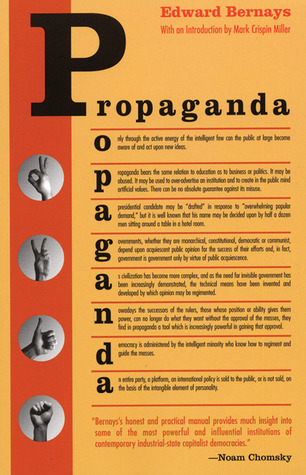
“Bernays’ honest and practical manual provides much insight into some of the most powerful and influential institutions of contemporary industrial state capitalist democracies.”— Noam Chomsky “The conscious and intelligent manipulation of the organized habits and opinions of the masses is an important element in democratic society. Those who manipulate this unseen mechanism of society constitute an invisible government which is the true ruling power of our country.”— Edward Bernays A seminal and controversial figure in the history of political thought and public relations, Edward Bernays (1891–1995), pioneered the scientific technique of shaping and manipulating public opinion, which he famously dubbed “engineering of consent.” During World War I, he was an integral part of the U.S. Committee on Public Information (CPI), a powerful propaganda apparatus that was mobilized to package, advertise and sell the war to the American people as one that would “Make the World Safe for Democracy.” The CPI would become the blueprint in which marketing strategies for future wars would be based upon. Bernays applied the techniques he had learned in the CPI and, incorporating some of the ideas of Walter Lipmann, as well as his uncle, Sigmund Freud, became an outspoken proponent of propaganda as a tool for democratic and corporate manipulation of the population. His 1928 bombshell Propaganda lays out his eerily prescient vision for using propaganda to regiment the collective mind in a variety of areas, including government, politics, art, science and education. To read this book today is to frightfully comprehend what our contemporary institutions of government and business have become in regards to organized manipulation of the masses.

How Asia Works( Success and Failure in the World's Most Dynamic Region) Hardcover JoeStudwell GrovePress

This urgent and eye-opening book makes the case that protecting humanity's future is the central challenge of our time.If all goes well, human history is just beginning. Our species could survive for billions of years - enough time to end disease, poverty, and injustice, and to flourish in ways unimaginable today. But this vast future is at risk. With the advent of nuclear weapons, humanity entered a new age, where we face existential catastrophes - those from which we could never come back. Since then, these dangers have only multiplied, from climate change to engineered pathogens and artificial intelligence. If we do not act fast to reach a place of safety, it will soon be too late.Drawing on over a decade of research, The Precipice explores the cutting-edge science behind the risks we face. It puts them in the context of the greater story of humanity: showing how ending these risks is among the most pressing moral issues of our time. And it points the way forward, to the actions and strategies that can safeguard humanity.An Oxford philosopher committed to putting ideas into action, Toby Ord has advised the US National Intelligence Council, the UK Prime Minister's Office, and the World Bank on the biggest questions facing humanity. In The Precipice, he offers a startling reassessment of human history, the future we are failing to protect, and the steps we must take to ensure that our generation is not the last.

Think a newspaper can’t be responsible for mass murder? Think again.As flagship of the American news media, the New York Times is the world’s most powerful news outlet. With thousands of reporters covering events from all corners of the globe, the Times has the power to influence wars, foment revolution, shape economies and change the very nature of our culture. It doesn’t just cover the news: it creates it.But the institution that is the New York Times is showing cracks. No longer the fact-stringing paper of record once known as the Gray Lady, the Times has become a political lightning rod that divides more often than it unites. It is frequently beset by scandal and has even emerged as a symbol of the political, cultural and social ills plaguing our society.The Gray Lady Winked pulls back the curtain on this illustrious institution to reveal a quintessentially human organization where ideology, ego, power and politics compete with the more humble need to present the facts. In its 10 gripping chapters, The Gray Lady Winked offers readers an eye-opening, often shocking, look at the New York Times’s greatest journalistic failures, so devastating they changed the course of history.These are the stories that mattered most, including the Times’s disastrous coverage of the:Second World War – Holocaust – Rise of the Soviet Union – Cuban Revolution – Vietnam War – Second Palestinian Intifada – Atomic Bombing of Japan – Iraq War – Founding of AmericaThe result is an essential look at the tangled relationship between media, power and politics in a post-truth world told with novelistic flair to reveal a uniquely powerful institution’s tortured relationship with the truth.Most importantly of all, The Gray Lady Winked presents a cautionary tale that shows what happens when the guardians of the truth abandon that sacred value in favor of self-interest and ideology—and what this means for our future as much as for our past.

This reissue of Thomas Sowell's classic study of decision making, which includes a preface by the author, updates his seminal work in the context of The Vision of the Anointed. Sowell, one of America's most celebrated public intellectuals, describes in concrete detail how knowledge is shared and disseminated throughout modern society. He warns that society suffers from an ever-widening gap between firsthand knowledge and decision making--a gap that threatens not only our economic and political efficiency but our very freedom. This is because actual knowledge is being replaced by assumptions based on an abstract and elitist social vision of what ought to be. Knowledge and Decisions, a winner of the 1980 Law and Economics Center Prize, was heralded as a landmark work and selected for this prize "because of its cogent contribution to our understanding of the differences between the market process and the process of government." In announcing the award, the center acclaimed that the "contribution to our understanding of the process of regulation alone would make the book important, but in reemphasizing the diversity and efficiency that the market makes possible, [this] work goes deeper and becomes even more significant."

One of America’s pre-eminent economists offers a provocative critique of the failures of liberalismIn The Vision of the Anointed , Thomas Sowell presents a devastating critique of the mind-set behind the failed social policies of the past thirty years. Sowell sees what has happened during that time not as a series of isolated mistakes but as a logical consequence of a tainted vision whose defects have led to crises in education, crime, and family dynamics, and to other social pathologies. In this book, he describes how elites—the anointed—have replaced facts and rational thinking with rhetorical assertions, thereby altering the course of our social policy.

An astonishing work of cultural criticism, this book is widely recognized as a brilliant and devastating challenge to conventional views of literature, anthropology, religion, and psychoanalysis. In its scope and interest it can be compared with Freud's Totem and Taboo, the subtext Girard refutes with polemic daring, vast erudition, and a persuasiveness that leaves the reader compelled to respond, one way or another.This is the single fullest summation of Girard's ideas to date, the book by which they will stand or fall. In a dialogue with two psychiatrists (Jean-Michel Oughourlian and Guy Lefort), Girard probes an encyclopedic array of topics, ranging across the entire spectrum of anthropology, psychoanalysis, and cultural production.Girard's point o departure is what he calls 'mimesis,' the conflict that arises when human rivals compete to differentiate themselves from each other, yet succeed only in becoming more and more alike. At certain points in the life of a society, according to Girard, this mimetic conflict erupts into a crisis in which all difference dissolves in indiscriminate violence. In primitive societies, such crises were resolved by the 'scapegoating mechanism,' in which the community, en masse, turned on an unpremeditated victim. The repression of this collective murder and its repetition in ritual sacrifice then formed the foundations of both religion and the restored social order.How does Christianity, at once the most 'sacrificial' of religions and a faith with a non-violent ideology, fit into this scheme? Girard grants Freud's point, in Totem and Taboo, that Christianity is similar to primitive religion, but only to refute Freud—if Christ is sacrificed, Girard argues, it is not because God willed it, but because human beings wanted it.The book is not merely, or perhaps not mainly, biblical exegesis, for within its scope fall some of the most vexing problems of social history—the paradox that violence has social efficacy, the function of the scapegoat, the mechanism of anti-semitism.

The greatest obstacle to sound economic policy is not entrenched special interests or rampant lobbying, but the popular misconceptions, irrational beliefs, and personal biases held by ordinary voters. This is economist Bryan Caplan's sobering assessment in this provocative and eye-opening book. Caplan argues that voters continually elect politicians who either share their biases or else pretend to, resulting in bad policies winning again and again by popular demand.Boldly calling into question our most basic assumptions about American politics, Caplan contends that democracy fails precisely because it does what voters want. Through an analysis of Americans' voting behavior and opinions on a range of economic issues, he makes the convincing case that noneconomists suffer from four prevailing biases: they underestimate the wisdom of the market mechanism, distrust foreigners, undervalue the benefits of conserving labor, and pessimistically believe the economy is going from bad to worse. Caplan lays out several bold ways to make democratic government work better--for example, urging economic educators to focus on correcting popular misconceptions and recommending that democracies do less and let markets take up the slack.The Myth of the Rational Voter takes an unflinching look at how people who vote under the influence of false beliefs ultimately end up with government that delivers lousy results. With the upcoming presidential election season drawing nearer, this thought-provoking book is sure to spark a long-overdue reappraisal of our elective system.

This is a history of how physics has drawn some inspiration from economics and how economics has sought to emulate physics, especially with regard to the theory of value. The author traces the development of the energy concept in Western physics and its subsequent effect on the invention and promulgation of neoclassical economics, the modern orthodox theory.

Evaluates the significant role being played by technological advances on the formation and experience of modern group dynamics, citing such examples as Wikipedia and MySpace to demonstrate the Internet's power in bridging geographical and cultural gaps. 40,000 first printing.

'Liquid life' is the kind of life commonly lived in our contemporary, liquid-modern society. Liquid life cannot stay on course, as liquid-modern society cannot keep its shape for long. Liquid life is a precarious life, lived under conditions of constant uncertainty. The most acute and stubborn worries that haunt this liquid life are the fears of being caught napping, of failing to catch up with fast moving events, of overlooking the 'use by' dates and being saddled with worthless possessions, of missing the moment calling for a change of tack and being left behind. Liquid life is also shot through by a contradiction: it ought to be a (possibly unending) series of new beginnings, yet precisely for that reason it is full of worries about swift and painless endings, without which new beginnings would be unthinkable. Among the arts of liquid-modern living and the skills needed to practice them, getting rid of things takes precedence over their acquisition. This and other challenges of life in a liquid-modern society are traced and unravelled in the successive chapters of this new book by one of the most brilliant and original social thinkers of our time.

Written in political exile in New Zealand during the Second World War and published in two volumes in 1945, The Open Society and its Enemies was hailed by Bertrand Russell as a 'vigorous and profound defence of democracy'. This legendary attack on the philosophies of Plato, Hegel and Marx prophesied the collapse of communism in Eastern Europe and exposed the fatal flaws of socially engineered political systems. It remains highly readable, erudite and lucid and as essential reading today as on publication in 1945. It is available here in a special centenary single-volume edition.

Brilliant and engagingly written, Why Nations Fail answers the question that has stumped the experts for centuries: Why are some nations rich and others poor, divided by wealth and poverty, health and sickness, food and famine? Is it culture, the weather, geography? Perhaps ignorance of what the right policies are? Simply, no. None of these factors is either definitive or destiny. Otherwise, how to explain why Botswana has become one of the fastest growing countries in the world, while other African nations, such as Zimbabwe, the Congo, and Sierra Leone, are mired in poverty and violence? Daron Acemoglu and James Robinson conclusively show that it is man-made political and economic institutions that underlie economic success (or lack of it). Korea, to take just one of their fascinating examples, is a remarkably homogeneous nation, yet the people of North Korea are among the poorest on earth while their brothers and sisters in South Korea are among the richest. The south forged a society that created incentives, rewarded innovation, and allowed everyone to participate in economic opportunities. The economic success thus spurred was sustained because the government became accountable and responsive to citizens and the great mass of people. Sadly, the people of the north have endured decades of famine, political repression, and very different economic institutions—with no end in sight. The differences between the Koreas is due to the politics that created these completely different institutional trajectories. Based on fifteen years of original research Acemoglu and Robinson marshall extraordinary historical evidence from the Roman Empire, the Mayan city-states, medieval Venice, the Soviet Union, Latin America, England, Europe, the United States, and Africa to build a new theory of political economy with great relevance for the big questions of today, including: - China has built an authoritarian growth machine. Will it continue to grow at such high speed and overwhelm the West? - Are America’s best days behind it? Are we moving from a virtuous circle in which efforts by elites to aggrandize power are resisted to a vicious one that enriches and empowers a small minority? - What is the most effective way to help move billions of people from the rut of poverty to prosperity? More philanthropy from the wealthy nations of the West? Or learning the hard-won lessons of Acemoglu and Robinson’s breakthrough ideas on the interplay between inclusive political and economic institutions? Why Nations Fail will change the way you look at—and understand—the world.

The world is a better place than it used to be. People are wealthier and healthier, and live longer lives. Yet the escapes from destitution by so many have left gaping inequalities between people and between nations. In The Great Escape, Angus Deaton--one of the foremost experts on economic development and on poverty--tells the remarkable story of how, starting 250 years ago, some parts of the world began to experience sustained progress, opening up gaps and setting the stage for today's hugely unequal world. Deaton takes an in-depth look at the historical and ongoing patterns behind the health and wealth of nations, and he addresses what needs to be done to help those left behind. Deaton describes vast innovations and wrenching the successes of antibiotics, pest control, vaccinations, and clean water on the one hand, and disastrous famines and the HIV/AIDS epidemic on the other. He examines the United States, a nation that has prospered but is today experiencing slower growth and increasing inequality. He also considers how economic growth in India and China has improved the lives of more than a billion people. Deaton argues that international aid has been ineffective and even harmful. He suggests alternative efforts--including reforming incentives to drug companies and lifting trade restrictions--that will allow the developing world to bring about its own Great Escape. Demonstrating how changes in health and living standards have transformed our lives, The Great Escape is a powerful guide to addressing the well-being of all nations.

In the words of economist and scholar Arnold Kling, Martin Gurri saw it coming.Technology has categorically reversed the information balance of power between the public and the elites who manage the great hierarchical institutions of the industrial age government, political parties, the media.The Revolt of the Public tells the story of how insurgencies, enabled by digital devices and a vast information sphere, have mobilized millions of ordinary people around the world.Originally published in 2014, this updated edition of The Revolt of the Public includes an extensive analysis of Donald Trump's improbable rise to the presidency and the electoral triumphs of Brexit and concludes with a speculative look forward, pondering whether the current elite class can bring about a reformation of the democratic process and whether new organizing principles, adapted to a digital world, can arise out of the present political turbulence.

From one of our leading technology thinkers and writers, a guide through the twelve technological imperatives that will shape the next thirty years and transform our livesMuch of what will happen in the next thirty years is inevitable, driven by technological trends that are already in motion. In this fascinating, provocative new book, Kevin Kelly provides an optimistic road map for the future, showing how the coming changes in our lives—from virtual reality in the home to an on-demand economy to artificial intelligence embedded in everything we manufacture—can be understood as the result of a few long-term, accelerating forces. Kelly both describes these deep trends—interacting, cognifying, flowing, screening, accessing, sharing, filtering, remixing, tracking, and questioning—and demonstrates how they overlap and are codependent on one another. These larger forces will completely revolutionize the way we buy, work, learn, and communicate with each other. By understanding and embracing them, says Kelly, it will be easier for us to remain on top of the coming wave of changes and to arrange our day-to-day relationships with technology in ways that bring forth maximum benefits. Kelly’s bright, hopeful book will be indispensable to anyone who seeks guidance on where their business, industry, or life is heading—what to invent, where to work, in what to invest, how to better reach customers, and what to begin to put into place—as this new world emerges.

This "brilliant and provocative" (Walter Isaacson) guide shares nine principles to adapt and survive the technological changes shaping our future from the director of the MIT Media Lab and a veteran Wired journalist.The world is more complex and volatile today than at any other time in our history. The tools of our modern existence are getting faster, cheaper, and smaller at an exponential rate, transforming every aspect of society, from business to culture and from the public sphere to our most private moments. The people who succeed will be the ones who learn to think differently.In Whiplash , Joi Ito and Jeff Howe distill that logic into nine organizing principles for navigating and surviving this tumultuous Filled with incredible case studies and cutting-edge research and philosophies from the MIT Media Lab and beyond, Whiplash will help you adapt and succeed in this unpredictable world.

WTF? can be an expression of amazement or an expression of dismay. In today’s economy, we have far too much dismay along with our amazement, and technology bears some of the blame. In this combination of memoir, business strategy guide, and call to action, Tim O'Reilly, Silicon Valley’s leading intellectual and the founder of O’Reilly Media, explores the upside and the potential downsides of today's WTF? technologies. What is the future when an increasing number of jobs can be performed by intelligent machines instead of people, or done only by people in partnership with those machines? What happens to our consumer based societies—to workers and to the companies that depend on their purchasing power? Is income inequality and unemployment an inevitable consequence of technological advancement, or are there paths to a better future? What will happen to business when technology-enabled networks and marketplaces are better at deploying talent than traditional companies? How should companies organize themselves to take advantage of these new tools? What’s the future of education when on-demand learning outperforms traditional institutions? How can individuals continue to adapt and retrain? Will the fundamental social safety nets of the developed world survive the transition, and if not, what will replace them? O'Reilly is "the man who can really can make a whole industry happen," according to Eric Schmidt, Executive Chairman of Alphabet (Google.) His genius over the past four decades has been to identify and to help shape our response to emerging technologies with world shaking potential—the World Wide Web, Open Source Software, Web 2.0, Open Government data, the Maker Movement, Big Data, and now AI. O’Reilly shares the techniques he's used at O’Reilly Media to make sense of and predict past innovation waves and applies those same techniques to provide a framework for thinking about how today’s world-spanning platforms and networks, on-demand services, and artificial intelligence are changing the nature of business, education, government, financial markets, and the economy as a whole. He provides tools for understanding how all the parts of modern digital businesses work together to create marketplace advantage and customer value, and why ultimately, they cannot succeed unless their ecosystem succeeds along with them.The core of the book's call to action is an exhortation to businesses to DO MORE with technology rather than just using it to cut costs and enrich their shareholders. Robots are going to take our jobs, they say. O'Reilly replies, “Only if that’s what we ask them to do! Technology is the solution to human problems, and we won’t run out of work till we run out of problems." Entrepreneurs need to set their sights on how they can use big data, sensors, and AI to create amazing human experiences and the economy of the future, making us all richer in the same way the tools of the first industrial revolution did. Yes, technology can eliminate labor and make things cheaper, but at its best, we use it to do things that were previously unimaginable! What is our poverty of imagination? What are the entrepreneurial leaps that will allow us to use the technology of today to build a better future, not just a more efficient one? Whether technology brings the WTF? of wonder or the WTF? of dismay isn't inevitable. It's up to us!

Has liberalism failed because it has succeeded? Of the three dominant ideologies of the twentieth century—fascism, communism, and liberalism—only the last remains. This has created a peculiar situation in which liberalism’s proponents tend to forget that it is an ideology and not the natural end-state of human political evolution. As Patrick Deneen argues in this provocative book, liberalism is built on a foundation of contradictions: it trumpets equal rights while fostering incomparable material inequality; its legitimacy rests on consent, yet it discourages civic commitments in favor of privatism; and in its pursuit of individual autonomy, it has given rise to the most far-reaching, comprehensive state system in human history. Here, Deneen offers an astringent warning that the centripetal forces now at work on our political culture are not superficial flaws but inherent features of a system whose success is generating its own failure.

An all-encompassing guide to skeptical thinking in the popular "The Skeptics Guide to the Universe" podcast's dryly humorous, accessible style.It's intimidating to realize that we live in a world overflowing with misinformation, bias, myths, deception, and flawed knowledge. There really are no ultimate authority figures-no one has the secret and there is no place to look up the definitive answers to our questions (not even Google). But, by thinking skeptically and logically, we can combat sloppy reasoning, bad arguments and superstitious thinking. It's difficult, and takes a lot of vigilance, but it's worth the effort.In this tie-in to their incredibly popular "The Skeptics Guide to the Universe" podcast, Steven Novella, MD along with "Skeptical Rogues" Bob Novella, Cara Santa Maria, Jay Novella, and Evan Bernstein will explain the tenets of skeptical thinking and debunk some of the biggest scientific myths, fallacies and conspiracy theories (Anti-vaccines, homeopathy, UFO sightings, etc.) They'll help us try to make sense of what seems like an increasingly crazy world using powerful tools like science and philosophy. THE SKEPTICS' GUIDE TO THE UNIVERSE is your guide through this maze of modern life. It covers essential critical thinking skills, as well as giving insight into how your brain works and how to avoid common pitfalls in thinking. They discuss the difference between science and pseudoscience, how to recognize common science news tropes, how to discuss conspiracy theories with that crazy coworker of yours, and how to apply all of this to everyday life.So, are you ready to join them on an epic scientific quest, one that has taken us from huddling in dark caves to stepping foot on the Moon? (Yes, we really did that.) Like all adventures, this one is foremost a journey of self discovery. The monsters you will slay and challenges you will face are mostly constructs of your own mind. With the SKEPTIC'S GUIDE TO THE UNIVERSE, we can do this together.

Douglas Murray examines the twenty-first century's most divisive issues: sexuality, gender, technology and race. He reveals the astonishing new culture wars playing out in our workplaces, universities, schools and homes in the names of social justice, identity politics and intersectionality.We are living through a postmodern era in which the grand narratives of religion and political ideology have collapsed. In their place have emerged a crusading desire to right perceived wrongs and a weaponization of identity, both accelerated by the new forms of social and news media. Narrow sets of interests now dominate the agenda as society becomes more and more tribal--and, as Murray shows, the casualties are mounting.

'A must-read. Acemoglu and Robinson are intellectual heavyweights of the first rank . . . erudite and fascinating' Paul Collier, Guardian, on Why Nations FailBy the authors of the international bestseller Why Nations Fail, based on decades of research, this powerful new big-picture framework explains how some countries develop towards and provide liberty while others fall to despotism, anarchy or asphyxiating norms- and explains how liberty can thrive despite new threats.Liberty is hardly the 'natural' order of things; usually states have been either too weak to protect individuals or too strong for people to protect themselves from despotism. There is also a happy Western myth that where liberty exists, it's a steady state, arrived at by 'enlightenment'. But liberty emerges only when a delicate and incessant balance is struck between state and society - between elites and citizens. This struggle becomes self-reinforcing, inducing both state and society to develop a richer array of capacities, thus affecting the peacefulness of societies, the success of economies and how people experience their daily lives.Explaining this new framework through compelling stories from around the world, in history and from today - and through a single diagram on which the development of any state can be plotted - this masterpiece helps us understand the past and present, and analyse the future.'An intellectually rich book that develops an important thesis with verve' Martin Wolf, Financial Times, on Why Nations Fail

Popular consensus says that the US rose over two centuries to Cold War victory and world domination, and is now in slow decline. But is this right? History’s great civilisations have always lasted much longer, and for all its colossal power, the US was overshadowed by Europe until recently. What if this isn’t the end?Bruno Maçães offers a compelling vision of America’s future, both fascinating and unnerving. From the early American Republic, Maçães takes us to the turbulent present, when, he argues, America is finally forging its own path. We can see the birth pangs of this new civilisation in today’s debates on guns, religion, foreign policy and the significance of Trump. What will its values be, and what will this new America look like?

Political disintegration is a persistent feature of world history. The Collapse of Complex Societies, though written by an archaeologist, will therefore strike a chord throughout the social sciences. Any explanation of societal collapse carries lessons not just for the study of ancient societies, but for the members of all such societies in both the present and future. Dr. Tainter describes nearly two dozen cases of collapse and reviews more than 2000 years of explanations. He then develops a new and far reaching theory that accounts for collapse among diverse kinds of societies, evaluating his model and clarifying the processes of disintegration by detailed studies of the Roman, Mayan and Chacoan collapses.

Updated to include a new chapter about the influence of social media and the Internet—the 20th anniversary edition of Bowling Alone remains a seminal work of social analysis, and its examination of what happened to our sense of community remains more relevant than ever in today’s fractured America. Twenty years, ago, Robert D. Putnam made a seemingly simple observation: once we bowled in leagues, usually after work; but no longer. This seemingly small phenomenon symbolized a significant social change that became the basis of the acclaimed bestseller, Bowling Alone, which The Washington Post called “a very important book” and Putnam, “the de Tocqueville of our generation.” Bowling Alone surveyed in detail Americans’ changing behavior over the decades, showing how we had become increasingly disconnected from family, friends, neighbors, and social structures, whether it’s with the PTA, church, clubs, political parties, or bowling leagues. In the revised edition of his classic work, Putnam shows how our shrinking access to the “social capital” that is the reward of communal activity and community sharing still poses a serious threat to our civic and personal health, and how these consequences have a new resonance for our divided country today. He includes critical new material on the pervasive influence of social media and the internet, which has introduced previously unthinkable opportunities for social connection—as well as unprecedented levels of alienation and isolation. At the time of its publication, Putnam’s then-groundbreaking work showed how social bonds are the most powerful predictor of life satisfaction, and how the loss of social capital is felt in critical ways, acting as a strong predictor of crime rates and other measures of neighborhood quality of life, and affecting our health in other ways. While the ways in which we connect, or become disconnected, have changed over the decades, his central argument remains as powerful and urgent as ever: mending our frayed social capital is key to preserving the very fabric of our society.

With a new Introduction by the author, this “erudite and brilliantly readable book” (The Observer, London) expertly dissects the political, economic, and social origins of Western civilization to reveal a culture cripplingly enslaved to crude notions of rationality and expertise.With a new introduction by the author, this “erudite and brilliantly readable book” (The Observer, London) astutely dissects the political, economic and social origins of Western civilization to reveal a culture cripplingly enslaved to crude notions of rationality and expertise. The Western world is full of paradoxes. We talk endlessly of individual freedom, yet we’ve never been under more pressure to conform. Our business leaders describe themselves as capitalists, yet most are corporate employees and financial speculators. We call our governments democracies, yet few of us participate in politics. We complain about invasive government, yet our legal, educational, financial, social, cultural and legislative systems are deteriorating. All these problems, John Ralston Saul argues, are largely the result of our blind faith in the value of reason. Over the past 400 years, our “rational elites” have turned the modern West into a vast, incomprehensible, directionless machine, run by process-minded experts—“Voltaire’s bastards”—whose cult of scientific management is empty of both sense and morality. Whether in politics, art, business, the military, entertainment, science, finance, academia or journalism, these experts share the same outlook and methods. The result, Saul maintains, is a civilization of immense technological power whose ordinary citizens are increasingly excluded from the decision-making process. In this wide-ranging anatomy of modern society and its origins—whose “pages explode with insight, style and intellectual rigor” (Camille Paglia, The Washington Post)—Saul presents a shattering critique of the political, economic and cultural establishments of the West.

Over 6.4 billion people participate in a $36.5 trillion global economy, designed and overseen by no one. How did this marvel of self-organized complexity evolve? How is wealth created within this system? And how can wealth be increased for the benefit of individuals, businesses, and society? In The Origin of Wealth, Eric D. Beinhocker argues that modern science provides a radical perspective on these age-old questions, with far-reaching implications. According to Beinhocker, wealth creation is the product of a simple but profoundly powerful evolutionary formula: differentiate, select, and amplify. In this view, the economy is a "complex adaptive system" in which physical technologies, social technologies, and business designs continuously interact to create novel products, new ideas, and increasing wealth. Taking readers on an entertaining journey through economic history, from the Stone Age to modern economy, Beinhocker explores how "complexity economics" provides provocative insights on issues ranging from creating adaptive organizations to the evolutionary workings of stock markets to new perspectives on government policies. A landmark book that shatters conventional economic theory, The Origin of Wealth will rewire our thinking about how we came to be here—and where we are going.

The first English translation of Guérin’s monumental anthology of anarchism, published here in one volume. It details a vast array of unpublished documents, letters, debates, manifestos, reports, impassioned calls-to-arms and reasoned analysis; the history, organization and practice of the movement—its theorists, advocates and activists; the great names and the obscure, towering legends and unsung heroes.This definitive anthology portrays anarchism as a sophisticated ideology whose nuances and complexities highlight the natural desire for freedom in all of us. The classical texts will re-establish anarchism as both an intellectual and practical force to be reckoned with. Includes writings by Emma Goldman, Kropotkin, Berkman, Bakunin, Proudhon, and Malatesta.Daniel Guérin was the author of Anarchism: From Theory to Practice.In Oakland, California on March 24, 2015 a fire destroyed the AK Press warehouse along with several other businesses. Please consider visiting the AK Press website to learn more about the fundraiser to help them and their neighbors.

The Lonely Crowd is considered by many to be the most influential book of the twentieth century. Its now-classic analysis of the “new middle class” in terms of inner-directed and other-directed social character opened exciting new dimensions in our understanding of the psychological, political, and economic problems that confront the individual in contemporary American society. The 1969 abridged and revised edition of the book is now reissued with a new foreword by Todd Gitlin that explains why the book is still relevant to our own era.

Here is a searing account-probably the best yet published-of life in the underclass and why it persists as it does. Theodore Dalrymple, a British psychiatrist who treats the poor in a slum hospital and a prison in England, has seemingly seen it all. Yet in listening to and observing his patients, he is continually astonished by the latest twist of depravity that exceeds even his own considerable experience. Dalrymple's key insight in Life at the Bottom is that long-term poverty is caused not by economics but by a dysfunctional set of values, one that is continually reinforced by an elite culture searching for victims. This culture persuades those at the bottom that they have no responsibility for their actions and are not the molders of their own lives. Drawn from the pages of the cutting-edge political and cultural quarterly City Journal, Dalrymple's book draws upon scores of eye-opening, true-life vignettes that are by turns hilariously funny, chillingly horrifying, and all too revealing-sometimes all at once. And Dalrymple writes in prose that transcends journalism and achieves the quality of literature.
This classic account of the traditional upper class in America traces its origins, lifestyles, and political and social attitudes from the time of Theodore Roosevelt to that of John F. Kennedy. Sociologist E. Digby Baltzell describes the problems of exclusion and prejudice within the community of white Anglo-Saxon Protestants (or WASPs, an acronym he coined) and predicts with amazing accuracy what will happen when this inbred group is forced to share privilege and power with talented members of minority groups. “The book may actually hold more interest today than when it was first published. New generations of readers can resonate all the more to this masterly and beautifully written work that provides sociological understanding of its engrossing subject.”―Robert K. Merton, Columbia University “The documentation and illustration in the book make it valuable as social history, quite apart from any theoretical hypothesis. As such, it sketches the rise of the WASP penchant for country clubs, patriotic societies and genealogy. It traces the history of anti-Semitism in America. It describes the intellectual conflict between Social Darwinism and the environmental social science founded half a century ago by men like John Dewey, Charles A. Beard, Thorstein Veblen, Franz Boas and Frederick Jackson Turner. In short, The Protestant Establishment is a wide-ranging, intelligent and provocative book.”―Alvin Toffler, New York Times Book Review “ The Protestant Establishment has many virtues that lift it above the level we have come to expect in works of contemporary social and cultural analysis. It is clearly and convincingly written.”―H. Stuart Hughes, New York Review of Books “What makes Baltzell’s analysis of the evolution of the American elite superior to the accounts of earlier writers . . . is that he exposes the connections between high social status and political and economic power.”―Dennis H. Wrong, Commentary

Straw Dogs is a work of philosophy, which sets out to challenge our most cherished assumptions about what it means to be human. From Plato to Christianity, from the Enlightenment to Nietzsche, the Western tradition has been based on arrogant and erroneous beliefs about human beings and their place in the world. Philosophies such as liberalism and Marxism think of humankind as a species whose destiny is to transcend natural limits and conquer the Earth. Even in the present day, despite Darwin's discoveries, nearly all schools of thought take as their starting point the belief that humans are radically different from other animals. John Gray argues that this humanist belief is an illusion. The aim of Straw Dogs is to explore how the world and human life look once humanism has been finally abandoned.Straw Dogs explores philosophical issues such as the nature of the self, free will, morality, progress and the value of truth. Drawing his inspiration from art, poetry, and the frontiers of science as well as philosophy itself, John Gray presents a post-humanist view of the world and of human life. Straw Dogs is an exhilarating, sometimes disturbing book that leads the reader to question their deepest beliefs.

When J. D. Williams wrote this entertaining, witty introduction for the nonscientist, game theory was still a somewhat mysterious subject familiar to very few scientists beyond those researchers, like himself, working for the military. Now, over thirty years after its original publication as a Rand Corporation research study, his light-hearted though thoroughly effective primer is the recognized classic introduction to an increasingly applicable discipline. Used by amateurs, professionals, and students throughout the world in the classroom, on the job, and for personal amusement, the book has been through ten printings, and has been translated into at least five languages (including Russian and Japanese).Revised, updated, and available for the first time in an inexpensive paperback edition, The Compleat Strategyst is a highly entertaining text essential for anyone interested in this provocative and engaging area of modern mathematics. In fully illustrated chapters complete with everyday examples and word problems, Williams offers readers a working understanding of the possible methods for selecting strategies in a variety of situations, simple to complex. With just a basic understanding of arithmetic, anyone can grasp all necessary aspects of two-, three-, four-, and larger strategy games with two or more sets of inimical interests and a limitless array of zero-sum payoffs.As research and study continues not only in this new discipline but in the related areas of statistics, probability and behavioral science, understanding of games, decision making, and the development of strategies will be increasingly important. In the areas of economics, sociology, politics, and the military, game theory is sure to have an even wider impact. For students and amateurs fascinated by game theory's implications there is no better, immediately applicable, or more entertaining introduction to the subject than this engaging text by the late J. D. Williams, Professor of Mathematics at Princeton University and a member of the Research Council of The Rand Corporation.

In this classic work Hayek restates the ideals of freedom that he believes have guided, and must continue to guide, the growth of Western civilization. Hayek's book, first published in 1960, urges us to clarify our beliefs in today's struggle of political ideologies.

Now revised and expanded, this edition of the splendidly detailed and lively history of the Middle Ages contains more than 30 percent new material.

In the spirit of On Bullshit and Assholes: A Theory, an economist explores the five laws that confirm our worst fears: stupid people can and do rule the worldSince time immemorial, a powerful dark force has hindered the growth of human welfare and happiness. It is more powerful than the Mafia or the military. It has global catastrophic effects and can be found anywhere from the world's most powerful boardrooms to your local pub. This is the immensely powerful force of human stupidity.Seeing the shambolic state of human affairs, and sensing the dark force at work behind it, Carlo M. Cipolla, the late, noted professor of economic history at the University of California, Berkeley, created a vitally important economic model that would allow us to detect, know, and neutralize this threat: The Basic Laws of Human Stupidity.If you've ever found yourself despairing at the ubiquity of stupidity among even the most 'intellectual' of people, then this hilarious, timely, and slightly alarming little book is for you. Arm yourself in the face of baffling political realities, unreasonable colleagues, or the unbridled misery of Christmas day with the in-laws with the first and only economic model for stupidity."A masterly book" --Nassim Nicholas Taleb, author of The Black Swan "A classic" --Simon Kuper, Financial Times"Cipolla's subtle tongue-in-cheek humor made this book an underground classic in Italy. Today, under current worldwide political trends, it reads more like black humor. Keep in mind: reliable statistical data shows that 98% of the people seriously believe that they are far less stupid than the average." --Carlo Rovelli, author of Seven Brief Lessons on Physics

Few works of political and cultural theory have been as enduringly provocative as Guy Debord's The Society of the Spectacle. From its publication amid the social upheavals of the 1960s up to the present, the volatile theses of this book have decisively transformed debates on the shape of modernity, capitalism and everyday life in the late twentieth century. Now finally available in a superb English translation approved by the author, Debord's text remains as crucial as ever for understanding the contemporary effects of power, which are increasingly inseparable from the new virtual worlds of our rapidly changing image/information culture.

"Bold, important and masterful . . . Marmot's message is not just timely, it's urgent."-The Washington Post Book WorldYou probably didn't realize that when you graduate from college you increase your lifespan, or that your co-worker who has a slightly better job is more likely to live a healthier life. In this groundbreaking book, epidemiologist Michael Marmot marshals evidence from nearly thirty years of research to demonstrate that status is not a footnote to the causes of ill health-it is the cause. He calls this effect the status syndrome.The status syndrome is pervasive. It determines the chances that you will succumb to heart disease, stroke, cancers, infectious diseases, even suicide and homicide. And the issue, as Marmot shows, is not simply one of income or lifestyle. It is the psychological experience of inequality-how much control you have over your life and the opportunities you have for full social participation-that has a profound effect on your health.The Status Syndrome will utterly change the way we think about health, society, and how we live our lives.

Can we continue to believe in progress? In this sobering analysis of the Western human condition, Christopher Lasch seeks the answer in a history of the struggle between two ideas: one is the idea of progress - an idea driven by the conviction that human desire is insatiable and requires ever larger production forces. Opposing this materialist view is the idea that condemns a boundless appetite for more and better goods and distrusts "improvements" that only feed desire. Tracing the opposition to the idea of progress from Rousseau through Montesquieu to Carlyle, Max Weber and G.D.H. Cole, Lasch finds much that is desirable in a turn toward moral conservatism, toward a lower-middle-class culture that features egalitarianism, workmanship and loyalty, and recognizes the danger of resentment of the material goods of others.

Americans create 57% of the world's advertising while representing only 6% of its population; half of our waking hours are spent immersed in the mass media. Persuasion has always been integral to the democratic process, but increasingly, thoughtful discussion is being replaced with simplistic soundbites and manipulative messages.Drawing on the history of propaganda as well as on contemporary research in social psychology, Age of Propaganda shows how the tactics used by political campaigners, sales agents, advertisers, televangelists, demagogues, and others often take advantage of our emotions by appealing to our deepest fears and most irrational hopes, creating a distorted vision of the world we live in.This revised and updated edition includes coverage of the Clinton/Lewinsky scandal, recent election campaigns, talk radio, teen suicide, U.F.O. abductions, the Columbine shootings, and novel propaganda tactics based on hypocrisy and false allegations.

This book is an expanded and revised edition of the author's critically acclaimed volume Nuts and Bolts for the Social Sciences. In twenty-six succinct chapters, Jon Elster provides an account of the nature of explanation in the social sciences. He offers an overview of key explanatory mechanisms in the social sciences, relying on hundreds of examples and drawing on a large variety of sources-psychology, behavioral economics, biology, political science, historical writings, philosophy and fiction. Written in accessible and jargon-free language, Elster aims at accuracy and clarity while eschewing formal models.

In a career spanning sixty years, Sir Karl Popper has made some of the most important contributions to the twentieth century discussion of science and rationality. The Myth of the Framework is a new collection of some of Popper's most important material on this subject.Sir Karl discusses such issues as the aims of science, the role that it plays in our civilization, the moral responsibility of the scientist, the structure of history, and the perennial choice between reason and revolution. In doing so, he attacks intellectual fashions (like positivism) that exagerrate what science and rationality have done, as well as intellectual fashions (like relativism) that denigrate what science and rationality can do. Scientific knowledge, according to Popper, is one of the most rational and creative of human achievements, but it is also inherently fallible and subject to revision.In place of intellectual fashions, Popper offers his own critical rationalism - a view that he regards both as a theory of knowlege and as an attitude towards human life, human morals and democracy.Published in cooperation with the Central European University.

With a new Afterword to the 2002 edition, No Logo employs journalistic savvy and personal testament to detail the insidious practices and far-reaching effects of corporate marketing—and the powerful potential of a growing activist sect that will surely alter the course of the 21st century. First published before the World Trade Organization protests in Seattle, this is an infuriating, inspiring, and altogether pioneering work of cultural criticism that investigates money, marketing, and the anti-corporate movement.As global corporations compete for the hearts and wallets of consumers who not only buy their products but willingly advertise them from head to toe—witness today's schoolbooks, superstores, sporting arenas, and brand-name synergy—a new generation has begun to battle consumerism with its own best weapons. In this provocative, well-written study, a front-line report on that battle, we learn how the Nike swoosh has changed from an athletic status-symbol to a metaphor for sweatshop labor, how teenaged McDonald's workers are risking their jobs to join the Teamsters, and how "culture jammers" utilize spray paint, computer-hacking acumen, and anti-propagandist wordplay to undercut the slogans and meanings of billboard ads (as in "Joe Chemo" for "Joe Camel").No Logo will challenge and enlighten students of sociology, economics, popular culture, international affairs, and marketing."This book is not another account of the power of the select group of corporate Goliaths that have gathered to form our de facto global government. Rather, it is an attempt to analyze and document the forces opposing corporate rule, and to lay out the particular set of cultural and economic conditions that made the emergence of that opposition inevitable." —Naomi Klein, from her Introduction

Born Red is an artistically wrought personal account, written very much from inside the experience, of the years 1966-1969, when the author was a young teenager at middle school. It was in the middle schools that much of the fury of the Cultural Revolution and Red Guard movement was spent, and Gao was caught up in very dramatic events, which he recounts as he understood them at the time. Gao's father was a county political official who was in and out of trouble during those years, and the intense interplay between father and son and the differing perceptions and impact of the Cultural Revolution for the two generations provide both an unusual perspective and some extraordinary moving moments. He also makes deft use of traditional mythology and proverbial wisdom to link, sometimes ironically, past and present. Gao relates in vivid fashion how students-turned-Red Guards held mass rallies against 'capitalist roader' teachers and administrators, marching them through the streets to the accompaniment of chants and jeers and driving some of them to suicide. Eventually the students divided into two factions, and school and town became armed camps. Gao tells of the exhilaration that he and his comrades experienced at their initial victories, of their deepening disillusionment as they utter defeat as the tumultuous first phase of the Cultural Revolution came to a close. The portraits of the persons to whom Gao introduces us - classmates, teachers, family members - gain weight and density as the story unfolds, so that in the end we see how they all became victims of the dynamics of a mass movement out of control.

Professor von Mises addressed himself to a particular what is the essential difference between bureaucratic management by government and market management in a system based on private ownership of the means of production? Mises does not discuss bureaus or bureaucrats, but inexorable principles of human action. He does not condemn bureaucracy, which is the appropriate technique for the conduct of government agencies such as courts of law, police departments, and the Internal Revenue Service; however, in economic production and distribution, the bureaucratic method is shown to be an abomination that spells universal ruin and disaster.

This is a history of the machine and a critical study of its effects on civilization. Mumford has drawn on every aspect of life to explain the machine and to trace its social results. "An extraordinarily wide-ranging, sensitive, and provocative book about a subject upon whichphilosophers have so far shed but little light" (Journal of Philosophy).

Those who practice the Muslim faith have resisted examinations of their religion. They are extremely guarded about their religion, and what they consider blasphemous acts by skeptical Muslims and non-Muslims alike has only served to pique the world's curiosity. This critical examination reveals an unflattering picture of the faith and its practitioners. Nevertheless, it is the truth, something that has either been deliberately concealed by modern scholars or buried in obscure journals accessible only to a select few.

Preference falsification, according to the economist Timur Kuran, is the act of misrepresenting one's wants under perceived social pressures. It happens frequently in everyday life, such as when we tell the host of a dinner party that we are enjoying the food when we actually find it bland. In Private Truths, Public Lies Kuran argues convincingly that the phenomenon not only is ubiquitous but has huge social and political consequences. Drawing on diverse intellectual traditions, including those rooted in economics, psychology, sociology, and political science, Kuran provides a unified theory of how preference falsification shapes collective decisions, orients structural change, sustains social stability, distorts human knowledge, and conceals political possibilities.A common effect of preference falsification is the preservation of widely disliked structures. Another is the conferment of an aura of stability on structures vulnerable to sudden collapse. When the support of a policy, tradition, or regime is largely contrived, a minor event may activate a bandwagon that generates massive yet unanticipated change.In distorting public opinion, preference falsification also corrupts public discourse and, hence, human knowledge. So structures held in place by preference falsification may, if the condition lasts long enough, achieve increasingly genuine acceptance. The book demonstrates how human knowledge and social structures co-evolve in complex and imperfectly predictable ways, without any guarantee of social efficiency.Private Truths, Public Lies uses its theoretical argument to illuminate an array of puzzling social phenomena. They include the unexpected fall of communism, the paucity, until recently, of open opposition to affirmative action in the United States, and the durability of the beliefs that have sustained India's caste system.

Congratulations to Elinor Ostrom, Co-Winner of The Sveriges Riksbank Prize in Economic Sciences in Memory of Alfred Nobel 2009!The governance of natural resources used by many individuals in common is an issue of increasing concern to policy analysts. Both state control and privatization of resources have been advocated, but neither the state nor the market have been uniformly successful in solving common pool resource problems. After critiquing the foundations of policy analysis as applied to natural resources, Elinor Ostrom here provides a unique body of empirical data to explore conditions under which common pool resource problems have been satisfactorily or unsatisfactorily solved. Dr. Ostrom first describes three models most frequently used as the foundation for recommending state or market solutions. She then outlines theoretical and empirical alternatives to these models in order to illustrate the diversity of possible solutions. In the following chapters she uses institutional analysis to examine different ways--both successful and unsuccessful--of governing the commons. In contrast to the proposition of the tragedy of the commons argument, common pool problems sometimes are solved by voluntary organizations rather than by a coercive state. Among the cases considered are communal tenure in meadows and forests, irrigation communities and other water rights, and fisheries.

Brilliant, illuminating, and immensely absorbing, Collapse is destined to take its place as one of the essential books of our time, raising the urgent question: How can our world best avoid committing ecological suicide?In his million-copy bestseller Guns, Germs, and Steel, Jared Diamond examined how and why Western civilizations developed the technologies and immunities that allowed them to dominate much of the world. Now in this brilliant companion volume, Diamond probes the other side of the equation: What caused some of the great civilizations of the past to collapse into ruin, and what can we learn from their fates?As in Guns, Germs, and Steel, Diamond weaves an all-encompassing global thesis through a series of fascinating historical-cultural narratives. Moving from the Polynesian cultures on Easter Island to the flourishing American civilizations of the Anasazi and the Maya and finally to the doomed Viking colony on Greenland, Diamond traces the fundamental pattern of catastrophe. Environmental damage, climate change, rapid population growth, and unwise political choices were all factors in the demise of these societies, but other societies found solutions and persisted. Similar problems face us today and have already brought disaster to Rwanda and Haiti, even as China and Australia are trying to cope in innovative ways. Despite our own society's apparently inexhaustible wealth and unrivaled political power, ominous warning signs have begun to emerge even in ecologically robust areas like Montana.Brilliant, illuminating, and immensely absorbing, Collapse is destined to take its place as one of the essential books of our time, raising the urgent question: How can our world best avoid committing ecological suicide?

This collection of lectures of Max Muller portrays India, specially the Vedic India, as an epitome of a virtuosity and morality.

When The Culture of Narcissism was first published in 1979, Christopher Lasch was hailed as a “biblical prophet” (Time). Lasch’s identification of narcissism as not only an individual ailment but also a burgeoning social epidemic was groundbreaking. His diagnosis of American culture is even more relevant today, predicting the limitless expansion of the anxious and grasping narcissistic self into every part of American life.The Culture of Narcissism offers an astute and urgent analysis of what we need to know in these troubled times.

If humanity cannot live with the dangers and responsibilities inherent in freedom, it will probably turn to authoritarianism. This is the central idea of Escape from Freedom, a landmark work by one of the most distinguished thinkers of our time, and a book that is as timely now as when first published in 1941. Few books have thrown such light upon the forces that shape modern society or penetrated so deeply into the causes of authoritarian systems. If the rise of democracy set some people free, at the same time it gave birth to a society in which the individual feels alienated and dehumanized. Using the insights of psychoanalysis as probing agents, Fromm's work analyzes the illness of contemporary civilization as witnessed by its willingness to submit to totalitarian rule.

This country’s most challenging writer on education presents here a distillation, for the general reader, of half a decade’s research and reflection. His theme is how children learn, and how they can best be helped to learn―how they can be brought to the fullest realization of their capacities.Jerome Bruner, Harper’s reports, has “stirred up more excitement than any educator since John Dewey.” His explorations into the nature of intellectual growth and its relation to theories of learning and methods of teaching have had a catalytic effect upon educational theory. In this new volume the subjects dealt with in The Process of Education are pursued further, probed more deeply, given concrete illustration and a broader context.“One is struck by the absence of a theory of instruction as a guide to pedagogy,” Mr. Bruner observes; “in its place there is principally a body of maxims.” The eight essays in this volume, as varied in topic as they are unified in theme, are contributions toward the construction of such a theory. What is needed in that enterprise is, inter alia , “the daring and freshness of hypotheses that do not take for granted as true what has merely become habitual,” and these are amply evidenced here.At the conceptual core of the book is an illuminating examination of how mental growth proceeds, and of the ways in which teaching can profitably adapt itself to that progression and can also help it along. Closely related to this is Mr. Bruner’s “evolutionary instrumentalism,” his conception of instruction as the means of transmitting the tools and skills of a culture, the acquired characteristics that express and amplify man’s powers―especially the crucial symbolic tools of language, number, and logic. Revealing insights are given into the manner in which language functions as an instrument of thought.The theories presented are anchored in practice, in the empirical research from which they derive and in the practical applications to which they can be put. The latter are exemplified incidentally throughout and extensively in detailed descriptions of two courses Mr. Bruner has helped to construct and to teach―an experimental mathematics course and a multifaceted course in social studies. In both, the students’ encounters with the material to be mastered are structured and sequenced in such a way as to work with, and to reinforce, the developmental process.Written with all the style and élan that readers have come to expect of Mr. Bruner, Toward a Theory of Instruction is charged with the provocative suggestions and inquiries of one of the great innovators in the field of education.

The landmark exploration of economic prosperity and how the world can escape from extreme poverty for the world's poorest citizens, from one of the world's most renowned economists Hailed by Time as one of the world's hundred most influential people, Jeffrey D. Sachs is renowned for his work around the globe advising economies in crisis. Now a classic of its genre, The End of Poverty distills more than thirty years of experience to offer a uniquely informed vision of the steps that can transform impoverished countries into prosperous ones. Marrying vivid storytelling with rigorous analysis, Sachs lays out a clear conceptual map of the world economy. Explaining his own work in Bolivia, Russia, India, China, and Africa, he offers an integrated set of solutions to the interwoven economic, political, environmental, and social problems that challenge the world's poorest countries. Ten years after its initial publication, The End of Poverty remains an indispensible and influential work. In this 10th anniversary edition, Sachs presents an extensive new foreword assessing the progress of the past decade, the work that remains to be done, and how each of us can help. He also looks ahead across the next fifteen years to 2030, the United Nations' target date for ending extreme poverty, offering new insights and recommendations.

Men, Machines, and Modern Times, though ultimately concerned with a positive alternative to an Orwellian 1984, offers an entertaining series of historical accounts taken from the nineteenth century to highlight a main theme: the nature of technological change, the fission brought about in society by such change, and society's reaction to that change. Beginning with a remarkable illustration of resistance to innovation in the U.S. Navy following an officer's discovery of a more accurate way to fire a gun at sea, Elting Morison goes on to narrate the strange history of the new model steamship, the Wapanoag, in the 1860s. He then continues with the difficulties confronting the introduction of the pasteurization process for milk; he traces the development of the Bessemer process; and finally, he considers the computer. While the discussions are liberally sprinkled with amusing examples and anecdotes, all are related to the more profound and current problem of how to organize and manage system of ideas, energies, and machinery so that it will conform to the human dimension.

Historian Arthur Herman traces the roots of declinism and shows how major thinkers, past and present, have contributed to its development as a coherent ideology of cultural pessimism. From Nazism to the Sixties counterculture, from Britain's Fabian socialists to America's multiculturalists, and from Dracula and Freud to Robert Bly and Madonna, this work examines the idea of decline in Western history and sets out to explain how the conviction of civilization's inevitable end has become a fixed part of the modern Western imagination. Through a series of biographical portraits spanning the 19th and 20th centuries, the author traces the roots of declinism and aims to show how major thinkers of the past and present, including Nietzsche, DuBois, Sartre, and Foucault, have contributed to its development as a coherent ideology of cultural pessimism.

A global catastrophic risk is one with the potential to wreak death and destruction on a global scale. In human history, wars and plagues have done so on more than one occasion, and misguided ideologies and totalitarian regimes have darkened an entire era or a region. Advances in technologyare adding dangers of a new kind. It could happen again.In Global Catastrophic Risks 25 leading experts look at the gravest risks facing humanity in the 21st century, including asteroid impacts, gamma-ray bursts, Earth-based natural catastrophes, nuclear war, terrorism, global warming, biological weapons, totalitarianism, advanced nanotechnology, generalartificial intelligence, and social collapse. The book also addresses over-arching issues - policy responses and methods for predicting and managing catastrophes.This is invaluable reading for anyone interested in the big issues of our time; for students focusing on science, society, technology, and public policy; and for academics, policy-makers, and professionals working in these acutely important fields.

This short treatise looks at how we construct a social reality from our sense impressions; at how, for example, we construct a 'five-pound note' with all that implies in terms of value and social meaning, from the printed piece of paper we see and touch. "John Searle has a distinctive intellectual style. It combines razor-sharp analysis with a swaggering chip-on-the-shoulder impudence that many of his opponents might find intolerably abrasive were it not for the good humour that pervades all he writes. This is a man who likes a good philosophical brawl." --New Scientist

American History

Chapter 5: Customers, Products, Services . . . . . . . . . . . . . 129 Close Customer Relations . . . . . . . . . . . . . . . . . . . . . . . . . . . . . . . . . . 130 Customer Requirements. . . . . . . . . . . . . . . . . . . . . . . . . . . . . . . . . . . . 134 Dependence on the Customer and Risk Aspects . . . . . . . . . . . . . . . . . 135 Achieving Closeness to Customer . . . . . . . . . . . . . . . . . . . . . . . . . . . . 139 Product and Service Spectrum . . . . . . . . . . . . . . . . . . . . . . . . . . . . . . . 144 Summary. . . . . . . . . . . . . . . . . . . . . . . . . . . . . . . . . . . . . . . . . . . . . . . . 156 Chapter 6: Innovation . . . . . . . . . . . . . . . . . . . . . . . . . . . . . . . . . . 159 What Does Innovation Mean?. . . . . . . . . . . . . . . . . . . . . . . . . . . . . . . 159 High Level of Innovativeness . . . . . . . . . . . . . . . . . . . . . . . . . . . . . . . . 163 Driving Forces of Innovation . . . . . . . . . . . . . . . . . . . . . . . . . . . . . . . . 172 The Origin of Innovations. . . . . . . . . . . . . . . . . . . . . . . . . . . . . . . . . . 176 Leadership and Organizational Aspects of Innovation . . . . . . . . . . . . 179 Summary. . . . . . . . . . . . . . . . . . . . . . . . . . . . . . . . . . . . . . . . . . . . . . . . 187 Chapter 7: Competition . . . . . . . . . . . . . . . . . . . . . . . . . . . . . . . . 191 Competitive Structure and Conduct . . . . . . . . . . . . . . . . . . . . . . . . . . 191 The Hidden Champions in the Light of Porter’s “Five Forces” . . . . . 195 Competitive Advantages. . . . . . . . . . . . . . . . . . . . . . . . . . . . . . . . . . . . 197 Sustainability of Competitive Advantages . . . . . . . . . . . . . . . . . . . . . . 203 Demonstration of Competitive Superiority . . . . . . . . . . . . . . . . . . . . 205 Competitive Edge and Costs . . . . . . . . . . . . . . . . . . . . . . . . . . . . . . . . 207 Sparring Partners for Competitive Fitness . . . . . . . . . . . . . . . . . . . . . . 214 Excessive Competitive Orientation . . . . . . . . . . . . . . . . . . . . . . . . . . . 217 Summary. . . . . . . . . . . . . . . . . . . . . . . . . . . . . . . . . . . . . . . . . . . . . . . . 218 Chapter 8: Financing, Organization, and Business Environment . . . . . . . . . . . . . . . . . . . . . . . . . . . . . . . . . . . . . . . . . . . 223 Financing . . . . . . . . . . . . . . . . . . . . . . . . . . . . . . . . . . . . . . . . . . . . . . . 224 Organization . . . . . . . . . . . . . . . . . . . . . . . . . . . . . . . . . . . . . . . . . . . . . 228 Contents ix Organization of the Value Chain . . . . . . . . . . . . . . . . . . . . . . . . . . . . . 237 Business Environment . . . . . . . . . . . . . . . . . . . . . . . . . . . . . . . . . . . . . 249 Entrepreneurial Clusters. . . . . . . . . . . . . . . . . . . . . . . . . . . . . . . . . . . . 251 Summary. . . . . . . . . . . . . . . . . . . . . . . . . . . . . . . . . . . . . . . . . . . . . . . . 253 Chapter 9: Employees . . . . . . . . . . . . . . . . . . . . . . . . . . . . . . . . . 257 Job Creation . . . . . . . . . . . . . . . . . . . . . . . . . . . . . . . . . . . . . . . . . . . . . 257 Corporate Culture . . . . . . . . . . . . . . . . . . . . . . . . . . . . . . . . . . . . . . . . 260 Quali?cations and Learning . . . . . . . . . . . . . . . . . . . . . . . . . . . . . . . . . 274 Creativity of Employees . . . . . . . . . . . . . . . . . . . . . . . . . . . . . . . . . . . . 278 Recruiting . . . . . . . . . . . . . . . . . . . . . . . . . . . . . . . . . . . . . . . . . . . . . . . 279 Summary. . . . . . . . . . . . . . . . . . . . . . . . . . . . . . . . . . . . . . . . . . . . . . . . 282 Chapter 10: The Leaders . . . . . . . . . . . . . . . . . . . . . . . . . . . . . . . 285 Structures of Ownership and Leadership . . . . . . . . . . . . . . . . . . . . . . 286 How Crucial Is Leadership? . . . . . . . . . . . . . . . . . . . . . . . . . . . . . . . . . 289 Leadership Continuity . . . . . . . . . . . . . . . . . . . . . . . . . . . . . . . . . . . . . 289 Young to the Top . . . . . . . . . . . . . . . . . . . . . . . . . . . . . . . . . . . . . . . . . 293 Powerful Women . . . . . . . . . . . . . . . . . . . . . . . . . . . . . . . . . . . . . . . . . 294 Internationalization of Management . . . . . . . . . . . . . . . . . . . . . . . . . . 298 Personalities . . . . . . . . . . . . . . . . . . . . . . . . . . . . . . . . . . . . . . . . . . . . . 300 Leadership Styles . . . . . . . . . . . . . . . . . . . . . . . . . . . . . . . . . . . . . . . . . 305 Management Succession . . . . . . . . . . . . . . . . . . . . . . . . . . . . . . . . . . . . 306 Summary. . . . . . . . . . . . . . . . . . . . . . . . . . . . . . . . . . . . . . . . . . . . . . . . 310 Chapter 11: Hidden Audit and Strategy Development . . . . . . . . . . . . . . . . . . . . . . . . . . . . . . . . . . . . . . . . . . 315 What Is Strategy? . . . . . . . . . . . . . . . . . . . . . . . ....

The good news is that the great thinkers from history have proposed the same strategies for happiness and fulfilment. The bad news is that these turn out to be the very things most discouraged by contemporary culture. This knotty dilemma is the subject of The Age of Absurdity - a wry and accessible investigation into how the desirable states of wellbeing and satisfaction are constantly undermined by modern life. Michael Foley examines the elusive condition of happiness common to philosophy, spiritual teachings and contemporary psychology, then shows how these are becoming increasingly difficult to apply in a world of high expectations. The common challenges of earning a living, maintaining a relationship and ageing are becoming battlegrounds of existential angst and self-loathing in a culture that demands conspicuous consumption, high-octane partnerships and perpetual youth. In conclusion, rather than denouncing and rejecting the age, Foley presents an entertaining strategy of not just accepting but embracing today's world - finding happiness in its absurdity.

Demography is destiny. It underlies many of the issues that shake the world, from war and economics to immigration. No wonder, then, that fears of overpopulation flared regularly over the last century, a century that saw the world's population quadruple. Even today, baby booms are blamed for genocide and terrorism, and overpopulation is regularly cited as the primary factor driving global warming and other environmental issues.Yet, surprisingly, it appears that the explosion is past its peak. Around the world, in developing countries as well as in rich ones, today's women are having on average 2.6 children, half the number their mothers had. Within a generation, world fertility will likely follow Europe's to below replacement levels—and by 2040, the world's population will be declining for the first time since the Black Death, almost seven hundred years ago.In The Coming Population Crash , veteran environmental writer Fred Pearce reveals the dynamics behind this dramatic shift. Charting the demographic path of our species over two hundred years, he begins by chronicling the troubling history of authoritarian efforts to contain the twentieth century's population explosion, as well as the worldwide trend toward the empowerment of women that led to lower birthrates. And then, with vivid reporting from around the globe, he dives into the environmental, social, and economic effects of our surprising demographic future.Now is probably the last time in history that our world will hold more young people than elders. Most fear that an aging world population will put a serious drain on national resources, as a shrinking working population supports a growing number of retirees. But is this necessarily so? Might an older world population have an upside? Pearce also shows us why our demographic future holds increased migration rates, and reveals the hypocrisy at the heart of anti-immigrant rhetoric in the developed the simple fact is that countries with lower birthrates need workers and countries with higher birthrates need work. And he tackles the truism that population density always leads to environmental degradation, taking us from some of the world's most densely packed urban slums to rural Africa to argue that underpopulation can sometimes be the cause of environmental woes, while cities could hold the key to sustainable living.Pearce's provocative book is essential reading for anyone who wants to know what demographics tell us about our global future, and for all those who believe in learning from the mistakes of the past.

A New York Times Notable Book for 2011 Sometime around 1750, English entrepreneurs unleashed the astounding energies of steam and coal, and the world was forever changed. The emergence of factories, railroads, and gunboats propelled the West’s rise to power in the nineteenth century, and the development of computers and nuclear weapons in the twentieth century secured its global supremacy. Now, at the beginning of the twenty-first century, many worry that the emerging economic power of China and India spells the end of the West as a superpower. In order to understand this possibility, we need to look back in time. Why has the West dominated the globe for the past two hundred years, and will its power last?Describing the patterns of human history, the archaeologist and historian Ian Morris offers surprising new answers to both questions. It is not, he reveals, differences of race or culture, or even the strivings of great individuals, that explain Western dominance. It is the effects of geography on the everyday efforts of ordinary people as they deal with crises of resources, disease, migration, and climate. As geography and human ingenuity continue to interact, the world will change in astonishing ways, transforming Western rule in the process.Deeply researched and brilliantly argued, Why the West Rules—for Now spans fifty thousand years of history and offers fresh insights on nearly every page. The book brings together the latest findings across disciplines—from ancient history to neuroscience—not only to explain why the West came to rule the world but also to predict what the future will bring in the next hundred years.

Our competitive, service-oriented societies are taking a toll on the late-modern individual. Rather than improving life, multitasking, "user-friendly" technology, and the culture of convenience are producing disorders that range from depression to attention deficit disorder to borderline personality disorder. Byung-Chul Han interprets the spreading malaise as an inability to manage negative experiences in an age characterized by excessive positivity and the universal availability of people and goods. Stress and exhaustion are not just personal experiences, but social and historical phenomena as well. Denouncing a world in which every against-the-grain response can lead to further disempowerment, he draws on literature, philosophy, and the social and natural sciences to explore the stakes of sacrificing intermittent intellectual reflection for constant neural connection.

As the income gap between developed and developing nations grows, so grows the cacophony of voices claiming that the quest to find a simple recipe for economic growth has failed. Getting Better, in sharp contrast, reports the good news about global progress. Economist Charles Kenny argues against development naysayers by pointing to the evidence of widespread improvements in health, education, peace, liberty--and even happiness.Kenny shows how the spread of cheap technologies, such as vaccines and bed nets, and ideas, such as political rights, has transformed the world. He also shows that by understanding this transformation, we can make the world an even better place to live.That's not to say that life is grand for everyone, or that we don't have a long way to go. But improvements have spread far, and, according to Kenny, they can spread even further.

"The revolution will be Twittered!" declared journalist Andrew Sullivan after protests erupted in Iran in June 2009. Yet for all the talk about the democratizing power of the Internet, regimes in Iran and China are as stable and repressive as ever. In fact, authoritarian governments are effectively using the Internet to suppress free speech, hone their surveillance techniques, disseminate cutting-edge propaganda, and pacify their populations with digital entertainment. Could the recent Western obsession with promoting democracy by digital means backfire?In this spirited book, journalist and social commentator Evgeny Morozov shows that by falling for the supposedly democratizing nature of the Internet, Western do-gooders may have missed how it also entrenches dictators, threatens dissidents, and makes it harder - not easier - to promote democracy. Buzzwords like "21st-century statecraft" sound good in PowerPoint presentations, but the reality is that "digital diplomacy" requires just as much oversight and consideration as any other kind of diplomacy.Marshaling compelling evidence, Morozov shows why we must stop thinking of the Internet and social media as inherently liberating and why ambitious and seemingly noble initiatives like the promotion of "Internet freedom" might have disastrous implications for the future of democracy as a whole.

Why do the poor borrow to save? Why do they miss out on free life-saving immunizations, but pay for unnecessary drugs? In Poor Economics, Abhijit V. Banerjee and Esther Duflo, two practical visionaries working toward ending world poverty, answer these questions from the ground. In a book the Wall Street Journal called “marvelous, rewarding,” the authors tell how the stress of living on less than 99 cents per day encourages the poor to make questionable decisions that feed—not fight—poverty. The result is a radical rethinking of the economics of poverty that offers a ringside view of the lives of the world’s poorest, and shows that creating a world without poverty begins with understanding the daily decisions facing the poor.

How does the situation we're in influence the way we behave and think? Professors Ross and Nisbett eloquently argue that the context we find ourselves in substantially affects our behavior in this timely reissue of one of social psychology's classic textbooks. With a new foreword by Malcolm Gladwell, author of The Tipping Point.

Neo-liberal policies and institutional changes have produced a huge and growing number of people with sufficiently common experiences to be called an emerging class. In this book Guy Standing introduces what he calls the Precariat - a growing number of people across the world living and working precariously, usually in a series of short-term jobs, without recourse to stable occupational identities, stable social protection or protective regulations relevant to them. They include migrant workers, but also locals.Standing argues that this class of people could produce new instabilities in society. They are increasingly frustrated and dangerous because they have no voice, and hence they are vulnerable to the siren calls of extreme political parties. He outlines a new kind of good society, with more people actively involved in civil society and the precariat re-engaged. He goes on to consider one way to a new better society -- an unconditional basic wage for everyone, contributed by the state, which could be topped up through employment.This is a topical, and a radical book, which will appeal to a broad market concerned by the increasing problems of job insecurity and civic disengagement.Guy Standing, professor of development studies at the University of London, offers an unprecedented, necessary and articulate examination of a dominant, crucial consequence of globalization: the creation and maintenance of a seemingly permanent, worldwide, growing underclass of migrant, underpaid, exploited, short-term workers, the “precariat.” Their jobs and social positions are just that: precarious. This group includes millions of people from rural China who flock to the cities to work for low wages, women in many places working service jobs without contracts, and youth disenfranchised by a lack of opportunities for a career or even a stable job. Standing explains how globalization forced them into this way of life and argues for their reintegration into mainstream society. While always politically neutral, getAbstract recommends his important, eye-opening and groundbreaking report to students, NGO officials, policy makers, CEOs, HR personnel, and anyone delving into business, politics and the consequences of globalization.

A decade ago, Thomas J. Tierney left Bain & Company to cofound The Bridgespan Group, a nonprofit focused on helping donors and nonprofit leaders to develop and execute strategies to accelerate social change. In Give Smart , Tierney pools his hands-on knowledge with Duke professor Joel L. Fleishman's expertise to create a much-needed primer for philanthropists and the nonprofit organizations they support. Drawing from personal experiences, research spanning twentieth- and twenty-first-century philanthropy, contemporary interviews, and Bridgespan's extensive field work, Give Smart presents the definitive guide to engaged philanthropy.

In a reporting tour de force that made national headlines and The New York Times bestseller list, award-winning journalist Steven Brill takes an uncompromising look at the adults who are fighting over America’s failure to educate its children—and points the way to reversing that failure. In a reporting tour de force, award-winning journalist Steven Brill takes an uncompromising look at the adults who are fighting over America’s failure to educate its children—and points the way to reversing that failure. Brill not only takes us inside their roller-coaster battles, he also concludes with a surprising prescription for what it will take from both sides to put the American dream back in America’s schools.

In 2009, the Good News Club came to the public elementary school where journalist Katherine Stewart sent her children. The Club, which is sponsored by the Child Evangelism Fellowship, bills itself as an after-school program of "Bible study." But Stewart soon discovered that the Club's real mission is to convert children to fundamentalist Christianity and encourage them to proselytize to their "unchurched" peers, all the while promoting the natural but false impression among the children that its activities are endorsed by the school.Astonished to discover that the U.S. Supreme Court has deemed this -- and other forms of religious activity in public schools -- legal, Stewart set off on an investigative journey to dozens of cities and towns across the nation to document the impact. In this book she demonstrates that there is more religion in America's public schools today than there has been for the past 100 years. The movement driving this agenda is stealthy. It is aggressive. It has our children in its sights. And its ultimate aim is to destroy the system of public education as we know it.

Roger Scruton was one of Britain's leading thinkers. In this book he offers a radically different approach to the planet's most urgent crisis. He demonstrates that international agendas have a natural tendency to exploit resources to tackle the present emergency and outlines policies of a new green conservatism.

Hunger is a daily reality for a billion people. More than six decades after the technological discoveries that led to the Green Revolution aimed at ending world hunger, regular food shortages, malnutrition, and poverty still plague vast swaths of the world. And with increasing food prices, climate change, resource inequality, and an ever-increasing global population, the future holds further challenges. In One Billion Hungry, Sir Gordon Conway, one of the world's foremost experts on global food needs, explains the many interrelated issues critical to our global food supply from the science of agricultural advances to the politics of food security. He expands the discussion begun in his influential The Doubly Green Revolution: Food for All in the Twenty-First Century, emphasizing the essential combination of increased food production, environmental stability, and poverty reduction necessary to end endemic hunger on our planet. Conway addresses a series of urgent questions about global hunger:• How we will feed a growing global population in the face of a wide range of adverse factors, including climate change?• What contributions can the social and natural sciences make in finding solutions?• And how can we engage both government and the private sector to apply these solutions and achieve significant impact in the lives of the poor?Conway succeeds in sharing his informed optimism about our collective ability to address these fundamental challenges if we use technology paired with sustainable practices and strategic planning. Beginning with a definition of hunger and how it is calculated, and moving through issues topically both detailed and comprehensive, each chapter focuses on specific challenges and solutions, ranging in scope from the farmer's daily life to the global movement of food, money, and ideas. Drawing on the latest scientific research and the results of projects around the world, Conway addresses the concepts and realities of our global food needs: the legacy of the Green Revolution; the impact of market forces on food availability; the promise and perils of genetically modified foods; agricultural innovation in regard to crops, livestock, pest control, soil, and water; and the need to both adapt to and slow the rate of climate change. One Billion Hungry will be welcomed by all readers seeking a multifaceted understanding of our global food supply, food security, international agricultural development, and sustainability.

A systematic introduction into the mimetic theory of the French-American literary theorist and philosophical anthropologist René Girard, this essential text explains its three main pillars (mimetic desire, the scapegoat mechanism, and the Biblical “difference”) with the help of examples from literature and philosophy. This book also offers an overview of René Girard’s life and work, showing how much mimetic theory results from existential and spiritual insights into one’s own mimetic entanglements. Furthermore it examines the broader implications of Girard’s theories, from the mimetic aspect of sovereignty and wars to the relationship between the scapegoat mechanism and the question of capital punishment. Mimetic theory is placed within the context of current cultural and political debates like the relationship between religion and modernity, terrorism, the death penalty, and gender issues. Drawing textual examples from European literature (Cervantes, Shakespeare, Goethe, Kleist, Stendhal, Storm, Flaubert, Dostoevsky, Proust) and philosophy (Plato, Camus, Sartre, Lévi-Strauss, Derrida, Vattimo), Palaver uses mimetic theory to explore the themes they present. A highly accessible book, this text is complemented by bibliographical references to Girard’s widespread work and secondary literature on mimetic theory and its applications, comprising a valuable bibliographical archive that provides the reader with an overview of the development and discussion of mimetic theory until the present day.

We know that power is From West to East and North to South, from presidential palaces to public squares, from once formidable corporate behemoths to nimble startups and, slowly but surely, from men to women. But power is not merely shifting and dispersing. It is also decaying. Those in power today are more constrained in what they can do with it and more at risk of losing it than ever before.In The End of Power , award-winning columnist and former Foreign Policy editor Moisés Naím illuminates the struggle between once-dominant megaplayers and the new micropowers challenging them in every field of human endeavor. Drawing on provocative, original research, Naím shows how the antiestablishment drive of micropowers can topple tyrants, dislodge monopolies, and open remarkable new opportunities, but it can also lead to chaos and paralysis. Naím deftly covers the seismic changes underway in business, religion, education, within families, and in all matters of war and peace. Examples abound in all walks of In 1977, eighty-nine countries were ruled by autocrats while today more than half the world's population lives in democracies. CEO's are more constrained and have shorter tenures than their predecessors. Modern tools of war, cheaper and more accessible, make it possible for groups like Hezbollah to afford their own drones. In the second half of 2010, the top ten hedge funds earned more than the world's largest six banks combined.Those in power retain it by erecting powerful barriers to keep challengers at bay. Today, insurgent forces dismantle those barriers more quickly and easily than ever, only to find that they themselves become vulnerable in the process. Accessible and captivating, Naím offers a revolutionary look at the inevitable end of power—and how it will change your world.

Widely acclaimed as one of the world’s most influential economists, Tyler Cowen returns with his groundbreaking follow-up to the New York Times bestseller The Great Stagnation .The widening gap between rich and poor means dealing with one big, uncomfortable If you’re not at the top, you’re at the bottom.The global labor market is changing radically thanks to growth at the high end—and the low. About three quarters of the jobs created in the United States since the great recession pay only a bit more than minimum wage. Still, the United States has more millionaires and billionaires than any country ever, and we continue to mint them.In this eye-opening book, renowned economist and bestselling author Tyler Cowen explains that High earners are taking ever more advantage of machine intelligence in data analysis and achieving ever-better results. Meanwhile, low earners who haven’t committed to learning, to making the most of new technologies, have poor prospects. Nearly every business sector relies less and less on manual labor, and this fact is forever changing the world of work and wages. A steady, secure life somewhere in the middle—average—is over.With The Great Stagnation, Cowen explained why median wages stagnated over the last four decades; in Average Is Over he reveals the essential nature of the new economy, identifies the best path forward for workers and entrepreneurs, and provides readers with actionable advice to make the most of the new economic landscape. It is a challenging and sober must-read but ultimately exciting, good news. In debates about our nation’s economic future, it will be impossible to ignore.

The news is everywhere. We can’t stop constantly checking it on our computer screens, but what is this doing to our minds? We are never really taught how to make sense of the torrent of news we face every day, writes Alain de Botton (author of the best-selling The Architecture of Happiness), but this has a huge impact on our sense of what matters and of how we should lead our lives. In his dazzling new book, de Botton takes twenty-five archetypal news stories—including an airplane crash, a murder, a celebrity interview and a political scandal—and submits them to unusually intense analysis with a view to helping us navigate our news-soaked age. He raises such questions as Why are disaster stories often so uplifting? What makes the love lives of celebrities so interesting? Why do we enjoy watching politicians being brought down? Why are upheavals in far-off lands often so boring? In The News: A User’s Manual, de Botton has written the ultimate guide for our frenzied era, certain