
Guy Standing
Guy Standing is a British professor of Development Studies at the School of Oriental and African Studies (SOAS), University of London, and co-founder of the Basic Income Earth Network (BIEN). Standing has written widely in the areas of labour economics, labour market policy, unemployment, labour market flexibility, structural adjustment policies and social protection. His recent work has concerned the emerging precariat class and the need to move towards unconditional basic income and deliberative democracy.
27 Books Written

First published in 2011 The Precariat is the hugely influential first account of an emerging class of people facing insecurity, moving in and out of precarious work that gives little meaning to their lives. Standing warns that the growth of the precariat is producing instabilities in society. Its internal divisions have led to the villainization of migrants and other vulnerable groups and some are susceptible to the dangers of political extremism. Standing argues for a new politics which puts the fears and aspirations of the precariat at the heart of a progressive strategy of redistribution and income security.The precariat is an increasingly global phenomenon, highly visible in the ongoing migrant crisis and protest movements around the world. In a new preface for the Revelations edition Guy Standing discusses recent political developments and their effect on the precariat.

'Basic Income is an idea whose time has come, and Guy Standing has pioneered our understanding of it... Standing's analysis is vital' Paul Mason'Guy Standing has been at the forefront of the movement for nearly 4 decades, and in this superb and thorough survey he explains how it works and why it has the potential to revitalise life and democracy in our societies. This is an essential book.' Brian EnoShouldn't everyone receive a stake in society's wealth?Could we create a fairer world by granting a guaranteed income to all?What would this mean for our health, wealth and happiness?Basic Income is a regular cash transfer from the state, received by all individual citizens. It is an acknowledgement that everyone plays a part in generating the wealth currently enjoyed only by a few. Political parties across the world are now adopting it as official policy and the idea generates headlines every day. Guy Standing has been at the forefront of thought about Basic Income for the past thirty years, and in this book he covers in authoritative detail its effects on the economy, poverty, work and labour; dissects and disproves the standard arguments against Basic Income; explains what we can learn from pilots across the world and illustrates exactly why a Basic Income has now become such an urgent necessity.

"In this thoughtful book, Guy Standing focuses on the central problem of modern capitalism―the tendency of great wealth to transform itself into political power that corrupts the political process and generates laws and regulations favouring the wealthy―and suggests useful and important solutions."―Robert Reich, US Labor Secretary 1993-1997 There is a lie at the heart of global capitalism. Politicians, financiers, and global bureaucrats claim to believe in free, competitive markets, but have constructed the most unfree market system ever made. It is corrupt because income is channelled to the owners of property―financial, physical and intellectual―at the expense of society. This book reveals how global capitalism is rigged in favour of rentiers to the detriment of all of us, especially the precariat. A plutocracy and elite enriches itself, not through production of goods and services, but through ownership of assets, including intellectual property, aided by subsidies, tax breaks, debt mechanisms, revolving doors between politics and business, and the privatization of public services. Rentier capitalism is entrenched by the corruption of democracy, manipulated by the plutocracy and an elite-dominated media. The Corruption of Capitalism argues that rentier capitalism is fostering revolt, and concludes by outlining a new income distribution system that would achieve the extinction of the rentier while promoting sustainable growth. Guy Standing is a professor at the School of Oriental and African Studies, University of London, and is a Fellow of the Academy of Social Sciences. He is currently co-president of the Basic Income Earth Network.
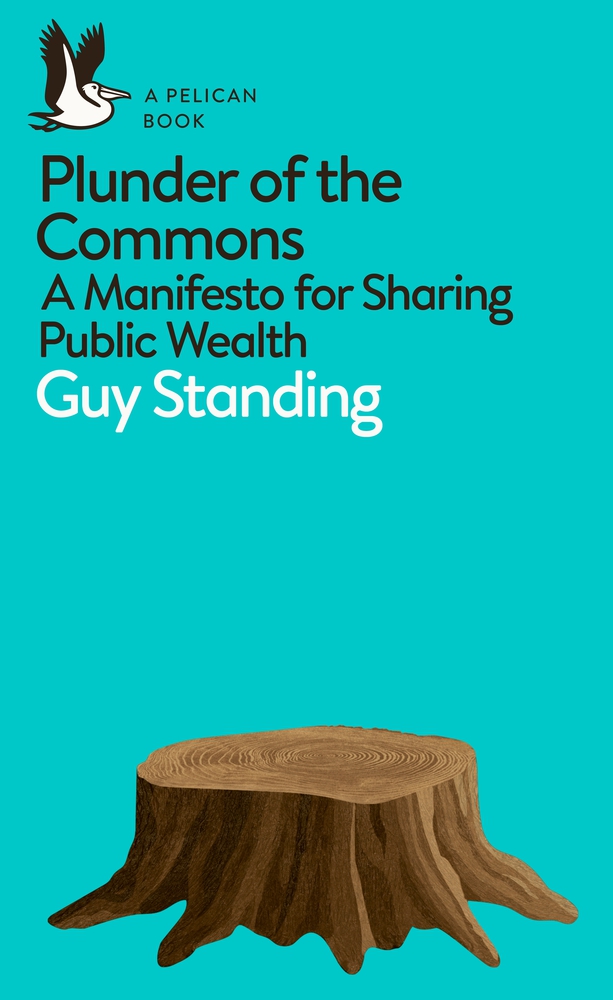
We are losing the commons. Austerity and neoliberal policies have depleted our shared wealth; our national utilities have been sold off to foreign conglomerates, social housing is almost non-existent, our parks are cordoned off for private events and our national art galleries are sponsored by banks and oil companies. This plunder deprives us all of our common rights, recognized as far back as the Magna Carta and the Charter of the Forest of 1217, to share fairly and equitably in our public wealth.Guy Standing leads us through a new appraisal of the commons, stemming from the medieval concept of common land reserved in ancient law from marauding barons, to his modern reappraisal of the resources we all hold in common - a brilliant new synthesis that crystallises quite how much public wealth has been redirected to the 1% in recent decades through the state-approved exploitation of everything from our land to our state housing, health and benefit systems, to our justice system, schools, newspapers and even the air we breathe. Plunder of the Commons proposes a charter for a new form of commoning, of remembering, guarding and sharing that which belongs to us all, to slash inequality and soothe our current political instability.

Guy Standing's immensely influential 2011 book introduced the Precariat as an emerging mass class, characterized by inequality and insecurity. Standing outlined the increasingly global nature of the Precariat as a social phenomenon, especially in the light of the social unrest characterized by the Occupy movements. He outlined the political risks they might pose, and at what might be done to diminish inequality and allow such workers to find a more stable labour identity.His concept and his conclusions have been widely taken up by thinkers from Noam Chomsky to Zygmunt Bauman, by political activists and by policy-makers.This new book takes the debate a stage further-looking in more detail at the kind of progressive politics that might form the vision of a Good Society in which such inequality, and the instability it produces is reduced.A Precariat Charter discusses how rights - political, civil, social and economic - have been denied to the Precariat, and at the importance of redefining our social contract around notions of associational freedom, agency and the commons. The ecological imperative is also discussed - something that was only hinted at in Standing's original book but has been widely discussed in relation to the Precariat by theorists and activists alike.

Shouldn’t everyone receive a stake in society's wealth? Could we create a fairer world by guaranteeing income to all? What would this mean for our health, wealth, and happiness?Basic income is a revolutionary idea that guarantees regular, unconditional cash transfers from the government to all citizens. It is an acknowledgement that everyone plays a part in generating the wealth currently enjoyed by only a few and would rectify the recent breakdown in income distribution. Political parties across the world are now adopting this innovative policy and the idea generates headlines every day. Guy Standing has been at the forefront of thought surrounding basic income for the past thirty years, and in this book he covers in authoritative detail its effects on the economy, poverty, work, and labor; dissects and disproves the standard arguments against basic income; explains what we can learn from pilots across the world; and illustrates exactly why basic income has now become such an urgent necessity.

A FINANCIAL TIMES BEST ECONOMICS BOOK OF 2022'A landmark book... The Blue Commons is at once a brilliant synthesis, a searing analysis, and an inspiring call to action.' - David Bollier'With remarkable erudition, passion and lyricism, Guy Standing commands the reader to wake up to the threat posed by rentier capitalism's violent policies for extraction, exploitation and depletion of that which is both common to us all, but also vital to our survival: the sea and all within it.' - Ann Pettifor'Shines a bright light on the economy of the oceans, directing us brilliantly towards where a sustainable future lies.' - Danny Dorling'This is a powerful, visionary book - essential reading for all who yearn for a better world.' - Jason HickelThe sea provides more than half the oxygen we breathe, food for billions of people and livelihoods for hundreds of millions. But giant corporations are plundering the world's oceans, aided by global finance and complicit states, following the neoliberal maxim of Blue Growth. The situation is dire: rampant exploitation and corruption now drive all aspects of the ocean economy, destroying communities, intensifying inequalities, and driving fish populations and other ocean life towards extinction.The Blue Commons is an urgent call for change, from a campaigning economist responsible for some of the most innovative solutions to inequality of recent times. From large nations bullying smaller nations into giving up eco-friendly fishing policies to the profiteering by the Crown Estate in commandeering much of the British seabed, the scale of the global problem is synthesised here for the first time, as well as a toolkit for all of us to rise up and tackle it.The oceans have been left out of calls for a Green New Deal but must be at the centre of the fight against climate change. How do we do it? By building a Blue Commons alternative: a transformative worldview and new set of proposals that prioritise the historic rights of local communities, the wellbeing of all people and, with it, the health of our oceans.

'Guy Standing's books have, over the years, pieced together a necessary political and intellectual agenda ... His Politics of Time is a splendid and timely addition to this body of important work' Yanis VaroufakisTime has always been political. Throughout history, how we use our time has been defined and controlled by the powerful, and today is no exception. But we can reclaim control, and in this book, the pioneering economist Guy Standing shows us how.The ancient Greeks organised time into five work, labour, recreation, leisure and contemplation. Labour was onerous, whereas leisure was schole, and included participation in public life and lifelong education. Since the industrial revolution, our time has been shaped by capitalism, our jobs are supposed to provide all meaning in life, our time outside labour is considered simply 'time off', and politicians prioritise jobs above all other aspects of a good life.Today, we are experiencing the age of chronic uncertainty. Mental illness is on the rise, some people are experiencing more time freedom while many others are having more and more of their time stolen from them, particularly the vulnerable and those in the precariat.But there is a way forward. We can create a new politics of time, one that liberates us and helps save the planet, through strengthening real leisure and working together through commoning. We can retake control of our time, but we must do it together.

Battling Eight Giants: Basic Income Now: How to End Austerity and Provide for All
by Guy Standing
Rating: 3.7 ⭐
Today in the richest countries in the world, 60% of those in poverty work full-time, inequality is the highest it has been for 100 years, climate change threatens our extinction and automation means millions are forced into a life of precarity.The solution? Basic Income. Here, Guy Standing, the leading expert on the concept, explains how to solve the new eight evils of modern life, and all for almost zero cost. There is a better future, one that makes certain all citizens can share in the wealth of the modern economy.Far from being a new idea, Standing shows how the roots of basic income go back to the Charter of the Forest, one of two foundational documents of the state - the other, sealed on the same day, being the Magna Carta. All citizens have a right to the wealth created by capitalism, and all - left or right, rich or poor - can benefit from a dynamic and creative economy created by the guarantee of subsistence to all.

Del reconocido economista internacional Guy Standing llega La política del tiempo, una historia de gran erudición que explora la politización del tiempo y nos muestra el camino para reclamarlo.El tiempo siempre ha sido político. Los poderosos han definido y controlado nuestra manera de usarlo a lo largo de la historia, y continúan haciéndolo hoy en día. Pero es posible recuperar el control de nuestro tiempo y, en La política del tiempo, el pionero economista Guy Standing nos muestra cómo.Los antiguos griegos organizaron el uso del tiempo en cinco categorí el trabajo independiente, la actividad laboral, el recreo, el ocio y la contemplación. Para ellos, la laboral era una actividad onerosa, y valoraban mucho más el ocio, el cual, entendido como sjolé, abarcaba también la participación en la vida pública y la educación de la persona.Desde la Revolución Industrial, sin embargo, el capitalismo ha invertido esta valoración. Actualmente se considera que nuestra actividad laboral es lo que da sentido a nuestra vida y que el resto de horas son simplemente tiempo «libre». Así, los políticos priorizan el empleo por encima de todos los demás aspectos que conforman una vida buena y, en el nuevo contexto de incertidumbre crónica, las enfermedades mentales son cada vez más frecuentes y a muchas personas (en particular, a las más vulnerables y a los miembros del precariado) se les roba cada vez más tiempo.No obstante, Guy Standing nos muestra otro podemos recobrar el control de nuestro tiempo. Para ello, debemos fortalecer el verdadero ocio y la colaboración (pro)comunal para crear una nueva política del tiempo que no solo nos libere, sino que, a su vez, contribuya a salvar el planeta. Y, lo que es más importante, debemos hacerlo juntos.

In this ground-breaking book, Guy Standing offers a new perspective on work and citizenship, rejecting the labourist orientation of the 20th century.Karl Polanyi's The Great Transformation marked the rise of industrial citizenship, which hinged on fictitious labour decommodification. Since the 1970s, this has collapsed and a Global Transformation is under way, in which inequalities and insecurities are becoming unsustainable. Guy Standing explains that while a struggle against paternalism is essential, the desirable egalitarian response to the problems caused by globalization is a strategy to build occupational citizenship. This is based on a right to universal economic security and institutions to enable everybody to develop their capabilities and work whilst respecting the ecological imperatives of the 21st century. The book also explores a phasing out of labour law and a re-orientation of collective bargaining towards collaborative bargaining, highlighting the increased importance of the relationship between groups of workers and citizens as well as between workers and capital. Work after Globalization offers a new perspective on work, rejecting the labourist orientation of the 20th century. Social scientists interested in globalization and labour market issues will warmly welcome this book. It will also strongly appeal to students, researchers, policy-makers, social activists and those connected with the international regulation of occupations.

What models of distributive justice can the twenty-first century promote to challenge the spread of insecurity, inequality and social fragmentation? The twentieth century was dominated by competition between two labour models of society - state socialism and welfare state capitalism, which promoted forms of labour security. Since the 1970s globalization and flexible labour markets have increased insecurity and inequalities. After a period dominated by libertarianism, politicians and social thinkers must find ways of promoting distributive justice, based on basic security and new forms of voice representation and regulation. Dismissing the approach of the `new paternalists', this book presents a vision combining security of income and representation without moralistic state control.

Very good condition.

De faste ansættelser bliver færre, de løst ansatte bliver flere og usikkerheden tager til. En voksende gruppe mennesker arbejder og lever under usikre vilkår med skiftende korte ansættelser, som hverken fører til fastansættelse, stabil indkomst eller social beskyttelse. Guy Standing har givet dem et prekariatet. Prekariatet er den første autoritative fremstilling af en ny klasse af mennesker med skiftende løsansættelser,hvis liv i periferien af arbejdsmarkedet først og fremmest er usikkert og udsat. Det store spørgsmål er, om det voksende prekariat er fanget i ubønhørlig indbyrdes konkurrence om arbejdet, eller om de fælles klassevilkår kan føre til en ny kollektiv politisk ånd og handlekraft."En meget vigtig bog" - Noam Chomsky"Køb Guy Standings bog, Prekariatet! Eller stjæl eller lån den!" Guy Standing (f. 1948) er økonom og professor i udviklingsstudier ved School of Oriental and African Studies (SOAS) i London. Han er tidligere professor i økonomi ved University of Bath i Storbritannien og Monash University i Australien og leder af det socio-økonomiske sikkerhedsprogram under Den internationale arbejdsorganisation (ILO). Hans forfatterskab inkluderer ud over hovedværket The Precariat (2011), bl.a. Basic And how we can make it happen (2017), The Corruption of Why Rentiers Thrive and Work Does Not Pay (2016) og Work after Building Occupational Citizenship (2009)



Social Income and Insecurity: A Study in Gujarat
by Guy Standing
Economic liberalisation associated with globalisation is causing a pervasive growth of economic insecurity experienced all over the world. This is placing urgent demands on policymakers to rethink old policies and institutions. This book sets out a new approach to the assessment of income dynamics, based on identifying the diverse components of people’s income and entitlements. It defines ‘social income’ as a broader concept of household income which includes state, community and private benefits. It shows how those components should be measured and provides a composite picture of the structure of incomes and support systems of different societal groups. It recognises how the structure of income, as well as its distribution, has been linked to policy and development dynamics. It starts from a premise that unless the totality of incomes and income support systems is taken into account, academics and policymakers cannot expect to develop appropriate interventions. This perspective is developed though a detailed household survey conducted in rural and urban areas of Gujarat in 2007–2008. This provides an up-to-date picture of how institutions, NGOs and the state system are operating in the context of rapid restructuring of village life in India.

A Basic Income Grant for South Africa
by Guy Standing
Providing a critical analysis of the feasibility and impact of a universal basic income grant for South Africans, which has been discussed extensively in parliament and the media for the past two years, this book assesses how comprehensive social security reform, including a universal grant, will impact inequality in the country and promote economic growth and employment. Revealed is that the grant is affordable, and an argument is made that it would reduce the criminality that is associated with poverty and inequality. The considerable implications for women and children and for the black majority are also considered.
In Defence of the Commons: A Manifesto for Saving Society
by Guy Standing

Labor Circulation and the Labour Process
by Guy Standing

Conceptualizing Territorial Mobility in Low-Income Countries
by Guy Standing

Los salarios mínimos en la Europa Central y Oriental: de la protección a la exclusión.
by Guy Standing
Labour force participation in low-income countries
by Guy Standing
Labour Force Participation in Low-income Countries [Paperback] Guy Standing (Author), Glen Sheehan (Author)

Beyond the New Paternalism: Basic Security as Equality
by Guy Standing
The century of laboring man has come to an end, and yet governments continue to link social entitlements to the performance of labor. This book argues that the era of market regulation has ended in an era of fiscal regulation: new social and economic insecurities have spread around the world, boosted by globalization and flexible labor markets, and compounded by privatization and increased selectivity of social policy. This global insecurity has spawned growing and vastly underestimated inequalities. To overcome these seemingly endemic insecurities and inequalities, Guy Standing argues for a complex egalitarianism, in which basic income security is recognized as a right for all. Work (including voluntary, community and care work), and not labor, must be the basis of a ‘good society,’ and policies must be judged by their capacity to promote occupational security.

In the 1990s, attempted shock therapy generated unemployment much worse than many economists claimed. This book, based on an enterprise survey conducted between 1991 and 1994, examines how factories responded to unprecedented pressures, highlighting employment cuts, changing corporate governance and unanticipated labour market outcomes.