
30 Books Written

WTF? can be an expression of amazement or an expression of dismay. In today’s economy, we have far too much dismay along with our amazement, and technology bears some of the blame. In this combination of memoir, business strategy guide, and call to action, Tim O'Reilly, Silicon Valley’s leading intellectual and the founder of O’Reilly Media, explores the upside and the potential downsides of today's WTF? technologies. What is the future when an increasing number of jobs can be performed by intelligent machines instead of people, or done only by people in partnership with those machines? What happens to our consumer based societies—to workers and to the companies that depend on their purchasing power? Is income inequality and unemployment an inevitable consequence of technological advancement, or are there paths to a better future? What will happen to business when technology-enabled networks and marketplaces are better at deploying talent than traditional companies? How should companies organize themselves to take advantage of these new tools? What’s the future of education when on-demand learning outperforms traditional institutions? How can individuals continue to adapt and retrain? Will the fundamental social safety nets of the developed world survive the transition, and if not, what will replace them? O'Reilly is "the man who can really can make a whole industry happen," according to Eric Schmidt, Executive Chairman of Alphabet (Google.) His genius over the past four decades has been to identify and to help shape our response to emerging technologies with world shaking potential—the World Wide Web, Open Source Software, Web 2.0, Open Government data, the Maker Movement, Big Data, and now AI. O’Reilly shares the techniques he's used at O’Reilly Media to make sense of and predict past innovation waves and applies those same techniques to provide a framework for thinking about how today’s world-spanning platforms and networks, on-demand services, and artificial intelligence are changing the nature of business, education, government, financial markets, and the economy as a whole. He provides tools for understanding how all the parts of modern digital businesses work together to create marketplace advantage and customer value, and why ultimately, they cannot succeed unless their ecosystem succeeds along with them.The core of the book's call to action is an exhortation to businesses to DO MORE with technology rather than just using it to cut costs and enrich their shareholders. Robots are going to take our jobs, they say. O'Reilly replies, “Only if that’s what we ask them to do! Technology is the solution to human problems, and we won’t run out of work till we run out of problems." Entrepreneurs need to set their sights on how they can use big data, sensors, and AI to create amazing human experiences and the economy of the future, making us all richer in the same way the tools of the first industrial revolution did. Yes, technology can eliminate labor and make things cheaper, but at its best, we use it to do things that were previously unimaginable! What is our poverty of imagination? What are the entrepreneurial leaps that will allow us to use the technology of today to build a better future, not just a more efficient one? Whether technology brings the WTF? of wonder or the WTF? of dismay isn't inevitable. It's up to us!

"Media organizations should take note of Twitter's power to quickly reach their target consumers." --Tim O'Reilly (@timoreilly), in a Los Angeles Times interview, March 2009 This practical guide will teach you everything you need to know to quickly become a Twitter power user. It includes information on the latest third party applications, strategies and tactics for using Twitter's 140-character messages as a serious--and effective--way to boost your business, as well as how to turn Twitter into your personal newspaper, tracking breaking news and learning what matters to you and your friends. Co-written by Tim O'Reilly and Sarah Milstein, widely followed and highly respected twitterers, the practical information in The Twitter Book is presented in an innovative, visually rich format that's packed with clear explanations and examples of best practices that show Twitter in action, as demonstrated by the work of over 60 twitterers. This book will help y
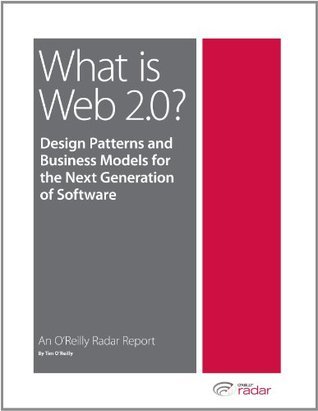
The concept of "Web 2.0" began with a conference brainstorming session between O'Reilly and MediaLive International. Dale Dougherty, web pioneer and O'Reilly VP, noted that far from having "crashed", the web was more important than ever, with exciting new applications and sites popping up with surprising regularity. What's more, the companies that had survived the collapse seemed to have some things in common. Could it be that the dot-com collapse marked some kind of turning point for the web, such that a call to action such as "Web 2.0" might make sense? We agreed that it did, and so the Web 2.0 Conference was born.In the year and a half since, the term "Web 2.0" has clearly taken hold, with more than 9.5 million citations in Google. But there's still a huge amount of disagreement about just what Web 2.0 means, with some people decrying it as a meaningless marketing buzzword, and others accepting it as the new conventional wisdom.This article is an attempt to clarify just what we mean by Web 2.0.

Book by O'Reilly, Tim, Dougherty, D.

Tim O'Reilly is het geweten van Silicon Valley. Als vooraanstaand denker uit dit centrum van innovatie legt hij uit hoe nieuwe technologieën onze wereld gaan veranderen.Wat hebben zelfrijdende auto's, on demand-dienstverlening, kunstmatige intelligentie en inkomensongelijkheid met elkaar gemeen? Het zijn signalen dat we halsoverkop afstormen op een wereld die door technologie wordt bepaald, op manieren die we niet begrijpen en waarvoor we alle reden hebben bang te zijn. Maar weinigen hebben zo'n vooruitziende blik voor nieuwe technologieën al Tim O'Reilly. In De nieuwe economie onderzoekt hij de dringende vraag hoe wij de technologieën die we creëren de baas kunnen blijven, voordat zij ons de baas worden. Welke keuzes moeten nú gemaakt worden om in de toekomst een wereld te krijgen waarin we willen leven?

For all its widespread use, UUCP is one of the most difficult UNIX utilities to master. Poor documentation, cryptic messages, and differences between various implementations make setting up UUCP links a nightmare for many a system administrator.This handbook is meant for system administrators who want to install and manage the UUCP and Usenet software. It covers HoneyDanBer UUCP as well as standard Version 2 UUCP, with special notes on Xenix. As one reader noted over the Net, "Don't even TRY to install UUCP without it!"Topics covered in Managing UUCP The tenth edition of this classic work has been revised and expanded to include descriptions
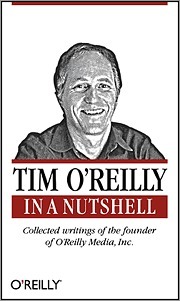
The essays in this collection offer valuable insight into one of today's technology leaders: the founder and CEO of O'Reilly Media. Tim O'Reilly in a Nutshell contains more than a dozen essays about paradigm shifts in technology, the future of online publishing, and the way he approaches business. Along the way, O'Reilly discusses open source projects, Unix, and technologies from Microsoft, Apple, and other companies.It's not easy to put Tim O'Reilly in a nutshell, but with the essays in this collection, you get valuable insight into the mind of the founder and CEO of O'Reilly Media. Tim O'Reilly in a Nutshell contains more than a dozen essays that discuss paradigm shifts in technology, the future of online publishing, and the way he approaches business. Along the way, he discusses open source projects, Unix, and technologies from Microsoft, Apple, and other companies.One thing that stands out in these essays is O'Reilly's ability to see technological trends long before they happen. Essays from a decade ago address today's networked world in detail, whether it's the Internet operating system, the Web's "architecture of participation," or the rapid rise of ebooks. It's a fascinating journey into the knowledge and passions of one of today's technology leaders.
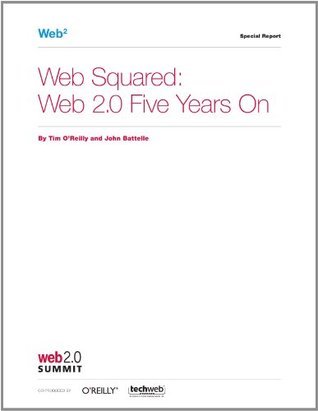
Ever since we first introduced the term Web 2.0, people have been asking, What ™s next? Assuming that Web 2.0 was meant to be a kind of software version number (rather than a statement about the second coming of the Web after the dotcom bust), we ™re constantly asked about Web 3.0. Is it the semantic web? The sentient web? Is it the social web? The mobile web? Is it some form of virtual reality?It is all of those, and more.The Web is no longer a collection of static pages of HTML that describe something in the world. Increasingly, the Web is the world "everything and everyone in the world casts an information shadow, an aura of data which, when captured and processed intelligently, offers extraordinary opportunity and mindbending implications. Web Squared is our way of exploring this phenomenon and giving it a name.
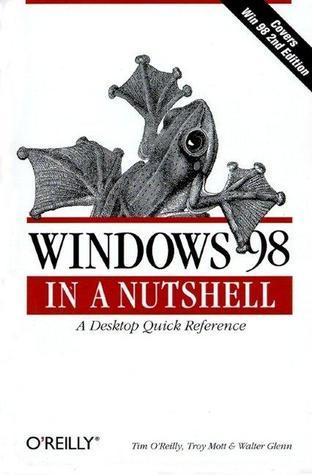
Windows 98 in a Nutshell is a comprehensive, compact reference that systematically unveils what serious users of Windows 98 will find interesting and useful. Little known details of the operating system, utility programs, and configuration settings are all captured in a consistent reference format. Based on the bestselling "In a Nutshell" approach, this book contains more information about using Windows 98 than any other book on the market. Guaranteed. Windows 98 in a Nutshell was coauthored by Tim O'Reilly, the publisher whose books have revolutionized computer book publishing with their commonsense approach, depth of detail, and focus on practical information that you can really use. If you can't remember which option on a dialog box controls a function, or if you just want to have a better handle on what's available in Windows 98 and Windows 98 Second Edition, this is the book you need. It This book follows the commonsense O'Reilly approach, cutting through the hype and giving practical details you can use every day. Any user who wants to make the most of Windows 98 and Windows 98 Second Edition will love this book.

Just as the 20th century only truly began when events in 1914 ignited World War I, the 21st century begins with the arrival of COVID-19. The Great War toppled the existing order, the future was up for grabs, and the decisions made over the next three decades triggered crisis after crisis before eventually leading to a more prosperous world. COVID portends a similar sea change.In this report, Tim O’Reilly shows how to prepare for this cloudy future through scenario planning, a discipline for building strategies that are robust in the face of large-scale uncertainty. What institutions are likely to disappear altogether? What might rise to fill the void? What technologies might bend the curves? Pick up this report and learn how to navigate this time of crisis.

Open source is not only a catalyst for small business growth, but also a driver of future success for many startups today. Bringing together Bluehost anonymized customer data and trends with O’Reilly Media’s job market data, along with other sources of trend data, this report captures the current state of open source as it relates to small to medium-sized businesses.

What is the future when more and more work can be done by intelligent machines instead of people, or only done by people in partnership with those machines? What happens to workers, and what happens to the companies that depend on their purchasing power? What's the future of business when technology-enabled networks and marketplaces are better at deploying talent than traditional companies? What's the future of education when on-demand learning outperforms traditional universities in keeping skills up to date?In this free collection of recent blog posts, Tim O'Reilly begins a focused, high-level conversation about the deep ways in which computers and their ilk are transforming how we do business, how we work, and how we live. Just about everyone's asking WTF? ("What the F***?" but also, more charitably, "What's the future?")

Welcome to the new normal. In part two of his essay series, 21 Technologies for the 21st Century, Tim O’Reilly examines seven technologies that almost seem like "old news" but are now exploding into the mainstream. This is how change happens: "gradually then suddenly."Inspired by his essay "Welcome to the 21st Century," this four-part series explores 21 technologies that are reshaping the world. Each essay in this series focuses on skills that will increase your ability to respond to these impending changes. You’ll also learn about resources on O’Reilly online learning that will help you acquire these skills.The complete essay series includes:Table Stakes—Fundamental skills that should be part of any robust strategy for dealing with changes that lie aheadThe New Normal—Established technologies still in the early stage of adoption that are already accelerating into the mainstreamThe Future Is Knocking—Market opportunities that have the power to utterly transform our economy. What will be the next Silicon Valley?Wild Cards—Technology breakthroughs that could open up new opportunities that, at present, are just the stuff of science fictionExplore "The New Normal" and continue your journey into 21 technologies that will help all of us face this challenging and uncertain future.

The Wild Wild West Cookbook : Cuisine from the land of Cactus and Cowboys
by Tim O'Reilly
Rating: 3.7 ⭐
A scrumptious cookbook celebrating the legendary cowboy through food, fun, and art. Specifically created to help the cook enjoy cooking as much as the folks enjoy eating. Enjoy authentic ranch recipes, Southwest favorites, some of Ma's staples, and original artwork depicting the excitement of the legendary cowboy and the western era through vivid color.

The X Window System User's Guide, Motif Edition, orients the new user to window system concepts and provides detailed tutorials for many client programs, including the xterm terminal emulator and the window manager. Building on this basic knowledge, later chapters explain how to customize the X environment and provide sample configurations.This alternative edition of the User's Guide highlights the Motif window manager for users of the Motif graphical user interface. Revised for Motif 1.2 and X11 Release 5.Topics Material covered in this second edition
The future of Silicon Valley is in the past. The next great wave of innovation won’t come from the industries that led the previous one. In part three of his essay series, 21 Technologies for the 21st Century, Tim O’Reilly explains why the next challenge—climate change mitigation and adaptation—will be solved by entrepreneurs focused on real-world infrastructure and operations beyond the reach of today’s tech giants.Inspired by his essay “Welcome to the 21st Century,” this four-part series explores 21 technologies that are reshaping the world. Each essay in this series focuses on skills that will increase your ability to respond to these impending changes. You’ll also learn about resources on O’Reilly online learning that will help you acquire these skills.The complete essay series includes:Table Stakes—Fundamental skills that should be part of any robust strategy for dealing with changes that lie aheadThe New Normal—Established technologies still in the early stage of adoption that are already accelerating into the mainstreamThe Future Is Knocking—Market opportunities that have the power to utterly transform our economy. What will be the next Silicon Valley?Wild Cards—Technology breakthroughs that could open up new opportunities that, at present, are just the stuff of science fictionExplore “The Future Is Knocking” and continue your journey into 21 technologies that will help all of us face this challenging and uncertain future.
Contains essential information from the other volumes of the X Window System Series in a boiled-down quick reference format. Highlights differences between R3 and R4, so it can be used with either release.

X Toolkit Intrinsics Reference Manual: For Version 11 of the X Window System Volume 5
by Tim O'Reilly
Rating: 2.0 ⭐
This work has been selected by scholars as being culturally important, and is part of the knowledge base of civilization as we know it. This work was reproduced from the original artifact, and remains as true to the original work as possible. Therefore, you will see the original copyright references, library stamps (as most of these works have been housed in our most important libraries around the world), and other notations in the work.This work is in the public domain in the United States of America, and possibly other nations. Within the United States, you may freely copy and distribute this work, as no entity (individual or corporate) has a copyright on the body of the work.As a reproduction of a historical artifact, this work may contain missing or blurred pages, poor pictures, errant marks, etc. Scholars believe, and we concur, that this work is important enough to be preserved, reproduced, and made generally available to the public. We appreciate your support of the preservation process, and thank you for being an important part of keeping this knowledge alive and relevant.

X Toolkit Intrinsics Reference Manual, Vol. 5 (Classic Reprint): For Version 11 of the X Window System
by Tim O'Reilly
Rating: 2.0 ⭐
Excerpt from X Toolkit Intrinsics Reference ManualVolumes Four and Five are designed to be used together. Volume 4 provides an explanation of the X Toolkit, including tutorial material and numerous programming examples. Arranged by task or topic, each chapter brings together a group of X Toolkit functions, describes the conceptual foundation they are based on, and illustrates how they are most often used in writ ing applications. This volume is structured so as to be useful as a tutorial and also as a task oriented reference. To get the most out of the examples in Volume Four, you will need the exact calling sequences of each function from Volume Five. To understand fully how to use each of the functions described in Volume Five, all but the most experienced Toolkit hacker will need the explanation and examples in Volume Four.

One of six O'Reilly and Associates volumes on the X Window system, volume 5 is updated to be used with Release 4, covering X Toolkit Intrinsics in depth and containing reference pages for the Athena widgets (v.4 is reported to be a tutorial on the subject to be used in conjunction with this reference). Contents include functions, macros, prototyping, classes, X Toolkit data types, events, errors, resources and headers. Annotation copyright Book News, Inc. Portland, Or.
Book by O'Reilly, Tim, Quercia, Valerie

Facebook bet that opening its Application Platform would spur growthand build buzz, giving it an edge in the white-hot social networkpopularity contest. Four months and nearly 5000 applications later, it looks like that bet is paying off. Is Facebook the next platformfor profits, too?Find out what it takes to launch a successful Facebook application, understand the new rules of the application development game in a Web2.0 world, and get the scoop on the most popular Facebook apps inthis new report from Tim O'Reilly and the O'Reilly Radar team.The report: Sizes up the Facebook opportunity--who's making money, and how?Lays out best practices of marketing with Facebook Applications, aka Social Media Optimization (SMO)Identifies the top 200 Facebook applications and plots their growthratesGoes beyond Facebook, and scopes out the emerging widget economyThe social network economy is sizzling, and "The Facebook ApplicationPlatform" is a must-read for anyone who wants in on the Facebookopportunity.

by Tim O'Reilly
Twitter ya no sirve sólo para contar lo que ha desayunado. Se ha convertido en una herramienta indispensable para los negocios, las organizaciones benéficas, los famosos y las personas de todo el mundo. Con esta agradable guía, enseguida se pondrá al tanto, no sólo de las funciones básicas, sino también de nuevas opciones y usos más específicos que le ayudarán a publicar mensajes con confianza. Este libro escrito por dos expertos en Twitter mundialmente conocidos, contiene numerosos ejemplos reales, consejos sólidos y explicaciones sencillas que le ayudarán a comprender las formas en las que Twitter puede ser útil y adictivo, así como distinto de cualquier otro servicio de comunicación, y cómo puede explotar ese poder para convertirse en un usuario experto.

X Toolkit Intrinsics Reference Manual: For Version 11 of the X Window System; Volume 5
by Tim O'Reilly
This work has been selected by scholars as being culturally important, and is part of the knowledge base of civilization as we know it. This work is in the "public domain in the United States of America, and possibly other nations. Within the United States, you may freely copy and distribute this work, as no entity (individual or corporate) has a copyright on the body of the work. Scholars believe, and we concur, that this work is important enough to be preserved, reproduced, and made generally available to the public. We appreciate your support of the preservation process, and thank you for being an important part of keeping this knowledge alive and relevant.

UUCPシステム管理
by Tim O'Reilly


Xウィンドウ・システム・ユーザ・ガイド
by Tim O'Reilly

Medical Spanish pocket.
by Tim O'Reilly