
Bryan Caplan
Bryan Caplan is a professor of economics at George Mason University in Fairfax, Virginia. He received his B.S. in economics from University of California, Berkeley and his Ph.D. from Princeton University. His professional work has been devoted to the philosophies of libertarianism and free-market capitalism and anarchism. (He is the author of the Anarchist Theory FAQ.) He has published in American Economic Review, Public Choice, and the Journal of Law and Economics, among others. He is a blogger at the EconLog blog along with Arnold Kling, and occasionally has been a guest blogger at Marginal Revolution with two of his colleagues at George Mason, Tyler Cowen and Alex Tabarrok. He is an adjunct scholar of the Cato Institute in Washington, D.C. Currently, his primary research interest is public economics. He has criticized the assumptions of rational voters that form the basis of public choice theory, but generally agrees with their conclusions based on his own model of "rational irrationality." Caplan has long disputed the efficacy of popular voter models, in a series of exchanges with Donald Wittman published by the Econ Journal Watch. Caplan outlined several major objections to popular political science and the economics sub-discipline public choice. Caplan later expanded upon this theme in his book The Myth of the Rational Voter (Princeton University Press 2007), in which he responded to the arguments put forward by Wittman in his The Myth of Democratic Failure. He maintains a website that includes a "Museum of Communism" section, that "provides historical, economic, and philosophical analysis of the political movement known as Communism", to draw attention to human rights violations of which, despite often exceeding those of Nazi Germany, there is little public knowledge. Caplan has also written an online graphic novel called Amore Infernale.
15 Books Written

The Myth of the Rational Voter: Why Democracies Choose Bad Policies
by Bryan Caplan
Rating: 3.9 ⭐
• 4 recommendations ❤️
The greatest obstacle to sound economic policy is not entrenched special interests or rampant lobbying, but the popular misconceptions, irrational beliefs, and personal biases held by ordinary voters. This is economist Bryan Caplan's sobering assessment in this provocative and eye-opening book. Caplan argues that voters continually elect politicians who either share their biases or else pretend to, resulting in bad policies winning again and again by popular demand.Boldly calling into question our most basic assumptions about American politics, Caplan contends that democracy fails precisely because it does what voters want. Through an analysis of Americans' voting behavior and opinions on a range of economic issues, he makes the convincing case that noneconomists suffer from four prevailing biases: they underestimate the wisdom of the market mechanism, distrust foreigners, undervalue the benefits of conserving labor, and pessimistically believe the economy is going from bad to worse. Caplan lays out several bold ways to make democratic government work better--for example, urging economic educators to focus on correcting popular misconceptions and recommending that democracies do less and let markets take up the slack. The Myth of the Rational Voter takes an unflinching look at how people who vote under the influence of false beliefs ultimately end up with government that delivers lousy results. With the upcoming presidential election season drawing nearer, this thought-provoking book is sure to spark a long-overdue reappraisal of our elective system.

Selfish Reasons to Have More Kids: Why Being a Great Parent is Less Work and More Fun Than You Think
by Bryan Caplan
Rating: 3.7 ⭐
• 2 recommendations ❤️
We've needlessly turned parenting into an unpleasant chore. Parents invest more time and money in their kids than ever, but the shocking lesson of twin and adoption research is that upbringing is much less important than genetics in the long run. These revelations have surprising implications for how we parent and how we spend time with our kids. The big Mold your kids less and enjoy your life more. Your kids will still turn out fine.Selfish Reasons to Have More Kids is a book of practical big ideas. How can parents be happier? What can they change -- and what do they need to just accept? Which of their worries can parents safely forget? Above all, what is the right number of kids for you to have? You'll never see kids or parenthood the same way again.
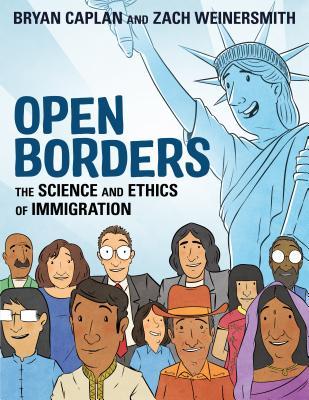
Open Borders: The Science and Ethics of Immigration
by Bryan Caplan
Rating: 4.1 ⭐
• 1 recommendation ❤️
Economist Bryan Caplan makes a bold case for unrestricted immigration in this fact-filled graphic nonfiction.American policy-makers have long been locked in a heated battle over whether, how many, and what kind of immigrants to allow to live and work in the country. Those in favor of welcoming more immigrants often cite humanitarian reasons, while those in favor of more restrictive laws argue the need to protect native citizens.But economist Bryan Caplan adds a new, compelling perspective to the immigration debate: He argues that opening all borders could eliminate absolute poverty worldwide and usher in a booming worldwide economy—greatly benefiting humanity.With a clear and conversational tone, exhaustive research, and vibrant illustrations by Zach Weinersmith, Open Borders makes the case for unrestricted immigration easy to follow and hard to deny.

The Case Against Education: Why the Education System Is a Waste of Time and Money
by Bryan Caplan
Rating: 3.9 ⭐
Despite being immensely popular--and immensely lucrative—education is grossly overrated. In this explosive book, Bryan Caplan argues that the primary function of education is not to enhance students' skill but to certify their intelligence, work ethic, and conformity—in other words, to signal the qualities of a good employee. Learn why students hunt for easy As and casually forget most of what they learn after the final exam, why decades of growing access to education have not resulted in better jobs for the average worker but instead in runaway credential inflation, how employers reward workers for costly schooling they rarely if ever use, and why cutting education spending is the best remedy.Caplan draws on the latest social science to show how the labor market values grades over knowledge, and why the more education your rivals have, the more you need to impress employers. He explains why graduation is our society's top conformity signal, and why even the most useless degrees can certify employability. He advocates two major policy responses. The first is educational austerity. Government needs to sharply cut education funding to curb this wasteful rat race. The second is more vocational education, because practical skills are more socially valuable than teaching students how to outshine their peers.Romantic notions about education being "good for the soul" must yield to careful research and common sense — The Case against Education points the way.

In this exciting new graphic novel, economist Bryan Caplan examines how changes to housing regulation can lead us to a vastly better world. Why are housing prices in America so unbelievably high, especially in the country's most desirable locations? The superficial answer is “supply and demand,” but the deep answer―the reason supply is so low―is draconian housing regulation. In Build, Baby, The Science and Ethics of Housing Regulation , economist Bryan Caplan makes the economic and philosophical case for radical deregulation of this massive market―freeing property owners to build as tall and dense as they wish. Not only would the average price of housing be cut in half, but the building boom unleashed by deregulation would simultaneously reduce inequality, increase social mobility, promote economic growth, reduce homelessness, increase birth rates, and help the environment. It's surprising then, that despite all these benefits, housing deregulation is universally unpopular with policymakers. Combining visually stunning graphics and careful interdisciplinary research, Build, Baby, Build , takes readers on a journey through what is wrong with the housing market―and what we can do about it.

Bryan Caplan, Professor of Economics at George Mason University and New York Times Bestselling author, blogged for EconLog from 2005-2022. His latest book combines the very best of his EconLog writings on finding happiness, success, meaning, connection, and convenience in a world that too often lacks all five.In the title essay, Caplan challenges the all-forgiving idea that people who make poor choices "can't do otherwise." If you don't accept this excuse from anti-vaxxers, why would you accept it from alcoholics or overeaters? Humoring the pseudo-helpless may be kind, but reinforces poor behavior and often leads to the scapegoating of innocent bystanders. Yourself included.Self-Help Is Like a Vaccine is packed with helpful life hacks. How to stop packing for trips. How to turn arguments into bargains. The high cost of being single. A long-time homeschooler, Caplan tells readers to turn truancy into a peak experience -- and master math along the way.

Bryan Caplan, Professor of Economics at George Mason University, and New York Times Bestselling author of Open Borders, The Myth of the Rational Voter, Selfish Reasons to Have More Kids, and The Case Against Education, blogged for EconLog from 2005-2022. His latest book combines an all-new piece, “Don’t Be a A Letter to My Daughter,” with the very best of his EconLog writings on the virtue – and perversion – of justice.In the title essay, Caplan challenges the conventional view that we treat women less fairly than men. Men predominate at the bottom as well as the top of society. Performance gaps, not unfairness, are the best explanation. Feminism succeeds because it is society cares more when women suffer. Much more.Later essays debunk the “woke” movement as an Orwellian program of uniformity and exclusion. The alternative is the Beckerian view that free markets foster genuine justice by rewarding employers who put bigotry aside. That is why even xenophobic employers often hire illegal immigrants. Blaming all men, whites, or immigrants for the sins of some is emotionally appealing but economically absurd.

Bryan Caplan, New York Times Bestselling author of Open Borders, The Myth of the Rational Voter, Selfish Reasons to Have More Kids, and The Case Against Education, has been blogging for EconLog since 2005. Labor Econ Versus the World collects the very best of his EconLog essays on the science and ethics of work.Caplan gives readers a tantalizing bundle of puzzling questions. Why is illegal immigration so low? What's the harm of banning jerky employers? How lazy are professors, really?He provides a long list of contrarian answers. Immigration is grossly underrated. Education is grossly overrated. "If you don't like it, quit" does far more for workers than government ever has.At the same time, Caplan happily embraces unfashionable yet obvious truths. Government regulation kills jobs. Most professors have a poor grasp of the real world. And bourgeois common sense is correct: Work hard, plan ahead, and your odds of finding prosperity and joy in the First World are excellent.

Bryan Caplan, Professor of Economics at George Mason University, and New York Times Bestselling author of Open Borders, The Myth of the Rational Voter, Selfish Reasons to Have More Kids, and The Case Against Education, blogged for EconLog from 2005-2022. How Evil Are Politicians? collects the very best of his EconLog essays on the vicious use of political authority.How Evil Are Politicians? explores how leaders manipulate voters to amass power. Above all, successful demagogues appeal to Social Desirability Bias – crowd-pleasing absurdities like, “Victory at any price,” “If it saves one life,” and “Every American deserves the best.” Democrats and dictators, left and right: they all rely on absurd lies – and they all neglect the Spiderman principle that, “With great power comes great responsibility.”This is clearest in wartime. Leveraging the moral precept that one should not kill innocents unless you know the gains far exceed the costs, Caplan argues that modern warfare is morally impermissible – and war-making politicians are villains. This “pragmatic pacifism” is perhaps Caplan’s most controversial view, but how is he wrong?

Bryan Caplan, Professor of Economics at George Mason University, and New York Times Bestselling Author of Open Borders, The Myth of the Rational Voter, Selfish Reasons to Have More Kids, and The Case Against Education, blogged for EconLog from 2005-2022. His latest book combines the very best of his EconLog writings on non-conformism. You really will live a better life once you learn to question — and, if prudent, defy — popular opinion.In the title essay, Caplan dissects the top mass hysterias he's experienced. The wars on terrorism, sexism, racism, disease, and war itself were all based on innumerate fear of the problems, combined with ferocious anger against naysayers. No wonder the "cures" were reliably worse than the crises. In a pinch, the people to trust are those who stay calm while others panic. Try to be one of them.How, though, can non-conformists flourish in a conformist world? With careful strategy. When social sanctions are harsh, wise non-conformists reluctantly conform. Normally, however, they can safely keep their own council. Why? Because the majority is too emotional to competently crush crafty rebels.

Bryan Caplan, Professor of Economics at George Mason University, and New York Times Bestselling Author of Open Borders, The Myth of the Rational Voter, Selfish Reasons to Have More Kids, and The Case Against Education, blogged for EconLog from 2005-2022. His latest book combines the very best of his EconLog writings on voter irrationality. The main cause of bad policy... is bad thinking.In the title essay, Caplan argues that democracy's main problem is not that voters are selfish, but that they are altruists with foolish views about how to help the world. Later essays explore voter irrationality from inside voters' heads - and show how much more sense democracy makes when you stop expecting the demos to make sense.If voters are so bad, what's the alternative? Caplan makes the rational case for freedom. What the world needs is not so much the right to do wrong as the right to do good things that sound wrong.

Many people grant the state the moral right to do all sorts of things — things that, were they done by private individuals, we would nonetheless find appalling. Can we justify this expansive moral authority, whether through social contract theory or otherwise? If we can't, what happens next?Philosopher Michael Huemer's new book, The Problem of Political Authority, proposes a radical The state and its agents should be judged using exactly the same standards that we apply in our judgments of private conduct. If it is wrong for me to extract money from my neighbor under threat of force, then — and by the same token — it is also wrong for the state. When we make these judgments, he argues, we rapidly discover that we have no duty whatsoever to obey the state.The result, for him, is philosophical anarchism. Of course, many libertarians and others decline to go so far. It's an old debate, and one not likely to be settled here in any case. What Huemer's argument brings, however, is a new methodological approach. He builds his case from from common, widely shared ethical intuitions rather than abstract first principles. Such principles may or may not be shared among all interlocutors, even while their intuitions agree. This initial agreement, Huemer claims, is a solid foundation for political and ethical reasoning.To discuss with him, we've recruited a panel of distinguished thinkers of varying George Mason economics professor Bryan Caplan, libertarian scholar-activist Tom G. Palmer, and Binghamton University philosophy professor Nicole Hassoun.

Bryan Caplan, Professor of Economics at George Mason University, and New York Times Bestselling author, blogged for EconLog from 2005-2022. His latest book combines the very best of his EconLog writings on how free markets, government regulation, and government ownership actually work.The opening essay argues that even friends of the free market should show business – and business leaders – more respect and appreciation. The free market isn’t just a mechanical “process” of wealth production; every business has founders and leaders, and the free market delivers thanks to their intelligence, creativity, and determination. While entrepreneurs are rarely saintly, they are routinely heroic.Pro-Market AND Pro-Business goes on to argue that business is the most functional form of social organization. Contrary to classic complaints about monopoly, imperfect information, and even externalities, what businesses do normally makes sense not just selfishly, but socially. Regulation and government ownership, in contrast, is a never-ending ode to self-righteous incompetence.“No one eviscerates foolish economic policies better than Bryan Caplan. He is a rare breed of economist-his work is rational, original, and easy to understand. Read this book and you will win any battle of wits about economic policy.”--Jeff Yass, Co-Founder of SIG

In this pamphlet, Bryan Caplan argues for free competition rather than "perfect" competition. He describes several benefits of laissez-faire that are not present in classic economics textbooks. Drawing on public choice theory and economic and political philosophy, Caplan produces a compelling and original argument for more economic freedom.
