
Anand Giridharadas
Anand Giridharadas is the author of the THE PERSUADERS (2022), the international bestseller WINNERS TAKE ALL (2018), THE TRUE AMERICAN (2014), and INDIA CALLING (2011). A former foreign correspondent and columnist for The New York Times for more than a decade, he has also written for The New Yorker, The Atlantic, and Time, and is the publisher of the newsletter The.Ink. He is an on-air political analyst for MSNBC. He has received the Radcliffe Fellowship, the Porchlight Business Book of the Year Award, Harvard University’s Outstanding Lifetime Achievement Award for Humanism in Culture, and the New York Public Library’s Helen Bernstein Book Award for Excellence in Journalism. He lives in Brooklyn, New York, with his wife, Priya Parker, and their two children.
9 Books Written

Winners Take All: The Elite Charade of Changing the World
by Anand Giridharadas
Rating: 4.1 ⭐
• 10 recommendations ❤️
An insider's groundbreaking investigation of how the global elite's efforts to "change the world" preserve the status quo and obscure their role in causing the problems they later seek to solve.Former New York Times columnist Anand Giridharadas takes us into the inner sanctums of a new gilded age, where the rich and powerful fight for equality and justice any way they can--except ways that threaten the social order and their position atop it. We see how they rebrand themselves as saviors of the poor; how they lavishly reward "thought leaders" who redefine "change" in winner-friendly ways; and how they constantly seek to do more good, but never less harm. We hear the limousine confessions of a celebrated foundation boss; witness an American president hem and haw about his plutocratic benefactors; and attend a cruise-ship conference where entrepreneurs celebrate their own self-interested magnanimity.Giridharadas asks hard questions: Why, for example, should our gravest problems be solved by the unelected upper crust instead of the public institutions it erodes by lobbying and dodging taxes? He also points toward an answer: Rather than rely on scraps from the winners, we must take on the grueling democratic work of building more robust, egalitarian institutions and truly changing the world. A call to action for elites and everyday citizens alike.

The Persuaders: At the Front Lines of the Fight for Hearts, Minds, and Democracy
by Anand Giridharadas
Rating: 4.1 ⭐
An insider account of activists, politicians, educators, and everyday citizens working to change minds, bridge divisions, and save democracyThe lifeblood of any free society is persuasion: changing other people's minds to enable real change. But America is suffering a crisis of faith in persuasion that is putting its democracy and the planet itself at risk. Americans increasingly write each other off instead of seeking to win each other over. Debates are framed in moralistic terms, with enemies battling the righteous. Movements for justice build barriers to entry, instead of on-ramps. Political parties focus on mobilizing the faithful rather than wooing the skeptical. And leaders who seek to forge coalition are labeled sellouts.In Persuasion Anand Giridharadas takes us inside these movements and battles, seeking out the dissenters who continue to champion persuasion in an age of polarization. We meet a co-founder of Black Lives Matter; a leader of the feminist resistance to Trumpism; white parents at a seminar on raising adopted children of color; Bernie Sanders and Alexandria Ocasio-Cortez; a team of door knockers with an uncanny formula for changing minds on immigration; an ex-cult member turned QAnon deprogrammer; and, hovering menacingly offstage, Russian operatives clandestinely stoking Americans' fatalism about each other. As the book's subjects grapple with how to "call out" threats and injustices while "calling in" those who don't agree with them but just might one day, they point a way to healing, and changing, a broken country.

The True American tells the story of Raisuddin Bhuiyan, a Bangladesh Air Force officer who dreams of immigrating to America and working in technology. But days after 9/11, an avowed "American terrorist" named Mark Stroman, seeking revenge, walks into the Dallas minimart where Bhuiyan has found temporary work and shoots him, maiming and nearly killing him. Two other victims, at other gas stations, aren’t so lucky, dying at once.The True American traces the making of these two men, Stroman and Bhuiyan, and of their fateful encounter. It follows them as they rebuild shattered lives—one striving on Death Row to become a better man, the other to heal and pull himself up from the lowest rung on the ladder of an unfamiliar country.Ten years after the shooting, an Islamic pilgrimage seeds in Bhuiyan a strange idea: if he is ever to be whole, he must reenter Stroman's life. He longs to confront Stroman and speak to him face to face about the attack that changed their lives. Bhuiyan publicly forgives Stroman, in the name of his religion and its notion of mercy. Then he wages a legal and public-relations campaign, against the State of Texas and Governor Rick Perry, to have his attacker spared from the death penalty.Ranging from Texas's juvenile justice system to the swirling crowd of pilgrims at the Hajj in Mecca; from a biker bar to an immigrant mosque in Dallas; from young military cadets in Bangladesh to elite paratroopers in Israel; from a wealthy household of chicken importers in Karachi, Pakistan, to the sober residences of Brownwood, Texas, The True American is a rich, colorful, profoundly moving exploration of the American dream in its many dimensions. Ultimately it tells a story about our love-hate relationship with immigrants, about the encounter of Islam and the West, about how—or whether—we choose what we become.
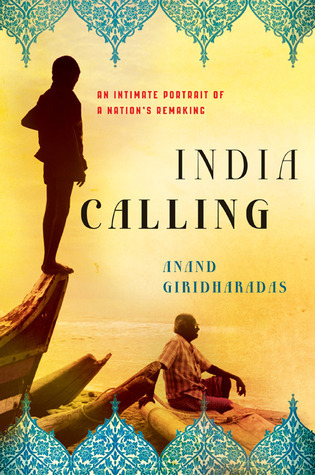
Reversing his parents' immigrant path, a young American-born writer returns to India and discovers an old country making itself newAnand Giridharadas sensed something was afoot as his plane from America prepared to land in Bombay. An elderly passenger looked at him and said, "We're all trying to go that way," pointing to the rear. "You, you're going this way?"Giridharadas was returning to the land of his ancestors, amid an unlikely economic boom. But he was interested less in its gold rush than in its cultural upheaval, as a new generation has sought to reconcile old traditions and customs with new ambitions and dreams.In "India Calling," Giridharadas brings to life the people and the dilemmas of India today, through the prism of his emigre family history and his childhood memories of India. He introduces us to entrepreneurs, radicals, industrialists, and religious seekers, but, most of all, to Indian families. He shows how parents and children, husbands and wives, cousins and siblings are reinventing relationships, bending the meaning of Indianness, and enduring the pangs of the old birthing the new.Through their stories, and his own, he paints an intimate portrait of a country becoming modern while striving to remain itself."

What does the next generation of Chinese want -- besides economic growth? A report from China on the country's search for meaning, by Anand Giridharadas, columnist for the International Herald Tribune and The New York Times online, and author of "India An Intimate Portrait of a Nation's Remaking."------------------An The airplane fell into China through what seemed like a vat of sour a thick, yellow-white haze of cloud and smog that gave a preview of all the frenetic world-changing activity below. As we taxied through Pudong’s airport, on the outskirts of Shanghai, the stew of rain and smog was thick enough to obscure the identities painted on other planes’ tails. They wove around the airport as strangers in daylight.I had been to China twice before, both times only to Shanghai and briefly. Six years had passed, spent mostly in India, writing about that nation’s own great turning. And, with India on my mind, what arrested me upon landing was the bodies. Every time I land in India, a jolt comes in seeing the bodies in the aerobridge and around the the bodies of ballerinas, worn by grown men. They are bodies that were once—and perhaps still are—hungry. They sober the visitor at once; they remind one of the degradations that endure. Now, arriving in China, the seeming absence of such bodies struck me. The men in the airport—the laborers, the gate staff, the taxi coordinators—were full-bodied men. They had none of the Indian worker’s meekness....China’s accomplishment in modern times is that much everyone knows. But it is also elusive. The Chinese scholar Steven N. S. Cheung has compared the nation to a clumsy, stumbling high jumper who, despite appearances, makes a world record jump. “The man must have done something right, more right than all jumpers before,” Cheung wrote in a book published last year. “What is it? That, in a different context, is the China question.”I traveled to China last summer as an outsider, seeking answers to that question. My time in India had schooled me in the dangers of interpreting so vast and complicated a country through Western-built frameworks. I knew all about China’s electronics sweatshops and factory suicides and cancer villages, its unaccountable death sentences and slow-oozing chemical spills and thick corruption, its prison abuse and censorship and treatment of minorities. What I didn’t have a handle on was how Chinese themselves viewed these heady new times. I wondered how they were defining and going after their Chinese dreams.In four different settings, I eavesdropped on a fascinating conversation among the younger generation about what China has become and is becoming....I began these conversations open-endedly and followed them wherever they led. But a common thread presented itself before long. In ways as diverse as the country itself, my interlocutors were consumed and frustrated by the thought that China is lost, adrift. It was variously claimed that everything has moved too fast; that the capitalist present is burying the Maoist past as crudely and dangerously as the Maoists buried the past that they inherited; that anything resembling the future has been adopted without a thought to consequences...There seemed among those I met to be a yearning to slow it all down, to chew on what China has done and will mean, to supplement growing with reflection. Again and again, I detected a feeling of wanting more than economic success—of wanting to invent, and not merely wake up in, a new China.“When you make a certain amount of money, you ask, ‘What’s next?’” Victor Koo, the effervescent co-founder of Youku, a Chinese equivalent of YouTube, told me high above the earth in his company’s headquarters in Beijing. “We’re getting to a point where we’ve moved up a level, where the basic needs of many people are taken care of. And so the question of purpose now comes up.”------------------

Book by Anand Giridharadas

The New York Times Book Review - August 23, 2020 - Hijacking America
by Anand Giridharadas
weekly book review
Pobediteli poluchayut vsyo: ulovki elit, (ne) menyayushchie mir
by Anand Giridharadas
Ship from Germany, hardcover. Ананд Гиридхарадас - иностранный корреспондент и обозреватель The New York Times на протяжении более чем десяти лет. Спикер конференц-платформы TED и политический аналитик NBC News, преподавал нарративную журналистику в Нью-Йоркском университете. Перед вами новаторское исследование того, как усилия глобальной элиты "изменить мир" лишь сохраняют статус-кво. Фактически великие мира сего цинично создают видимость решения проблем, причиной которых сами же и являются. Богатые и могущественные филантропы борются за равенство и справедливость всеми возможными способами, кроме тех, которые угрожают их положению в обществе. Они громогласно выступают за права бедных, щедро вознаграждают угодных им "лидеров мнений" и стремятся к идеалам добра и справедливости, зачастую нанося ощутимый ущерб обществу, за которое ратуют. Гиридхарадас задает непростые вопросы. Например, почему наши самые важные проблемы должна решать неизбираемая верхушка, а не общественные институты, которые она разрушает, лоббируя свои интересы и уклоняясь от уплаты налогов? Факты, изложенные в книге, указывают на ответ: вместо того чтобы довольствоваться объедками с роскошного стола победителей, мы должны взять на себя изнурительную работу по созданию более надежных демократических институтов и действительно изменить мир.
Persuaders: At the Front Lines of the Fight for Hearts, Minds, and Democracy
by Anand Giridharadas