
Robert D. Putnam
Robert David Putnam is an American political scientist specializing in comparative politics. He is the Peter and Isabel Malkin Professor of Public Policy at the Harvard University John F. Kennedy School of Government. Putnam developed the influential two-level game theory that assumes international agreements will only be successfully brokered if they also result in domestic benefits. His most famous work, Bowling Alone, argues that the United States has undergone an unprecedented collapse in civic, social, associational, and political life (social capital) since the 1960s, with serious negative consequences. In March 2015, he published a book called Our Kids: The American Dream in Crisis that looked at issues of inequality of opportunity in the United States. According to the Open Syllabus Project, Putnam is the fourth most frequently cited author on college syllabi for political science courses.[
18 Books Written

Bowling Alone: Revised and Updated: The Collapse and Revival of American Community
by Robert D. Putnam
Rating: 3.9 ⭐
• 2 recommendations ❤️
Updated to include a new chapter about the influence of social media and the Internet—the 20th anniversary edition of Bowling Alone remains a seminal work of social analysis, and its examination of what happened to our sense of community remains more relevant than ever in today’s fractured America. Twenty years, ago, Robert D. Putnam made a seemingly simple observation: once we bowled in leagues, usually after work; but no longer. This seemingly small phenomenon symbolized a significant social change that became the basis of the acclaimed bestseller, Bowling Alone, which The Washington Post called “a very important book” and Putnam, “the de Tocqueville of our generation.” Bowling Alone surveyed in detail Americans’ changing behavior over the decades, showing how we had become increasingly disconnected from family, friends, neighbors, and social structures, whether it’s with the PTA, church, clubs, political parties, or bowling leagues. In the revised edition of his classic work, Putnam shows how our shrinking access to the “social capital” that is the reward of communal activity and community sharing still poses a serious threat to our civic and personal health, and how these consequences have a new resonance for our divided country today. He includes critical new material on the pervasive influence of social media and the internet, which has introduced previously unthinkable opportunities for social connection—as well as unprecedented levels of alienation and isolation. At the time of its publication, Putnam’s then-groundbreaking work showed how social bonds are the most powerful predictor of life satisfaction, and how the loss of social capital is felt in critical ways, acting as a strong predictor of crime rates and other measures of neighborhood quality of life, and affecting our health in other ways. While the ways in which we connect, or become disconnected, have changed over the decades, his central argument remains as powerful and urgent as ever: mending our frayed social capital is key to preserving the very fabric of our society.

A groundbreaking examination of the growing inequality gap from the bestselling author of Bowling Alone: why fewer Americans today have the opportunity for upward mobility.It's the American dream: get a good education, work hard, buy a house, and achieve prosperity and success. This is the America we believe in a nation of opportunity, constrained only by ability and effort. But during the last twenty-five years we have seen a disturbing opportunity gap emerge. Americans have always believed in equality of opportunity, the idea that all kids, regardless of their family background, should have a decent chance to improve their lot in life. Now, this central tenet of the American dream seems no longer true or at the least, much less true than it was. Robert Putnam about whom The Economist said, "His scholarship is wide-ranging, his intelligence luminous, his tone modest, his prose unpretentious and frequently funny," offers a personal but also authoritative look at this new American crisis. Putnam begins with his high school class of 1959 in Port Clinton, Ohio. By and large the vast majority of those students "our kids" went on to lives better than those of their parents. But their children and grandchildren have had harder lives amid diminishing prospects. Putnam tells the tale of lessening opportunity through poignant life stories of rich and poor kids from cities and suburbs across the country, drawing on a formidable body of research done especially for this book. Our Kids is a rare combination of individual testimony and rigorous evidence. Putnam provides a disturbing account of the American dream that should initiate a deep examination of the future of our country.

The Upswing: How America Came Together a Century Ago and How We Can Do It Again
by Robert D. Putnam
Rating: 3.9 ⭐
An eminent political scientist’s brilliant analysis of economic, social, and political trends over the past century demonstrating how we have gone from an individualistic “I” society to a more communitarian “We” society and then back again—and how we can learn from that experience to turn the corner towards a stronger, more unified nation, from the author of Bowling Alone and Our Kids. Deep and accelerating inequality; unprecedented political polarization; vitriolic public discourse; a fraying social fabric; public and private narcissism—Americans today seem to agree on only one thing: This is the worst of times. But we’ve been here before. During the Gilded Age of the late 1800s, America was highly individualistic, starkly unequal, fiercely polarized, and deeply fragmented, just as it is today. However as the twentieth century opened, America became—slowly, unevenly, but steadily—more egalitarian, more cooperative, more generous; a society more focused on our responsibilities to one another and less focused on our narrower self-interest. Sometime during the 1960s, however, our nation turned another corner, and all of these trends reversed, leaving us in today’s disarray. In a sweeping overview of more than a century of history, drawing on his inimitable combination of statistical analysis and storytelling, Robert Putnam analyzes a remarkable confluence of trends that brought us from an “I” society to a “We” society and then back again. He draws inspiring lessons for our time from an earlier era, when a dedicated group of reformers righted the ship, putting us on a path to becoming a society once again based on community. Engaging, revelatory, and timely, this is Putnam’s most ambitious work yet, a fitting capstone to a brilliant career.

American Grace is a major achievement, a groundbreaking examination of religion in America. Unique among nations, America is deeply religious, religiously diverse, and remarkably tolerant. But in recent decades the nation's religious landscape has been reshaped. America has experienced three seismic shocks, say Robert Putnam and David Campbell. In the 1960s, religious observance plummeted. Then in the 1970s and 1980s, a conservative reaction produced the rise of evangelicalism and the Religious Right. Since the 1990s, however, young people, turned off by that linkage between faith and conservative politics, have abandoned organized religion. The result has been a growing polarization—the ranks of religious conservatives and secular liberals have swelled, leaving a dwindling group of religious moderates in between. At the same time, personal interfaith ties are strengthening. Interfaith marriage has increased while religious identities have become more fluid. Putnam and Campbell show how this denser web of personal ties brings surprising interfaith tolerance, notwithstanding the so-called culture wars. American Grace is based on two of the most comprehensive surveys ever conducted on religion and public life in America. It includes a dozen in-depth profiles of diverse congregations across the country, which illuminate how the trends described by Putnam and Campbell affect the lives of real Americans. Nearly every chapter of American Grace contains a surprise about American religious life. Among them:● Between one-third and one-half of all American marriages are interfaith; ● Roughly one-third of Americans have switched religions at some point in their lives; ● Young people are more opposed to abortion than their parents but more accepting of gay marriage; ● Even fervently religious Americans believe that people of other faiths can go to heaven; ● Religious Americans are better neighbors than secular Americans—more generous with their time and treasure even for secular causes—but the explanation has less to do with faith than with their communities of faith; ● Jews are the most broadly popular religious group in America today. American Grace promises to be the most important book in decades about American religious life and an essential book for understanding the United States today.
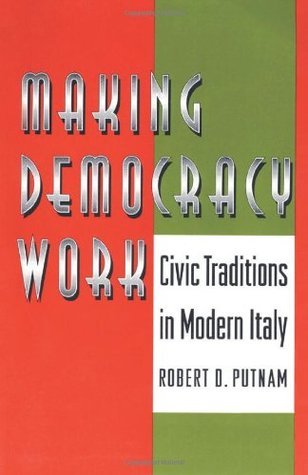
Why do some democratic governments succeed and others fail? In a book that has received attention from policymakers and civic activists in America and around the world, Robert Putnam and his collaborators offer empirical evidence for the importance of "civic community" in developing successful institutions. Their focus is on a unique experiment begun in 1970 when Italy created new governments for each of its regions. After spending two decades analyzing the efficacy of these governments in such fields as agriculture, housing, and health services, they reveal patterns of associationism, trust, and cooperation that facilitate good governance and economic prosperity.

Libro usado en buenas condiciones, por su antiguedad podria contener señales normales de uso

The Contemporary Comparative Politics Series will treat the more enduring as well as the more recent themes, approaches, and problems pertaining to the study of political systems. In all cases, the volumes are pointed toward the following goals; to illustrate the relationship between theory and method without being theoretically pretentious or methodologically self-conscious; to underline the essential interrelatedness between fact and value or empirical and normative considerations in politics; to inform the reader in brief compass and in ordinary language, free from the jargon and neologisms of modern social science. The final and overriding goal of the series is to show what the comparative political scientist does and why this is an activity of intrinsic interest for the reader and considerable utility for society.


The beliefs of politicians: ideology, conflict, and democracy in Britain and Italy
by Robert D. Putnam
Rating: 3.3 ⭐
VERY GOOD

Hanging Together: Cooperation and Conflict in the Seven-Power Summits, Revised and Enlarged Edition
by Robert D. Putnam
For nearly a decade the leaders of the seven major industrial countries―the United States, Japan, Germany, France, Britain, Italy, and Canada―have met annually to discuss international economic and political issues. Regular summitry of this sort is virtually unprecedented in modern diplomacy. Proponents see the Western summits as providing collective leadership that is vital in a turbulent world, while critics dismiss summitry as distracting and even damaging to political and economic stability.Hanging Together charts the modern dilemma between economic interdependence and national sovereignty. It assesses the history, decisions, successes, and failures of the seven-power summits from Rambouillet in 1975 to the 1983 meeting at Williamsburg, and looks forward to the 1984 summit in London. The authors show how the growing importance of international commerce and finance has caused national and international politics to become entangled, and how national borders have become more permeable. Born in an era of waning American hegemony, the summits reveal the tension between American leadership and collective Western management of the world economy. The authors also trace the struggles of heads of state to balance the conflicting imperatives of personal authority and bureaucratic expertise. Because summits involve the power and prestige of each country's highest authorities, summitry reveals in concentrated form how these conflicts are expressed and managed.As a blend of contemporary history and political economy, Hanging Together demonstrates that summits are not isolated annual encounters, but part of a continuous process of international and domestic negotiation about the most important and controversial issues facing all governments today.

サミット―先進国首脳会議
by Robert D. Putnam

La pianta e le radici: Il radicamento dell'istituto regionale nel sistema politico italiano (Ricerche e studi dell'Istituto Cattaneo)
by Robert D. Putnam
Italian
Epilepsy: What It is What to Do About It
by Robert D. Putnam
[Making Democracy Work: Civic Traditions in Modern Italy (Princeton Paperbacks)] [Author: Putnam, Robert D.] [June, 1994]
by Robert D. Putnam
Bowling Alone
by Robert D. Putnam
Better Together: Restoring the American Community by Robert D. Putnam Lewis Feldstein
by Robert D. Putnam
(Better Together: Restoring the American Community) [By: Putnam, Robert D.] [Feb, 2005]
by Robert D. Putnam