
Joseph A. Tainter
Joseph Tainter studied anthropology at the University of California, Berkeley and Northwestern University, where he received his Ph.D. in 1975. As of 2012 he holds a professorship in the Department of Environment and Society at Utah State University. His previous positions include Project Leader of Cultural Heritage Research, Rocky Mountain Forest and Range Experiment Station, Albuquerque, New Mexico and Professor of Anthropology at the University of New Mexico. Tainter has written or edited many articles and monographs. His arguably best-known work, The Collapse of Complex Societies (1988), examines the collapse of Maya and Chacoan civilizations, and of the Western Roman Empire, in terms of network theory, energy economics and complexity theory. Tainter argues that sustainability or collapse of societies follow from the success or failure of problem-solving institutions and that societies collapse when their investments in social complexity and their "energy subsidies" reach a point of diminishing marginal returns. He recognizes collapse when a society rapidly sheds a significant portion of its complexity.
10 Books Written

Political disintegration is a persistent feature of world history. The Collapse of Complex Societies, though written by an archaeologist, will therefore strike a chord throughout the social sciences. Any explanation of societal collapse carries lessons not just for the study of ancient societies, but for the members of all such societies in both the present and future. Dr. Tainter describes nearly two dozen cases of collapse and reviews more than 2000 years of explanations. He then develops a new and far reaching theory that accounts for collapse among diverse kinds of societies, evaluating his model and clarifying the processes of disintegration by detailed studies of the Roman, Mayan and Chacoan collapses.

For more than a century, oil has been the engine of growth for a society that delivers an unprecedented standard of living to many. We now take for granted that economic growth is good, necessary, and even inevitable, but also feel a sense of unease about the simultaneous growth of complexity in the processes and institutions that generate and manage that growth. As societies grow more complex through the bounty of cheap energy, they also confront problems that seem to increase in number and severity. In this era of fossil fuels, cheap energy and increasing complexity have been in a mutually-reinforcing spiral. The more energy we have and the more problems our societies confront, the more we grow complex and require still more energy. How did our demand for energy, our technological prowess, the resulting need for complex problem solving, and the end of easy oil conspire to make the Deepwater Horizon oil spill increasingly likely, if not inevitable? This book explains the real causal factors leading up to the worst environmental catastrophe in U.S. history, a disaster from which it will take decades to recover.

Evolving Complexity And Environmental Risk In The Prehistoric Southwest
by Joseph A. Tainter
Rating: 4.0 ⭐
Cultural behavior exhibits many of the features of complex adaptive systems, but is in some ways distinctive. Cultural complexity is enigmatic, improbable, and difficult to maintain. It constrains behavior, limits understanding of processes, and imposes economic burdens. The advantages of complexity are modified by human cognition and limited by economic and environmental costs. This book explores in detail how and why prehistoric Southwestern societies changed in complexity, and thus offers important new perspectives on the evolution of culture.The papers discuss the factors that made prehistoric Southwesterners vulnerable to an arid environment, and their strategies to lessen risk and stress. The topics of the book link Southwestern data to fields such as economics, climatology, and evolutionary theory. In addition to a readership of archaeologists and anthropologists, this volume will be of interest to specialists in these related fields and to those concerned with complex adaptive systems and the work of the Santa Fe Institute.

Archeology of the Farmington Sector of the Elena Gallegos Project
by Joseph A. Tainter
Excerpt from Archeology of the Farmington Sector of the Elena Gallegos ProjectChapter 2 Research Testing By Michael L. Elliott Introduction The Research Program Previous Archeological Research in the Study Area Overview of Prehistory of the Area Environmental Setting The Survey The Cultural Resources The Testing Program Theoretical Perspective Research Objectives References.About the PublisherForgotten Books publishes hundreds of thousands of rare and classic books. Find more at www.forgottenbooks.comThis book is a reproduction of an important historical work. Forgotten Books uses state-of-the-art technology to digitally reconstruct the work, preserving the original format whilst repairing imperfections present in the aged copy. In rare cases, an imperfection in the original, such as a blemish or missing page, may be replicated in our edition. We do, however, repair the vast majority of imperfections successfully; any imperfections that remain are intentionally left to preserve the state of such historical works.

复杂社会的崩溃
by Joseph A. Tainter
本书描述了历史上从中国西周到乌干达北部的伊克族等二十多个由简单社会进化到相对复杂的社会后却走向崩溃的案例,并回顾了两千多年来后人对于这些崩溃现象的解释。作者还阐释了复杂社会的性质,并通过在社会政治复杂化领域具有广泛代表性的罗马文明、玛雅文明、查科文明从兴起到衰落的详细研究,为理解崩溃现象提供了一个新的视角,那就是从社会复杂化投资的边际回报(即每增加一个单位的劳动投入所带来的产量增加的回报)来判断一个社会是处于向更高阶段发展的复杂化进程中,还是正走向相反的崩溃进程。

L'effondrement des sociétés complexes: Nouvelle édition
by Joseph A. Tainter
La désintégration politique est, à travers l'Histoire, une caractéristique constante des sociétés humaines. Lorsque le moteur de l'économie mondiale tousse et hésite, comme il le fit en 2008 avec une gigantesque crise bancaire et monétaire, les experts se demandent si, cette fois-ci, la fin de tout est réellement proche. Mais, au juste, quand et pourquoi les États, les empires et les civilisations s'effondrent-ils ? Et, inversement, quand et pourquoi survivent-ils, et continuent-ils de prospérer en bravant des périls insensés? L'auteur passe en revue une vingtaine de cas d'effondrement, et examine les diverses explications données depuis plus de deux mille ans.En se concentrant sur trois cas d'effondrement bien documentés, les Romains, les Mayas et les Chacoans, il développe une nouvelle théorie, dont la portée est considérable. Les idées de l'auteur soulèvent ainsi des questions nouvelles et cruciales sur l'avenir des sociétés industrielles. Et bien au-delà des spécialistes des domaines étudiés, cet ouvrage intéressera tous ceux qui s'interrogent sur l'avenir de notre civilisation.
![Cultural resources overview : Mt. Taylor area, New Mexico by Joseph A. Tainter, David "A" Gillio, for Cibola National Forest, Albuquerque District, Bureau of Land Management, [and] S [Leather Bound]](https://m.media-amazon.com/images/S/compressed.photo.goodreads.com/books/1699801460i/129874733.jpg)
Leather Binding on Spine and Corners with Golden Leaf Printing on round Spine (extra customization on request like complete leather, Golden Screen printing in Front, Color Leather, Colored book etc.) Reprinted in 2018 with the help of original edition published long back [1980]. This book is printed in black & white, sewing binding for longer life, Printed on high quality Paper, re-sized as per Current standards, professionally processed without changing its contents. As these are old books, we processed each page manually and make them readable but in some cases some pages which are blur or missing or black spots. If it is multi volume set, then it is only single volume, if you wish to order a specific or all the volumes you may contact us. We expect that you will understand our compulsion in these books. We found this book important for the readers who want to know more about our old treasure so we brought it back to the shelves. Hope you will like it and give your comments and suggestions. - English, Pages 214. EXTRA 10 DAYS APART FROM THE NORMAL SHIPPING PERIOD WILL BE REQUIRED FOR LEATHER BOUND BOOKS. COMPLETE LEATHER WILL COST YOU EXTRA US$ 25 APART FROM THE LEATHER BOUND BOOKS. {FOLIO EDITION IS ALSO AVAILABLE.} Complete Cultural resources overview : Mt. Taylor area, New Mexico by Joseph A. Tainter, David "A" Gillio, for Cibola National Forest, Albuquerque District, Bureau of Land Management, [and] Socorro District, Bureau of Land Management. 1980 Tainter, Joseph A.

Cultural Resources Overview Mt. Taylor Area New Mexico
by Joseph A. Tainter
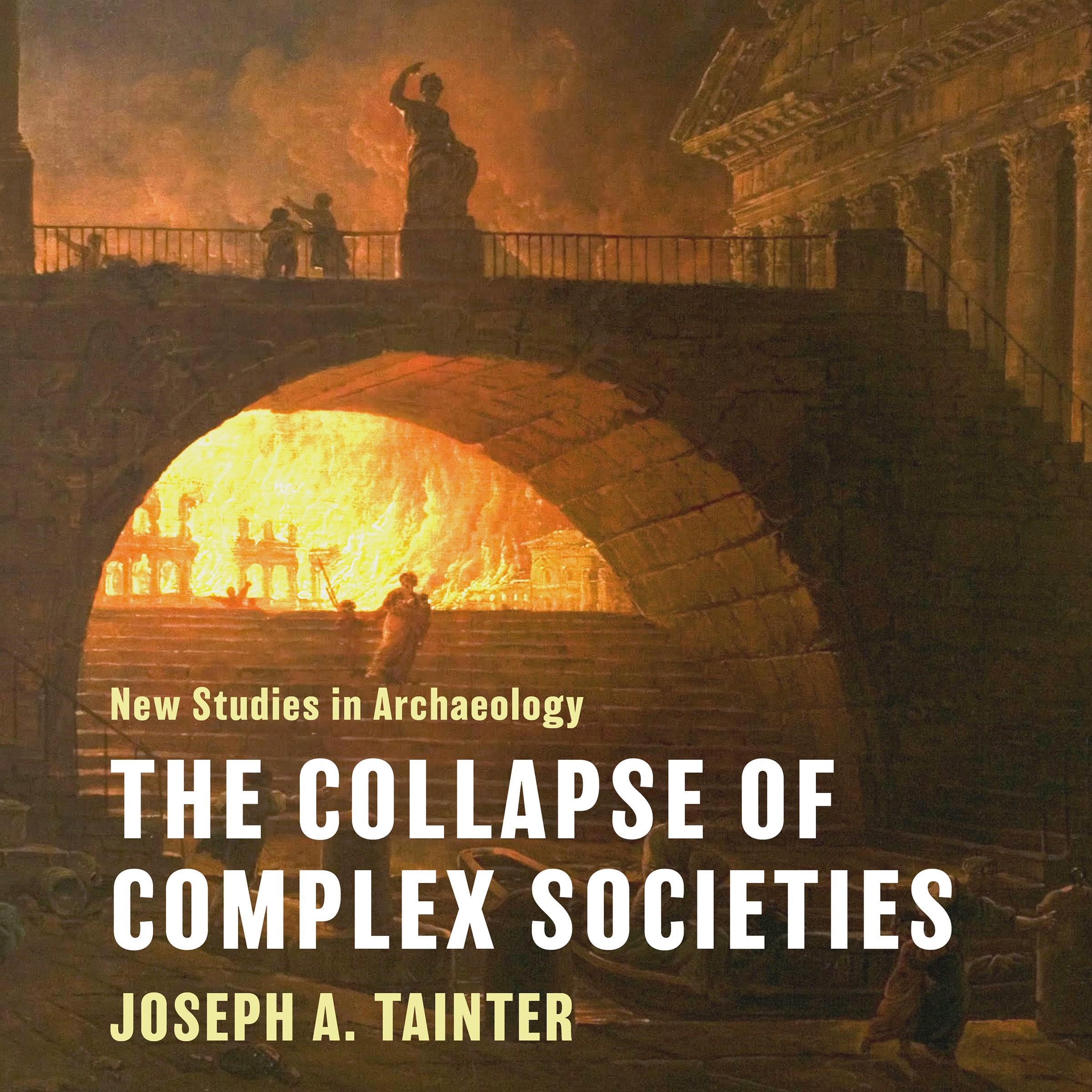
The Collapse of Complex Societies: New Studies in Archaeology
by Joseph A. Tainter
Political disintegration is a persistent feature of world history. The Collapse of Complex Societies, though written by an archaeologist, will therefore strike a chord throughout the social sciences. Any explanation of societal collapse carries lessons not just for the study of ancient societies, but for the members of all such societies in both the present and future. Dr. Tainter describes nearly two dozen cases of collapse and reviews more than 2,000 years of explanations. He then develops a new and far-reaching theory that accounts for collapse among diverse kinds of societies, evaluating his model and clarifying the processes of disintegration by detailed studies of the Roman, Mayan, and Chacoan collapses.1988 Cambridge University Press. Produced and published by Echo Point Books & Media, an independent bookseller in Brattleboro, Vermont.PLEASE When you purchase this title, the accompanying PDF will be available in your Audible Library along with the audio.
![[The Way the Wind Blows] [By: x] [September, 2000]](/placeholder.svg?height=400&width=300)
[The Way the Wind Blows] [By: x] [September, 2000]
by Joseph A. Tainter