
Ludwig von Mises
Ludwig Heinrich Edler von Mises (German pronunciation: [ˈluːtvɪç fɔn ˈmiːzəs]; September 29, 1881 – October 10, 1973) was an Austrian economist, historian, philosopher, author, and classical liberal who had a significant influence on the Austrian government's economic policies in the first third of the 20th century, the Austrian School of Economics, and the modern free-market libertarian movement.
30 Books Written

2012 Reprint of 1949 Edition. Exact facsimile of the original edition, not reproduced with Optical Recognition Software. "Human Action: A Treatise on Economics" is the first comprehensive treatise on economics written by a leading member of the modern Austrian school of economics. Von Mises contribution was very simple, yet at the same time extremely profound: he pointed out that the whole economy is the result of what individuals do. Individuals act, choose, cooperate, compete, and trade with one another. In this way Mises explained how complex market phenomena develop. Mises did not simply describe economic phenomena - prices, wages, interest rates, money, monopoly and even the trade cycle - he explained them as the outcomes of countless conscious, purposive actions, choices, and preferences of individuals, each of whom was trying as best as he or she could under the circumstances to attain various wants and ends and to avoid undesired consequences. Hence the title Mises chose for his economic treatise, "Human Action."

Originally published by Yale University Press in 1944, Bureaucracy is a classic fundamental examination of the nature of bureaucracies and free markets in juxtaposition to various political systems. Bureaucracy contrasts the two forms of economic management—that of a free market economy and that of a bureaucracy. In the market economy entrepreneurs are driven to serve consumers by their desire to earn profits and to avoid losses. In a bureaucracy, the managers must comply with orders issued by the legislative body under which they operate; they may not spend without authorization and they may not deviate from the path prescribed by law.Writing in an age of exuberant socialism, Ludwig von Mises here lucidly demonstrates how the efficiencies of private ownership and control of public good production ultimately trump the guesswork of publicly administered “planning” through codes and “officialdom.” Although Mises aptly critiques bureaucracy and expounds thoroughly upon the immense power of law-like codes of commissions and administrations, he does not condemn nor dismiss bureaucracy but rather frames its proper bounds within constitutional democratic governments.Ludwig von Mises (1881–1973) was the leading spokesman of the Austrian School of Economics throughout most of the twentieth century. He earned his doctorate in law and economics from the University of Vienna in 1906. In 1926, Mises founded the Austrian Institute for Business Cycle Research. From 1909 to 1934, he was an economist for the Vienna Chamber of Commerce. Before the Anschluss, in 1934 Mises left for Geneva, where he was a professor at the Graduate Institute of International Studies until 1940, when he emigrated to New York City. From 1948 to 1969, he was a visiting professor at New York University.Bettina Bien Greaves is a former resident scholar, trustee, and longtime staff member of the Foundation for Economic Education. She has written and lectured extensively on topics of free market economics. Her articles have appeared in such journals as Human Events, Reason, and The Freeman: Ideas on Liberty. A student of Mises, Greaves has become an expert on his work in particular and that of the Austrian School of economics in general. She has translated several Mises monographs, compiled an annotated bibliography of his work, and edited collections of papers by Mises and other members of the Austrian School.

In The Anti-capitalistic Mentality, the respected economist Ludwig von Mises plainly explains the causes of the irrational fear and hatred many intellectuals and others feel for capitalism. In five concise chapters, he traces the causation of the misunderstandings and resultant fears that cause resistance to economic development and social change. He enumerates and rebuts the economic arguments against and the psychological and social objections to economic freedom in the form of capitalism. Written during the heyday of twentieth-century socialism, this work provides the reader with lucid and compelling insights into human reactions to capitalism.Ludwig von Mises (1881–1973) was the leading spokesman of the Austrian School of Economics throughout most of the twentieth century. He earned his doctorate in law and economics from the University of Vienna in 1906. In 1926, Mises founded the Austrian Institute for Business Cycle Research. From 1909 to 1934, he was an economist for the Vienna Chamber of Commerce. Before the Anschluss, in 1934 Mises left for Geneva, where he was a professor at the Graduate Institute of International Studies until 1940, when he emigrated to New York City. From 1948 to 1969, he was a visiting professor at New York University.Bettina Bien Greaves is a former resident scholar, trustee, and longtime staff member of the Foundation for Economic Education. She has written and lectured extensively on topics of free market economics. Her articles have appeared in such journals as Human Events, Reason, and The Freeman: Ideas on Liberty. A student of Mises, Greaves has become an expert on his work in particular and that of the Austrian School of economics in general. She has translated several Mises monographs, compiled an annotated bibliography of his work, and edited collections of papers by Mises and other members of the Austrian School.

Von Mises' economic theories and views on economic policy are revealed in his lectures on capitalism, socialism, interventionism, inflation, foreign investment, and policies and ideas

The term "liberalism" comes from the Latin word liber meaning "free." Mises defines liberalism as "the liberal doctrine of the harmony of the rightly understood interests of all members of a free society founded on the principle of private ownership of the means of production." This book presents the theoretical and practical arguments for liberalism in the classical tradition.The foundation of liberalism, Mises says, rests on an understanding and appreciation of private property, social cooperation, the freedom idea, ethics and morality, democracy, and the legitimate role of government. Liberalism is not a political party; it is a system of social organization. The liberal program aims at securing equality under law and freedom of opportunity for everyone to make their own choices and decisions, so long as they do not interfere with the equal rights of others; it offers no special privileges to anyone. Under liberalism, the role of government would be limited to protecting the lives, property, and freedom of its citizens to pursue their own ends and goals. Mises is more specific here than elsewhere in applying the liberal program to economic policy, domestic and foreign. Also in this book, Mises contrasts liberalism with other conceivable systems of social organization such as socialism, communism, and fascism.Ludwig von Mises (1881–1973) was the leading spokesman of the Austrian School of Economics throughout most of the twentieth century. He earned his doctorate in law and economics from the University of Vienna in 1906. In 1926, Mises founded the Austrian Institute for Business Cycle Research. From 1909 to 1934, he was an economist for the Vienna Chamber of Commerce. Before the Anschluss, in 1934 Mises left for Geneva, where he was a professor at the Graduate Institute of International Studies until 1940, when he emigrated to New York City. From 1948 to 1969, he was a visiting professor at New York University.Bettina Bien Greaves is a former resident scholar, trustee, and longtime staff member of the Foundation for Economic Education. She has written and lectured extensively on topics of free market economics. Her articles have appeared in such journals as Human Events, Reason, and The Freeman: Ideas on Liberty. A student of Mises, Greaves has become an expert on his work in particular and that of the Austrian School of economics in general. She has translated several Mises monographs, compiled an annotated bibliography of his work, and edited collections of papers by Mises and other members of the Austrian School.

More than thirty years ago F. A. Hayek said of Socialism: "It was a work on political economy in the tradition of the great moral philosophers, a Montesquieu or Adam Smith, containing both acute knowledge and profound wisdom. . . . To none of us young men who read the book when it appeared was the world ever the same again."This is a newly annotated edition of the classic first published in German in 1922. It is the definitive refutation of nearly every type of socialism ever devised. Mises presents a wide-ranging analysis of society, comparing the results of socialist planning with those of free-market capitalism in all areas of life.Friedrich Hayek's foreword comments on the continuing relevance of this great work: "Most readers today will find that Socialism has more immediate application to contemporary events than it had when it first appeared."Ludwig von Mises (1881–1973) was the leading spokesman of the Austrian School of Economics throughout most of the twentieth century. He earned his doctorate in law and economics from the University of Vienna in 1906. In 1926, Mises founded the Austrian Institute for Business Cycle Research. From 1909 to 1934, he was an economist for the Vienna Chamber of Commerce. Before the Anschluss, in 1934 Mises left for Geneva, where he was a professor at the Graduate Institute of International Studies until 1940, when he emigrated to New York City. From 1948 to 1969, he was a visiting professor at New York University.

The Theory of Money and Credit integrated monetary theory into the main body of economic analysis for the first time, providing fresh, new insights into the nature of money and its role in the economy and bringing Mises into the front rank of European economists. The Theory of Money and Credit also presented a new monetary theory of the trade cycle, which, under further development by Mises’s student Nobel Laureate F. A. Hayek, came to challenge all previous trade-cycle theories. Ludwig von Mises (1881–1973) was the leading spokesman of the Austrian School of economics throughout most of the twentieth century.
This is the essay that overthrew the socialist paradigm in economics, and provided the foundation for modern Austrian price theory. When it first appeared in 1920, Mises was alone in challenging the socialists to explain how their pricing system would actually work in practice. Mises proved that socialism could not work because it could not distinguish more or less valuable uses of social resources, and predicted the system would end in chaos. The result of his proof was the two-decade-long "socialist calculation" debate. This new edition contains an afterword by Joseph Salerno, who applies the calculation argument to contemporary problems like environmentalism and business regulation.

An essay on the destruction of individual liberty by totalitarian ideologies.

We can't sit under Mises at his famous Vienna private seminar. We can't go back in time and attend his New York seminar, or follow him to his speaking engagements that he held in the 50s and 60s. But thanks to this second volume in a thrilling series (here is volume one), we do have access to what he said. He is warm, funny, passionate, and learned. This book provides a candid look at the man and his teaching style. It demonstrates his dazzling command over the material, and teaches in a breezier way than his treatises. This volume contains nine lectures delivered over one week, from June 23, to July 3, 1952, at the San Francisco Public Library. Mises was at his prime as a teacher and lecturer. He shares a lifetime of learning on topics that were (and remain) central to American public life. As the title indicates, his main focus is on Marxism. He discusses Marx and his place in the history of ideas, the destruction wrought by his dangerous ideology, the manner in which his followers h
Liberty is not, as the German precursors of Nazism asserted, a negative ideal. Whether a concept is presented in an affirmative or in a negative form is merely a question of idiom. Freedom from want is tantamount to the expression striving after a state of affairs under which people are better supplied with necessities. Freedom of speech is tantamount to a state of affairs under which everybody can say what he wants to say. At the bottom of all totalitarian doctrines lies the belief that the rulers are wiser and loftier than their subjects and that they therefore know better what benefits those ruled than they themselves. Werner Sombart, for many years a fanatical champion of Marxism and later a no less fanatical advocate of Nazism, was bold enough to assert frankly that the Führer gets his orders from God, the supreme Führer of the universe, and that Führertum is a permanent revelation.* Whoever admits this, must, of course, stop questioning the expediency of government omnipotence. Those disagreeing with this theocratical justification of dictatorship claim for themselves the right to discuss freely the problems involved. They do not write state with a capital S. They do not shrink from analyzing the metaphysical notions of Hegelianism and Marxism. They reduce all this high-sounding oratory to the simple are the means suggested suitable to attain the ends sought? In answering this question, they hope to render a service to the great majority of their fellow men.
Theory and History: An Interpretation of Social and Economic Evolution
by Ludwig von Mises
Rating: 4.3 ⭐
Like Hayek, Mises moved beyond economics in his later years to address questions regarding the foundation of all social science. But unlike Hayek's attempts, Mises's writings on these matters have received less attention than they deserve. Theory and History should be required for any student of 20th century ideas.

With a forceful style and suberb use of language, Mises outlines the nature, funtion and effects of capitalism. He demolishes many of the myths surrounding the industrial Revolution, shows why political freedom is impossible without economic freedom, points out the differances betweeen government and the market, and demonstrates how socialism destroys freedom.1 audio CD

In 1951, Mises gave an outstanding paper that made the summary case for the price system under capitalistic economic systems. In "Profit and Loss," he explains how cost accounting is the critical institution that ferrets out social waste, ensures that resources are directed to their most highly valued ends, and how entrepreneurs respond to price signals. His presentation is systematic, relentless, logical, and ultimately devastating to the opponents of profit and loss.He explains what it is that entrepreneurs confront in a market economy and how no bureaucratic institution can replicate the trial-and-error process that is at the heart of the market system. He weaves into his analysis the role of the consumer as the final arbiter of what is produced and distributed.Behind Mises's presentation was a burning desire to not only persuade the world but the attendees of the Mont Pelerin Society meeting in particular, whom Mises suspected were losing touch with core truths about the market order.The great merit of this essay is its brevity and passion. It explains the workings of what most people never think about or take for granted. Graduate students of economics have appreciated this essay for many years as the best summary of the technical side of the market. When it first appeared, it was as a monograph but it has been more than 50 years since it has been available in this format.

The Free Market and Its Enemies: Pseudo Science, Socialism, and Inflation
by Ludwig von Mises
Rating: 4.3 ⭐
This is a "new" book by Ludwig von Mises, the first of a series of lecture transcripts drawn from careful notes taken by Bettina Bien Greaves in the summer of 1951. It features Mises in a role in which we do not usually find him, not as a writer but as a speaker of enormous erudition and power.There are nine lectures in this Economics and its Opponents; Pseudo-Science and Historical Understanding; Acting Man and Economics; Marxism, Socialism, and Pseudo-Science; Capitalism and Human Progress; Money and Inflation; The Gold Its Importance and Restoration; Money, Credit, and the Business Cycle; and The Business Cycle and Beyond.If one has doubts about the method by which this book came about, it only takes a quick glance to see that these must be very faithful renderings of what he said in his famous New York seminar. The brilliance, determination, and unique Misesian perspective are all here.Plus, we find him commenting on matters one usually doesn't find in his others books, such as the impact that Plato had on the classical world, the place of Rousseau in history, the role of liberalism on the Continent as versus England, the impact of Poincare and Einstein, as well as passing comments on everything from banking debates of the 19th century as well as the role of ideology in modern life.A thrilling aspect of the book is how one can almost hear Mises speaking as you read through the prose. The reader senses that he or she is right there in the room with Mises as professor and teacher, generously sharing his reflections on theory, history, and politics.So, for example, Mises begins his 5th "I want to start tonight with the relations between economics and human practical life, and the consequences of the development of the theory of economics. Kipling said...."None of us have the chance to study directly under Mises, but this book gets us as close to that ideal as is possible.

Shortly after arriving in the United States, having fled a war-torn Europe, Ludwig von Mises sat down to complete his trilogy on economic systems. The result was this remarkably concise treatise, which tragically was not published until 1998. What Mises had foreseen was a world trapped between fully planned economies, which were clearly failing, and fully free markets, which were a casualty of depression and war. He warned that mixed systems give rise of political instability and economic stagnation, and proved that this was the case through a general model of interventionism and a specific analysis of price control, credit expansion, subsidies, welfare, corporatism, and the war economy. Particularly interesting is his discussion of the draft, which he sees as a species of socialism itself. A crucial book to understand in the post-socialist age. This book is not to be confused with his earlier book on price control entitled A Critique of Interventionism.The contents of this volume Introduction 1. The Problem 2. Capitalism or Market Economy 3. The Socialist Economy 4. The Capitalist State and the Socialist State 5. the Interventionist State 6. The Plea for Moral Reform I. Interference by Restriction 1. The Nature of Restrictive Measures 2. Costs and Benefits of Restrictive Measures 3. The Restrictive Measure as a Privilege 4. Restrictive Measures as Expenditures II. Interference by Price Control 1. The Statutory Law Versus Economic Law 2. The Reaction of the Market 3. Minimum Wages and Unemployment 4. The Political Consequences of Unemployment III. Inflation and Credit Expansion 1. Inflation 2. Credit Expansion 3. Foreign Exchange Control 4. The Flight of Capital and the Problem of "Hot Money" ISBN 1572460717 93 pp. (pb)
Written toward the end of Mises’s life, his last monograph, The Ultimate Foundation of Economic Science, returned to economics as a science based on human action. Mises believed that, since the publication of Human Action, economists and scientists alike had misinterpreted the idea of economics as a science by deeming it epistemological positivism—that they believed that the “science” basis was still more rooted in philosophy than in actual science.In this volume, Mises argued that economics is a science because human action is a natural order of life and that it is the actions of humans that determine markets and capital decisions. Since Mises believed these links could be proven scientifically, he concluded that economics, with its basis on that human action, is indeed a science in its own right and not an ideology or a metaphysical doctrine.What has been described as his most passionate work, The Ultimate Foundation of Economic Science brings together all of the themes from Mises’s previous works to proclaim what Israel Kirzner calls “the true character of economics.”Ludwig von Mises (1881–1973) was the leading spokesman of the Austrian School of Economics throughout most of the twentieth century. He earned his doctorate in law and economics from the University of Vienna in 1906. In 1926, Mises founded the Austrian Institute for Business Cycle Research. From 1909 to 1934, he was an economist for the Vienna Chamber of Commerce. Before the Anschluss, in 1934 Mises left for Geneva, where he was a professor at the Graduate Institute of International Studies until 1940, when he emigrated to New York City. From 1948 to 1969, he was a visiting professor at New York University.Bettina Bien Greaves is a former resident scholar, trustee, and longtime staff member of the Foundation for Economic Education. She has written and lectured extensively on topics of free market economics. Her articles have appeared in such journals as Human Events, Reason, and The Freeman: Ideas on Liberty. A student of Mises, Greaves has become an expert on his work in particular and that of the Austrian School of economics in general. She has translated several Mises monographs, compiled an annotated bibliography of his work, and edited collections of papers by Mises and other members of the Austrian School.
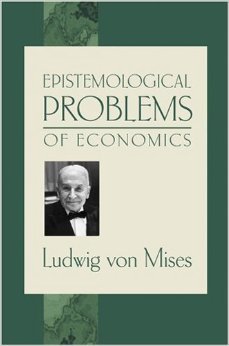
"The characteristic feature of this age of destructive wars and social disintegration is the revolt against economics." So says Ludwig von Mises in his most thorough defense of the method and scope of economic science. In this treatise, he argues that the core intellectual errors of statism, socialism, protectionism, racism, irrationalism can be found in a revolt against economic logic and its special character. Epistemological Problems of Economics was original published in 1933, a period when the social sciences and economic policy were undergoing upheaval. The classical view of economics as a deductive science, along with the laissez-faire policies implied by that view, were being displaced by positivism and economic planning. Mises set out to put the classical view on a firmer foundation. In so doing, he examines a range of philosophical problems associated with economics. He goes further to delineate the scope of the general science of human action. This treatise, out of print for many years, is now brought back by the Mises Institute in a 3rd edition, with a comprehensive introduction by Jörg Guido Hülsmann, senior fellow of the Mises Institute. He observes that "the great majority of contemporary economists, sociologists, political scientists, and philosophers are either completely unaware of Mises's contributions to the epistemology of the social sciences or think they can safely neglect dealing with them. They are in error. One can ignore a thinker, but the fundamental problems of social analysis remain. There will be no progress in these disciplines before the mainstream has fully absorbed and digested Mises's ideas."

This book has grown, from thirteen essays to seventeen essays. It is now the largest ever. There are now four additional essays of special merit. Also, for the first time, an analytical and descriptive essay has been added, "The Essential Von Mises," by a former student, Murray N. Rothbard, which is extraordinarily helpful. How do you introduce Mises into your thinking? Read these essays, and Rothbard's superior analysis, and you will be a better-informed person. Socrates considered ethics to be the queen of all the sciences; if so, economics is the bridegroom. Nobody can afford to be ignorant of economics, unless he is indifferent about having knowledge in the second most important of the social sciences.

In the 1960s, Ludwig von Mises lectured often on money and inflation. Bettina Bien Greaves was there taking shorthand. Mises on Money and Inflation is the result of her effort to transcribe those notes.Ms. Greaves "Upon the establishment of the Foundation for Economic Education (FEE) in 1946, Ludwig von Mises became a part-time adviser. Whenever FEE held a seminar in Irvington, if he was in town he would drive out from New York City … to speak to the participants. His topic was quite often inflation. I attended all those lectures, took them down in shorthand and later transcribed them. The thought occurred to me that eight to ten of his lectures on inflation, delivered in the 1960s, might be integrated, with the duplications deleted, and turned into a single piece."Hence this paper."Mises did not like to have his oral remarks quoted or published because, obviously, they did not represent the care and precision he devoted to his writings. However, it does not seem to me that these lectures, as I have edited them, misrepresent his ideas in any way. Moreover, they reveal his unpretentious manner and the informal simple style he used when talking to students. He often rephrased an idea in several different ways, repeating it for emphasis. He was frequently accused of being 'simplistic,' of making economic subjects appear too clear and simple, but it was this very approach that made it possible for persons, even those without any background in economics, to understand and appreciate what he was saying."To have this work is like having Mises as your private tutor, telling you about money and inflation in a casual setting and in plain language. He is the prophet of the 20th century on these topics, and here he presents his entire apparatus.True, this book is not technically by Mises, or officially sanctioned by him. But they are his lectures, providing a glimpse into the workings of an incredible mind on a topic that is crucial to our future.To search for Mises Institute titles, enter a keyword and LvMI (short for Ludwig von Mises Institute); e.g., Depression LvMI

Nation, State, and Economy: Contributions to the Politics and History of Our Time
by Ludwig von Mises
Rating: 4.3 ⭐
In 1919, Mises explained how the first World War had come about, distinguishing between nations, states, and economies. Prior to the nineteenth century, the boundaries of a state were determined by conquest, coercion, rulers, and princes; the people had nothing to say in the matter. A nation, composed of persons speaking the same language and to a large extent sharing the same culture, was an essentially neutral concept, in no way incompatible with a liberal economy, individual freedom, democracy, and the right of self-determination. Yet this peaceful nationalism gave way to militarism, international conflict, and war. Why?Nations, like individuals, learn from experience. The largely liberal movement for a “greater Germany,” composed of Germany, German-Austria, and scattered enclaves of German nationals in neighboring countries, was frustrated by the state in the form of the Kingdom of Prussia, which became the German Empire, and the Hapsburg Empire of Austria-Hungary. Essential to Mises’s concept of a classical liberal economy is the absence of interference by the state. Under the chancellorship of Bismarck, the essentially reactionary German state became increasingly intrusive in every aspect of the nation—economic, social, and of course political. As the German state sought to become stronger by forcefully acquiring additional territory, German nationalism became increasingly militaristic and imperialistic, leading to international conflict and war. In World War I, Germany and its allies were overpowered by the Allied Powers in population, economic production, and military might. Because Germany needed imports to survive, much less to wage war, and was cut off from foreign suppliers, its defeat was inevitable.Mises believed that Germany should not seek revenge for the “fetters . . . forced upon German development by the peace of Versailles.” Rather, his theme throughout this book is that Germany should adopt liberal ideas and a free market economy by expanding the international division of labor, which would help all parties. “For us and for humanity,” Mises wrote, “there is only one salvation: return to rationalistic liberalism.” Ludwig von Mises (1881–1973) was the leading spokesman of the Austrian School of Economics throughout most of the twentieth century. He earned his doctorate in law and economics from the University of Vienna in 1906. In 1926, Mises founded the Austrian Institute for Business Cycle Research. From 1909 to 1934, he was an economist for the Vienna Chamber of Commerce. Before the Anschluss, in 1934 Mises left for Geneva, where he was a professor at the Graduate Institute of International Studies until 1940, when he emigrated to New York City. From 1948 to 1969, he was a visiting professor at New York University.Bettina Bien Greaves is a former resident scholar, trustee, and longtime staff member of the Foundation for Economic Education. She has written and lectured extensively on topics of free market economics. Her articles have appeared in such journals as Human Events, Reason, and The Freeman: Ideas on Liberty. A student of Mises, Greaves has become an expert on his work in particular and that of the Austrian School of economics in general. She has translated several Mises monographs, compiled an annotated bibliography of his work, and edited collections of papers by Mises and other members of the Austrian School.

In the sequence Mises's books concerning policy, this book followed Socialism, and was the first to present a new theory of interventionism.In Mises's view, interventionism is an inherently unstable policy because it creates new dislocations that would seem to cry out for further interventions, which, in turn, do not solve the problem. The end of interventionism is socialism, a fate which can be logically avoided only by a sharp turn towards free markets.Along with Socialism and the Liberalism, this book stands as a masterpiece of policy logic.[Description taken from Mises.org]

This little essay offers something spectacular: an intellectual history of Mises's own tradition, with first person accounts of conversations with the greats. And truly, Mises turns out to have written the best single account of the origin and early growth of the Austrian School. Mises discusses the intellectual milieu in which the Austrian School began, and recalls a conversation he had with Carl Menger. He writes about it with vivid recall, as if were only yesterday. He tells how the enemies of the Austrians gave it the label, and how it came to backfire on the historical school. He shows that Austrian economists have always been "independent economists," unconnected with the leviathan state and its approved institutions.The essay was first published in 1969--one of his last pieces of writing--and remains a crucial text for understanding the history of a tradition.[Description taken from Mises.org]

These are difficult times for those who love freedom. But they are nothing like what Mises faced during his life. He prevailed, and his Memoirs explain how. "How one carries on in the face of unavoidable catastrophe is a matter of temperament," wrote Ludwig von Mises in his private memoir of his life in Europe. It was true in his time and it is true in ours. This new translation and edition of Mises's moving account of his life, published by the Mises Institute, provides not only deeply fascinating personal history; it also functions as a moral and spiritual guide for any lover of liberty during times of despotism. It was written during and after his immigration to the United States in 1940. Despite being driven from his home, seeing his country taken over by a foreign dictator, having his books burned and his papers stolen, and finally pushed out of the sanctuary he had for six years, he never lost determination and never doubted the truth of liberty. "Again and again I had met with situations from which rational deliberation found no means of escape; but then the unexpected intervened, and with it came salvation. I would not lose courage even now. I wanted to do everything an economist could do. I would not tire in saying what I knew to be true." Mises wrote his memoirs and then promptly locked up the manuscript. He had good reason. Many of the politicians and intellectuals he exposed were still alive. Much of the jaw-dropping detail had never been revealed. He figured it would have to wait until after his death. He was 59-years old, and a political exile, first from Vienna (fleeing the Nazi takeover) and then from Geneva. He had been camped out in Switzerland for six years, teaching and writing the masterpiece that would later become Human Action. But he had been warned that some people wanted him turned in. He had to find a new home. Leaving Geneva, he and his wife Margit drove across France, just in front of the advancing German army. They barely made it out. There was no professorship waiting for him in the United States. He had lost everything. His library had been burned. His papers were missing. He had no money. He would have to start over, writing and speaking in a new language. Making this transition would require all his moral courage. As he looked back over his life, he wrote the most moving, personal work ever to bear his name. It is one of the most inspiring books ever written by an intellectual and it happens to be by one of the greatest intellectuals of all time. There is anger in this book but also inspiration. What strikes the reader is how Mises never lost his focus on the battle of ideas. The enemies in this book are bad ideas. The answer, however, is not war or revolution or a new form of rule. For him, the path to liberty is through the right ideas. In this sense, this book is incredibly high minded, revealing his nobility and intellectual commitments to truth. Mises writes about his time as an economic advisor to Austrian officials; his battles against Bolshevism and the inflationism; and his attempts to prevent New Deal-like policies in Europe. He talks about his teaching and his seminar. He discusses corrupt politicians and central bankers, and all the shills for statism in academia and the media. He had almost singlehandedly stopped a Bolshevik takeover, and stopped Austrian from following Germany into the inflationist abyss. And here he even writes of his one regret that he compromised more than he should have! The vault that held Mises's manuscript wasn't opened until after his death. He died in 1973. A German translation appeared. F.A. Hayek wrote the introduction. Four years ago, we commission a new translation that preserves his idiom and preci

The Causes of the Economic Crisis: And Other Essays Before and After the Great Depression
by Ludwig von Mises
Rating: 4.1 ⭐
Stimulus or laissez-faire? That's the essential debate about what to about financial crisis in our time. It was the same in the 1930s.In this world before and after the Great Depression, there was a lone voice for sanity and freedom: Ludwig von Mises. He speaks in The Causes of the Economic Crisis, a collection of newly in print essays by Mises that have been very hard to come by, and are published for the first time in this format.Here we have the evidence that the master economist foresaw and warned against the breakdown of the German mark, as well as the market crash of 1929 and the depression that followed.He presents his business cycle theory in its most elaborate form, applies it to the prevailing conditions, and discusses the policies that governments undertake that make recessions worse. He recommends a path for monetary reform that would eliminate business cycles and provide the basis for a sustainable prosperity.In foreseeing the interwar economic breakdown, Mises was nearly alone among his contemporaries. In 1923, he warned that central banks will not "stabilize" money; they will distort credit markets and generate booms and busts. In 1928, he departed dramatically from the judgment of his contemporaries and sounded an alarm: "every boom must one day come to an end."Then after the Great Depression hit, he wrote again in 1931. His essay was called: "The Causes of the Economic Crisis." And the essays kept coming, in 1933 and 1946, each explaining that the business cycle results from central-bank generated loose money and cheap credit, and that the cycle can only be made worse by intervention.Credit expansion cannot increase the supply of real goods. It merely brings about a rearrangement. It diverts capital investment away from the course prescribed by the state of economic wealth and market conditions. It causes production to pursue paths which it would not follow unless the economy were to acquire an increase in material goods. As a result, the upswing lacks a solid base. It is not real prosperity. It is illusory prosperity. It did not develop from an increase in economic wealth. Rather, it arose because the credit expansion created the illusion of such an increase. Sooner or later it must become apparent that this economic situation is built on sand.Did the world listen? The German-speaking world knew his essays well, and he was considered a prophet, until the Nazis came to power and wiped out his legacy. In England, his student F.A. Hayek made the Austrian theory a presence in academic life.In the popular mind, the media, and politics, however, it was Keynes who held sway, with his claim that the depression was the fault of the market, and that it can only be solved through government planning.Just at the time he wanted to be fighting, Mises had to leave Austria, forced out by political events and the rising of the Nazis. He wrote from Geneva, his writings accessible to too few people. They were never translated into English until after his death. Even then, they were not circulated widely.The sad result is that Mises is not given the credit he deserves for having warned about the coming depression, and having seen the solution. His writings were prolific and profound, but they were swallowed up in the rise of the total state and total war.But today, we hear him speak again in this book.Bettina B. Greaves did the translations. It is her view that in the essays, Mises provides the clearest explanation of the Great Depression ever written. Indeed, he is crystal clear: precise, patient, and thorough. It makes for a gripping read, especially given that we face many of the same problems today.This book refutes the socialists and Keynesian, as well as anyone who believes that the printing press can provide a way out of trouble. Mises shows who was responsible for driving the world into economic calamity. It was the inevitable effects of the government's monopoly over money and banking.Just as in his attack on socialism, here he was brilliant and brave and prescient. Mises was there, before and after. He was writing about contemporary events. He issued the warnings that the world did not heed, the warnings we must heed today.

Economic Freedom and Interventionism: An Anthology of Articles and Essays
by Ludwig von Mises
Rating: 4.4 ⭐
Economic Freedom and Interventionism is both a primer of the fundamental thought of Ludwig von Mises and an anthology of the writings of perhaps the best-known exponent of what is now known as the Austrian School of economics. This volume contains forty-seven articles edited by Mises scholar Bettina Bien Greaves. Among them are Mises’s expositions of the role of government, his discussion of inequality of wealth, inflation, socialism, welfare, and economic education, as well as his exploration of the “deeper” significance of economics as it affects seemingly noneconomic relations between human beings. These papers are essential reading for students of economic freedom and the science of human action.Ludwig von Mises (1881–1973) was the leading spokesman of the Austrian School of Economics throughout most of the twentieth century. He earned his doctorate in law and economics from the University of Vienna in 1906. In 1926, Mises founded the Austrian Institute for Business Cycle Research. From 1909 to 1934, he was an economist for the Vienna Chamber of Commerce. Before the Anschluss, in 1934 Mises left for Geneva, where he was a professor at the Graduate Institute of International Studies until 1940, when he emigrated to New York City. From 1948 to 1969, he was a visiting professor at New York University.Bettina Bien Greaves is a former resident scholar, trustee, and longtime staff member of the Foundation for Economic Education. She has written and lectured extensively on topics of free market economics. Her articles have appeared in such journals as Human Events, Reason, and The Freeman: Ideas on Liberty. A student of Mises, Greaves has become an expert on his work in particular and that of the Austrian School of economics in general. She has translated several Mises monographs, compiled an annotated bibliography of his work, and edited collections of papers by Mises and other members of the Austrian School.

The Quotable Mises is 300-plus pages of some of the most thrilling words on politics and economics ever written. In some ways, it is the perfect introduction to Mises's thought, something that immediately grabs one's attention and gives a fast and accessible presentation of the range of his ideas. The content is Mises in a brand-new way, in a way that you have never encountered him before. Each page exudes energy and wisdom. After we sent it to Bettina-Bien Greaves, she wrote us to "A thrilling project, a thorough job, and a marvelous result. The Quotable Mises performs a great service." The biggest struggle in putting the book together was not in finding enough quotes but in limiting the number. The editor tried to provide a representative list of topics and subjects that Mises is most famous for such as socialism, bureaucracy, interventionism, money, government, and war. But he also included many subject areas for which Mises is not often quoted, including arts, fate, health, instinct, martyrdom, religion, and youth. Most economists don't write enough memorable material in an entire lifetime to fill 20 pages. But Mises was different. He was brilliant, brave, and tenacious. He could also write. He wanted to reach all people, not just specialists. This serves as an introduction and guide to his thought, or even a kind of concordance, all in his own words. Mostly it is a means for putting Mises's ideas in even greater circulation.

Originally delivered before the University Club in New York, April 18, 1950. First printed by Commerical and Financial Chronicle, May 4, 1950.Included as a chapter in Planning for Freedom and Sixteen Other Essays and Addresses, and published by Libertarian Press, 1952.Reprinted in 2018 by the Mises Institute and published under the Creative Commons Attribution NonCommercial-NoDerivs 4.0 International License.

Official Mises Institute Edition. Unabridged Ludwig von Mises truly was an intellectual giant among men. He was perhaps the greatest economist of the twentieth century, and a tireless advocate for political liberalism and laissez-faire. Human Action, his magnum opus, stands among the truly great works of social science. But his work, based on the study of human action, transcends both economics and social theory. Mises's scholarship is more relevant than ever today. His clarity, wisdom, and brilliance are the product of a once-in-a-generation mind. Every intelligent person will benefit from introducing — or reacquainting — themselves with that mind through the curated writings contained in this volume. Mises is required reading for anyone who seeks to understand the critical questions of our time, or any time. Each generation must learn anew from their predecessors the virtues of private property and the consequences of statism. Those ready to dive into deeper Misesian waters are encouraged to pick up The Mises Reader Unabridged contains all of the material in The Mises Reader plus over 125 pages of additional material, primarily from his more scholarly works. If you are interested in things economic, you can do no better than to turn to Ludwig von Mises.

The Clash of Group Interests I To apply the term “group tensions” to denote contemporary antagonisms is certainly a euphemism. ...