
John Gray
John Nicholas Gray is a English political philosopher with interests in analytic philosophy and the history of ideas. He retired in 2008 as School Professor of European Thought at the London School of Economics and Political Science. Gray contributes regularly to The Guardian, The Times Literary Supplement and the New Statesman, where he is the lead book reviewer.
29 Books Written

The British bestseller Straw Dogs is an exciting, radical work of philosophy, which sets out to challenge our most cherished assumptions about what it means to be human. From Plato to Christianity, from the Enlightenment to Nietzsche and Marx, the Western tradition has been based on arrogant and erroneous beliefs about human beings and their place in the world. Philosophies such as liberalism and Marxism think of humankind as a species whose destiny is to transcend natural limits and conquer the Earth. John Gray argues that this belief in human difference is a dangerous illusion and explores how the world and human life look once humanism has been finally abandoned. The result is an exhilarating, sometimes disturbing book that leads the reader to question our deepest-held beliefs. Will Self, in the New Statesman , called Straw Dogs his book of the "I read it once, I read it twice and took notes . . . I thought it that good." "Nothing will get you thinking as much as this brilliant book" ( Sunday Telegraph ).

The author of Straw Dogs , famous for his provocative critiques of scientific hubris and the delusions of progress and humanism, turns his attention to cats — and what they reveal about humans' torturous relationship to the world and to themselves.The history of philosophy has been a predictably tragic or comical succession of palliatives for human disquiet. Thinkers from Spinoza to Berdyaev have pursued the perennial questions of how to be happy, how to be good, how to be loved, and how to live in a world of change and loss. But perhaps we can learn more from cats--the animal that has most captured our imagination--than from the great thinkers of the world.In Feline Philosophy , the philosopher John Gray discovers in cats a way of living that is unburdened by anxiety and self-consciousness, showing how they embody answers to the big questions of love and attachment, mortality, morality, and the Montaigne's house cat, whose un-examined life may have been the one worth living; Meo, the Vietnam War survivor with an unshakable capacity for "fearless joy"; and Colette's Saha, the feline heroine of her subversive short story "The Cat" , a parable about the pitfalls of human jealousy.Exploring the nature of cats, and what we can learn from it, Gray offers a profound, thought-provoking meditation on the follies of human exceptionalism and our fundamentally vulnerable and lonely condition. He charts a path toward a life without illusions and delusions, revealing how we can endure both crisis and transformation, and adapt to a changed scene, as cats have always done.

For a generation now, public debate has been corroded by a narrow derision of religion in the name of an often very vaguely understood 'science'. John Gray's stimulating and extremely enjoyable new book describes the rich, complex world of the atheist tradition, a tradition which he sees as in many ways as rich as that of religion itself, as well as being deeply intertwined with what is so often crudely viewed as its 'opposite'.The result is a book that sheds an extraordinary and varied light on what it is to be human and on the thinkers who have, at different times and places, battled to understand this issue.

A searching, captivating look at the persistence of myth in our modern world "By nature volatile and discordant, the human animal looks to silence for relief from being itself while other creatures enjoy silence as their birthright."In a book by turns chilling and beautiful, John Gray continues the thinking that made his Straw Dogs such a cult classic. Gray draws on an extraordinary array of memoirs, poems, fiction, and philosophy to re-imagine our place in the world. Writers as varied as Ballard, Borges, Conrad, and Freud have been mesmerized by forms of human extremity―experiences that are on the outer edge of the possible or that tip into fantasy and myth. What happens to us when we starve, when we fight, when we are imprisoned? And how do our imaginations leap into worlds way beyond our real experiences? The Silence of Animals is consistently fascinating, filled with unforgettable images and a delight in the conundrum of human existence―an existence that we decorate with countless myths and ideas, where we twist and turn to avoid acknowledging that we too are animals, separated from the others perhaps only by our self-conceit. In the Babel we have created for ourselves, it is the silence of animals that both reproaches and bewitches us.

For the decade that followed the end of the cold war, the world was lulled into a sense that a consumerist, globalized, peaceful future beckoned. The beginning of the twenty-first century has rudely disposed of such ideas--most obviously through 9/11and its aftermath. But just as damaging has been the rise in the West of a belief that a single model of political behaviour will become a worldwide norm and that, if necessary, it will be enforced at gunpoint. In "Black Mass," celebrated philosopher and critic John Gray explains how utopian ideals have taken on a dangerous significance in the hands of right-wing conservatives and religious zealots. He charts the history of utopianism, from the Reformation through the French Revolution and into the present. And most urgently, he describes how utopian politics have moved from the extremes of the political spectrum into mainstream politics, dominating the administrations of both George W. Bush and Tony Blair, and indeed coming to define the political centre. Far from having shaken off discredited ideology, Gray suggests, we are more than ever in its clutches."Black Mass "is a truly frightening and challenging work by one of Britain's leading political thinkers. John Gray is the author of many critically acclaimed books, including "Straw Dogs "and "Al Qaeda and What It Means to Be Modern." A regular contributor to "The New York Review of Books," he is a professor of European thought at the London School of Economics.

Compared with that of humans, the life of the marionette looks more like an enviable state of freedomIn his brilliantly enjoyable and freewheeling new book, John Gray draws together the religious, philosophic, and fantastical traditions that question the very idea of human freedom. We flatter ourselves about the nature of free will and yet the most enormous forces—logical, physical, metaphysical—constrain our every action. Many writers and intellectuals have always understood this, but instead of embracing our condition we battle against it, with everyone from world conquerors to modern scientists dreaming of a "human dominion" almost comically at odds with our true state. Filled with wonderful examples and drawing on the widest possible reading (from the Gnostics to Philip K. Dick), The Soul of the Marionette is a stimulating and engaging meditation on everything from cybernetics to the fairground marionettes of the title.

Ever since its publication in 1651, Thomas Hobbes' Leviathan has unsettled and challenged how we understand the world. Condemned and vilified by each new generation, Hobbes' cold political vision continues to see through any number of political and ethical vanities.In his wonderfully stimulating book The New Leviathans , John Gray allows us to understand the world of the 2020s with all its contradictions, moral horrors and disappointments through a new reading of Hobbes' classic work. The collapse of the USSR ushered in an era of near-apoplectic triumphalism in the a genuine belief that a rational, liberal, well-managed future now awaited humankind and that tyranny, nationalism and unreason lay in the past. Since then, so many terrible events have occurred and so many poisonous ideas flourished, and yet still our liberal certainties treat them as aberrations which will somehow dissolve away. Hobbes would not be so confident.Filled with fascinating and challenging perceptions, The New Leviathans is a powerful meditation on historical and current folly. As a species we always seem to be struggling to face the reality of base and delusive human instincts. Might a more self-aware, realistic and disabused ethics help us all?

Hailed by Kirkus Reviews as both "a convincing analysis of an international economy headed for disaster" and a "powerful challenge to economic orthodoxy," False Dawn shows that the attempt to impose the Anglo-American-style free market on the world will create a disaster, possibly on the scale of Soviet communism. Even America, the supposed flagship of the new civilization, risks moral and social disintegration as it loses ground to other cultures that have never forgotten that the market works best when it is embedded in society. John Gray, well known in the 1980s as an important conservative political thinker, whose writings were relied upon by Margaret Thatcher and the New Right in Britain, has concluded that the conservative agenda is no longer viable. In his examination of the ripple effects of the economic turmoil in Russia and Asia on our collective future, Gray provides one of the most passionate polemics against the utopia of the free market since Carlyle and Marx.
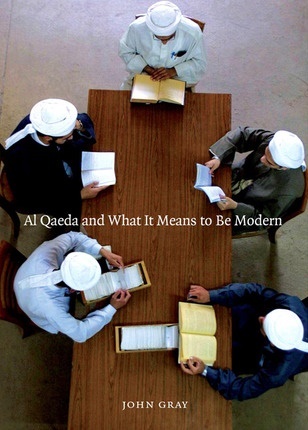
While many Americans view the September 11th terrorist attack as the act of an anachronistic and dangerous sect, one that champions medieval and outmoded ideals, John Gray here argues that in fact the ideology of Al Qaeda is both Western and modern, a by-product of globalization’s transnational capital flows and open borders. Indeed, according to Gray, Al Qaeda’s utopian zeal to remake the world in its own image descends from the same Enlightenment creed that informed both the disastrous Soviet experiment and the new neoliberal dream of a global free market.In this “excellent short introduction to modern thought” (The Guardian), first published in 2003, Gray warns that the United States, once a champion of revolutionary economic and social change, must now understand its new foes. He also confronts some of the faults he perceives in Western ideology: the faith that global development will eradicate war and hunger, trust in technology to address the coming catastrophe of population explosion, and the belief that democracy is an infallible institution that can serve as political panacea for all.

The Immortalization Commission: Science and the Strange Quest to Cheat Death
by John Gray
Rating: 3.6 ⭐
At the heart of human experience lies an obsession with the nature of death. Religion, for most of history, has provided an explanation for human life and a vision of what comes after it. But in the late nineteenth and early twentieth centuries, such beliefs came under relentless pressure as new ideas—from psychiatry to evolution to communism—seemed to suggest that our fate was now in our own hands: humans could cease to be animals, defeat death, and become immortal.In The Immortalization Commission, the acclaimed political philosopher and critic John Gray takes a brilliant and frightening look at humankind’s dangerous striving toward a scientific version of immortality. Probing the parallel faiths of Bolshevik “God-builders,” who sought to reshape the planet and psychical researchers, who believed they had evidence of a nonreligious form of life after death, Gray raises fascinating questions about how such beliefs threaten the very nature of what it means to be human. He looks to philosophers, journalists, politicians, charlatans, and mass murderers who all felt driven by a specifically scientific and modern worldview and whose revolt against death resulted in a series of experiments that ravaged whole countries. An urgent examination of Darwin’s post-religious legacy, The Immortalization Commission is an important work from “one of Britain’s leading public intellectuals” (The Wall Street Journal).

By the author of the best-selling Straw Dogs, this book is a characteristically trenchant and unflinchingly clear-sighted collection of reflections on our contemporary lot. Whether writing about the future of our species on this planet, the folly of our faith in technological progress, or the self-deceptions of the liberal establishment, John Gray dares to be heretical like few other thinkers today.

John Gray is one of the most original and iconoclastic thinkers of our time. In this pugnacious and readable collection of essays from across his career, he smashes through humanity's most cherished beliefs to overturn our view of the world, and our place in it.

Following on the heels of the widely hailed False Dawn, this new work by John Gray, "one of Britain’s leading intellectuals" (The Wall Street Journal), offers a thoughtful and provocative analysis of the failure of classical liberalism to keep up with the complex political realities of today’s increasingly divided world.Two Faces of Liberalism argues that, from its inception, liberalism contained two contradictory philosophies of tolerance. In one, it advanced the enlightenment project of a universal civilization. In the other, it framed terms for peaceful coexistence between warring communities and different ways of life. Each of these liberal ideals of toleration, developed when a single worldview dominated society, has many historic achievements to its credit. But how relevant is traditional liberalism in a world where Kosovo represents the collapse of the spirit of cohabitation?In a spirited attack on today’s liberal orthodoxies, Gray argues that establishing a modus vivendi between different cultures and regimes should be at the heart of contemporary liberalism. In this major contribution to political theory, Gray proposes a new framework for liberal thought that addresses these burning issues.

John Gray is the bestselling author of such books as Straw Dogs and Al Qaeda and What it Means to be Modern which brought a mainstream readership to a man who was already one of the UK's most well respected thinkers and political theorists. Gray wrote Enlightenment’s Wake in 1995 – six years after the fall of the Berlin Wall and six years before the terrorist attacks on the World Trade Center. Turning his back on neoliberalism at exactly the moment that its advocates were in their pomp, trumpeting 'the end of history' and the supposedly unstoppable spread of liberal values across the globe, Gray’s was a lone voice of scepticism. The thinking he criticised here would lead ultimately to the invasion of Iraq. Today, its folly might seem obvious to all, but as this edition of Enlightenment’s Wake shows, John Gray has been trying to warn us for some fifteen years – the rest of us are only now catching up with him.

Since the publication in 1986 of the first edition of Liberalism , both the world and the author’s views have changed significantly. In this new edition, John Gray argues that whereas liberalism was the political theory of modernity, it is ill-equipped to cope with the dilemmas of the postmodern condition. The task now, as Gray sees it, is to develop a pluralist theory, in which the liberal problem of finding a modus vivendi among rival communities and worldviews is solved in postliberal terms. Copublished with Open University Press

In 1921, at the age of eleven, Isaiah Berlin arrived in England from Riga, Latvia. By the time he was thirty he was at the heart of British intellectual life. He has remained its commanding presence ever since, and few would dispute that he was one of Britain's greatest thinkers. His reputation extends worldwide--as a great conversationalist, intellectual historian, and man of letters. He has been called the century's most inspired reader.Yet Berlin's contributions to thought--in particular to moral and political philosophy, and to liberal theory--are little understood, and surprisingly neglected by the academic world. In this book, they are shown to be animated by a single, powerful, subversive value-pluralism which affirms the reality of a deep conflict between ultimate human values that reason cannot resolve. Though bracingly clear-headed, humane and realist, Berlin's value-pluralism runs against the dominant Western traditions, secular and religious, which avow an ultimate harmony of values. It supports a highly distinctive restatement of liberalism in Berlin's work--an agnostic liberalism, which is founded not on rational choice but on the radical choices we make when faced with intractable dilemmas. It is this new statement of liberalism, the central subject of John Gray's lively and lucid book, which gives the liberal intellectual tradition a new lease on life, a new source of life, and which comprises Berlin's central and enduring legacy.

Not available since the 1980s, this up-dated edition by the leading political philosopher, John Gray, outlines his new position on Hayek. In a substantial new chapter, Gray assesses how far the historical development of the last ten years can be deployed in a critique of Hayek's thought. His reassessment is not only a provoking study of a classical philosopher. It is also a timely contribution to the debate over the future of conservatism, as Gray argues that Hayekian liberalism - 'the most well-articulated political theory of the new right' - is flawed.

Written for the general reader, this work is the 3rd batch of 6 books in this series on the "Greatest Philosophers", by acclaimed specialists. From Aristotle to Wittgenstein, from Democritus to Derrida, this series provides a survey of most of the philosophers. Each volume is briefed to address the adventurous non-specialist reader.

Now available in paperback, this second edition reproduces the text of the first with the addition of an extensive postscript which defends the interpretation of Mill set out in the first edition.

John Gray has become one of our liveliest and most influential political philosophers. This current volume is a sequel to his Essays in Political Philosophy . The earlier book ended on a sceptical note, both in respect of what a post-liberal political philosophy might look like, and with respect to the claims of political philosophy itself.John Gray's new book gives post-liberal theory a more definite content. It does so by considering particular thinkers in the history of political thought, by criticizing the conventional wisdom, liberal and socialist, of the Western academic class, and most directly by specifying what remains of value in liberalism. The upshot of this line of thought is that we need not regret the failure of foundationalist liberalism, since we have all we need in the historic inheritance of the institutions of civil society. It is to the practice of liberty that these institutions encompass, rather than to empty liberal theory, that we should repair.

In this book John Gray argues that we live in a time of endings for the ideologies that governed the modern period. The Enlightenment projects of universal emancipation animates all the political doctrines and movements that are central in contemporary western societies. Yet it does not reflect the reality of the plural world in which we live. The western cultural hegemony which the Enlightenment embodied is coming to a close. Western liberal societies are not precursors of a universal civilization, but only one form of life among many in the late modern world.Our inherited stock of political ideas no longer tracks that world. The crisis of New Right thought is as profound as that of the Left. Green theorists and communitarian thinkers have not understood the deep diversity and intractable conflicts of contemporary societies. And postmodernists, whose thought is ruled by the dated utopias of the modern period, do not engage with the real conditions of the world's emerging postmodern societies. Late modern thought occurs in an interregnum between modern projects that are no longer credible and postmodern realities that many find intolerable.John Gray suggests that some Enlightenment hopes of progress must be extinguished if we are to learn to respect cultural diversity and accept ecological limits. Respect for the Earth and for other species and cultures means abandoning the utopian and arcadian projects that haunt modern thought. We should aim to moderate the impact of human activity on the Earth while alleviating the unavoidable evils of human life. Yet the hubris which treats the Earth as an instrument of human purposes, and which regards other cultures as approximations to a universal civilization, embodies ancient and powerful traditions. John Gray's aim is to question these traditions and thereby to prepare our thinking for a time of beginnings.

A radical critique of New Right ideology and politics from a leading light of resurgent traditional conservatism.

Gives a coherent and comprehensive analytical guide to liberal thinking over the past century and considers its dominance in Anglo-American political philosophy over the past twenty years.

Tecnología, progreso y el impacto humano sobre la Tierra: "Cualquier proyecto basado en la expectativa de alcanzar la armonía o el consenso es ...
by John Gray
Rating: 3.6 ⭐
En coedición con el Centro de Cultura Contemporánea de Barcelona, CCCB "Creo que el progreso es real en la técnica y en la tecnología. En la ética y en la política, sin embargo, pienso que el progreso en el sentido de un avance acumulativo, paso a paso y fase tras fase, es en el fondo un mito o una ilusión. De modo que los males que pensamos haber abolido en un determinado momento regresan. Y el mejor ejemplo que puedo dar de ello quizá sea el de la tortura. No hay triunfo que no pueda perderse ni victoria que, con el tiempo, no acabe perdiéndose." El libro incluye dos textos : una conferencia, pronunciada en Barcelona en 2007, y una entrevista realizada al autor por Daniel Gamper, también en 2007


Published to coincide with the Conservative Party conference, Gray and Willetts comment on a highly topi cal subject following the election and the splits that run d eep within the Conservative party '


Reklam, en geniş tanımıyla üreticilerin tüketicilerle kendi ürünleri hakkında iletişim kurma yoludur. Tıpkı politikacıların seçmenle iletişim kurmak ve seçmeni kendilerine oy vermeye ikna etmek için siyasi parti yayınlarını ve diğer platformları kullanmaları veya vaizlerin minberlerini ve yazılı kaynaklarını, cemaatlarini kendi dinlerinin veya mezheplerinin inançlarına bağlamak için kullanmaları gibi, üreticiler de tüketiciyi kendi ürünlerini almaya teşvik etmek için reklamları kullanırlar. Siyasi, sanatsal, dini ve ticari iletişim şekilleri çağdaş liberal demokrasilerde -şartların zorunlu kıldığı- bazı belirli kısıtlamalar dışında 'ifade özgürlüğü'nü oluştururlar." Digby Anderson Social Affairs Unite Direktörü.

John N. Gray