
Bruno Maçães
7 Books Written

Popular consensus says that the US rose over two centuries to Cold War victory and world domination, and is now in slow decline. But is this right? History's great civilizations have always lasted much longer, and for all its colossal power, American culture was overshadowed by Europe until recently. What if this isn't the end?In History Has Begun , Bruno Maçães offers a compelling vision of America's future, both fascinating and unnerving. From the early American Republic, he takes us to the turbulent present, when, he argues, America is finally forging its own path. We can see the birth pangs of this new civilization in today's debates on guns, religion, foreign policy and the significance of Trump. Should the coronavirus pandemic be regarded as an opportunity to build a new kind of society? What will its values be, and what will this new America look like? Maçães traces the long arc of US history to argue that in contrast to those who see the US on the cusp of decline, it may well be simply shifting to a new model, one equally powerful but no longer liberal. Consequently, it is no longer enough to analyze America's current trajectory through the simple prism of decline vs. progress, which assumes a static model-America as liberal leviathan. Rather, Maçães argues that America may be casting off the liberalism that has defined the country since its founding for a new model, one more appropriate to succeeding in a transformed world.

1st edn 1st printing. 8vo. Original black lettered grey cloth (Fine), dustwrapper (VG in protective cover, not price clipped). Pp. xix + 281, illus with b&w photos and maps (no inscriptions).

China's Belt and Road strategy is acknowledged to be the most ambitious geopolitical initiative of the age. Covering almost seventy countries by land and sea, it will affect every element of global society, from shipping to agriculture, digital economy to tourism, politics to culture. Most importantly, it symbolizes a new phase in China's ambitions as a superpower: to remake the world economy and crown Beijing as the new center of capitalism and globalization.Bruno Maçães traces this extraordinary initiative's history, highlighting its achievements to date, and its staggering complexity. He asks whether Belt and Road is about more than power projection and profit. Might it herald a new set of universal political values, to rival those of the West? Is it, in fact, the story of the century?

A sharp vision of our changing world order as Covid and climate breakdown usher in a new ‘survival of the fittest’.How well have different cultures and societies responded, and could this become a turning point in the flow of history?Before Covid, a new competition was already arising between alternative geopolitical models–but the context of this clash wasn’t yet clear. What if it takes place on neutral ground? In a state of nature, with few or no political rules, amid quickly evolving chaos? When the greatest threat to national security is no longer other states, but the environment itself, which countries might rise to the top?This book explores how Covid-19 has already transformed the global system, and how it serves as a prelude to a planet afflicted by climate change. Bruno Maçães is one of the first to see the pandemic as the dawn of a new strategic era, heralding a profoundly changed world-political landscape.

World politics has changed, claims Bruno Maçães. Geopolitics is no longer simply a contest to control territory; in this age of advanced technology, it has become a contest to create the territory. Great powers seek to build a world for other states to inhabit, while keeping the ability to change the rules or the state of the world when necessary. At a moment when the old concepts no longer work, this book aims to introduce a radically new theory of world politics and technology. Understood as 'world building', the most important events of our troubled times suddenly appear connected and their inner logic is revealed; technology wars between China and the United States, the pandemic, the wars in Ukraine and the Middle East, and the energy transition. To conclude, Maçães considers the more distant future, when the metaverse and artificial intelligence become the world, a world the great powers must struggle to build and control.

The problems that the eurozone is facing are all of its own making. Not only did the common currency deprive European nations of the ability to adjust to economic shocks, the euro was itself the shock to which it could not respond. Countries on the periphery had access to cheaper credit than they had experienced in living memory, contributing to fiscal imbalances and growing public debt. The current crisis has shown the impracticability of an economic and monetary union in Europe without the essential institutions of a banking or financial union. As the recent cases of Spain and Cyprus already indicate, a banking union will draw on the widespread political reluctance to support euro area bailouts for banks. Electorates in Europe will find it even more difficult to bail out a foreign bank, so we may well expect that a common resolution regime will rest on the “bailing in” of bank creditors. The feedback loop linking banks and states is not broken from above, but from below, by imposing losses on investors and unsecured bank creditors.
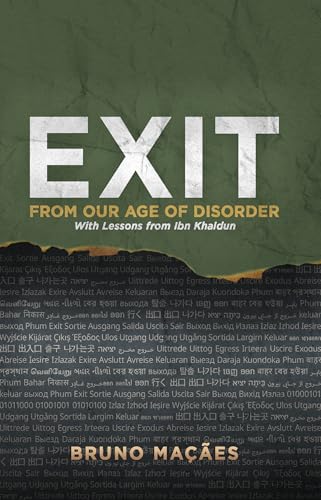
From the celebrated author and politician Bruno Maçães, Exit explores the breakdown of the existing global order. Starting from the insights of historian and philosopher Ibn Khaldun, Exit explores how that breakdown is expressed in growing conflict, destruction and intellectual confusion. It offers a guide into how to approach the transition to a new kind of order, and the hard task of building it from the ruins of the present.Exit also serves as one of first works of the newly founded Ibn Khaldun Institute. Ibn Khaldun, (Abu Zayd Abd ar-Rahman ibn Muhammad ibn Khaldun), was one of the most prominent historians, philosophers, and scholars of the Middle Ages. He was born in May 1332, in Tunis, and passed away in March 1406, in Cairo.Ibn Khaldun is best known for his ground-breaking work, "Muqaddimah" (also known as "The Introduction" or "Prolegomena"). With a multidisciplinary approach to the study of societies, Ibn Khaldun developed his ‘new science’ (umrān) – a positive rather than a normative study of state and society as they are, rather than as they should be. This methodology allowed him to identify and characterise sociological and economic phenomena centuries before these ideas were developed in the West. He developed the concept of ʿasabiyyah – the importance of social cohesion in avoiding civilisational decline. Above all, his elegant contributions to economics included some of the earliest known descriptions of the multiplier effect, human capital, the effect of technological improvements on growth, supply side-economics and the Laffer Curve.Ibn Khaldun Institute is committed to preserving, promoting, and perpetuating the legacy of Ibn Khaldun, transforming his ideas into a powerful force for positive change and a source of inspiration for generations to come. Together, we strive to create a global community that values the wisdom and vision of this exceptional scholar, characterized by the defense of free trade, property rights and the rule of law.You may learn more at ibnkhaldun.com.