
Daron Acemoğlu
Daron Acemoglu is the Elizabeth and James Killian Professor of Economics at the Massachusetts Institute of Technology. In 2005 he won the prestigious John Bates Clark medal, awarded to the best economist under 40.
26 Books Written

Why Nations Fail: The Origins of Power, Prosperity, and Poverty
by Daron Acemoğlu
Rating: 4.1 ⭐
• 4 recommendations ❤️
WHY ARE SOME NATIONS RICH AND OTHERS POOR, DIVIDED BY WEALTH AND POVERTY, HEALTH AND SICKNESS, FOOD AND FAMINE? Is it culture, the weather, geography that determines prosperity or poverty? As Why Nations Fail shows, none of these factors is either definitive or destiny. Drawing on fifteen years of original research, Daron Acemoglu and James Robinson conclusively show that it is man-made political and economic institutions that underlie economic success (or lack of it). Korea, to take one example, is a remarkably homogeneous nation, yet the people of North Korea are among the poorest on earth while their brothers and sisters in South Korea are among the richest. The differences between the Koreas is due to the politics that created those two different institutional trajectories. Acemoglu and Robinson marshal extraordinary historical evidence from the Roman Empire, the Mayan city-states, the Soviet Union, the United States, and Africa to build a new theory of political economy with great relevance for the big questions of today, among them: - Will China's economy continue to grow at such a high speed and ultimately overwhelm the West? - Are America’s best days behind it? Are we creating a vicious cycle that enriches and empowers a a small minority?

The Narrow Corridor: States, Societies, and the Fate of Liberty
by Daron Acemoğlu
Rating: 4.2 ⭐
• 4 recommendations ❤️
From the authors of the international bestseller Why Nations Fail, a crucial new big-picture framework that answers the question of how liberty flourishes in some states but falls to authoritarianism or anarchy in others--and explains how it can continue to thrive despite new threats.Liberty is hardly the "natural" order of things. In most places and at most times, the strong have dominated the weak and human freedom has been quashed by force or by customs and norms. Either states have been too weak to protect individuals from these threats or states have been too strong for people to protect themselves from despotism. Liberty emerges only when a delicate and precarious balance is struck between state and society.There is a happy Western myth that political liberty is a durable construct, a steady state, arrived at by a process of "enlightenment." This static view is a fantasy, the authors argue; rather, the space to attain and maintain liberty stays open only via a fundamental and incessant struggle between state and society. The power of state institutions and the elites that control them has never gone uncontested in a free society. In fact, the capacity to contest them is the definition of liberty. State institutions have to evolve continuously as the nature of conflicts and needs of the society change, and thus society's ability to keep state and rulers accountable must intensify in tandem with the capabilities of the state. This struggle between state and society becomes self-reinforcing, inducing both to develop a richer array of capacities just to keep moving forward along the corridor. Yet this struggle also underscores the fragile nature of liberty. It is built on a delicate balance between state and society, between economic, political and social elites and citizens, between institutions and norms. One side of the balance gets too strong, and as it has often happened in history, liberty begins to wane. Liberty depends on the vigilant mobilization of society. But it also needs state institutions to continuously reinvent themselves in order to meet new economic and social challenges that can easily close the space liberty needs to survive.Today we are in the midst of a time of wrenching destabilization. We need liberty more than ever, and yet the corridor to liberty is getting narrower and more treacherous. The danger on the horizon is not "just" the loss of our political freedom, however grim that is in itself; it is also to the prosperity and safety that critically depend on liberty. The opposite of the corridor of liberty is the road to ruin.

Power and Progress: Our Thousand-Year Struggle Over Technology and Prosperity
by Daron Acemoğlu
Rating: 3.9 ⭐
The bestselling co-author of Why Nations Fail and the bestselling co-author of 13 Bankers deliver a bold reinterpretation of economics and history that will fundamentally change how you see the world A thousand years of history and contemporary evidence make one thing clear. Progress depends on the choices we make about technology. New ways of organizing production and communication can either serve the narrow interests of an elite or become the foundation for widespread prosperity. The wealth generated by technological improvements in agriculture during the European Middle Ages was captured by the nobility and used to build grand cathedrals while peasants remained on the edge of starvation. The first hundred years of industrialization in England delivered stagnant incomes for working people. And throughout the world today, digital technologies and artificial intelligence undermine jobs and democracy through excessive automation, massive data collection, and intrusive surveillance. It doesn’t have to be this way. Power and Progress demonstrates that the path of technology was once—and may again be—brought under control. The tremendous computing advances of the last half century can become empowering and democratizing tools, but not if all major decisions remain in the hands of a few hubristic tech leaders. With their breakthrough economic theory and manifesto for a better society, Acemoglu and Johnson provide the vision needed to reshape how we innovate and who really gains from technological advances.
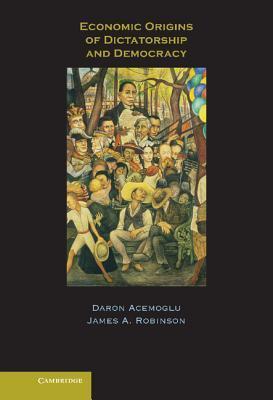
What forces lead to democracy's creation? Why does it sometimes consolidate only to collapse at other times? Written by two of the foremost authorities on this subject in the world, this volume develops a framework for analyzing the creation and consolidation of democracy. It revolutionizes scholarship on the factors underlying government and popular movements toward democracy or dictatorship. Daron Acemoglu and James Robinson argue that different social groups prefer different political institutions because of the way they allocate political power and resources. Their book, the subject of a four-day seminar at Harvard's Center for Basic Research in the Social Sciences, was also the basis for the Walras-Bowley lecture at the joint meetings of the European Economic Association and Econometric Society in 2003 and is the winner of the John Bates Clark Medal. Daron Acemoglu is Charles P. Kindleberger Professor of Applied Economics at The Massachusetts Institute of Technology. He received the 2005 John Bates Clark Medal awarded by the American Economic Association as the best economist working in the United States under age 40. He is the author of the forthcoming text Introduction to Modern Economic Growth. James A. Robinson is Professor of Government at Harvard University. He is a Harvard Faculty Associate at the Weatherhead Center for International Affairs and a member of the Canadian Institute for Advanced Research’s Program on Institutions, Organizations, and Growth. He is coeditor with Jared Diamond of the forthcoming book Natural Experiments in History.

Introduction to Modern Economic Growth is a groundbreaking text from one of today's leading economists. Daron Acemoglu gives graduate students not only the tools to analyze growth and related macroeconomic problems, but also the broad perspective needed to apply those tools to the big-picture questions of growth and divergence. And he introduces the economic and mathematical foundations of modern growth theory and macroeconomics in a rigorous but easy to follow manner.After covering the necessary background on dynamic general equilibrium and dynamic optimization, the book presents the basic workhorse models of growth and takes students to the frontier areas of growth theory, including models of human capital, endogenous technological change, technology transfer, international trade, economic development, and political economy. The book integrates these theories with data and shows how theoretical approaches can lead to better perspectives on the fundamental causes of economic growth and the wealth of nations.Innovative and authoritative, this book is likely to shape how economic growth is taught and learned for years to come.

You are purchasing a standalone product; MyEconLab does not come packaged with this content. If you would like to purchase both the physical text and MyEconLab, search for 0133578038 / 9780133578034. That package includes 0321391578 / 9780321391575 and 0133498948 / 9780133498943.MyEconLab should only be purchased when required by an instructor. -- For courses in Principles of MicroeconomicsAcemoglu, Laibson, An evidence-based approach to economicsThroughout Microeconomics , authors Daron Acemoglu, David Laibson, and John List use real economic questions and data to help students learn about the world around them.Taking a fresh approach, the authors use the themes of optimization, equilibrium and empiricism to illustrate the power of simple economic ideas, and their ability to explain, predict, and improve what happens in the world. Each chapter begins with an empirical question that is later answered using data in the Evidence-Based Economics feature. As a result of the text’s practical emphasis, students will learn to apply economic principles to guide the decisions they make in their own lives.Also available with MyEconLab®This title is also available with MyEconLab — an online homework, tutorial, and assessment program designed to work with this text to engage students and improve results. Within its structured environment, students practice what they learn, test their understanding, and pursue a personalized study plan that helps them better absorb course material and understand difficult concepts. Students, if interested in purchasing this title with MyEconLab, ask your instructor for the correct package ISBN and Course ID. Instructors, contact your Pearson representative for more information.

En este libro, pensado para un primer curso de economía, Daron Acemoglu, David Laibson y John List utilizan problemas económicos y datos reales para ayudar a los estudiantes a aprender sobre el mundo que los rodea. Adoptando una perspectiva fresca y novedosa, los autores nos muestran la enorme capacidad de las ideas económicas básicas para explicar, predecir y mejorar lo que ocurre en el mundo. Cada capítulo se abre planteando una pregunta a los estudiantes, que es contestada mediante datos reales en el apartado “Economía basada en la evidencia”, que cierra cada unidad. Como resultado del énfasis que hace el texto en los aspectos prácticos de la disciplina, los estudiantes aprenden a ver los principios económicos más allá del contexto del aula, e incluso a aplicarlos a las decisiones que deben tomar en su día a día. Economía es un libro profusamente ilustrado, con un planteamiento didáctico, ameno y riguroso, conectado con el mundo actual. “Nos encanta la economía. Nos maravilla cómo funcionan los sistemas económicos. Cuando compramos un smartphone, pensamos en los cientos de miles de personas que intervinieron en la producción de esa increíble pieza de tecnología, ensamblada a partir de componentes de todo el mundo. Escribimos este libro para mostrar la simplicidad de las ideas económicas y su extraordinaria capacidad para explicar, predecir y mejorar lo que pasa en el mundo. Queremos que los estudiantes dominen los principios esenciales del análisis económico. Con ese propósito, identificamos las tres ideas clave para comprender el comportamiento humano desde una perspectiva económica: la optimización, el equilibrio y el empirismo. Estos conceptos abstractos son, en realidad, muy intuitivos.”

A look at how new technologies can be put to use in the creation of a more just society.Artificial Intelligence (AI) is not likely to make humans redundant. Nor will it create superintelligence anytime soon. But it will make huge advances in the next two decades, revolutionizing medicine, entertainment, and transport, transforming jobs and markets, and vastly increasing the amount of information that governments and companies have about individuals.AI for Good leads off with economist and best-selling author Daron Acemoglu, who argues that there are reasons to be concerned about these developments. AI research today pays too much attention to the technological hurdles ahead, without enough attention to its disruptive effects on the fabric of society: displacing workers while failing to create new opportunities for them and threatening to undermine democratic governance itself.Yet the direction of AI development is not preordained. Acemoglu argues for AI's potential to create shared prosperity and bolster democratic freedoms. But directing it to that task will take great effort. It will require new funding and regulation, new norms and priorities for developers themselves, and regulations of new technologies and their applications.At the intersection of technology and economic justice, this book brings together experts—economists, legal scholars, policy makers, and developers—to debate these challenges and consider what steps tech companies can do take to ensure the advancement of AI does not further diminish economic prospects of the most vulnerable groups of population.
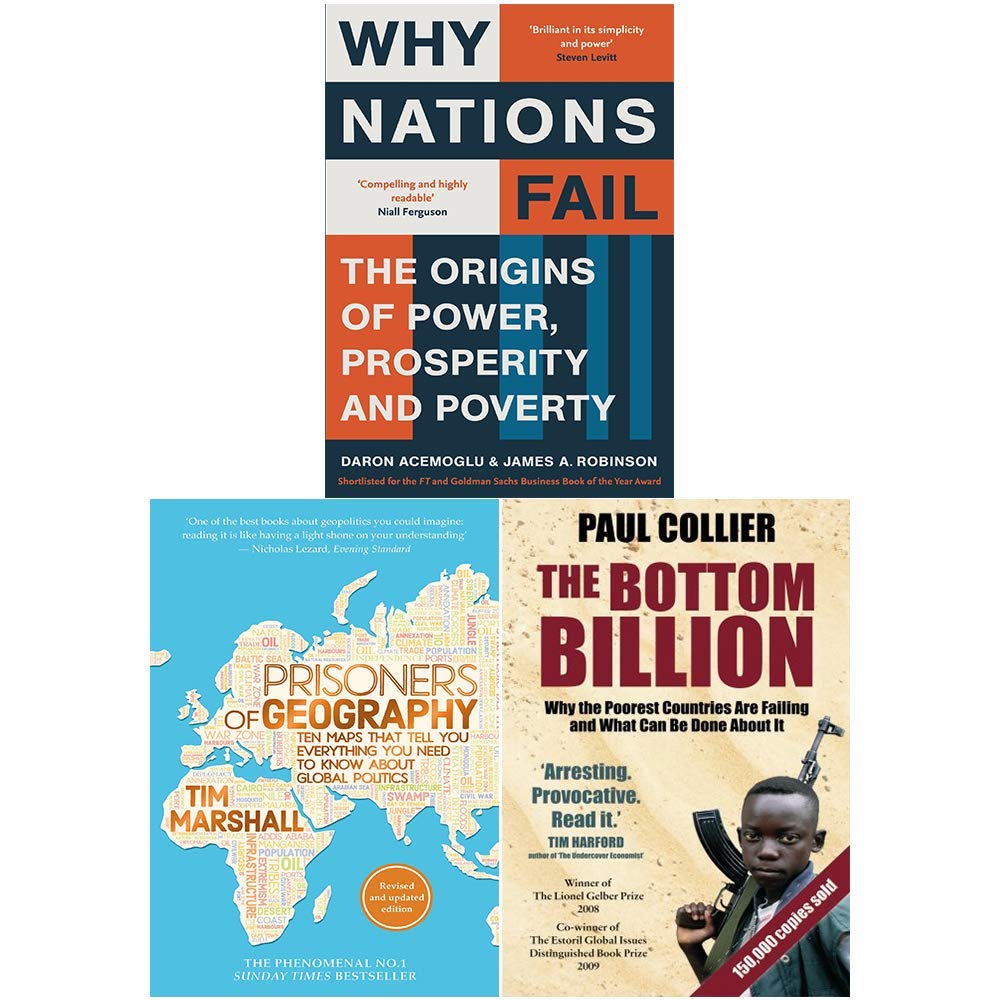
Why Nations Fail, Prisoners of Geography, The Bottom Billion 3 Books Collection Set
by Daron Acemoğlu
Rating: 4.3 ⭐

NOTE: This edition features the same content as the traditional text in a convenient, three-hole-punched, loose-leaf version. Student Value Editions also offer a great value; this format costs significantly less than a new textbook. Before purchasing, check with your instructor or review your course syllabus to ensure that you select the correct ISBN. Several versions of MyLab (TM) and Mastering (TM) platforms exist for each title, including customized versions for individual schools, and registrations are not transferable. In addition, you may need a Course ID, provided by your instructor, to register for and use MyLab and Mastering platforms. For courses in Principles of Macroeconomics. An evidence-based approach to economics Throughout Macroeconomics, 2nd Edition, authors Daron Acemoglu, David Laibson, and John List use real economic questions and data to help readers learn about the world around them. Taking a fresh approach, they use the themes of optimization, equilibrium, and empiricism to not only illustrate the power of simple economic ideas, but also to explain and predict what's happening in today's society. Each chapter begins with an empirical question that is relevant to the life of the reader, and is later answered using data in the Evidence-Based Economics feature. As a result of the text's practical emphasis, readers will learn to apply economic principles to guide the decisions they make in their own lives. Also available with MyLab Economics MyLab(TM) Economics is an online homework, tutorial, and assessment program designed to work with this text to engage students and improve results. Within its structured environment, students practice what they learn, test their understanding, and pursue a personalized study plan that helps them better absorb course material and understand difficult concepts. Learn more. Note: You are purchasing a standalone product; MyLab Economics does not come packaged with this content. Students, if interested in purchasing this title with MyLab Economics, ask your instructor for the correct package ISBN and Course ID. Instructors, contact your Pearson representative for more information. If you would like to purchase both the loose-leaf version of the text and MyLab Economics, search for: 0134641914 / 9780134641911 Macroeconomics, Student Value Edition Plus MyLab Economics with Pearson eText -- Access Card Package Package consists of: 0134461851 / 9780134461854 Macroeconomics, Student Value Edition013451906X / 9780134519067 MyLab Economics with Pearson eText -- Access Card -- for Macroeconomics

Wieso unterwerfen wir uns den Zielen von Technologieführern, die wir nicht gewählt haben, und denken, dabei handele es sich um Fortschritt?, fragen die zwei MIT-Professoren und Bestsellerautoren Daron Acemoglu und Simon Johnson. Die verbesserte Landwirtschaft im Mittelalter, später die industrielle Revolution und heute die künstliche Intelligenz - im Laufe der Geschichte wurde der technologische Wandel stets als Haupttriebkraft für das Gemeinwohl angesehen. Doch die Fortschrittsgewinne fallen nur wenigen zu, und die Technologie ist von den Zielen und Obsessionen der Mächtigen geprägt und verhilft ihnen zu noch mehr Reichtum, sozialem Ansehen und Einfluss.Wie kann echter Fortschritt, wie kann gerechtere Innovation gelingen?Hier kommen die Antworten.


Economía versus política: Peligros de las medidas que los economistas aconsejan a los políticos
by Daron Acemoğlu
Rating: 3.6 ⭐

Libro usado en buenas condiciones, por su antiguedad podria contener señales normales de uso

Outre les concepts et mécanismes fondamentaux de l’économie comme les incitations, la main invisible, la théorie des jeux, la comptabilité nationale, le fonctionnement du marché du travail, les politiques contracycliques, etc., cet ouvrage offre des développements sur des sujets particulièrement actuels

Pouvoir et Progrès: Technologie et prospérité, notre combat millénaire
by Daron Acemoğlu
Rating: 3.5 ⭐
Révolution agricole ou industrielle, intelligence artificielle, ordinateur quantique... autant de promesses d'une prospérité qui devrait naturellement ruisseler. La réalité est tout autre : la technologie est façonnée et confisquée par des élites qui assurent le maintien de l'ordre établi, de leur domination intellectuelle et de leur pouvoir politique. Pour le commun des mortels, le progrès n’est qu’un mirage, ou un vaste « enfumage ».Dans cet essai aussi engagé que documenté, les économistes Daron Acemoglu et Simon Johnson démontent point par point la logique des grappes d’innovation chère à Schumpeter et la théorie néolibérale du ruissellement. Au terme de ce passionnant voyage à travers mille ans d’inventions peuplés de visionnaires (Ferdinand de Lesseps, Thomas Edison, Elon Musk...), vous ne pourrez plus dire que vous ne saviez pas, retranché derrière votre iPhone.Après la parenthèse des Trente Glorieuses, les 40 dernières années n’ont fait que creuser des inégalités déjà criantes à coups de plateformisation, de délocalisation et de sape systématique des contre-pouvoirs. Les auteurs montrent qu’il est possible de rebattre les cartes, avec un peu de volonté politique et un minimum d’organisation de la société civile. Le combat est loin d’être perdu. Encore faut-il être conscient du danger et lutter contre une vision du progrès qui divise, isole et précarise jusqu’à ce que mort (sociale) s’ensuive.Un manifeste constructif pour une croissance partagée qui concilie progrès, confort et reconnaissance de la valeur de chacun.

Il manuale è pensato per tutti gli studenti che frequentano un primo corso di economia politica. Spesso i ragazzi hanno l’impressione che l’economia consista in una serie di modelli e affermazioni teoriche con scarse basi empiriche. L’approccio evidence based degli autori vuole ribaltare questa impressione: usando i dati, gli autori spiegano in che modo gli economisti valutano e migliorano le intuizioni della scienza economica; i dati, inoltre, rendono i concetti più facili da ricordare. L’uso dell’evidenza empirica aiuta gli studenti a sviluppare l’intuizione, perché i dati spostano il discorso da principi astratti a fatti concreti. Ogni capitolo è una dimostrazione del ruolo chiave che l’evidenza empirica gioca nell’avanzamento della scienza economica.

Gleichgewicht der Macht: Der ewige Kampf zwischen Staat und Gesellschaft | Ausgezeichnet mit dem Wirtschaftsnobelpreis 2024
by Daron Acemoğlu
Rating: 5.0 ⭐
Wie viel Staat muss sein? Nach dem internationalen Bestseller »Warum Nationen scheitern?« widmen sich Starökonom Daron Acemoglu und Harvard-Politologe James A. Robinson in ihrem neuen Buch dieser fundamentalen Frage.Auseinandersetzungen zwischen rivalisierenden Milizen in Libyen, Einschränkung der Presse- und Demonstrationsfreiheit in der Türkei, Umerziehungslager in Nordkorea. Gegenwärtig erleben wir viele Staaten als sie sind entweder gescheitert, überreguliert oder despotisch. Aber wie viel Staat ist denn eigentlich notwendig? Die Autoren geben hierauf eine überraschende und provokante Antwort. Anhand zahlreicher historischer und aktueller Beispiele – vom antiken Griechenland über Deutschland im Nationalsozialismus bis zum heutigen China – zeigen Wohlstand, Sicherheit und Freiheit sind in hohem Maße von dem richtigen Rahmen abhängig, in dem der ewige Kampf um Macht zwischen Staat und Gesellschaft ausgetragen wird. Eine überzeugende Analyse, die Ein starker Staat und eine starke Gesellschaft sind kein Widerspruch, sondern bedingen sich gegenseitig.

Macroeconomics Plus MyLab Economics with Pearson eText -- Access Card Package
by Daron Acemoğlu
Rating: 5.0 ⭐
Before purchasing, check with your instructor to ensure you select the correct ISBN. Several versions of MyLab™ and Mastering™ platforms exist for each title, and registrations are not transferable. To register for and use MyLab or Mastering platforms, you may also need a Course ID, which your instructor will provide. Used books, rentals, and purchases made outside of Pearson If purchasing or renting from companies other than Pearson, the access codes for MyLab or Mastering platforms may not be included, may be incorrect, or may be previously redeemed. Check with the seller before completing your purchase. For courses in Principles of Macroeconomics. This package includes MyLab Economics. An evidence-based approach to economics Throughout Macroeconomics , 2nd Edition, authors Daron Acemoglu, David Laibson, and John List use real economic questions and data to help readers learn about the world around them. Taking a fresh approach, they use the themes of optimization, equilibrium, and empiricism to not only illustrate the power of simple economic ideas, but also to explain and predict what’s happening in today’s society. Each chapter begins with an empirical question that is relevant to the life of the reader, and is later answered using data in the Evidence-Based Economics feature. As a result of the text’s practical emphasis, readers will learn to apply economic principles to guide the decisions they make in their own lives. Personalize learning with MyLab Economics MyLab™ Economics is an online homework, tutorial, and assessment program designed to work with this text to engage students and improve results. Within its structured environment, students practice what they learn, test their understanding, and pursue a personalized study plan that helps them better absorb course material and understand difficult concepts. 0134641477 / 9780134641478 Macroeconomics Plus MyLab Economics with Pearson eText -- Access Card Package, 2/e Package consists

Microeconomics plus Pearson MyLab Economic with Pearson eText, Global Edition
by Daron Acemoğlu
Rating: 4.0 ⭐
Forcourses in the principles of microeconomics. Anevidence-based approach to economicsThroughout Microeconomics , 3rd Edition, authors DaronAcemoglu, David Laibson, and John List use real economic questions anddata to help you learn about the world around you. Taking a freshapproach, they use the themes of optimization, equilibrium, and empiricism tonot only illustrate the power of simple economic ideas, but also to explain andpredict what’s happening in today’s society. Each chapter begins with anempirical question that is relevant to the life of the reader, and islater answered using data in the Evidence-Based Economics feature. As a resultof the text’s practical emphasis, you learn to apply economicprinciples to guide the decisions you make in your own dailylife.

The Colonial Origins of Comparative Development: An Empirical Investigation
by Daron Acemoğlu
Rating: 3.0 ⭐
We exploit differences in European mortality rates to estimate the effect of institutions on economic performance. Europeans adopted very different colonization policies in different colonies, with different associated institutions. In places where Europeans faced high mortality rates, they could not settle and were more likely to set up extractive institutions. These institutions persisted to the present. Exploiting differences in European mortality rates as an instrument for current institutions, we estimate large effects of institutions on income per capita. Once the effect of institutions is controlled for, countries in Africa or those closer to the equator do not have lower incomes.

經濟長久繁榮的關鍵,竟然是政治!問世十年後,仍是解釋力最強的經典之作窮國之所以窮,不是因為地理或文化,而是制度選擇的結果!『應該列為政治人物及所有關心經濟發展的人的必讀書目。』────賈德.戴蒙,《槍炮、病菌與鋼鐵》作者為什麼有些國家十分富裕,有些國家卻異常貧困?帶來繁榮富裕的根本原因是什麼?富裕的社會能夠一直繁榮下去嗎?作者的研究顯示,窮國之所以貧窮,不是由於命定的地理因素,也不是因為傳統文化作祟,繁榮富裕的關鍵在於社會選擇採行何種政治經濟制度。一個社會若能將經濟機會與經濟利益開放給更多人分享、致力於保護個人權益,並且在政治上廣泛分配權力、建立制衡並鼓勵多元思想,作者稱為「廣納型制度」,國家就會邁向繁榮富裕。反之,經濟利益與政治權力若只由少數特權菁英把持,作者稱為「榨取型制度」,則國家必然走向衰敗,即使短期之內出現經濟成長,卻必定無法持續。數千年的全球歷史說明了,制度可以往更具廣納性的方向移動,也可能會倒退回較具榨取性的狀態,淺層的民主也可能被綁架成為實質的權貴政治。作者將備受推崇的多年學術成果,化為架構完整順暢易讀的一般讀物。他們以全球史為素材,運用嚴謹的經濟&#

Введение в теорию современного экономического роста. Книга 2
by Daron Acemoğlu
Введение в теорию экономического роста — новаторский учебник одного из ведущих современных макроэкономистов. Дарон Асемоглу не только предоставляет студентам инструменты для анализа процесса экономического роста и связанных с ним макроэкономических задач, но и описывает широкий набор вопросов, понимание которых необходимо для применения этих инструментов в анализе современного мирового экономического роста и межстранового расхождения доходов. Автор описывает экономические и математические основания современной теории экономического роста на необходимом уровне строгости, но при этом в легко понятной форме.В первой части книги представлены базовые основы теории динамического общего равновесия и динамической оптимизации. Затем Д. Асемоглу описывает основные модели экономического роста и переходит к темам, лежащим на рубеже текущих исследований в теории экономического роста, включая модели накопления человеческого капитала, эндогенных технологических изменений, распространения и внедрения технологий, международной торговли, экономического развития и политической экономии. Книга объединяет эти теории с эмпирическими данными и показывает, как теоретические методы могут позволить лучше понять фундаментальные причины экономического роста и богатства народов.

macroeconomics
by Daron Acemoğlu
This book is a Custom edition for Gateway Community College.

Eine aufgabenorientierte Vorbereitung ist für das Bestehen vieler Prüfungen im Bereich der Wirtschaftswissenschaften unerlässlich. Auch das Übungsbuch zur Volkswirtschaftslehre in seiner 2. Auflage wird dabei helfen, Wissen aus Vorlesungen und Übungen zielgerichtet zu testen und zu vertiefen.Viele aus Klausuren bekannten Aufgabentypen werden berü Im Rahmen von Multiple-Choice-Kontrollfragen kann das Wissen getestet, anhand von einfachen Rechenaufgaben und komplexeren Textaufgaben Souveränität im Umgang mit dem Klausurstoff entwickelt werden. Die Lösungen zu allen Aufgaben am Ende jedes Kapitels stellen sicher, dass auch kontrolliert werden kann, ob der Weg der richtige ist.

Macroéconomie
by Daron Acemoğlu