
Elting E. Morison
Elting Elmore Morison was an author of non-fiction books, an essayist, a United States historian of technology, a military biographer, an MIT professor emeritus, the conceiver and founder of MIT's program in Science, Technology and Society (STS). Morison earned his BA (1932) and MA (1937) at Harvard University, where he served for two years as assistant dean. In 1946 he took a position at the Massachusetts Institute of Technology as an assistant professor of humanities in the Sloan School of Industrial Management. Apart from a six-year stint at Yale University as master of Timothy Dwight College, Morison taught at MIT until his retirement as the Killian Chair of the Humanities. He was the grand-nephew of George Shattuck Morison.
7 Books Written

Men, Machines, and Modern Times, though ultimately concerned with a positive alternative to an Orwellian 1984, offers an entertaining series of historical accounts taken from the nineteenth century to highlight a main theme: the nature of technological change, the fission brought about in society by such change, and society's reaction to that change. Beginning with a remarkable illustration of resistance to innovation in the U.S. Navy following an officer's discovery of a more accurate way to fire a gun at sea, Elting Morison goes on to narrate the strange history of the new model steamship, the Wapanoag, in the 1860s. He then continues with the difficulties confronting the introduction of the pasteurization process for milk; he traces the development of the Bessemer process; and finally, he considers the computer. While the discussions are liberally sprinkled with amusing examples and anecdotes, all are related to the more profound and current problem of how to organize and manage system of ideas, energies, and machinery so that it will conform to the human dimension.
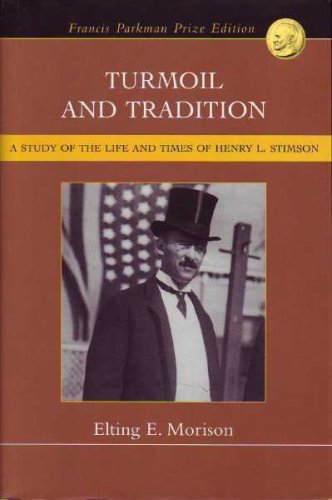
Turmoil and Tradition: A Study of the Life and Times of Henry L. Stimson
by Elting E. Morison
Rating: 3.5 ⭐
In Turmoil and Tradition Elting Morison has written a wise and subtle exploration of American life and society. Just as Lord David Cecil laid open an era in his Melbourne, just as Henry Adams in The Education exposed the mainsprings of his country and his age so Mr. Morison illuminates the history of a stirring half century in the biography of a man who was concerned in most of its key events.When Henry Lewis Stimson was born, Andrew Johnson was President of the United States; when he died, Harry S. Truman had been in the White House for five years.During those eighty-three years, America, broken loose from its past by the violence of the Civil War,changed spectacularly and chaotically. In this turbulent era Stimson, devoted as he was to principle and firm standards, was able both to resist the vulgarity and to accept the danger of his times. From his apprenticeship in the law under Elihu Root, Stimson was associated with great events and great men. He served the state under seven of the eight Presidents from Theodore Roosevelt to Harry S. Truman. He was Secretary of War, Secretary of State, Governor General of he Philippines, close contender for the governorship of New York, world statesman -- more than once, as Dwight D. Eisenhower has said of him, "an inspiration at a moment when all of the world seemed black."Elting Morison here not only tells the story of a great public servant; he explores the sources of Stimson's power in his traditions and training and he places him amongst the brilliant and varied men with whom his career was led: Theodore Roosevelt, William Howard Taft, Felix Frankfurter, Leonard Wood, Franklin D. Roosevelt, George C. Marshall, Ernest J. King, Cordell Hull -- these and many more great men engage in historic events in these pages.

On New Hampshire's thin, cold soil, strewn with rocks, generations of resourceful, tough, independent men and women created a landscape of meadows and pastures, of stone walls and weathered barns and clapboard houses, that has affected the American imagination. This is the story of a historically small and relatively poor state, which seems in our own time increasingly attractive to those who seek what the authors call a simple kind of life lost elsewhere. Posing questions about land use and balanced growth that are important to all Americans, the Morisons' account of New Hampshire and its fluctuating fortunes will fascinate both residents and those who only visit or dream of doing so.
1974 edition of the book in good condition.No marking or highlight, some time wear and tear.



The American Style
by Elting E. Morison