
Philip Mirowski
Philip Mirowski (born 21 August 1951, Jackson, Michigan) is a historian and philosopher of economic thought at the University of Notre Dame (Carl E. Koch Professor of Economics and Policy Studies and the History and Philosophy of Science). He received a PhD in Economics from the University of Michigan in 1979, and is a Director of the Reilly Center for Science, Technology, and Values.
17 Books Written

More Heat than Light: Economics as Social Physics, Physics as Nature's Economics
by Philip Mirowski
Rating: 4.1 ⭐
• 5 recommendations ❤️
This is a history of how physics has drawn some inspiration from economics and how economics has sought to emulate physics, especially with regard to the theory of value. The author traces the development of the energy concept in Western physics and its subsequent effect on the invention and promulgation of neoclassical economics, the modern orthodox theory.

Never Let a Serious Crisis Go to Waste: How Neoliberalism Survived the Financial Meltdown
by Philip Mirowski
Rating: 4.1 ⭐
At the onset of the Great Recession, as house prices sank and joblessness soared, many commentators concluded that the economic convictions behind the disaster would now be consigned to history. Yet in the harsh light of a new day, attacks against government intervention and the global drive for austerity are as strong as ever. Never Let a Serious Crisis Go to Waste is the definitive account of the wreckage of what passes for economic thought, and how neoliberal ideas were used to solve the very crisis they had created. Now updated with a new afterword, Philip Mirowski’s sharp and witty work provides a roadmap for those looking to escape today’s misguided economic dogma.

This is the first cross-over book in the history of science written by an historian of economics, combining a number of disciplinary and stylistic orientations. In it Philip Mirowshki shows how what is conventionally thought to be "history of technology" can be integrated with the history of economic ideas. His analysis combines Cold War history with the history of the postwar economics profession in America and later elsewhere, revealing that the Pax Americana had much to do with the content of such abstruse and formal doctrines such as linear programming and game theory. He links the literature on "cyborg science" found in science studies to economics, an element missing in the literature to date. Mirowski further calls into question the idea that economics has been immune to postmodern currents found in the larger culture, arguing that neoclassical economics has surreptitiously participated in the desconstruction of the integral "Self." Finally, he argues for a different style of economics, an alliance of computational and institutional themes, and challenges the widespread impression that there is nothing else besides American neoclassical economic theory left standing after the demise of Marxism. Philip Mirowski is Carl Koch Professor of Economics and the History and Philosophy of Science, University of Notre Dame. He teaches in both the economics and science studies communities and has written frequently for academic journals. He is also the author of More Heat than Light (Cambridge, 1992) and editor of Natural Images in Economics (Cambridge, 1994) and Science Bought and Sold (University of Chicago, 2001).

This trenchant study analyzes the rise and decline in the quality and format of science in America since World War II.During the Cold War, the U.S. government amply funded basic research in science and medicine. Starting in the 1980s, however, this support began to decline and for-profit corporations became the largest funders of research. Philip Mirowski argues that a powerful neoliberal ideology promoted a radically different view of knowledge and discovery: the fruits of scientific investigation are not a public good that should be freely available to all, but are commodities that could be monetized.Consequently, patent and intellectual property laws were greatly strengthened, universities demanded patents on the discoveries of their faculty, information sharing among researchers was impeded, and the line between universities and corporations began to blur. At the same time, corporations shed their in-house research laboratories, contracting with independent firms both in the States and abroad to supply new products. Among such firms were AT&T and IBM, whose outstanding research laboratories during much of the twentieth century produced Nobel Prize–winning work in chemistry and physics, ranging from the transistor to superconductivity.Science-Mart offers a provocative, learned, and timely critique, of interest to anyone concerned that American science―once the envy of the world―must be more than just another way to make money.

The Knowledge We Have Lost in Information: The History of Information in Modern Economics
by Philip Mirowski
Rating: 4.2 ⭐
Information is a central concept in economics, and The Knowledge We Have Lost in Information explores its treatment in modern economics. The study of information, far from offering enlightenment, resulted in all matter of confusion for economists and the public.Philip Mirowski and Edward Nik-Khah argue that the conventional wisdom suggesting "economic rationality" was the core of modern economics is incomplete. In this trenchant investigation, they demonstrate that the history of modern microeconomics is better organized as a history of the treatment of information. The book begins with a brief primer on information, and then shows how economists have responded over time to successive developments on the concept of information in the natural sciences. Mirowski and Nik-Khah detail various intellectual battles that were fought to define, analyze, and employ information in economics. As these debates developed, economists progressively moved away from pure agent conscious self-awareness as a non-negotiable desideratum of economic models toward a focus on markets and their design as information processors. This has led to a number of policies, foremost among auction design of resources like the electromagnetic spectrum crucial to moderncommunications.The Knowledge We Have Lost in Information provides insight into the interface between disputes within the economics discipline and the increasing role of information in contemporary society. Mirowski and Nik-Khah examine how this intersection contributed to the dominance of neoliberal approaches to economics, politics, and other realms.

A leading scholar of the history and philosophy of economic thought, Philip Mirowski argues that there has been a top-to-bottom transformation in how scientific research is organized and funded in Western countries over the past two decades and that these changes necessitate a reexamination of the ways that science and economics interact. Mirowski insists on the need to bring together the insights of economics, science studies, and the philosophy of science in order to understand how and why particular research programs get stabilized through interdisciplinary appropriation, controlled attributions of error, and funding restrictions. Mirowski contends that neoclassical economists have persistently presumed and advanced an “effortless economy of science,” a misleading model of a self-sufficient and conceptually self-referential social structure that transcends market operations in pursuit of absolute truth. In the stunning essays collected here, he presents a radical critique of the ways that neoclassical economics is used to support, explain, and legitimate the current social practices underlying the funding and selection of “successful” science projects. He questions a host of theories, including the portraits of science put forth by Karl Popper, Michael Polanyi, and Thomas Kuhn. Among the many topics he examines are the social stabilization of quantitative measurement, the repressed history of econometrics, and the social construction of the laws of supply and demand and their putative opposite, the gift economy. In The Effortless Economy of Science? Mirowski moves beyond grand abstractions about science, truth, and democracy in order to begin to talk about the way science is lived and practiced today.

'...the history of economic theory at its best.'-EASTERN ECONOMIC JOURNAL
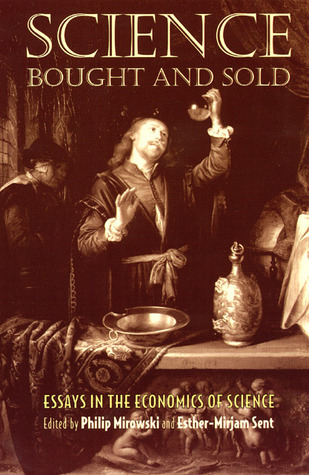
"A serious reconsideration of the 'economics of science' is long overdue," say Philip Mirowski and Esther-Mirjam Sent in the introduction to Science Bought and Sold . Indeed, it is only recently that one could speak of a field of economics of science at all. Although it has long been accepted that economics can provide useful tools with which to understand science, economics has only lately shifted its focus to the economic agent as information processor, making it more broadly applicable to science.Bringing together central themes in this emerging discipline, the editors have assembled important articles that provide a wider context and background against which the economics of science can be evaluated. Roughly one-third of the essays presented here are original papers, and the rest are critical articles previously published in the field. From essays examining economic welfare to the idea of scientists as agents to the digital aspects of higher education, Science Bought and Sold presents a comprehensive overview of the new directions of this expanding area.Kenneth J. ArrowMario BiagioliWilliam A. BrockMichel CallonPartha DasguptaPaul A. DavidSteven N. DurlaufPaul FormanSteve FullerD. Wade HandsShaun P. Hargreaves HeapPhilip KitcherSharon G. LevinRichard R. NelsonDavid F. NobleMichael PolanyiGary RhoadesCharles Sanders PeirceSheila SlaughterPaula E. StephanStephen TurnerJames R. WibleJohn Ziman

This collection of interdisciplinary essays is the first to investigate how images in the history of the natural and physical sciences have been used to shape the history of economic thought. It documents the extent to which scholars have drawn on physical and natural science to ground economic ideas and evaluate the role and importance of metaphors in the structure and content of economic thought. These range from Aristotle's discussion of the division of labor, to Marshall's evocation of population biology, to Hayek's dependence upon evolutionary concepts, and more recently to neoclassical economists' invocation of chaos theory.

Nunca dejes que una crisis te gane la partida: ¿Cómo ha conseguido el neoliberalismo, responsable de la crisis, salir indemne de la misma?
by Philip Mirowski
Rating: 1.0 ⭐
La crisis económica que hemos padecido estos últimos años ha causado estragos entre las clases medias y bajas, y ha disparado los índices de desigualdad. No obstante, no se ha hecho nada para evitar que en un futuro las causas que nos llevaron a la crisis puedan volver a repetirse.Asimismo, los máximos responsables del desastre no sólo no han sido juzgados y condenados, sino que siguen en sus cargos haciendo exactamente lo mismo que hacían antes de la enriquecerse a costa del resto de la sociedad. Amparados bajo la doctrina neoliberal imperante y cobijados por quienes la defi enden, su respuesta es sólo abordar la crisis como si de un acto divino se tratara y seguir adelante, una máxima que ha paralizado todo intento de enmendar el desastre.Cualquier evidencia empírica se interpreta como un refuerzo de la teoría revelada, de tal modo que nadie puede oponerse a ella. Así, como un monolito de pensamiento, el neoliberalismo se erige sólido y hegemónico, mientras la izquierda naufraga, en parte víctima de su propio aniquilamiento y la economía neoclásica es desterrada por la austeridad ofi cial.En este relato afi lado, lúcido e informado, Mirowski da cuenta de una paradoja la de cómo el neoliberalismo nos llevó al colapso fi nanciero, sobrevivió y a la postre ha salido reforzado de él. Al mismo tiempo, esta obra sienta las bases para una crítica del modelo ortodoxo imperante y ofrece nuevas perspectivas de futuro.

The Birth of the Business Cycle
by Philip Mirowski

The Economic Writings of William Thornton
by Philip Mirowski
Thornton's writings are central to the history of the "Laws of Supply and Demand" and seminal in understanding the rise of neoclassical economics. Thornton has been cast as a minor player in John Stuart Mill's recantation of the wages fund doctrine. This text should show how he played a major role.

The Economic Writings of William Thornton Vol 1
by Philip Mirowski
Thornton's writings are central to the history of the "Laws of Supply and Demand" and seminal in understanding the rise of neoclassical economics. Thornton has been cast as a minor player in John Stuart Mill's recantation of the wages fund doctrine. This text should show how he played a major role.

The Economic Writings of William Thornton Vol 2
by Philip Mirowski
Thornton's writings are central to the history of the "Laws of Supply and Demand" and seminal in understanding the rise of neoclassical economics. Thornton has been cast as a minor player in John Stuart Mill's recantation of the wages fund doctrine. This text should show how he played a major role.

The Economic Writings of William Thornton Vol 3
by Philip Mirowski
Thornton's writings are central to the history of the "Laws of Supply and Demand" and seminal in understanding the rise of neoclassical economics. Thornton has been cast as a minor player in John Stuart Mill's recantation of the wages fund doctrine. This text should show how he played a major role.

The Economic Writings of William Thornton Vol 4
by Philip Mirowski
Thornton's writings are central to the history of the "Laws of Supply and Demand" and seminal in understanding the rise of neoclassical economics. Thornton has been cast as a minor player in John Stuart Mill's recantation of the wages fund doctrine. This text should show how he played a major role.

The Economic Writings of William Thornton Vol 5
by Philip Mirowski
Thornton's writings are central to the history of the "Laws of Supply and Demand" and seminal in understanding the rise of neoclassical economics. Thornton has been cast as a minor player in John Stuart Mill's recantation of the wages fund doctrine. This text should show how he played a major role.