Loading genres...
Explore the best books about History genre.

"The Selfish Gene" caused a wave of excitement among biologists and the general public when it was first published in 1976. Its vivid rendering of a gene's eye view of life, in lucid prose, gathered together the strands of thought about the nature of natural selection into a conceptual framework with far-reaching implications for our understanding of evolution. Time has confirmed its significance. Intellectually rigorous, yet written in non-technical language, "The Selfish Gene" is widely regarded as a masterpiece of science writing, and its insights remain as relevant today as on the day it was published.Chapters:1. Why are people?2. The replicators3. Immortal coils4. The gene machine5. Aggression stability and the selfish machine6. Genesmanship7. Family planning8. Battle of the generations9. Battle of the sexes10. You scratch my back, I'll ride on yours11. Memes: the new replicators12. Nice guys finish first13. The long reach of the gene
A black swan is a highly improbable event with three principal characteristics: It is unpredictable; it carries a massive impact; and, after the fact, we concoct an explanation that makes it appear less random, and more predictable, than it was. The astonishing success of Google was a black swan; so was 9/11. For Nassim Nicholas Taleb, black swans underlie almost everything about our world, from the rise of religions to events in our own personal lives.Why do we not acknowledge the phenomenon of black swans until after they occur? Part of the answer, according to Taleb, is that humans are hardwired to learn specifics when they should be focused on generalities. We concentrate on things we already know and time and time again fail to take into consideration what we don’t know. We are, therefore, unable to truly estimate opportunities, too vulnerable to the impulse to simplify, narrate, and categorize, and not open enough to rewarding those who can imagine the “impossible.”For years, Taleb has studied how we fool ourselves into thinking we know more than we actually do. We restrict our thinking to the irrelevant and inconsequential, while large events continue to surprise us and shape our world. Now, in this revelatory book, Taleb explains everything we know about what we don’t know. He offers surprisingly simple tricks for dealing with black swans and benefiting from them.Elegant, startling, and universal in its applications 'The Black Swan' will change the way you look at the world. Taleb is a vastly entertaining writer, with wit, irreverence, and unusual stories to tell. He has a polymathic command of subjects ranging from cognitive science to business to probability theory. 'The Black Swan' is a landmark book – itself a black swan.

PULITZER PRIZE WINNER • A modern American classic, this huge and galvanizing biography of Robert Moses reveals not only the saga of one man’s incredible accumulation of power but the story of his shaping (and mis-shaping) of twentieth-century New York.One of the Modern Library’s hundred greatest books of the twentieth century, Robert Caro's monumental book makes public what few outsiders that Robert Moses was the single most powerful man of his time in the City and in the State of New York. And in telling the Moses story, Caro both opens up to an unprecedented degree the way in which politics really happens—the way things really get done in America's City Halls and Statehouses—and brings to light a bonanza of vital information about such national figures as Alfred E. Smith and Franklin D. Roosevelt (and the genesis of their blood feud), about Fiorello La Guardia, John V. Lindsay and Nelson Rockefeller.But The Power Broker is first and foremost a brilliant multidimensional portrait of a man—an extraordinary man who, denied power within the normal framework of the democratic process, stepped outside that framework to grasp power sufficient to shape a great city and to hold sway over the very texture of millions of lives. We see how Moses the handsome, intellectual young heir to the world of Our Crowd, an idealist. How, rebuffed by the entrenched political establishment, he fought for the power to accomplish his ideals. How he first created a miraculous flowering of parks and parkways, playlands and beaches—and then ultimately brought down on the city the smog-choked aridity of our urban landscape, the endless miles of (never sufficient) highway, the hopeless sprawl of Long Island, the massive failures of public housing, and countless other barriers to humane living. How, inevitably, the accumulation of power became an end in itself.Moses built an empire and lived like an emperor. He was held in fear—his dossiers could disgorge the dark secret of anyone who opposed him. He was, he claimed, above politics, above deals; and through decade after decade, the newspapers and the public believed. Meanwhile, he was developing his public authorities into a fourth branch of government known as "Triborough"—a government whose records were closed to the public, whose policies and plans were decided not by voters or elected officials but solely by Moses—an immense economic force directing pressure on labor unions, on banks, on all the city's political and economic institutions, and on the press, and on the Church. He doled out millions of dollars' worth of legal fees, insurance commissions, lucrative contracts on the basis of who could best pay him back in the only coin he power. He dominated the politics and politicians of his time—without ever having been elected to any office. He was, in essence, above our democratic system.Robert Moses held power in the state for 44 years, through the governorships of Smith, Roosevelt, Lehman, Dewey, Harriman and Rockefeller, and in the city for 34 years, through the mayoralties of La Guardia, O'Dwyer, Impellitteri, Wagner and Lindsay, He personally conceived and carried through public works costing 27 billion dollars—he was undoubtedly America's greatest builder.This is how he built and dominated New York—before, finally, he was stripped of his reputation (by the press) and his power (by Nelson Rockefeller). But his work, and his will, had been done.

The harrowing tale of British explorer Ernest Shackleton's 1914 attempt to reach the South Pole, one of the greatest adventure stories of the modern age.In August 1914, polar explorer Ernest Shackleton boarded the Endurance and set sail for Antarctica, where he planned to cross the last uncharted continent on foot. In January 1915, after battling its way through a thousand miles of pack ice and only a day's sail short of its destination, the Endurance became locked in an island of ice. Thus began the legendary ordeal of Shackleton and his crew of twenty-seven men. When their ship was finally crushed between two ice floes, they attempted a near-impossible journey over 850 miles of the South Atlantic's heaviest seas to the closest outpost of civilization.In Endurance, the definitive account of Ernest Shackleton's fateful trip, Alfred Lansing brilliantly narrates the harrowing and miraculous voyage that has defined heroism for the modern age.First edition: here.

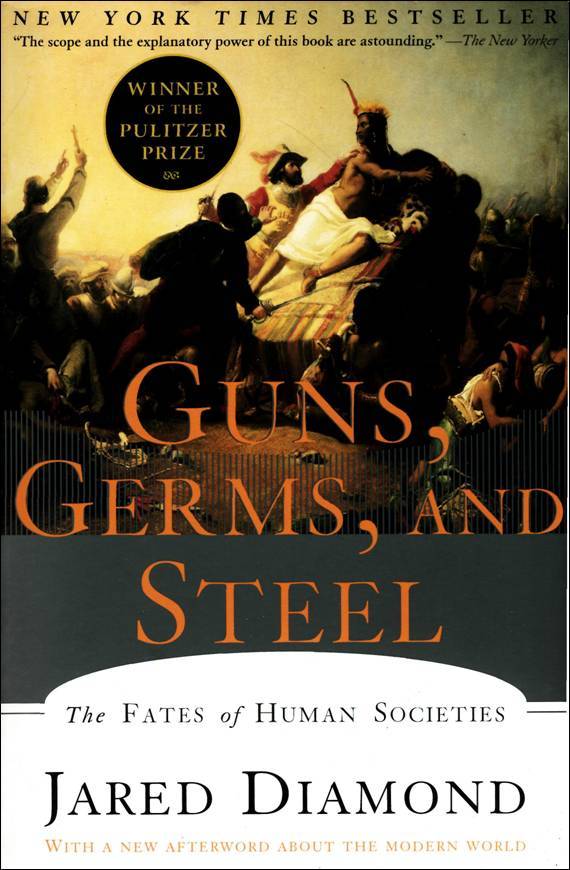
"Diamond has written a book of remarkable scope ... one of the most important and readable works on the human past published in recent years."Winner of the Pulitzer Prize and a national bestseller: the global account of the rise of civilization that is also a stunning refutation of ideas of human development based on race.In this "artful, informative, and delightful" (William H. McNeill, New York Review of Books) book, Jared Diamond convincingly argues that geographical and environmental factors shaped the modern world. Societies that had a head start in food production advanced beyond the hunter-gatherer stage, and then developed writing, technology, government, and organized religion—as well as nasty germs and potent weapons of war—and adventured on sea and land to conquer and decimate preliterate cultures. A major advance in our understanding of human societies, Guns, Germs, and Steel chronicles the way that the modern world came to be and stunningly dismantles racially based theories of human history.Winner of the Pulitzer Prize, the Phi Beta Kappa Award in Science, the Rhone-Poulenc Prize, and the Commonwealth Club of California's Gold Medal

Walter Isaacson’s “enthralling” ( The New Yorker ) worldwide bestselling biography of Apple cofounder Steve Jobs.Based on more than forty interviews with Steve Jobs conducted over two years—as well as interviews with more than 100 family members, friends, adversaries, competitors, and colleagues—Walter Isaacson has written a riveting story of the roller-coaster life and searingly intense personality of a creative entrepreneur whose passion for perfection and ferocious drive revolutionized six personal computers, animated movies, music, phones, tablet computing, and digital publishing.At a time when America is seeking ways to sustain its innovative edge, Jobs stands as the ultimate icon of inventiveness and applied imagination. He knew that the best way to create value in 21st century was to connect creativity with technology. He built a company where leaps of the imagination were combined with remarkable feats of engineering.Although Jobs cooperated with the author, he asked for no control over what was written. He put nothing off-limits. He encouraged the people he knew to speak honestly. And Jobs speaks candidly, sometimes brutally so, about the people he worked with and competed against. His friends, foes, and colleagues provide an unvarnished view of the passions, perfectionism, obsessions, artistry, devilry, and compulsion for control that shaped his approach to business and the innovative products that resulted.Driven by demons, Jobs could drive those around him to fury and despair. But his personality and products were interrelated, just as Apple’s hardware and software tended to be, as if part of an integrated system. His tale is instructive and cautionary, filled with lessons about innovation, character, leadership, and values.Steve Jobs is the inspiration for the movie of the same name starring Michael Fassbender, Kate Winslet, Seth Rogen, and Jeff Daniels, directed by Danny Boyle with a screenplay by Aaron Sorkin.

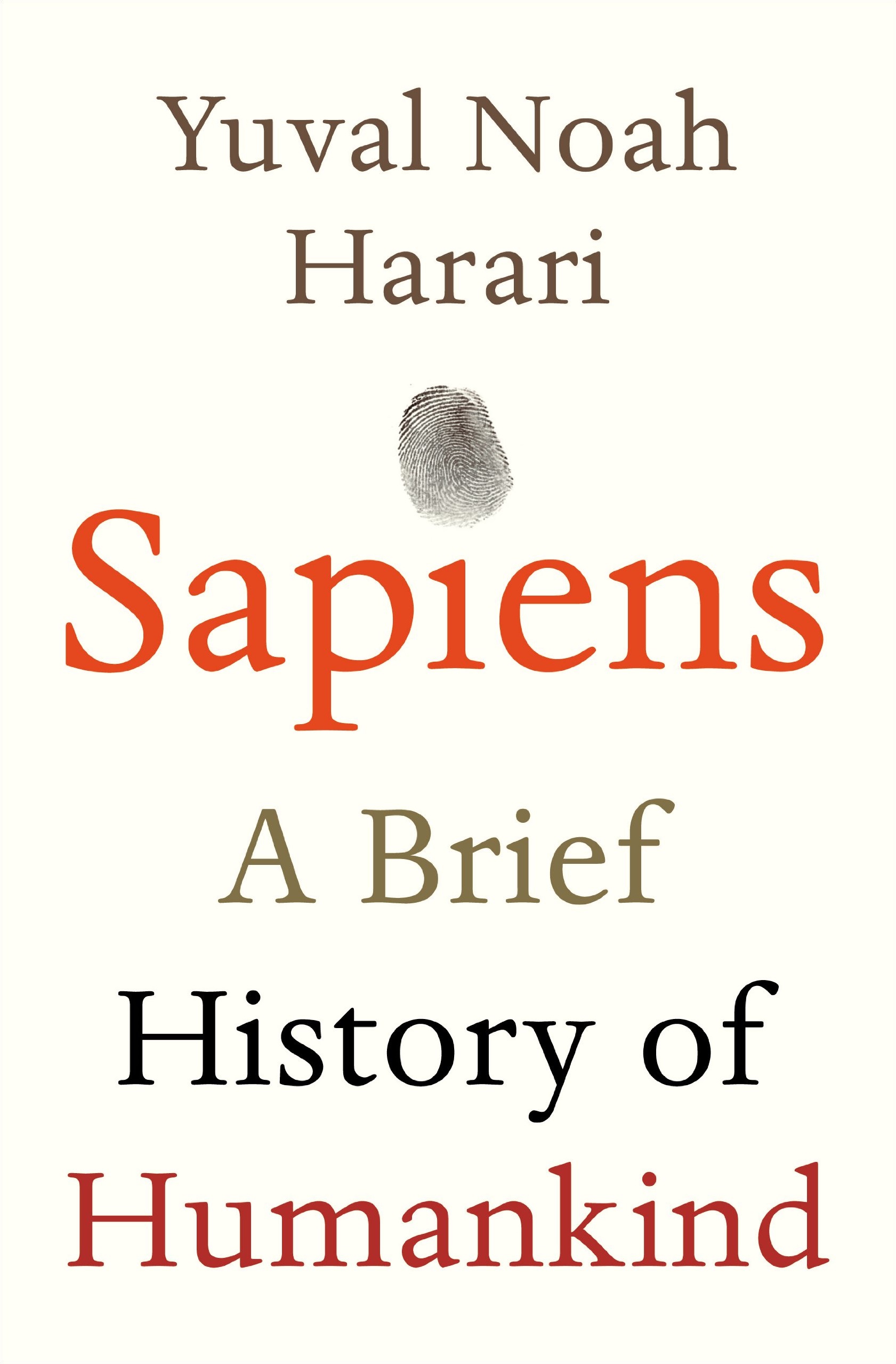
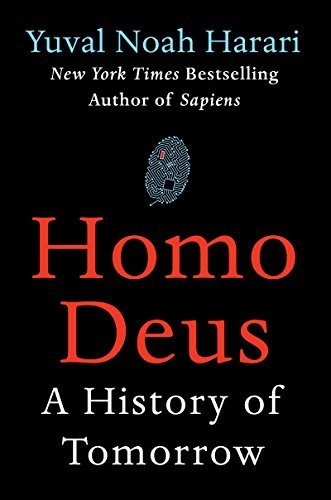
Yuval Noah Harari, author of the critically-acclaimed New York Times bestseller and international phenomenon Sapiens, returns with an equally original, compelling, and provocative book, turning his focus toward humanity’s future, and our quest to upgrade humans into gods.Over the past century humankind has managed to do the impossible and rein in famine, plague, and war. This may seem hard to accept, but, as Harari explains in his trademark style—thorough, yet riveting—famine, plague and war have been transformed from incomprehensible and uncontrollable forces of nature into manageable challenges. For the first time ever, more people die from eating too much than from eating too little; more people die from old age than from infectious diseases; and more people commit suicide than are killed by soldiers, terrorists and criminals put together. The average American is a thousand times more likely to die from binging at McDonalds than from being blown up by Al Qaeda.What then will replace famine, plague, and war at the top of the human agenda? As the self-made gods of planet earth, what destinies will we set ourselves, and which quests will we undertake? Homo Deus explores the projects, dreams and nightmares that will shape the twenty-first century—from overcoming death to creating artificial life. It asks the fundamental questions: Where do we go from here? And how will we protect this fragile world from our own destructive powers? This is the next stage of evolution. This is Homo Deus.With the same insight and clarity that made Sapiens an international hit and a New York Times bestseller, Harari maps out our future.

Machiavelli needs to be looked at as he really was. Hence: Can Machiavelli, who makes the following observations, be Machiavellian as we understand the disparaging term?1. So it is that to know the nature of a people, one need be a Prince; to know the nature of a Prince, one need to be of the people.2. If a Prince is not given to vices that make him hated, it is unsusal for his subjects to show their affection for him.3. Opportunity made Moses, Cyrus, Romulus, Theseus, and others; their virtue domi-nated the opportunity, making their homelands noble and happy. Armed prophets win; the disarmed lose.4. Without faith and religion, man achieves power but not glory.5. Prominent citizens want to command and oppress; the populace only wants to be free of oppression.6. A Prince needs a friendly populace; otherwise in diversity there is no hope.7. A Prince, who rules as a man of valor, avoids disasters,8. Nations based on mercenary forces will never be solid or secure.9. Mercenaries are dangerous because of their cowardice10. There are two ways to fight: one with laws, the other with force. The first is rightly man’s way; the second, the way of beasts.
“Ridley writes with panache, wit, and humor and displays remarkable ingenuity in finding ways to present complicated materials for the lay reader.” — Los Angeles Times In a bold and provocative interpretation of economic history, Matt Ridley, the New York Times -bestselling author of Genome and The Red Queen , makes the case for an economics of hope, arguing that the benefits of commerce, technology, innovation, and change—what Ridley calls cultural evolution—will inevitably increase human prosperity. Fans of the works of Jared Diamond ( Guns, Germs, and Steel ), Niall Ferguson ( The Ascent of Money ), and Thomas Friedman ( The World Is Flat ) will find much to ponder and enjoy in The Rational Optimist.

'Science has never had an advocate quite like David Deutsch ... A computational physicist on a par with his touchstones Alan Turing and Richard Feynman, and a philosopher in the line of his greatest hero, Karl Popper. His arguments are so clear that to read him is to experience the thrill of the highest level of discourse available on this planet and to understand it' Peter Forbes, IndependentIn our search for truth, how far have we advanced? This uniquely human quest for good explanations has driven amazing improvements in everything from scientific understanding and technology to politics, moral values and human welfare. But will progress end, either in catastrophe or completion - or will it continue infinitely?In this profound and seminal book, David Deutsch explores the furthest reaches of our current understanding, taking in the Infinity Hotel, supernovae and the nature of optimism, to instill in all of us a wonder at what we have achieved - and the fact that this is only the beginning of humanity's infinite possibility.'This is Deutsch at his most ambitious, seeking to understand the implications of our scientific explanations of the world ... I enthusiastically recommend this rich, wide-ranging and elegantly written exposition of the unique insights of one of our most original intellectuals' Michael Berry, Times Higher Education Supplement'Bold ... profound ... provocative and persuasive' Economist'David Deutsch may well go down in history as one of the great scientists of our age' Scotsman

“The impediment to action advances action. What stands in the way becomes the way.” — Marcus AureliusWe are stuck, stymied, frustrated. But it needn’t be this way. There is a formula for success that’s been followed by the icons of history—from John D. Rockefeller to Amelia Earhart to Ulysses S. Grant to Steve Jobs—a formula that let them turn obstacles into opportunities. Faced with impossible situations, they found the astounding triumphs we all seek.These men and women were not exceptionally brilliant, lucky, or gifted. Their success came from timeless philosophical principles laid down by a Roman emperor who struggled to articulate a method for excellence in any and all situations.This book reveals that formula for the first time—and shows us how we can turn our own adversity into advantage.

Could psychedelic drugs change our worldview? One of America's most admired writers takes us on a mind-altering journey to the frontiers of human consciousnessWhen LSD was first discovered in the 1940s, it seemed to researchers, scientists and doctors as if the world might be on the cusp of psychological revolution. It promised to shed light on the deep mysteries of consciousness, as well as offer relief to addicts and the mentally ill. But in the 1960s, with the vicious backlash against the counter-culture, all further research was banned. In recent years, however, work has quietly begun again on the amazing potential of LSD, psilocybin and DMT. Could these drugs in fact improve the lives of many people? Diving deep into this extraordinary world and putting himself forward as a guinea-pig, Michael Pollan has written a remarkable history of psychedelics and a compelling portrait of the new generation of scientists fascinated by the implications of these drugs. How to Change Your Mind is a report from what could very well be the future of human consciousness.

From the #1 New York Times bestselling author of Principles and legendary investor Ray Dalio, who has spent half a century studying global markets, The Changing World Order examines history’s most turbulent economic and political periods to reveal why the times ahead will likely be radically different from those we’ve experienced in our lifetimes. A few years ago, renowned investor Ray Dalio began noticing a confluence of political and economic conditions he hadn’t encountered before in his fifty-year career. They included large debts and zero or near-zero interest rates in the world’s three major reserve currencies; significant wealth, political, and values divisions within countries; and emerging conflict between a rising world power (China) and the existing one (US). Seeking to explain the cause-effect relationships behind these conditions, he began a study of analogous historical times and discovered that such combinations of conditions were characteristic of periods of transition, such as the years between 1930 and 1945, in which wealth and power shifted in ways that reshaped the world order. Looking back across five hundred years of history and nine major empires—including the Dutch, the British, and the American—The Changing World Order puts into perspective the cycles and forces that have driven the successes and failures of all the world’s major countries throughout history. Dalio reveals the timeless and universal dynamics that were behind these shifts, while also offering practical principles for policymakers, business leaders, investors, and others operating in this environment.

John D. Rockefeller, Sr.--history's first billionaire and the patriarch of America's most famous dynasty--is an icon whose true nature has eluded three generations of historians. Now Ron Chernow, the National Book Award-winning biographer of the Morgan and Warburg banking families, gives us a history of the mogul "etched with uncommon objectivity and literary grace . . . as detailed, balanced, and psychologically insightful a portrait of the tycoon as we may ever have" (Kirkus Reviews). Titan is the first full-length biography based on unrestricted access to Rockefeller's exceptionally rich trove of papers. A landmark publication full of startling revelations, the book will indelibly alter our image of this most enigmatic capitalist. Born the son of a flamboyant, bigamous snake-oil salesman and a pious, straitlaced mother, Rockefeller rose from rustic origins to become the world's richest man by creating America's most powerful and feared monopoly, Standard Oil. Branded "the Octopus" by legions of muckrakers, the trust refined and marketed nearly 90 percent of the oil produced in America. Rockefeller was likely the most controversial businessman in our nation's history. Critics charged that his empire was built on unscrupulous grand-scale collusion with the railroads, predatory pricing, industrial espionage, and wholesale bribery of political officials. The titan spent more than thirty years dodging investigations until Teddy Roosevelt and his trustbusters embarked on a marathon crusade to bring Standard Oil to bay. While providing abundant new evidence of Rockefeller's misdeeds, Chernow discards the stereotype of the cold-blooded monster to sketch an unforgettably human portrait of a quirky, eccentric original. A devout Baptist and temperance advocate, Rockefeller gave money more generously--his chosen philanthropies included the Rockefeller Foundation, the University of Chicago, and what is today Rockefeller University--than anyone before him. Titan presents a finely nuanced portrait of a fascinating, complex man, synthesizing his public and private lives and disclosing numerous family scandals, tragedies, and misfortunes that have never before come to light. John D. Rockefeller's story captures a pivotal moment in American history, documenting the dramatic post-Civil War shift from small business to the rise of giant corporations that irrevocably transformed the nation. With cameos by Joseph Pulitzer, William Randolph Hearst, Jay Gould, William Vanderbilt, Ida Tarbell, Andrew Carnegie, Carl Jung, J. Pierpont Morgan, William James, Henry Clay Frick, Mark Twain, and Will Rogers, Titan turns Rockefeller's life into a vivid tapestry of American society in the late nineteenth and early twentieth centuries. It is Ron Chernow's signal triumph that he narrates this monumental saga with all the sweep, drama, and insight that this giant subject deserves.

In this illuminating and thoughtful book, Will and Ariel Durant have succeeded in distilling for the reader the accumulated store of knowledge and experience from their four decades of work on the ten monumental volumes of "The Story of Civilization." The result is a survey of human history, full of dazzling insights into the nature of human experience, the evolution of civilization, the culture of man. With the completion of their life's work they look back and ask what history has to say about the nature, the conduct and the prospects of man, seeking in the great lives, the great ideas, the great events of the past for the meaning of man's long journey through war, conquest and creation - and for the great themes that can help us to understand our own era.To the Durants, history is "not merely a warning reminder of man's follies and crimes, but also an encouraging remembrance of generative souls ... a spacious country of the mind wherein a thousand saints, statesman, inventors, scientists, poets, artists, musicians, lovers, and philosophers still live and speak, teach and carve and sing..."Designed to accompany the ten-volume set of "The Story of Civilization, The Lessons of History" is, in its own right, a profound and original work of history and philosophy.

“This is your country, this is your world, this is your body, and you must find some way to live within the all of it.” In a profound work that pivots from the biggest questions about American history and ideals to the most intimate concerns of a father for his son, Ta-Nehisi Coates offers a powerful new framework for understanding our nation’s history and current crisis. Americans have built an empire on the idea of “race,” a falsehood that damages us all but falls most heavily on the bodies of black women and men—bodies exploited through slavery and segregation, and, today, threatened, locked up, and murdered out of all proportion. What is it like to inhabit a black body and find a way to live within it? And how can we all honestly reckon with this fraught history and free ourselves from its burden? Between the World and Me is Ta-Nehisi Coates’s attempt to answer these questions in a letter to his adolescent son. Coates shares with his son—and readers—the story of his awakening to the truth about his place in the world through a series of revelatory experiences, from Howard University to Civil War battlefields, from the South Side of Chicago to Paris, from his childhood home to the living rooms of mothers whose children’s lives were taken as American plunder. Beautifully woven from personal narrative, reimagined history, and fresh, emotionally charged reportage, Between the World and Me clearly illuminates the past, bracingly confronts our present, and offers a transcendent vision for a way forward.

"Do not act as if thou were going to live ten thousand years. Death hangs over thee. While thoug livest, while it is in thy power, be good."Meditations contains the private wisdom of Marcus Aurelius, Roman Emperor from AD 161 to 180, and a great philosopher.His Meditations were never intended for publication. They were his personal thoughts and spiritual reflections, which he wrote down and referred to in order to help him manage the challenges of governing the Roman Empire while maintaining a peaceful private life.His philosophy articulated the need for inner peace and moral certainty in a world filled with chaos and suffering. The insights found in Meditations are just as helpful today as when Marcus Aurelius first wrote them nearly two millennia ago.

Just before the 2002 season opens, the Oakland Athletics must relinquish its three most prominent (and expensive) players and is written off by just about everyone—but then comes roaring back to challenge the American League record for consecutive wins. How did one of the poorest teams in baseball win so many games?In a quest to discover the answer, Michael Lewis delivers not only “the single most influential baseball book ever” (Rob Neyer, Slate) but also what “may be the best book ever written on business” (Weekly Standard). Lewis first looks to all the logical places—the front offices of major league teams, the coaches, the minds of brilliant players—but discovers the real jackpot is a cache of numbers?numbers!?collected over the years by a strange brotherhood of amateur baseball software engineers, statisticians, Wall Street analysts, lawyers, and physics professors.What these numbers prove is that the traditional yardsticks of success for players and teams are fatally flawed. Even the box score misleads us by ignoring the crucial importance of the humble base-on-balls. This information had been around for years, and nobody inside Major League Baseball paid it any mind. And then came Billy Beane, general manager of the Oakland Athletics. He paid attention to those numbers?with the second-lowest payroll in baseball at his disposal he had to?to conduct an astonishing experiment in finding and fielding a team that nobody else wanted.In a narrative full of fabulous characters and brilliant excursions into the unexpected, Michael Lewis shows us how and why the new baseball knowledge works. He also sets up a sly and hilarious morality Big Money, like Goliath, is always supposed to win . . . how can we not cheer for David?

Under Andy Grove’s leadership, Intel became the world’s largest chip maker and one of the most admired companies in the world. In Only the Paranoid Survive, Grove reveals his strategy for measuring the nightmare moment every leader dreads–when massive change occurs and a company must, virtually overnight, adapt or fall by the wayside–in a new way.Grove calls such a moment a Strategic Inflection Point, which can be set off by almost anything: mega-competition, a change in regulations, or a seemingly modest change in technology. When a Strategic Inflection Point hits, the ordinary rules of business go out the window. Yet, managed right, a Strategic Inflection Point can be an opportunity to win in the marketplace and emerge stronger than ever.Grove underscores his message by examining his own record of success and failure, including how he navigated the events of the Pentium flaw, which threatened Intel’s reputation in 1994, and how he has dealt with the explosions in growth of the Internet. The work of a lifetime, Only the Paranoid Survive is a classic of managerial and leadership skills.

Benjamin Franklin is the Founding Father who winks at us. An ambitious urban entrepreneur who rose up the social ladder, from leather-aproned shopkeeper to dining with kings, he seems made of flesh rather than of marble. In bestselling author Walter Isaacson's vivid and witty full-scale biography, we discover why Franklin seems to turn to us from history's stage with eyes that twinkle from behind his new-fangled spectacles. By bringing Franklin to life, Isaacson shows how he helped to define both his own time and ours.He was, during his 84-year life, America's best scientist, inventor, diplomat, writer, and business strategist, and he was also one of its most practical—though not most profound—political thinkers. He proved by flying a kite that lightning was electricity, and he invented a rod to tame it. He sought practical ways to make stoves less smoky and commonwealths less corrupt. He organized neighborhood constabularies and international alliances, local lending libraries and national legislatures. He combined two types of lenses to create bifocals and two concepts of representation to foster the nation's federal compromise. He was the only man who shaped all the founding documents of America: the Albany Plan of Union, the Declaration of Independence, the treaty of alliance with France, the peace treaty with England, and the Constitution. And he helped invent America's unique style of homespun humor, democratic values, and philosophical pragmatism.But the most interesting thing that Franklin invented, and continually reinvented, was himself. America's first great publicist, he was, in his life and in his writings, consciously trying to create a new American archetype. In the process, he carefully crafted his own persona, portrayed it in public, and polished it for posterity.Through it all, he trusted the hearts and minds of his fellow "leather-aprons" more than he did those of any inbred elite. He saw middle-class values as a source of social strength, not as something to be derided. His guiding principle was a "dislike of everything that tended to debase the spirit of the common people." Few of his fellow founders felt this comfort with democracy so fully, and none so intuitively.In this colorful and intimate narrative, Isaacson provides the full sweep of Franklin's amazing life, from his days as a runaway printer to his triumphs as a statesman, scientist, and Founding Father. He chronicles Franklin's tumultuous relationship with his illegitimate son and grandson, his practical marriage, and his flirtations with the ladies of Paris. He also shows how Franklin helped to create the American character and why he has a particular resonance in the twenty-first century.

Douglas Hofstadter's book is concerned directly with the nature of “maps” or links between formal systems. However, according to Hofstadter, the formal system that underlies all mental activity transcends the system that supports it. If life can grow out of the formal chemical substrate of the cell, if consciousness can emerge out of a formal system of firing neurons, then so too will computers attain human intelligence. Gödel, Escher, Bach is a wonderful exploration of fascinating ideas at the heart of cognitive science: meaning, reduction, recursion, and much more.

How did Einstein's mind work? What made him a genius? Isaacson's biography shows how his scientific imagination sprang from the rebellious nature of his personality. His fascinating story is a testament to the connection between creativity and freedom.Based on the newly released personal letters of Albert Einstein, Walter Isaacson explores how an imaginative, impertinent patent clerk -- a struggling father in a difficult marriage who couldn't get a teaching job or a doctorate -- became the mind reader of the creator of the cosmos, the locksmith of the mysteries of the atom and the universe. His success came from questioning conventional wisdom and marveling at mysteries that struck others as mundane. This led him to embrace a morality and politics based on respect for free minds, free spirits, and free individuals.These traits are just as vital for this new century of globalization, in which our success will depend on our creativity, as they were for the beginning of the last century, when Einstein helped usher in the modern age.

Adam Smith's masterpiece, first published in 1776, is the foundation of modern economic thought and remains the single most important account of the rise of, and the principles behind, modern capitalism. Written in clear and incisive prose, The Wealth of Nations articulates the concepts indispensable to an understanding of contemporary society; and Robert Reich's Introduction both clarifies Smith's analyses and illuminates his overall relevance to the world in which we live. As Reich writes, "Smith's mind ranged over issues as fresh and topical today as they were in the late eighteenth century--jobs, wages, politics, government, trade, education, business, and ethics."Introduction by Robert Reich - Commentary by R. H. Campbell and A. S. Skinner - Includes a Modern Library Reading Group Guide

The definitive biography of the founder of history's greatest empire. In 25 years, Genghis Khan and his Mongol armies conquered more than the Romans had in four centuries, founding the most extensive empire humankind has ever seen. Born Temujin, a pariah from the steppes, the man destined to make history as the Great Khan of the Mongols conquered every territory he held, from Georgia and Armenia to Korea. Genghis Khan emerged as an unexpected leader, abolishing torture, guaranteeing religious freedom, and destroying feudal systems based on aristocratic privilege. When he was born, holding a blood clot in his hand, his mother predicted that the child would change the course of the world. Thus, Genghis Khan united all the Mongol tribes of the steppes and transformed their way of life. He created the most efficient army of the Middle Ages, opened trade routes that connected the known world, and founded an empire that stretched from Europe to East Asia. His successors were kings, khans, and emperors in China, India, and Russia, and his legacy was enduring. From the early life of Genghis Khan and his rise and transformation from the tribal world of the steppes to the civilizing explosion of the Mongol Empire, this brilliant essay by Jack Weatherford, an anthropologist specializing in Mongol history, tells the epic story of how the modern world was forged.

One of the great fears many of us face is that despite all our effort and striving, we will discover at the end that we have wasted our life. In A Guide to the Good Life, William B. Irvine plumbs the wisdom of Stoic philosophy, one of the most popular and successful schools of thought in ancient Rome, and shows how its insight and advice are still remarkably applicable to modern lives. In A Guide to the Good Life, Irvine offers a refreshing presentation of Stoicism, showing how this ancient philosophy can still direct us toward a better life. Using the psychological insights and the practical techniques of the Stoics, Irvine offers a roadmap for anyone seeking to avoid the feelings of chronic dissatisfaction that plague so many of us. Irvine looks at various Stoic techniques for attaining tranquility and shows how to put these techniques to work in our own life. As he does so, he describes his own experiences practicing Stoicism and offers valuable first-hand advice for anyone wishing to live better by following in the footsteps of these ancient philosophers. Readers learn how to minimize worry, how to let go of the past and focus our efforts on the things we can control, and how to deal with insults, grief, old age, and the distracting temptations of fame and fortune. We learn from Marcus Aurelius the importance of prizing only things of true value, and from Epictetus we learn how to be more content with what we have. Finally, A Guide to the Good Life shows readers how to become thoughtful observers of their own life. If we watch ourselves as we go about our daily business and later reflect on what we saw, we can better identify the sources of distress and eventually avoid that pain in our life. By doing this, the Stoics thought, we can hope to attain a truly joyful life.

#1 New York Times Bestseller There have been many books—on a large and small scale—about Steve Jobs, one of the most famous CEOs in history. But this book is different from all the others.Becoming Steve Jobs takes on and breaks down the existing myth and stereotypes about Steve Jobs. The conventional, one-dimensional view of Jobs is that he was half-genius, half-jerk from youth, an irascible and selfish leader who slighted friends and family alike. Becoming Steve Jobs answers the central question about the life and career of the Apple cofounder and CEO: How did a young man so reckless and arrogant that he was exiled from the company he founded become the most effective visionary business leader of our time, ultimately transforming the daily life of billions of people?Drawing on incredible and sometimes exclusive access, Schlender and Tetzeli tell a different story of a real human being who wrestled with his failings and learned to maximize his strengths over time. Their rich, compelling narrative is filled with stories never told before from the people who knew Jobs best, and who decided to open up to the authors, including his family, former inner circle executives, and top people at Apple, Pixar and Disney, most notably Tim Cook, Jony Ive, Eddy Cue, Ed Catmull, John Lasseter, Robert Iger and many others. In addition, Brent knew Jobs personally for 25 years and draws upon his many interviews with him, on and off the record, in writing the book. He and Rick humanize the man and explain, rather than simply describe, his behavior. Along the way, the book provides rich context about the technology revolution we all have lived through, and the ways in which Jobs changed our world.Schlender and Tetzeli make clear that Jobs's astounding success at Apple was far more complicated than simply picking the right products: he became more patient, he learned to trust his inner circle, and discovered the importance of growing the company incrementally rather than only shooting for dazzling game-changing products.A rich and revealing account that will change the way we view Jobs, Becoming Steve Jobs shows us how one of the most colorful and compelling figures of our times was able to combine his unchanging, relentless passion with a more mature management style to create one of the most valuable and beloved companies on the planet.

INSTANT NEW YORK TIMES BESTSELLER A NEW YORK TIMES NOTABLE BOOK OF 2018ONE OF THE ECONOMIST'S BOOKS OF THE YEAR"My new favorite book of all time." --Bill Gates If you think the world is coming to an end, think again: people are living longer, healthier, freer, and happier lives, and while our problems are formidable, the solutions lie in the Enlightenment ideal of using reason and science.Is the world really falling apart? Is the ideal of progress obsolete? In this elegant assessment of the human condition in the third millennium, cognitive scientist and public intellectual Steven Pinker urges us to step back from the gory headlines and prophecies of doom, which play to our psychological biases. Instead, follow the data: In seventy-five jaw-dropping graphs, Pinker shows that life, health, prosperity, safety, peace, knowledge, and happiness are on the rise, not just in the West, but worldwide. This progress is not the result of some cosmic force. It is a gift of the Enlightenment: the conviction that reason and science can enhance human flourishing.Far from being a naive hope, the Enlightenment, we now know, has worked. But more than ever, it needs a vigorous defense. The Enlightenment project swims against currents of human nature--tribalism, authoritarianism, demonization, magical thinking--which demagogues are all too willing to exploit. Many commentators, committed to political, religious, or romantic ideologies, fight a rearguard action against it. The result is a corrosive fatalism and a willingness to wreck the precious institutions of liberal democracy and global cooperation.With intellectual depth and literary flair, Enlightenment Now makes the case for reason, science, and humanism: the ideals we need to confront our problems and continue our progress.

Shortlisted for the Financial Times Business Book of the Year Named a Best Book of 2022 by The Economist“A gripping fly-on-the-wall story of the rise of this unique and important industry based on extensive interviews with some of the most successful venture capitalists.” - Daniel Rasmussen, Wall Street Journal“A must-read for anyone seeking to understand modern-day Silicon Valley and even our economy writ large.” -Bethany McLean, The Washington Post"A rare and unsettling look inside a subculture of unparalleled influence.” —Jane Mayer"A classic...A book of exceptional reporting, analysis and storytelling.” —Charles DuhiggFrom the New York Times bestselling author of More Money Than God comes the astonishingly frank and intimate story of Silicon Valley’s dominant venture-capital firms—and how their strategies and fates have shaped the path of innovation and the global economyInnovations rarely come from “experts.” Elon Musk was not an “electric car person” before he started Tesla. When it comes to improbable innovations, a legendary tech VC told Sebastian Mallaby, the future cannot be predicted , it can only be discovered . It is the nature of the venture-capital game that most attempts at discovery fail, but a very few succeed at such a scale that they more than make up for everything else. That extreme ratio of success and failure is the power law that drives the VC business, all of Silicon Valley, the wider tech sector, and, by extension, the world. In The Power Law , Sebastian Mallaby has parlayed unprecedented access to the most celebrated venture capitalists of all time—the key figures at Sequoia, Kleiner Perkins, Accel, Benchmark, and Andreessen Horowitz, as well as Chinese partnerships such as Qiming and Capital Today—into a riveting blend of storytelling and analysis that unfurls the history of tech incubation, in the Valley and ultimately worldwide. We learn the unvarnished truth, often for the first time, about some of the most iconic triumphs and infamous disasters in Valley history, from the comedy of errors at the birth of Apple to the avalanche of venture money that fostered hubris at WeWork and Uber. VCs’ relentless search for grand slams brews an obsession with the ideal of the lone entrepreneur-genius, and companies seen as potential “unicorns” are given intoxicating amounts of power, with sometimes disastrous results. On a more systemic level, the need to make outsized bets on unproven talent reinforces bias, with women and minorities still represented at woefully low levels. This does not just have social justice as Mallaby relates, China’s homegrown VC sector, having learned at the Valley’s feet, is exploding and now has more women VC luminaries than America has ever had. Still, Silicon Valley VC remains the top incubator of business innovation anywhere—it is not where ideas come from so much as where they go to become the products and companies that create the future. By taking us so deeply into the VCs’ game, The Power Law helps us think about our own future through their eyes.

A stevedore on the San Francisco docks in the 1940s, Eric Hoffer wrote philosophical treatises in his spare time while living in the railroad yards. The True Believer -- the first and most famous of his books -- was made into a bestseller when President Eisenhower cited it during one of the earliest television press conferences. Completely relevant and essential for understanding the world today, The True Believer is a visionary, highly provocative look into the mind of the fanatic and a penetrating study of how an individual becomes one.

Masters of Doom is the amazing true story of the Lennon and McCartney of video games: John Carmack and John Romero. Together, they ruled big business. They transformed popular culture. And they provoked a national controversy. More than anything, they lived a unique and rollicking American Dream, escaping the broken homes of their youth to produce the most notoriously successful game franchises in history - Doom and Quake - until the games they made tore them apart. This is a story of friendship and betrayal, commerce and artistry - a powerful and compassionate account of what it's like to be young, driven, and wildly creative.

Darwin's theory of natural selection issued a profound challenge to orthodox thought and belief: no being or species has been specifically created; all are locked into a pitiless struggle for existence, with extinction looming for those not fitted for the task. Yet The Origin of Species (1859) is also a humane and inspirational vision of ecological interrelatedness, revealing the complex mutual interdependencies between animal and plant life, climate and physical environment, and—by implication—within the human world. Written for the general reader, in a style which combines the rigour of science with the subtlety of literature, The Origin of Species remains one of the founding documents of the modern age.

Written initially to guide his son, Benjamin Franklin’s autobiography is a lively, spellbinding account of his unique and eventful life, now a classic of world literature that is sure to inspire and delight readers everywhere.Few men could compare to Benjamin Franklin. Virtually self-taught, he excelled as an athlete, a man of letters, a printer, a scientist, a wit, an inventor, an editor, and a writer, and he was probably the most successful diplomat in American history. David Hume hailed him as the first great philosopher and great man of letters in the New World.

The time was the 1980s. The place was Wall Street. The game was called Liar’s Poker. Michael Lewis was fresh out of Princeton and the London School of Economics when he landed a job at Salomon Brothers, one of Wall Street’s premier investment firms. During the next three years, Lewis rose from callow trainee to bond salesman, raking in millions for the firm and cashing in on a modern-day gold rush. Liar’s Poker is the culmination of those heady, frenzied years—a behind-the-scenes look at a unique and turbulent time in American business. From the frat-boy camaraderie of the forty-first-floor trading room to the killer instinct that made ambitious young men gamble everything on a high-stakes game of bluffing and deception, here is Michael Lewis’s knowing and hilarious insider’s account of an unprecedented era of greed, gluttony, and outrageous fortune. .

The #1 New York Times–bestselling sequel to The 48 Laws of PowerMastery synthesizes the years of research Robert Greene conducted while writing the international bestsellers The 48 Laws of Power, The 33 Strategies of War, and The Art of Seduction and demonstrates that the ultimate form of power is mastery itself. By analyzing the lives of such past masters as Charles Darwin, Benjamin Franklin, Albert Einstein, and Leonard da Vinci, as well as by interviewing nine contemporary masters, including tech guru Paul Graham and animal rights advocate Temple Grandin, Greene debunks our culture’s many myths about genius and distills the wisdom of the ages to reveal the secret to greatness. With this seminal text as a guide, readers will learn how to unlock the passion within and become masters.

**Winner of the 2013 Financial Times and Goldman Sachs Business Book of the Year Award**Though Amazon.com started off delivering books through the mail, its visionary founder, Jeff Bezos, was never content with being just a bookseller. He wanted Amazon to become ‘the everything store’, offering limitless selection and seductive convenience at disruptively low prices. To achieve that end, he developed a corporate culture of relentless ambition and secrecy that's never been cracked. Until now...Jeff Bezos stands out for his relentless pursuit of new markets, leading Amazon into risky new ventures like the Kindle and cloud computing, and transforming retail in the same way that Henry Ford revolutionized manufacturing. Amazon placed one of the first and largest bets on the Internet. Nothing would ever be the same again.

A real-life political thriller about an American financier in the Wild East of Russia, the murder of his principled young tax attorney, and his dangerous mission to expose the Kremlin’s corruption.Bill Browder’s journey started on the South Side of Chicago and moved through Stanford Business School to the dog-eat-dog world of hedge fund investing in the 1990s. It continued in Moscow, where Browder made his fortune heading the largest investment fund in Russia after the Soviet Union’s collapse. But when he exposed the corrupt oligarchs who were robbing the companies in which he was investing, Vladimir Putin turned on him and, in 2005, had him expelled from Russia. In 2007, a group of law enforcement officers raided Browder’s offices in Moscow and stole $230 million of taxes that his fund’s companies had paid to the Russian government. Browder’s attorney Sergei Magnitsky investigated the incident and uncovered a sprawling criminal enterprise. A month after Sergei testified against the officials involved, he was arrested and thrown into pre-trial detention, where he was tortured for a year. On November 16, 2009, he was led to an isolation chamber, handcuffed to a bedrail, and beaten to death by eight guards in full riot gear. Browder glimpsed the heart of darkness, and it transformed his life: he embarked on an unrelenting quest for justice in Sergei’s name, exposing the towering cover-up that leads right up to Putin. A financial caper, a crime thriller, and a political crusade, Red Notice is the story of one man taking on overpowering odds to change the world.

Sebastian Junger, the bestselling author of War and The Perfect Storm, takes a critical look at post-traumatic stress disorder and the many challenges today’s returning veterans face in modern society.There are ancient tribal human behaviors-loyalty, inter-reliance, cooperation-that flare up in communities during times of turmoil and suffering. These are the very same behaviors that typify good soldiering and foster a sense of belonging among troops, whether they’re fighting on the front lines or engaged in non-combat activities away from the action. Drawing from history, psychology, and anthropology, bestselling author Sebastian Junger shows us just how at odds the structure of modern society is with our tribal instincts, arguing that the difficulties many veterans face upon returning home from war do not stem entirely from the trauma they’ve suffered, but also from the individualist societies they must reintegrate into.A 2011 study by the Canadian Forces and Statistics Canada reveals that 78 percent of military suicides from 1972 to the end of 2006 involved veterans. Though these numbers present an implicit call to action, the government is only just taking steps now to address the problems veterans face when they return home. But can the government ever truly eliminate the challenges faced by returning veterans? Or is the problem deeper, woven into the very fabric of our modern existence? Perhaps our circumstances are not so bleak, and simply understanding that beneath our modern guises we all belong to one tribe or another would help us face not just the problems of our nation but of our individual lives as well.Well-researched and compellingly written, this timely look at how veterans react to coming home will reconceive our approach to veteran’s affairs and help us to repair our current social dynamic.

The unbelievable true story of the man who built a billion-dollar online drug empire from his bedroom—and almost got away with it. In 2011, a twenty-six-year-old libertarian programmer named Ross Ulbricht launched the ultimate free market: the Silk Road, a clandestine Web site hosted on the Dark Web where anyone could trade anything—drugs, hacking software, forged passports, counterfeit cash, poisons—free of the government’s watchful eye. It wasn’t long before the media got wind of the new Web site where anyone—not just teenagers and weed dealers but terrorists and black hat hackers—could buy and sell contraband detection-free. Spurred by a public outcry, the federal government launched an epic two-year manhunt for the site’s elusive proprietor, with no leads, no witnesses, and no clear jurisdiction. All the investigators knew was that whoever was running the site called himself the Dread Pirate Roberts. The Silk Road quickly ballooned into $1.2 billion enterprise, and Ross embraced his new role as kingpin. He enlisted a loyal crew of allies in high and low places, all as addicted to the danger and thrill of running an illegal marketplace as their customers were to the heroin they sold. Through his network he got wind of the target on his back and took drastic steps to protect himself—including ordering a hit on a former employee. As Ross made plans to disappear forever, the Feds raced against the clock to catch a man they weren’t sure even existed, searching for a needle in the haystack of the global Internet.Drawing on exclusive access to key players and two billion digital words and images Ross left behind, Vanity Fair correspondent and New York Times bestselling author Nick Bilton offers a tale filled with twists and turns, lucky breaks and unbelievable close calls. It’s a story of the boy next door’s ambition gone criminal, spurred on by the clash between the new world of libertarian-leaning, anonymous, decentralized Web advocates and the old world of government control, order, and the rule of law. Filled with unforgettable characters and capped by an astonishing climax, American Kingpin might be dismissed as too outrageous for fiction. But it’s all too real.

A million copy seller, Henry Hazlitt’s Economics in One Lesson is a classic economic primer. But it is also much more, having become a fundamental influence on modern “libertarian” economics of the type espoused by Ron Paul and others.Considered among the leading economic thinkers of the “Austrian School,” which includes Carl Menger, Ludwig von Mises, Friedrich (F.A.) Hayek, and others, Henry Hazlitt (1894-1993), was a libertarian philosopher, an economist, and a journalist. He was the founding vice-president of the Foundation for Economic Education and an early editor of The Freeman magazine, an influential libertarian publication. Hazlitt wrote Economics in One Lesson, his seminal work, in 1946. Concise and instructive, it is also deceptively prescient and far-reaching in its efforts to dissemble economic fallacies that are so prevalent they have almost become a new orthodoxy.Many current economic commentators across the political spectrum have credited Hazlitt with foreseeing the collapse of the global economy which occurred more than 50 years after the initial publication of Economics in One Lesson. Hazlitt’s focus on non-governmental solutions, strong — and strongly reasoned — anti-deficit position, and general emphasis on free markets, economic liberty of individuals, and the dangers of government intervention make Economics in One Lesson, every bit as relevant and valuable today as it has been since publication.

Two renowned investment advisors and authors of the best seller The Great Reckoning bring to light both currents of disaster and the potential for prosperity and renewal in the face of radical changes in human history as we move into the next century. The Sovereign Individual details strategies necessary for adapting financially to the next phase of Western civilization.Few observers of the late-20th century have their fingers so presciently on the pulse of the global political and economic realignment ushering in the new millennium as do James Dale Davidson and Lord William Rees-Mogg. Their bold prediction of disaster on Wall Street in Blood in the Streets was borne out by Black Tuesday. In their ensuing best sellar, The Great Reckoning, published just weeks before the coup attempt against Gorbachev, they analyzed the pending collapse of the Soviet Union and foretold the civil war in Yugoslavia and other events that have proved to be among the most searing developments of the past few years.In The Sovereign Individual, Davidson and Rees-Mogg explore the greatest economic and political transition in centuries - the shift from an industrial to an information-based society. This transition, which they have termed "the fourth stage of human society", will liberate individuals as never before, irrevocably altering the power of government. This outstanding book will replace false hopes and fictions with new understanding and clarified values.

One of the most influential books in the history of literature, recognized as the greatest literary masterpiece in Arabic, the Qur'an is the supreme authority and living source of all Islamic teaching, the sacred text that sets out the creed, rituals, ethics, and laws of Islam. Yet despite thegrowing interest in Islamic teachings and culture, there has never been a truly satisfactory English translation of the Qur'an , until now.This superb new translation of the Qur'an is written in contemporary language that remains faithful to the meaning and spirit of the original, making the text crystal clear while retaining all of this great work's eloquence. The translation is accurate and completely free from the archaisms,incoherence, and alien structures that mar existing translations. Thus, for the first time, English-speaking readers will have a text of the Qur'an which is easy to use and comprehensible. Furthermore, Haleem includes notes that explain geographical, historical, and personal allusions as well as anindex in which Qur'anic material is arranged into topics for easy reference. His introduction traces the history of the Qur'an, examines its structure and stylistic features, and considers issues related to militancy, intolerance, and the subjection of women.Clearly written and filled with helpful information and guidance, this brilliant translation of the Qur'an is the best available introduction to the faith of Moslems around the world.

Originally published in 1978, this classic exploration of humanity’s complex relationship with and understanding of wolves returns with a new afterword by the author.Humankind's relationship with the wolf is the sum of a spectrum of responses ranging from fear to admiration and affection. Lopez’s classic, careful study has won praise from a wide range of reviewers and improved the way books on wild animals are written. Of Wolves and Men explores the uneasy interaction between wolves and civilization over the centuries, and the wolf's prominence in our thoughts about wild creatures. Drawing upon an impressive array of literature, history, science, and mythology as well as extensive personal experience with captive and free-ranging wolves, Lopez argues for the wolf's preservation and immerses the reader in its sensory world, creating a compelling portrait of the wolf both as a real animal and as imagined by different kinds of men. A scientist might perceive the wolf as defined by research data, while an Eskimo hunter sees a family provider much like himself. For many Native Americans the wolf is also a spiritual symbol, a respected animal that can strengthen the individual and the community. With irresistible charm and elegance, Of Wolves and Men celebrates careful scientific fieldwork, dispels folklore that has enabled the Western mind to demonize wolves, explains myths, and honors indigenous traditions, allowing us to understand how this remarkable animal has become so prominent for so long in the human heart.

Amoral, cunning, ruthless, and instructive, this multi-million-copy New York Times bestseller is the definitive manual for anyone interested in gaining, observing, or defending against ultimate control – from the author of The Laws of Human Nature.In the book that People magazine proclaimed “beguiling” and “fascinating,” Robert Greene and Joost Elffers have distilled three thousand years of the history of power into 48 essential laws by drawing from the philosophies of Machiavelli, Sun Tzu, and Carl Von Clausewitz and also from the lives of figures ranging from Henry Kissinger to P.T. Barnum. Some laws teach the need for prudence (“Law 1: Never Outshine the Master”), others teach the value of confidence (“Law 28: Enter Action with Boldness”), and many recommend absolute self-preservation (“Law 15: Crush Your Enemy Totally”). Every law, though, has one thing in common: an interest in total domination. In a bold and arresting two-color package, The 48 Laws of Power is ideal whether your aim is conquest, self-defense, or simply to understand the rules of the game.

At the center of Mountains Beyond Mountains stands Paul Farmer. Doctor, Harvard professor, renowned infectious-disease specialist, anthropologist, the recipient of a MacArthur "genius" grant, world-class Robin Hood, Farmer was brought up in a bus and on a boat, and in medical school found his life’s calling: to diagnose and cure infectious diseases and to bring the lifesaving tools of modern medicine to those who need them most.Mountains Beyond Mountains takes us from Harvard to Haiti, Peru, Cuba, and Russia as Farmer changes minds and practices through his dedication to the philosophy that "the only real nation is humanity"—a philosophy that is embodied in the small public charity he founded, Partners in Health. He enlists the help of the Gates Foundation, George Soros, the U.N.’s World Health Organization, and others in his quest to cure the world. At the heart of this book is the example of a life based on hope, and on an understanding of the truth of the Haitian proverb "Beyond mountains there are mountains": as you solve one problem, another problem presents itself, and so you go on and try to solve that one too.

A good book may have the power to change the way we see the world, but a great book actually becomes part of our daily consciousness, pervading our thinking to the point that we take it for granted, and we forget how provocative and challenging its ideas once were—and still are. The Structure of Scientific Revolutions is that kind of book. When it was first published in 1962, it was a landmark event in the history and philosophy of science. Fifty years later, it still has many lessons to teach. With The Structure of Scientific Revolutions, Kuhn challenged long-standing linear notions of scientific progress, arguing that transformative ideas don’t arise from the day-to-day, gradual process of experimentation and data accumulation but that the revolutions in science, those breakthrough moments that disrupt accepted thinking and offer unanticipated ideas, occur outside of “normal science,” as he called it. Though Kuhn was writing when physics ruled the sciences, his ideas on how scientific revolutions bring order to the anomalies that amass over time in research experiments are still instructive in our biotech age. This new edition of Kuhn’s essential work in the history of science includes an insightful introduction by Ian Hacking, which clarifies terms popularized by Kuhn, including paradigm and incommensurability, and applies Kuhn’s ideas to the science of today. Usefully keyed to the separate sections of the book, Hacking’s introduction provides important background information as well as a contemporary context. Newly designed, with an expanded index, this edition will be eagerly welcomed by the next generation of readers seeking to understand the history of our perspectives on science.

The #1 New York Times bestseller: "It is the work of our greatest financial journalist, at the top of his game. And it's essential reading."—Graydon Carter, Vanity FairThe real story of the crash began in bizarre feeder markets where the sun doesn't shine and the SEC doesn't dare, or bother, to tread: the bond and real estate derivative markets where geeks invent impenetrable securities to profit from the misery of lower- and middle-class Americans who can't pay their debts. The smart people who understood what was or might be happening were paralyzed by hope and fear; in any case, they weren't talking.Michael Lewis creates a fresh, character-driven narrative brimming with indignation and dark humor, a fitting sequel to his #1 bestseller Liar's Poker. Out of a handful of unlikely-really unlikely-heroes, Lewis fashions a story as compelling and unusual as any of his earlier bestsellers, proving yet again that he is the finest and funniest chronicler of our time.

How did salesforce.com grow from a start up in a rented apartment into the world's fastest growing software company in less than a decade? For the first time, Marc Benioff, the visionary founder, chairman and CEO of salesforce.com, tells how he and his team created and used new business, technology, and philanthropic models tailored to this time of extraordinary change. Showing how salesforce.com not only survived the dotcom implosion of 2001, but went on to define itself as the leader of the cloud computing revolution and spark a $46-billion dollar industry, Benioff's story will help business leaders and entrepreneurs stand out, innovate better, and grow faster in any economic climate. In Behind the Cloud , Benioff shares the strategies that have inspired employees, turned customers into evangelists, leveraged an ecosystem of partners, and allowed innovation to flourish.

Based on author Sebastian Mallaby's unprecedented access to the industry, including three hundred hours of interviews, More Money Than God tells the inside story of hedge funds, from their origins in the 1960s and 1970s to their role in the financial crisis of 2007-2009. Wealthy, powerful, and potentially dangerous, hedge fund moguls have become the It Boys of twenty-first century capitalism. Ken Griffin of Citadel started out trading convertible bonds from his dorm room at Harvard. Julian Robertson staffed his hedge fund with college athletes half his age, then he flew them to various retreats in the Rockies and raced them up the mountains. Paul Tudor Jones posed for a magazine photograph next to a killer shark and happily declared that a 1929-style crash would be "total rock-and-roll" for him. Michael Steinhardt was capable of reducing underlings to sobs. "All I want to do is kill myself," one said. "Can I watch?" Steinhardt responded. Finance professors have long argued that beating the market is impossible, and yet drawing on insights from physics, economics, and psychology, these titans have cracked the market's mysteries and gone on to earn fortunes. Their innovation has transformed the world, spawning new markets in exotic financial instruments and rewriting the rules of capitalism. More than just a history, More Money Than God is a window on tomorrow's financial system. Hedge funds have been left for dead after past financial panics: After the stock market rout of the early 1970s, after the bond market bloodbath of 1994, after the collapse of Long Term Capital Management in 1998, and yet again after the dot-com crash in 2000. Each time, hedge funds have proved to be survivors, and it would be wrong to bet against them now. Banks such as CitiGroup, brokers such as Bear Stearns and Lehman Brothers, home lenders such as Fannie Mae and Freddie Mac, insurers such as AIG, and money market funds run by giants such as Fidelity-all have failed or been bailed out. But the hedge fund industry has survived the test of 2008 far better than its rivals. The future of finance lies in the history of hedge funds.

Librarian's note: An alternate cover edition can be found hereTwo-time winner of the Pulitzer Prize David McCullough tells the dramatic story-behind-the-story about the courageous brothers who taught the world how to fly: Wilbur and Orville Wright.On a winter day in 1903, in the Outer Banks of North Carolina, two unknown brothers from Ohio changed history. But it would take the world some time to believe what had happened: the age of flight had begun, with the first heavier-than-air, powered machine carrying a pilot.Who were these men and how was it that they achieved what they did?David McCullough, two-time winner of the Pulitzer Prize, tells the surprising, profoundly American story of Wilbur and Orville Wright.Far more than a couple of unschooled Dayton bicycle mechanics who happened to hit on success, they were men of exceptional courage and determination, and of far-ranging intellectual interests and ceaseless curiosity, much of which they attributed to their upbringing. The house they lived in had no electricity or indoor plumbing, but there were books aplenty, supplied mainly by their preacher father, and they never stopped reading.When they worked together, no problem seemed to be insurmountable. Wilbur was unquestionably a genius. Orville had such mechanical ingenuity as few had ever seen. That they had no more than a public high school education, little money and no contacts in high places, never stopped them in their mission to take to the air. Nothing did, not even the self-evident reality that every time they took off in one of their contrivances, they risked being killed.In this thrilling book, master historian David McCullough draws on the immense riches of the Wright Papers, including private diaries, notebooks, scrapbooks, and more than a thousand letters from private family correspondence to tell the human side of the Wright Brothers' story, including the little-known contributions of their sister, Katharine, without whom things might well have gone differently for them.

Factfulness: The stress-reducing habit of only carrying opinions for which you have strong supporting facts.When asked simple questions about global trends—what percentage of the world’s population live in poverty; why the world’s population is increasing; how many girls finish school—we systematically get the answers wrong. So wrong that a chimpanzee choosing answers at random will consistently outguess teachers, journalists, Nobel laureates, and investment bankers.In Factfulness, Professor of International Health and global TED phenomenon Hans Rosling, together with his two long-time collaborators, Anna and Ola, offers a radical new explanation of why this happens. They reveal the ten instincts that distort our perspective—from our tendency to divide the world into two camps (usually some version of us and them) to the way we consume media (where fear rules) to how we perceive progress (believing that most things are getting worse).Our problem is that we don’t know what we don’t know, and even our guesses are informed by unconscious and predictable biases.It turns out that the world, for all its imperfections, is in a much better state than we might think. That doesn’t mean there aren’t real concerns. But when we worry about everything all the time instead of embracing a worldview based on facts, we can lose our ability to focus on the things that threaten us most.Inspiring and revelatory, filled with lively anecdotes and moving stories, Factfulness is an urgent and essential book that will change the way you see the world and empower you to respond to the crises and opportunities of the future.

21 Lessons For The 21st Century [Hardcover], Headspace Guide To Meditation And Mindfulness, Meditation For Fidgety Skeptics, 10% Happier 4 Books Collection Set. Description:- 21 Lessons for the 21st Century Yuval Noah Harari takes us on a thrilling journey through today’s most urgent issues. The golden thread running through his exhilarating new book is the challenge of maintaining our collective and individual focus in the face of constant and disorienting change. Are we still capable of understanding the world we have created? The Headspace Guide to Mindfulness & Meditation: 10 minutes can make the difference Demystifying meditation for the modern world: an accessible and practical route to improved health, happiness and well being, in as little as 10 minutes. Andy Puddicombe, founder of the celebrated Headspace, is on a mission: to get people to take 10 minutes out of their day to sit in the now. Here he shares his simple to learn, but highly effective techniques of meditation. Meditation For Fidgety Skeptics: A 10% Happier How-To Book ABC News anchor Dan Harris used to think that meditation was for people who collect crystals, play the pan pipes, and use the word namaste without irony. After he had a panic attack on live television, he went on a strange journey that ultimately led him to become one of meditation's most vocal public proponents. 10% Happier: How I Tamed the Voice in My Head, Reduced Stress Without Losing My Edge, and Found Self-Help That Actually Works After having a nationally televised panic attack, Harris knew he had to make some changes. A lifelong non-believer, he found himself on a bizarre adventure and realised that the sources of his problems was the very thing he always thought was his greatest asset.

Alternate cover for ISBN 9780345350688Through a life of passion and struggle, Malcolm X became one of the most influential figures of the 20th Century. In this riveting account, he tells of his journey from a prison cell to Mecca, describing his transition from hoodlum to Muslim minister. Here, the man who called himself "the angriest Black man in America" relates how his conversion to true Islam helped him confront his rage and recognize the brotherhood of all mankind. An established classic of modern America, "The Autobiography of Malcolm X" was hailed by the New York Times as "Extraordinary. A brilliant, painful, important book." Still extraordinary, still important, this electrifying story has transformed Malcolm X's life into his legacy. The strength of his words, and the power of his ideas continue to resonate more than a generation after they first appeared.

The first book from the legendary New Yorker writer John McPhee, tells about Bill Bradley when he was the best basketball player Princeton had ever seen.When John McPhee met Bill Bradley, both were at the beginning of their careers. In A Sense of Where You Are ,McPhee delineates for the reader the training and techniques that made Bradley the extraordinary athlete he was, and this part of the book is a blueprint of superlative basketball. But athletic prowess alone would not explain Bradley's magnetism, which is in the quality of the man himself―his self-discipline, his rationality, and his sense of responsibility.Here is a portrait of Bradley as he was in college, before his time with the New York Knicks and his election to the U.S. Senate―a story that suggests the abundant beginnings of his professional careers in sport and politics.

In his monumental 1687 work Philosophiae Naturalis Principia Mathematica, known familiarly as the Principia, Isaac Newton laid out in mathematical terms the principles of time, force, and motion that have guided the development of modern physical science. Even after more than three centuries and the revolutions of Einsteinian relativity and quantum mechanics, Newtonian physics continues to account for many of the phenomena of the observed world, and Newtonian celestial dynamics is used to determine the orbits of our space vehicles.This completely new translation, the first in 270 years, is based on the third (1726) edition, the final revised version approved by Newton; it includes extracts from the earlier editions, corrects errors found in earlier versions, and replaces archaic English with contemporary prose and up-to-date mathematical forms. Newton's principles describe acceleration, deceleration, and inertial movement; fluid dynamics; and the motions of the earth, moon, planets, and comets. A great work in itself, the Principia also revolutionized the methods of scientific investigation. It set forth the fundamental three laws of motion and the law of universal gravity, the physical principles that account for the Copernican system of the world as emended by Kepler, thus effectively ending controversy concerning the Copernican planetary system.The illuminating Guide to the Principia by I. Bernard Cohen, along with his and Anne Whitman's translation, will make this preeminent work truly accessible for today's scientists, scholars, and students.

A #1 New York Times bestseller and arguably the best business narrative ever written, Barbarians at the Gate is the classic account of the fall of RJR Nabisco. An enduring masterpiece of investigative journalism by Bryan Burrough and John Helyar, it includes a new afterword by the authors that brings this remarkable story of greed and double-dealings up to date twenty years after the famed deal. The Los Angeles Times calls Barbarians at the Gate, “Superlative.” The Chicago Tribune raves, “It’s hard to imagine a better story...and it’s hard to imagine a better account.” And in an era of spectacular business crashes and federal bailouts, it still stands as a valuable cautionary tale that must be heeded.

'When you attain the Way of strategy, there will not be one thing you cannot see.'- Miyamoto Musashi, Book of Five RingsShortly before his death in 1645, the undefeated swordsman Miyamoto Musashi retreated to a cave to live as a hermit. There he wrote five scrolls describing the "true principles" required for victory in the martial arts and on the battlefield. Instead of relying on religion or theory, Musashi based his writings on his own experience, observation, and reason.

The Bhagavad Gita (Sanskrit , Bhagavad G t , "Song of God"), also more simply known as Gita, is a sacred Hindu scripture,considered among the most important texts in the history of literature and philosophy. The Bhagavad Gita comprises roughly 700 verses, and is a part of the Mahabharata. The teacher of the Bhagavad Gita is Lord Krishna, who is revered by Hindus as a manifestation of God (Parabrahman) himself,and is referred to within as Bhagavan, the Divine One. The content of the Gita is the conversation between Lord Krishna and Arjuna taking place on the battlefield before the start of the Kurukshetra war. Responding to Arjuna's confusion and moral dilemma about fighting his own cousins, Lord Krishna explains to Arjuna his duties as a warrior and prince and elaborates on different Yogic and Vedantic philosophies, with examples and analogies. This has led to the Gita often being described as a concise guide to Hindu theology and also as a practical, self-contained guide to life. During the discourse, Lord Krishna reveals His identity as the Supreme Being Himself (Svayam Bhagavan), blessing Arjuna with an awe-inspiring vision of His divine universal form. The Bhagavad Gita is also called G topanisad, implying its having the status of an Upanishad, i.e. a Vedantic scripture. Since the Gita is drawn from the Mahabharata, it is classified as a Smriti text. However, those branches of Hinduism that give it the status of an Upanishad also consider it a ruti or "revealed" text. As it is taken to represent a summary of the Upanishadic teachings, it is also called "the Upanishad of the Upanishads". Another title is mok a stra, or "Scripture of Liberation".

Presented in the form of a dialogue between Socrates and three different interlocutors, this classic text is an enquiry into the notion of a perfect community and the ideal individual within it. During the conversation, other questions are raised: what is goodness?; what is reality?; and what is knowledge? The Republic also addresses the purpose of education and the role of both women and men as guardians of the people. With remarkable lucidity and deft use of allegory, Plato arrives at a depiction of a state bound by harmony and ruled by philosopher kings.

Television has conditioned us to tolerate visually entertaining material measured out in spoonfuls of time, to the detriment of rational public discourse and reasoned public affairs. In this eloquent, persuasive book, Neil Postman alerts us to the real and present dangers of this state of affairs, and offers compelling suggestions as to how to withstand the media onslaught. Before we hand over politics, education, religion, and journalism to the show business demands of the television age, we must recognize the ways in which the media shape our lives and the ways we can, in turn, shape them to serve out highest goals.

How America's high standard of living came to be and why future growth is under threatIn the century after the Civil War, an economic revolution improved the American standard of living in ways previously unimaginable. Electric lighting, indoor plumbing, motor vehicles, air travel, and television transformed households and workplaces. But has that era of unprecedented growth come to an end? Weaving together a vivid narrative, historical anecdotes, and economic analysis, The Rise and Fall of American Growth challenges the view that economic growth will continue unabated, and demonstrates that the life-altering scale of innovations between 1870 and 1970 cannot be repeated. Robert Gordon contends that the nation's productivity growth will be further held back by the headwinds of rising inequality, stagnating education, an aging population, and the rising debt of college students and the federal government, and that we must find new solutions. A critical voice in the most pressing debates of our time, The Rise and Fall of American Growth is at once a tribute to a century of radical change and a harbinger of tougher times to come.

"He was history's most creative genius. What secrets can he teach us? The author of the acclaimed bestsellers Steve Jobs, Einstein, and Benjamin Franklin brings Leonardo da Vinci to life in this exciting new biography. Based on thousands of pages from Leonardo's astonishing notebooks and new discoveries about his life and work, Walter Isaacson weaves a narrative that connects his art to his science. He shows how Leonardo's genius was based on skills we can improve in ourselves, such as passionate curiosity, careful observation, and an imagination so playful that it flirted with fantasy. He produced the two most famous paintings in history, The Last Supper and the Mona Lisa. But in his own mind, he was just as much a man of science and technology. With a passion that sometimes became obsessive, he pursued innovative studies of anatomy, fossils, birds, the heart, flying machines, botany, geology, and weaponry. His ability to stand at the crossroads of the humanities and the sciences, made iconic by his drawing of Vitruvian Man, made him history's most creative genius"--

For women in tech, Silicon Valley is not a fantasyland where millions of dollars grow on trees. It's a "Brotopia," where men hold all the cards and make all the rules. Vastly outnumbered, women face toxic workplaces rife with discrimination and sexual harassment, where investors take meetings in hot tubs and network at sex parties.In this powerful exposé, Bloomberg TV journalist Emily Chang reveals how Silicon Valley got so sexist despite its utopian ideals, why bro culture endures despite decades of companies claiming the moral high ground (Don't Be Evil! Connect the World!)--and how women are finally starting to speak out and fight back.Drawing on her deep network of Silicon Valley insiders, Chang opens the boardroom doors of male-dominated venture capital firms like Kleiner Perkins, the subject of Ellen Pao's high-profile gender discrimination lawsuit, and Sequoia, where a partner once famously said they "won't lower their standards" just to hire women. Interviews with Facebook COO Sheryl Sandberg, YouTube CEO Susan Wojcicki, and former Yahoo! CEO Marissa Mayer--who got their start at Google, where just one in five engineers is a woman--reveal just how hard it is to crack the Silicon Ceiling. And Chang shows how women such as former Uber engineer Susan Fowler, entrepreneur Niniane Wang, and game developer Brianna Wu, have risked their careers and sometimes their lives to pave a way for other women.Silicon Valley's aggressive, misogynistic, work-at-all costs culture has shut women out of the greatest wealth creation in the history of the world. It's time to break up the boys' club. Emily Chang shows us how to fix this toxic culture--to bring down Brotopia, once and for all.

An epic true-tale of hubris and greed from two Pulitzer-finalist Wall Street Journal reporters, Billion Dollar Whale reveals how a young social climber pulled off one of the biggest financial heists in history--right under the nose of the global financial industry--exposing the shocking secret nexus of elite wealth, banking, Hollywood, and politics. The dust had yet to settle on the global financial crisis in 2009 when an unlikely Wharton grad was setting in motion a fraud of unprecedented gall and magnitude--one that would come to symbolize the next great threat to the global financial system. Billion Dollar Whale will become a classic, harrowing parable about the financial world in the twenty-first century.

Now in paperback--the intimate, powerful, and inspiring memoir by the former First Lady of the United States, featuring a new introduction by Michelle Obama, a letter from the author to her younger self, and a book club guide with 20 discussion questions and a 5-question Q&A#1 NEW YORK TIMES BESTSELLER - WATCH THE EMMY-NOMINATED NETFLIX ORIGINAL DOCUMENTARY - OPRAH'S BOOK CLUB PICK - NAACP IMAGE AWARD WINNER - ONE OF ESSENCE'S 50 MOST IMPACTFUL BLACK BOOKS OF THE PAST 50 YEARSIn a life filled with meaning and accomplishment, Michelle Obama has emerged as one of the most iconic and compelling women of our era. As First Lady of the United States of America--the first African American to serve in that role--she helped create the most welcoming and inclusive White House in history, while also establishing herself as a powerful advocate for women and girls in the U.S. and around the world, dramatically changing the ways that families pursue healthier and more active lives, and standing with her husband as he led America through some of its most harrowing moments. Along the way, she showed us a few dance moves, crushed Carpool Karaoke, and raised two down-to-earth daughters under an unforgiving media glare.In her memoir, a work of deep reflection and mesmerizing storytelling, Michelle Obama invites readers into her world, chronicling the experiences that have shaped her--from her childhood on the South Side of Chicago to her years as an executive balancing the demands of motherhood and work, to her time spent at the world's most famous address. With unerring honesty and lively wit, she describes her triumphs and her disappointments, both public and private, telling her full story as she has lived it--in her own words and on her own terms. Warm, wise, and revelatory, Becoming is the deeply personal reckoning of a woman of soul and substance who has steadily defied expectations--and whose story inspires us to do the same.

New York Times and Wall Street Journal BestsellerA New York Times technology correspondent presents the dramatic story of Uber, the Silicon Valley startup at the center of one of the great venture capital power struggles of our time. In June 2017, Travis Kalanick, the hard-charging CEO of Uber, was ousted in a boardroom coup that capped a brutal year for the transportation giant. Uber had catapulted to the top of the tech world, yet for many came to symbolize everything wrong with Silicon Valley. Award-winning New York Times technology correspondent Mike Isaac’s Super Pumped presents the dramatic rise and fall of Uber, set against an era of rapid upheaval in Silicon Valley. Backed by billions in venture capital dollars and led by a brash and ambitious founder, Uber promised to revolutionize the way we move people and goods through the world. A near instant “unicorn,” Uber seemed poised to take its place next to Amazon, Apple, and Google as a technology giant. What followed would become a corporate cautionary tale about the perils of startup culture and a vivid example of how blind worship of startup founders can go wildly wrong. Isaac recounts Uber’s pitched battles with taxi unions and drivers, the company’s toxic internal culture, and the bare-knuckle tactics it devised to overcome obstacles in its quest for dominance. With billions of dollars at stake, Isaac shows how venture capitalists asserted their power and seized control of the startup as it fought its way toward its fateful IPO. Based on hundreds of interviews with current and former Uber employees, along with previously unpublished documents, Super Pumped is a page-turning story of ambition and deception, obscene wealth, and bad behavior that explores how blistering technological and financial innovation culminated in one of the most catastrophic twelve-month periods in American corporate history.

Founders at Work recounts the early struggles for independence and acceptance of many of modern technology’s giants, through personal interviews that are at times hilarious, at times painful, and always inspiring. As human-interest stories they will interest the same audience that enjoys reading about the Google founders in PEOPLE magazine. These stories are exceptionally interesting, because they're about the early stages, when the founders were younger and inexperienced. Most readers know startup founders only as confident millionaires. As novices trying to find their way by trial and error, they're more human, and easier for the reader to identify with.

Ricardo Semler inherited his family company, Semco - manufacturer of marine pumps, industrial dishwashers and mixing equipment - when he was 19. Soon, by 1980, it was on the brink of bankruptcy, but a decade later, during a period of savage recession in Brazil, it had been transformed into a rapidly-growing company with profits of 10% on sales of $37 million. This was achieved by throwing out the rule-book and getting rid of all manuals and written procedures. Workers make the decisions previously made by their bosses; assembly workers can come and go as they please, and set their own production schedules; corporate decisions are put to the vote; managerial staff set their own salaries and bonuses; everyone has access to the company books; and there is a minimum of meetings, memos and approvals. All this was achieved through a series of 30 programmes designed to change the entire working environment, and in this book Semler presents an account of his company's revolution.

The Power Of Myth launched an extraordinary resurgence of interest in Joseph Campbell and his work. A preeminent scholar, writer, and teacher, he has had a profound influence on millions of people. To him, mythology was the "song of the universe, the music of the spheres." With Bill Moyers, one of America's most prominent journalists, as his thoughtful and engaging interviewer, The Power Of Myth touches on subjects from modern marriage to virgin births, from Jesus to John Lennon, offering a brilliant combination of intelligence and wit.

The first popular work to combine the spiritual and psychological insights of modern psychoanalysis with the archetypes of world mythology, the book creates a roadmap for navigating the frustrating path of contemporary life. Examining heroic myths in the light of modern psychology, it considers not only the patterns and stages of mythology but also its relevance to our lives today—and to the life of any person seeking a fully realized existence. Myth, according to Campbell, is the projection of a culture's dreams onto a large screen; Campbell's book, like Star Wars, the film it helped inspire, is an exploration of the big-picture moments from the stage that is our world. It is a must-have resource for both experienced students of mythology and the explorer just beginning to approach myth as a source of knowledge.

"Com uma linguagem leve, lúcida e atraente, neste texto Sêneca ensina como examinar os temas práticos da vida, sobretudo um dos mais cruciais da atualidade: o tempo. Sua atenção concentra-se na velocidade com que a vida humana passa, enfatizando o fato de que o problema não é a falta, mas sim como nosso tempo é empregado. Devemos não só reservar tempo para nós mesmos, mas sobretudo evitar toda dispersão fútil e enganosa da vida, cuidando do tempo presente e vivendo o agora. Ao mesmo tempo, o filósofo destaca a importância da prática do bem e das virtudes, bem como o papel da filosofia, que nos ensina a viver de modo correto e nos fornece os elementos para uma análise crítica do mundo."

Peter Bevelin begins his fascinating book with Confucius' great "A man who has committed a mistake and doesn't correct it, is committing another mistake." Seeking Wisdom is the result of Bevelin's learning about attaining wisdom. His quest for wisdom originated partly from making mistakes himself and observing those of others but also from the philosophy of super-investor and Berkshire Hathaway Vice Chairman Charles Munger. A man whose simplicity and clarity of thought was unequal to anything Bevelin had seen. In addition to naturalist Charles Darwin and Munger, Bevelin cites an encyclopedic range of from first-century BCE Roman poet Publius Terentius to Mark Twain—from Albert Einstein to Richard Feynman—from 16th Century French essayist Michel de Montaigne to Berkshire Hathaway Chairman Warren Buffett. In the book, he describes ideas and research findings from many different fields. This book is for those who love the constant search for knowledge. It is in the spirit of Charles Munger, who says, "All I want to know is where I'm going to die so I'll never go there." There are roads that lead to unhappiness. An understanding of how and why we can "die" should help us avoid them. We can't eliminate mistakes, but we can prevent those that can really hurt us. Using exemplars of clear thinking and attained wisdom, Bevelin focuses on how our thoughts are influenced, why we make misjudgments and tools to improve our thinking. Bevelin tackles such eternal questions Why do we behave like we do? What do we want out of life? What interferes with our goals? Read and study this wonderful multidisciplinary exploration of wisdom. It may change the way you think and act in business and in life.

The personally revealing and complete biography of the man known everywhere as “The Oracle of Omaha”—for fans of the HBO documentary Becoming Warren BuffettHere is the book recounting the life and times of one of the most respected men in the world, Warren Buffett. The legendary Omaha investor has never written a memoir, but now he has allowed one writer, Alice Schroeder, unprecedented access to explore directly with him and with those closest to him his work, opinions, struggles, triumphs, follies, and wisdom.Although the media track him constantly, Buffett himself has never told his full life story. His reality is private, especially by celebrity standards. Indeed, while the homespun persona that the public sees is true as far as it goes, it goes only so far. Warren Buffett is an array of paradoxes. He set out to prove that nice guys can finish first. Over the years he treated his investors as partners, acted as their steward, and championed honesty as an investor, CEO, board member, essayist, and speaker. At the same time he became the world’s richest man, all from the modest Omaha headquarters of his company Berkshire Hathaway. None of this fits the term “simple.”When Alice Schroeder met Warren Buffett she was an insurance industry analyst and a gifted writer known for her keen perception and business acumen. Her writings on finance impressed him, and as she came to know him she realized that while much had been written on the subject of his investing style, no one had moved beyond that to explore his larger philosophy, which is bound up in a complex personality and the details of his life. Out of this came his decision to cooperate with her on the book about himself that he would never write.Never before has Buffett spent countless hours responding to a writer’s questions, talking, giving complete access to his wife, children, friends, and business associates—opening his files, recalling his childhood. It was an act of courage, as The Snowball makes immensely clear. Being human, his own life, like most lives, has been a mix of strengths and frailties. Yet notable though his wealth may be, Buffett’s legacy will not be his ranking on the scorecard of wealth; it will be his principles and ideas that have enriched people’s lives. This book tells you why Warren Buffett is the most fascinating American success story of our time.Praise for The Snowball“Even people who don't care a whit about business will be intrigued by this portrait. . . . Schroeder, a former insurance-industry analyst, spent years interviewing Buffett, and the result is a side of the Oracle of Omaha that has rarely been seen.” — Time“Will mesmerize anyone interested in who Mr. Buffett is or how he got that way. The Snowball tells a fascinating story.” — New York Times“If the replication of any great achievement first requires knowledge of how it was done, then The Snowball , the most detailed glimpse inside Warren Buffett and his world that we likely will ever get, should become a Bible for capitalists.” — Washington Post“Riveting and encyclopedic.” — Wall Street Journal“A monumental biography . . . Schroeder got the best access yet of any Buffett biographer. . . . She deals out marvelously funny and poignant stories about Buffett and the conglomerate he runs, Berkshire Hathaway.” — Forbes“The most authoritative portrait of one of the most important American investors of our time.” — Los Angeles Times

Bill Bryson describes himself as a reluctant traveller, but even when he stays safely at home he can't contain his curiosity about the world around him. "A Short History of Nearly Everything" is his quest to understand everything that has happened from the Big Bang to the rise of civilisation - how we got from there, being nothing at all, to here, being us. The ultimate eye-opening journey through time and space, revealing the world in a way most of us have never seen it before.

Levels of the Game is John McPhee's astonishing account of a tennis match played by Arthur Ashe against Clark Graebner at Forest Hills in 1968.It begins with the ball rising into the air for the initial serve and ends with the final point. McPhee provides a brilliant, stroke-by-stroke description while examining the backgrounds and attitudes which have molded the players' games."This may be the high point of American sports journalism"- Robert Lipsyte, The New York Times

"Jarvious Cotton's great-great-grandfather could not vote as a slave. His great-grandfather was beaten to death by the Klu Klux Klan for attempting to vote. His grandfather was prevented from voting by Klan intimidation; his father was barred by poll taxes and literacy tests. Today, Cotton cannot vote because he, like many black men in the United States, has been labeled a felon and is currently on parole."As the United States celebrates the nation's "triumph over race" with the election of Barack Obama, the majority of young black men in major American cities are locked behind bars or have been labeled felons for life. Although Jim Crow laws have been wiped off the books, an astounding percentage of the African American community remains trapped in a subordinate status--much like their grandparents before them.In this incisive critique, former litigator-turned-legal-scholar Michelle Alexander provocatively argues that we have not ended racial caste in America: we have simply redesigned it. Alexander shows that, by targeting black men and decimating communities of color, the U.S. criminal justice system functions as a contemporary system of racial control, even as it formally adheres to the principle of color blindness. The New Jim Crow challenges the civil rights community--and all of us--to place mass incarceration at the forefront of a new movement for racial justice in America.

Since Darwin's day, we've been told that sexual monogamy comes naturally to our species. Mainstream science--as well as religious and cultural institutions--has maintained that men and women evolved in families in which a man's possessions and protection were exchanged for a woman's fertility and fidelity. But this narrative is collapsing. Fewer and fewer couples are getting married, and divorce rates keep climbing as adultery and flagging libido drag down even seemingly solid marriages.How can reality be reconciled with the accepted narrative? It can't be, according to renegade thinkers Christopher Ryan and Cacilda Jethá. While debunking almost everything we "know" about sex, they offer a bold alternative explanation in this provocative and brilliant book.Ryan and Jethá's central contention is that human beings evolved in egalitarian groups that shared food, child care, and, often, sexual partners. Weaving together convergent, frequently overlooked evidence from anthropology, archaeology, primatology, anatomy, and psychosexuality, the authors show how far from human nature monogamy really is. Human beings everywhere and in every era have confronted the same familiar, intimate situations in surprisingly different ways. The authors expose the ancient roots of human sexuality while pointing toward a more optimistic future illuminated by our innate capacities for love, cooperation, and generosity.With intelligence, humor, and wonder, Ryan and Jethá show how our promiscuous past haunts our struggles over monogamy, sexual orientation, and family dynamics. They explore why long-term fidelity can be so difficult for so many; why sexual passion tends to fade even as love deepens; why many middle-aged men risk everything for transient affairs with younger women; why homosexuality persists in the face of standard evolutionary logic; and what the human body reveals about the prehistoric origins of modern sexuality.In the tradition of the best historical and scientific writing, Sex at Dawn unapologetically upends unwarranted assumptions and unfounded conclusions while offering a revolutionary understanding of why we live and love as we do.

Illustrated in B/W. A sweeping, atmospheric history of Bell Labs that highlights its unparalleled role as an incubator of innovation and birthplace of the century's most influential technologies.

A legendary tale, both true and astonishing, from the author of Israel is Real and Sweet and Low When Samuel Zemurray arrived in America in 1891, he was tall, gangly, and penniless. When he died in the grandest house in New Orleans sixty-nine years later, he was among the richest, most powerful men in the world. In between, he worked as a fruit peddler, a banana hauler, a dockside hustler, and a plantation owner. He battled and conquered the United Fruit Company, becoming a symbol of the best and worst of the United States: proof that America is the land of opportunity, but also a classic example of the corporate pirate who treats foreign nations as the backdrop for his adventures. In Latin America, when people shouted “Yankee, go home!” it was men like Zemurray they had in mind. Rich Cohen’s brilliant historical profile The Fish That Ate the Whale unveils Zemurray as a hidden kingmaker and capitalist revolutionary, driven by an indomitable will to succeed. Known as El Amigo, the Gringo, or simply Z, the Banana Man lived one of the great untold stories of the last hundred years. Starting with nothing but a cart of freckled bananas, he built a sprawling empire of banana cowboys, mercenary soldiers, Honduran peasants, CIA agents, and American statesmen. From hustling on the docks of New Orleans to overthrowing Central American governments, from feuding with Huey Long to working with the Dulles brothers, Zemurray emerges as an unforgettable figure, connected to the birth of modern American diplomacy, public relations, business, and war—a monumental life that reads like a parable of the American dream.

In his #1 bestselling books The Tipping Point, Blink, and Outliers, Malcolm Gladwell has explored the ways we understand and change our world. Now he looks at the complex and surprising ways the weak can defeat the strong, the small can match up against the giant, and how our goals (often culturally determined) can make a huge difference in our ultimate sense of success. Drawing upon examples from the world of business, sports, culture, cutting-edge psychology, and an array of unforgettable characters around the world, David and Goliath is in many ways the most practical and provocative book Malcolm Gladwell has ever written.

As today's preeminent doomsday investor Mark Spitznagel describes his Daoist and roundabout investment approach, "one gains by losing and loses by gaining." This is Austrian Investing, an archetypal, counterintuitive, and proven approach, gleaned from the 150-year-old Austrian School of economics, that is both timeless and exceedingly timely.In The Dao of Capital, hedge fund manager and tail-hedging pioneer Mark Spitznagel--with one of the top returns on capital of the financial crisis, as well as over a career--takes us on a gripping, circuitous journey from the Chicago trading pits, over the coniferous boreal forests and canonical strategists from Warring States China to Napoleonic Europe to burgeoning industrial America, to the great economic thinkers of late 19th century Austria. We arrive at his central investment methodology of Austrian Investing, where victory comes not from waging the immediate decisive battle, but rather from the roundabout approach of seeking the intermediate positional advantage (what he calls shi), of aiming at the indirect means rather than directly at the ends. The monumental challenge is in seeing time differently, in a whole new intertemporal dimension, one that is so contrary to our wiring.Spitznagel is the first to condense the theories of Ludwig von Mises and his Austrian School of economics into a cohesive and--as Spitznagel has shown--highly effective investment methodology. From identifying the monetary distortions and non-randomness of stock market routs (Spitznagel's bread and butter) to scorned highly-productive assets, in Ron Paul's words from the foreword, Spitznagel "brings Austrian economics from the ivory tower to the investment portfolio."The Dao of Capital provides a rare and accessible look through the lens of one of today's great investors to discover a profound harmony with the market process--a harmony that is so essential today.

The retired four-star general and and bestselling author of My Share of the Task shares a powerful new leadership model As commander of Joint Special Operations Command (JSOC), General Stanley McChrystal played a crucial role in the War on Terror. But when he took the helm in 2004, America was losing that war badly: despite vastly inferior resources and technology, Al Qaeda was outmaneuvering America’s most elite warriors. McChrystal came to realize that today’s faster, more interdependent world had overwhelmed the conventional, top-down hierarchy of the US military. Al Qaeda had seen the future: a decentralized network that could move quickly and strike ruthlessly. To defeat such an enemy, JSOC would have to discard a century of management wisdom, and pivot from a pursuit of mechanical efficiency to organic adaptability. Under McChrystal’s leadership, JSOC remade itself, in the midst of a grueling war, into something entirely new: a network that combined robust centralized communication with decentralized managerial authority. As a result, they beat back Al Qaeda. In this book, McChrystal shows not only how the military made that transition, but also how similar shifts are possible in all organizations, from large companies to startups to charities to governments. In a turbulent world, the best organizations think and act like a team of teams, embracing small groups that combine the freedom to experiment with a relentless drive to share what they’ve learned. Drawing on a wealth of evidence from his military career, the private sector, and sources as diverse as hospital emergency rooms and NASA’s space program, McChrystal frames the existential challenge facing today’s organizations, and presents a compelling, effective solution.

An insider's groundbreaking investigation of how the global elite's efforts to "change the world" preserve the status quo and obscure their role in causing the problems they later seek to solve.Former New York Times columnist Anand Giridharadas takes us into the inner sanctums of a new gilded age, where the rich and powerful fight for equality and justice any way they can--except ways that threaten the social order and their position atop it. We see how they rebrand themselves as saviors of the poor; how they lavishly reward "thought leaders" who redefine "change" in winner-friendly ways; and how they constantly seek to do more good, but never less harm. We hear the limousine confessions of a celebrated foundation boss; witness an American president hem and haw about his plutocratic benefactors; and attend a cruise-ship conference where entrepreneurs celebrate their own self-interested magnanimity.Giridharadas asks hard questions: Why, for example, should our gravest problems be solved by the unelected upper crust instead of the public institutions it erodes by lobbying and dodging taxes? He also points toward an answer: Rather than rely on scraps from the winners, we must take on the grueling democratic work of building more robust, egalitarian institutions and truly changing the world. A call to action for elites and everyday citizens alike.

The full inside story of the breathtaking rise and shocking collapse of a multibillion-dollar startup, by the prize-winning journalist who first broke the story and pursued it to the end in the face of pressure and threats from the CEO and her lawyers. In 2014, Theranos founder and CEO Elizabeth Holmes was widely seen as the female Steve Jobs: a brilliant Stanford dropout whose startup "unicorn" promised to revolutionize the medical industry with a machine that would make blood tests significantly faster and easier. Backed by investors such as Larry Ellison and Tim Draper, Theranos sold shares in a fundraising round that valued the company at $9 billion, putting Holmes's worth at an estimated $4.7 billion. There was just one problem: The technology didn't work. For years, Holmes had been misleading investors, FDA officials, and her own employees. When Carreyrou, working at The Wall Street Journal, got a tip from a former Theranos employee and started asking questions, both Carreyrou and the Journal were threatened with lawsuits. Undaunted, the newspaper ran the first of dozens of Theranos articles in late 2015. By early 2017, the company's value was zero and Holmes faced potential legal action from the government and her investors. Here is the riveting story of the biggest corporate fraud since Enron, a disturbing cautionary tale set amid the bold promises and gold-rush frenzy of Silicon Valley.

The fascinating story of brothers Tyler and Cameron Winklevoss's big bet on crypto-currency and its dazzling pay-off.Planning to start careers as venture capitalists, the brothers quickly discover that no one will take their money after their fight with Zuckerberg. While nursing their wounds in Ibiza, they accidentally run into an eccentric character who tells them about a brand-new idea: cryptocurrency. Immersing themselves in what is then an obscure and sometimes sinister world, they begin to realize “crypto” is, in their own words, "either the next big thing or total bulls--t." There’s nothing left to do but make a bet.From the Silk Road to the halls of the Securities and Exchange Commission, Bitcoin Billionaires will take us on a wild and surprising ride while illuminating a tantalizing economic future. On November 26, 2017, the Winklevoss brothers became the first bitcoin billionaires. Here’s the story of how they got there—as only Ben Mezrich could tell it.

The Pulitzer Prize–winning, bestselling author of The Warmth of Other Suns examines the unspoken caste system that has shaped America and shows how our lives today are still defined by a hierarchy of human divisions.“As we go about our daily lives, caste is the wordless usher in a darkened theater, flashlight cast down in the aisles, guiding us to our assigned seats for a performance. The hierarchy of caste is not about feelings or morality. It is about power—which groups have it and which do not.”In this brilliant book, Isabel Wilkerson gives us a masterful portrait of an unseen phenomenon in America as she explores, through an immersive, deeply researched narrative and stories about real people, how America today and throughout its history has been shaped by a hidden caste system, a rigid hierarchy of human rankings.Beyond race, class, or other factors, there is a powerful caste system that influences people’s lives and behavior and the nation’s fate. Linking the caste systems of America, India, and Nazi Germany, Wilkerson explores eight pillars that underlie caste systems across civilizations, including divine will, bloodlines, stigma, and more. Using riveting stories about people—including Martin Luther King, Jr., baseball’s Satchel Paige, a single father and his toddler son, Wilkerson herself, and many others—she shows the ways that the insidious undertow of caste is experienced every day. She documents how the Nazis studied the racial systems in America to plan their out-cast of the Jews; she discusses why the cruel logic of caste requires that there be a bottom rung for those in the middle to measure themselves against; she writes about the surprising health costs of caste, in depression and life expectancy, and the effects of this hierarchy on our culture and politics. Finally, she points forward to ways America can move beyond the artificial and destructive separations of human divisions, toward hope in our common humanity.

From the creator of the wildly popular blog Wait But Why, a fun and fascinating deep dive into what the hell is going on in our strange, unprecedented modern times.Between 2013 and 2016, Tim Urban became one of the world’s most popular bloggers, writing dozens of viral, long-form articlesabout everything from AI to colonizing Mars to procrastination. Then, he turned his attention to a new topic: the society around him. Why was everything such a mess? Why was everyone acting like such a baby? When did things get so tribal? Why do humans do this stuff?This massive topic sent Tim tumbling down his deepest rabbit hole yet, through mountains of history, evolutionary psychology, political theory, neuroscience, and modern-day political movements, as he tried to figure out the answer to a simple question: What’s our problem?Six years later, he emerged from the hole holding this book. What’s Our Problem? is a deep and expansive analysis of our modern times, in the classic style of Wait But Why, packed with original concepts, sticky metaphors, and 300 drawings. The book provides an entirely new framework and language for thinking and talking about today’s complex world. Instead of focusing on the usual left-center-right horizontal political axis, which is all about what we think, the book introduces a verticalaxis that explores how we think, as individuals and as groups. Readers will find themselves on a delightful and fascinating journey that will ultimately change the way they see the world around them.Anyway he wanted to say a lot more about all of this but there was a word limit on this book description so just go read the book.

Since its hardcover publication in August of 1995, Buffett has appeared on the Wall Street Journal, New York Times, San Francisco Chronicle, Los Angeles Times, Seattle Times, Newsday and Business Week bestseller lists.Starting from scratch, simply by picking stocks and companies for investment, Warren Buffett amassed one of the epochal fortunes of the twentieth century—an astounding net worth of $10 billion, and counting. His awesome investment record has made him a cult figure popularly known for his seeming a billionaire who has a modest lifestyle, a phenomenally successful investor who eschews the revolving-door trading of modern Wall Street, a brilliant dealmaker who cultivates a homespun aura.Journalist Roger Lowenstein draws on three years of unprecedented access to Buffett’s family, friends, and colleagues to provide the first definitive, inside account of the life and career of this American original. Buffett explains Buffett’s investment strategy—a long-term philosophy grounded in buying stock in companies that are undervalued on the market and hanging on until their worth invariably surfaces—and shows how it is a reflection of his inner self.

At the height of WWI, history’s most lethal influenza virus erupted in an army camp in Kansas, moved east with American troops, then exploded, killing as many as 100 million people worldwide. It killed more people in twenty-four months than AIDS killed in twenty-four years, more in a year than the Black Death killed in a century. But this was not the Middle Ages, and 1918 marked the first collision of science and epidemic disease. Magisterial in its breadth of perspective and depth of research and now revised to reflect the growing danger of the avian flu, The Great Influenza is ultimately a tale of triumph amid tragedy, which provides us with a precise and sobering model as we confront the epidemics looming on our own horizon. John M. Barry has written a new afterword for this edition that brings us up to speed on the terrible threat of the avian flu and suggest ways in which we might head off another flu pandemic.

The Prize recounts the panoramic history of oil -- and the struggle for wealth and power that has always surrounded oil. This struggle has shaken the world economy, dictated the outcome of wars, and transformed the destiny of men and nations.The Prize is as much a history of the twentieth century as of the oil industry itself. The canvas of history is enormous -- from the drilling of the first well in Pennsylvania through two great world wars to the Iraqi invasion of Kuwait and Operation Desert Storm.

A classic work in political philosophy, intellectual and cultural history, and economics, The Road to Serfdom has inspired and infuriated politicians, scholars, and general readers for half a century. Originally published in England in the spring of 1944—when Eleanor Roosevelt supported the efforts of Stalin, and Albert Einstein subscribed lock, stock, and barrel to the socialist program—The Road to Serfdom was seen as heretical for its passionate warning against the dangers of state control over the means of production. For F. A. Hayek, the collectivist idea of empowering government with increasing economic control would inevitably lead not to a utopia but to the horrors of nazi Germany and fascist Italy.First published by the University of Chicago Press on September 18, 1944, The Road to Serfdom garnered immediate attention from the public, politicians, and scholars alike. The first printing of 2,000 copies was exhausted instantly, and within six months more than 30,000 were sold. In April of 1945, Reader's Digest published a condensed version of the book, and soon thereafter the Book-of-the-Month Club distributed this condensation to more than 600,000 readers. A perennial best-seller, the book has sold over a quarter of a million copies in the United States, not including the British edition or the nearly twenty translations into such languages as German, French, Dutch, Swedish, and Japanese, and not to mention the many underground editions produced in Eastern Europe before the fall of the iron curtain.After thirty-two printings in the United States, The Road to Serfdom has established itself alongside the works of Alexis de Tocqueville, John Stuart Mill, and George Orwell for its timeless meditation on the relation between individual liberty and government authority. This fiftieth anniversary edition, with a new introduction by Milton Friedman, commemorates the enduring influence of The Road to Serfdom on the ever-changing political and social climates of the twentieth century, from the rise of socialism after World War II to the Reagan and Thatcher "revolutions" in the 1980s and the transitions in Eastern Europe from communism to capitalism in the 1990s.F. A. Hayek (1899-1992), recipient of the Medal of Freedom in 1991 and co-winner of the Nobel Memorial Prize in Economics in 1974, was a pioneer in monetary theory and the principal proponent of libertarianism in the twentieth century.On the first American edition of The Road to Serfdom:"One of the most important books of our generation. . . . It restates for our time the issue between liberty and authority with the power and rigor of reasoning with which John Stuart Mill stated the issue for his own generation in his great essay On Liberty. . . . It is an arresting call to all well-intentioned planners and socialists, to all those who are sincere democrats and liberals at heart to stop, look and listen."—Henry Hazlitt, New York Times Book Review, September 1944"In the negative part of Professor Hayek's thesis there is a great deal of truth. It cannot be said too often—at any rate, it is not being said nearly often enough—that collectivism is not inherently democratic, but, on the contrary, gives to a tyrannical minority such powers as the Spanish Inquisitors never dreamt of."—George Orwell, Collected Essays

One of the great war memoirs, published here in a stunning Deluxe Edition for the centenary of World War I and the Battle of the Somme — and featuring a foreword by the New York Times bestselling author of MatterhornA worldwide bestseller published shortly after the end of World War I, Storm of Steel is a memoir of astonishing power, savagery, and ashen lyricism. It illuminates not only the horrors but also the fascination of total war, as seen through the eyes of an ordinary German soldier.Young, tough, patriotic, but also disturbingly self-aware, Ernst Jünger exulted in the Great War, which he saw not just as a great national conflict but also — more importantly — as a unique personal struggle. Leading raiding parties, defending trenches against murderous British incursions, simply enduring as shells tore his comrades apart, Jünger keeps testing himself, braced for the death that will mark his failure. His account is ripe for rediscovery upon the centennial of the Battle of the Somme — a major set piece in Storm of Steel — and a bracing read for fans of Redeployment and American Sniper.

In April 1956, a refitted oil tanker carried fifty-eight shipping containers from Newark to Houston. From that modest beginning, container shipping developed into a huge industry that made the boom in global trade possible. "The Box" tells the dramatic story of the container's creation, the decade of struggle before it was widely adopted, and the sweeping economic consequences of the sharp fall in transportation costs that containerization brought about.Published on the fiftieth anniversary of the first container voyage, this is the first comprehensive history of the shipping container. It recounts how the drive and imagination of an iconoclastic entrepreneur, Malcom McLean, turned containerization from an impractical idea into a massive industry that slashed the cost of transporting goods around the world and made the boom in global trade possible.But the container didn't just happen. Its adoption required huge sums of money, both from private investors and from ports that aspired to be on the leading edge of a new technology. It required years of high-stakes bargaining with two of the titans of organized labor, Harry Bridges and Teddy Gleason, as well as delicate negotiations on standards that made it possible for almost any container to travel on any truck or train or ship. Ultimately, it took McLean's success in supplying U.S. forces in Vietnam to persuade the world of the container's potential.Drawing on previously neglected sources, economist Marc Levinson shows how the container transformed economic geography, devastating traditional ports such as New York and London and fueling the growth of previously obscure ones, such as Oakland. By making shipping so cheap that industry could locate factories far from its customers, the container paved the way for Asia to become the world's workshop and brought consumers a previously unimaginable variety of low-cost products from around the globe.

Friedrich Nietzsche's Beyond Good and Evil is translated from the German by R.J. Hollingdale with an introduction by Michael Tanner in Penguin Classics.Beyond Good and Evil confirmed Nietzsche's position as the towering European philosopher of his age. The work dramatically rejects the tradition of Western thought with its notions of truth and God, good and evil. Nietzsche demonstrates that the Christian world is steeped in a false piety and infected with a 'slave morality'. With wit and energy, he turns from this critique to a philosophy that celebrates the present and demands that the individual imposes their own 'will to power' upon the world.This edition includes a commentary on the text by the translator and Michael Tanner's introduction, which explains some of the more abstract passages in Beyond Good and Evil.Frederich Nietzsche (1844-1900) became the chair of classical philology at Basel University at the age of 24 until his bad health forced him to retire in 1879. He divorced himself from society until his final collapse in 1899 when he became insane. A powerfully original thinker, Nietzsche's influence on subsequent writers, such as George Bernard Shaw, D.H. Lawrence, Thomas Mann and Jean-Paul Sartre, was considerable.If you enjoyed Beyond Good and Evil you might like Nietzsche's Thus Spoke Zarathustra, also available in Penguin Classics."One of the greatest books of a very great thinker." —Michael Tanner

World-renowned anthropologist and ethnopharmacologist Christian Ratsch provides the latest scientific updates to this classic work on psychoactive flora by two eminent researchers.• Numerous new and rare color photographs complement the completely revised and updated text.• Explores the uses of hallucinogenic plants in shamanic rituals throughout the world.• Cross-referenced by plant, illness, preparation, season of collection, and chemical constituents.Three scientific titans join forces to completely revise the classic text on the ritual uses of psychoactive plants. They provide a fascinating testimony of these "plants of the gods," tracing their uses throughout the world and their significance in shaping culture and history. In the traditions of every culture, plants have been highly valued for their nourishing, healing, and transformative properties. The most powerful of those plants, which are known to transport the human mind into other dimensions of consciousness, have always been regarded as sacred. The authors detail the uses of hallucinogens in sacred shamanic rites while providing lucid explanations of the biochemistry of these plants and the cultural prayers, songs, and dances associated with them. The text is lavishly illustrated with 400 rare photographs of plants, people, ceremonies, and art related to the ritual use of the world's sacred psychoactive flora.

By identifying the structure of DNA, the molecule of life, Francis Crick and James Watson revolutionized biochemistry & won themselves a Nobel Prize. At the time, Watson was only 24, a young scientist hungry to make his mark. His uncompromisingly honest account of the heady days of their thrilling sprint against other world-class researchers to solve one of science's greatest mysteries gives a dazzlingly clear picture of a world of brilliant scientists with great gifts, very human ambitions & bitter rivalries. With humility unspoiled by false modesty, Watson relates his & Crick's desperate efforts to beat Linus Pauling to the Holy Grail of life sciences, the identification of the basic building block of life. Never has a scientist been so truthful in capturing in words the flavor of his work.