
Adam Smith
For other authors of this name, see Adam Smith. Adam Smith FRSA FRS FRSE was a Scottish philosopher and economist who was a pioneer in thinking on political economy and a key figure during the Scottish Enlightenment. He wrote two classic works, The Theory of Moral Sentiments (1759) and An Inquiry into the Nature and Causes of the Wealth of Nations (1776). The latter, often abbreviated as The Wealth of Nations , is considered his magnum opus and the first modern work that treats economics as a comprehensive system and as an academic discipline. Authorities recorded his baptism on 16 June 1723 at Kirkcaldy. https://en.wikipedia.org/wiki/Adam_Smith
30 Books Written

This seminal work on political economy and the foundation of the modern market economy was originally published in 1776. Rich in historical background and acute observations of the 18th-century scene, Adam Smith's masterpiece of economic analysis is also an insightful work of political philosophy. Its revolutionary concepts, including the notion that self-interest stimulates the healthiest economic conditions for all, remain influential with politicians and economists alike.

Written in 1759 by Scottish philosopher and political economist Adam Smith, "The Theory of Moral Sentiments" provides much of the foundation for the ideas in his later works, most notably in "The Wealth of Nations." Through this initial text, Smith expresses his general system of morals, exploring the propriety of action, reward and punishment, sense of duty, and the effect of numerous factors on moral sentiment. In so doing, Smith devised innovative theories on virtues, conscience, and moral judgment that are still relevant and accessible today. Though somewhat surprising to find a philosopher of Smith's abilities discussing aspects such as luck and sympathy and how they affect self-image or relationships, "The Theory of Moral Sentiments" never loses its critical excellence in its good-natured understanding of the human exploration for the meaning of being good. This edition is printed on premium acid-free paper and includes an introduction by Herbert W. Schneider.

Originally delivered in the form of lectures at Glasgow, Adam Smith's The Wealth of Nations Books I-III laid the foundations of economic theory in general and 'classical' economics in particular, and this Penguin Classics edition is edited with an introduction and notes by Andrew Skinner.The publication of The Wealth of Nations in 1776 coincided with America's Declaration of Independence, and with this landmark treatise on political economy, Adam Smith paved the way for modern capitalism, arguing that a truly free market - fired by competition yet guided as if by an 'invisible hand' to ensure justice and equality - was the engine of a fair and productive society. Books I - III of The Wealth of Nations examine the 'division of labour' as the key to economic growth, by ensuring the interdependence of individuals within society. They also cover the origins of money and the importance of wages, profit, rent and stocks; but the real sophistication of his analysis derives from the fact that it encompasses a combination of ethics, philosophy and history to create a vast panorama of society.This edition contains an analytical introduction offering an in-depth discussion of Smith as an economist and social scientist, as well as a preface, further reading and explanatory notes.

Adam Smith’s landmark treatise on the free market paved the way for modern capitalism, arguing that competition is the engine of a productive society, and that self-interest will eventually come to enrich the whole community, as if by an ‘invisible hand’. Throughout history, some books have changed the world. They have transformed the way we see ourselves – and each other. They have inspired debate, dissent, war and revolution. They have enlightened, outraged, provoked and comforted. They have enriched lives – and destroyed them. Now Penguin brings you the works of the great thinkers, pioneers, radicals and visionaries whose ideas shook civilization and helped make us who we are.

THE MOST INFLUENTIAL BOOK ON MODERN ECONOMICSThe Wealth of Nations is an economics book like no other. First published in 1776, Adam Smith's groundbreaking theories provide a recipe for national prosperity that has not been bettered since. It assumes no prior knowledge of its subject, and over 200 years on, still provides valuable lessons on the fundamentals of economics.This keepsake edition is a selected abridgement of all five books, and includes an Introduction by Tom Butler-Bowdon, drawing out lessons for the contemporary reader, a Foreword from Eamonn Butler, Director of the Adam Smith Institute, and a Preface from Dr. Razeen Sally of the London School of Economics.

First published in 1776, the year in which the American Revolution officially began, Smith's Wealth of Nations sparked a revolution of its own. In it Smith analyzes the major elements of political economy, from market pricing and the division of labor to monetary, tax, trade, and other government policies that affect economic behavior. Throughout he offers seminal arguments for free trade, free markets, and limited government.Criticizing mercantilists who sought to use the state to increase their nations' supply of precious metals, Smith points out that a nation's wealth should be measured by the well-being of its people. Prosperity in turn requires voluntary exchange of goods in a peaceful, well-ordered market. How to establish and maintain such markets? For Smith the answer lay in man's social instincts, which government may encourage by upholding social standards of decency, honesty, and virtue, but which government undermines when it unduly interferes with the intrinsically private functions of production and exchange.

First published in 1776, the year in which the American Revolution officially began, Smith’s Wealth of Nations sparked a revolution of its own. In it Smith analyzes the major elements of political economy, from market pricing and the division of labor to monetary, tax, trade, and other government policies that affect economic behavior. Throughout he offers seminal arguments for free trade, free markets, and limited government.Criticizing mercantilists who sought to use the state to increase their nations’ supply of precious metals, Smith points out that a nation’s wealth should be measured by the well-being of its people. Prosperity in turn requires voluntary exchange of goods in a peaceful, well-ordered market. How to establish and maintain such markets? For Smith the answer lay in man’s social instincts, which government may encourage by upholding social standards of decency, honesty, and virtue, but which government undermines when it unduly interferes with the intrinsically private functions of production and exchange.

While it has been pointed to time and again by governments and pundits promoting laissez-faire economics, the Wealth of Nations actually shows that Adam Smith viewed capitalism with a deep suspicion, and tempered his celebration of a self-regulating market with a darker vision of the dehumanizing potential of a profit-oriented society. Smith did not write an economics textbook, but rather a panoramic narrative about the struggle for individual liberty and general prosperity in history. This edition includes generous selections from all five books of the Wealth of Nations. It also provides full notes and a commentary that places Smith's work within a rich interdisciplinary context.About the Series: For over 100 years Oxford World's Classics has made available the broadest spectrum of literature from around the globe. Each affordable volume reflects Oxford's commitment to scholarship, providing the most accurate text plus a wealth of other valuable features, including expert introductions by leading authorities, voluminous notes to clarify the text, up-to-date bibliographies for further study, and much more.

The sheer strength of his great work, The Wealth of Nations, discourages many from attempting to explore its rich and lucid arguments. In this brilliantly crafted volume, one of the most eminent economists of our day provides a generous selection from the entire body of Smith's work, ranging from his fascinating psychological observations on human nature to his famous treatise on what Smith called a "society of natural liberty," The Wealth of Nations.Among the works represented in this volume in addition to The Wealth of Nations are The History of Astronomy, Lectures on Jurisprudence, The Theory of Moral Sentiments, and Smith's correspondence with David Hume.Before each of Smith's writings Robert Heilbroner presents a clear and lively discussion that will interest the scholar as much as it will clarify the work for the non-specialist. Adam Smith emerges from this collection of his writings, as he does from his portrait in Professor Heilbroner's well-known book, as the first economist to deserve the title of "worldly philosopher."

It is in Books IV and V of The Wealth of Nations that Adam Smith offers his considered response to the French Physiocrats, perhaps the first great school of economic theorists, and assesses the nature of the mercantile system, particularly the coloniaL relationship with America, whose achievements could have been even more spectacular if conditions of free trade and economic union had existed. Even on the eve of the Declaration of Independence, Smith famously predicted that America "will be one of the foremost nations of the world." It is also here that he develops the case for a limited state role in economic planning, notably to combat market failure and induce efficiency in areas such as education, public works, justice, and defense. His pioneering analysis still provides many subtle and penetrating insights into one of today's most vital and controversial policy debates.

Originally delivered in the form of lectures at Glasgow, Adam Smith's The Wealth of Nations Books I-III laid the foundations of economic theory in general and 'classical' economics in particular, and this Penguin Classics edition is edited with an introduction and notes by Andrew Skinner.The publication of The Wealth of Nations in 1776 coincided with America's Declaration of Independence, and with this landmark treatise on political economy, Adam Smith paved the way for modern capitalism, arguing that a truly free market - fired by competition yet guided as if by an 'invisible hand' to ensure justice and equality - was the engine of a fair and productive society. Books I - III of The Wealth of Nations examine the 'division of labour' as the key to economic growth, by ensuring the interdependence of individuals within society. They also cover the origins of money and the importance of wages, profit, rent and stocks; but the real sophistication of his analysis derives from the fact that it encompasses a combination of ethics, philosophy and history to create a vast panorama of society.This edition contains an analytical introduction offering an in-depth discussion of Smith as an economist and social scientist, as well as a preface, further reading and explanatory notes.

يلقى الكتيب الضوء على بعض ما قدمه الفيلسوف الاقتصادي آدم سميث في كتابة الشهير "ثروة الأمم" آدم سميث هو أبو الاقتصاد الحديث ومؤسس الرأسمالية الليبرالية الحديثة وهو أول من تحدث عن حماية الحكومة لرؤوس الأموال والأسواق دون التحكم فيها ، نشر كتابه "ثروة الأمم" لأول مرة عام 1776م أحدث بعدها تغييرا هاما في تاريخ الاقتصاد السياسي

La riqueza de las naciones. Libros I-II-III y selección de los Libros IV y V
by Adam Smith
Rating: 4.1 ⭐
Considerado el fundador de la ciencia económica por La riqueza de las naciones, el escocés Adam Smith (1723-1790) no sólo puso con esta obra los contentos de una ciencia, sino también de una doctrina: el liberalismo económico. La idea de que la riqueza proviene del trabajo (y no del oro ni ser la plata), siendo susceptible de aumentar con una adecuada regulación del funcionamiento del mercado; la noción de la competencia como mecanismo limitador de la sed de beneficios y fomentador del bien común,y el deseo de un Estado fuerte, aunque no grande, que garantice la libertad, la propiedad y el funcionamiento de la "mano invisible"que armoniza los intereses de la persona y de la comunidad, son en efecto, su perdurable aportación al mundo que se había de desarrollar en los siglos siguientes.Estudio preliminar y traducción de Carlos Rodríguez Braun.

An Inquiry into the Nature and Causes of the Wealth of Nations is the magnum opus of the Scottish economist Adam Smith, published on March 9, 1776 during the Scottish Enlightenment. It is a clearly written account of political economy at the dawn of the Industrial Revolution, and is widely considered to be the first modern work in the field of economics. (Summary from Wikipedia)

The Invisible Hand of the Market: The Theory of Moral Sentiments/The Wealth of Nations
by Adam Smith
Rating: 4.1 ⭐
This carefully crafted ebook: “The Invisible Hand of the Market: The Theory of Moral Sentiments + The Wealth of Nations (2 Pioneering Studies of Capitalism)” is formatted for your eReader with a functional and detailed table of contents.The invisible hand of the market is a metaphor conceived by Adam Smith to describe the self-regulating behavior of the marketplace. The exact phrase is used just three times in Smith's writings, but has come to capture his important claim that individuals' efforts to maximize their own gains in a free market benefits society, even if the ambitious have no benevolent intentions. Smith came up with the two meanings of the phrase from Richard Cantillon who developed both economic applications in his model of the isolated estate. He first introduced the concept in The Theory of Moral Sentiments, written in 1759. In this work, however, the idea of the market is not discussed, and the word "capitalism" is never used. By the time he wrote The Wealth of Nations in 1776, Smith had studied the economic models of the French Physiocrats for many years, and in this work the invisible hand is more directly linked to the concept of the market: specifically that it is competition between buyers and sellers that channels the profit motive of individuals on both sides of the transaction such that improved products are produced and at lower costs. This process whereby competition channels ambition toward socially desirable ends comes out most clearly in The Wealth of Nations, Book I, Chapter 7. The idea of markets automatically channeling self-interest toward socially desirable ends is a central justification for the laissez-faire economic philosophy, which lies behind neoclassical economics. In this sense, the central disagreement between economic ideologies can be viewed as a disagreement about how powerful the "invisible hand" is.
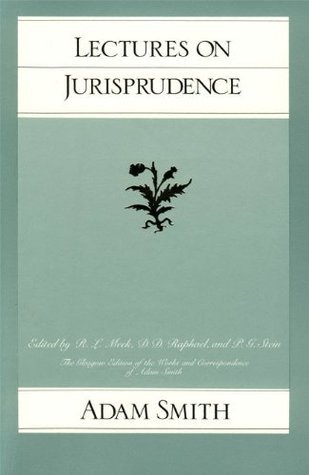
Smith’s Lectures on Jurisprudence, originally delivered at the University of Glasgow in 1762–1763, present his “theory of the rules by which civil government ought to be directed.” The chief purpose of government, according to Smith, is to preserve justice; and “the object of justice is security from injury.” The state must protect the individual’s right to his person, property, reputation, and social relations.Building on his Theory of Moral Sentiments, Smith argues that the state must act as an impartial spectator, judging when an individual has been injured. The state must then design and apply civil and criminal laws to prevent further injuries and punish transgressors. Laws are also the means by which the state promotes public prosperity. Thus, regulations concerning trade, commerce, and production must be crafted so as to encourage rather than interfere with our productive capacities.

No book has done more to instruct, enlighten, and inform conservatives about economics than Adam Smith's undisputed classic.

This carefully annotated selection features the main analysis of the operation of an economic system, the introductory chapter of the great attack on mercantilism, and portions of the analysis of the functions of the state-Books I, IV, and V. Edited by George J. Stigler, this useful volume includes an introduction and a bibliography.

Contents:1. The Wealth of Nations, by Adam SmithAlso available:The Complete Harvard Classics Collection (51 Volumes + The Harvard Classic Shelf Of Fiction)50 Masterpieces You Have To Read Before You Die (Golden Deer Classics)

Reflecting Adam Smith’s wide learning and varied interests, these essays shed considerable light on his place in the Scottish Enlightenment. Included are histories of astronomy, ancient logic, and ancient physics; essays on the “imitative” arts and the affinity between music, dancing, and poetry; and a critical review of Samuel Johnson’s famous Dictionary, which Smith originally published in the Edinburgh Review (1755 - 1756).

The Wealth of Nations Book 5: An Inquiry into the Nature and Causes of the Wealth of Nations.
by Adam Smith
Rating: 4.1 ⭐
Adam Smith's masterpiece, first published in 1776, is the foundation of modern economic thought and remains the single most important account of the rise of, and the principles behind, modern capitalism. Written in clear and incisive prose, The Wealth of Nations articulates the concepts indispensable to an understanding of contemporary society.

Born from the Tree of Life, Una is a little sapling born to destroy an evil tainting her world

Adam Smith fue uno de los exponentes más representativos de la economía clásica, ya que introdujo una serie de nuevos conceptos que lo llevaron a desarrollar los cimientos del liberalismo económico, lo que lo hizo merecedor del título de padre de la economía moderna.La riqueza de las naciones se considera su obra más importante, pues en ella analiza de manera cuidadosa ―no solo desde el prisma económico, sino también social, histórico y moral― la economía de su tiempo, criticando en especial el sistema mercantilista que imperaba y abogando por un sistema de libre mercado poco común en aquel entonces, pero sin duda vigente y estudiado a fondo a día de hoy, más de dos siglos después.

The “Notes of Dr. Smith’s Rhetorick Lectures,” discovered in 1958 by a University of Aberdeen professor, consists of lecture notes taken by two of Smith’s students at the University of Glasgow in 1762–1763. There are thirty lectures in the collection, all on rhetoric and the different kinds or characteristics of style.The book is divided into “an examination of the several ways of communicating our thoughts by speech” and “an attention to the principles of those literary compositions which contribute to persuasion or entertainment.” The species of communication discussed include descriptive and narrative (or historical) composition, poetry, demonstrative oratory, panegyric, didactic or scientific language, deliberative oratory, and judicial or forensic oratory.The subjects addressed in his teachings include the style and genius of some of the best of the ancient writers and poets, especially the historians and the English classics.

Antrajame XVIII a. anglų filosofo moralisto ir ekonomisto A. Smitho klasikinio politinės ekonomijos veikalo, sutrumpintai vadinamo „Tautų turtas“, tome spausdinamos IV ir V knygos. IV knygoje išsamiai analizuojamos dvi tuo metu susiklosčiusios ekonominių pažiūrų sistemos – merkantilizmas ir fiziokratizmas. V knygoje aptariamos valdovo arba valstybės išlaidos gynybai, teisingumo vykdymui, švietimui ir kt., pagrindiniai valstybės pajamų šaltiniai, įvairūs mokesčiai, skolinimosi politika.Knygos leidybą parėmė Vadovų klubų tinklo nariai.

An Inquiry into the Nature and Causes of the Wealth of Nations is the foundation of classical economics, and it has influenced a broad range of thinkers. In it, Adam Smith stresses the importance of the division of labor to economic progress. He criticizes the arguments for economic planning and offers a detailed theoretical and historical case for free trade. Far more than a work on economic theory, The Wealth of Nations contains philosophy, history, and political theory.This program examines the basic problems addressed by Adam Smith in the context of the Scottish Enlightenment. It discusses Adam Smith's general approach to philosophy and how The Wealth of Nations fits into that approach. It then goes on to cover some major themes in The Wealth of Nations, a lengthy and complex book. Some of these include the division of labor, the idea of an unplanned social order, and Smith's defense of free trade. Smith's sometimes difficult arguments are given with the background necessary for comprehension.

The Theory of Moral Sentiments to Which is Added a Dissertation on the Origin of Languages
by Adam Smith
Rating: 3.9 ⭐
Purchase of this book includes free trial access to www.million-books.com where you can read more than a million books for free. This is an OCR edition with typos. Excerpt from book: CHAP. III. Of the manner in which we judge' of the propriety or impropriety of the aff'etlions of other men, by their concord or dif/'onance ivitb our ' .U . own. IJ H E N the original paffions of the perfon principally concerned .are in perfect concord with the fympathetic emotions of the fpectator, they necefTarily appear to this laf t juft and proper, and fuitable to their objects; and, on the contrary, when, upon bringing the cafe home to himfelf, he finds that they do not coincide with what he feels, they neceflarily appear to him unjuft and improper, and unfuitable to the caufes which excite them. To approve of the paffions of another, therefore, as fuitable to their objects, is the fame thing as to obferve that we entirely fympathize with them; anj not to approve of them as fuch, is the fame thing as to obferve that we do not entirely fympathize with them. The man who re- fents the injuries that have been done to me, and obferves that I refent them precifely as he does, neceflarily approves of my refentment. The man whofe fympathy keeps time to my grief, cannot but admit the reafonablenefs of my forrow. He who admires the fame poem, or the fame picture, and admires them exactly as 1 do, muft furely allow the juftnefs of my admiration. He who laughs at the fame joke, and laughs along with me, cannot well deny the propriety of my laughter. On the contrary, the perfon who upon thefe different occafions, either feels no fuch emotion as that which I feel, or feels none that bears any proportion to mine, cannot avoid difapproving my fentiments on account of their diflbnance with his own. If my animofity goes beyond what the indignation of my friend can cor- refpond to j if my grief exceeds what his moft tender compaffion can go along with; if my admiration is eit...
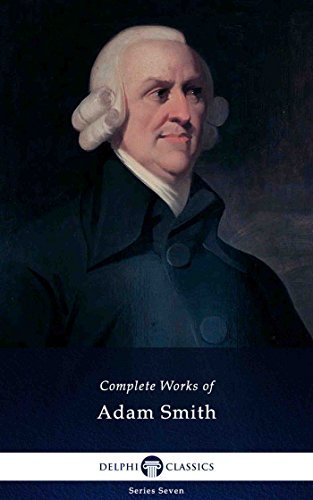
The moral philosopher and pioneer of political economy, Adam Smith was a key figure of the Scottish Enlightenment. His famous treatise ‘The Wealth of Nations’ is the first modern work of economics, earning him recognition as the father of modern economics. This comprehensive eBook presents Smith’s complete works, with numerous illustrations, rare texts appearing in digital print for the first time, informative introductions and the usual Delphi bonus material. (Version 1) * Beautifully illustrated with images relating to Smith’s life and works * Concise introductions to the works * All the published books, with individual contents tables * Includes rare texts appearing for the first time in digital publishing, including lectures by Smith * Images of how the books were first published, giving your eReader a taste of the original texts * Excellent formatting of the texts * Features two biographies, including Dugald Stewart’s first memoir on the great man * Scholarly ordering of texts into chronological order and literary genres Please note: the recently rediscovered LECTURES ON RHETORIC AND BELLES LETTRES cannot appear in this collection due to its copyright status. Please visit www.delphiclassics.com to browse through our range of exciting titles CONTENTS: The Books THE THEORY OF MORAL SENTIMENTS THE ORIGINS OF LANGUAGES AN INQUIRY INTO THE NATURE AND CAUSES OF THE WEALTH OF NATIONS ESSAYS ON PHILOSOPHICAL SUBJECTS The Lectures LECTURES ON JUSTICE, POLICE, REVENUE AND ARMS REPORTED BY A STUDENT IN 1763 The Biographies ACCOUNT OF THE LIFE AND WRITINGS OF ADAM SMITH by Dugald Stewart LIFE OF ADAM SMITH by John Rae Please visit www.delphiclassics.com to browse through our range of exciting titles or to purchase this eBook as a Parts Edition of individual

The Wealth of Nations by Adam Smith is a seminal work in economics that revolutionized our understanding of the market system and laid the foundation for modern capitalism. Smith explores the principles of division of labor, free markets, and the invisible hand, shaping economic thought for centuries to come.Discover the groundbreaking work that shaped modern economics. Explore Adam Smith's profound insights on the market system. Learn about the principles of division of labor and specialization. Gain a deep understanding of the concept of the invisible hand. Explore the impact of "The Wealth of Nations" on economic thought.
![The Wealth of Nations: Adam Smith (Literature, History, Europe) [Annotated]](https://m.media-amazon.com/images/S/compressed.photo.goodreads.com/books/1662913642i/62361394.jpg)
The Wealth of Nations: Adam Smith (Literature, History, Europe) [Annotated]
by Adam Smith
Rating: 3.9 ⭐
An Inquiry into the Nature and Causes of the Wealth of Nations, generally referred to by its shortened title The Wealth of Nations, is the magnum opus of the Scottish economist Adam Smith. First published in 1776, the book offers one of the world's first collected descriptions of what builds nations' wealth and is today a fundamental work in classical economics. Through reflection over the economics at the beginning of the Industrial Revolution the book touches upon such broad topics as the division of labor, productivity, and free markets.