
John McPhee
John Angus McPhee is an American writer. He is considered one of the pioneers of creative nonfiction. He is a four-time finalist for the Pulitzer Prize in the category General Nonfiction, and he won that award on the fourth occasion in 1999 for Annals of the Former World (a collection of five books, including two of his previous Pulitzer finalists). In 2008, he received the George Polk Career Award for his "indelible mark on American journalism during his nearly half-century career". Since 1974, McPhee has been the Ferris Professor of Journalism at Princeton University.
30 Books Written

A Sense of Where You Are: Bill Bradley at Princeton
by John McPhee
Rating: 4.1 ⭐
• 11 recommendations ❤️
The first book from the legendary New Yorker writer John McPhee, tells about Bill Bradley when he was the best basketball player Princeton had ever seen.When John McPhee met Bill Bradley, both were at the beginning of their careers. In A Sense of Where You Are ,McPhee delineates for the reader the training and techniques that made Bradley the extraordinary athlete he was, and this part of the book is a blueprint of superlative basketball. But athletic prowess alone would not explain Bradley's magnetism, which is in the quality of the man himself―his self-discipline, his rationality, and his sense of responsibility.Here is a portrait of Bradley as he was in college, before his time with the New York Knicks and his election to the U.S. Senate―a story that suggests the abundant beginnings of his professional careers in sport and politics.

Levels of the Game is John McPhee's astonishing account of a tennis match played by Arthur Ashe against Clark Graebner at Forest Hills in 1968.It begins with the ball rising into the air for the initial serve and ends with the final point. McPhee provides a brilliant, stroke-by-stroke description while examining the backgrounds and attitudes which have molded the players' games."This may be the high point of American sports journalism"- Robert Lipsyte, The New York Times

Recipient of the Ivan Sandrof Lifetime Achievement AwardDraft No. 4 is a master class on the writer's craft. John McPhee shares insights he has gathered over his long career, and has refined while teaching at Princeton University, where he has nurtured some of the most highly regarded writers of our time. He discusses structure, diction and tone, observing that 'readers are not supposed to notice the structure. It is meant to be about as visible as someone's bones.' This book is a vivid depiction of the writing process, from reporting to drafting to revising - and revising and revising.

In Greenville, New Hampshire, a small town in the southern part of the state, Henri Vaillancourt makes birch-bark canoes in the same manner and with the same tools that the Indians used. The Survival of the Bark Canoe is the story of this ancient craft and of a 150-mile trip through the Maine woods in those graceful survivors of a prehistoric technology. It is a book squarely in the tradition of one written by the first tourist in these woods, Henry David Thoreau, whose The Maine Woods recounts similar journeys in similar vessel. As McPhee describes the expedition he made with Vaillancourt, he also traces the evolution of the bark canoe, from its beginnings through the development of the huge canoes used by the fur traders of the Canadian North Woods, where the bark canoe played the key role in opening up the wilderness. He discusses as well the differing types of bark canoes, whose construction varied from tribe to tribe, according to custom and available materials. In a style as pure and as effortless as the waters of Maine and the glide of a canoe, John McPhee has written one of his most fascinating books, one in which his talents as a journalist are on brilliant display.

While John McPhee was working on his previous book, Rising from the Plains, he happened to walk by the engineering building at the University of Wyoming, where words etched in limestone said: "Strive on--the control of Nature is won, not given." In the morning sunlight, that central phrase--"the control of nature"--seemed to sparkle with unintended ambiguity. Bilateral, symmetrical, it could with equal speed travel in opposite directions. For some years, he had been planning a book about places in the world where people have been engaged in all-out battles with nature, about (in the words of the book itself) "any struggle against natural forces--heroic or venal, rash or well advised--when human beings conscript themselves to fight against the earth, to take what is not given, to rout the destroying enemy, to surround the base of Mt. Olympus demanding and expecting the surrender of the gods." His interest had first been sparked when he went into the Atchafalaya--the largest river swamp in North America--and had learned that virtually all of its waters were metered and rationed by a U.S. Army Corps of Engineers' project called Old River Control.In the natural cycles of the Mississippi's deltaic plain, the time had come for the Mississippi to change course, to shift its mouth more than a hundred miles and go down the Atchafalaya, one of its distributary branches. The United States could not afford that--for New Orleans, Baton Rouge, and all the industries that lie between would be cut off from river commerce with the rest of the nation. At a place called Old River, the Corps therefore had built a great fortress--part dam, part valve--to restrain the flow of the Atchafalaya and compel the Mississippi to stay where it is.In Iceland, in 1973, an island split open without warning and huge volumes of lava began moving in the direction of a harbor scarcely half a mile away. It was not only Iceland's premier fishing port (accounting for a large percentage of Iceland's export economy) but it was also the only harbor along the nation's southern coast. As the lava threatened to fill the harbor and wipe it out, a physicist named Thorbjorn Sigurgeirsson suggested a way to fight against the flowing red rock--initiating an all-out endeavor unique in human history. On the big island of Hawaii, one of the world's two must eruptive hot spots, people are not unmindful of the Icelandic example. McPhee went to Hawaii to talk with them and to walk beside the edges of a molten lake and incandescent rivers.Some of the more expensive real estate in Los Angeles is up against mountains that are rising and disintegrating as rapidly as any in the world. After a complex coincidence of natural events, boulders will flow out of these mountains like fish eggs, mixed with mud, sand, and smaller rocks in a cascading mass known as debris flow. Plucking up trees and cars, bursting through doors and windows, filling up houses to their eaves, debris flows threaten the lives of people living in and near Los Angeles' famous canyons. At extraordinary expense the city has built a hundred and fifty stadium-like basins in a daring effort to catch the debris.Taking us deep into these contested territories, McPhee details the strategies and tactics through which people attempt to control nature. Most striking in his vivid depiction of the main contestants: nature in complex and awesome guises, and those who would attempt to wrest control from her--stubborn, often ingenious, and always arresting characters.

A classic of reportage, Oranges was first conceived as a short magazine article about oranges and orange juice, but the author kept encountering so much irresistible information that he eventually found that he had in fact written a book. It contains sketches of orange growers, orange botanists, orange pickers, orange packers, early settlers on Florida's Indian River, the first orange barons, modern concentrate makers, and a fascinating profile of Ben Hill Griffin of Frostproof, Florida who may be the last of the individual orange barons. McPhee's astonishing book has an almost narrative progression, is immensely readable, and is frequently amusing. Louis XIV hung tapestries of oranges in the halls of Versailles, because oranges and orange trees were the symbols of his nature and his reign. This book, in a sense, is a tapestry of oranges, too―with elements in it that range from the great orangeries of European monarchs to a custom of people in the modern Caribbean who split oranges and clean floors with them, one half in each hand.

The Pulitzer Prize-winning view of the continent, across the fortieth parallel and down through 4.6 billion yearsTwenty years ago, when John McPhee began his journeys back and forth across the United States, he planned to describe a cross section of North America at about the fortieth parallel and, in the process, come to an understanding not only of the science but of the style of the geologists he traveled with. The structure of the book never changed, but its breadth caused him to complete it in stages, under the overall title Annals of the Former World.Like the terrain it covers, Annals of the Former World tells a multilayered tale, and the reader may choose one of many paths through it. As clearly and succinctly written as it is profoundly informed, this is our finest popular survey of geology and a masterpiece of modern nonfiction.Annals of the Former World is the winner of the 1999 Pulitzer Prize for Nonfiction.
The narratives in this book are of journeys made in three wildernesses - on a coastal island, in a Western mountain range, and on the Colorado River in the Grand Canyon. The four men portrayed here have different relationships to their environment, and they encounter each other on mountain trails, in forests and rapids, sometimes with reserve, sometimes with friendliness, sometimes fighting hard across a philosophical divide.

‘John McPhee is celebrated in America and all but unknown in this country. The volume I love most is Coming into the Country, an account of Alaska and the Alaskans. His genius is that he can write about anything.’ – Robert MacfarlaneIn this unforgettable and astutely observed travel account, Pulitzer Prize-winner John McPhee journeys into the wild frontiers and frigid climate of Alaska – exploring the diverse terrain of this Northern US state. Travelling by foot and canoe, helicopter and dog team, McPhee traverses total wilderness, urban landscape, and the depths of the bush, drawing a rich and comprehensive history of this vast land and its varied inhabitants.With his keen eye and poetic sensibility at the helm, we paddle with McPhee through the salmon-filled waters of the Brooks Range Rivers, meet a young chief of the Athapaskan tribe, and become well-acquainted with the habits of the barren-ground grizzly bear. We encounter settlers along the way and discover the extraordinary dreams that impel them to survive in one of the most remote regions on Earth.McPhee is an endlessly curious adventurer and Coming into the Country is the work of a master storyteller.‘It is a reviewer’s greatest pleasure to ring the gong for a species of masterpiece.’ – New York Times Book Review‘McPhee has acted like an antenna in a far-off place that few will see. He has brought back a wholly satisfying voyage of spirit and mind.’ – Time‘With this book McPhee proves to be the most versatile journalist in America.’ – New York Times

"You people come into the market―the Greenmarket, in the open air under the down pouring sun―and you slit the tomatoes with your fingernails. With your thumbs, you excavate the cheese. You choose your stringbeans one at a time. You pulp the nectarines and rape the sweet corn. You are something wonderful, you are―people of the city―and we, who are almost without exception strangers here, are as absorbed with you as you seem to be with the numbers on our hanging scales." So opens the title piece in this collection of John McPhee's classic essays, grouped here with four others, including "Brigade de Cuisine," a profile of an artistic and extraordinary chef; "The Keel of Lake Dickey," in which a journey down the whitewater of a wild river ends in the shadow of a huge projected dam; a report on plans for the construction of nuclear power plants that would float in the ocean; and a pinball shoot-out between two prizewinning journalists.

Anyone who has ever traveled in Switzerland cannot help but to have remarked upon the overwhelming tranquility of the country. But this tranquility is illusory. As John McPhee writes in La Place de la Concorde Suisse, a rich journalistic study of the Swiss Army's role in Swiss society, "there is scarcely a scene in Switzerland that is not ready to erupt in fire to repel an invasive war." With a population smaller than New Jersey's, Switzerland has a standing army of 650,000 ready to be mobilized in less than 48 hours. The Swiss Army, known in this country chiefly for its little red pocketknives, is so quietly efficient at the arts of war that the Israelis carefully patterned their own military on the Swiss model. You'll understand why after reading this outstanding book.

Most people think of New Jersey as a suburban-industrial corridor that runs between New York and Philadelphia. Yet in the low center of the state is a near wilderness, larger than most national parks, which has been known since the seventeenth century as the Pine Barrens.The term refers to the predominant trees in the vast forests that cover the area and to the quality of the soils below, which are too sandy and acid to be good for farming. On all sides, however, developments of one kind or another have gradually moved in, so that now the central and integral forest is reduced to about a thousand square miles. Although New Jersey has the heaviest population density of any state, huge segments of the Pine Barrens remain uninhabited. The few people who dwell in the region, the "Pineys," are little known and often misunderstood. Here McPhee uses his uncanny skills as a journalist to explore the history of the region and describe the people "and their distinctive folklore" who call it home.
The first of John McPhee’s works in his series on geology and geologists, Basin and Range is a book of journeys through ancient terrains, always in juxtaposition with travels in the modern world—a history of vanished landscapes, enhanced by the histories of people who bring them to light. The title refers to the physiographic province of the United States that reaches from eastern Utah to eastern California, a silent world of austere beauty, of hundreds of discrete high mountain ranges that are green with junipers and often white with snow. The terrain becomes the setting for a lyrical evocation of the science of geology, with important digressions into the plate-tectonics revolution and the history of the geologic time scale.

At various times in a span of fifteen years, John McPhee made geological field surveys in the company of Eldridge Moores, a tectonicist at the University of California at Davis. The result of these trips is Assembling California, a cross-section in human and geologic time, from Donner Pass in the Sierra Nevada through the golden foothills of the Mother Lode and across the Great Central Valley to the wine country of the Coast Ranges, the rock of San Francisco, and the San Andreas family of faults. The two disparate time scales occasionally intersect--in the gold disruptions of the nineteenth century no less than in the earthquakes of the twentieth--and always with relevance to a newly understood geologic history in which half a dozen large and separate pieces of country are seen to have drifted in from far and near to coalesce as California.McPhee and Moores also journeyed to remote mountains of Arizona and to Cyprus and northern Greece, where rock of the deep-ocean floor has been transported into continental settings, as it has in California. Global in scope and a delight to read, Assembling California is a sweeping narrative of maps in motion, of evolving and dissolving lands.

What John McPhee's books all have in common is that they are about real people in real places. Here, at his adventurous best, he is out and about with people who work in freight transportation.Over the past eight years, John McPhee has spent considerable time in the company of people who work in freight transportation. Uncommon Carriers is his sketchbook of them and of his journeys with them. He rides from Atlanta to Tacoma alongside Don Ainsworth, owner and operator of a sixty-five-foot, eighteen-wheel chemical tanker carrying hazmats. McPhee attends ship-handling school on a pond in the foothills of the French Alps, where, for a tuition of $15,000 a week, skippers of the largest ocean ships refine their capabilities in twenty-foot scale models. He goes up the tight-assed Illinois River on atowboat pushing a triple string of barges, the overall vessel being a good deal longer than the Titanic. And he travels by canoe up the canal-and-lock commercial waterways traveled by Henry David Thoreau and his brother, John, in a homemade skiff in 1839.Uncommon Carriers is classic work by McPhee, in prose distinguished, as always, by its author's warm humor, keen insight, and rich sense of human character.

This is about high-country geology and a Rocky Mountain regional geologist. I raise that semaphore here at the start so no one will feel misled by an opening passage in which a slim young woman who is not in any sense a geologist steps down from a train in Rawlins, Wyoming, in order to go north by stagecoach into country that was still very much the Old West. So begins John McPhee's Rising from the Plains. If you like to read about geology, you will find good reading here. If, on the other hand, you are not much engaged by the spatial complexities of the science, you could miss a richness of human history that has its place among the strata described. Sometimes it is said of geologists that they reflect in their professional styles the sort of country in which they grew up. Nowhere could that be more true than in the life of a geologist born in the center of Wyoming and raised on an isolated ranch. This is the story of that ranch, soon after the turn of the century, and of the geologist who grew up there, at home with the composition of the high country in the way that someone growing up in a coastal harbor would be at home with the vagaries of the sea. While Rising from the Plains is a portrayal of extraordinary people, it is also a history of the landscape around them, where, with remarkable rapidity, mountains came up out of the flat terrain. Gradually, the mountains were buried, until only the higher peaks remained above a vast plain. Recently, they have been exhumed, and they stand now as the Rockies. Rising from the Plains is John McPhee's third book on geology and geologists. Following Basin and Range and In Suspect Terrain, it continues to present a cross section of North America along the fortieth parallel—a series gathering under the overall title Annals of the Former World.Description from the first-edition dust jacket (1986).

On one of the last American merchant ships, second mate Andy Chase and author board the S.S. Stella Lykes, captained by Paul McHenry Washburn. The 42-day journey down the Pacific coast of South America stops for freight at Cartagena, Balboa, Lima, and Guayaquil — notorious for pirates. The crew exchange tales of disaster, stupidity, greed, generosity, and courage.

From the outwash plains of Brooklyn to Indiana's drifted diamonds and gold In Suspect Terrain is a narrative of the earth, told in four sections of equal length, each in a different way reflecting the three others―a biography; a set piece about a fragment of Appalachian landscape in illuminating counterpoint to the human history there; a modern collision of ideas about the origins of the mountain range; and, in contrast, a century-old collision of ideas about the existence of the Ice Age. The central figure is Anita Harris, an internationally celebrated geologist who went into her profession to get out of a Brooklyn ghetto. The unifying theme is plate tectonics―here concentrating on the acceptance that all aspects of the theory do not universally enjoy. As such, In Suspect Terrain is a report from the rough spots at the front edge of a science.

When John McPhee returned to the island of his ancestors?Colonsay, twenty-five miles west of the Scottish mainland?a hundred and thirty-eight people were living there. About eighty of these, crofters and farmers, had familial histories of unbroken residence on the island for two or three hundred years; the rest, including the English laird who owned Colonsay, were ?incomers.? Donald McNeill, the crofter of the title, was working out his existence in this last domain of the feudal system; the laird, the fourth Baron Strathcona, lived in Bath, appeared on Colonsay mainly in the summer, and accepted with nonchalance the fact that he was the least popular man on the island he owned. While comparing crofter and laird, McPhee gives readers a deep and rich portrait of the terrain, the history, the legends, and the people of this fragment of the Hebrides.

John McPhee's twenty-sixth book is a braid of personal history, natural history, and American history, in descending order of volume. Each spring, American shad-Alosa sapidissima-leave the ocean in hundreds of thousands and run heroic distances upriver to spawn. McPhee--a shad fisherman himself--recounts the shad's cameo role in the lives of George Washington and Henry David Thoreau. He fishes with and visits the laboratories of famous ichthyologists; he takes instruction in the making of shad darts from a master of the art; and he cooks shad in a variety of ways, delectably explained at the end of the book. Mostly, though, he goes fishing for shad in various North American rivers, and he "fishes the same way he writes books, avidly and intensely. He wants to know everything about the fish he's after--its history, its habits, its place in the cosmos" (Bill Pride, The Denver Post). His adventures in pursuit of shad occasion the kind of writing--expert and ardent--at which he has no equal.

With his customary reportorial brilliance, John McPhee has written the story of the life and career of Theodore B. Taylor, a theoretical physicist who has been one of the most inventive nuclear scientists of our time.Taylor was one of the most brilliant engineers of the nuclear age, but in his later years he became concerned with the possibility of an individual being able to construct a weapon of mass destruction on their own. McPhee tours American nuclear institutions with Taylor and shows us how close we are to terrorist attacks employing homemade nuclear weaponry.

The John McPhee Reader, first published in 1976, is comprised of selections from the author's first twelve books. In 1965, John McPhee published his first book, A Sense of Where You Are; a decade later, he had published eleven others. His fertility, his precision and grace as a stylist, his wit and uncanny brilliance in choosing subject matter, his crack storytelling skills have made him into one of our best writers: a journalist whom L.E. Sissman ranked with Liebling and Mencken, who Geoffrey Wolff said "is bringing his work to levels that have no measurable limit," who has been called "a master craftsman" so many times that it is pointless to number them.

A WONDROUS NEW BOOK OF MCPHEE'S PROSE PIECES—IN MANY ASPECTS HIS MOST PERSONAL IN FOUR DECADES The brief, brilliant essay "Silk Parachute," which first appeared in The New Yorker a decade ago, has become John McPhee's most anthologized piece of writing. In the nine other pieces here—highly varied in length and theme—McPhee ranges with his characteristic humor and intensity through lacrosse, long-exposure view-camera photography, the weird foods he has sometimes been served in the course of his reportorial travels, a U.S. Open golf championship, and a season in Europe "on the chalk" from the downs and sea cliffs of England to the Maas valley in the Netherlands and the champagne country of northern France. Some of the pieces are wholly personal. In luminous recollections of his early years, for example, he goes on outings with his mother, deliberately overturns canoes in a learning process at a summer camp, and germinates a future book while riding on a jump seat to away games as a basketball player. But each piece—on whatever theme—contains somewhere a personal aspect in which McPhee suggests why he was attracted to write about the subject, and each opens like a silk parachute, lofted skyward and suddenly blossoming with color and form.

This acclaimed collection of essays begins with the title essay and a trip to Nevada, where, in the company of a brand inspector, John McPhee discovers that cattle rustling is not just history.

Starting in 1902 at a country school that had an enrollment of fourteen, Frank Boyden built an academy that has long since taken its place on a level with Andover and Exeter. Boyden, who died in 1972, was the school's headmaster for sixty-six years. John McPhee portrays a remarkable man "at the near end of a skein of magnanimous despots who...created enduring schools through their own individual energies, maintained them under their own absolute rule, and left them forever imprinted with their own personalities." More than simply a portrait of the Headmaster of Deerfield Academy, it is a revealing look at the nature of private school education in America.

An "album quilt," an artful assortment of nonfiction writings by John McPhee that have not previously appeared in any bookThe Patch is the seventh collection of essays by the nonfiction master, all published by Farrar, Straus and Giroux. It is divided into two parts.Part 1, "The Sporting Scene," consists of pieces on fishing, football, golf, and lacrosse--from fly casting for chain pickerel in fall in New Hampshire to walking the linksland of St. Andrews at an Open Championship. Part 2, called "An Album Quilt," is a montage of fragments of varying length from pieces done across the years that have never appeared in book form--occasional pieces, memorial pieces, reflections, reminiscences, and short items in various magazines including The New Yorker. They range from a visit to the Hershey chocolate factory to encounters with Oscar Hammerstein, Joan Baez, and Mount Denali.Emphatically, the author's purpose was not merely to preserve things but to choose passages that might entertain contemporary readers. Starting with 250,000 words, he gradually threw out 75 percent of them, and randomly assembled the remaining fragments into "an album quilt." Among other things, The Patch is a covert memoir.

A literary legend’s engaging review of his career, stressing the work he never completed, and why.Over seven decades, John McPhee has set a standard for literary nonfiction. Assaying mountain ranges, bark canoes, experimental aircraft, the Swiss Army, geophysical hot spots, ocean shipping, shad fishing, dissident art in the Soviet Union, and an even wider variety of other subjects, he has consistently written narrative pieces of immaculate design.In Tabula Rasa, Volume 1 , McPhee looks back at his career from the vantage point of his desk drawer, reflecting wryly upon projects he once planned to do but never got around to―people to profile, regions he meant to portray. There are so many examples that he plans to go on writing these vignettes, an ideal project for an old man, he says, and a “reminiscent montage” from a writing life. This first volume includes, among other things, glimpses of a frosty encounter with Thornton Wilder, interrogative dinners with Henry Luce, the allure of western Spain, criteria in writing about science, fireworks over the East River as seen from Malcolm Forbes’s yacht, the evolving inclinations of the Tower of Pisa, the islands among the river deltas of central California, teaching in a pandemic, and persuading The New Yorker to publish an entire book on oranges. The result is a fresh survey of McPhee’s singular planet.
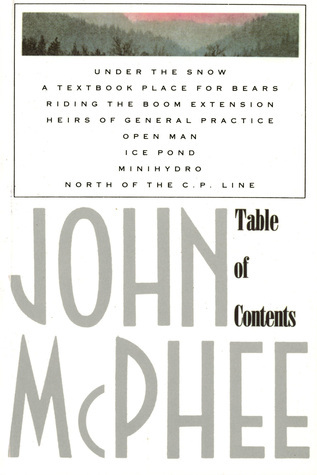
Table of Contents is a collection of eight pieces that range from Alaska to New Jersey, describing, for example, the arrival of telephones in a small village near the Arctic Circle and the arrival of wild bears in considerable numbers in New Jersey, swarming in from the Poconos in search of a better life ("Riding the Boom Extension," "A Textbook Place for Bears").In "North of the C.P. Line" the author introduces his friend John McPhee, a bush-pilot fish-and-game warden in northern Maine, who is also a writer. The two men met after the flying warden wrote to The New Yorker complaining that someone was using his name. Maine also is the milieu of "Heirs of General Practice," McPhee's highly acclaimed report―virtually a book in itself―on the new medical specialty called family practice. Much of it takes place in the examining rooms of a dozen young physicans in various rural communities, where they are seen in the context of their work with a great many patients of all ages.Two relatively short pieces revisit the subjects of earlier McPhee books. "Ice Pond" demonstrates anew the innovative genius of the physicist Theodore B. Taylor, who developed a way of making and using with impressive results in the conservation of the electrical energy. "Open Man" describes a summer day in New Jersey in the company of Senator Bill Bradley.In "Minihydro," various small-scale entrepreneurs in New York State set up turbines at nineteenth-century mill sites and sell electricity to power companies. A nice little country waterfall can earn as much as two hundred dollars a year for someone with such a turbine. And, "Under the Snow," McPhee Goes back into black bear's dens in Pensylvania in winter, where he becomes intoxicated with affection for some five-pound cubs. They remind him of his daughters.

This is the fascinating story of the dream of a completely new aircraft, a hybrid of the plane and the rigid airship - huge, wingless, moving slowly through the lower sky. John McPhee chronicles the perhaps unfathomable perseverance of the aircraft's sucessive progenitors.

Heirs of General Practice is a frieze of glimpses of young doctors with patients of every age―about a dozen physicians in all, who belong to the new medical specialty called family practice. They are people who have addressed themselves to a need for a unifying generalism in a world that has become greatly subdivided by specialization, physicians who work with the "unquantifiable idea that a doctor who treats your grandmother, your father, your niece, and your daughter will be more adroit in treating you."These young men and women are seen in their examining rooms in various rural communities in Maine, but Maine is only the example. Their medical objectives, their successes, the professional obstacles they do and do not overcome are representative of any place family practitioners are working. While essential medical background is provided, McPhee's masterful approach to a trend significant to all of us is replete with affecting, and often amusing, stories about both doctors and their charges.