
Roger Lowenstein
Roger Lowenstein is an American financial journalist and writer. He graduated from Cornell University and reported for The Wall Street Journal for more than a decade, including two years writing its Heard on the Street column, 1989 to 1991. Born in 1954, he is the son of Helen and Louis Lowenstein of Larchmont, New York. Lowenstein is married to Judith Slovin. He is also a director of Sequoia Fund. In 2016, he joined the board of trustees of Lesley University. His father, the late Louis Lowenstein, was an attorney and Columbia University law professor who wrote books and articles critical of the American financial industry. Roger Lowenstein's latest book, Ways and Means: Lincoln and His Cabinet and the Financing of the Civil War, was released on March 8, 2022, and won the 2022 Harold Holzer Lincoln Forum Book Prize.
26 Books Written

Since its hardcover publication in August of 1995, Buffett has appeared on the Wall Street Journal, New York Times, San Francisco Chronicle, Los Angeles Times, Seattle Times, Newsday and Business Week bestseller lists.Starting from scratch, simply by picking stocks and companies for investment, Warren Buffett amassed one of the epochal fortunes of the twentieth century—an astounding net worth of $10 billion, and counting. His awesome investment record has made him a cult figure popularly known for his seeming a billionaire who has a modest lifestyle, a phenomenally successful investor who eschews the revolving-door trading of modern Wall Street, a brilliant dealmaker who cultivates a homespun aura.Journalist Roger Lowenstein draws on three years of unprecedented access to Buffett’s family, friends, and colleagues to provide the first definitive, inside account of the life and career of this American original. Buffett explains Buffett’s investment strategy—a long-term philosophy grounded in buying stock in companies that are undervalued on the market and hanging on until their worth invariably surfaces—and shows how it is a reflection of his inner self.
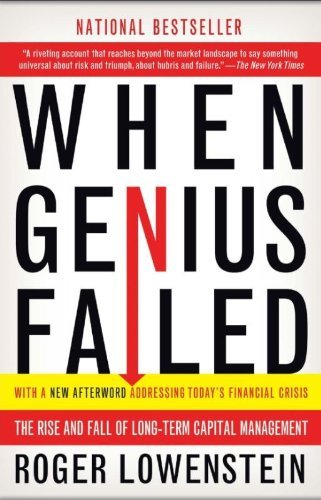
When Genius Failed: The Rise and Fall of Long-Term Capital Management
by Roger Lowenstein
Rating: 4.2 ⭐
“A riveting account that reaches beyond the market landscape to say something universal about risk and triumph, about hubris and failure.”— The New York TimesNAMED ONE OF THE BEST BOOKS OF THE YEAR BY BUSINESSWEEKIn this business classic—now with a new Afterword in which the author draws parallels to the recent financial crisis—Roger Lowenstein captures the gripping roller-coaster ride of Long-Term Capital Management. Drawing on confidential internal memos and interviews with dozens of key players, Lowenstein explains not just how the fund made and lost its money but also how the personalities of Long-Term’s partners, the arrogance of their mathematical certainties, and the culture of Wall Street itself contributed to both their rise and their fall.When it was founded in 1993, Long-Term was hailed as the most impressive hedge fund in history. But after four years in which the firm dazzled Wall Street as a $100 billion moneymaking juggernaut, it suddenly suffered catastrophic losses that jeopardized not only the biggest banks on Wall Street but the stability of the financial system itself. The dramatic story of Long-Term’s fall is now a chilling harbinger of the crisis that would strike all of Wall Street, from Lehman Brothers to AIG, a decade later. In his new Afterword, Lowenstein shows that LTCM’s implosion should be seen not as a one-off drama but as a template for market meltdowns in an age of instability—and as a wake-up call that Wall Street and government alike tragically ignored.Praise for When Genius Failed“[Roger] Lowenstein has written a squalid and fascinating tale of world-class greed and, above all, hubris.” —BusinessWeek“Compelling . . . The fund was long cloaked in secrecy, making the story of its rise . . . and its ultimate destruction that much more fascinating.” — The Washington Post“Story-telling journalism at its best.” — The Economist

Watch a VideoDownload the cheat sheet for Roger Lowenstein's The End of Wall Street » The roots of the mortgage bubble and the story of the Wall Street collapse-and the government's unprecedented response-from our most trusted business journalist.The End of Wall Street is a blow-by-blow account of America's biggest financial collapse since the Great Depression. Drawing on 180 interviews, including sit-downs with top government officials and Wall Street CEOs, Lowenstein tells, with grace, wit, and razor-sharp understanding, the full story of the end of Wall Street as we knew it. Displaying the qualities that made When Genius Failed a timeless classic of Wall Street-his sixth sense for narrative drama and his unmatched ability to tell complicated financial stories in ways that resonate with the ordinary reader- Roger Lowenstein weaves a financial, economic, and sociological thriller that indicts America for succumbing to the siren song of easy debt and speculative mortgages.The End of Wall Street is rife with historical lessons and bursting with fast-paced action. Lowenstein introduces his story with precisely etched, laserlike profiles of Angelo Mozilo, the Johnny Appleseed of subprime mortgages who spreads toxic loans across the landscape like wild crabapples, and moves to a damning explication of how rating agencies helped gift wrap faulty loans in the guise of triple-A paper and a takedown of the academic formulas that-once again- proved the ruin of investors and banks. Lowenstein excels with a series of searing profiles of banking CEOs, such as the ferretlike Dick Fuld of Lehman and the bloodless Jamie Dimon of JP Morgan, and of government officials from the restless, deal-obsessed Hank Paulson and the overmatched Tim Geithner to the cerebral academic Ben Bernanke, who sought to avoid a repeat of the one crisis he spent a lifetime trying to understand-the Great Depression. Finally, we come to understand the majesty of Lowenstein's theme of liquidity and capital, which explains the origins of the crisis and that positions the collapse of 2008 as the greatest ever of Wall Street's unlearned lessons. The End of Wall Street will be essential reading as we work to identify the lessons of the market failure and start to reb...

A tour de force of historical reportage, America’s Bank illuminates the tumultuous era and remarkable personalities that spurred the unlikely birth of America’s modern central bank, the Federal Reserve. Today, the Fed is the bedrock of the financial landscape, yet the fight to create it was so protracted and divisive that it seems a small miracle that it was ever established. For nearly a century, America, alone among developed nations, refused to consider any central or organizing agency in its financial system. Americans’ mistrust of big government and of big banks—a legacy of the country’s Jeffersonian, small-government traditions—was so widespread that modernizing reform was deemed impossible. Each bank was left to stand on its own, with no central reserve or lender of last resort. The real-world consequences of this chaotic and provincial system were frequent financial panics, bank runs, money shortages, and depressions. By the first decade of the twentieth century, it had become plain that the outmoded banking system was ill equipped to finance America’s burgeoning industry. But political will for reform was lacking. It took an economic meltdown, a high-level tour of Europe, and—improbably—a conspiratorial effort by vilified captains of Wall Street to overcome popular resistance. Finally, in 1913, Congress conceived a federalist and quintessentially American solution to the conflict that had divided bankers, farmers, populists, and ordinary Americans, and enacted the landmark Federal Reserve Act.Roger Lowenstein—acclaimed financial journalist and bestselling author of When Genius Failed and The End of Wall Street—tells the drama-laden story of how America created the Federal Reserve, thereby taking its first steps onto the world stage as a global financial power. America’s Bank showcases Lowenstein at his very finest: illuminating complex financial and political issues with striking clarity, infusing the debates of our past with all the gripping immediacy of today, and painting unforgettable portraits of Gilded Age bankers, presidents, and politicians.Lowenstein focuses on the four men at the heart of the struggle to create the Federal Reserve. These were Paul Warburg, a refined, German-born financier, recently relocated to New York, who was horrified by the primitive condition of America’s finances; Rhode Island’s Nelson W. Aldrich, the reigning power broker in the U.S. Senate and an archetypal Gilded Age legislator; Carter Glass, the ambitious, if then little-known, Virginia congressman who chaired the House Banking Committee at a crucial moment of political transition; and President Woodrow Wilson, the academician-turned-progressive-politician who forced Glass to reconcile his deep-seated differences with bankers and accept the principle (anathema to southern Democrats) of federal control. Weaving together a raucous era in American politics with a storied financial crisis and intrigue at the highest levels of Washington and Wall Street, Lowenstein brings the beginnings of one of the country’s most crucial institutions to vivid and unforgettable life. Readers of this gripping historical narrative will wonder whether they’re reading about one hundred years ago or the still-seething conflicts that mark our discussions of banking and politics today.

Ways and Means: Lincoln and His Cabinet and the Financing of the Civil War
by Roger Lowenstein
Rating: 4.2 ⭐
From renowned journalist and master storyteller Roger Lowenstein, a revelatory financial investigation into how Lincoln and his administration used the funding of the Civil War as the catalyst to centralize the government and accomplish the most far-reaching reform in the country's history Upon his election to the presidency, Abraham Lincoln inherited a country in crisis. Even before the Confederacy's secession, the United States Treasury had run out of money. The government had no authority to raise taxes, no federal bank, no currency. But amid unprecedented troubles Lincoln saw opportunity--the chance to legislate in the centralizing spirit of the "more perfect union" that had first drawn him to politics. With Lincoln at the helm, the United States would now govern "for" its people: it would enact laws, establish a currency, raise armies, underwrite transportation and higher education, assist farmers, and impose taxes for them. Lincoln believed this agenda would foster the economic opportunity he had always sought for upwardly striving Americans, and which he would seek in particular for enslaved Black Americans.Salmon Chase, Lincoln's vanquished rival and his new secretary of the Treasury, waged war on the financial front, levying taxes and marketing bonds while desperately battling to contain wartime inflation. And while the Union and Rebel armies fought increasingly savage battles, the Republican-led Congress enacted a blizzard of legislation that made the government, for the first time, a powerful presence in the lives of ordinary Americans. The impact was revolutionary. The activist 37th Congress legislated for homesteads and a transcontinental railroad and involved the federal government in education, agriculture, and eventually immigration policy. It established a progressive income tax and created the greenback--paper money. While the Union became self-sustaining, the South plunged into financial free fall, having failed to leverage its cotton wealth to finance the war. Founded in a crucible of anticentralism, the Confederacy was trapped in a static (and slave-based) agrarian economy without federal taxing power or other means of government financing, save for its overworked printing presses. This led to an epic collapse. Though Confederate troops continued to hold their own, the North's financial advantage over the South, where citizens increasingly went hungry, proved decisive; the war was won as much (or more) in the respective treasuries as on the battlefields.Roger Lowenstein reveals the largely untold story of how Lincoln used the urgency of the Civil War to transform a union of states into a nation. Through a financial lens, he explores how this second American revolution, led by Lincoln, his cabinet, and a Congress studded with towering statesmen, changed the direction of the country and established a government of the people, by the people, and for the people.

While America Aged: How Pension Debts Ruined General Motors, Stopped the NYC Subways, Bankrupted San Diego, and Loom as the Next Financial Crisis
by Roger Lowenstein
Rating: 3.8 ⭐
While America Aged illuminates the scope of the problem we’re facing, and warns that the worst is yet to come. With the narrative flair and talent for decoding financial ambiguities that readers have come to rely on, Lowenstein brilliantly chronicles three fascinating pension the collapse of the over-obligated General Motors, the pension strike that halted New York City’s subways and effectively shut down the city, and the scandalous bankrupting of the affluent corner of Southern California, the city of San Diego. Not only compelling historical sagas rich with detail and unforgettable characters, each story also acts as an object lesson. Lowenstein warns that these pension wars are only the beginning of the retirement and healthcare crisis we will face if we don’t find ways to address this latest moral hazard. Governments and corporations across the country used pensions as a seemingly easy way to curry favor with unions (easy because the expense would be deferred until a later generation). But now, with cumulative retirement deficits approaching $1 trillion, the day of reckoning has arrived. Is there a way out? Lowenstein recognizes that fixing pensions will be difficult but securing retirement is a critical issue—especially in our rapidly aging country—and he proposes a cogent solution to the impending crisis. Masterfully written and convincingly argued, While America Aged is a timely and crucial wake-up call to a pension damaged America.

With his singular gift for turning complex financial events into eminently readable stories, Roger Lowenstein lays bare the labyrinthine events of the manic and tumultuous 1990s. In an enthralling narrative, he ties together all of the characters of the dot-com bubble and offers a unique portrait of the culture of the era. Just as John Kenneth Galbraith’s The Great Crash was a defining text of the Great Depression, Lowenstein’s Origins of the Crash is destined to be the book that will frame our understanding of the 1990s.

Benjamin Graham developed value investing, a style adopted by Warren Buffett, one of history's most successful investors; it is based on fundamental analysis, which quantitatively compares a company's stock price to various measures of financial strength and promise. Growth investing is a fundamentally different style that seeks to identify tomorrow's great business successes. Learn the ins and outs, and the pros and cons, of these basic investment styles.

When Genius Failed The Rise and Fall of Long Term Capital Management Paperback 2 Jan 2002
by Roger Lowenstein
Rating: 4.5 ⭐

Since its hardcover publication in August of 1995, Buffett has appeared on the Wall Street Journal, New York Times, San Francisco Chronicle, Los Angeles Times, Seattle Times, Newsday and Business Week bestseller lists. The incredible landmark portrait of Warren Buffett's uniquely American life is now available in paperback, revised and updated by the author. Starting from scratch, simply by picking stocks and companies for investment, Warren Buffett amassed one of the epochal fortunes of the twentieth century--an astounding net worth of $10 billion, and counting. His awesome investment record has made him a cult figure popularly known for his seeming a billionaire who has a modest lifestyle, a phenomenally successful investor who eschews the revolving-door trading of modern Wall Street, a brilliant dealmaker who cultivates a homespun aura. Journalist Roger Lowenstein draws on three years of unprecedented access to Buffett's family, friends, and colleagues to provide the first definitive, inside account of the life and career of this American original. Buffett explains Buffett's' investment strategy--a long-term philosophy grounded in buying stock in companies that are undervalued on the market and hanging on until their worth invariably surfaces--and shows how it is a reflection of his inner self.


While America Aged: How Pension Debts Ruined General Motors, Stopped the NYC Sub
by Roger Lowenstein
Rating: 4.5 ⭐

Buffett: The Making of an American Capitalist (in Simplified Chinese) by Roger Lowenstein (2007) Paperback
by Roger Lowenstein
Rating: 4.5 ⭐

Warren Buffett - Quá trình Hình Thành Một Nhà Tư Bản Mỹ - Tái bản 12/13/2013
by Roger Lowenstein
Rating: 5.0 ⭐
Kể từ khi được xuất bản vào tháng Tám năm 1995, cuốn Buffett đã xuất hiện trong danh sách bán chạy nhất của các tờ Wall Street Journal, New York Times, San Francisco Chronicle, Los Angeles Times, Seattle Times, Newsday và Business Week.Khởi đầu từ con số không, chỉ đơn giản bằng cách chọn các cổ phiếu và các công ty để đầu tư, Warren Buffett tích lũy được một một tài sản ròng đồ sộ trị giá 10 tỷ USD, và hiện vẫn đang ngày càng tăng. Hồ sơ đầu tư đáng kinh ngạc của ông đã khiến ông trở thành một hình mẫu được sùng bái trong giới đầu tư, nổi tiếng với vẻ mâu thuẫn của mì một tỷ phú với lối sống rất chừng mực, một nhà đầu tư thành công phi thường mà không phải ra vào thường xuyên Phố Wall.Nhà báo Roger Lowenstein dựa trên ba năm tiếp xúc với gia đình, bạn bè, và các đồng nghiệp của Buffett để đưa ra bản ghi chép đầu tiên, chi tiết và chân thực về đời sống và sự nghiệp của con người này. Roger Loweinstein giải thích chiến lược đầu tư của Buffett - một triết lý dài hạn căn cứ vào việc mua cổ phần của các công ty được định giá thấp trên thị trường và giữ cho đến khi đạt được giá trị thực của chúng - và chỉ ra triết lý đó chính là sự phản chiếu những giá trị cuộc sống mà ông theo đuổi từ thời trai trẻ."Đã có nhiều cuốn sách viết về Warren Buffett và phương pháp đầu tư của ông, nhưng...đây mới là cuốn bạn cần đọc" - Bill Gates, Harvard Business-"Cuốn Buffett của Roger Lowenstein còn hơn cả một…
When Genius Failed: The Rise and Fall of Long Term Capital Management: Written by Roger Lowenstein, 2001 Edition, (First Edition) Publisher: Fourth Estate [Hardcover]
by Roger Lowenstein
Rating: 4.0 ⭐

天才たちの誤算―ドキュメントLTCM破綻
by Roger Lowenstein

Der große Irrtum: Die Spektakuläre Geschichte Vom Aufstieg Und Untergang Des Raffiniertesten Invesmtentfonds Aller Zeiten
by Roger Lowenstein
So hätte es nicht kommen dürfen. Drei Jahre sorgten zwei Nobelpreisträger und ein gewiefter Wall-Street-Händler dafür, dass superreiche Investoren mit dem Finanzdienstleister Long-Term Capital Management noch reicher werden konnten. Plötzlich aber brach das Kartenhaus aus Schulden, milliardenschweren Spekulationen und internationalen Arbitragegeschäften in sich zusammen. Long-Term Capital stand vor dem Ruin. Roger Lowenstein zeichnet eine der größten Geschäftspleiten der Menschheitsgeschichte detailgetreu nach. Vom kometenhaften Aufstieg bis zum tiefen Fall von Ltcm. Packend erzählt wie ein Krimi.

Naze GM wa tenrakushitanoka : Amerika nenkin seido no wana
by Roger Lowenstein

Biography for Warren Buffett
by Roger Lowenstein
正版授权 卖家 : Boolee 加微信[soweinc]每天分享好书,邀你加入国际微信群学习交流.微信好友低至5优惠 .书名:巴菲特传(纪念版)简介:作者:Roger Lowenstein出版社:中信出版社出版时间:2013年10月装订方式:精装分类:传记|财经人物|外国财经人物中信十年人物经典
Buffett: The Making Of An American Capitalist by Roger Lowenstein
by Roger Lowenstein
![When Genius Failed [Russian Edition]: The Rise and Fall of Long-Term Capital Management](https://m.media-amazon.com/images/S/compressed.photo.goodreads.com/books/1742409313i/229778132.jpg)
When Genius Failed [Russian Edition]: The Rise and Fall of Long-Term Capital Management
by Roger Lowenstein
In this business classic - now with a new Afterword in which the author draws parallels to the recent financial crisis - Roger Lowenstein captures the gripping roller-coaster ride of Long-Term Capital Management. Drawing on confidential internal memos and interviews with dozens of key players, Lowenstein explains not just how the fund made and lost its money but also how the personalities of Long-Term's partners, the arrogance of their mathematical certainties, and the culture of Wall Street itself contributed to both their rise and their fall.When it was founded in 1993, Long-Term was hailed as the most impressive hedge fund in history. But after four years in which the firm dazzled Wall Street as a $100 billion moneymaking juggernaut, it suddenly suffered catastrophic losses that jeopardized not only the biggest banks on Wall Street but the stability of the financial system itself. The dramatic story of Long-Term's fall is now a chilling harbinger of the crisis that would strike all of Wall Street, from Lehman Brothers to AIG, a decade later. In his new Afterword, Lowenstein shows that LTCM's implosion should be seen not as a one-off drama but as a template for market meltdowns in an age of instability - and as a wake-up call that Wall Street and government alike tragically ignored.Please This audiobook is in Russian.
When Genius Failed By Roger Lowenstein & The Magnetic Personality Attract, Engage, Impress! By Michael Hobberman 2 Books Collection Set
by Roger Lowenstein
Please Note That The Following Individual Books As Per Original UK ISBN and UK EDITION Cover Image In this Listing shall be When Genius Failed By Roger Lowenstein & The Magnetic Personality Attract, Engage, Impress! By Michael Hobberman 2 Books Collection When Genius Picking up where Liar’s Poker left off (literally, in the bond dealer’s desks of Salomon Brothers) the story of Long-Term Capital Management is of a group of elite investors who believed they could beat the market and, like alchemists, create limitless wealth for themselves and their partners.Founded by John Meriweather, a notoriously confident bond dealer, along with two Nobel prize winners and a floor of Wall Street’s brightest and best, Long-Term Captial Management was from the beginning hailed as a new gold standard in investing. It was to be the hedge fund to end all other hedge a discreet private investment club limited to those rich enough to pony up millions.It became the banks’ own favourite fund and from its inception achieved a run of dizzyingly spectacular returns. The Magnetic Personality : Attract, Engage, Impress!: Why do some people just draw you in? It’s not luck—it’s a skill. It’s not about trying harder; It’s about knowing the moves. The Magnetic Personality spills the secrets to getting noticed, heard, and remembered. No fluff, just a fresh take on mastering presence and influence that sticks. 9781841155043/9789361568930
When Genius Failed
by Roger Lowenstein
Origins of the Crash : The Great Bubble and Its Undoing
by Roger Lowenstein
Orgins Of The The Great Bubble and Its Undoing (Hardback)