
Charles Darwin
Charles Robert Darwin of Britain revolutionized the study of biology with his theory, based on natural selection; his most famous works include On the Origin of Species (1859) and The Descent of Man (1871). Chiefly Asa Gray of America advocated his theories. Works of Jacques Martin Barzun include Darwin, Marx, Wagner (1941). Charles Robert Darwin, an eminent English collector and geologist, proposed and provided scientific evidence of common ancestors for all life over time through the process that he called. The scientific community and the public in his lifetime accepted the facts that occur and then in the 1930s widely came to see the primary explanation of the process that now forms modernity. In modified form, the foundational scientific discovery of Darwin provides a unifying logical explanation for the diversity of life. Darwin developed his interest in history and medicine at Edinburgh University and then theology at Cambridge. His five-year voyage on the Beagle established him as a geologist, whose observations and supported uniformitarian ideas of Charles Lyell, and publication of his journal made him as a popular author. Darwin collected wildlife and fossils on the voyage, but their geographical distribution puzzled him, who investigated the transmutation and conceived idea in 1838. He discussed his ideas but needed time for extensive research despite priority of geology. He wrote in 1858, when Alfred Russel Wallace sent him an essay, which described the same idea, prompting immediate joint publication. His book of 1859 commonly established the dominant scientific explanation of diversification in nature. He examined human sexuality in Selection in Relation to Sex , and The Expression of the Emotions in Man and Animals followed. A series of books published his research on plants, and he finally examined effect of earthworms on soil. A state funeral recognized Darwin in recognition of preeminence and only four other non-royal personages of the United Kingdom of the 19th century; people buried his body in Westminster abbey, close to those of John Herschel and Isaac Newton. Her fathered Francis Darwin, astronomer George Darwin, and politician, economist and eugenicist Leonard Darwin. (Arabic: تشارلز داروين)
33 Books Written

The classic that exploded into public controversy, revolutionized the course of science, and continues to transform our views of the world.Few other books have created such a lasting storm of controversy as The Origin of Species. Darwin's theory that species derive from other species by a gradual evolutionary process and that the average level of each species is heightened by the "survival of the fittest" stirred up popular debate to a fever pitch. Its acceptance revolutionized the course of science.As Sir Julian Huxley, the noted biologist, points out in his illuminating introduction, the importance of Darwin's contribution to modern scientific knowledge is almost impossible to evaluate: "a truly great book, one which after a century of scientific progress can still be read with profit by professional biologists.""Darwin was one of history's towering geniuses and ranks with the greatest heroes of man's intellectual progress." -George Gaylord Simpson in The Meaning of Evolution

Charles Darwin's travels around the world as an independent naturalist on HMS Beagle between 1831 and 1836 impressed upon him a sense of the natural world's beauty and sublimity which language could barely capture. Words, he said, were inadequate to convey to those who have not visited the inter-tropical regions, the sensation of delight which the mind experiences. Yet in a travel journal which takes the reader from the coasts and interiors of South America to South Sea islands, Darwin's descriptive powers are constantly challenged, but never once overcome.In addition, The Voyage of the Beagle displays Darwin's powerful, speculative mind at work, posing searching questions about the complex relation between the Earth's structure, animal forms, anthropology, and the origins of life itself.

Charles Darwin's Autobiography was first published in 1887, five years after his death. It was a bowdlerized edition: Darwin's family, attempting to protect his posthumous reputation, had deleted all the passages they considered too personal or controversial. The present complete edition did not appear until 1959, one hundred years after the publication of The Origin of Species. Upon its appearance, Loren Eiseley wrote:"No man can pretend to know Darwin who does not know his autobiography. Here, for the first time since his death, it is presented complete and unexpurgated, as it exists in the family archives. It will prove invaluable to biographers and cast new light on the personality of one of the world's greatest scientists. Nora Barlow, Darwin's granddaughter, has proved herself a superb editor. Her own annotations make fascinating reading."The daring and restless mind, the integrity and simplicity of Darwin's character are revealed in this direct and personal account of his life—his family, his education, his explorations of the natural world, his religion and philosophy. The editor has provided page and line references to the more important restored passages, and previously unpublished notes and letters on family matters and on the controversy between Samuel Butler appear in an appendix.
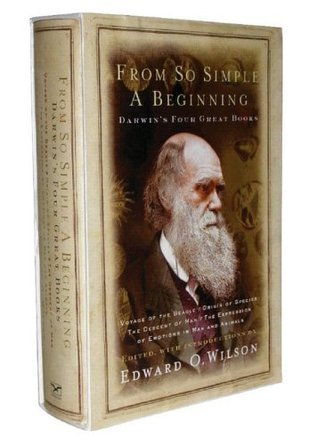
From So Simple a Beginning: Voyage of the Beagle / Origin of Species / Descent of Man / Expression of Emotions in Man & Animals
by Charles Darwin
Rating: 4.4 ⭐
Never before have the four great works of Charles Darwin--Voyage of the H.M.S. Beagle (1845), The Origin of Species (1859), The Descent of Man (1871), and The Expression of Emotions in Man and Animals (1872)--been collected under one cover. Undertaking this challenging endeavor 123 years after Darwin's death, two-time Pulitzer Prize winner Edward O. Wilson has written an introductory essay for the occasion, while providing new, insightful introductions to each of the four volumes and an afterword that examines the fate of evolutionary theory in an era of religious resistance. In addition, Wilson has crafted a creative new index to accompany these four texts, which links the nineteenth-century, Darwinian evolutionary concepts to contemporary biological thought. Beautifully slipcased, and including restored versions of the original illustrations, From So Simple a Beginning turns our attention to the astounding power of the natural creative process and the magnificence of its products.

Applying his controversial theory of evolution to the origins of the human species, Charles Darwin's The Descent of Man was the culmination of his life's work. This Penguin Classics edition is edited with an introduction by James Moore and Adrian Desmond.In The Origin of Species, Charles Darwin refused to discuss human evolution, believing the subject too 'surrounded with prejudices'. He had been reworking his notes since the 1830s, but only with trepidation did he finally publish The Descent of Man in 1871. The book notoriously put apes in our family tree and made the races one family, diversified by 'sexual selection' - Darwin's provocative theory that female choice among competing males leads to diverging racial characteristics. Named by Sigmund Freud as 'one of the ten most significant books' ever written, Darwin's Descent of Man continues to shape the way we think about what it is that makes us uniquely human.In their introduction, James Moore and Adrian Desmond, acclaimed biographers of Charles Darwin, call for a radical re-assessment of the book, arguing that its core ideas on race were fired by Darwin's hatred of slavery. The text is the second and definitive edition and this volume also contains suggestions for further reading, a chronology and biographical sketches of prominent individuals mentioned.Charles Darwin (1809-82), a Victorian scientist and naturalist, has become one of the most famous figures of science to date. The advent of On the Origin of Species by Means of Natural Selection in 1859 challenged and contradicted all contemporary biological and religious beliefs.If you enjoyed The Descent of Man, you might like Darwin's On the Origin of Species, also available in Penguin Classics.
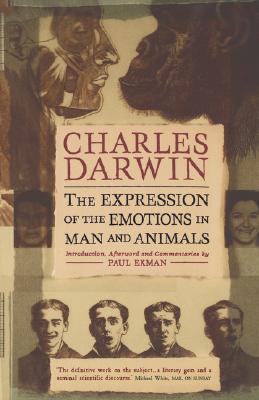
Published in 1872, The Expression of the Emotions in Man and Animals was a book at the very heart of Darwin's research interests - a central pillar of his 'human' series. This book engaged some of the hardest questions in the evolution debate, and it showed the ever-cautious Darwin at his boldest. If Darwin had one goal with Expression, it was to demonstrate the power of his theories for explaining the origin of our most cherished human morality and intellect. As Darwin explained, "He who admits, on general grounds, that the structure and habits of all animals have been gradually evolved, will look at the whole subject of Expression in a new and interesting light."

Charles Darwin's theory of evolution turned the Victorian world upside down, utterly rewrote our notions of life on earth, and is still attacked by religious creationists today.

'The vessel drove before her bows two billows of liquid phosphorus' A selection of Darwin's extraordinary adventures during the voyage of the Beagle Introducing Little Black Classics: 80 books for Penguin's 80th birthday. Little Black Classics celebrate the huge range and diversity of Penguin Classics, with books from around the world and across many centuries. They take us from a balloon ride over Victorian London to a garden of blossom in Japan, from Tierra del Fuego to 16th century California and the Russian steppe. Here are stories lyrical and savage; poems epic and intimate; essays satirical and inspirational; and ideas that have shaped the lives of millions. Charles Darwin (1809-1882). Darwin's Autobiographies, On the Origin of Species, The Descent of Man, The Expression of the Emotions in Man and Animals and The Voyage of the Beagle are available in Penguin Classics.

Easily the most influential book published in the nineteenth century, Darwin’s The Origin of Species is also that most unusual phenomenon, an altogether readable discussion of a scientific subject. On its appearance in 1859 it was immediately recognized by enthusiasts and detractors alike as a work of the greatest importance: its revolutionary theory of evolution by means of natural selection provoked a furious reaction that continues to this day.The Origin of Species is here published together with Darwin’s earlier Voyage of the ‘Beagle.’ This 1839 account of the journeys to South America and the Pacific islands that first put Darwin on the track of his remarkable theories derives an added charm from his vivid description of his travels in exotic places and his eye for the piquant detail.(Book Jacket Status: Jacketed)

Librarian's note: There is an Alternate Cover Edition for this edition of this book here.The impact of Charles Darwin’s work on Western civilization has been broad and deep. As much as anyone in the modern era, he changed human thought, and his influence is still felt in virtually all aspects of our lives. This new edition, larger and more varied than the previous ones, includes more of Darwin's own work and also presents the most recent research and scholarship on all aspects of Darwin’s legacy. The biological sciences, as well as social thought, philosophy, ethics, religion, and literature, have all been shaped and reshaped by evolutionary concepts.Excerpts from the most important books and articles of recent years confirm this Darwinian heritage. New work by Richard Dawkins, Edward O. Wilson, Kevin Padian, Eugene C. Scott, Steven Pinker, Daniel Dennett, Michael Ruse, Frans de Waal, Noretta Koertge, George C. Williams, George Levine, Stephen Jay Gould, Gillian Beer, Ernst Mayr, and many others illuminates this exciting intellectual history. A wide-ranging new introduction by the editor provides context and coherence to this rich body of engaging material, much of which will be shaping human thought well into the new century.This collection of Darwin's writing, those of his critics and those of his intellectual descendants, includes:- The Voyage of the Beagle (1845): Ch. I, XVII- On the Tendency of Species to Form Varieties; And on the Perpetuation of Varieties and Species by Natural Means of Selection (1858): Ch. I-II- An Historical Sketch of the Progress of Opinion on the Origin of Species Previously to the Publication of this Work (1861) The Origin of Species (1859): Introduction, Ch. I-IV, VI, IX, XIII-XIV- The Descent of Man (1871): Introduction, Ch. I-III, VI, VIII, XIX-XXI

On the Origin of Species by Means of Natural Selection, or the Preservation of Favoured Races in the Struggle for Life, published on 11/24/1859, is at the foundation of evolutionary biology. For the 6th edition of 1872, the short title was changed to The Origin of Species. It introduced the scientific theory that populations evolve over the course of generations thru a process of natural selection. It presented a body of evidence that the diversity of life arose by common descent thru a branching pattern of evolution. Darwin included evidence he'd gathered during the 1830s Beagle expedition & his subsequent findings from research, correspondence & experimentation. The Descent of Man & Selection in Relation to Sex was 1st published in 1871. It was Darwin's 2nd book on evolutionary theory, following his 1859 Origin of Species. The Descent of Man applies evolutionary theory to human evolution, detailing a theory of sexual selection. It discusses many related issues, including evolutionary psychology, evolutionary ethics, racial differences, differences between sexes, the dominant role of women in choosing mating partners & the relevance of the evolutionary theory to society.

One of 60 low-priced classic texts published to celebrate Penguin's 60th anniversary. All the titles are extracts from "Penguin Classics" titles.

The Formation of Vegetable Mould Through the Action of Worms with Observations on Their Habits
by Charles Darwin
Rating: 4.2 ⭐
This is a pre-1923 historical reproduction that was curated for quality. Quality assurance was conducted on each of these books in an attempt to remove books with imperfections introduced by the digitization process. Though we have made best efforts - the books may have occasional errors that do not impede the reading experience. We believe this work is culturally important and have elected to bring the book back into print as part of our continuing commitment to the preservation of printed works worldwide. This text refers to the Bibliobazaar edition.

On topics ranging from intelligent design and climate change to the politics of gender and race, the evolutionary writings of Charles Darwin occupy a pivotal position in contemporary public debate. This volume brings together the key chapters of his most important and accessible books,including the Journal of Researches on the Beagle voyage (1845), The Origin of Species (1859), and The Descent of Man (1871), along with the full text of his delightful autobiography. They are accompanied by generous selections of responses from Darwin's nineteenth-century readers from across theworld. More than anything, they give a keen sense of the controversial nature of Darwin's ideas, and his position within Victorian debates about man's place in nature.The wide-ranging Introduction by James A. Secord, Director of the Darwin Correspondence Project, explores the global impact and origins of Darwin's work and the reasons for its unparalleled significance today. To increase its usefulness for readers coming to Darwin for the first time, the selectionalso includes a map of the Beagle voyage, a detailed chronology of Darwin's life, and a biographical appendix identifying every individual mentioned in the text.

This is a reproduction of a book published before 1923. This book may have occasional imperfections such as missing or blurred pages, poor pictures, errant marks, etc. that were either part of the original artifact, or were introduced by the scanning process. We believe this work is culturally important, and despite the imperfections, have elected to bring it back into print as part of our continuing commitment to the preservation of printed works worldwide. We appreciate your understanding of the imperfections in the preservation process, and hope you enjoy this valuable book.

On The Origin Of Species & Other Bonus Works: Einstein Theory of Relativity, An Inquiry into the Nature and Causes of the Wealth of Nations
by Charles Darwin
Rating: 4.2 ⭐
On the Origin of Species, published on 24 November 1859, is a work of scientific literature by Charles Darwin which is considered to be the foundation ofevolutionary biology. Its full title was On the Origin of Species by Means of Natural Selection, or the Preservation of Favoured Races in the Struggle for Life.Darwin's book introduced the scientific theory that populations evolve over the course of generations through a process of natural selection. It presented a body of evidence that the diversity of life arose by common descent through a branching pattern of evolution. Darwin included evidence that he had gathered on the Beagle expedition in the 1830s and his subsequent findings from research, correspondence, and experimentation.The book is written for non-specialist readersBonus •Einstein Theory of RelativityThe theory of relativity, or simply relativity in physics, usually encompasses two theories by Albert special relativity and general relativity.[1]Concepts introduced by the theories of relativity •Measurements of various quantities are relative to the velocities of observers. In particular, space contracts and time dilates.• space and time should be considered together and in relation to each other.•Space is a physical entity that can be changed, space is not just nothing, space can affect mass (gravity)[2]•The speed of light is nonetheless invariant, the same for all observers.The theory of relativity transformed theoretical physics and astronomy during the 20th century. When first published, relativity superseded a 200-year-old theory of mechanics created primarily by Isaac Newton.•An Inquiry into the Nature and Causes of the Wealth of NationsGenerally referred to by its shortened title The Wealth of Nations, is the magnum opus of theScottish economist and moral philosopher Adam Smith. First published in 1776, the book offers one of the world's first collected descriptions of what builds nations' wealth and is today a fundamental work in classical economics. By reflecting upon the economics at the beginning of the Industrial Revolution, the book touches upon such broad topics as the division of labour, productivity, and free markets.
This book was converted from its physical edition to the digital format by a community of volunteers. You may find it for free on the web. Purchase of the Kindle edition includes wireless delivery.

Charles Robert Darwin (1809–1882) has been widely recognized since his own time as one of the most influential writers in the history of Western thought. His books were widely read by specialists and the general public, and his influence had been extended by almost continuous public debate over the past 150 years. New York University Press's new paperback edition makes it possible to review Darwin's public literary output as a whole, plus his scientific journal articles, his private notebooks, and his correspondence.This is complete edition contains all of Darwin's published books, featuring definitive texts recording original pagination with Darwin's indexes retained. The set also features a general introduction and index, and introductions to each volume.
s/t: Or, The Preservation Of Favored Races In The Struggle For LifeThis historic book may have numerous typos and missing text. Purchasers can download a free scanned copy of the original book (without typos) from the publisher. Not indexed. Not illustrated. 1882. Excerpt: ... GLOSSARY OP THE PRINCIPAL SCIENTIFIC TERMS USED IN THE PRESENT VOLUME. Aberrant.--Forms or groups of animals or plants which deviate in im portant characters from their nearest allies, so as not to be easily included in the same group with them, are said to be aberrant. Aberration (in Opties).--In the refraction of light by a convex lens the rays passing through different parts of the lens are brought to a focus at slightly different distances, --this is called spherical aberration; at the same time the coloured rays are separated by the prismatic action ot the lens and likewise brought to a focus at different distances, --this is chromatic aberration. Abnormal.--Contrary to the general rule. Aborted.--An organ is said to be aborted, when its development has been arrested at a very early stage. Albinism.--Albinos are animals in which the usual colouring matters characteristic of the species have not been produced in the skin and its appendages. Albinism is the state of being an albino. ALCLE.--A class of plants including the ordinary sea-weeds and the filamentous fresh-water weeds. Alternation Of Generations.--This term is applied to a peculiar mode of reproduction which prevails among many of the lower animals, in which the egg produces a living foan quite different from its parent, but from which the parent-form is reproduced by a process of budding, 01 by the division of the substance of the first product of the egg. Ammonites.--A group of fossil, spiral, chambered shells, allied to the existing pearly Nautilus, but having the partitions between the chambers waved in complicated patterns at their junction with the outer wall of the shell. Analogy.--That resemblance of structures which depends upon similarity of function, as in the wings of insects ...

Tutkularimiz En Buyuk Zaaflarimizdir, Darwin'in eserlerinden ozenle derlenmis bir seckidir."Sadece en gucluler hayatta kalir.""Iyimser olmayi birakana kadar iyimserizdir."(Tanitim Bulteninden)Sayfa 128Baski 2016 Aylak Adam

This Elibron Classics book is a facsimile reprint of a 1885 edition by John Murray, London. Second edition, revised.

L'origine delle specie, L'origine dell'uomo e altri scritti sull'evoluzione
by Charles Darwin
Rating: 4.2 ⭐
Edizioni integraliViaggio di un naturalista intorno al mondo, L’origine delle specie, L’origine dell’uomo e la selezione sessuale; I fondamenti dell’origine delle specie, AutobiografiaL’idea che gli esseri viventi abbiano trovato origine in forme elementari primordiali, dalle quali si sarebbero poi sviluppate per gradi le specie attuali, si ritrova già accennata nella storia del pensiero dai Greci in poi: ma solo con Charles Darwin questa intuizione raggiunge una struttura sistematica e una fisionomia definita. Sulla base d’un numero imponente di dati, osservazioni, raffronti sulla flora e la fauna di differenti latitudini, il giovane naturalista inglese giunse, verso la metà del secolo XIX, a conclusioni sconvolgenti, rivoluzionarie circa l’origine della vita. La pubblicazione, nel 1859, dell’Origine delle specie, che raccoglieva i risultati delle sue ricerche, procurò a Darwin la notorietà, la gloria, e il biasimo a un tempo. Il successo editoriale fu prodigioso, la prima edizione (oltre mille esemplari) fu esaurita in un giorno. Con quest’opera rigorosa e straordinaria, Darwin scardinava la tradizione biblica della creazione del mondo, introducendo il concetto di una lenta evoluzione delle specie animali e vegetali da antenati profondamente diversi. In questo volume sono riuniti, oltre ai due testi fondamentali per la teoria dell'evoluzionismo (L'origine delle specie e L'origine dell'uomo e la selezione sessuale), Viaggio di un naturalista intorno al mondo, diario del viaggio che Darwin nel 1831 intraprese a bordo del brigantino Beagle e durante il quale, osservando e raccogliendo specie animali e vegetali ancora sconosciute, iniziò a formulare le sue teorie; i saggi, gli abbozzi e le comunicazioni che precedettero la pubblicazione della sua prima opera e l'Autobiografia, scritta da Darwin per i figli e che proprio il figlio scienziato Francis fece pubblicare nel 1887.

Coral Reefs is a book written by Charles Darwin. It is widely considered to be one of the top 100 greatest books of all time. This great novel will surely attract a whole new generation of readers. For many, Coral Reefs is required reading for various courses and curriculums. And for others who simply enjoy reading timeless pieces of classic literature, this gem by Charles Darwin is highly recommended. Published by Quill Pen Classics and beautifully produced, Coral Reefs would make an ideal gift and it should be a part of everyone's personal library.

CHAPTER I.THE CIRCUMNUTATING MOVEMENTS OF SEEDLING PLANTS.Brassica oleracea, circumnutation of the radicle, of the arched hypocotyl whilst still buried beneath the ground, whilst rising above the ground and straightening itself, and when erect--Circumnutation of the cotyledons-- Rate of movement--Analogous observations on various organs in species of Githago, Gossypium, Oxalis, Tropaeolum, Citrus, Aesculus, of several Leguminous and Cucurbitaceous genera, Opuntia, Helianthus, Primula, Cyclamen, Stapelia, Cerinthe, Nolana, Solanum, Beta, Ricinus, Quercus, Corylus, Pinus, Cycas, Canna, Allium, Asparagus, Phalaris, Zea, Avena, Nephrodium, and Selaginella...10-66CHAPTER II.GENERAL CONSIDERATIONS ON THE MOVEMENTS AND GROWTH OF SEEDLING PLANTS.Generality of the circumnutating movement--Radicles, their circumnutation of service--Manner in which they penetrate the ground--Manner in which hypocotyls and other organs break through the ground by being arched-- Singular manner of germination in Megarrhiza, etc.--Abortion of cotyledons- -Circumnutation of hypocotyls and epicotyls whilst still buried and arched- -Their power of straightening themselves--Bursting of the seed-coats-- Inherited effect of the arching process in hypo- [page vi.] gean hypocotyls--Circumnutation of hypocotyls and epicotyls when erect-- Circumnutation of cotyledons--Pulvini or joints of cotyledons, duration of their activity, rudimentary in Oxalis corniculata, their development-- Sensitiveness of cotyledons to light and consequent disturbance of their periodic movements--Sensitiveness of cotyledons to contact...Page 67-128CHAPTER III.SENSITIVENESS OF THE APEX OF THE RADICLE TO CONTACT AND TO OTHER IRRITANTS.Manner in which radicles bend when they encounter an obstacle in the soil-- Vicia faba, tips of radicles highly sensitive to contact and other irritants--Effects of too high a temperature--Power of discriminating between objects attached on opposite sides--Tips of secondary radicles sensitive--Pisum, tips of radicles sensitive--Effects of such sensitiveness in overcoming geotropism--Secondary radicles--Phaseolus, tips of radicles hardly sensitive to contact, but highly sensitive to caustic and to the removal of a slice--Tropaeolum--Gossypium--Cucurbita--Raphanus--Aesculus, tip not sensitive to slight contact, highly sensitive to caustic--Quercus, tip highly sensitive to contact--Power of discrimination--Zea, tip highly sensitive, secondary radicles--Sensitiveness of radicles to moist air-- Summary of chapter...129-200CHAPTER IV.THE CIRCUMNUTATING MOVEMENTS OF THE SEVERAL PARTS OF MATURE PLANTS.Circumnutation of concluding remarks on--Circumnutation of aid thus afforded in winding amongst the stems of surrounding plants-- Circumnutation of flower-stems--Circumnutation of Dicotyledonous leaves-- Singular oscillatory movement of leaves of Dionaea--Leaves of Cannabis sink at night--Leaves of Gymnosperms--Of Monocotyledons--Cryptogams--Concluding remarks on the circumnutation of leaves; generally rise in the evening and sink in the morning...201-262 [page vii.]CHAPTER V.MODIFIED CLIMBING PLANTS; EPINASTIC AND HYPONASTIC MOVEMENTS.Circumnutation modified through innate causes or through the action of external conditions--Innate causes--Climbing plants; similarity of their movements with those of ordinary plants; increased amplitude; occasional points of difference--Epinastic growth of young leaves--Hyponastic growth of the hypocotyls and epicotyls of seedlings--Hooked tips of climbing and other plants due to modified circumnutation--Ampelopsis tricuspidata-- Smithia Pfundii--Straightening of the tip due to hyponasty--Epinastic growth and circumnutation of the fl

Charles Darwin transformed our understanding of the world with the idea of natural selection, challenging the notion that species are fixed and unchanging. These writings from On the Origin of Species explain how different life forms appear all over the globe, evolve over millions of years, become extinct and are supplanted. GREAT IDEAS. Throughout history, some books have changed the world. They have transformed the way we see ourselves - and each other. They have inspired debate, dissent, war and revolution. They have enlightened, outraged, provoked and comforted. They have enriched lives - and destroyed them. Now Penguin brings you the works of the great thinkers, pioneers, radicals and visionaries whose ideas shook civilization and helped make us who we are.

The Foundations of the Origin of Species Two Essays written in 1842 & 1844
by Charles Darwin
Rating: 3.7 ⭐
This book was converted from its physical edition to the digital format by a community of volunteers. You may find it for free on the web. Purchase of the Kindle edition includes wireless delivery.

This work has been selected by scholars as being culturally important, and is part of the knowledge base of civilization as we know it. This work was reproduced from the original artifact, and remains as true to the original work as possible. Therefore, you will see the original copyright references, library stamps (as most of these works have been housed in our most important libraries around the world), and other notations in the work.This work is in the public domain in the United States of America, and possibly other nations. Within the United States, you may freely copy and distribute this work, as no entity (individual or corporate) has a copyright on the body of the work.As a reproduction of a historical artifact, this work may contain missing or blurred pages, poor pictures, errant marks, etc. Scholars believe, and we concur, that this work is important enough to be preserved, reproduced, and made generally available to the public. We appreciate your support of the preservation process, and thank you for being an important part of keeping this knowledge alive and relevant.

This book was converted from its physical edition to the digital format by a community of volunteers. You may find it for free on the web. Purchase of the Kindle edition includes wireless delivery.


Darwin Compendium: Voyage of the Beagle/Origin of the Species/Descent of Man & Selection in Relation to Sex/Expression of Emotions in Humans & Animals/Autobiography
by Charles Darwin
Rating: 4.4 ⭐
The father of modern evolutionary thought, Charles Darwin showed the world a new way to explain the origins of living things. The Darwin Compendium helps to generate an understanding of what Darwin's potent ideas were, and how they affect the very nature of our civilization and understanding of the universe. This collection includes five of his core works:In The Voyage of the Beagle (1839), a young Darwin travels to the Galapagos Islands, where the diversity of finches and iguanas leads him to hypothesize that living organisms changed over time.The Origin of Species (1859), Darwin's most celebrated work, states that natural selection-the theory of survival of the fittest-resulted in the wide variety of life on earth.The Descent of Man (1871) argues that there is considerable evidence that humans are part of the animal kingdom and have been created according to the same natural laws that produced all other life on earth.To further his thesis of humans as part of the natural world, Darwin published The Expression of Emotions in Man and Animals (1872). In this work he argued that facial expressions in humans are complex forms of communication performed by intricate musculature that was the result of evolutionary processes.In 1876, after years of insults and praise over his theories about the world, Charles Darwin took stock of his own life and wrote Autobiography of Charles Darwin.

Diario 1838-1881 e scritti autobiografici
by Charles Darwin
This work has been selected by scholars as being culturally important, and is part of the knowledge base of civilization as we know it. This work was reproduced from the original artifact, and remains as true to the original work as possible. Therefore, you will see the original copyright references, library stamps (as most of these works have been housed in our most important libraries around the world), and other notations in the work.This work is in the public domain in the United States of America, and possibly other nations. Within the United States, you may freely copy and distribute this work, as no entity (individual or corporate) has a copyright on the body of the work.As a reproduction of a historical artifact, this work may contain missing or blurred pages, poor pictures, errant marks, etc. Scholars believe, and we concur, that this work is important enough to be preserved, reproduced, and made generally available to the public. We appreciate your support of the preservation process, and thank you for being an important part of keeping this knowledge alive and relevant.

Charles Darwin and the Origin of Species a Horizon Caravel Book
by Charles Darwin
Darwin's work

Charles Robert Darwin (1809-1882) has been widely recognized since his own time as one of the most influential writers in the history of Western thought. His books were widely read by specialists and the general public, and his influence had been extended by almost continuous public debate over the past 150 years. New York University Press's new paperback edition makes it possible to review Darwin's public literary output as a whole, plus his scientific journal articles, his private notebooks, and his correspondence.This is complete edition contains all of Darwin's published books, featuring definitive texts recording original pagination with Darwin's indexes retained. The set also features a general introduction and index, and introductions to each volume.