
Steven Pinker
Steven Arthur Pinker is a prominent Canadian-American experimental psychologist, cognitive scientist, and author of popular science. Pinker is known for his wide-ranging explorations of human nature and its relevance to language, history, morality, politics, and everyday life. He conducts research on language and cognition, writes for publications such as the New York Times, Time, and The New Republic, and is the author of numerous books, including The Language Instinct, How the Mind Works, Words and Rules, The Blank Slate, The Stuff of Thought, The Better Angels of Our Nature, The Sense of Style, and most recently, Enlightenment Now: The Case for Reason, Science, Humanism, and Progress. He was born in Canada and graduated from Montreal's Dawson College in 1973. He received a bachelor's degree in experimental psychology from McGill University in 1976, and then went on to earn his doctorate in the same discipline at Harvard in 1979. He did research at the Massachusetts Institute of Technology (MIT) for a year, then became an assistant professor at Harvard and then Stanford University. From 1982 until 2003, Pinker taught at the Department of Brain and Cognitive Sciences at MIT, and eventually became the director of the Center for Cognitive Neuroscience. (Except for a one-year sabbatical at the University of California, Santa Barbara in 1995-6.) As of 2008, he is the Johnstone Family Professor of Psychology at Harvard. Pinker was named one of Time Magazine's 100 most influential people in the world in 2004 and one of Prospect and Foreign Policy's 100 top public intellectuals in 2005. He has also received honorary doctorates from the universities of Newcastle, Surrey, Tel Aviv, McGill, and the University of Tromsø, Norway. He was twice a finalist for the Pulitzer Prize, in 1998 and in 2003. In January 2005, Pinker defended Lawrence Summers, President of Harvard University, whose comments about the gender gap in mathematics and science angered much of the faculty. On May 13th 2006, Pinker received the American Humanist Association's Humanist of the Year award for his contributions to public understanding of human evolution. In 2007, he was invited on The Colbert Report and asked under pressure to sum up how the brain works in five words – Pinker answered "Brain cells fire in patterns." Pinker was born into the English-speaking Jewish community of Montreal. He has said, "I was never religious in the theological sense... I never outgrew my conversion to atheism at 13, but at various times was a serious cultural Jew." As a teenager, he says he considered himself an anarchist until he witnessed civil unrest following a police strike in 1969. His father, a trained lawyer, first worked as a traveling salesman, while his mother was first a home-maker then a guidance counselor and high-school vice-principal. He has two younger siblings. His brother is a policy analyst for the Canadian government. His sister, Susan Pinker, is a columnist for the Wall Street Journal and the author of The Sexual Paradox and The Village Effect. Pinker married Nancy Etcoff in 1980 and they divorced 1992; he married Ilavenil Subbiah in 1995 and they too divorced. He is married to the novelist and philosopher Rebecca Goldstein, the author of 10 books and winner of the National Medal of the Humanities. He has no children. His next book will take off from his research on "common knowledge" (knowing that everyone knows something). Its tentative title is: Don't Go There: Common Knowledge and the Science of Civility, Hypocrisy, Outrage, and Taboo.
26 Books Written

The Better Angels of Our Nature: Why Violence Has Declined
by Steven Pinker
Rating: 4.1 ⭐
• 28 recommendations ❤️
Selected by The New York Times Book Review as a Notable Book of the Year. The author of The New York Times bestseller The Stuff of Thought offers a controversial history of violence. Faced with the ceaseless stream of news about war, crime, and terrorism, one could easily think we live in the most violent age ever seen. Yet as New York Times bestselling author Steven Pinker shows in this startling and engaging new work, just the opposite is true: violence has been diminishing for millennia and we may be living in the most peaceful time in our species' existence. For most of history, war, slavery, infanticide, child abuse, assassinations, pogroms, gruesome punishments, deadly quarrels, and genocide were ordinary features of life. But today, Pinker shows (with the help of more than a hundred graphs and maps) all these forms of violence have dwindled and are widely condemned. How has this happened?This groundbreaking book continues Pinker's exploration of the essence of human nature, mixing psychology and history to provide a remarkable picture of an increasingly nonviolent world. The key, he explains, is to understand our intrinsic motives- the inner demons that incline us toward violence and the better angels that steer us away-and how changing circumstances have allowed our better angels to prevail. Exploding fatalist myths about humankind's inherent violence and the curse of modernity, this ambitious and provocative book is sure to be hotly debated in living rooms and the Pentagon alike, and will challenge and change the way we think about our society.
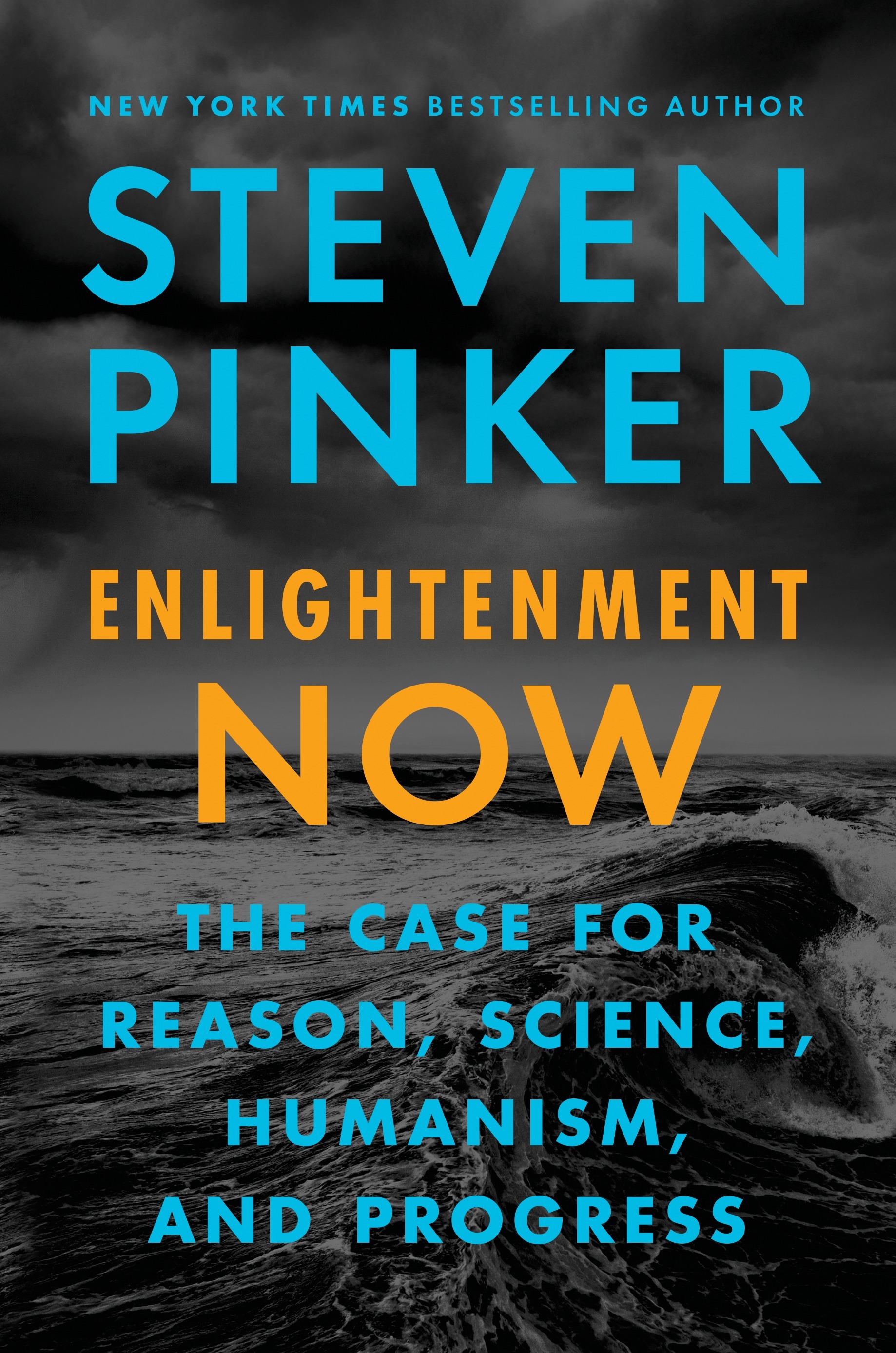
Enlightenment Now: The Case for Reason, Science, Humanism, and Progress
by Steven Pinker
Rating: 4.2 ⭐
• 18 recommendations ❤️
If you think the world is coming to an end, think again: people are living longer, healthier, freer, and happier lives, and while our problems are formidable, the solutions lie in the Enlightenment ideal of using reason and science.Is the world really falling apart? Is the ideal of progress obsolete? In this elegant assessment of the human condition in the third millennium, cognitive scientist and public intellectual Steven Pinker urges us to step back from the gory headlines and prophecies of doom, which play to our psychological biases. Instead, follow the data: In seventy-five jaw-dropping graphs, Pinker shows that life, health, prosperity, safety, peace, knowledge, and happiness are on the rise, not just in the West, but worldwide. This progress is not the result of some cosmic force. It is a gift of the Enlightenment: the conviction that reason and science can enhance human flourishing.Far from being a naïve hope, the Enlightenment, we now know, has worked. But more than ever, it needs a vigorous defense. The Enlightenment project swims against currents of human nature–tribalism, authoritarianism, demonization, magical thinking–which demagogues are all too willing to exploit. Many commentators, committed to political, religious, or romantic ideologies, fight a rearguard action against it. The result is a corrosive fatalism and a willingness to wreck the precious institutions of liberal democracy and global cooperation.With intellectual depth and literary flair, Enlightenment Now makes the case for reason, science, and humanism: the ideals we need to confront our problems and continue our progress.
The Language Instinct: How the Mind Creates Language
by Steven Pinker
Rating: 4.1 ⭐
• 2 recommendations ❤️
"A brilliant, witty, and altogether satisfying book." — New York Times Book Review The classic work on the development of human language by the world’s leading expert on language and the mind In The Language Instinct , the world's expert on language and mind lucidly explains everything you always wanted to know about language: how it works, how children learn it, how it changes, how the brain computes it, and how it evolved. With deft use of examples of humor and wordplay, Steven Pinker weaves our vast knowledge of language into a compelling story: language is a human instinct, wired into our brains by evolution. The Language Instinct received the William James Book Prize from the American Psychological Association and the Public Interest Award from the Linguistics Society of America. This edition includes an update on advances in the science of language since The Language Instinct was first published.

The Sense of Style: The Thinking Person’s Guide to Writing in the 21st Century
by Steven Pinker
Rating: 4.1 ⭐
• 2 recommendations ❤️
Why is so much writing so bad, and how can we make it better? Is the English language being corrupted by texting and social media? Do the kids today even care about good writing—and why should we care? In this entertaining and eminently practical book, the cognitive scientist, dictionary consultant, and New York Times–bestselling author Steven Pinker rethinks the usage guide for the twenty-first century. Using examples of great and gruesome modern prose while avoiding the scolding tone and Spartan tastes of the classic manuals, he shows how the art of writing can be a form of pleasurable mastery and a fascinating intellectual topic in its own right. The Sense of Style is for writers of all kinds, and for readers who are interested in letters and literature and are curious about the ways in which the sciences of mind can illuminate how language works at its best.

"A model of scientific erudite, witty, and clear." ― New York Review of Books In this Pulitzer Prize finalist and national bestseller, one of the world's leading cognitive scientists tackles the workings of the human mind. What makes us rational―and why are we so often irrational? How do we see in three dimensions? What makes us happy, afraid, angry, disgusted, or sexually aroused? Why do we fall in love? And how do we grapple with the imponderables of morality, religion, and consciousness? How the Mind Works synthesizes the most satisfying explanations of our mental life from cognitive science, evolutionary biology, and other fields to explain what the mind is, how it evolved, and how it allows us to see, think, feel, laugh, interact, enjoy the arts, and contemplate the mysteries of life. This edition of Pinker's bold and buoyant classic is updated with a new foreword by the author.

When Everyone Knows That Everyone Knows...: Common Knowledge and the Mysteries of Money, Power, and Everyday Life
by Steven Pinker
Rating: 3.8 ⭐
From one of the world’s most celebrated intellectuals, a brilliantly insightful work that explains how we think about each other’s thoughts about each other’s thoughts, ad infinitum. It sounds impossible, but Steven Pinker shows that we do it all the time. This awareness, which we experience as something that is public or “out there,” is called common knowledge, and it has a momentous impact on our social, political, and economic lives.Common knowledge is necessary for coordination, for making arbitrary but complementary choices like driving on the right, using paper currency, and coalescing behind a political leader or movement. It’s also necessary for social everything from rendezvousing at a time and place to speaking the same language to forming enduring relationships of friendship, romance, or authority. Humans have a sixth sense for common knowledge, and we create it with signals like laughter, tears, blushing, eye contact, and blunt speech. But people also go to great lengths to avoid common knowledge—to ensure that even if everyone knows something, they can’t know that everyone else knows they know it. And so we get rituals like benign hypocrisy, veiled bribes and threats, sexual innuendo, and pretending not to see the elephant in the room. Pinker shows how the hidden logic of common knowledge can make sense of many of life’s financial bubbles and crashes, revolutions that come out of nowhere, the posturing and pretense of diplomacy, the eruption of social media shaming mobs and academic cancel culture, the awkwardness of a first date. Artists and humorists have long mined the intrigues of common knowledge, and Pinker liberally uses their novels, jokes, cartoons, films, and sitcom dialogues to illuminate social life’s tragedies and comedies. Along the way he answers questions Why do people hoard toilet paper at the first sign of an emergency? Why are Super Bowl ads filled with ads for crypto? Why, in American presidential primary voting, do citizens typically select the candidate they believe is preferred by others rather than their favorite? Why did Russian authorities arrest a protester who carried a blank sign? Why is it so hard for nervous lovers to say goodbye at the end of a phone call? Why does everyone agree that if we were completely honest all the time, life would be unbearable? Consistently riveting in explaining the paradoxes of human behavior, When Everyone Knows That Everyone Knows… invites us to understand the ways we try to get into each other’s heads and the harmonies, hypocrisies, and outrages that result.

لقد كتب بنكر كتابا جيدا جدا، واضحا، جيد العرض، منصفا، واسع المعرفة، قويا، نبيها، إنسانيا، ومحفزا، أمل أن يدرسه الناس بدقة قبل أن ينتفضوا أيديولوجيا ضده إن فعلوا ذلك فإنهم سيرون أن فكرة الطبيعة البشرية فيها عيوب فطرية، لكنها طبيعة غنية بشكل رائع، وهي قوة من أجل الخير لا من أجل البشر. كولن ماكوين - الواشنطن بوست ستيفن بنكر ذو معرفة موسوعية، وأسلوب نقاش قاطع، نقاشه في - الصفحة البيضاء - هو أن الحياة الفكرية في الغرب، وأن معظم سياساتنا الاجتماعية والسياسية كانت محكومة - إلى حد كبير - خلال القرن العشرين بنظرة للطبيعة البشرية فيها عيوب أساسا، وأن هذه الهيمنة كانت مدعومة من شيء ما يبلغ درجة إرهاب أكاديمي (إنه لم يطرح هذا بقوة). إننا سوف نستفيد كثيرا من وجهة نظر أكثر واقعية، من الممتع قراءة عرض بنكر لأنه واضح بشكل يحسد عليه، فشرحه لمسألة تقنية صعبة مثل الإختلاف والإنتكاس في دراسات التوائم، لن تجد شرحا أفضل لها، إنه لا يخشى إستخدام لغة قوية، يضاف إلى ذلك أن أجزاء من الكتاب مسلية تبعث السرور. جون ر. سي تيرنر - الملحق الأدبي لصحيفة التايمز يصور كتاب الصفحة البيضاء الحالة الراهنة من التلاعب في مناقشة الطبيعة والتربية، اقرأه كي تفهم ليس فقط العمى الأخلاقي والجمالي لدى أصدقائك، بل أيضا كي تفهم المثالية المضللة لدى الأمم، إنه عمل رائع، في الوقت المناسب. فاي ويلدون - الديلي تلغراف

New York Times bestselling author Steven Pinker possesses that rare combination of scientific aptitude and verbal eloquence that enables him to provide lucid explanations of deep and powerful ideas. His previous books, including the Pulitzer Prize finalist The Blank Slate, have catapulted him into the limelight as one of today's most important and popular science writers. Now, in The Stuff of Thought, Pinker marries two of the subjects he knows best: language and human nature. The result is a fascinating look at how our words explain our nature. What does swearing reveal about our emotions? Why does innuendo disclose something about relationships? Pinker reveals how our use of prepositions and tenses taps into peculiarly human concepts of space and time, and how our nouns and verbs speak to our notions of matter. Even the names we give our babies have important things to say about our relations to our children and to society. With his signature wit and style, Pinker takes on scientific questions like whether language affects thought, as well as forays into everyday life: why is bulk e-mail called spam and how do romantic comedies get such mileage out of the ambiguities of dating? The Stuff of Thought is a brilliantly crafted and highly readable work that will appeal to fans of readers of everything from The Selfish Gene and Blink to Eats, Shoots & Leaves.

In Rationality, Pinker rejects the cynical cliché that humans are simply an irrational species - cavemen out of time fatally cursed with biases, fallacies and illusions. After all, we discovered the laws of nature, lengthened and enriched our lives and set the benchmarks for rationality itself. Instead, he explains, we think in ways that suit the low-tech contexts in which we spend most of our lives, but fail to take advantage of the powerful tools of reasoning we have built up over millennia: logic, critical thinking, probability, causal inference, and decision-making under uncertainty. These tools are not a standard part of our educational curricula, and have never been presented clearly and entertainingly in a single book - until now.Rationality matters. It leads to better choices in our lives and in the public sphere, and is the ultimate driver of social justice and moral progress. Brimming with insight and humour, Rationality will enlighten, inspire and empower.

In Words and Rules, Steven Pinker explains the mysteries of language by examining a single construction from a dozen viewpoints, proposing that the essence of language is a mental dictionary of memorized words, and a mental grammar of creative rules.

Progress. It is one of the animating concepts of the modern era. From the Enlightenment onwards, the West has had an enduring belief that through the evolution of institutions, innovations, and ideas, the human condition is improving. This process is supposedly accelerating as new technologies, individual freedoms, and the spread of global norms empower individuals and societies around the world. But is progress inevitable? Its critics argue that human civilization has become different, not better, over the last two and a half centuries. What is seen as a breakthrough or innovation in one period becomes a setback or limitation in another. In short, progress is an ideology not a fact; a way of thinking about the world as opposed to a description of reality.In the seventeenth semi-annual Munk Debates, which was held in Toronto on November 6, 2015, pioneering cognitive scientist Steven Pinker and best-selling author Matt Ridley squared off against noted philosopher Alain de Botton and best-selling author Malcolm Gladwell to debate whether humankind’s best days lie ahead.

Why are some words rude and others aren't? Why can launching into expletives be so shocking - and sometimes so amusing?In this hilarious extract from his bestselling "The Stuff of Thought" Steven Pinker takes us on a fascinating journey through the world of profanities, to show us why we swear, how taboos change and how we use obscenities in different ways. Why do so many swear words involve sex, bodily functions and religion? What are the biological roots of swearing? Why would a democracy deter the use of words for two activities - sex and excretion - that harm no one and are inescapable parts of the human condition?Taboo language enters into a startling array of human concerns from capital crimes in the Bible to the future of electronic media. You'll discover that in Quebecois French the expression 'Tabernacle' is outrageous, that 'scumbag' has a very unsavoury origin and that in a certain Aboriginal language every word is filthy when spoken in front of your mother-in-law.Covering everything from free speech to Tourette's, from pottymouthed celebrities to poetry, this book reveals what swearing tells us about how our minds work. (It's also a bloody good read).

Language, Cognition, and Human Nature collects together for the first time much of Steven Pinker's most influential scholarly work on language and cognition. Pinker's seminal research explores the workings of language and its connections to cognition, perception, social relationships, child development, human evolution, and theories of human nature.This eclectic collection spans Pinker's thirty-year career, exploring his favorite themes in greater depth and scientific detail. It includes thirteen of Pinker's classic articles, ranging over topics such as language development in children, mental imagery, the recognition of shapes, the computational architecture of the mind, the meaning and uses of verbs, the evolution of language and cognition, the nature-nurture debate, and the logic of innuendo and euphemism. Each outlines a major theory or takes up an argument with another prominent scholar, such as Stephen Jay Gould, Noam Chomsky, or Richard Dawkins. Featuring a new introduction by Pinker that discusses his books and scholarly work, this collection reflects essential contributions to cognitive science by one of our leading thinkers and public intellectuals.

Award-winning writer and psychologist Steven Pinker has continually shown that provocative, complex ideas can be translated into bestsellers. In this extract from How the Mind Works he takes us deep into the human psyche as he considers people's desire for happiness, the power of the emotions and how love can come to conquer all.
When children learn a language, they soon are able to make surprisingly subtle "donate them a book" sounds odd, for example, even though "give them a book" is perfectly natural. How can this happen, given that children do not confine themselves to the sentence types they hear, and are usually not corrected when they speak ungrammatically? Steven Pinker resolves this paradox in a detailed theory of how children acquire argument structure. In tackling a learning paradox that has challenged scholars for more than a decade, Pinker synthesizes a vast literature in linguistics and psycholinguistics and outlines explicit theories of the mental representation, learning, and development of verb meaning and verb syntax. The new theory that he describes has some surprising implications for the relation between language and thought.Pinker's solution provides insight into such key questions as, When do children generalize and when do they stick with what they hear? What is the rationale behind linguistic constraints? How is the syntax of predicates and arguments related to their semantics? What is a possible word meaning? Do languages force their speakers to construe the world in certain ways? Why does children's language seem different from that of adults? Learnability and Cognition is included in the series Learning, Development, and Conceptual Change, edited by Lila Gleitman, Susan Carey, Elissa Newport, and Elizabeth Spelke. A Bradford Book
In this influential study, Steven Pinker develops a new approach to the problem of language learning. Now reprinted with new commentary by the author, this classic work continues to be an indispensable resource in developmental psycholinguistics.


Before Steven Pinker wrote bestsellers on language and human nature, he wrote several technical monographs on language acquisition that have become classics in cognitive science. The phenomena and ideas he explored in this early book inspired his 2007 bestseller The Stuff of Thought: Language as a Window into Human Nature. This BIT offers Pinker's look back at his early work and two pivotal chapters from Learnability and Cognition.

Cognitive scientist Professor Steven Pinker has spent his life thinking about thinking, and now he wants us to join him. With the aid of his critical thinking toolkit, he hopes to help us make smarter choices, become more rational, gain a greater understanding of the confused world we live in - and maybe even become better citizens.In this fascinating series, produced in partnership with the Open University, he examines the different ways the human brain can be tripped up, from understanding probability to the difference between correlation and causation. Joined by an array of other prominent thinkers, he explores such diverse subjects as whether formulas can predict how well an athlete will perform, why it's dangerous to see patterns in the randomness of everyday experience and why so many of us believe in conspiracy theories.He also considers the life and death choices made by judges and juries, ponders whether some thoughts are too evil to think, asks why making future predictions can be hard, and wonders: should we eat, drink and be merry, or make sacrifices now to benefit our future selves? And what can the game 'Rock, Paper, Scissors' teach us about preventing a climate catastrophe? In addition, he and his fellow experts discuss how we can stop the news distorting our understanding of the world - and why getting it right might mean admitting you're wrong...

Un viaggio alla scoperta dell’evoluzione del linguaggio in termini selettivi che mostra come l’origine delle nostre capacità verbali debba essere interpretata in termini di complessità adattiva. La sofisticata organizzazione che riguarda il linguaggio indica che questo non è altro che il prodotto di una selezione naturale. Questa e altre questioni affrontate nel saggio restano, a vent’anni dalla pubblicazione, di straordinaria attualità nel dibattito teorico contemporaneo, evidenziando quanto il loro scritto rappresenti una pietra miliare nello studio dell’evoluzione del linguaggio.
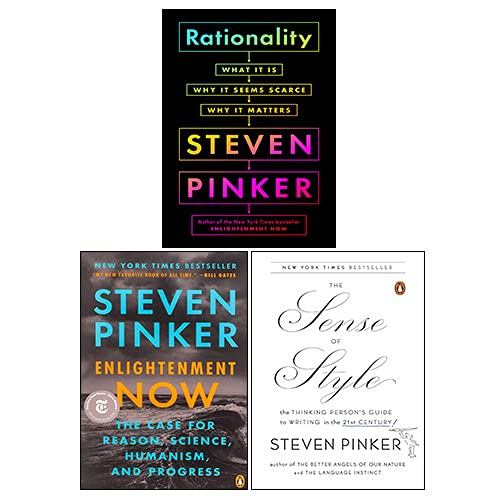
Please Note That The Following Individual Books As Per Original ISBN and Cover Image In this Listing shall be Dispatched Enlightenment Now Rationality [Hardcover] The Sense of Style Steven Pinker Collection 3 Books Enlightenment If you think the world is coming to an end, think people are living longer, healthier, freer, and happier lives, and while our problems are formidable, the solutions lie in the Enlightenment ideal of using reason and science. Is the world really falling apart? Is the ideal of progress obsolete? In this elegant assessment of the human condition in the third millennium. Rationality [Hardcover]: “In our uncertain age, which can so often feel so dark and disturbing, Steven Pinker has distinguished himself as a voice of positivity.” – New York Times Can reading a book make you more rational? Can it help us understand why there is so much irrationality in the world? Steven Pinker, author of Enlightenment Now (Bill Gates’s "new favorite book of all time”) answers all the questions here. The Sense of “Charming and erudite," from the author of Enlightenment Now, "The wit and insight and clarity he brings . . . is what makes this book such a gem.” —Time.com Why is so much writing so bad, and how can we make it better? Is the English language being corrupted by texting and social media? Do the kids today even care about good writing—and why should we care? From the author of The Better Angels of Our Nature and Enlightenment Now.


در اثر حاضر، نویسنده کوشیده است تا ریشه گرایشات و سمتگیریهای اخلاقی انسان را بررسی کند و همینطور معلوم کند آیا دغدغههای اخلاقی افراد در تمامی فرهنگها یکسان است و اگر تفاوتی وجود دارد آیا این تفاوت در کلیات است یا جزئیات. همچنین، نویسنده با استناد به برخی شواهد مدعی شده خاستگاه اخلاقیات، بسیار کهن و دستکم بخشی از آن در تاروپود وجود ما ریشه دارد. به باور او، انسان تا اندازهای واجد ظرفیتی ذاتی برای تمیز خوبی از بدی، و امر اخلاقی از غیراخلاقی ست.
