
Eric Hoffer
Eric Hoffer was an American social writer and philosopher. He produced ten books and was awarded the Presidential Medal of Freedom in February 1983 by President of the United States Ronald Reagan. His first book, The True Believer, published in 1951, was widely recognized as a classic, receiving critical acclaim from both scholars and laymen, although Hoffer believed that his book The Ordeal of Change was his finest work. In 2001, the Eric Hoffer Award was established in his honor with permission granted by the Eric Hoffer Estate in 2005. Early life Hoffer was born in the Bronx, New York City in 1902 (or possibly 1898), the son of Knut and Elsa Hoffer, immigrants from Alsace. By the age of five, he could read in both German and English. When he was age five, his mother fell down a flight of stairs with Eric in her arms. Hoffer went blind for unknown medical reasons two years later, but later in life he said he thought it might have been due to trauma. ("I lost my sight at the age of seven. Two years before, my mother and I fell down a flight of stairs. She did not recover and died in that second year after the fall.I lost my sight and for a time my memory"). After his mother's death he was raised by a live-in relative or servant, a German woman named Martha. His eyesight inexplicably returned when he was 15. Fearing he would again go blind, he seized upon the opportunity to read as much as he could for as long as he could. His eyesight remained, and Hoffer never abandoned his habit of voracious reading. Hoffer was a young man when his father, a cabinetmaker, died. The cabinetmaker's union paid for the funeral and gave Hoffer a little over three hundred dollars. Sensing that warm Los Angeles was the best place for a poor man, Hoffer took a bus there in 1920. He spent the next 10 years on Los Angeles' skid row, reading, occasionally writing, and working odd jobs. On one such job, selling oranges door-to-door, he discovered he was a natural salesman and could easily make good money. Uncomfortable with this discovery, he quit after one day. In 1931, he attempted suicide by drinking a solution of oxalic acid, but the attempt failed as he could not bring himself to swallow the poison. The experience gave him a new determination to live adventurously. It was then he left skid row and became a migrant worker. Following the harvests along the length of California, he collected library cards for each town near the fields where he worked and, living by preference, "between the books and the brothels." A seminal event for Hoffer occurred in the mountains where he had gone in search of gold. Snowed in for the winter, he read the Essays by Michel de Montaigne. Montaigne's book impressed Hoffer deeply, and he often made reference to its importance for him. He also developed a great respect for America's underclass, which, he declared, was "lumpy with talent." Longshoreman Hoffer was in San Francisco by 1941. He attempted to enlist in the Armed forces there in 1942 but was rejected because of a hernia. Wanting to contribute to the war effort, he found ample opportunity as a longshoreman on the docks of The Embarcadero. It was there he felt at home and finally settled down. He continued reading voraciously and soon began to write while earning a living loading and unloading ships. He continued this work until he retired at age 65. Hoffer considered his best work to be The True Believer, a landmark explanation of fanaticism and mass movements. The Ordeal of Change is also a literary favorite. In 1970 he endowed the Lili Fabilli and Eric Hoffer Laconic Essay Prize for students, faculty, and staff at the University of California, Berkeley. Hoffer was a charismatic individual and persuasive public speaker, but said that he didn’t really care about people. Despite authoring 10 books and a newspaper column, in retirement Hoffer continued his robust life of the mind, thinking and writing alone, in an apartment.
30 Books Written

The True Believer: Thoughts on the Nature of Mass Movements
by Eric Hoffer
Rating: 4.2 ⭐
• 16 recommendations ❤️
A stevedore on the San Francisco docks in the 1940s, Eric Hoffer wrote philosophical treatises in his spare time while living in the railroad yards. The True Believer -- the first and most famous of his books -- was made into a bestseller when President Eisenhower cited it during one of the earliest television press conferences. Completely relevant and essential for understanding the world today, The True Believer is a visionary, highly provocative look into the mind of the fanatic and a penetrating study of how an individual becomes one.

Eric Hoffer--one of America's most important thinkers and the author of The True Believer--lived for years as a Depression Era migratory worker. Self-taught, his appetite for knowledge--history, science, mankind--formed the basis of his insight to human nature. Nowhere is this more evident than in Hoffer's seminal work, The Ordeal of Change, essays on the duality and essentiality of change in man throughout history. (Restored to print by noted author Christopher Klim.)

Eric Hoffer--one of America's most important thinkers and the author of The True Believer--lived for years as a Depression Era migratory worker. Self-taught, his appetite for knowledge--history, science, mankind--formed the basis of his insight to human nature. The Passionate State of Mind is a collection of timeless aphorisms taken from his brilliant writings. (Restored to print by noted author Christopher Klim.)

Eric Hoffer--one of America's most important thinkers and the author of The True Believer--lived for years as a Depression Era migratory worker. Self-taught, his appetite for knowledge--history, science, mankind--formed the basis of his insight to human nature. Reflections on the Human Condition is a collection of poignant aphorisms taken from his writings. (Restored to print by noted author Christopher Klim.)

Blind as a child, Eric Hoffer--one of America's most important thinkers--regained his sight at the age of fifteen and became a voracious reader. At eighteen, fate would take his remaining family, sending him on the road with three hundred dollars and into the life of a Depression Era migrant worker, but his appetite for knowledge--history, science, mankind--remained and became the basis for his insights on human nature. Filled with timeless aphorisms and entertaining stories, Truth Imagined tracks Hoffer's years on the road, which served as the breeding ground for his most fertile thoughts. (Restored to print by noted author Christopher Klim.)

Eric Hoffer--one of America's most important thinkers and the author of The True Believer--lived for years as a Depression Era migratory worker. Self-taught, his appetite for knowledge--history, science, mankind--formed the basis of his insight to human nature. The Temper of Our Time examines the influence of the juvenile mentality, the rise of automation, the black revolution, the regression of the back-to-nature movement, the intellectual vs. learning, and other relevent issues. (Restored to print by noted author Christopher Klim.)
A clean, unmarked copy.

Eric Hoffer, one of America's most important thinkers and the author of The True Believer. begins with a macro view on the progress of civilization, ending with his crucible vision on the unique and transformative aspects of mankind.

Between the Devil and the Dragon: The Best Essays and Aphorisms of Eric Hoffer
by Eric Hoffer
Rating: 4.5 ⭐
This collection of the major writings of American longshoreman-philosopher Eric Hoffer includes the complete text of "The True Believer" and important essays and aphorisms from all of his works

A collection of thoughts inspired by daily events, this six-month diary, begun in November 1974, contains Hoffer's reflections on history, current affairs, world conflicts, inflation, democracy, working, retirement, and growing old

Eric Hoffer—one of America's most important thinkers and the author of The True Believer—approaches the critical problems of our time with the common sense that leads to startling conclusions and recommendations for an optimistic future.

Eric Hoffer-one of America's most important thinkers and the author of The True Believer-was at the height of his popularity in the late 1960s when he wrote a weekly news column that appeared in hundreds of papers across the country. Hoffer fearlessly delved into the issues of the day, seeking not only an understanding of but also a solution to contemporary problems. Sixty years later, many of these insights still hold true.

W 1951 roku doker i filozof samouk z San Francisco zadziwił świat, publikując przenikliwą analizę zjawiska ruchów masowych i fanatyzmu politycznego, która prędko zyskała szeroki rozgłos i uznanie środowiska akademickiego oraz trwale wpisała się do kanonu filozofii społecznej. „Prawdziwy wyznawca” Erica Hoffera po dziś dzień nie stracił na aktualności – to dzieło nieodzowne dla rozumienia naszej epoki galopującego populizmu i „wojen plemiennych” targających życiem społecznym

A stevedore on the San Francisco docks in the 1940s, Eric Hoffer wrote philosophical treatises in his spare time while living in the railroad yards. The True Believer -- the first and most famous of his books -- was made into a bestseller when President Eisenhower cited it during one of the earliest television press conferences. Completely relevant and essential for understanding the world today, The True Believer is a visionary, highly provocative look into the mind of the fanatic and a penetrating study of how an individual becomes one.
This book is a series of 280 quotes demonstrating 17th century-style brooding on 20th century problems. According to the San Francisco Chronicle it has a flavor all it's own. A must for those who like this type of mental challenge.

Eric Hoffer’in, yazdığı eserler sadece özgün değil, fakat aynı zamanda hâkim akademik eğilimlerle de çatışma hâlindeydi. Neredeyse bütünüyle Hoffer, psikolojik sağlık açısından özsaygının merkezî önemini kavrayan ilk kişilerden biri oldu. Çoğu yazarlar olumlu bir özsaygının yararları üzerinde yoğunlaşırken; Hoffer, özsaygının yokluğunun sonuçları üzerinde yoğunlaştı. Bağnazlığın ve kendini üstün görmenin köklerinin kendinden nefret, şüphe ve güvensiz yaşam koşullarında yattığını ileri sürdü.

A Classic on social psychology first published in 1951, it discusses the psychological causes of fanaticism. President Dwight Eisenhower read the book in 1952, and gave copies to friends and highly recommended the book to others. In fact, "Look Magazine" went so far as writing in a 1956 issue that Hoffer was Ike's favorite author. The book examines the motives of the various types of personalities that give rise to mass movements; why and how mass movements start, progress and end; and the similarities between them, whether religious, political, radical or reactionary, refering to Communism, Fascism, National Socialism (Nazi), Christianity, Protestantism, and Islam throughout the text. In analyzing these mass movements, Hoffer believes that they are all interchangeable, that adherents will often flip from one movement to another, and that the motivations for mass movements are interchangeable; that religious, nationalist and social movements, whether radical or reactionary, tend to attract the same type of followers, behave in the same way and use the same tactics, even when their stated goals or values differed. An excellent, thought-provoking book. Highly recommended (by IKe) and us also.


The True Believer - Cover Price .50 - #MD228-
by Eric Hoffer

THE PASSIONATE STATE OF MIND
by Eric Hoffer
This rare and vintage book is a perfect addition to any bibliophile's collection


Truth Imagined
by Eric Hoffer
Truth Imagined ( 006015215X) [Hardcover] [Jan 01, 1983] Eric Hoffer

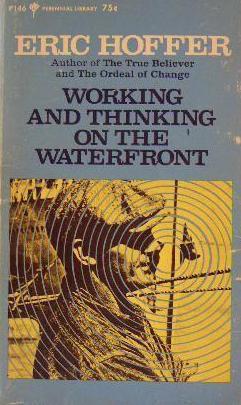
波止場日記―労働と思索
by Eric Hoffer

Truth Imagined
by Eric Hoffer
The Crowded Life
by Eric Hoffer
Feeling No Pain
by Eric Hoffer
The True Believe
by Eric Hoffer
(The Ordeal of Change) [By: Hoffer, Eric] [Jun, 2006]
by Eric Hoffer