
John M. Barry
John M. Barry is an American author and historian, perhaps best known for his books on the Great Mississippi Flood of 1927 the influenza pandemic of 1918 and his book on the development of the modern form of the ideas of separation of church and state and individual liberty. His most recent book is Roger Williams and the Creation of the American Soul: Church, State, and the Birth of Liberty (Viking 2012). Barry's 1997 book Rising Tide: The Great Mississippi Flood of 1927 and How It Changed America appeared on the New York Times Best Seller list and won the 1998 Francis Parkman Prize from the Society of American Historians for the year's best book on American history. His work on water-related issues was recognized by the National Academies of Sciences in its invitation to give the 2006 Abel Wolman Distinguished Lecture on Water Resources; he is the only non-scientist ever to give that lecture. His 2004 book The Great Influenza: The Epic Story of the Greatest Plague in History was also a New York Times Best Seller, and won the 2005 Keck Communications Award from the United States National Academies of Science for the year's outstanding book on science or medicine. In 2005 he also won the "September 11th Award" from the Center for Biodefense and Emerging Pathogens at Brown University. He has served on a federal government's Infectious Disease Board of Experts, on the advisory board of MIT's Center for Engineering Fundamentals, and on the advisory committee at Johns Hopkins Bloomberg School of Public Health for its Center for Refugee and Disaster Response. The expertise he developed in these two areas has involved him in policy-making, risk communication and disaster management strategies, and developing resilient communities, and this work resulted in his induction into Delta Omega, the academic honorary society for public health. More specifically, he has advised the private sector and local, state, national, and international government officials about preparing for another influenza pandemic. He has also both advised officials and taken a direct role in preparing for water-related disasters. A resident of New Orleans, after Hurricane Katrina he was also named to both the Southeast Louisiana Flood Protection Authority, which is the levee board overseeing several separate levee districts in the New Orleans area, and the state's Coastal Protection and Restoration Authority, which is responsible for hurricane protection for the entire state. His first book, The Ambition and the Power: A true story of Washington, appeared in 1989 and explored the operation of the U.S. Congress, the use of power by Speaker of the House Jim Wright, and the rise of future Speaker Newt Gingrich. In 1995 the New York Times named it one of the eleven best books ever written on Congress and Washington. With Steven Rosenberg, MD, Ph.D., chief of the Surgery Branch at the National Cancer Institute and a pioneer in the development of "immunotherapy" for cancer—stimulating the immune system to attack cancer—Barry co-authored his second book, The Transformed Cell: Unlocking the Mysteries of Cancer, which was published in 12 languages. Barry has written for The New York Times, Time Magazine, Fortune, The Washington Post, Esquire, and other publications and frequently appears as a guest commentator on broadcast media. He has also coached high school and college football, and his first published article was about blocking assignments for offensive linemen and appeared in a professional journal for coaches, Scholastic Coach.
9 Books Written

The Great Influenza: The Story of the Deadliest Pandemic in History
by John M. Barry
Rating: 4.0 ⭐
• 7 recommendations ❤️
At the height of WWI, history’s most lethal influenza virus erupted in an army camp in Kansas, moved east with American troops, then exploded, killing as many as 100 million people worldwide. It killed more people in twenty-four months than AIDS killed in twenty-four years, more in a year than the Black Death killed in a century. But this was not the Middle Ages, and 1918 marked the first collision of science and epidemic disease. Magisterial in its breadth of perspective and depth of research and now revised to reflect the growing danger of the avian flu, The Great Influenza is ultimately a tale of triumph amid tragedy, which provides us with a precise and sobering model as we confront the epidemics looming on our own horizon. John M. Barry has written a new afterword for this edition that brings us up to speed on the terrible threat of the avian flu and suggest ways in which we might head off another flu pandemic.
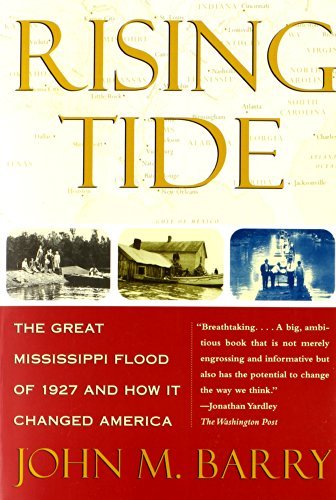
Rising Tide: the Great Mississippi Flood of 1927 and How it Changed America
by John M. Barry
Rating: 4.2 ⭐
In 1927, the Mississippi River swept across an area roughly equal in size to Massachusetts, Connecticut, New Hampshire, and Vermont combined, leaving water as deep as thirty feet on the land stretching from Illinois and Missouri south to the Gulf of Mexico. Close to a million people—in a nation of 120 million—were forced out of their homes. Some estimates place the death toll in the thousands. The Red Cross fed nearly 700,000 refugees for months. Rising Tide is the story of this forgotten event, the greatest natural disaster this country has ever known. But it is not simply a tale of disaster. The flood transformed part of the nation and had a major cultural and political impact on the rest. Rising Tide is an American epic about science, race, honor, politics, and society. Rising Tide begins in the nineteenth century, when the first serious attempts to control the river began. The story focuses on engineers James Eads and Andrew Humphreys, who hated each other. Out of the collision of their personalities and their theories came a compromise river policy that would lead to the disaster of the 1927 flood yet would also allow the cultivation of the Yazoo-Mississippi Delta and create wealth and aristocracy, as well as a whole culture. In the end, the flood had indeed changed the face of America, leading to the most comprehensive legislation the government had ever enacted, touching the entire Mississippi valley from Pennsylvania to Montana. In its aftermath was laid the foundation for the New Deal of Franklin D. Roosevelt.

Roger Williams and the Creation of the American Soul: Church, State, and the Birth of Liberty
by John M. Barry
Rating: 4.2 ⭐
A revelatory look at how Roger Williams shaped the nature of religion, political power, and individual rights in America.For four hundred years, Americans have wrestled with and fought over two concepts that define the nature of the nation: the proper relation between church and state and between a free individual and the state. These debates began with the extraordinary thought and struggles of Roger Williams, who had an unparalleled understanding of the conflict between a government that justified itself by "reason of state"—i.e., national security—and its perceived "will of God" and the "ancient rights and liberties" of individuals.This is a story of power, set against Puritan America and the English Civil War. Williams's interactions with King James, Francis Bacon, Oliver Cromwell, and his mentor Edward Coke set his course, but his fundamental ideas came to fruition in America, as Williams, though a Puritan, collided with John Winthrop's vision of his "City upon a Hill."Acclaimed historian John M. Barry explores the development of these fundamental ideas through the story of the man who was the first to link religious freedom to individual liberty, and who created in America the first government and society on earth informed by those beliefs. The story is essential to the continuing debate over how we define the role of religion and political power in modern American life.

The Ambition and the Power: The Fall of Jim Wright : A True Story of Washington
by John M. Barry
Rating: 4.4 ⭐
Profiles the man whose thirty-five-year congressional career ended ignominiously in the spring of 1989

The pursuit and wielding of power may be America's most intoxicating and sometimes revolting pastime. John M. Barry, award-winning author of Rising The Great Mississippi Flood of 1927 and How It Changed America (1997), purveys American uses and abuses of might in the media, in Washington, in Olympians, and in college football. With Power Politics, Football, and Other Blood Sports Barry draws together essays that examine the causes and effects of power. He shows how much politics and powerful agendas affect our lives. Barry draws from personal experience to probe deep into all aspects of gaining and expending personal clout. Reflecting on life as a major college football coach, on politicians such as Dick Cheney, Newt Gingrich, and Jim Wright, or on such American athletes as world record-holding hurdler Renaldo Nehemiah, Barry pushes past the glamour and glitz to tackle the nitty-gritty, down-and-dirty stratagems that create and destroy America's most powerful figures. Barry's witty and well-informed narrative voice keeps the discussion from becoming purely abstract. His numerous examples, including candid moments from his own life, focus on people and specific events that remain--and should remain--in the public eye and imagination. Revealing the ethos, skills, and brinksmanship inherent in both sports and politics, Barry draws parallels between the two, often presenting sports as a metaphor for understanding the American political scene. His poignant memoirs of coaching football, and his highly opinionated voice within the other essays, make Barry as much a character and example in the book as any of the people he profiles. Drawing on his 1989 book on the rise of Newt Gingrich and the fall of Jim Wright, The Ambition and the A True Story of Washington , Barry re-envisions a book-length argument as a series of profiles and shorter articles. Barry creates in Power Politics, Football, and Other Blood Sports an engrossing and disturbing primer on American politics, helping readers to understand how might is made, manipulated, and lost.The pursuit and wielding of power may be America's most intoxicating and sometimes revolting pastime. John M. Barry, award-winning author of Rising The Great Mississippi Flood of 1927 and How It Changed America (1997), purveys American uses and abuses of might in the media, in Washington, in Olympians, and in college football. With Power Politics, Football, and Other Blood Sports Barry draws together essays that examine the causes and effects of power. He shows how much politics and powerful agendas affect our lives. Barry draws from personal experience to probe deep into all aspects of gaining and expending personal clout. Reflecting on life as a major college football coach, on politicians such as Dick Cheney, Newt Gingrich, and Jim Wright, or on such American athletes as world record-holding hurdler Renaldo Nehemiah, Barry pushes past the glamour and glitz to tackle the nitty-gritty, down-and-dirty stratagems that create and destroy America's most powerful figures. Barry's witty and well-informed narrative voice keeps the discussion from becoming purely abstract. His numerous examples, including candid moments from his own life, focus on people and specific events that remain--and should remain--in the public eye and imagination. Revealing the ethos, skills, and brinksmanship inherent in both sports and politics, Barry draws parallels between the two, often presenting sports as a metaphor for understanding the American political scene. His poignant memoirs of coaching football, and his highly opinionated voice within the other essays, make Barry as much a character and example in the book as any of the people he profiles. Drawing on his 1989 book on the rise of Newt Gingrich and the fall of Jim Wright, The Ambition and the A True Story of Washington , Barry re-envisions a book-length argument as a series of profiles and shorter articles. Barry creates in Power Politics, Football, and Other Blood Sports an engrossing and disturbing primer on American politics, helping readers to understand how might is made, manipulated, and lost.

Book by Barry, John M.
Analysis of Trip Generation Factors Involved in Ground Passenger Transportation Within Montgomery and Greene Counties, OH
by John M. Barry