
Neil Postman
Neil Postman, an important American educator, media theorist and cultural critic was probably best known for his popular 1985 book, Amusing Ourselves to Death. For more than four decades he was associated with New York University, where he created and led the Media Ecology program. He is the author of more than thirty significant books on education, media criticism, and cultural change including Teaching as a Subversive Activity, The Disappearance of Childhood, Technopoly, and Building a Bridge to the Eighteenth Century. Amusing Ourselves to Death (1985), a historical narrative which warns of a decline in the ability of our mass communications media to share serious ideas. Since television images replace the written word, Postman argues that television confounds serious issues by demeaning and undermining political discourse and by turning real, complex issues into superficial images, less about ideas and thoughts and more about entertainment. He also argues that television is not an effective way of providing education, as it provides only top-down information transfer, rather than the interaction that he believes is necessary to maximize learning. He refers to the relationship between information and human response as the Information-action ratio.
29 Books Written
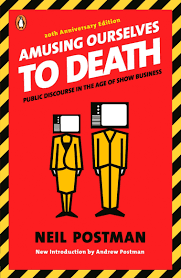
Amusing Ourselves to Death: Public Discourse in the Age of Show Business
by Neil Postman
Rating: 4.2 ⭐
• 13 recommendations ❤️
Television has conditioned us to tolerate visually entertaining material measured out in spoonfuls of time, to the detriment of rational public discourse and reasoned public affairs. In this eloquent, persuasive book, Neil Postman alerts us to the real and present dangers of this state of affairs, and offers compelling suggestions as to how to withstand the media onslaught. Before we hand over politics, education, religion, and journalism to the show business demands of the television age, we must recognize the ways in which the media shape our lives and the ways we can, in turn, shape them to serve out highest goals.

Technopoly: The Surrender of Culture to Technology
by Neil Postman
Rating: 4.0 ⭐
• 2 recommendations ❤️
A witty, often terrifying that chronicles our transformation into a society that is shaped by technology—from the acclaimed author of Amusing Ourselves to Death."A provocative book ... A tool for fighting back against the tools that run our lives." — Dallas Morning NewsThe story of our society's transformation into a Technopoly: a society that no longer merely uses technology as a support system but instead is shaped by it—with radical consequences for the meanings of politics, art, education, intelligence, and truth.

From the vogue for nubile models to the explosion in the juvenile crime rate, this modern classic of social history and media traces the precipitous decline of childhood in America today ˆ’and the corresponding threat to the notion of adulthood.Deftly marshaling a vast array of historical and demographic research, Neil Postman, author of Technopoly, suggests that childhood is a relatively recent invention, which came into being as the new medium of print imposed divisions between children and adults. But now these divisions are eroding under the barrage of television, which turns the adult secrets of sex and violence into popular entertainment and pitches both news and advertising at the intellectual level of ten-year-olds.

Postman suggests that the current crisis in our educational system derives from its failure to supply students with a translucent, unifying "narrative" like those that inspired earlier generations. Instead, today's schools promote the false "gods" of economic utility, consumerism, or ethnic separatism and resentment. What alternative strategies can we use to instill our children with a sense of global citizenship, healthy intellectual skepticism, respect of America's traditions, and appreciation of its diversity? In answering this question, The End of Education restores meaning and common sense to the arena in which they are most urgently needed."Informal and clear...Postman's ideas about education are appealingly fresh."--New York Times Book Review

A no-holds-barred assault on outdated teaching methods—with dramatic and practical proposals on how education can be made relevant to today's world.Praise for Teaching As a Subversive Activity“A healthy dose of Postman and Weingartner is a good if they make even a dent in the pious . . . American classroom, the book will be worthwhile.” — New York Times Book Review “Teaching and knowledge are subversive in that they necessarily substitute awareness for guesswork, and knowledge for experience. Experience is no use in the world of Apollo 8. It is simply necessary to know. However, it is also necessary to know the effect of Apollo 8 in creating a new Global Theatre in which student and teacher alike are looking for roles. Postman and Weingartner make excellent theatrical producers in the new Global Theatre.” —Marshall McLuhan “It will take courage to read this book . . . but those who are asking honest questions—what’s wrong with the worlds in which we live, how do we build communication bridges cross the Generation Gap, what do they want from us?—these people will squirm in the discovery that the answers are really within themselves.” — Saturday Review “Neil Postman and Charles Weingartner go beyond the now-familiar indictments of American education to propose basic ways of liberating both teachers and students from becoming personnel rather than people . . . the authors have created what may become a primer of ‘the new education’ Their book is intended for anyone, teacher or not, who is concerned with sanity and survival in a world of precipitously rapid change, and it’s worth your reading.” — Playboy “This challenging, liberating book can unlock not only teachers but anyone for whom language and learning are not dead.” —Nat Hentoff

A guide to watching television news discusses the calculated programming, the viewer manipulation, and the big business behind today's news networks and shows readers how to interpret what they are hearing and seeing. Original.

Building a Bridge to the 18th Century: How the Past Can Improve Our Future
by Neil Postman
Rating: 3.9 ⭐
In Building a Bridge to the 18th Century , acclaimed cultural critic Neil Postman offers a cure for the hysteria and hazy values of the postmodern world.Postman shows us how to reclaim that balance between mind and machine in a dazzling celebration of the accomplishments of the Enlightenment-from Jefferson's representative democracy to Locke's deductive reasoning to Rousseau's demand that the care and edification of children be considered an investment in our collective future. Here, too, is the bold assertion that Truth is invulnerable to fashion or the passing of time. Provocative and brilliantly argued, Building a Bridge to the 18th Century illuminates a navigable path through the Information Age-a byway whose signposts, it turns out, were there all along.
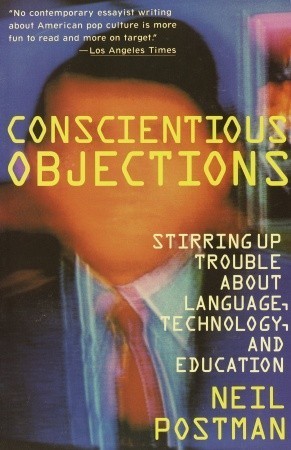
Conscientious Objections: Stirring Up Trouble About Language, Technology and Education
by Neil Postman
Rating: 4.1 ⭐
In a series of feisty and ultimately hopeful essays, one of America's sharpest social critics casts a shrewd eye over contemporary culture to reveal the worst -- and the best -- of our habits of discourse, tendencies in education, and obsessions with technological novelty. Readers will find themselves rethinking many of their bedrock Should education transmit culture or defend us against it? Is technological innovation progress or a peculiarly American addiction? When everyone watches the same television programs -- and television producers don't discriminate between the audiences for Sesame Street and Dynasty -- is childhood anything more than a sentimental concept? Writing in the traditions of Orwell and H.L. Mencken, Neil Postman sends shock waves of wit and critical intelligence through the cultural wasteland.

A co-author of the influential Teaching as a Subversive Activity, Postman reassesses and reworks some of his "revolutionary" theories of ten years ago in a continuing effort to take the fear out of the classroom situation


Hardback, ex-library, with usual stamps and markings, in fair all round condition suitable as a reading copy. No dust jacket, cover worn and discoloured.
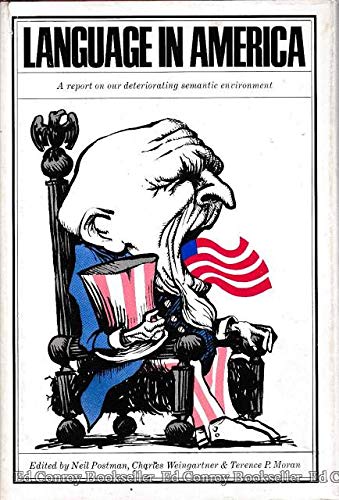
Working from the premise that language is a key to human survival, these essays explore the ways in which this valuable tool is currently manipulated in various fields

Paperback. Text contains very minor underlining/marking. Covers show light edge wear and heavy rubbing. Previous owner's name on end paper. COVER MAY NOT MATCH THE PICTURE ON THIS SITE.


正版授权 卖家 : Boolee加微信[soweinc]每天分享好书,邀你加入国际微信群学习交流.微信好友低至5优惠 .书名:技术垄断:文化向技术投降(见识丛书28)(尼尔·波兹曼媒介三部曲)简介:《娱乐至死》《童年的消逝》姐妹篇,波斯曼“媒介批评三部曲”完结番!在信息技术甚嚣尘上、数字媒体万众欢腾的时代,倾听智者的声音,反思技术的利弊,警惕技术垄断,呼吁人文精神,坚决拒绝文化向技术投降!作者:尼尔·波兹曼出版社:中信出版社出版时间:2019年04月装订方式:精装分类:社会科学|社会科学总论无
Editorial Reviews:Technology has a powerful capacity to affect the way we perceive the world and how it works. The authors and scientists in these interviews share their thoughts on computer-assisted communications technologies and the increasing capability of scientific technology to affect the world for good or ill. They also discuss the influence of cyberspace, virtual reality, and intelligent design. The interviewees include Neil Postman, Jane Metcalfe, Howard Rheingold, Mark Slouka, Andrew Kimbrell, Doug Groothius, Dean Kenyon, Philip Johnson, and Michael Behe.


Por un ateísmo tecnológico: La cultura frente a la civilización informática
by Neil Postman
Rating: 4.0 ⭐
Der Autrag der Schule heute : Wirklichkeit und Unwirklichkeit in der Erziehung
by Neil Postman
Rating: 5.0 ⭐

cover, University Pub. Date :2007-11-01, Peking University Pub. 2007 - 11-01. technical surrender of culture to technology (1992) Neil Bossman media criticism of the trilogy, one of the other two are the passage of childhood (1982) and ente...
Die Verweigerung der Hörigkeit
by Neil Postman

Collins Student World Atlas. Ab 7. Schuljahr
by Neil Postman