
Jack Weatherford
Jack McIver Weatherford is the DeWitt Wallace Professor of anthropology at Macalester College in Minnesota. He is best known for his 2004 book, Genghis Khan and the Making of the Modern World. In 2006, he was awarded the Order of the Polar Star, and the Order of Genghis Khan in 2022, Mongolia’s two highest national honors. Moreover, he was honoured with the Order of the Gran Mariscal de Ayacucho by the Government of Bolivia in 2014. His books in the late 20th century on the influence of Native American cultures have been translated into numerous languages. In addition to publishing chapters and reviews in academic books and journals, Weatherford has published numerous articles in national newspapers to popularize his historic and anthropological coverage of Native American cultures, as well as the American political culture in Congress in the 20th century. In recent years, he has concentrated on the Mongols by looking at their impact since the time that Genghis Khan united the Mongol tribes in 1206.
12 Books Written

Genghis Khan and the Making of the Modern World
by Jack Weatherford
Rating: 4.0 ⭐
• 13 recommendations ❤️
The definitive biography of the founder of history's greatest empire. In 25 years, Genghis Khan and his Mongol armies conquered more than the Romans had in four centuries, founding the most extensive empire humankind has ever seen. Born Temujin, a pariah from the steppes, the man destined to make history as the Great Khan of the Mongols conquered every territory he held, from Georgia and Armenia to Korea. Genghis Khan emerged as an unexpected leader, abolishing torture, guaranteeing religious freedom, and destroying feudal systems based on aristocratic privilege. When he was born, holding a blood clot in his hand, his mother predicted that the child would change the course of the world. Thus, Genghis Khan united all the Mongol tribes of the steppes and transformed their way of life. He created the most efficient army of the Middle Ages, opened trade routes that connected the known world, and founded an empire that stretched from Europe to East Asia. His successors were kings, khans, and emperors in China, India, and Russia, and his legacy was enduring. From the early life of Genghis Khan and his rise and transformation from the tribal world of the steppes to the civilizing explosion of the Mongol Empire, this brilliant essay by Jack Weatherford, an anthropologist specializing in Mongol history, tells the epic story of how the modern world was forged.

In his most widely appealing book yet, one of today's leading authors of popular anthropology looks at the intriguing history and peculiar nature of money, tracing our relationship with it from the time when primitive men exchanged cowrie shells to the imminent arrival of the all-purpose electronic cash card.

The Secret History of the Mongol Queens: How the Daughters of Genghis Khan Rescued His Empire
by Jack Weatherford
Rating: 3.9 ⭐
The Mongol queens of the thirteenth century ruled the largest empire the world has ever known. Yet sometime near the end of the century, censors cut a section from The Secret History of the Mongols, leaving a single tantalizing quote from Genghis “Let us reward our female offspring.” Only this hint of a father’s legacy for his daughters remained of a much larger story. The queens of the Silk Route turned their father’s conquests into the world’s first truly international empire, fostering trade, education, and religion throughout their territories and creating an economic system that stretched from the Pacific to the Mediterranean. Outlandish stories of these powerful queens trickled out of the Empire, shocking the citizens of Europe and and the Islamic world.After Genghis Khan’s death in 1227, conflicts erupted between his daughters and his daughters-in-law; what began as a war between powerful women soon became a war against women in power as brother turned against sister, son against mother. At the end of this epic struggle, the dynasty of the Mongol queens had seemingly been extinguished forever, as even their names were erased from the historical record.. One of the most unusual and important warrior queens of history arose to avenge the wrongs, rescue the tattered shreds of the Mongol Empire, and restore order to a shattered world. Putting on her quiver and picking up her bow, Queen Mandhuhai led her soldiers through victory after victory. In her thirties she married a seventeen-year-old prince, and she bore eight children in the midst of a career spent fighting the Ming Dynasty of China on one side and a series of Muslim warlords on the other. Her unprecedented success on the battlefield provoked the Chinese into the most frantic and expensive phase of wall building in history. Charging into battle even while pregnant, she fought to reassemble the Mongol Nation of Genghis Khan and to preserve it for her own children to rule in peace. At the conclusion of his magnificently researched and ground-breaking narrative, Weatherford notes that, despite their mystery and the efforts to erase them from our collective memory, the deeds of these Mongol queens inspired great artists from Chaucer and Milton to Goethe and Puccini, and so their stories live on today. With The Secret History of the Mongol Queens , Jack Weatherford restores the queens’ missing chapter to the annals of history.

Control the sea, and you control everything...a gripping tale of naval warfare, dynastic rivalry, and technical innovation, from the author of the classic work Genghis Khan and the Making of the Modern World.Genghis Khan built a formidable land empire, but he never crossed the sea. Yet by the time his grandson Kublai Khan had defeated the last vestiges of the Song empire and established the Yuan dynasty in 1279, the Mongols controlled the most powerful navy in the world. How did a nomad come to conquer China and master the sea? Based on ten years of research and a lifetime of immersion in Mongol culture and tradition, Emperor of the Seas brings this little-known story vibrantly to life. Kublai Khan is one of history's most fascinating characters. He brought Islamic mathematicians to his court, where they invented modern cartography and celestial measurement. He transformed the world's largest land mass into a unified, diverse and economically progressive empire, introducing paper money. And, after bitter early setbacks, he transformed China into an outward looking sea-faring empire. By the end of his reign, the Chinese were building and supplying remarkable ships to transport men, grain, and weapons over vast distances, of a size and dexterity that would be inconceivable in Europe for hundreds of years. Khan had come to a brilliant control the sea, and you control everything. A master storyteller with an unparalleled grasp of Mongol sources, Jack Weatherford shows how Chinese naval hegemony changed the world forever - revolutionizing world commerce and transforming tastes as far away as England and France.
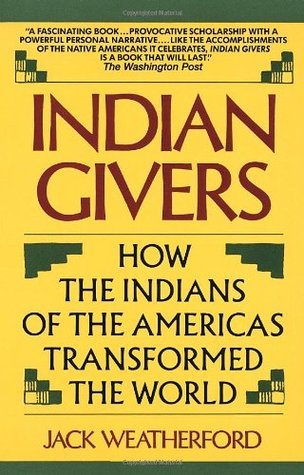
Indian Givers: How the Indians of the Americas Transformed the World
by Jack Weatherford
Rating: 4.1 ⭐
" As entertaining as it is thoughtful....Few contemporary writers have Weatherford's talent for making the deep sweep of history seem vital and immediate." THE WASHINGTON POSTAfter 500 years, the world's huge debt to the wisdom of the Indians of the Americas has finally been explored in all its vivid drama by anthropologist Jack Weatherford. He traces the crucial contributions made by the Indians to our federal system of government, our democratic institutions, modern medicine, agriculture, architecture, and ecology, and in this astonishing, ground-breaking book takes a giant step toward recovering a true American history.

Genghis Khan and the Quest for God: How the World's Greatest Conqueror Gave Us Religious Freedom
by Jack Weatherford
Rating: 4.0 ⭐
Thru history the world’s great conquerors have made their mark not just on the battlefield, but also in the societies they've transformed. Genghis Khan conquered by arms & bravery. He ruled by commerce & religion. He transformed the silk road into the world’s most effective trading network, established new laws & drastically lowered merchant taxes. But he knew that if his empire was going to last, he'd need something stronger & more binding than trade. He needed religion. Unlike the Christian, Taoist & Muslim conquerors who'd come before, he gave his subjects freedom of religion using an argument that would directly influence Th Jefferson. But before that, he looted their shrines, killed their priests. Genghis lived in the 13th century, but he struggled with many of the same problems faced today: How may one balance religious freedom with the need to restrain fanatics? Can one compel rival religions—driven by deep-seated hatred—to live together peacefully? A celebrated anthropologist whose bestselling Genghis Khan & the Making of the Modern World radically transformed our understanding of the Mongols & their legacy, Weatherford has spent 18 years exploring areas of Mongolia closed until the USSR's fall & researching The Secret History of the Mongols, an astonishing document written in code that was only recently discovered. He pored thru archives & found groundbreaking evidence of Genghis’ influence on the founding fathers. Now, with this masterpiece of historical erudition & religious insight, he's written his most resonant work.

“Gracefully written . . . thoroughly researched . . . America is a banquet prepared by the Indians—who were forgotten when it was time to give thanks at the table.”— St. Paul Pioneer-Express“Well written, imagery-ridden . . . A tale of what was, what became, and what is today regarding the Indian relation to the European civilization that ‘grafted’ itself onto this ‘ancient stem’”— Minneapolis Star TribuneIn Indian Givers, anthropologist Jack Weatherford revealed how the cultural, social, and political practices of the American Indians transformed the world. In Native Roots, Weatherford focuses on the vital role Indian civilizations have played in the making of the United States. Conventional American history holds that the white settlers of the New World re-created the societies they had known in England, France, and Spain. But, as Weatherford so brilliantly shows, Europeans in fact grafted their civilizations onto the deep and nourishing roots of Native American customs and beliefs. Beneath the glass-and-steel skyscrapers of contemporary Manhattan lies an Indian fur-trading post. Behind the tactics of modern guerrilla warfare are the lightning-fast maneuvers of the Plains Indians. Our place names, our farming and hunting techniques, our crafts, and the very blood that flows in our veins—all derive from American Indians in ways that we consistently fail to see. In Weatherford’s words, “Without understanding Native Americans, we will never know who we are today in America.”

A “provocative [and] vivid” ( Minneapolis Star Tribune ) look at the primitive cultures that have given many gifts to the modern world, and how their very existence is now threatened “This book should serve as a ‘wake-up’ call to people everywhere.”— Library JournalIn Indian Givers and Native Roots , renowned anthropologist Jack Weatherford explored the clash between Native American and European cultures. Now, in Savages and Civilization, Weatherford broadens his focus to examine how civilization threatens to obliterate unique tribal and ethnic cultures around the world—and in the process imperils its own existence. As Weatherford explains, the relationship between “civilized” and “savage” peoples through history has encompassed not only violence, but also a surprising degree of cooperation, mutual influence, trade, and intermarriage. But this relationship has now entered a critical stage everywhere in the world, as indigenous peoples fiercely resist the onslaught of a global civilization that will obliterate their identities. Savages and Civilization powerfully demonstrates that our survival as a species is based not on a choice between savages and civilization, but rather on a commitment to their vital coexistence.

A revealing, witty, and altogether fascinating story of the tribal customs and rituals that help shape our nation's laws. "The Washingtonian"Sharp, funny and ultimately disquieting. "The Washington Book RevieW"

Porn Row: An Inside Look at the Sex for Sale District of a Major American City
by Jack Weatherford
Rating: 3.8 ⭐


ファーストフード・ラブ―都会人の性の飢えと渇き
by Jack Weatherford