
Bill Bryson
Bill Bryson is a bestselling American-British author known for his witty and accessible nonfiction books spanning travel, science, and language. He rose to prominence with Notes from a Small Island (1995), an affectionate portrait of Britain, and solidified his global reputation with A Short History of Nearly Everything (2003), a popular science book that won the Aventis and Descartes Prizes. Raised in Iowa, Bryson lived most of his adult life in the UK, working as a journalist before turning to writing full-time. His other notable works include A Walk in the Woods, The Life and Times of the Thunderbolt Kid, and The Mother Tongue. Bryson served as Chancellor of Durham University (2005–2011) and received numerous honorary degrees and awards, including an honorary OBE and election as an Honorary Fellow of the Royal Society. Though he announced his retirement from writing in 2020, he remains one of the most beloved voices in contemporary nonfiction, with over 16 million books sold worldwide.
25 Books Written

Bill Bryson describes himself as a reluctant traveller, but even when he stays safely at home he can't contain his curiosity about the world around him. "A Short History of Nearly Everything" is his quest to understand everything that has happened from the Big Bang to the rise of civilisation - how we got from there, being nothing at all, to here, being us. The ultimate eye-opening journey through time and space, revealing the world in a way most of us have never seen it before.

A Walk in the Woods: Rediscovering America on the Appalachian Trail
by Bill Bryson
Rating: 4.1 ⭐
• 4 recommendations ❤️
The Appalachian Trail stretches from Georgia to Maine and covers some of the most breathtaking terrain in America—majestic mountains, silent forests, sparking lakes. If you’re going to take a hike, it’s probably the place to go. And Bill Bryson is surely the most entertaining guide you’ll find. He introduces us to the history and ecology of the trail and to some of the other hardy (or just foolhardy) folks he meets along the way—and a couple of bears. Already a classic, A Walk in the Woods will make you long for the great outdoors (or at least a comfortable chair to sit and read in).
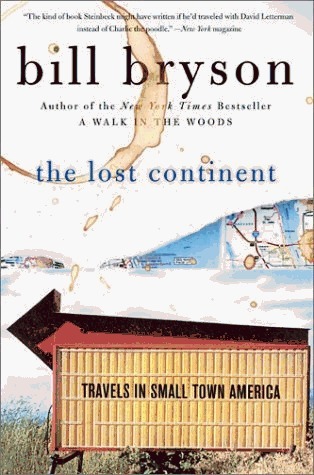
'I come from Des Moines. Somebody had to'And, as soon as Bill Bryson was old enough, he left. Des Moines couldn't hold him, but it did lure him back. After ten years in England, he returned to the land of his youth, and drove almost 14,000 miles in search of a mythical small town called Amalgam, the kind of trim and sunny place where the films of his youth were set. Instead, his search led him to Anywhere, USA; a lookalike strip of gas stations, motels and hamburger outlets populated by lookalike people with a penchant for synthetic fibres. Travelling around thirty-eight of the lower states - united only in their mind-numbingly dreary uniformity - he discovered a continent that was doubly lost; lost to itself because blighted by greed, pollution, mobile homes and television; lost to him because he had become a stranger in his own land.The Lost Continent is a classic of travel literature - hilariously, stomach-achingly funny, yet tinged with heartache - and the book that first staked Bill Bryson's claim as the most beloved writer of his generation.

In these pages, the beloved Bill Bryson gives us a fascinating history of the modern home, taking us on a room-by-room tour through his own house and using each room to explore the vast history of the domestic artifacts we take for granted. As he takes us through the history of our modern comforts, Bryson demonstrates that whatever happens in the world eventually ends up in our home, in the paint, the pipes, the pillows, and every item of furniture. Bryson has one of the liveliest, most inquisitive minds on the planet, and his sheer prose fluency makes At Home one of the most entertaining books ever written about private life.

A Chicago Tribune Noteworthy BookA GoodReads Reader's ChoiceIn One Summer Bill Bryson, one of our greatest and most beloved nonfiction writers, transports readers on a journey back to one amazing season in American life.The summer of 1927 began with one of the signature events of the twentieth century: on May 21, 1927, Charles Lindbergh became the first man to cross the Atlantic by plane nonstop, and when he landed in Le Bourget airfield near Paris, he ignited an explosion of worldwide rapture and instantly became the most famous person on the planet. Meanwhile, the titanically talented Babe Ruth was beginning his assault on the home run record, which would culminate on September 30 with his sixtieth blast, one of the most resonant and durable records in sports history. In between those dates a Queens housewife named Ruth Snyder and her corset-salesman lover garroted her husband, leading to a murder trial that became a huge tabloid sensation. Alvin “Shipwreck” Kelly sat atop a flagpole in Newark, New Jersey, for twelve days—a new record. The American South was clobbered by unprecedented rain and by flooding of the Mississippi basin, a great human disaster, the relief efforts for which were guided by the uncannily able and insufferably pompous Herbert Hoover. Calvin Coolidge interrupted an already leisurely presidency for an even more relaxing three-month vacation in the Black Hills of South Dakota. The gangster Al Capone tightened his grip on the illegal booze business through a gaudy and murderous reign of terror and municipal corruption. The first true “talking picture,” Al Jolson’s The Jazz Singer, was filmed and forever changed the motion picture industry. The four most powerful central bankers on earth met in secret session on a Long Island estate and made a fateful decision that virtually guaranteed a future crash and depression. All this and much, much more transpired in that epochal summer of 1927, and Bill Bryson captures its outsized personalities, exciting events, and occasional just plain weirdness with his trademark vividness, eye for telling detail, and delicious humor. In that year America stepped out onto the world stage as the main event, and One Summer transforms it all into narrative nonfiction of the highest order.

In the bestselling, prize-winning A Short History of Nearly Everything, Bill Bryson achieved the seemingly impossible by making the science of our world both understandable and entertaining to millions of people around the globe.Now he turns his attention inwards to explore the human body, how it functions and its remarkable ability to heal itself. Full of extraordinary facts and astonishing stories, The Body: A Guide for Occupants is a brilliant, often very funny attempt to understand the miracle of our physical and neurological make up.A wonderful successor to A Short History of Nearly Everything, this book will have you marvelling at the form you occupy, and celebrating the genius of your existence, time and time again.

It is the driest, flattest, hottest, most desiccated, infertile and climatically aggressive of all the inhabited continents and still Australia teems with life – a large portion of it quite deadly. In fact, Australia has more things that can kill you in a very nasty way than anywhere else.Ignoring such dangers – and yet curiously obsessed by them – Bill Bryson journeyed to Australia and promptly fell in love with the country. And who can blame him? The people are cheerful, extrovert, quick-witted and unfailingly obliging: their cities are safe and clean and nearly always built on water; the food is excellent; the beer is cold and the sun nearly always shines. Life doesn’t get much better than this…

"Suddenly, in the space of a moment, I realized what it was that I loved about Britain-which is to say, all of it."After nearly two decades spent on British soil, Bill Bryson - bestselling author of The Mother Tongue and Made in America-decided to return to the United States. ("I had recently read," Bryson writes, "that 3.7 million Americans believed that they had been abducted by aliens at one time or another, so it was clear that my people needed me.") But before departing, he set out on a grand farewell tour of the green and kindly island that had so long been his home.Veering from the ludicrous to the endearing and back again, Notes from a Small Island is a delightfully irreverent jaunt around the unparalleled floating nation that has produced zebra crossings, Shakespeare, Twiggie Winkie's Farm, and places with names like Farleigh Wallop and Titsey. The result is an uproarious social commentary that conveys the true glory of Britain, from the satiric pen of an unapologetic Anglophile.

Bill Bryson's first travel book, The Lost Continent, was unanimously acclaimed as one of the funniest books in years. In Neither Here nor There he brings his unique brand of humour to bear on Europe as he shoulders his backpack, keeps a tight hold on his wallet, and journeys from Hammerfest, the northernmost town on the continent, to Istanbul on the cusp of Asia. Fluent in, oh, at least one language, he retraces his travels as a student twenty years before.Whether braving the homicidal motorist of Paris, being robbed by gypsies in Florence, attempting not to order tripe and eyeballs in a German restaurant, window-shopping in the sex shops of the Reeperbahn or disputing his hotel bill in Copenhagen, Bryson takes in the sights, dissects the culture and illuminates each place and person with his hilariously caustic observations. He even goes to Liechtenstein.
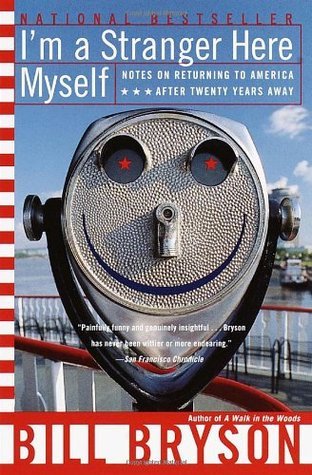
I'm a Stranger Here Myself: Notes on Returning to America After Twenty Years Away
by Bill Bryson
Rating: 3.9 ⭐
After living in Britain for two decades, Bill Bryson recently moved back to the United States with his English wife and four children (he had read somewhere that nearly 3 million Americans believed they had been abducted by aliens--as he later put it, "it was clear my people needed me"). They were greeted by a new and improved America that boasts microwave pancakes, twenty-four-hour dental-floss hotlines, and the staunch conviction that ice is not a luxury item. Delivering the brilliant comic musings that are a Bryson hallmark, I'm a Stranger Here Myself recounts his sometimes disconcerting reunion with the land of his birth. The result is a book filled with hysterical scenes of one man's attempt to reacquaint himself with his own country, but it is also an extended if at times bemused love letter to the homeland he has returned to after twenty years away.

From one of the most beloved and bestselling authors in the English language, a vivid, nostalgic, and utterly hilarious memoir of growing up in the 1950sBill Bryson was born in the middle of the American century—1951—in the middle of the United States—Des Moines, Iowa—in the middle of the largest generation in American history—the baby boomers. As one of the best and funniest writers alive, he is perfectly positioned to mine his memories of a totally all-American childhood for 24-carat memoir gold. Like millions of his generational peers, Bill Bryson grew up with a rich fantasy life as a superhero. In his case, he ran around his house and neighborhood with an old football jersey with a thunderbolt on it and a towel about his neck that served as his cape, leaping tall buildings in a single bound and vanquishing awful evildoers (and morons)—in his head—as "The Thunderbolt Kid."Using this persona as a springboard, Bill Bryson re-creates the life of his family and his native city in the 1950s in all its transcendent normality—a life at once completely familiar to us all and as far away and unreachable as another galaxy. It was, he reminds us, a happy time, when automobiles and televisions and appliances (not to mention nuclear weapons) grew larger and more numerous with each passing year, and DDT, cigarettes, and the fallout from atmospheric testing were considered harmless or even good for you. He brings us into the life of his loving but eccentric family, including affectionate portraits of his father, a gifted sportswriter for the local paper and dedicated practitioner of isometric exercises, and OF his mother, whose job as the home furnishing editor for the same paper left her little time for practicing the domestic arts at home. The many readers of Bill Bryson’s earlier classic, A Walk in the Woods, will greet the reappearance in these pages of the immortal Stephen Katz, seen hijacking literally boxcar loads of beer. He is joined in the Bryson gallery of immortal characters by the demonically clever Willoughby brothers, who apply their scientific skills and can-do attitude to gleefully destructive ends.Warm and laugh-out-loud funny, and full of his inimitable, pitch-perfect observations, The Life and Times of the Thunderbolt Kid is as wondrous a book as Bill Bryson has ever written. It will enchant anyone who has ever been young.

At first glance, Bill Bryson seems an odd choice to write this addition to the Eminent Lives series. The author of 'The Life and Times of the Thunderbolt Kid' isn't, after all, a Shakespeare scholar, a playwright, or even a biographer. Reading 'Shakespeare The World As Stage', however, one gets the sense that this eclectic Iowan is exactly the type of person the Bard himself would have selected for the task. The man who gave us 'The Mother Tongue' and 'A Walk in the Woods' approaches Shakespeare with the same freedom of spirit and curiosity that made those books such reader favorites. A refreshing take on an elusive literary master.

Only Bill Bryson could make a book about the English language so entertaining. With his boundless enthusiasm and restless eye for the absurd, this is his astonishing tour of English.From its mongrel origins to its status as the world's most-spoken tongue; its apparent simplicity to its deceptive complexity; its vibrant swearing to its uncertain spelling and pronunciation; Bryson covers all this as well as the many curious eccentricities that make it as maddening to learn as it is flexible to use.Bill Bryson's classic Mother Tongue is a highly readable and hilarious tale of how English came to be the world's language.

The hilarious and loving sequel to a hilarious and loving classic of travel writing: Notes from a Small Island, Bill Bryson’s valentine to his adopted country of EnglandIn 1995 Bill Bryson got into his car and took a weeks-long farewell motoring trip about England before moving his family back to the United States. The book about that trip, Notes from a Small Island, is uproarious and endlessly endearing, one of the most acute and affectionate portrayals of England in all its glorious eccentricity ever written. Two decades later, he set out again to rediscover that country, and the result is The Road to Little Dribbling. Nothing is funnier than Bill Bryson on the road—prepare for the total joy and multiple episodes of unseemly laughter.

Made in America: An Informal History of the English Language in the United States
by Bill Bryson
Rating: 3.9 ⭐
This book turns away from the highways and byways of middle America for a fast, exhilarating ride along the Route 66 of American language and popular culture.Exploding much of America's self-created self-image, Bryson de-mythologises his native land - explaining how a dusty desert hamlet with neither woods nor holly became Hollywood, how the Wild West wasn't won, why Americans say "lootenant" and "Toosday", how Americans were eating junk food long before the word itself was cooked up - as well as exposing the true origins of the G-string, the original $64,000 question and Dr Kellogg of cornflakes fame.

In the early fall of 2002, famed travel Writer Bill Bryson journeyed to Kenya at the invitation of CARE International, the charity dedicated to working with local communities to eradicate poverty around the world. He arrived with a set of mental images of Africa gleaned from television broadcasts of low-budget Jungle Jim movies in his Iowa childhood and a single viewing of the film version of Out of Africa. (Also with some worries about tropical diseases, insects and large predators.) But the vibrant reality of Kenya and its people took over the second he deplaned in Nairobi, and this diary records Bill Bryson's impresssions of his trip with his inimitable trademark style of wry observation and curious insight. From the wrenching poverty of the Kibera slum in Nairobi to the meticulously manicured grounds of the Karen Blixen house and the human fossil riches of the National Museum, Bryson registers the striking contrasts of a postcolonial society in transition. He visits the astoundingly vast Great Rift Valley; undergoes the rigors of a teeth-rattling train journey to Mombasa and a hair-whitening flight through a vicious storm; and visits the refugee camps and the agricultural and economic projects where dedicated CARE professionals wage noble and dogged war against poverty, dislocation and corruption.
Bryson's Dictionary of Troublesome Words: A Writer's Guide to Getting It Right
by Bill Bryson
Rating: 3.9 ⭐
A revised and updated edition of a humorous primer on the English language, expanded for an American audience, contains entries on correct and questionable usage, a glossary, and a pronunciation guide.

Bill Bryson’s own fascination with science began with a battered old school book he had when he was about ten or eleven years old. It had an illustration that captivated him–a diagram showing Earth’s interior as it would look if you cut into it with a large knife and removed about a quarter of its bulk. The idea of lots of startled cars and people falling off the edge of that sudden cliff (and 4,000 miles is a pretty long way to fall) was what grabbed him in the beginning, but gradually his attention turned to what the picture was trying to teach him: namely that Earth’s interior is made up of several different layers of materials, and at the very centre is a glowing sphere of iron and nickel, as hot as the Sun’s surface, according to the caption. And he very clearly remembers thinking: “How do they know that?”Bill’s storytelling skill makes the “How?” and, just as importantly, the “Who?” of scientific discovery entertaining and accessible for all ages. He covers the wonder and mystery of time and space, the frequently bizarre and often obsessive scientists and the methods they used, and the mind-boggling fact that, somehow, the universe exists and against all odds, life came to be on this wondrous planet we call home.

Omnibus edition of A Walk in the Woods and Down Under, which is also published under the title In a Sunburned Country.Combined in one volume are Bryson's "Down Under/In a Sunburned Country", an account of his memorable walk across Australia, and "A Walk in the Woods", that tells of his lengthy stroll along the longest continuous footpath in the world - The Appalachian Trail, with his old friend Stephen Katz. The Trail stretches along the East Coast of the United States, from Georgia to Maine, through some of the most arresting and celebrated landscapes in America - the Smoky Mountains, Shenandoah National Park, the Berkshire Hills of Massachusetts and the Great North Woods of Maine.

After nearly two decades in Britain, Bill Bryson took the decision to move Mrs Bryson, little Jimmy et al. back to the States for a while. But before leaving his much-loved Yorkshire, Bryson insisted on taking one last trip around old Blighty, a sort of valedictory tour of the green and kindly island that had for so long been his home. The resulting book, Notes from a Small Island, is a eulogy to the country that produced Marmite, George Formby, by-elections, milky tea, place names like Farleigh Wallop, Titsey and Shellow Bowels, Gardeners' Question Time and people who say, 'Mustn't grumble'. Britain will never seem the same again.Once ensconced back home in New Hampshire, Bryson couldn't resist the invitation to write a weekly dispatch for the Mail on Sunday's Night & Day magazine. Notes from a Big Country is a collection of eighteen months' worth of his popular columns about that strangest of phenomena - the American way of life. Whether discussing the dazzling efficiency of the garbage disposal unit, the exoticism of having your groceries bagged for you, or the mind-numbing frequency of commercial breaks on American TV, Bill Bryson brings his inimitable brand of bemused wit to bear on the world's richest and craziest country.The Complete Notes combines two of Bill Bryson's best-loved travel books in one volume, It demonstrates his unique take on life - from either side of the pond.

This BBC Radio 4 series is written and presented by Bill Bryson and based on his best-selling book "Mother Tongue". In it he romps through the history of Britain to reveal how English became such an infuriatingly complex - but ultimately world-beating - language. The subject areas covered in the course of the programme (which was originally broadcast in 6 episodes) include the arrival of the Angles and the Saxons, the rules which brought order to a disorderly language, the million and one ways to have fun with the English language, the struggle with phrasal verbs (and the way things often get lost in the translation) and the future of English - does Estuary English Rule OK?

Here in one volume are two comic masterpieces by Bill Bryson ; - The Lost Continent is the story of Bryson's return to the land of his youth; - Neither Here nor There Bryson is in Europe, travelling the breadth of the continent.

From one of the world’s most beloved and bestselling authors, a terrifically useful and readable guide to the problems of the English language most commonly encountered by editors and writers.What is the singular form of graffiti? From what mythological figure is the word “tantalize” derived? One of the English language’s most skilled writers guides us all toward precise, mistake-free usage. Covering spelling, capitalization, plurals, hyphens, abbreviations, and foreign names and phrases, Bryson’s Dictionary for Writers and Editors will be an indispensable companion for all who care enough about our language not to maul, misuse, or contort it.As Bill Bryson notes, “English is a dazzlingly idiosyncratic tongue, full of quirks and irregularities that often seem willfully at odds with logic and common sense.” This dictionary is an essential guide to the wonderfully disordered thing that is the English language.

Bill Bryson Collector's Edition: Notes from a Small Island / Neither Here Nor There / I'm a Stranger Here Myself
by Bill Bryson
Rating: 4.2 ⭐
Notes from a Small Island After nearly two decades in Britain, Bill Bryson decided to move his wife and kids back to his homeland of the United States. But not before taking one last trip around Britain, a sort of valedictory tour of the green and kindly island that had so long been his home. The result is a hilarious social commentary that conveys the true glory of Britain.Neither Here nor There Thirty years after backpacking across Europe, Bill Bryson decides to retrace the journey he undertook in the halcyon days of his youth–carrying with him a bag of maps, old clothes…and a stinging wit honed to razor sharpness by two decades of adult experience. I’m a Stranger Here Myself Bill Bryson read “somewhere” that nearly three million Americans believed they had been abducted by aliens–clearly the Americans needed Bill back. So after years raising his family in Britain with his English wife, the brood moves to the United States, and leaves Bill to chronicle the quirkiest aspects of life in America as he reveals his own rules for life.

In this selection from The Body, Bill Bryson introduces us to the mysterious, and often devastating, world of disease.