
Friedrich Nietzsche
Friedrich Wilhelm Nietzsche was a German classical scholar, philosopher, and critic of culture, who became one of the most influential of all modern thinkers. He began his career as a classical philologist before turning to philosophy. He became the youngest person to hold the Chair of Classical Philology at the University of Basel in 1869 at the age of 24, but resigned in 1879 due to health problems that plagued him most of his life; he completed much of his core writing in the following decade. In 1889, at age 44, he suffered a collapse and afterward a complete loss of his mental faculties, with paralysis and probably vascular dementia. He lived his remaining years in the care of his mother until her death in 1897 and then with his sister Elisabeth Förster-Nietzsche. Nietzsche died in 1900, after experiencing pneumonia and multiple strokes. Nietzsche's work spans philosophical polemics, poetry, cultural criticism, and fiction while displaying a fondness for aphorism and irony. Prominent elements of his philosophy include his radical critique of truth in favour of perspectivism; a genealogical critique of religion and Christian morality and a related theory of master–slave morality; the aesthetic affirmation of life in response to both the "death of God" and the profound crisis of nihilism; the notion of Apollonian and Dionysian forces; and a characterisation of the human subject as the expression of competing wills, collectively understood as the will to power. He also developed influential concepts such as the Übermensch and his doctrine of eternal return. In his later work, he became increasingly preoccupied with the creative powers of the individual to overcome cultural and moral mores in pursuit of new values and aesthetic health. His body of work touched a wide range of topics, including art, philology, history, music, religion, tragedy, culture, and science, and drew inspiration from Greek tragedy as well as figures such as Zoroaster, Arthur Schopenhauer, Ralph Waldo Emerson, Richard Wagner, Fyodor Dostoevsky, and Johann Wolfgang von Goethe. After his death, Nietzsche's sister Elisabeth became the curator and editor of his manuscripts. She edited his unpublished writings to fit her German ultranationalist ideology, often contradicting or obfuscating Nietzsche's stated opinions, which were explicitly opposed to antisemitism and nationalism. Through her published editions, Nietzsche's work became associated with fascism and Nazism. 20th-century scholars such as Walter Kaufmann, R.J. Hollingdale, and Georges Bataille defended Nietzsche against this interpretation, and corrected editions of his writings were soon made available. Nietzsche's thought enjoyed renewed popularity in the 1960s and his ideas have since had a profound impact on 20th- and early 21st-century thinkers across philosophy—especially in schools of continental philosophy such as existentialism, postmodernism, and post-structuralism—as well as art, literature, music, poetry, politics, and popular culture.
30 Books Written

One of the most remarkable and influential books of the nineteenth century—Nietzsche's attempt to sum up his philosophy.In nine parts the book is designed to give the reader a comprehensive idea of Nietzsche's thought and style: they span "The Prejudices of Philsophers," "The Free Spirit," religion, morals, scholarship, "Our Virtues," "Peoples and Fatherlands," and "What Is Noble," as well as epigrams and a concluding poem. This translation by Walter Kaufmann has become the standard one, for accuracy and fidelity to the eccentricities and grace of the style of the original. The translation is based on the only edition Nietzsche himself published, and all variant reading in later editions. This volume offers an inclusive index of subjects and persons, as well as a running footnote commentary on the text.

The Genealogy of Morals consists of three essays exploring morality and its origins where Nietzsche makes ample use of his training as a philologist. These works contain Nietzsche's most thorough and clear expression of his psychological philosophy. This edition includes Ecce Homo, Nietzsche's review of his life and works, with the exception of The Antichrist. These two books are compiled, translated and annotated by renowned Nietzsche scholar Walter Kaufmann.

The Gay Science: With a Prelude in Rhymes and an Appendix of Songs
by Friedrich Nietzsche
Rating: 4.3 ⭐
• 4 recommendations ❤️
"[This book] mirrors all of Nietzsche's thought and could be related in hundreds of ways to his other books, his notes, and his letters. And yet it is complete in itself. For it is a work of art." —Walter Kaufmann in the IntroductionNietzsche called The Gay Science "the most personal of all my books." It was here that he first proclaimed the death of God—to which a large part of the book is devoted—and his doctrine of the eternal recurrence.Walter Kaufmann's commentary, with its many quotations from previously untranslated letters, brings to life Nietzsche as a human being and illuminates his philosophy. The book contains some of Nietzsche's most sustained discussions of art and morality, knowledge and truth, the intellectual conscience and the origin of logic.Most of the book was written just before Thus Spoke Zarathustra, the last part five years later, after Beyond Good and Evil. We encounter Zarathustra in these pages as well as many of Nietzsche's most interesting philosophical ideas and the largest collection of his own poetry that he himself ever published.Walter Kaufmann's English versions of Nietzsche represent one of the major translation enterprises of our time. He is the first philosopher to have translated Nietzsche's major works, and never before has a single translator given us so much of Nietzsche.

Here is Friedrich Nietzsche's great masterpiece The Anti-Christ, wherein Nietzsche attacks Christianity as a blight on humanity. This classic is essential reading for anyone wishing to understand Nietzsche and his place within the history of philosophy. "We should not deck out and embellish Christianity: it has waged a war to the death against this higher type of man, it has put all the deepest instincts of this type under its ban, it has developed its concept of evil, of the Evil One himself, out of these instincts-the strong man as the typical reprobate, the 'outcast among men.' Christianity has taken the part of all the weak, the low, the botched; it has made an ideal out of antagonism to all the self-preservative instincts of sound life; it has corrupted even the faculties of those natures that are intellectually most vigorous, by representing the highest intellectual values as sinful, as misleading, as full of temptation. The most lamentable example: the corruption of Pascal, who believed that his intellect had been destroyed by original sin, whereas it was actually destroyed by Christianity!" -Friedrich Nietzsche

Nietzsche’s notebooks, kept by him during his most productive years, offer a fascinating glimpse into the workshop and mind of a great thinker, and compare favorably with the notebooks of Gide and Kafka, Camus and Wittgenstein. The Will to Power, compiled from the notebooks, is one of the most famous books of the past hundred years, but few have studied it. Here is the first critical edition in any language.Down through the Nazi period The Will to Power, was often mistakenly considered to be Nietzche’s crowning systematic labor; since World War II it has frequently been denigrated. In fact, it represents a stunning selection from Nietzsche’s notebooks, in a topical arrangement that enables the reader to find what Nietzsche wrote on nihilism, art, morality, religion, the theory of knowledge, and whatever else interested him. But no previous edition—even in the original German—shows which notes Nietzsche utilized subsequently in his works, and which sections are not paralleled in the finished books. Nor has any previous edition furnished a commentary or index.Walter Kaufmann, in collaboration with R. J. Holilngdale, brings to this volume his unsurpassed skills as a Nietzsche translator and scholar. Professor Kaufmann has included an approximate date of each note. His running footnote commentary offers information needed to follow Nietzsche’s train of thought, and indicates, among other things, which notes were eventually superseded by later formulations. The comprehensive index serves to guide the reader to the extraordinary riches of this book.

Friedrich Nietzsche's most accessible and influential philosophical work, misquoted, misrepresented, brilliantly original and enormously influential, Thus Spoke Zarathustra is translated from the German by R.J. Hollingdale in Penguin Classics.Nietzsche was one of the most revolutionary and subversive thinkers in Western philosophy, and Thus Spoke Zarathustra remains his most famous and influential work. It describes how the ancient Persian prophet Zarathustra descends from his solitude in the mountains to tell the world that God is dead and that the Superman, the human embodiment of divinity, is his successor. Nietzsche's utterance 'God is dead', his insistence that the meaning of life is to be found in purely human terms, and his doctrine of the Superman and the will to power were all later seized upon and unrecognisably twisted by, among others, Nazi intellectuals. With blazing intensity and poetic brilliance, Nietzsche argues that the meaning of existence is not to be found in religious pieties or meek submission to authority, but in an all-powerful life passionate, chaotic and free.

On the Genealogy of Morals (1887) is a book about the history of ethics and about interpretation. Nietzsche rewrites the former as a history of cruelty, exposing the central values of the Judaeo-Christian and liberal traditions - compassion, equality, justice - as the product of a brutal process of conditioning designed to domesticate the animal vitality of earlier cultures. The result is a book which raises profoundly disquieting issues about the violence of both ethics and interpretation. Nietzsche questions moral certainties by showing that religion and science have no claim to absolute truth, before turning on his own arguments in order to call their very presuppositions into question. The Genealogy is the most sustained of Nietzsche's later works and offers one of the fullest expressions of his characteristic concerns. This edition places his ideas within the cultural context of his own time and stresses the relevance of his work for a contemporary audience.

A compelling argument for the necessity for art in life, Nietzsche's first book is fuelled by his enthusiasms for Greek tragedy, for the philosophy of Schopenhauer and for the music of Wagner, to whom this work was dedicated. Nietzsche outlined a distinction between its two central forces: the Apolline, representing beauty and order, and the Dionysiac, a primal or ecstatic reaction to the sublime. He believed the combination of these states produced the highest forms of music and tragic drama, which not only reveal the truth about suffering in life, but also provide a consolation for it. Impassioned and exhilarating in its conviction, The Birth of Tragedy has become a key text in European culture and in literary criticism.

In late 1888, only weeks before his final collapse into madness, Nietzsche (1844-1900) set out to compose his autobiography, and Ecce Homo remains one of the most intriguing yet bizarre examples of the genre ever written. In this extraordinary work Nietzsche traces his life, work and development as a philosopher, examines the heroes he has identified with, struggled against and then overcome - Schopenhauer, Wagner, Socrates, Christ - and predicts the cataclysmic impact of his 'forthcoming revelation of all values'. Both self-celebrating and self-mocking, penetrating and strange, Ecce Homo gives the final, definitive expression to Nietzsche's main beliefs and is in every way his last testament.

Twilight of the Idols presents a vivid, compressed overview of many of Nietzsche’s mature ideas, including his attack on Plato’s Socrates and on the Platonic legacy in Western philosophy and culture. Polt provides a trustworthy rendering of Nietzsche’s text in contemporary American English, complete with notes prepared by the translator and Tracy Strong. An authoritative Introduction by Strong makes this an outstanding edition.

This volume presents Nietzsche's remarkable collection of almost 1400 aphorisms in R. J. Hollingdale's distinguished translation, together with a new historical introduction by Richard Schacht. Subtitled "A Book for Free Spirits," Human, All Too Human marked for Nietzsche a new "positivism" and skepticism with which he challenged his previous metaphysical and psychological assumptions. Nearly all the themes of his later work are displayed here with characteristic perceptiveness and honesty--not to say suspicion and irony--in language of great brio. It remains one of the fundamental works for an understanding of his thought.

In 1888, the last sane year of his life Nietsche produced these two brief but devastating books.Twilight of the Idols, 'a grand declaration of war' on all the prevalent ideas of his time, offers a lightning tour of his whole philosophy. It also prepares the way for The Anti-Christ, a final assault on institutional Christianity. Yet although Nietzsche makes a compelling case for the 'Dionysian' artist and celebrates magnificently two of his great heroes, Goethe and Cesare Borgia, he also gives a moving, almost ecstatic portrait of his only worthy opponent: Christ. Both works show Nietsche lashing out at self-deception, astounded at how often morality is based on vengefulness and resentment. Both combine utterly unfair attacks on individuals with amazingly acute surveys of the whole contemporary cultural scene. Both reveal a profound understanding of human mean-spiritedness which still cannot destroy the underlying optimism of Nietzsche, the supreme affirmer among the great philosophers.

The works of Friedrich Nietzsche have fascinated readers around the world ever since the publication of his first book more than a hundred years ago. As Walter Kaufmann, one of the world's leading authorities on Nietzsche, notes in his introduction, "Few writers in any age were so full of ideas," and few writers have been so consistently misinterpreted. The Portable Nietzsche includes Kaufmann's definitive translations of the complete and unabridged texts of Nietzsche's four major works: Twilight of the Idols, The Antichrist, Nietzsche Contra Wagner and Thus Spoke Zarathustra. In addition, Kaufmann brings together selections from his other books, notes, and letters, to give a full picture of Nietzsche's development, versatility, and inexhaustibly. "In this volume, one may very conveniently have a rich review of one of the most sensitive, passionate, and misunderstood writers in Western, or any, literature." -Newsweek

'We must learn to love, learn to be kind, and this from our earliest youth ... Likewise, hatred must be learned and nurtured, if one wishes to become a proficient hater'This volume contains a selection of Nietzsche's brilliant and challenging aphorisms, examining the pleasures of revenge, the falsity of pity, and the incompatibility of marriage with the philosophical life.Introducing Little Black Classics: 80 books for Penguin's 80th birthday. Little Black Classics celebrate the huge range and diversity of Penguin Classics, with books from around the world and across many centuries. They take us from a balloon ride over Victorian London to a garden of blossom in Japan, from Tierra del Fuego to 16th-century California and the Russian steppe. Here are stories lyrical and savage; poems epic and intimate; essays satirical and inspirational; and ideas that have shaped the lives of millions.Friedrich Nietzsche (1844-1900) Nietzsche's works available in Penguin Classics are A Nietzsche Reader, Beyond Good and Evil, Ecce Homo, Human, All Too Human, On the Genealogy of Morals, The Birth of Tragedy, The Portable Nietzsche, Thus Spoke Zarathustra, Twilight of Idols and Anti-Christ.

Introduction by Peter GayTranslated and edited by Walter Kaufmann Commentary by Martin Heidegger, Albert Camus, and Gilles Deleuze One hundred years after his death, Friedrich Nietzsche remains the most influential philosopher of the modern era. Basic Writings of Nietzsche gathers the complete texts of five of Nietzsche's most important works, from his first book to his last: The Birth of Tragedy, Beyond Good and Evil, On the Genealogy of Morals, The Case of Wagner, and Ecce Homo. Edited and translated by the great Nietzsche scholar Walter Kaufmann, this volume also features seventy-five aphorisms, selections from Nietzsche's correspondence, and variants from drafts for Ecce Homo. It is a definitive guide to the full range of Nietzsche's thought.Includes a Modern Library Reading Group Guide

The Birth of Tragedy (1872) was Nietzsche's 1st book. Its youthful faults were exposed by him in the brilliant 'Attempt at a Self-Criticism' which he added to the new edition of 1886. But the book, whatever its excesses, remains one of the most relevant statements on tragedy ever penned. It exploded the conception of Greek culture that was prevalent down thru the Victorian era. It sounded themes developed in the 20th century by classicists, existentialists, psychoanalysts & others. The Case of Wagner (1888) was one his last books & his wittiest. In attitude & style it's diametrically opposed to The Birth of Tragedy. Both works transcend their ostensible subjects & deal with art & culture, as well as the problems of the modern age generally. Each book in itself gives us an inadequate idea of its author; together, they furnish a striking image of Nietzsche's thought. The distinguished new translations by Walter Kaufmann superbly reflect in English Nietzsche's idiom & the vitality of his style. Kaufmann has also furnished running footnote commentaries, relevant passages from Nietzsche's correspondence, a bibliography, &, for the 1st time in any edition, an extensive index to each book.

(Part II of Thoughts Out of Season)"Moreover I hate everything which merely instructs me without increasing or directly quickening my activity.” These are Goethe’s words with which, as with a boldly expressed ceterum censeo, we may begin our consideration of the worth and worthlessness of history. Our aim will be to show why instruction which fails to quicken activity, why knowledge which enfeebles activity, why history as a costly intellectual excess and luxury must, in the spirit of Goethe’s words, be seriously hated; for we still lack what is most necessary, and superfluous excess is the enemy of the necessary. Certainly we need history. But our need for history is quite different from that of the spoiled idler in the garden of knowledge, even if he in his refinement looks down on our rude and graceless requirements and needs. That is, we require history for life and action, not for the smug avoiding of life and action, or even to whitewash a selfish life and cowardly, bad acts. Only so far as history serves life will we serve it: but there is a degree of doing history and an estimation of it which brings with it a withering and degenerating of life: a phenomenon which is now as necessary as it may be painful to bring to consciousness through some remarkable symptoms of our age."

"On Truth and Lie in an Extra-Moral Sense") is an (initially) unpublished work of Friedrich Nietzsche written in 1873, one year after The Birth of Tragedy. It deals largely with epistemological questions of truth and language, including the formation of concepts. Every word immediately becomes a concept, inasmuch as it is not intended to serve as a reminder of the unique and wholly individualized original experience to which it owes its birth, but must at the same time fit innumerable, more or less similar cases—which means, strictly speaking, never equal—in other words, a lot of unequal cases. Every concept originates through our equating what is unequal. According to Paul F. Glenn, Nietzsche is arguing that "concepts are metaphors which do not correspond to reality." Although all concepts are human inventions (created by common agreement to facilitate ease of communication), human beings forget this fact after inventing them, and come to believe that they are "true" and do correspond to reality. Thus Nietzsche argues that "truth" is actually: A mobile army of metaphors, metonyms, and anthropomorphisms—in short, a sum of human relations which have been enhanced, transposed, and embellished poetically and rhetorically, and which after long use seem firm, canonical, and obligatory to a people: truths are illusions about which one has forgotten that this is what they are; metaphors which are worn out and without sensuous power; coins which have lost their pictures and now matter only as metal, no longer as coins. These ideas about truth and its relation to human language have been particularly influential among postmodern theorists, and "On Truth and Lies in a Nonmoral Sense" is one of the works most responsible for Nietzsche's reputation (albeit a contentious one) as "the godfather of postmodernism."

The four early essays in Untimely Meditations are key documents for understanding the development of Nietzsche's thought and clearly anticipate many of his later writings. They deal with such broad topics as the relationship between popular and genuine culture, strategies for cultural reform, the task of philosophy, the nature of education, and the relationship among art, science and life. This new edition presents R. J. Hollingdale's translation of the essays and a new introduction by Daniel Breazeale, who places them in their historical context and discusses their significance for Nietzsche's philosophy.

Daybreak marks the arrival of Nietzsche's 'mature' philosophy and is indispensable for an understanding of his critique of morality and 'revaluation of all values'. This volume presents the distinguished translation by R. J. Hollingdale, with a new introduction that argues for a dramatic change in Nietzsche's views from Human, All too Human to Daybreak, and shows how this change, in turn, presages the main themes of Nietzsche's later and better-known works such as On the Genealogy of Morality. The edition is completed by a chronology, notes and a guide to further reading
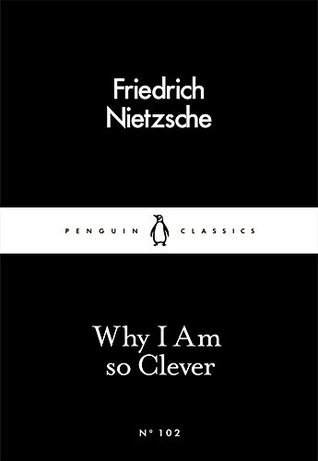
'Why do I know a few more things? Why am I so clever altogether?'Self-celebrating and self-mocking autobiographical writings from Ecce Homo, the last work iconoclastic German philosopher Nietzsche wrote before his descent into madness.One of 46 new books in the bestselling Little Black Classics series, to celebrate the first ever Penguin Classic in 1946. Each book gives readers a taste of the Classics' huge range and diversity, with works from around the world and across the centuries - including fables, decadence, heartbreak, tall tales, satire, ghosts, battles and elephants.

Ecce Homo, Friedrich Nietzsche's final book.

For Nietzsche the Age of Greek Tragedy was indeed a tragic age. He saw in it the rise and climax of values so dear to him that their subsequent drop into catastrophe (in the person of Socrates - Plato) was clearly foreshadowed as though these were events taking place in the theater.And so in this work, unpublished in his own day but written at the same time that his The Birth of Tragedy had so outraged the German professorate as to imperil his own academic career, his most deeply felt task was one of education. He wanted to present the culture of the Greeks as a paradigm to his young German contemporaries who might thus be persuaded to work toward a state of culture of their own; a state where Nietzsche found sorely missing.

Friedrich Nietzsche was one of the most revolutionary thinkers in Western philosophy. Here he sets out his subversive views in a series of aphorisms on subjects ranging from art to arrogance, boredom to passion, science to vanity, rejecting conventional notions of morality to celebrate the individual's 'will to power'.

Friedrich Wilhelm Nietzsche (1844-1900) was a German philosopher. His writing included critiques of religion, morality, contemporary culture, philosophy and science, using a distinctive style and displaying a fondness for aphorism. Nietzsche’s influence remains substantial within and beyond philosophy, notably in existentialism and postmodernism. He began his career as a philologist before turning to philosophy. At the age of 24 he became Professor of Classical Philology at the University of Basel, but resigned in 1879 due to health problems, which would plague him for most of his life. In 1889 he exhibited symptoms of serious mental illness, living out his remaining years in the care of his mother and sister until his death in 1900. His works include From my Life (1858), On Music (1858), Napoleon III as a President (1862), Free Willand Fate (1862), My Life (1864), The Birth of Tragedy (1872), Richard Wagner in Bayreuth (1876), Human, All-Too-Human (1878), Beyond Good and Evil (1886), The Antichrist (1888) and Ecce Homo (1888).

Skillful, sophisticated translations of two of Nietzsche's essential works about the conflict between the moral and aesthetic approaches to life, the impact of Christianity on human values, the meaning of science, the contrast between the Apollonian and Dionysian spirits, and other themes central to his thinking.The Birth of Tragedy (1872) was Nietzsche's first book, The Geneology of Morals (1887) one of his last. Though they span the career of this controversial genius, both address the problems such as the conflict between the moral versus aesthetic approaches to life, the effect of Christianity on human values, the meaning of science, and the famous dichotomy between the Apollonian and Dionysian spirits, among many themes which Nietzsche struggled throughout his tortured life.

Grounded in his famous notion that "God is dead," a selection from Nietzsche's most personal book, The Joyous ScienceNietzsche's devastating demolition of religion would have seismic consequences for future generations. With God dead, he envisages a brilliant future for one in which individuals would at last be responsible for their destinies.Throughout history, some books have changed the world. They have transformed the way we see ourselves - and each other. They have inspired debate, dissent, war and revolution. They have enlightened, outraged, provoked and comforted. They have enriched lives--and upended them. Now Penguin brings you a new set of the acclaimed Great Ideas, a curated library of selections from the works of the great thinkers, pioneers, radicals and visionaries whose ideas shook civilization and helped make us who we are.

لا تستخدم الآلة التي هي نتاج الملكة الفكرية العليا، لدى الذين يستخدمونها سوى الطاقات الدنيا وليس الفكر. وبفعلها ذلك تطلق كمية هائلة من الطاقة التي لولاها لظلت كامنة، هذا صحيح ولكنها لا تدفع المرء إلى التسامي، إلى القيام بما هو أفضل، لأن يصب فناناً. إنها تجعله نشطاً مكرراً نفس العمل بانتظام، ولكن هذا يثير على التمادي رد فعل، يثير في الروح ضجراً يائساً تتعلم من خلاله أن تطمح إلى تسليات الكسل.نبذة النيل والفرات:يقول نيتشه في مقدمة كتابه في معارضته للتشاؤم الرومانسي، أي لتشاؤم المحيطين والناقصين والمهزومين: "تعتبر إرادة المأساة والتشاؤم علام على الصرامة وقوة الذكاء (قوة الذوق والإحساس والوعي). حيث تكون هذه الإرادة في قلبنا فإننا لا نعود نخشى الأشياء المرعبة في هذا الوجود، بل إننا نسعى إليها. وراء تلك الإرادة نجد الشجاعة والأنفة، والرغبة في أن يكون لنا عدد كبير ذلك هو منذ البداية منظوري المتشائم. وهو منظور جديد على ما يبدو لي؟ ولا يزال اليوم منظوراً جديداً وغريباً، وما زالت متعلقاً به حتى الآن سواء حين يكون لصالحي أو حين يقف ضدي أحياناً...".هكذا شرع نيتشه في ممارسة ذلك الكلام في كتابه هذا الكلام الذي لا يتقنه إلا الصمدتون والمعانون أشد المعاناة...يتكلم عن اشياء لا يهمه أي شيء فيها، متصنعاً عثوره فيها على منفعة ما، آنذاك تعلم فن إظهار نفسه مرحاً، موضوعياً، فضولياً، وبالخصوص متمتعاً بصحة جيدة وفظاً، وذلك ما يبدو له أنه هو "الذوق السليم" لدى المريض.في كتابه هذا، كتب نيتشه قصة مرض وشفاء، لأن مجار الأمر كله على الشفاء، مجرد تجربة شخصية فقط، لتكون فقط ذلك الجزء "الإنساني المفرط في إنسانيته" في شخصيته. وكان قد أصدر "آراء وحكم مختلطة" وكذلك "المسافر وظله" في كتابين منفصلين، وكان كل واحد منهما تتمة وملحقاً لهذا الكتاب الخاص بالعقول الحرة، أي كتاب "إنسان مفرد في إنسانيته" الذي اعتبره في ذات الوقت تتمة وتكرار لعلاج ثقافي، لعلاج تلقائي من الرومانسية وصنعته له فطرته التي ظلت سالمة. وبعد مرور ست سنوات على شفائه يقدم للقارئ أعماله هذه في هذا الكتاب الذي هو الجزء الثاني من "إنسان مفرط في إنسانيته"، فلربما تستطيع وهي مجموعة أن تنقل إلى الناس تعاليم نيتشه وفلسفته تلك بقوة ووضوح أكثر، تعاليم تتعلق بالصحة ستوصي ذوي العقول المتطلبة من أبناء الجيل الصاعد بالامتثال الطوعي لها. ويقول نيتشه بأن المتحدث في هذا الكتاب هو متشائم غالباً ما ينسلخ من جلده، لكنه دائماً يعود ليندمج فيه، هو إذن متشائم ميال إلى التشاؤم، وهو بذلك غير رومانسى بالمدة: وأي عيب في ذلك؟ ألا يحق لعقل قد انغمس مثل الأفعى في فن تغيير الجلد أن يعطي درساً لمتشائمي الوقت الراهن الذي لا يزال خطر الرومانسية يترصدهم؟ وأن يبين لهم على الأقل كيف يفعلون. تلك هي فلسفة نيتشه في الحياة يقدمها من خلال نصوص هذا الكتاب مبرهناً بأنه ما زال للفكر متسع رحب للفلسفة.

Los lectores tomarán un gran placer en descubrir los clásicos con estas bellas y económicas ediciones de literatura famosa y universal. Esta selección editorial cuenta con títulos que abarcan todos los géneros literarios, desde teatro, narrativa, poesía y el ensayo.

“We continue to live within the intellectual shadow cast by Nietzsche.” —New York Times Book Review Best known for his seminal works on religion, morality, existentialism, and contemporary culture, such as The Birth of Tragedy and Thus Spoke Zarathustra, Nietzsche focuses his penetrating insight on assessing the nature of truth in this concise and highly readable collection that charts the great philosopher's writings on truth. Joining Heidegger’s Basic Writings, The Essential Schopenhauer, and other books in the Harper Perennial Modern Thought series, On Truth and Untruth offers unprecedented access to “the most influential of the great philosophers” (New Yorker).