Loading genres...
Explore the best books about Social Science genre.


Audiobook: 8 hrs and 47 minsA surprising and intriguing examination of how scarcity—and our flawed responses to it—shapes our lives, our society, and our cultureWhy do successful people get things done at the last minute? Why does poverty persist? Why do organizations get stuck firefighting? Why do the lonely find it hard to make friends? These questions seem unconnected, yet Sendhil Mullainathan and Eldar Shafir show that they are all are examples of a mind-set produced by scarcity.Drawing on cutting-edge research from behavioral science and economics, Mullainathan and Shafir show that scarcity creates a similar psychology for everyone struggling to manage with less than they need. Busy people fail to manage their time efficiently for the same reasons the poor and those maxed out on credit cards fail to manage their money. The dynamics of scarcity reveal why dieters find it hard to resist temptation, why students and busy executives mismanage their time, and why sugarcane farmers are smarter after harvest than before. Once we start thinking in terms of scarcity and the strategies it imposes, the problems of modern life come into sharper focus.Mullainathan and Shafir discuss how scarcity affects our daily lives, recounting anecdotes of their own foibles and making surprising connections that bring this research alive. Their book provides a new way of understanding why the poor stay poor and the busy stay busy, and it reveals not only how scarcity leads us astray but also how individuals and organizations can better manage scarcity for greater satisfaction and success.http://us.macmillan.com/scarcity/Send...
America is polarized by identity. Over the past fifty years in America, partisan identities have merged with racial, religious, geographic, ideological, and cultural identities, attaining a weight that is breaking much in politics and tearing at the bonds that hold the country together. Political analyst Ezra Klein shows how and why American politics polarized around identity in the twentieth century and what that polarization did to the way people see the world and one another. He traces the feedback loops—between polarized political identities and polarized political institutions—driving the system toward crisis.Why We’re Polarized reveals the structural and psychological forces behind America’s descent into division and dysfunction. Neither a polemic nor a lament, it offers a clear framework for understanding everything from Donald Trump’s rise to the Democratic Party’s leftward shift to the politicization of everyday culture.

The intelligence failures surrounding the invasion of Iraq dramatically illustrate the necessity of developing standards for evaluating expert opinion. This book fills that need. Here, Philip E. Tetlock explores what constitutes good judgment in predicting future events, and looks at why experts are often wrong in their forecasts.Tetlock first discusses arguments about whether the world is too complex for people to find the tools to understand political phenomena, let alone predict the future. He evaluates predictions from experts in different fields, comparing them to predictions by well-informed laity or those based on simple extrapolation from current trends. He goes on to analyze which styles of thinking are more successful in forecasting. Classifying thinking styles using Isaiah Berlin's prototypes of the fox and the hedgehog, Tetlock contends that the fox--the thinker who knows many little things, draws from an eclectic array of traditions, and is better able to improvise in response to changing events--is more successful in predicting the future than the hedgehog, who knows one big thing, toils devotedly within one tradition, and imposes formulaic solutions on ill-defined problems. He notes a perversely inverse relationship between the best scientific indicators of good judgement and the qualities that the media most prizes in pundits--the single-minded determination required to prevail in ideological combat.Clearly written and impeccably researched, the book fills a huge void in the literature on evaluating expert opinion. It will appeal across many academic disciplines as well as to corporations seeking to develop standards for judging expert decision-making.

Hayek gives the main arguments for the free-market case and presents his manifesto on the "errors of socialism." Hayek argues that socialism has, from its origins, been mistaken on factual, and even on logical, grounds and that its repeated failures in the many different practical applications of socialist ideas that this century has witnessed were the direct outcome of these errors. He labels as the "fatal conceit" the idea that "man is able to shape the world around him according to his wishes.""The achievement of The Fatal Conceit is that it freshly shows why socialism must be refuted rather than merely dismissed—then refutes it again."—David R. Henderson, Fortune."Fascinating. . . . The energy and precision with which Mr. Hayek sweeps away his opposition is impressive."—Edward H. Crane, Wall Street JournalF. A. Hayek is considered a pioneer in monetary theory, the preeminent proponent of the libertarian philosophy, and the ideological mentor of the Reagan and Thatcher "revolutions."

NEW YORK TIMES BESTSELLER • Our minds don’t work the way we think they do. Two renowned psychologists explain how and why our intuitions lead us astray, “[spinning] the plain world [we] know into a wonderment of surprising new insights” (Time). “A must-read for anyone who wants to better understand how the mind works.”—Associated Press In The Invisible Gorilla, Christopher Chabris and Daniel Simons, creators of one of psychology’s most famous experiments, use remarkable stories and counterintuitive scientific findings to demonstrate an important truth: We think we see ourselves and the world as they really are, but we’re actually missing a whole lot. Chabris and Simons combine the work of other researchers with their own findings on attention, perception, memory, and reasoning to reveal how faulty intuitions can lead us to make shocking, costly—even life-threatening—mistakes. In the process, they explain: • Why a company would spend billions to launch a product that its own analysts know will fail• Why award-winning movies are full of editing mistakes• What criminals have in common with chess masters• Why measles and other childhood diseases are making a comeback• Why money managers could learn a lot from weather forecastersThe Invisible Gorilla reveals the myriad ways that our intuitions can deceive us, but it’s much more than a catalog of human failings. Chabris and Simons explain why we succumb to these everyday illusions and what we can do to inoculate ourselves against their effects. Ultimately, the book provides a kind of x-ray vision into our own minds, making it possible to pierce the veil of illusions that clouds our thoughts and to think clearly for perhaps the first time.

"One of the most profound and illuminating studies of this century to have been published in recent decades." —John Gray, New York Times Book ReviewHailed as "a magisterial critique of top-down social planning" by the New York Times, this essential work analyzes disasters from Russia to Tanzania to uncover why states so often fail—sometimes catastrophically—in grand efforts to engineer their society or their environment, and uncovers the conditions common to all such planning disasters."Beautifully written, this book calls into sharp relief the nature of the world we now inhabit." —New Yorker"A tour de force." —Charles Tilly, Columbia University

Ambitiously tackling the nature of economic life and how to study it comparatively, Stone Age Economics includes six studies that reflect the author's ideas on revising traditional views of hunter-gatherer and so-called primitive societies, revealing them to be the original affluent society. When it was originally published in 1974, E. Evans-Pritchard of the Times Literary Supplement noted that this classic study of anthropological economics "is rich in factual evidence and in ideas, so rich that a brief review cannot do it justice; only another book could do that."

One of our greatest scientists—and the winner of two Pulitzer Prizes for On Human Nature and The Ants—gives us a work of visionary importance that may be the crowning achievement of his career. In Consilience (a word that originally meant "jumping together"), Edward O. Wilson renews the Enlightenment's search for a unified theory of knowledge in disciplines that range from physics to biology, the social sciences and the humanities.Using the natural sciences as his model, Wilson forges dramatic links between fields. He explores the chemistry of the mind and the genetic bases of culture. He postulates the biological principles underlying works of art from cave-drawings to Lolita. Presenting the latest findings in prose of wonderful clarity and oratorical eloquence, and synthesizing it into a dazzling whole, Consilience is science in the path-clearing traditions of Newton, Einstein, and Richard Feynman.

How much credit do parents deserve when their children turn out well? How much blame when they turn out badly? Judith Rich Harris has a message that will change parents' lives: The "nurture assumption"-- the belief that what makes children turn out the way they do, aside from their genes, is the way their parents raise them--is nothing more than a cultural myth. This electrifying book explodes some of our unquestioned beliefs about children and parents and gives us a radically new view of childhood.Harris examines with a fresh eye the lives of real children to show that it is what they experience outside the home, in the company of their peers, that matters most. Parents don't socialize children; children socialize children. With eloquence and humor, Judith Harris explains why parents have little power to determine the sort of people their children will become. The Nurture Assumption brings together insights from psychology, sociology, anthropology, primatology, and evolutionary biology to offer a startling new view of who we are and how we got that way.

The greatest obstacle to sound economic policy is not entrenched special interests or rampant lobbying, but the popular misconceptions, irrational beliefs, and personal biases held by ordinary voters. This is economist Bryan Caplan's sobering assessment in this provocative and eye-opening book. Caplan argues that voters continually elect politicians who either share their biases or else pretend to, resulting in bad policies winning again and again by popular demand.Boldly calling into question our most basic assumptions about American politics, Caplan contends that democracy fails precisely because it does what voters want. Through an analysis of Americans' voting behavior and opinions on a range of economic issues, he makes the convincing case that noneconomists suffer from four prevailing biases: they underestimate the wisdom of the market mechanism, distrust foreigners, undervalue the benefits of conserving labor, and pessimistically believe the economy is going from bad to worse. Caplan lays out several bold ways to make democratic government work better--for example, urging economic educators to focus on correcting popular misconceptions and recommending that democracies do less and let markets take up the slack.The Myth of the Rational Voter takes an unflinching look at how people who vote under the influence of false beliefs ultimately end up with government that delivers lousy results. With the upcoming presidential election season drawing nearer, this thought-provoking book is sure to spark a long-overdue reappraisal of our elective system.

Note: This book was originally published as Not a Hazardous Sport. When British anthropologist Nigel Barley set up home among the Dowayo people in northern Cameroon, he knew how fieldwork should be conducted. Unfortunately, nobody had told the Dowayo. His compulsive, witty account of first fieldwork offers a wonderfully inspiring introduction to the real life of a cultural anthropologist doing research in a Third World area. Both touching and hilarious, Barley's unconventional story—in which he survived boredom, hostility, disaster, and illness—addresses many critical issues in anthropology and in fieldwork.

The science behind global warming, and its history: how scientists learned to understand the atmosphere, to measure it, to trace its past, and to model its future.Global warming skeptics often fall back on the argument that the scientific case for global warming is all model predictions, nothing but simulation; they warn us that we need to wait for real data, “sound science.” In A Vast Machine Paul Edwards has news for these skeptics: without models, there are no data. Today, no collection of signals or observations—even from satellites, which can “see” the whole planet with a single instrument—becomes global in time and space without passing through a series of data models. Everything we know about the world's climate we know through models. Edwards offers an engaging and innovative history of how scientists learned to understand the atmosphere—to measure it, trace its past, and model its future.

The world is a better place than it used to be. People are wealthier and healthier, and live longer lives. Yet the escapes from destitution by so many have left gaping inequalities between people and between nations. In The Great Escape, Angus Deaton--one of the foremost experts on economic development and on poverty--tells the remarkable story of how, starting 250 years ago, some parts of the world began to experience sustained progress, opening up gaps and setting the stage for today's hugely unequal world. Deaton takes an in-depth look at the historical and ongoing patterns behind the health and wealth of nations, and he addresses what needs to be done to help those left behind. Deaton describes vast innovations and wrenching the successes of antibiotics, pest control, vaccinations, and clean water on the one hand, and disastrous famines and the HIV/AIDS epidemic on the other. He examines the United States, a nation that has prospered but is today experiencing slower growth and increasing inequality. He also considers how economic growth in India and China has improved the lives of more than a billion people. Deaton argues that international aid has been ineffective and even harmful. He suggests alternative efforts--including reforming incentives to drug companies and lifting trade restrictions--that will allow the developing world to bring about its own Great Escape. Demonstrating how changes in health and living standards have transformed our lives, The Great Escape is a powerful guide to addressing the well-being of all nations.

'A must-read. Acemoglu and Robinson are intellectual heavyweights of the first rank . . . erudite and fascinating' Paul Collier, Guardian, on Why Nations FailBy the authors of the international bestseller Why Nations Fail, based on decades of research, this powerful new big-picture framework explains how some countries develop towards and provide liberty while others fall to despotism, anarchy or asphyxiating norms- and explains how liberty can thrive despite new threats.Liberty is hardly the 'natural' order of things; usually states have been either too weak to protect individuals or too strong for people to protect themselves from despotism. There is also a happy Western myth that where liberty exists, it's a steady state, arrived at by 'enlightenment'. But liberty emerges only when a delicate and incessant balance is struck between state and society - between elites and citizens. This struggle becomes self-reinforcing, inducing both state and society to develop a richer array of capacities, thus affecting the peacefulness of societies, the success of economies and how people experience their daily lives.Explaining this new framework through compelling stories from around the world, in history and from today - and through a single diagram on which the development of any state can be plotted - this masterpiece helps us understand the past and present, and analyse the future.'An intellectually rich book that develops an important thesis with verve' Martin Wolf, Financial Times, on Why Nations Fail

In the tradition of Susan Cain's Quiet and Scott Stossel's My Age of Anxiety, Atlantic staff writer Olga Khazan reclaims the concept of "weird" and turns it into a badge of honor rather than a slur, showing how being different -- culturally, socially, physically, or mentally -- can actually be a person's greatest strength.Most of us have at some point in our lives felt like an outsider, sometimes considering ourselves "too weird" to fit in. Growing up as a Russian immigrant in West Texas, Olga Khazan always felt there was something different about her. This feeling has permeated her life, and as she embarked on a science writing career, she realized there were psychological connections between this feeling of being an outsider and both her struggles and successes later in life. She decided to reach out to other people who were unique in their environments to see if they had experienced similar feelings of alienation, and if so, to learn how they overcame them. Weird is based on in-person interviews with many of these individuals, such as a woman who is professionally surrounded by men, a liberal in a conservative area, and a Muslim in a predominantly Christian town. In addition, it provides actionable insights based on interviews with dozens of experts and a review of hundreds of scientific studies.Weird explores why it is that we crave conformity, how that affects people who are different, and what they can do about it. First, the book dives into the history of social norms and why some people hew to them more strictly than others. Next, Khazan explores the causes behind-and the consequences of-social rejection. She then reveals the hidden upsides to being "weird," as well as the strategies that people who are different might use in order to achieve success in a society that values normalcy. Finally, the book follows the trajectories of unique individuals who either decided to be among others just like them; to stay weird; or to dwell somewhere in between.Combining Khazan's own story with those of others and with fascinating takeaways from cutting-edge psychology research, Weird reveals how successful individuals learned to embrace their weirdness, using it to their advantage.

Popular consensus says that the US rose over two centuries to Cold War victory and world domination, and is now in slow decline. But is this right? History’s great civilisations have always lasted much longer, and for all its colossal power, the US was overshadowed by Europe until recently. What if this isn’t the end?Bruno Maçães offers a compelling vision of America’s future, both fascinating and unnerving. From the early American Republic, Maçães takes us to the turbulent present, when, he argues, America is finally forging its own path. We can see the birth pangs of this new civilisation in today’s debates on guns, religion, foreign policy and the significance of Trump. What will its values be, and what will this new America look like?

* Financial Times Business Book of the Month * Next Big Idea Club Nominee * One of Bloomberg's "52 New Books That Top Business Leaders Are Recommending" * Aleo Review of Books 2022 Book of the Year *A groundbreaking exploration of why we want what we want, and a toolkit for freeing ourselves from chasing unfulfilling desires.Gravity affects every aspect of our physical being, but there’s a psychological force just as powerful—yet almost nobody has heard of it. It’s responsible for bringing groups of people together and pulling them apart, making certain goals attractive to some and not to others, and fueling cycles of anxiety and conflict. In Wanting, Luke Burgis draws on the work of French polymath René Girard to bring this hidden force to light and reveals how it shapes our lives and societies. According to Girard, humans don’t desire anything independently. Human desire is mimetic—we imitate what other people want. This affects the way we choose partners, friends, careers, clothes, and vacation destinations. Mimetic desire is responsible for the formation of our very identities. It explains the enduring relevancy of Shakespeare’s plays, why Peter Thiel decided to be the first investor in Facebook, and why our world is growing more divided as it becomes more connected.Wanting also shows that conflict does not arise because of our differences—it comes from our sameness. Because we learn to want what other people want, we often end up competing for the same things. Ignoring our large similarities, we cling to our perceived differences.Drawing on his experience as an entrepreneur, teacher, and student of classical philosophy and theology, Burgis shares tactics that help turn blind wanting into intentional wanting--not by trying to rid ourselves of desire, but by desiring differently. It’s possible to be more in control of the things we want, to achieve more independence from trends and bubbles, and to find more meaning in our work and lives.The future will be shaped by our desires. Wanting shows us how to desire a better one.

A revealing look at how user behavior is powering deep social divisions online--and how we might yet defeat political tribalism on social mediaIn an era of increasing social isolation, platforms like Facebook and Twitter are among the most important tools we have to understand each other. We use social media as a mirror to decipher our place in society but, as Chris Bail explains, it functions more like a prism that distorts our identities, empowers status-seeking extremists, and renders moderates all but invisible. Breaking the Social Media Prism challenges common myths about echo chambers, foreign misinformation campaigns, and radicalizing algorithms, revealing that the solution to political tribalism lies deep inside ourselves.Drawing on innovative online experiments and in-depth interviews with social media users from across the political spectrum, this book explains why stepping outside of our echo chambers can make us more polarized, not less. Bail takes you inside the minds of online extremists through vivid narratives that trace their lives on the platforms and off--detailing how they dominate public discourse at the expense of the moderate majority. Wherever you stand on the spectrum of user behavior and political opinion, he offers fresh solutions to counter political tribalism from the bottom up and the top down. He introduces new apps and bots to help readers avoid misperceptions and engage in better conversations with the other side. Finally, he explores what the virtual public square might look like if we could hit reset and redesign social media from scratch through a first-of-its-kind experiment on a new social media platform built for scientific research.Providing data-driven recommendations for strengthening our social media connections, Breaking the Social Media Prism shows how to combat online polarization without deleting our accounts.

Updated to include a new chapter about the influence of social media and the Internet—the 20th anniversary edition of Bowling Alone remains a seminal work of social analysis, and its examination of what happened to our sense of community remains more relevant than ever in today’s fractured America. Twenty years, ago, Robert D. Putnam made a seemingly simple observation: once we bowled in leagues, usually after work; but no longer. This seemingly small phenomenon symbolized a significant social change that became the basis of the acclaimed bestseller, Bowling Alone, which The Washington Post called “a very important book” and Putnam, “the de Tocqueville of our generation.” Bowling Alone surveyed in detail Americans’ changing behavior over the decades, showing how we had become increasingly disconnected from family, friends, neighbors, and social structures, whether it’s with the PTA, church, clubs, political parties, or bowling leagues. In the revised edition of his classic work, Putnam shows how our shrinking access to the “social capital” that is the reward of communal activity and community sharing still poses a serious threat to our civic and personal health, and how these consequences have a new resonance for our divided country today. He includes critical new material on the pervasive influence of social media and the internet, which has introduced previously unthinkable opportunities for social connection—as well as unprecedented levels of alienation and isolation. At the time of its publication, Putnam’s then-groundbreaking work showed how social bonds are the most powerful predictor of life satisfaction, and how the loss of social capital is felt in critical ways, acting as a strong predictor of crime rates and other measures of neighborhood quality of life, and affecting our health in other ways. While the ways in which we connect, or become disconnected, have changed over the decades, his central argument remains as powerful and urgent as ever: mending our frayed social capital is key to preserving the very fabric of our society.

The first English translation of Guérin’s monumental anthology of anarchism, published here in one volume. It details a vast array of unpublished documents, letters, debates, manifestos, reports, impassioned calls-to-arms and reasoned analysis; the history, organization and practice of the movement—its theorists, advocates and activists; the great names and the obscure, towering legends and unsung heroes.This definitive anthology portrays anarchism as a sophisticated ideology whose nuances and complexities highlight the natural desire for freedom in all of us. The classical texts will re-establish anarchism as both an intellectual and practical force to be reckoned with. Includes writings by Emma Goldman, Kropotkin, Berkman, Bakunin, Proudhon, and Malatesta.Daniel Guérin was the author of Anarchism: From Theory to Practice.In Oakland, California on March 24, 2015 a fire destroyed the AK Press warehouse along with several other businesses. Please consider visiting the AK Press website to learn more about the fundraiser to help them and their neighbors.

The Lonely Crowd is considered by many to be the most influential book of the twentieth century. Its now-classic analysis of the “new middle class” in terms of inner-directed and other-directed social character opened exciting new dimensions in our understanding of the psychological, political, and economic problems that confront the individual in contemporary American society. The 1969 abridged and revised edition of the book is now reissued with a new foreword by Todd Gitlin that explains why the book is still relevant to our own era.

A renowned expert on the social and economic impact of technology and author of the Pulitzer Prize-nominated The Wireless Society explains how fast-developing technologies, broadening gaps between economic classes, and global extremism are posing difficult challenges in today's world, recommending greater environmental responsibility and possible scientific solutions. Reprint.

Ever since Yasir Arafat and Yitzhak Rabin shook hands on the White House lawn, Israel and the Palestinian people have been engaged in what commentators persist in calling "the peace process." Yet Israel remains racked by violence and continuing land seizures, and Palestinians are more demoralized than ever before. Now in this probing and impassioned book, one of our foremost Palestinian-American intellectuals explains why the much-vaunted process has yet to produce peace--and is unlikely to as presently constituted.Whether Edward Said is addressing the fatal flaws in the PLO's bargain, denouncing fundamentalists on both sides of the religious divide, or calling our attention to the distortions in official coverage of the Arab world, he offers insights beyond the conventional wisdom and a sympathy that extends to bot Israelis and Palestinians. He does so with an incisiveness, clarity, and fairness that make Peace and Its Discontents essential reading for anyonve who cares about the future of the Middle East.

William Miller embarks on an alluring journey into the world of disgust, showing how it brings order and meaning to our lives even as it horrifies and revolts us. Our notion of the self, intimately dependent as it is on our response to the excretions and secretions of our bodies, depends on it. Cultural identities have frequent recourse to its boundary-policing powers. Love depends on overcoming it, while the pleasure of sex comes in large measure from the titillating violation of disgust prohibitions. Imagine aesthetics without disgust for tastelessness and vulgarity; imagine morality without disgust for evil, hypocrisy, stupidity, and cruelty.Miller details our anxious relation to basic life eating, excreting, fornicating, decaying, and dying. But disgust pushes beyond the flesh to vivify the larger social order with the idiom it commandeers from the sights, smells, tastes, feels, and sounds of fleshly physicality. Disgust and contempt, Miller argues, play crucial political roles in creating and maintaining social hierarchy. Democracy depends less on respect for persons than on an equal distribution of contempt. Disgust, however, signals dangerous division. The high's belief that the low actually smell bad, or are sources of pollution, seriously threatens democracy.Miller argues that disgust is deeply grounded in our ambivalence to it distresses us that the fair is so fragile, so easily reduced to foulness, and that the foul may seem more than passing fair in certain slants of light. When we are disgusted, we are attempting to set bounds, to keep chaos at bay. Of course we fail. But, as Miller points out, our failure is hardly an occasion for despair, for disgust also helps to animate the world, and to make it a dangerous, magical, and exciting place.

Robert Jackall's Moral Mazes offers an eye-opening account of how corporate managers think the world works, and how big organizations shape moral consciousness.Based on extensive interviews with managers at every level of two industrial firms and of a large public relations agency, Moral Mazes takes the reader inside the intricate world of the corporation. Jackall reveals a world where hard work does not necessarily lead to success, but where sharptalk, self-promotion, powerful patrons, and sheer luck might. Cheerfully-bland public faces mask intense competition in this world where people hide their intentions, and accountability often depends on the ability to outrun mistakes.In this topsy-turvy world, managers must bring often unforgiving technology and always difficult people together to make money, an uncompromising task demanding continual compromises with conventional truths. Moral questions become merely practical concerns and issues of public relations.Sooner or later, managers find themselves wondering how to act in such a world and still maintain a sense of personal integrity.This brilliant, sometimes disturbing, often wildly funny study of corporate thinking, decision-making, and morality presents compelling real life stories of the men and women charged with running the businesses of America. It will interest anyone concerned with how big organizations actuallyfunction, or with the current moral malaise in our public life.

Newsweek hailed Paul Krugman as "a superstar among economists" and went on to praise Peddling Prosperity as "the best primer around on recent U.S. economic history." Others joined the chorus. This wonderfully received book finds him in top form, observing the years he's dubbed "the age of diminished expectations." The past twenty years have been an era of economic disappointment in the United States. They have also been a time of intense economic debate, as rival ideologies contend for policy influence. But strange things have happened to economic ideas on their way to power: they've been hijacked by policy entrepreneurs―economic snake-oil salesmen, right or left, who offer easy answers to hard problems. Supply-siders rose to power with Ronald Reagan and not only cured nothing but left behind a $3 trillion debt. Krugman finds an unhappy parallel in those who shape policy within the Clinton administration.

Edwin Hutchins combines his background as an anthropologist and an open ocean racing sailor and navigator in this account of how anthropological methods can be combined with cognitive theory to produce a new reading of cognitive science. His theoretical insights are grounded in an extended analysis of ship navigation -- its computational basis, its historical roots, its social organization, and the details of its implementation in actual practice aboard large ships. The result is an unusual interdisciplinary approach to cognition in culturally constituted activities outside the laboratory -- "in the wild."Hutchins examines a set of phenomena that have fallen in the cracks between the established disciplines of psychology and anthropology, bringing to light a new set of relationships between culture and cognition. The standard view is that culture affects the cognition of individuals. Hutchins argues instead that cultural activity systems have cognitive properties of their own that are different from the cognitive properties of the individuals who participate in them. Each action for bringing a large naval vessel into port, for example, is informed by culture: the navigation team can be seen as a cognitive and computational system.Introducing Navy life and work on the bridge, Hutchins makes a clear distinction between the cognitive properties of an individual and the cognitive properties of a system. In striking contrast to the usual laboratory tasks of research in cognitive science, he applies the principal metaphor of cognitive science -- cognition as computation (adopting David Marr's paradigm) -- to the navigation task. After comparing modern Western navigation with the method practiced in Micronesia, Hutchins explores the computational and cognitive properties of systems that are larger than an individual. He then turns to an analysis of learning or change in the organization of cognitive systems at several scales. Hutchins's conclusion illustrates the costs of ignoring the cultural nature of cognition, pointing to the ways in which contemporary cognitive science can be transformed by new meanings and interpretations. A Bradford Book

Book by Brodie, Richard

Newly revised and up-to-date, this edition of The Social Animal is a brief, compelling introduction to modern social psychology. Through vivid narrative, lively presentations of important research, and intriguing examples, Elliot Aronson probes the patterns and motives of human behavior, covering such diverse topics as terrorism, conformity, obedience, politics, race relations, advertising, war, interpersonal attraction, and the power of religious cults.

Most Americans take for granted that they live in an open society with a free market of ideas. But as Herbert Schiller reveals in Culture, Inc. , the corporate arm has reached into every corner of daily life, and from the shopping mall to the art gallery, big-business influence has broughtabout some frightening changes in American culture. Examining the effects of fifty years worth of corporate growth on American culture, Schiller argues that corporate control over such arenas of culture as museums, theaters, performing arts centers, and public broadcasting stations has resulted ina broad manipulation of consciousness as well as an insidious form of censorship. A disturbing but enlightening picture of corporate America, Culture, Inc. exposes the agenda and methods of the corporate cultural takeover, reveals the growing threat to free access to information at home andabroad, shows how independent channels of expression have been greatly restricted, and explains how the few keep managing to benefit from the many.

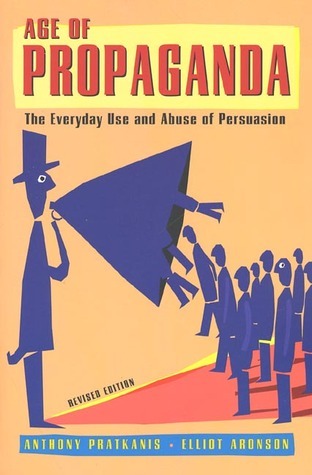
Americans create 57% of the world's advertising while representing only 6% of its population; half of our waking hours are spent immersed in the mass media. Persuasion has always been integral to the democratic process, but increasingly, thoughtful discussion is being replaced with simplistic soundbites and manipulative messages.Drawing on the history of propaganda as well as on contemporary research in social psychology, Age of Propaganda shows how the tactics used by political campaigners, sales agents, advertisers, televangelists, demagogues, and others often take advantage of our emotions by appealing to our deepest fears and most irrational hopes, creating a distorted vision of the world we live in.This revised and updated edition includes coverage of the Clinton/Lewinsky scandal, recent election campaigns, talk radio, teen suicide, U.F.O. abductions, the Columbine shootings, and novel propaganda tactics based on hypocrisy and false allegations.

What is a meme? First coined by Richard Dawkins in 'The Selfish Gene', a meme is any idea, behavior, or skill that can be transferred from one person to another by imitation: stories, fashions, inventions, recipes, songs, ways of plowing a field or throwing a baseball or making a sculpture. The meme is also one of the most important--and controversial--concepts to emerge since 'The Origin of the Species' appeared nearly 150 years ago.In 'The Meme Machine' Susan Blackmore boldly asserts: "Just as the design of our bodies can be understood only in terms of natural selection, so the design of our minds can be understood only in terms of memetic selection." Indeed, Blackmore shows that once our distant ancestors acquired the crucial ability to imitate, a second kind of natural selection began, a survival of the fittest amongst competing ideas and behaviors. Ideas and behaviors that proved most adaptive - making tools, for example, or using language--survived and flourished, replicating themselves in as many minds as possible. These memes then passed themselves on from generation to generation by helping to ensure that the genes of those who acquired them also survived and reproduced. Applying this theory to many aspects of human life, Blackmore offers brilliant explanations for why we live in cities, why we talk so much, why we can't stop thinking, why we behave altruistically, how we choose our mates, and much more.With controversial implications for our religious beliefs, our free will, our very sense of "self," 'The Meme Machine' offers a provocative theory everyone will soon be talking about.

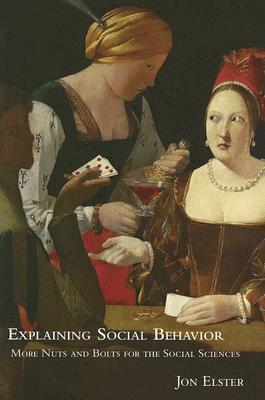
This book is an expanded and revised edition of the author's critically acclaimed volume Nuts and Bolts for the Social Sciences. In twenty-six succinct chapters, Jon Elster provides an account of the nature of explanation in the social sciences. He offers an overview of key explanatory mechanisms in the social sciences, relying on hundreds of examples and drawing on a large variety of sources-psychology, behavioral economics, biology, political science, historical writings, philosophy and fiction. Written in accessible and jargon-free language, Elster aims at accuracy and clarity while eschewing formal models.

How do we feel when our friend turns up with a holiday present and we have nothing ready to give in exchange? What lies behind our small social panics and the maneuvers we use, to avoid losing face? Recognizing how much we care about how others see us, this wise and witty book tackles the complex subject of humiliation and the emotions that keep us going as self-respecting social actors.William Ian Miller writes astutely about a host of homely and seemingly banal social occasions and shows us what is buried behind them. In his view, our lives are permeated with sometimes merely uncomfortable, sometimes hair-raising rituals of shame and humiliation. Take the unwanted dinner invitation, the exchange of valentines in grade school, or the "diabolically ingenious invention of the bridal registry." Readers will have no trouble recognizing the social situations he finds indicative of our often perilous dealings with each other.Educated as a literary critic and philologist, by profession a historian of medieval Iceland, by employment a law professor, Miller ranges comfortably beyond his areas of formal expertise to talk about emotions across time and culture. His scenarios are based on incidents from his own college town and from the Iceland of the sagas. He also makes incursions into the emotional worlds represented in the Middle English poem, Sir Gawain and the Green Knight, and in some of the works of Shakespeare, Dostoyevsky, and others. Indeed, one theme that gradually becomes specific is how meaning travels from one culture to another. Ancient codes of honor, he insists, still function in contemporary American life.Some of Miller's narratives are unsettling, and he acknowledges that a certain ironical misanthropy may run through his discussions. But he succeeds in cutting through a mountain of pretensions to entertain and enlighten us.

'I want to begin by declaring that I regard scientific knowledge as the most important kind of knowledge we have', writes Sir Karl Popper in the opening essay of this book, which collects his meditations on the real improvements science has wrought in society, in politics and in the arts in the course of the twentieth century. His subjects range from the beginnings of scientific speculation in classical Greece to the destructive effects of twentieth century totalitarianism, from major figures of the Enlightenment such as Kant and Voltaire to the role of science and self-criticism in the arts. The essays offer striking new insights into the mind of one of the greatest twentieth century philosophers.

In Common Wealth, Jeffrey D. Sachs-one of the world's most respected economists and the author of The New York Times bestseller The End of Poverty- offers an urgent assessment of the environmental degradation, rapid population growth, and extreme poverty that threaten global peace and prosperity. Through crystalline examination of hard facts, Sachs predicts the cascade of crises that awaits this crowded planet-and presents a program of sustainable development and international cooperation that will correct this dangerous course. Few luminaries anywhere on the planet are as schooled in this daunting subject as Sachs, and this is the vital product of his experience and wisdom.

Birth, puberty, marriage, and death are, in all cultures, marked by ceremonies which may differ but are universal in function. Arnold van Gennep (1873-1957) was the first anthropologist to note the regularity and significance of the rituals attached to the transitional stages in man's life, and his phrase for these, "the rites of passage," has become a part of the language of anthropology and sociology.

With over one million copies sold, The Undercover Economist has been hailed worldwide as a fantastic guide to the fundamental principles of economics. An economist's version of The Way Things Work , this engaging volume is part Economics 101 and part exposé of the economic principles lurking behind daily events, explaining everything from traffic jams to high coffee prices.New to this edition : This revised edition, newly updated to consider the banking crisis and economic turbulence of the last four years, is essential for anyone who has wondered why the gap between rich and poor nations is so great, or why they can't seem to find a decent second-hand car, or how to outwit Starbucks. Senior columnist for the Financial Times Tim Harford brings his experience and insight as he ranges from Africa, Asia, Europe, and the United States to reveal how supermarkets, airlines, and coffee chains--to name just a few--are vacuuming money from our wallets. Harford punctures the myths surrounding some of today's biggest controversies, including the high cost of health-care; he reveals why certain environmental laws can put a smile on a landlord's face; and he explains why some industries can have high profits for innocent reasons, while in other industries something sinister is going on.Covering an array of economic concepts including scarce resources, market power, efficiency, price gouging, market failure, inside information, and game theory, Harford sheds light on how these forces shape our day-to-day lives, often without our knowing it. Showing us the world through the eyes of an economist, Tim Harford reveals that everyday events are intricate games of negotiations, contests of strength, and battles of wits. Written with a light touch and sly wit, The Undercover Economist turns "the dismal science" into a true delight.

Professor von Mises addressed himself to a particular what is the essential difference between bureaucratic management by government and market management in a system based on private ownership of the means of production? Mises does not discuss bureaus or bureaucrats, but inexorable principles of human action. He does not condemn bureaucracy, which is the appropriate technique for the conduct of government agencies such as courts of law, police departments, and the Internal Revenue Service; however, in economic production and distribution, the bureaucratic method is shown to be an abomination that spells universal ruin and disaster.

The second edition of this seminal work includes the original text, first published in 1974, alongside two major new chapters. Power: A Radical View assesses the main debates about how to conceptualize and study power, including the influential contributions of Michel Foucault. Power Revisited reconsiders Steven Lukes' own views in light of these debates and of criticisms of his original argument.With a new introduction and bibliographical essay, this book has consolidated its reputation as a classic work and a major reference point within Social and Political Theory. It can be used on modules across the Social and Political Sciences dealing with the concept of power and its manifestation in the world. It is also essential reading for all undergraduate and postgraduates interested in the history of Social and Political Thought.

The third edition of Geoffery Blainey’s highly acclaimed study on the causes of war has been expanded and updated to include a complete discussion of World War II and the road towards nuclear war.Analyzing all international wars since 1700, Causes of War solves the riddle of why some wars are long and some are short and demonstrates how the “outbreak of peace” offers insight into the outbreak of war.Proving that war and peace are alternating phases of a relationship between rival nations, this widely quoted work offers a crucial, new understanding of international armed conflict.

Preference falsification, according to the economist Timur Kuran, is the act of misrepresenting one's wants under perceived social pressures. It happens frequently in everyday life, such as when we tell the host of a dinner party that we are enjoying the food when we actually find it bland. In Private Truths, Public Lies Kuran argues convincingly that the phenomenon not only is ubiquitous but has huge social and political consequences. Drawing on diverse intellectual traditions, including those rooted in economics, psychology, sociology, and political science, Kuran provides a unified theory of how preference falsification shapes collective decisions, orients structural change, sustains social stability, distorts human knowledge, and conceals political possibilities.A common effect of preference falsification is the preservation of widely disliked structures. Another is the conferment of an aura of stability on structures vulnerable to sudden collapse. When the support of a policy, tradition, or regime is largely contrived, a minor event may activate a bandwagon that generates massive yet unanticipated change.In distorting public opinion, preference falsification also corrupts public discourse and, hence, human knowledge. So structures held in place by preference falsification may, if the condition lasts long enough, achieve increasingly genuine acceptance. The book demonstrates how human knowledge and social structures co-evolve in complex and imperfectly predictable ways, without any guarantee of social efficiency.Private Truths, Public Lies uses its theoretical argument to illuminate an array of puzzling social phenomena. They include the unexpected fall of communism, the paucity, until recently, of open opposition to affirmative action in the United States, and the durability of the beliefs that have sustained India's caste system.

A provocative discussion of recent wars and the issues that surround them, written by a preeminent political theoristMichael Walzer is one of the world’s most eminent philosophers on the subject of war and ethics. Now, for the first time since his classic Just and Unjust Wars was published almost three decades ago, this volume brings together his most provocative arguments about contemporary military conflicts and the ethical issues they raise.The essays in the book are divided into three sections. The first deals with issues such as humanitarian intervention, emergency ethics, and terrorism. The second consists of Walzer’s responses to particular wars, including the first Gulf War, Kosovo, Afghanistan, and Iraq. And the third presents an essay in which Walzer imagines a future in which war might play a less significant part in our lives. In his introduction, Walzer reveals how his thinking has changed over time.Written during a period of intense debate over the proper use of armed force, this book gets to the heart of difficult problems and argues persuasively for a moral perspective on war.

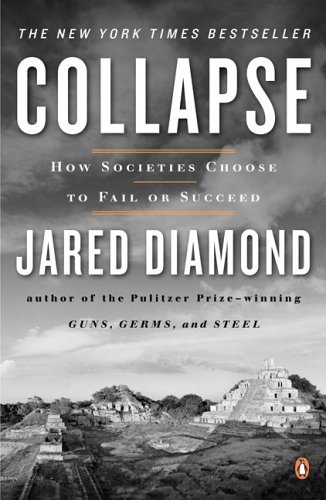
Brilliant, illuminating, and immensely absorbing, Collapse is destined to take its place as one of the essential books of our time, raising the urgent question: How can our world best avoid committing ecological suicide?In his million-copy bestseller Guns, Germs, and Steel, Jared Diamond examined how and why Western civilizations developed the technologies and immunities that allowed them to dominate much of the world. Now in this brilliant companion volume, Diamond probes the other side of the equation: What caused some of the great civilizations of the past to collapse into ruin, and what can we learn from their fates?As in Guns, Germs, and Steel, Diamond weaves an all-encompassing global thesis through a series of fascinating historical-cultural narratives. Moving from the Polynesian cultures on Easter Island to the flourishing American civilizations of the Anasazi and the Maya and finally to the doomed Viking colony on Greenland, Diamond traces the fundamental pattern of catastrophe. Environmental damage, climate change, rapid population growth, and unwise political choices were all factors in the demise of these societies, but other societies found solutions and persisted. Similar problems face us today and have already brought disaster to Rwanda and Haiti, even as China and Australia are trying to cope in innovative ways. Despite our own society's apparently inexhaustible wealth and unrivaled political power, ominous warning signs have begun to emerge even in ecologically robust areas like Montana.Brilliant, illuminating, and immensely absorbing, Collapse is destined to take its place as one of the essential books of our time, raising the urgent question: How can our world best avoid committing ecological suicide?

The story of the young sociologist who studied a Chicago crack-dealing gang from the inside captured the world's attention when it was first described in Freakonomics. Gang Leader for a Day is the fascinating full story of how Sudhir Venkatesh managed to gain entrée into the gang, what he learned, and how his method revolutionized the academic establishment.When Venkatesh walked into an abandoned building in one of Chicago's most notorious housing projects, he was looking for people to take a multiple-choice survey on urban poverty. A first-year grad student, he would befriend a gang leader named JT and spend the better part of the next decade inside the projects under JT's protection, documenting what he saw there.Over the next seven years, Venkatesh observed JT and the rest of the gang as they operated their crack selling business, conducted PR within their community, and rose up or fell within the ranks of the gang's complex organizational structure.Gang Leader for a Day is an inside view into the morally ambiguous, highly intricate, often corrupt struggle to survive in an urban war zone. It is also the story of a complicated friendship between two young and ambitious men, a universe apart.

The landmark exploration of economic prosperity and how the world can escape from extreme poverty for the world's poorest citizens, from one of the world's most renowned economists Hailed by Time as one of the world's hundred most influential people, Jeffrey D. Sachs is renowned for his work around the globe advising economies in crisis. Now a classic of its genre, The End of Poverty distills more than thirty years of experience to offer a uniquely informed vision of the steps that can transform impoverished countries into prosperous ones. Marrying vivid storytelling with rigorous analysis, Sachs lays out a clear conceptual map of the world economy. Explaining his own work in Bolivia, Russia, India, China, and Africa, he offers an integrated set of solutions to the interwoven economic, political, environmental, and social problems that challenge the world's poorest countries. Ten years after its initial publication, The End of Poverty remains an indispensible and influential work. In this 10th anniversary edition, Sachs presents an extensive new foreword assessing the progress of the past decade, the work that remains to be done, and how each of us can help. He also looks ahead across the next fifteen years to 2030, the United Nations' target date for ending extreme poverty, offering new insights and recommendations.

At last! A new edition of the economics book that won’t put you to sleep. In fact, you won’t be able to put this bestseller down. In our challenging economic climate, this perennial favorite of students and general readers is more than a good read, it’s a necessary investment—with a blessedly sure rate of return. This revised and updated edition includes commentary on hot topics such as automation, trade, income inequality, and America’s rising debt. Ten years after the financial crisis, Naked Economics examines how policymakers managed the worst economic crisis since the Great Depression.Demystifying buzzwords, laying bare the truths behind oft-quoted numbers, and answering the questions you were always too embarrassed to ask, the breezy Naked Economics gives you the tools to engage with pleasure and confidence in the deeply relevant, not so dismal science.

In Discover Your Inner Economist one of America’s most respected economists presents a quirky, incisive romp through everyday life that reveals how you can turn economic reasoning to your advantage—often when you least expect it to be relevant. Like no other economist, Tyler Cowen shows how economic notions--such as incentives, signals, and markets--apply far more widely than merely to the decisions of social planners, governments, and big business. What does economic theory say about ordering from a menu? Or attracting the right mate? Or controlling people who talk too much in meetings? Or dealing with your dentist? With a wryly amusing voice, in chapters such as “How to Control the World, The Basics” and “How to Control the World, Knowing When to Stop” Cowen reveals the hidden economic patterns behind everyday situations so you can get more of what you really want. Readers will also gain less selfish insights into how to be a good partner, neighbor and even citizen of the world. For instance, what is the best way to give to charity? The chapter title “How to Save the World—More Christmas Presents Won’t Help” makes a point that is every bit as personal as it is global. Incentives are at the core of an economic approach to the world, but they don’t just come in cash. In fact, money can be a disincentive. Cowen shows why, for example, it doesn’t work to pay your kids to do the dishes. Other kinds of incentives--like making sure family members know they will be admired if they respect you--can work. Another non- monetary incentive? Try having everyone stand up in your next meeting if you don’t want anyone to drone on. Deeply felt incentives like pride in one’s work or a passing smile from a loved one, can be the most powerful of all, even while they operate alongside more mundane rewards such as money and free food. Discover Your Inner Economist is an introduction to the science of economics that shows it to be built on notions that are already within all of us. While the implications of those ideas lead to Cowen’s often counterintuitive advice, their wisdom is presented in ordinary examples taken from home life, work life, and even vacation life… How do you get a good guide in a Moroccan bazaar?

A single-volume edition of the three-part study of Marxism provides a comprehensive history of the origins, structure, and posthumous development of the Marxist thought system, tracing its intellectual foundations from Plotonius through the philosophies of such figures as Lenin, Sarte, and Mao, in an publication complemented by a new preface and epilogue.

Your every significant choice -- every important decision you make -- is determined by a force operating deep inside your mind: your perspective on time -- your internal, personal time zone. This is the most influential force in your life, yet you are virtually unaware of it. Once you become aware of your personal time zone, you can begin to see and manage your life in exciting new ways. In The Time Paradox, Drs. Zimbardo and Boyd draw on thirty years of pioneering research to reveal, for the first time, how your individual time perspective shapes your life and is shaped by the world around you. Further, they demonstrate that your and every other individual's time zones interact to create national cultures, economics, and personal destinies. You will discover what time zone you live in through Drs. Zimbardo and Boyd's revolutionary tests. Ask yourself: • Does the smell of fresh-baked cookies bring you back to your childhood? • Do you believe that nothing will ever change in your world? • Do you believe that the present encompasses all and the future and past are mere abstractions? • Do you wear a watch, balance your checkbook, and make to-do lists -- every day? • Do you believe that life on earth is merely preparation for life after death? • Do you ruminate over failed relationships? • Are you the life of every party -- always late, always laughing, and always broke? These statements are representative of the seven most common ways people relate to time, each of which, in its extreme, creates benefits and pitfalls. The Time Paradox is a practical plan for optimizing your blend of time perspectives so you get the utmost out of every minute in your personal and professional life as well as a fascinating commentary about the power and paradoxes of time in the modern world. No matter your time perspective, you experience these paradoxes. Only by understanding this new psychological science of time zones will you be able to overcome the mental biases that keep you too attached to the past, too focused on immediate gratification, or unhealthily obsessed with future goals. Time passes no matter what you do -- it's up to you to spend it wisely and enjoy it well. Here's how.

It lurks in the corner of our imagination, almost beyond our ability to see the possibility that a tear in the fabric of life could open up without warning, upending a house, a skyscraper, or a civilization.Today, nine out of ten Americans live in places at significant risk of earthquakes, hurricanes, tornadoes, terrorism, or other disasters. Tomorrow, some of us will have to make split-second choices to save ourselves and our families. How will we react? What will it feel like? Will we be heroes or victims? Will our upbringing, our gender, our personality–anything we’ve ever learned, thought, or dreamed of–ultimately matter? Amanda Ripley, an award-winning journalist for Time magazine who has covered some of the most devastating disasters of our age, set out to discover what lies beyond fear and speculation. In this magnificent work of investigative journalism, Ripley retraces the human response to some of history’s epic disasters, from the explosion of the Mont Blanc munitions ship in 1917–one of the biggest explosions before the invention of the atomic bomb–to a plane crash in England in 1985 that mystified investigators for years, to the journeys of the 15,000 people who found their way out of the World Trade Center on September 11, 2001. Then, to understand the science behind the stories, Ripley turns to leading brain scientists, trauma psychologists, and other disaster experts, formal and informal, from a Holocaust survivor who studies heroism to a master gunfighter who learned to overcome the effects of extreme fear.Finally, Ripley steps into the dark corners of her own imagination, having her brain examined by military researchers and experiencing through realistic simulations what it might be like to survive a plane crash into the ocean or to escape a raging fire. Ripley comes back with precious wisdom about the surprising humanity of crowds, the elegance of the brain’s fear circuits, and the stunning inadequacy of many of our evolutionary responses. Most unexpectedly, she discovers the brain’s ability to do much, much better, with just a little help.The Unthinkable escorts us into the bleakest regions of our nightmares, flicks on a flashlight, and takes a steady look around. Then it leads us home, smarter and stronger than we were before.

Would you be surprised that road rage can be good for society? Or that most crashes happen on sunny, dry days? That our minds can trick us into thinking the next lane is moving faster? Or that you can gauge a nation’s driving behavior by its levels of corruption? These are only a few of the remarkable dynamics that Tom Vanderbilt explores in this fascinating tour through the mysteries of the road.Based on exhaustive research and interviews with driving experts and traffic officials around the globe, Traffic gets under the hood of the everyday activity of driving to uncover the surprisingly complex web of physical, psychological, and technical factors that explain how traffic works, why we drive the way we do, and what our driving says about us. Vanderbilt examines the perceptual limits and cognitive underpinnings that make us worse drivers than we think we are. He demonstrates why plans to protect pedestrians from cars often lead to more accidents. He shows how roundabouts, which can feel dangerous and chaotic, actually make roads safer—and reduce traffic in the bargain. He uncovers who is more likely to honk at whom, and why. He explains why traffic jams form, outlines the unintended consequences of our quest for safety, and even identifies the most common mistake drivers make in parking lots.The car has long been a central part of American life; whether we see it as a symbol of freedom or a symptom of sprawl, we define ourselves by what and how we drive. As Vanderbilt shows, driving is a provocatively revealing prism for examining how our minds work and the ways in which we interact with one another. Ultimately, Traffic is about more than it’s about human nature. This book will change the way we see ourselves and the world around us. And who knows? It may even make us better drivers.

Michel Foucault's lectures at the Collège de France in 1979, The Birth of Biopolitics, pursue and develop further the themes of his lectures from the previous year, Security, Territory, Population. Having shown how Eighteenth century political economy marks the birth of a new governmental rationality – seeking maximum effectiveness by governing less and in accordance with the naturalness of the phenomena to be governed – Michel Foucault undertakes the detailed analysis of this liberal governmentality. This involves describing the political rationality within which the specific problems of life and population were posed: "Studying liberalism as the general framework of biopolitics".What are the specific features of the liberal art of government as they were outlined in the Eighteenth century? What crisis of governmentality characterises the present world and what revisions of liberal government has it given rise to? This is the diagnostic task addressed by Foucault's study of the two major twentieth century schools of neo-liberalism: German ordo-liberalism and the neo-liberalism of the Chicago School. In the years he taught at the Collège de France, this was Michel Foucault's sole foray into the field of contemporary history. This course thus raises questions of political philosophy and social policy that are at the heart of current debates about the role and status of neo-liberalism in twentieth century politics. A remarkable feature of these lectures is their discussion of contemporary economic theory and practice, culminating in an analysis of the model of homo oeconomicus.Foucault's analysis also highlights the paradoxical role played by "society" in relation to government. "Society" is both that in the name of which government strives to limit itself, but it is also the target for permanent governmental intervention to produce, multiply, and guarantee the freedoms required by economic liberalism. Far from being opposed to the State, civil society is thus shown to be the correlate of a liberal technology of government.

Widely regarded as the standard book on the British Media, this authoritative introduction to the history, sociology, theory and politics of media and communications studies has been substantially revised and updated to bring it up to date with developments in the media industry. Its three new chapters describe the battle for the soul of the internet, the impact of the internet on society and the rise of new media in Britain. In addition it examines the recuperation of the BBC, how international and European regulation is changing the British media and why Britain has the least trusted press in Europe.

This short treatise looks at how we construct a social reality from our sense impressions; at how, for example, we construct a 'five-pound note' with all that implies in terms of value and social meaning, from the printed piece of paper we see and touch. "John Searle has a distinctive intellectual style. It combines razor-sharp analysis with a swaggering chip-on-the-shoulder impudence that many of his opponents might find intolerably abrasive were it not for the good humour that pervades all he writes. This is a man who likes a good philosophical brawl." --New Scientist

A brilliant research mathematician who has devoted his career to teaching kids reveals math to be creative and beautiful and rejects standard anxiety-producing teaching methods. Witty and accessible, Paul Lockhart’s controversial approach will provoke spirited debate among educators and parents alike and it will alter the way we think about math forever.

An economics professor and author describes how the World Wide Web is changing the way our minds work, and provides a guide to the coming world of Web 3.0, where social networking and “Tweeting” will improve education and enrich lives.

The New York Times best-selling Freakonomics was a worldwide sensation, selling over four million copies in thirty-five languages and changing the way we look at the world. Now, Steven D. Levitt and Stephen J. Dubner return with SuperFreakonomics, and fans and newcomers alike will find that the freakquel is even bolder, funnier, and more surprising than the first.Four years in the making, SuperFreakonomics asks not only the tough questions, but the unexpected ones: What's more dangerous, driving drunk or walking drunk? Why is chemotherapy prescribed so often if it's so ineffective? Can a sex change boost your salary?SuperFreakonomics challenges the way we think all over again, exploring the hidden side of everything with such questions as:How is a street prostitute like a department-store Santa?Why are doctors so bad at washing their hands?How much good do car seats do?What's the best way to catch a terrorist?Did TV cause a rise in crime?What do hurricanes, heart attacks, and highway deaths have in common?Are people hard-wired for altruism or selfishness?Can eating kangaroo save the planet?Which adds more value: a pimp or a Realtor?Levitt and Dubner mix smart thinking and great storytelling like no one else, whether investigating a solution to global warming or explaining why the price of oral sex has fallen so drastically. By examining how people respond to incentives, they show the world for what it really is – good, bad, ugly, and, in the final analysis, super freaky.Freakonomics has been imitated many times over – but only now, with SuperFreakonomics, has it met its match.

What is the difference between choking and panicking? Why are there dozens of varieties of mustard but only one variety of ketchup? What do football players teach us about how to hire teachers? What does hair dye tell us about the history of the 20th century?In the past decade, Malcolm Gladwell has written three books that have radically changed how we understand our world and ourselves: The Tipping Point, Blink, and Outliers. Now, in What the Dog Saw, he brings together, for the first time, the best of his writing from The New Yorker over the same period. Here you'll find the bittersweet tale of the inventor of the birth control pill, and the dazzling creations of pasta sauce pioneer Howard Moscowitz. Gladwell sits with Ron Popeil, the king of the American kitchen, as he sells rotisserie ovens, and divines the secrets of Cesar Millan, the "dog whisperer" who can calm savage animals with the touch of his hand. He explores intelligence tests and ethnic profiling and why it was that employers in Silicon Valley once tripped over themselves to hire the same college graduate.

The congressional agenda, Frances Lee contends, includes many issues about which liberals and conservatives generally agree. Even over these matters, though, Democratic and Republican senators tend to fight with each other. What explains this discord? Beyond Ideology argues that many partisan battles are rooted in competition for power rather than disagreement over the rightful role of government. The first book to systematically distinguish Senate disputes centering on ideological questions from the large proportion of them that do not, this volume foregrounds the role of power struggle in partisan conflict. Presidential leadership, for example, inherently polarizes legislators who can influence public opinion of the president and his party by how they handle his agenda. Senators also exploit good government measures and floor debate to embarrass opponents and burnish their own party’s image—even when the issues involved are broadly supported or low-stakes. Moreover, Lee contends, the congressional agenda itself amplifies conflict by increasingly focusing on issues that reliably differentiate the parties. With the new president pledging to stem the tide of partisan polarization, Beyond Ideology provides a timely taxonomy of exactly what stands in his way.

Demography is destiny. It underlies many of the issues that shake the world, from war and economics to immigration. No wonder, then, that fears of overpopulation flared regularly over the last century, a century that saw the world's population quadruple. Even today, baby booms are blamed for genocide and terrorism, and overpopulation is regularly cited as the primary factor driving global warming and other environmental issues.Yet, surprisingly, it appears that the explosion is past its peak. Around the world, in developing countries as well as in rich ones, today's women are having on average 2.6 children, half the number their mothers had. Within a generation, world fertility will likely follow Europe's to below replacement levels—and by 2040, the world's population will be declining for the first time since the Black Death, almost seven hundred years ago.In The Coming Population Crash , veteran environmental writer Fred Pearce reveals the dynamics behind this dramatic shift. Charting the demographic path of our species over two hundred years, he begins by chronicling the troubling history of authoritarian efforts to contain the twentieth century's population explosion, as well as the worldwide trend toward the empowerment of women that led to lower birthrates. And then, with vivid reporting from around the globe, he dives into the environmental, social, and economic effects of our surprising demographic future.Now is probably the last time in history that our world will hold more young people than elders. Most fear that an aging world population will put a serious drain on national resources, as a shrinking working population supports a growing number of retirees. But is this necessarily so? Might an older world population have an upside? Pearce also shows us why our demographic future holds increased migration rates, and reveals the hypocrisy at the heart of anti-immigrant rhetoric in the developed the simple fact is that countries with lower birthrates need workers and countries with higher birthrates need work. And he tackles the truism that population density always leads to environmental degradation, taking us from some of the world's most densely packed urban slums to rural Africa to argue that underpopulation can sometimes be the cause of environmental woes, while cities could hold the key to sustainable living.Pearce's provocative book is essential reading for anyone who wants to know what demographics tell us about our global future, and for all those who believe in learning from the mistakes of the past.

With unequaled insight and brio, David Brooks, the New York Times columnist and bestselling author of Bobos in Paradise, has long explored and explained the way we live. Now, with the intellectual curiosity and emotional wisdom that make his columns among the most read in the nation, Brooks turns to the building blocks of human flourishing in a multilayered, profoundly illuminating work grounded in everyday life.This is the story of how success happens. It is told through the lives of one composite American couple, Harold and Erica—how they grow, push forward, are pulled back, fail, and succeed. Distilling a vast array of information into these two vividly realized characters, Brooks illustrates a fundamental new understanding of human nature. A scientific revolution has occurred—we have learned more about the human brain in the last thirty years than we had in the previous three thousand. The unconscious mind, it turns out, is most of the mind—not a dark, vestigial place but a creative and enchanted one, where most of the brain’s work gets done. This is the realm of emotions, intuitions, biases, longings, genetic predispositions, personality traits, and social the realm where character is formed and where our most important life decisions are made. The natural habitat of The Social Animal. Drawing on a wealth of current research from numerous disciplines, Brooks takes Harold and Erica from infancy to school; from the “odyssey years” that have come to define young adulthood to the high walls of poverty; from the nature of attachment, love, and commitment, to the nature of effective leadership. He reveals the deeply social aspect of our very minds and exposes the bias in modern culture that overemphasizes rationalism, individualism, and IQ. Along the way, he demolishes conventional definitions of success while looking toward a culture based on trust and humility.The Social Animal is a moving and nuanced intellectual adventure, a story of achievement and a defense of progress. Impossible to put down, it is an essential book for our time, one that will have broad social impact and will change the way we see ourselves and the world.

As the income gap between developed and developing nations grows, so grows the cacophony of voices claiming that the quest to find a simple recipe for economic growth has failed. Getting Better, in sharp contrast, reports the good news about global progress. Economist Charles Kenny argues against development naysayers by pointing to the evidence of widespread improvements in health, education, peace, liberty--and even happiness.Kenny shows how the spread of cheap technologies, such as vaccines and bed nets, and ideas, such as political rights, has transformed the world. He also shows that by understanding this transformation, we can make the world an even better place to live.That's not to say that life is grand for everyone, or that we don't have a long way to go. But improvements have spread far, and, according to Kenny, they can spread even further.

How does the situation we're in influence the way we behave and think? Professors Ross and Nisbett eloquently argue that the context we find ourselves in substantially affects our behavior in this timely reissue of one of social psychology's classic textbooks. With a new foreword by Malcolm Gladwell, author of The Tipping Point.

Neo-liberal policies and institutional changes have produced a huge and growing number of people with sufficiently common experiences to be called an emerging class. In this book Guy Standing introduces what he calls the Precariat - a growing number of people across the world living and working precariously, usually in a series of short-term jobs, without recourse to stable occupational identities, stable social protection or protective regulations relevant to them. They include migrant workers, but also locals.Standing argues that this class of people could produce new instabilities in society. They are increasingly frustrated and dangerous because they have no voice, and hence they are vulnerable to the siren calls of extreme political parties. He outlines a new kind of good society, with more people actively involved in civil society and the precariat re-engaged. He goes on to consider one way to a new better society -- an unconditional basic wage for everyone, contributed by the state, which could be topped up through employment.This is a topical, and a radical book, which will appeal to a broad market concerned by the increasing problems of job insecurity and civic disengagement.Guy Standing, professor of development studies at the University of London, offers an unprecedented, necessary and articulate examination of a dominant, crucial consequence of globalization: the creation and maintenance of a seemingly permanent, worldwide, growing underclass of migrant, underpaid, exploited, short-term workers, the “precariat.” Their jobs and social positions are just that: precarious. This group includes millions of people from rural China who flock to the cities to work for low wages, women in many places working service jobs without contracts, and youth disenfranchised by a lack of opportunities for a career or even a stable job. Standing explains how globalization forced them into this way of life and argues for their reintegration into mainstream society. While always politically neutral, getAbstract recommends his important, eye-opening and groundbreaking report to students, NGO officials, policy makers, CEOs, HR personnel, and anyone delving into business, politics and the consequences of globalization.

What do sex and murder have to do with the meaning of life? Everything.In Sex, Murder, and the Meaning of Life, social psychologist Douglas Kenrick exposes the selfish animalistic underside of human nature, and shows how it is intimately connected to our greatest and most selfless achievements. Masterfully integrating cognitive science, evolutionary psychology, and complexity theory, this intriguing book paints a comprehensive picture of the principles that govern our lives. As Kenrick divulges, beneath our civilized veneer, human beings are a lot like howling hyenas and barking baboons, with heads full of homicidal tendencies and sexual fantasies. But, in his view, many ingrained, apparently irrational behaviors—such as inclinations to one-night stands, racial prejudices, and conspicuous consumption—ultimately manifest what he calls “Deep Rationality.”Although our heads are full of simple selfish biases that evolved to help our ancestors survive, modern human beings are anything but simple and selfish cavemen. Kenrick argues that simple and selfish mental mechanisms we inherited from our ancestors ultimately give rise to the multifaceted social lives that we humans lead today, and to the most positive features of humanity, including generosity, artistic creativity, love, and familial bonds. And out of those simple mechanisms emerge all the complexities of society, including international conflicts and global economic markets. By exploring the nuance of social psychology and the surprising results of his own research, Kenrick offers a detailed picture of what makes us caring, creative, and complex — that is, fully human. Illuminated with stories from Kenrick’s own colorful experiences — from his criminally inclined shantytown Irish relatives, his own multiple high school expulsions, broken marriages, and homicidal fantasies, to his eventual success as an evolutionary psychologist and loving father of two boys separated by 26 years — this book is an exploration of our mental biases and failures, and our mind’s great successes. Idiosyncratic, controversial, and fascinating, Sex, Murder, and the Meaning of Life uncovers the pitfalls and promise of our biological inheritance.

The New York Times bestselling author of Predictably Irrational and The Upside of Irrationality returns with thought-provoking work to challenge our preconceptions about dishonesty and urge us to take an honest look at ourselves.Does the chance of getting caught affect how likely we are to cheat? How do companies pave the way for dishonesty? Does collaboration make us more honest or less so? Does religion improve our honesty? Most of us think of ourselves as honest, but, in fact, we all cheat. From Washington to Wall Street, the classroom to the workplace, unethical behavior is everywhere. None of us is immune, whether it's the white lie to head off trouble or padding our expense reports. In The (Honest) Truth About Dishonesty, award-winning, bestselling author Dan Ariely turns his unique insight and innovative research to the question of dishonesty. Generally, we assume that cheating, like most other decisions, is based on a rational cost-benefit analysis. But Ariely argues, and then demonstrates, that it's actually the irrational forces that we don't take into account that often determine whether we behave ethically or not. For every Enron or political bribe, there are countless puffed résumés, hidden commissions, and knockoff purses. In The (Honest) Truth About Dishonesty, Ariely shows why some things are easier to lie about; how getting caught matters less than we think; and how business practices pave the way for unethical behavior, both intentionally and unintentionally. Ariely explores how unethical behavior works in the personal, professional, and political worlds, and how it affects all of us, even as we think of ourselves as having high moral standards. But all is not lost. Ariely also identifies what keeps us honest, pointing the way for achieving higher ethics in our everyday lives. With compelling personal and academic findings, The (Honest) Truth About Dishonesty will change the way we see ourselves, our actions, and others

From a rising young economist, an examination of innovation and success, and where to find them in America. An unprecedented redistribution of jobs, population, and wealth is under way in America, and it is likely to accelerate in the years to come. America’s new economic map shows growing differences, not just between people but especially between communities. In this important and persuasive book, U.C. Berkeley economist Enrico Moretti provides a fresh perspective on the tectonic shifts that are reshaping America’s labor market—from globalization and income inequality to immigration and technological progress—and how these shifts are affecting our communities. Drawing on a wealth of stimulating new studies, Moretti uncovers what smart policies may be appropriate to address the social challenges that are arising. We’re used to thinking of the United States in dichotomous terms: red versus blue, black versus white, haves versus have-nots. But today there are three Americas. At one extreme are the brain hubs—cities like San Francisco, Boston, Austin, and Durham—with a well-educated labor force and a strong innovation sector. Their workers are among the most productive, creative, and best paid on the planet. At the other extreme are cities once dominated by traditional manufacturing, which are declining rapidly, losing jobs and residents. In the middle are a number of cities that could go either way. For the past thirty years, the three Americas have been growing apart at an accelerating rate. This divergence is one the most important recent developments in the United States and is causing growing geographic disparities is all other aspects of our lives, from health and longevity to family stability and political engagement. But the winners and losers aren’t necessarily who you’d expect. Moretti’s groundbreaking research shows that you don’t have to be a scientist or an engineer to thrive in one of these brain hubs. Among the beneficiaries are the workers who support the "idea-creators"—the carpenters, hair stylists, personal trainers, lawyers, doctors, teachers and the like. In fact, Moretti has shown that for every new innovation job in a city, five additional non-innovation jobs are created, and those workers earn higher salaries than their counterparts in other cities. It wasn’t supposed to be this way. As the global economy shifted from manufacturing to innovation, geography was supposed to matter less. But the pundits were wrong. A new map is being drawn—the inevitable result of deep-seated but rarely discussed economic forces. These trends are reshaping the very fabric of our society. Dealing with this split—supporting growth in the hubs while arresting the decline elsewhere—will be the challenge of the century, and The New Geography of Jobs lights the way.

The bestselling author of Collapse and Guns, Germs and Steel surveys the history of human societies to answer the question: What can we learn from traditional societies that can make the world a better place for all of us? Most of us take for granted the features of our modern society, from air travel and telecommunications to literacy and obesity. Yet for nearly all of its six million years of existence, human society had none of these things. While the gulf that divides us from our primitive ancestors may seem unbridgeably wide, we can glimpse much of our former lifestyle in those largely traditional societies still or recently in existence. Societies like those of the New Guinea Highlanders remind us that it was only yesterday—in evolutionary time—when everything changed and that we moderns still possess bodies and social practices often better adapted to traditional than to modern conditions.The World Until Yesterday provides a mesmerizing firsthand picture of the human past as it had been for millions of years—a past that has mostly vanished—and considers what the differences between that past and our present mean for our lives today.This is Jared Diamond’s most personal book to date, as he draws extensively from his decades of field work in the Pacific islands, as well as evidence from Inuit, Amazonian Indians, Kalahari San people, and others. Diamond doesn’t romanticize traditional societies—after all, we are shocked by some of their practices—but he finds that their solutions to universal human problems such as child rearing, elder care, dispute resolution, risk, and physical fitness have much to teach us. Provocative, enlightening, and entertaining, The World Until Yesterday is an essential and fascinating read.

The “H” in the H factor stands for “Honesty-Humility,” and it’s one of only six basic dimensions of personality. People who have high levels of H are sincere and modest; people who have low levels are deceitful and pretentious. It isn’t intuitively obvious that traits of honesty and humility go hand in hand, and until very recently the H factor hadn’t been recognized as a personality dimension. But scientific evidence shows that honesty and humility belong to a unified group of personality characteristcs, separate from five other groups identified several decades ago.This book, written by the discoverers of the H factor, explores the importance of this personality dimension in various aspects of people’s lives: their approaches to money, power, and sex; their inclination to commit crimes or obey the law; their attitudes about society, politics, and religion; and their choice of friends and spouse. Finally, the book provides ways of identifying people who are low in the H factor, as well as advice on how to raise one’s own level of H.

British politician Daniel Hannan's Inventing Freedom is an ambitious account of the historical origin and spread of the principles that have made America great, and their role in creating a sphere of economic and political liberty that is as crucial as it is imperiled.According to Hannan, the ideas and institutions we consider essential to maintaining and preserving our freedoms—individual rights, private property, the rule of law, and the institutions of representative government—are the legacy of a very specific tradition that was born in England and that we Americans, along with other former British colonies, inherited.By the tenth century, England was a nation-state whose people were already starting to define themselves with reference to inherited common-law rights. The story of liberty is the story of how that model triumphed. How it was enshrined in a series of landmark victories—the Magna Carta, the English Civil War, the Glorious Revolution, the U.S. Constitution—and how it came to defeat every international rival.Today we see those ideas abandoned and scorned in the places where they once went unchallenged. Inventing Freedom is a chronicle of the success of Anglosphere exceptionalism. And it is offered at a time that may turn out to be the end of the age of political freedom.

Sides, John, Vavreck, Lynn

How much of our fate is tied to the status of our parents and grandparents? How much does it influence our children? More than we wish to believe. While it has been argued that rigid class structures have eroded in favor of greater social equality, The Son Also Rises proves that movement on the social ladder has changed little over eight centuries. Using a novel technique--tracking family names over generations to measure social mobility across countries and periods--renowned economic historian Gregory Clark reveals that mobility rates are lower than conventionally estimated, do not vary across societies, and are resistant to social policies.Clark examines and compares surnames in such diverse cases as modern Sweden and Qing Dynasty China. He demonstrates how fate is determined by ancestry and that almost all societies have similarly low social mobility rates. Challenging popular assumptions about mobility and revealing the deeply entrenched force of inherited advantage, The Son Also Rises is sure to prompt intense debate for years to come.

CNN host and best-selling author Fareed Zakaria argues for a renewed commitment to the world’s most valuable educational tradition. The liberal arts are under attack. The governors of Florida, Texas, and North Carolina have all pledged that they will not spend taxpayer money subsidizing the liberal arts, and they seem to have an unlikely ally in President Obama. While at a General Electric plant in early 2014, Obama remarked, "I promise you, folks can make a lot more, potentially, with skilled manufacturing or the trades than they might with an art history degree." These messages are hitting home: majors like English and history, once very popular and highly respected, are in steep decline. "I get it," writes Fareed Zakaria, recalling the atmosphere in India where he grew up, which was even more obsessed with getting a skills-based education. However, the CNN host and best-selling author explains why this widely held view is mistaken and shortsighted. Zakaria eloquently expounds on the virtues of a liberal arts education―how to write clearly, how to express yourself convincingly, and how to think analytically. He turns our leaders' vocational argument on its head. American routine manufacturing jobs continue to get automated or outsourced, and specific vocational knowledge is often outdated within a few years. Engineering is a great profession, but key value-added skills you will also need are creativity, lateral thinking, design, communication, storytelling, and, more than anything, the ability to continually learn and enjoy learning―precisely the gifts of a liberal education. Zakaria argues that technology is transforming education, opening up access to the best courses and classes in a vast variety of subjects for millions around the world. We are at the dawn of the greatest expansion of the idea of a liberal education in human history.

Humans are a puzzling species. On the one hand, we struggle to survive on our own in the wild, often unable to solve basic problems, like obtaining food, building shelters, or avoiding predators. On the other hand, human groups have produced innovative technologies, sophisticated languages, and complex institutions that have permitted us to successfully expand into environments across the globe. What has enabled us to dominate such a vast range of environments, more than any other species? As this book shows, the secret of our success lies not in our innate intelligence, but in our collective brains--in the ability of human groups to socially interconnect and learn from one another.Drawing insights from lost European explorers, clever chimpanzees, hunter-gatherers, neuroscientists, ancient bones, and the human genome, Joseph Henrich demonstrates how our collective brains have propelled our species' genetic evolution and shaped our biology. Our early capacities for learning from others produced many innovations, such as fire, cooking, water containers, plant knowledge, and projectile weapons, which in turn drove the expansion of our brains and altered our physiology, anatomy, and psychology in crucial ways. Further on, some collective brains generated and recombined powerful concepts, such as the lever, wheel, screw, and writing. Henrich shows how our genetics and biology are inextricably interwoven with cultural evolution, and that this particular culture-gene interaction has propelled our species on an extraordinary evolutionary trajectory.Tracking clues from our ancient past to the present, "The Secret of Our Success" explores how our cultural and social natures produce a collective intelligence that explains both our species' immense success and our human uniqueness.

In anthropology as much as in popular imagination, kings are figures of fascination and intrigue, heroes or tyrants in ways presidents and prime ministers can never be. This collection of essays by two of the world’s most distinguished anthropologists—David Graeber and Marshall Sahlins—explores what kingship actually is, historically and anthropologically. As they show, kings are symbols for more than just sovereignty: indeed, the study of kingship offers a unique window into fundamental dilemmas concerning the very nature of power, meaning, and the human condition.Reflecting on issues such as temporality, alterity, piracy, and utopia—not to mention the divine, the strange, the numinous, and the bestial—Graeber and Sahlins explore the role of kings as they have existed around the world, from the BaKongo to the Aztec to the Shilluk to the eighteenth-century pirate kings of Madagascar and beyond. Richly delivered with the wit and sharp analysis characteristic of Graeber and Sahlins, this book opens up new avenues for the anthropological study of this fascinating and ubiquitous political figure.

Democracy for Realists assails the romantic folk-theory at the heart of contemporary thinking about democratic politics and government, and offers a provocative alternative view grounded in the actual human nature of democratic citizens.Christopher Achen and Larry Bartels deploy a wealth of social-scientific evidence, including ingenious original analyses of topics ranging from abortion politics and budget deficits to the Great Depression and shark attacks, to show that the familiar ideal of thoughtful citizens steering the ship of state from the voting booth is fundamentally misguided. They demonstrate that voters even those who are well informed and politically engaged mostly choose parties and candidates on the basis of social identities and partisan loyalties, not political issues. They also show that voters adjust their policy views and even their perceptions of basic matters of fact to match those loyalties. When parties are roughly evenly matched, elections often turn on irrelevant or misleading considerations such as economic spurts or downturns beyond the incumbents' control; the outcomes are essentially random. Thus, voters do not control the course of public policy, even indirectly.Achen and Bartels argue that democratic theory needs to be founded on identity groups and political parties, not on the preferences of individual voters. "Democracy for Realists" provides a powerful challenge to conventional thinking, pointing the way toward a fundamentally different understanding of the realities and potential of democratic government."

New York Post Best Book of 2016. We often think of our capacity to experience the suffering of others as the ultimate source of goodness. Many of our wisest policy-makers, activists, scientists, and philosophers agree that the only problem with empathy is that we don’t have enough of it. Nothing could be farther from the truth, argues Yale researcher Paul Bloom. In Against Empathy, Bloom reveals empathy to be one of the leading motivators of inequality and immorality in society. Far from helping us to improve the lives of others, empathy is a capricious and irrational emotion that appeals to our narrow prejudices. It muddles our judgment and, ironically, often leads to cruelty. We are at our best when we are smart enough not to rely on it, but to draw instead upon a more distanced compassion. Basing his argument on groundbreaking scientific findings, Bloom makes the case that some of the worst decisions made by individuals and nations—who to give money to, when to go to war, how to respond to climate change, and who to imprison—are too often motivated by honest, yet misplaced, emotions. With precision and wit, he demonstrates how empathy distorts our judgment in every aspect of our lives, from philanthropy and charity to the justice system; from medical care and education to parenting and marriage. Without empathy, Bloom insists, our decisions would be clearer, fairer, and—yes—ultimately more moral. Brilliantly argued, urgent and humane, Against Empathy shows us that, when it comes to both major policy decisions and the choices we make in our everyday lives, limiting our impulse toward empathy is often the most compassionate choice we can make.

From Nobel Prize-winning economist Jean Tirole, a bold new agenda for the role of economics in societyWhen Jean Tirole won the 2014 Nobel Prize in Economics, he suddenly found himself being stopped in the street by complete strangers and asked to comment on issues of the day, no matter how distant from his own areas of research. His transformation from academic economist to public intellectual prompted him to reflect further on the role economists and their discipline play in society. The result is Economics for the Common Good, a passionate manifesto for a world in which economics, far from being a "dismal science," is a positive force for the common good.Economists are rewarded for writing technical papers in scholarly journals, not joining in public debates. But Tirole says we urgently need economists to engage with the many challenges facing society, helping to identify our key objectives and the tools needed to meet them.To show how economics can help us realize the common good, Tirole shares his insights on a broad array of questions affecting our everyday lives and the future of our society, including global warming, unemployment, the post-2008 global financial order, the euro crisis, the digital revolution, innovation, and the proper balance between the free market and regulation.Providing a rich account of how economics can benefit everyone, Economics for the Common Good sets a new agenda for the role of economics in society.

A timely examination by a leading scientist of the physical, psychological, and moral effects of inequality. Today’s inequality is on a scale that none of us has seen in our lifetimes, yet this disparity between rich and poor has ramifications that extend far beyond mere financial means. In The Broken Ladder psychologist Keith Payne examines how inequality divides us not just economically, but has profound consequences for how we think, how our cardiovascular systems respond to stress, how our immune systems function, and how we view moral ideas like justice and fairness. Experiments in psychology, neuroscience, and behavioral economics have not only revealed important new insights on how inequality changes people in predictable ways, but have provided a corrective to our flawed way of viewing poverty as the result of individual character failings. Among modern, developed societies, economic inequality is not primarily about money, but rather about relative where we stand in relation to other people. Regardless of their average income, countries or states with greater levels of income inequality have much higher rates of all the social problems we associate with poverty, including lower average life expectancies, serious health issues, mental illness, and crime. The Broken Ladder explores such issues as why women in poor societies often have more children, and have them younger; why there is little trust among the working class that investing for the future will pay off; why people’s perception of their relative social status affects their political beliefs, and why growing inequality leads to greater political divisions; how poverty raises stress levels in the same way as a physical threat; inequality in the workplace, and how it affects performance; why unequal societies become more religious; and finally offers measures people can take to lessen the harm done by inequality in their own lives and the lives of their children.

Varje dag översköljs vi av samma budskap: vi är på väg åt fel håll. Det handlar om finansiella krascher, migrationskriser, arbetslöshet, hungersnöd, krig och miljökatastrofer. Det är inte konstigt om känslan är att världen kollapsar.Men i motsats till vad många tror har mänsklighetens framsteg under de senaste decennierna varit oöverträffade. Oavsett vilken statistik du refererar till är det mesta bättre nu - för nästan alla.Genom att skärskåda hårda fakta från institutioner som FN, Världsbanken och Världshälsoorganisationen visar Johan Norberg hur långt vi har kommit:- mänskligheten har gjort större framsteg under de senaste 100 åren än våra första 100 000 år- fattigdomen har de senaste 50 åren minskat mer än de 500 åren dessförinnan- 90 procent av världens befolkning har i dag tillgång till rent vatten, jämfört med 50 procent år 1980Även om många utmaningar kvarstår så presenteras i boken lösningar. För vi kan inte ta fortsatta framsteg för givna om vi inte förstår vad människan har skapat så riskerar vi att kasta bort dem.Framsteg är en överraskande och upplyftande berättelse om förnyat hopp, som går tvärtemot domedagsprofetiorna.

There is a quiet revolution that is radically reshaping the Muslim 50 million women have entered the workforce and are upending their countries' economies and societies.Across the Muslim world, ever greater numbers of women are going to work. In the span of just over a decade, millions have joined the workforce, giving them more earning and purchasing power and greater autonomy.In Fifty Million Rising , award-winning economist Saadia Zahidi illuminates this discreet but momentous revolution through the stories of the remarkable women who are at the forefront of this shift -- a McDonald's worker in Pakistan who has climbed the ranks to manager; the founder of an online modest fashion startup in Indonesia; a widow in Cairo who runs a catering business with her daughter, against her son's wishes; and an executive in a Saudi corporation who is altering the culture of her workplace; among many others. These women are challenging familial and social conventions, as well as compelling businesses to cater to women as both workers and consumers. More importantly, they are gaining the economic power that will upend entrenched cultural norms, re-shape how women are viewed in the Muslim world and elsewhere, and change the mindset of the next generation.Inspiring and deeply reported, Fifty Million Rising is a uniquely insightful portrait of a seismic shift with global significance, as Muslim women worldwide claim a seat at the table.

Around the world, populist movements are gaining traction among the white working class. Meanwhile, members of the professional elite―journalists, managers, and establishment politicians--are on the outside looking in, left to argue over the reasons. In White Working Class , Joan C. Williams, described as having "something approaching rock star status" by the New York Times , explains why so much of the elite's analysis of the white working class is misguided, rooted in class cluelessness. Williams explains that many people have conflated "working class" with "poor"--but the working class is, in fact, the elusive, purportedly disappearing middle class. They often resent the poor and the professionals alike. But they don't resent the truly rich, nor are they particularly bothered by income inequality. Their dream is not to join the upper middle class, with its different culture, but to stay true to their own values in their own communities--just with more money. While white working-class motivations are often dismissed as racist or xenophobic, Williams shows that they have their own class consciousness. White Working Class is a blunt, bracing narrative that sketches a nuanced portrait of millions of people who have proven to be a potent political force. For anyone stunned by the rise of populist, nationalist movements, wondering why so many would seemingly vote against their own economic interests, or simply feeling like a stranger in their own country, White Working Class will be a convincing primer on how to connect with a crucial set of workers--and voters.

At fourteen, Amber could boast of killing her guinea pig, threatening to burn down her home, and seducing men in exchange for gifts. She used the tools she had available to get what she wanted, and she didn't care about the damage she inflicted. A few miles away, Lenny Skutnik was so concerned about the life of a drowning woman that he jumped into an ice-cold river to save her. How could Amber care so little about others' lives while Lenny cared so much? Neuroscientist Abigail Marsh studied the brains of both psychopathic children and extreme altruists and found that the answer lies in humans' ability to recognize others' fear. By studying people who demonstrate heroic behavior and evil behavior, we can learn more about how human morality is coded in the brain. An enlightening read, The Fear Factor is essential for anyone seeking to understand the heights and depths of human nature.

Donald Trump's presidency has raised a question that many of us never thought we'd be asking: Is our democracy in danger? Harvard professors Steven Levitsky and Daniel Ziblatt have spent more than twenty years studying the breakdown of democracies in Europe and Latin America, and they believe the answer is yes. Democracy no longer ends with a bang--in a revolution or military coup--but with a whimper: the slow, steady weakening of critical institutions, such as the judiciary and the press, and the gradual erosion of long-standing political norms. The good news is that there are several exit ramps on the road to authoritarianism. The bad news is that, by electing Trump, we have already passed the first one.Drawing on decades of research and a wide range of historical and global examples, from 1930s Europe to contemporary Hungary, Turkey, and Venezuela, to the American South during Jim Crow, Levitsky and Ziblatt show how democracies die--and how ours can be saved.

The New York Times bestselling author of The Origins of Political Order offers a provocative examination of modern identity politics: its origins, its effects, and what it means for domestic and international affairs of stateIn 2014, Francis Fukuyama wrote that American institutions were in decay, as the state was progressively captured by powerful interest groups. Two years later, his predictions were borne out by the rise to power of a series of political outsiders whose economic nationalism and authoritarian tendencies threatened to destabilize the entire international order. These populist nationalists seek direct charismatic connection to "the people," who are usually defined in narrow identity terms that offer an irresistible call to an in-group and exclude large parts of the population as a whole.Demand for recognition of one's identity is a master concept that unifies much of what is going on in world politics today. The universal recognition on which liberal democracy is based has been increasingly challenged by narrower forms of recognition based on nation, religion, sect, race, ethnicity, or gender, which have resulted in anti-immigrant populism, the upsurge of politicized Islam, the fractious "identity liberalism" of college campuses, and the emergence of white nationalism. Populist nationalism, said to be rooted in economic motivation, actually springs from the demand for recognition and therefore cannot simply be satisfied by economic means. The demand for identity cannot be transcended; we must begin to shape identity in a way that supports rather than undermines democracy.Identity is an urgent and necessary book--a sharp warning that unless we forge a universal understanding of human dignity, we will doom ourselves to continuing conflict.

If you wanted to build a machine that would distribute propaganda to millions of people, distract them from important issues, energize hatred and bigotry, erode social trust, undermine respectable journalism, foster doubts about science, and engage in massive surveillance all at once, you would make something a lot like Facebook. Of course, none of that was part of the plan. In this fully updated paperback edition of Antisocial Media , Siva Vaidhyanathan explains how Facebook devolved from an innocent social site hacked together by Harvard students into a force that, while it may make personal life just a little more pleasurable, makes democracy a lot more challenging. It's an account of the hubris of good intentions, a missionary spirit, and an ideology that sees computer code as the universal solvent for all human problems. And it's an indictment of how "social media" has fostered the deterioration of democratic culture around the world, from facilitating Russian meddling in support of Trump's election to the exploitation of the platform by murderous authoritarians in Burma and the Philippines. Both authoritative and trenchant, Antisocial Media shows how Facebook's mission went so wrong.

Generation Priced Out is a call to action on one of the most talked-about issues of our time: how skyrocketing rents and home values are pricing the working and middle classes out of urban America. Randy Shaw tells the powerful stories of tenants, politicians, homeowner groups, developers, and activists in over a dozen cities impacted by the national housing crisis. From San Francisco to New York, Seattle to Denver, and Los Angeles to Austin, Generation Priced Out challenges progressive cities to reverse rising economic and racial inequality.Shaw exposes how boomer homeowners restrict millennials' access to housing in big cities, a generational divide that increasingly dominates city politics. Shaw also demonstrates that neighborhood gentrification is not inevitable and presents proven measures for cities to preserve and expand their working- and middle-class populations and achieve more equitable and inclusive outcomes. Generation Priced Out is a must-read for anyone concerned about the future of urban America.

A major exposé that reveals the absurd and shocking problems that pervade and undermine contemporary science.So much relies on science. But what if science itself can’t be relied on?Medicine, education, psychology, health, parenting – wherever it really matters, we look to science for advice. Science Fictions reveals the disturbing flaws that undermine our understanding of all of these fields and more.While the scientific method will always be our best and only way of knowing about the world, in reality the current system of funding and publishing science not only fails to safeguard against scientists’ inescapable biases and foibles, it actively encourages them. From widely accepted theories about ‘priming’ and ‘growth mindset’ to claims about genetics, sleep, microbiotics, as well as a host of drugs, allergies and therapies, we can trace the effects of unreliable, overhyped and even fraudulent papers in austerity economics, the anti-vaccination movement and dozens of bestselling books – and occasionally count the cost in human lives.Stuart Ritchie was among the first people to help expose these problems. In this vital investigation, he gathers together the evidence of their full and shocking extent – and how a new reform movement within science is fighting back. Often witty yet deadly serious, Science Fictions is at the vanguard of the insurgency, proposing a host of remedies to save and protect this most valuable of human endeavours from itself.

A revolutionary new argument from eminent Yale Law professor Daniel Markovits attacking the false promise of meritocracy It is an axiom of American life that advantage should be earned through ability and effort. Even as the country divides itself at every turn, the meritocratic ideal – that social and economic rewards should follow achievement rather than breeding – reigns supreme. Both Democrats and Republicans insistently repeat meritocratic notions. Meritocracy cuts to the heart of who we are. It sustains the American dream. But what if, both up and down the social ladder, meritocracy is a sham? Today, meritocracy has become exactly what it was conceived to a mechanism for the concentration and dynastic transmission of wealth and privilege across generations. Upward mobility has become a fantasy, and the embattled middle classes are now more likely to sink into the working poor than to rise into the professional elite. At the same time, meritocracy now ensnares even those who manage to claw their way to the top, requiring rich adults to work with crushing intensity, exploiting their expensive educations in order to extract a return. All this is not the result of deviations or retreats from meritocracy but rather stems directly from meritocracy’s successes. This is the radical argument that Daniel Markovits prosecutes with rare force. Markovits is well placed to expose the sham of meritocracy. Having spent his life at elite universities, he knows from the inside the corrosive system we are trapped within. Markovits also knows that, if we understand that meritocratic inequality produces near-universal harm, we can cure it. When The Meritocracy Trap reveals the inner workings of the meritocratic machine, it also illuminates the first steps outward, towards a new world that might once again afford dignity and prosperity to the American people.

"[We need] a grassroots, bottom-up movement that understands the challenge in front of us, and then organizes against monopoly power in communities across this country. This book is a blueprint for that organizing. In these pages, you will learn how monopolies and oligopolies have taken over almost every aspect of American life, and you will also learn about what can be done to stop that trend before it is too late." —From the foreword by Bernie Sanders.A passionate attack on the monopolies that are throttling American democracy.Every facet of American life is being overtaken by big platform monopolists like Facebook, Google, and Bayer (which has merged with the former agricultural giant Monsanto), resulting in a greater concentration of wealth and power than we've seen since the Gilded Age. They are evolving into political entities that often have more influence than the actual government, bending state and federal legislatures to their will and even creating arbitration courts that circumvent the US justice system. How can we recover our freedom from these giants? Anti-corruption scholar and activist Zephyr Teachout has the answer: Break 'Em Up.This book is a clarion call for liberals and leftists looking to find a common cause. Teachout makes a compelling case that monopolies are the root cause of many of the issues that today's progressives care about; they drive economic inequality, harm the planet, limit the political power of average citizens, and historically-disenfranchised groups bear the brunt of their shameful and irresponsible business practices. In order to build a better future, we must eradicate monopolies from the private sector and create new safeguards that prevent new ones from seizing power.Through her expert analysis of monopolies in several sectors and their impact on courts, journalism, inequality, and politics, Teachout offers a concrete path toward thwarting these enemies of working Americans and reclaiming our democracy before it’s too late.

Why do so many conservative Christians continue to support Donald Trump despite his many overt moral failings? Why do many Americans advocate so vehemently for xenophobic policies, such as a border wall with Mexico? Why do many Americans seem so unwilling to acknowledge the injustices that ethnic and racial minorities experience in the United States? Why do a sizeable proportion of Americans continue to oppose women's equality in the workplace and in the home?To answer these questions, Taking America Back for God points to the phenomenon of "Christian nationalism," the belief that the United States is-and should be-a Christian nation. Christian ideals and symbols have long played an important role in American public life, but Christian nationalism is about far more than whether the phrase "under God" belongs in the pledge of allegiance. At its heart, Christian nationalism demands that we must preserve a particular kind of social order, an order in which everyone--Christians and non-Christians, native-born and immigrants, whites and minorities, men and women recognizes their "proper" place in society. The first comprehensive empirical analysis of Christian nationalism in the United States, Taking America Back for God illustrates the influence of Christian nationalism on today's most contentious social and political issues.Drawing on multiple sources of national survey data as well as in-depth interviews, Andrew Whitehead and Samuel Perry document how Christian nationalism shapes what Americans think about who they are as a people, what their future should look like, and how they should get there. Americans' stance toward Christian nationalism provides powerful insight into what they think about immigration, Islam, gun control, police shootings, atheists, gender roles, and many other political issues-very much including who they want in the White House. Taking America Back for God is a guide to one of the most important-and least understood-forces shaping American politics.

A sociologist and former fashion model takes readers inside the elite global party circuit of models and bottles to reveal how beautiful young women are used to boost the status of menMillion-dollar birthday parties, mega-yachts on the French Riviera, and $40,000 bottles of champagne. In today's New Gilded Age, the world's moneyed classes have taken conspicuous consumption to new extremes. In Very Important People, sociologist, author, and former fashion model Ashley Mears takes readers inside the exclusive global nightclub and party circuit--from New York City and the Hamptons to Miami and Saint-Tropez--to reveal the intricate economy of beauty, status, and money that lies behind these spectacular displays of wealth and leisure.Mears spent eighteen months in this world of models and bottles to write this captivating, sometimes funny, sometimes heartbreaking narrative. She describes how clubs and restaurants pay promoters to recruit beautiful young women to their venues in order to attract men and get them to spend huge sums in the ritual of bottle service. These girls enhance the status of the men and enrich club owners, exchanging their bodily capital for as little as free drinks and a chance to party with men who are rich or aspire to be. Though they are priceless assets in the party circuit, these women are regarded as worthless as long-term relationship prospects, and their bodies are constantly assessed against men's money.A story of extreme gender inequality in a seductive world, Very Important People unveils troubling realities behind moneyed leisure in an age of record economic disparity.

Ghosting the News tells the most troubling media story of our time: how democracy suffers when local news dies. From 2004 to 2015, 1,800 print newspaper outlets closed in the US. One in five news organizations in Canada has closed since 2008. One in three Brazilians lives in news deserts. The absence of accountability journalism has created an atmosphere in which indicted politicians were elected, school superintendents were mismanaging districts, and police chiefs were getting mysterious payouts. This is not the much-discussed fake-news problem--it's the separate problem of a critical shortage of real news.America's premier media critic, Margaret Sullivan, charts the contours of the damage, and surveys a range of new efforts to keep local news alive--from non-profit digital sites to an effort modeled on the Peace Corps. No nostalgic paean to the roar of rumbling presses, Ghosting the News instead sounds a loud alarm, alerting citizens to a growing crisis in local news that has already done serious damage.

“This book will challenge you to rethink your vision of a good life. With sharp insights and lucid prose, Paul Bloom makes a captivating case that pain and suffering are essential to happiness. It’s an exhilarating antidote to toxic positivity.” —Adam Grant, #1 New York Times bestselling author of Think Again and host of the TED podcast WorkLife One of Behavioral Scientist 's "Notable Books of 2021" From the author of Against Empathy , a different kind of happiness book, one that shows us how suffering is an essential source of both pleasure and meaning in our lives Why do we so often seek out physical pain and emotional turmoil? We go to movies that make us cry, or scream, or gag. We poke at sores, eat spicy foods, immerse ourselves in hot baths, run marathons. Some of us even seek out pain and humiliation in sexual role-play. Where do these seemingly perverse appetites come from? Drawing on groundbreaking findings from psychology and brain science, The Sweet Spot shows how the right kind of suffering sets the stage for enhanced pleasure. Pain can distract us from our anxieties and help us transcend the self. Choosing to suffer can serve social goals; it can display how tough we are or, conversely, can function as a cry for help. Feelings of fear and sadness are part of the pleasure of immersing ourselves in play and fantasy and can provide certain moral satisfactions. And effort, struggle, and difficulty can, in the right contexts, lead to the joys of mastery and flow. But suffering plays a deeper role as well. We are not natural hedonists—a good life involves more than pleasure. People seek lives of meaning and significance; we aspire to rich relationships and satisfying pursuits, and this requires some amount of struggle, anxiety, and loss. Brilliantly argued, witty, and humane, Paul Bloom shows how a life without chosen suffering would be empty—and worse than that, boring .