
Sudhir Venkatesh
Sudhir Alladi Venkatesh is William B. Ransford Professor of Sociology, and the Committee on Global Thought, at Columbia University in the City of New York. His most recent book is Gang Leader for a Day (Penguin Press), which received a Best Book award from The Economist, and is currently being translated into Chinese, Korean, Japanese, German, Italian, Polish, French and Portuguese. His previous work, Off the Books: The Underground Economy of the Urban Poor (Harvard University Press, 2006) about illegal economies in Chicago, received a Best Book Award from Slate.com (2006) as well as the C. Wright Mills Award (2007). His first book, American Project: The Rise and Fall of a Modern Ghetto (2000) explored life in Chicago public housing. Venkatesh’ editorial writings have appeared in The New York Times, the Chicago Tribune, and the Washington Post. He writes for Slate.com, and his stories have appeared in This American Life, WIRED, and on National Public Radio. His next book, under contract with Penguin Press, will focus on the role of black market economies—from sex work and drug trafficking to day care and entertainment—in the revitalization of New York since 1999. Venkatesh is completing an ethnographic study of policing in the Department of Justice, where he served as a Senior Research Advisor from 2010-2011. Venkatesh’s first documentary film, Dislocation, followed families as they relocated from condemned public housing developments. The documentary aired on PBS in 2005. He directed and produced a three-part award winning documentary on the history of public housing for public radio. And, he recently completed At the Top of My Voice, a documentary film on a scholar and artist who return to the ex-Soviet republic of Georgia to promote democracy and safeguard human rights. Venkatesh received his Ph.D. in Sociology from the University of Chicago. He was a Junior Fellow at the Society of Fellows, Harvard University from 1996-1999, and an NSF CAREER award recipient in 2000. He holds a visiting appointment in Columbia University’s Law School and he is a voting member of the Institute for Research in African-American Studies.
6 Books Written

Gang Leader for a Day: A Rogue Sociologist Takes to the Streets
by Sudhir Venkatesh
Rating: 4.1 ⭐
• 2 recommendations ❤️
A New York Times Bestseller"A rich portrait of the urban poor, drawn not from statistics but from vivid tales of their lives and his, and how they intertwined." — The Economist"A sensitive, sympathetic, unpatronizing portrayal of lives that are ususally ignored or lumped into ill-defined stereotype." — Finanical TimesForeword by Stephen J. Dubner, coauthor of FreakonomicsWhen first-year graduate student Sudhir Venkatesh walked into an abandoned building in one of Chicago’s most notorious housing projects, he hoped to find a few people willing to take a multiple-choice survey on urban poverty--and impress his professors with his boldness. He never imagined that as a result of this assignment he would befriend a gang leader named JT and spend the better part of a decade embedded inside the projects under JT’s protection. From a privileged position of unprecedented access, Venkatesh observed JT and the rest of his gang as they operated their crack-selling business, made peace with their neighbors, evaded the law, and rose up or fell within the ranks of the gang’s complex hierarchical structure. Examining the morally ambiguous, highly intricate, and often corrupt struggle to survive in an urban war zone, Gang Leader for a Day also tells the story of the complicated friendship that develops between Venkatesh and JT--two young and ambitious men a universe apart.Sudhir Venkatesh’s latest book Floating City: A Rogue Sociologist Lost and Found in New York’s Underground Economy— a memoir of sociological investigation revealing the true face of America’s most diverse city—is also published by Penguin Press.

Floating City: A Rogue Sociologist Lost and Found in New York's Underground Economy
by Sudhir Venkatesh
Rating: 3.4 ⭐
"[A] fascinating X-ray of the city...Venkatesh's engrossing narrative dissects the intricacies of illegal commerce." --Publishers Weekly (STARRED review) New York is a city of highs and lows, where wealthy elites share the streets with desperate immigrants and destitute locals. Bridging this economic divide is New York’s underground economy, the invisible network of illicit transactions between rich and poor that secretly weaves together the whole city. Sudhir Venkatesh, acclaimed sociologist at Columbia University and author of Gang Leader for a Day, returns to the streets to connect the dots of New York’s divergent economic worlds and crack the code of the city’s underground economy. Based on Venkatesh’s interviews with prostitutes and socialites, immigrants and academics, high end drug bosses and street-level dealers, Floating City exposes the underground as the city’s true engine of social transformation and economic prosperity—revealing a wholly unprecedented vision of New York. A memoir of sociological investigation, Floating City draws from Venkatesh’s decade of research within the affluent communities of Upper East Side socialites and Midtown businessmen, the drug gangs of Harlem and the sex workers of Brooklyn, the artists of Tribeca and the escort services of Hell’s Kitchen. Venkatesh arrived in the city after his groundbreaking research in Chicago, where crime remained stubbornly local: gangs stuck to their housing projects and criminals stayed on their corners. But in Floating City, Venkatesh discovers that New York’s underground economy unites instead of divides inhabitants: a vast network of “off the books” transactions linking the high and low worlds of the city. Venkatesh shows how dealing in drugs and sex and undocumented labor bridges the conventional divides between rich and poor, unmasking a city knit together by the invisible threads of the underground economy. Planting himself squarely within this unexplored world, Venkatesh closely follows a dozen New Yorkers locked in the underground economy. Bangledeshi shop clerks like Manjun and Santosh navigate immense networks of illegal goods and services, connecting inquisitive tourists with sex workers and drug dealers. Hispanic prostitutes like Angela and Carla feel secure enough in the new city to leave their old neighborhoods behind in pursuit of bigger money, yet abandon all the safety they had when their clients were known locals. Rich uptown women like Analise and Brittany have the changing city at their beck and call, but both turn to sex work as an easy way to make ends meet without relying on their family fortunes. Venkatesh’s greatest guide is Shine, an African American drug boss based in Harlem who hopes to break into the elusive, upscale cocaine market. Without connections among wealthy whites, Shine undertakes an audacious campaign of self-reinvention, leaving behind the certainties of race and class with all the drive of the greatest entrepreneurs. As Shine explains to Venkatesh, “This is New York! We’re like hummingbirds, man. We go flower to flower. . . . Here, you need to float.”Floating City: A Rogue Sociologist Lost and Found in New York’s Underground Economy chronicles Venkatesh’s decade of discovery and loss in the shifting terrain of New York, where research subjects might disappear suddenly and new allies emerge by chance, where close friends might reveal themselves to be criminals of the lowest order. Propelled by Venkatesh’s numerous interviews and firsthand research, Floating City at its heart is a story of one man struggling to understand a complex global city constantly in the throes of becoming.Booklist "Venkatesh brings to life the underground economy of New York, where rich and poor and varying ethnicities and backgrounds meet and function while they “float.” An enlightening book."Kirkus "Displays a piercing sense of empathy and ability to translate dry sociological principles into an understanding of the difficult lives of the urban poor... Venkatesh has established a singular voice in urban sociology, and his immersive research and insights remain penetrating and unique. "
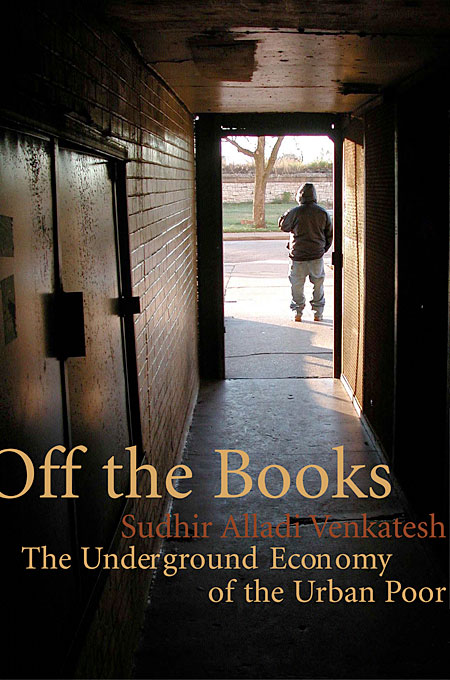
In this revelatory book, Sudhir Venkatesh takes us into Maquis Park, a poor black neighborhood on Chicago’s Southside, to explore the desperate, dangerous, and remarkable ways in which a community survives. We find there an entire world of unregulated, unreported, and untaxed work, a system of living off the books that is daily life in the ghetto. From women who clean houses and prepare lunches for the local hospital to small-scale entrepreneurs like the mechanic who works in an alley; from the preacher who provides mediation services to the salon owner who rents her store out for gambling parties; and from street vendors hawking socks and incense to the drug dealing and extortion of the local gang, we come to see how these activities form the backbone of the ghetto economy.What emerges are the innumerable ways that these men and women, immersed in their shadowy economic pursuits, are connected to and reliant upon one another. The underground economy, as Venkatesh’s subtle storytelling reveals, functions as an intricate web, and in the strength of its strands lie the fates of many Maquis Park residents. The result is a dramatic narrative of individuals at work, and a rich portrait of a community. But while excavating the efforts of men and women to generate a basic livelihood for themselves and their families, Off the Books offers a devastating critique of the entrenched poverty that we so often ignore in America, and reveals how the underground economy is an inevitable response to the ghetto’s appalling isolation from the rest of the country.

The Tomorrow Game: Rival Teenagers, Their Race for a Gun, and a Community United to Save Them
by Sudhir Venkatesh
Rating: 3.6 ⭐
A New York Times bestselling author’s gripping account of a Chicago community coming together to save a group of teenagers from gun violence.In the tradition of works like Random Family and Behind the Beautiful Forevers, Sudhir Venkatesh’s The Tomorrow Game is a deeply reported chronicle of families surviving in a Southside Chicago community. At the heart of the story are two Marshall Mariot, an introverted video gamer and bike rider, and Frankie Paul, who leaves foster care to direct his cousin’s drug business while he’s in prison. Frankie devises a plan to attack Marshall and his friends—it is his best chance to showcase his toughness and win respect for his crew. Catching wind of the plan, Marshall and his friends decide they must preemptively go after Frankie’s crew to defend their honor. The pressure mounts as both groups of teens race to find a gun and strike first. All the while, the community at large—a cast that includes the teens’ families, black market gun dealers, local pastors, a bodega owner, and a veteran beat cop—try their best to defuse the conflict and keep the kids alive. Based on Venkatesh’s three decades of immersion in Chicago’s Southside, and as propulsive as a novel, The Tomorrow Game is a nuanced, timely look at the toll that poverty and gun violence take on families and their communities.

Quels liens unissent les hommes d’affaires de Manhattan, la haute société de l’Upper East Side, les travailleurs du sexe de Brooklyn, les artistes de Tribeca, les agences d’escort de Hell’s Kitchen, les dealers de Harlem et de petits marchands bangladais ?Après avoir passé dix ans dans le ghetto de Chicago pour en percer les secrets (Dans la peau d’un chef de gang), Sudhir Venkatesh, sociologue renommé de l’université Columbia, retourne arpenter les rues de New York pour y comprendre le fonctionnement de l’économie souterraine. Épaulé par un petit baron de la drogue qui espère percer dans le marché « haut de gamme » de la cocaïne, il va de nouveau tâcher de cerner le réseau invisible de transactions illicites entre riches et pauvres qui, secrètement, raccorde toute la ville. Trafics, c’est dix ans d’enquêtes, entre échecs et découvertes, dans cette zone instable qu’est New York, où vos sujets de recherches disparaissent du jour au lendemain, où vos amis les plus proches peuvent s’avérer faire partie des pires criminels.

The political economy of an American street gang
by Sudhir Venkatesh