
Michel Foucault
Paul-Michel Foucault was a French philosopher, historian of ideas, writer, political activist, and literary critic. Foucault's theories primarily address the relationships between power and knowledge, and how they are used as a form of social control through societal institutions. Though often cited as a structuralist and postmodernist, Foucault rejected these labels. His thought has influenced academics, especially those working in communication studies, anthropology, psychology, sociology, criminology, cultural studies, literary theory, feminism, Marxism and critical theory. Born in Poitiers, France, into an upper-middle-class family, Foucault was educated at the Lycée Henri-IV, at the École Normale Supérieure, where he developed an interest in philosophy and came under the influence of his tutors Jean Hyppolite and Louis Althusser, and at the University of Paris (Sorbonne), where he earned degrees in philosophy and psychology. After several years as a cultural diplomat abroad, he returned to France and published his first major book, The History of Madness (1961). After obtaining work between 1960 and 1966 at the University of Clermont-Ferrand, he produced The Birth of the Clinic (1963) and The Order of Things (1966), publications that displayed his increasing involvement with structuralism, from which he later distanced himself. These first three histories exemplified a historiographical technique Foucault was developing called "archaeology". From 1966 to 1968, Foucault lectured at the University of Tunis before returning to France, where he became head of the philosophy department at the new experimental university of Paris VIII. Foucault subsequently published The Archaeology of Knowledge (1969). In 1970, Foucault was admitted to the Collège de France, a membership he retained until his death. He also became active in several left-wing groups involved in campaigns against racism and human rights abuses and for penal reform. Foucault later published Discipline and Punish (1975) and The History of Sexuality (1976), in which he developed archaeological and genealogical methods that emphasized the role that power plays in society. Foucault died in Paris from complications of HIV/AIDS; he became the first public figure in France to die from complications of the disease. His partner Daniel Defert founded the AIDES charity in his memory.
29 Books Written

L'ordre du discours est la leçon inaugurale de Michel Foucault au Collège de France, prononcée le 2 décembre 1970.

Naissance de la biopolitique. Cours au Collège de France, 1978-1979
by Michel Foucault
Rating: 4.2 ⭐
• 1 recommendation ❤️
Le cours prononcé par Michel Foucault au Collège de France de janvier à avril 1979, Naissance de la biopolitique, s'inscrit dans la continuité de celui de l'année précédente, Sécurité, Territoire, Population. Après avoir montré comment l'économie politique, au XVIIIe siècle, marque la naissance d'une nouvelle raison gouvernementale - gouverner moins, par souci d'efficacité maximum, en fonction de la naturalité des phénomènes auxquels on a affaire -, Michel Foucault entreprend l'analyse des formes de cette gouvernementalité libérale. Il s'agit de décrire la rationalité politique à l'intérieur de laquelle ont été posés les problèmes spécifiques de la vie et de la population : «Étudier le libéralisme comme cadre général de la biopolitique.»Quels sont les traits spécifiques de l'art libéral de gouverner, tel qu'il se dessine au XVIIIe siècle ? Quelle crise de gouvernementalité caractérise le monde actuel et à quelles révisions du gouvernement libéral a-t-elle donné lieu ? C'est à cette tâche de diagnostic que répond l'étude des deux grandes écoles néolibérales du XXe siècle, l'ordolibéralisme allemand et le néolibéralisme de l'École de Chicago - unique incursion de Michel Foucault, tout au long de son enseignement au Collège de France, dans le champ de l'histoire contemporaine.Cette analyse met en évidence le rôle paradoxal que joue la «société» par rapport au gouvernement : principe au nom duquel celui-ci tend à s'autolimiter, mais cible également d'une intervention gouvernementale permanente, pour produire, multiplier et garantir les libertés nécessaires au libéralisme économique. La société civile, loin de s'opposer à l'État, est donc le corrélatif de la technologie libérale de gouvernement.

Librarian note: an alternate cover for this edition can be found here.Michel Foucault examines the archeology of madness in the West from 1500 to 1800 – from the late Middle Ages, when insanity was still considered part of everyday life and fools and lunatics walked the streets freely, to the time when such people began to be considered a threat, asylums were first built, and walls were erected between the “insane” and the rest of humanity.

Librarian note: an alternate cover for this edition can be found here.Barely two hundred and fifty years ago a man condemned of attempting to assassinate the King of France was drawn and quartered in a grisly spectacle that suggested an unmediated duel between the violence of the criminal and the violence of the state. This groundbreaking book by the most influential philosopher since Sartre compels us to reevaluate our assumptions about all the ensuing reforms in the penal institutions of the West. For as he examines innovations that range from the abolition of torture to the institution of forced labor and the appearance of the modern penitentiary, Michel Foucault suggests that punishment has shifted its focus from the prisoner's body to the soul — and that our very concern with rehabilitation encourages and refines criminal activity.Lucidly reasoned and deftly marshaling a vast body of research, Discipline and Punish is a genuinely revolutionary book, whose implications extend beyond the prison to the minute power relations of our society.

Michel Foucault offers an iconoclastic exploration of why we feel compelled to continually analyze and discuss sex, and of the social and mental mechanisms of power that cause us to direct the questions of what we are to what our sexuality is.

Librarian note: an alternate cover for this edition can be found here.With vast erudition, Foucault cuts across disciplines and reaches back into seventeenth century to show how classical systems of knowledge, which linked all of nature within a great chain of being and analogies between the stars in the heavens and the features in a human face, gave way to the modern sciences of biology, philology, and political economy. The result is nothing less than an archaeology of the sciences that unearths old patterns of meaning and reveals the shocking arbitrariness of our received truths.In the work that established him as the most important French thinker since Sartre, Michel Foucault offers startling evidence that “man”—man as a subject of scientific knowledge—is at best a recent invention, the result of a fundamental mutation in our culture.

Librarian note: an alternate cover for this edition can be found here.Madness, sexuality, power, knowledge—are these facts of life or simply parts of speech? In a series of works of astonishing brilliance, historian Michel Foucault excavated the hidden assumptions that govern the way we live and the way we think. The Archaeology of Knowledge begins at the level of “things said” and moves quickly to illuminate the connections between knowledge, language, and action in a style at once profound and personal. A summing up of Foucault’s own methodological assumptions, this book is also a first step toward a genealogy of the way we live now. Challenging, at times infuriating, it is an absolutely indispensable guide to one of the most innovative thinkers of our time.

In this sequel to The History of Sexuality, Volume I: An Introduction, the brilliantly original French thinker who died in 1984 gives an analysis of how the ancient Greeks perceived sexuality. Throughout The Uses of Pleasure Foucault analyzes an irresistible array of ancient Greek texts on eroticism as he tries to answer basic questions: How in the West did sexual experience become a moral issue? And why were other appetites of the body, such as hunger, and collective concerns, such as civic duty, not subjected to the numberless rules and regulations and judgments that have defined, if not confined, sexual behavior?

Librarian note: an alternate cover for this edition can be found here.Michel Foucault has become famous for a series of books that have permanently altered our understanding of many institutions of Western society. He analyzed mental institutions in the remarkable Madness and Civilization; hospitals in The Birth of the Clinic; prisons in Discipline and Punish; and schools and families in The History of Sexuality. But the general reader as well as the specialist is apt to miss the consistent purposes that lay behind these difficult individual studies, thus losing sight of the broad social vision and political aims that unified them.Now, in this superb set of essays and interviews, Foucault has provided a much-needed guide to Foucault. These pieces, ranging over the entire spectrum of his concerns, enabled Foucault, in his most intimate and accessible voice, to interpret the conclusions of his research in each area and to demonstrate the contribution of each to the magnificent - and terrifying - portrait of society that he was patiently compiling.For, as Foucault shows, what he was always describing was the nature of power in society; not the conventional treatment of power that concentrates on powerful individuals and repressive institutions, but the much more pervasive and insidious mechanisms by which power "reaches into the very grain of individuals, touches their bodies and inserts itself into their actions and attitudes, their discourses, learning processes and everyday lives."Foucault's investigations of prisons, schools, barracks, hospitals, factories, cities, lodgings, families, and other organized forms of social life are each a segment of one of the most astonishing intellectual enterprises of all time - and, as this book proves, one which possesses profound implications for understanding the social control of our bodies and our minds.

What does it mean to write "This is not a pipe" across a bluntly literal painting of a pipe? René Magritte's famous canvas provides the starting point for a delightful homage by French philosopher and historian Michel Foucault. Much better known for his incisive and mordant explorations of power and social exclusion, Foucault here assumes a more playful stance. By exploring the nuances and ambiguities of Magritte's visual critique of language, he finds the painter less removed than previously thought from the pioneers of modern abstraction.

Society Must Be Defended: Lectures at the Collège de France, 1975-1976
by Michel Foucault
Rating: 4.3 ⭐
An examination of relations between war and politicsFrom 1971 until his death in 1984, Michel Foucault taught at the Collège de France, perhaps the most prestigious intellectual institution in Europe. Each year, in a series of 12 public lectures, Foucault sought to explain his research of the previous year. These lectures do not reduplicate his published books, although they do have themes in common. The lectures show Foucault ranging freely and conversationally over the implications of his research.In Society Must Be Defended, Foucault deals with the emergence in the early 17th century of a new understanding of society and its relation to war. War was now seen as the permanent basis of all institutions of power, a hidden presence within society that could be deciphered by an historical analysis. Tracing this development, Foucault outlines a genealogy of power/knowledge that was to become a primary concern in his final years.

Michel Foucault takes us into the first two centuries of our own era, into the Golden Age of Rome, to reveal a subtle but decisive break from the classical Greek vision of sexual pleasure. He skillfully explores the whole corpus of moral reflection among philosophers (Plutarch, Epictetus, Marcus Aurelius, Seneca) and physicians of the era, and uncovers an increasing mistrust of pleasure and growing anxiety over sexual activity and its consequences.

Michel Foucault was one of the most influential thinkers in the contemporary world, someone whose work has affected the teaching of half a dozen disciplines ranging from literary criticism to the history of criminology. But of his many books, not one offers a satisfactory introduction to the entire complex body of his work. The Foucault Reader was commissioned precisely to serve that purpose.The Reader contains selections from each area of Foucault's work as well as a wealth of previously unpublished writings, including important material written especially for this volume, the preface to the long-awaited second volume of The History of Sexuality, and interviews with Foucault himself, in the course of which he discussed his philosophy at first hand and with unprecedented candor.This philosophy comprises an astonishing intellectual enterprise: a minute and ongoing investigation of the nature of power in society. Foucault's analyses of this power as it manifests itself in society, schools, hospitals, factories, homes, families, and other forms of organized society are brought together in The Foucault Reader to create an overview of this theme and of the broad social and political vision that underlies it.

Librarian note: an alternate cover for this edition can be found here.In the eighteenth century, medicine underwent a mutation. For the first time, medical knowledge took on a precision that had formerly belonged only to mathematics. The body became something that could be mapped. Disease became subject to new rules of classification. And doctors begin to describe phenomena that for centuries had remained below the threshold of the visible and expressible.In The Birth of the Clinic the philosopher and intellectual historian who may be the true heir to Nietzsche charts this dramatic transformation of medical knowledge. As in his classic Madness and Civilization, Michel Foucault shows how much what we think of as pure science owes to social and cultural attitudes — in this case, to the climate of the French Revolution. Brilliant, provocative, and omnivorously learned, his book sheds new light on the origins of our current notions of health and sickness, life and death.

The Hermeneutics of the Subject: Lectures at the Collège de France, 1981-82
by Michel Foucault
Rating: 4.2 ⭐
The Hermeneutics of the Subject is the third volume in the collection of Michel Foucault's lectures at the Collège de France, where faculty give public lectures on any topic of their choosing. Attended by thousands, Foucault's lectures were seminal events in the world of French letters, and his ideas expressed there remain benchmarks of contemporary critical inquiry.Foucault's wide-ranging lectures at this school, delivered throughout the 1970s and early 1980s, clearly influenced his groundbreaking books, especially The History of Sexuality and Discipline and Punish. In the lectures comprising this volume, Foucault focuses on how the "self" and the "care of the self" were conceived during the period of antiquity, beginning with Socrates. The problems of the ethical formation of the self, Foucault argues, form the background for our own questions about subjectivity and remain at the center of contemporary moral thought.This series of lectures continues to throw new light on Foucault's final works, and shows the full depth of his engagement with ancient thought. Lucid and provocative, The Hermeneutics of the Subject reveals Foucault at the height of his powers.

Security, Territory, Population: Lectures at the Collège de France, 1977-1978
by Michel Foucault
Rating: 4.3 ⭐
Marking a major development in Foucault's thinking, this book derives from the lecture course which he gave at the Collège de France between January and April, 1978. Taking as his starting point the notion of 'bio-power', introduced both in his 1976 course Society Must be Defended and in the first volume of his History of Sexuality, Foucault sets out to study the foundations of this new technology of power over population. Distinct from disciplinary techniques, the mechanisms of power are here finely entwined with technologies of security, and it is to the 18th century developments of these technologies with which the first chapters of the book are concerned. By the fourth lecture however Foucault's attention turns, focusing newly on a history of 'governmentality' from the first centuries of the Christian era through to the emergence of the modern nation state. As Michel Sennerlart explains in his afterword, the effect of this change of direction is to "shift the center of gravity of the lectures from the question of biopower to that of government, to such an extent that the latter almost entirely eclipses the former..." Consequently, in light of Foucault's later work, these lectures represent a radical turning point at which the transition to the problematic of the "government of self and others" begins.

What is an Author? is an influential lecture given by French philosopher, sociologist and historian, Michel Foucault, on literary theory. The work considers the relationship between author, text, and reader; concluding that:“The Author is a certain functional principle by which, in our culture, one limits, excludes and chooses: (…) The author is therefore the ideological figure by which one marks the manner in which we fear the proliferation of meaning.”For many, Foucault's lecture mirrors much of Roland Barthes' essay Death of the Author.

From 1971 until his death in 1984, Foucault gave public lectures at the world-famous College de France. Attended by thousands, these were seminal events in the world of French letters. Picador is proud to be publishing the lectures in thirteen volumes.The lectures comprising Abnormal begin by examining the role of psychiatry in modern criminal justice, and its method of categorizing individuals who "resemble their crime before they commit it." Building on the themes of societal self-defense in Society Must Be Defended, Foucault shows how and why defining "abnormality" and "normality" were preorogatives of power in the nineteenth century.The Collège de France lectures add immeasurably to our appreciation of Foucault's work and offer a unique window into his thinking.

This seminal early work of Foucault is indispensable to understanding his development as a thinker. Written in 1954 and revised in 1962, Mental Illness and Psychology delineates the shift that occurred in Foucault's thought during this period. The first iteration reflects the philosopher's early interest in and respect for Freud and the psychoanalytic tradition. The second part, rewritten in 1962, marks a dramatic change in Foucault's thinking. Examining the history of madness as a social and cultural construct, he moves outside of the psychoanalytic tradition into the radical critique of Freud that was to dominate his later work. Mental Illness and Psychology is an important document tracing the intellectual evolution of this influential thinker. A foreword by Foucault scholar Hubert Dreyfus situates the book within the framework of Foucault's entire body of work.

Few philosophers have had as strong an influence on the twentieth century as Michel Foucault. His work has affected the teaching of any number of disciplines and remains, twenty years after his death, critically important. This newly available edition is drawn from the complete collection of all of Foucault's courses, articles, and interviews, and brings his most important work to a new generation of readers.Ethics (edited by Paul Rabinow) contains the summaries of Foucault's renowned courses at the Collège de France, paired with key writings and interviews on friendship, sexuality, and the care of the self and others.

The final volume in the definitive collection of Foucault’s articles, interviews, and seminars.Power, the third and final volume of The New Press's Essential Works of Foucault series, draws together Foucault s contributions to what he saw as the still-underdeveloped practice of political analysis. It covers the domains Foucault helped to make part of the core agenda of Western political culture medicine, psychiatry, the penal system, sexuality illuminating and expanding on the themes of The Birth of the Clinic, Discipline and Punish, and the first volume of The History of Sexuality.Power includes previously unpublished lectures, later writings highlighting Foucault s revolutionary analysis of the politics of personal conduct and freedom, interviews, and letters that illuminate Foucault's own political activism.

This text, entitled Des Espace Autres, and published by the French journal Architecture /Mouvement/ Continuité in October, 1984, was the basis of a lecture given by Michel Foucault in March 1967. Although not reviewed for publication by the author and thus not part of the official corpus of his work, the manuscript was released into the public domain for an exhibition in Berlin shortly before Michel Foucault's death.

I would like to distinguish between the ‘history of ideas’ and the ‘history of thought.’ The history of ideas involves the analysis of a notion from its birth, through its development, and in the setting of other ideas, which constitute its context. The history of thought is the analysis of the way an unproblematic field of experience becomes a problem, raises discussions and debate, incites new reactions, and induces crisis in the previously silent behaviors, practices, and institutions. It is the history of the way people become anxious, for example, about madness, about crime, about themselves, or about truth.Comprised of six lectures delivered, in English, by Michel Foucault while teaching at Berkeley in the Fall of 1983, Fearless Speech was edited by Joseph Pearson and published in 2001. Reviewed by the author, it is the last book Foucault wrote before his death in 1984 and can be read as his last testament. Here, he positions the philosopher as the only person able to confront power with the truth, a stance that boldly sums up Foucault’s project as a philosopher.Still unpublished in France, Fearless Speech concludes the genealogy of truth that Foucault pursued throughout his life, starting with his investigations in Madness and Civilization, into the question of power and its technology. The expression “fearless speech” is a rough translation of the Greek parrhesia, which designates those who take a risk to tell the truth; the citizen who has the moral qualities required to speak the truth, even if it differs from what the majority of people believe and faces danger for speaking it.Parrhesia is a verbal activity in which a speaker expresses his personal relationship to truth through frankness instead of persuasion, truth instead of flattery, and moral duty instead of self-interest and moral apathy.Michel Foucault (1926–84) is widely considered to be one of the most influe

A medicina, a psiquiatria, a justiça, a geografia, o corpo, a sexualidade, o papel dos intelectuais, o Estado, são analisados por Foucault em vários artigos, entrevistas e conferências reunidos neste livro. Todos os textos têm como tema central a questão do poder nas sociedades capitalistas - a sua natureza, seu exercício em instituições, sua relação com a produção da verdade e as resistências que suscita. O método genealógico desenvolvido por Foucault evidencia a existência de formas de exercício do poder diferentes do Estado, a ele articuladas e indispensáveis à sua sustentação e atuação eficaz. E na medida em que o poder não está localizado exclusivamente no aparelho de Estado, diz Foucault, "nada mudará a sociedade se os mecanismos de poder que funcionam fora, abaixo e ao lado dos aparelhos de Estado a um nível muito mais elementar, cotidiano, não forem modificados".

In Psychiatric Power, the fourth volume in the collection of his groundbreaking lectures at the Collège de France, Michel Foucault addresses and expands upon the ideas in his seminal Madness and Civilization, sketching the genealogy of psychiatry and of its characteristic form of power/knowledge. Madness and Civilization undertook the archeology of the division according to which, in Western Society, the madman found himself separated from the sane. That book ends with the medicalization of madness at the beginning of the nineteenth century. Psychiatric Power continues this discourse up to the end of the nineteenth century, and the double "depsychiatrization" of madness, now dispersed between the neurologist and the psychoanalyst. Presented in a conversational tone, Psychiatric Power brings fresh access and light to the work of one of the past century's preeminent thinkers.

Shortly before his death in 1984, Michel Foucault spoke of an idea for a new book on "technologies of the self." He described it as "composed of different papers about the self...,about the role of reading and writing in constituting the self... and so on." The book Foucault envisioned was based on a faculty seminar on "Technologies of the Self," originally presented at the University of Vermont in the fall of 1982. This volume is a partial record of that seminar.In many ways, Foucault's project on the self was the logical conclusion to his historical inquiry over twenty-five years into insanity, deviancy, criminality, and sexuality. Because Foucault died before he completed the revisions of his seminar presentations, this volume includes a careful transcription instead...as a prolegomenon to that unfinished task.

Estas cinco conferencias, dictadas por Michel Foucault en la Universidad Católica de Río de Janeiro en 1973, desarrollan las tesis básicas a partir de las cuales construiría más adelante una de sus obras principales: Vigilar y castigar, en la que examina el nacimiento de la prisión moderna como reflejo de las estrategias de vigilancia y control del poder a partir del siglo xix.Partiendo de una idea originaria de Nietzsche, Foucault investiga en la presente obra las formas de establecer la verdad en la Grecia antigua, en la Edad Media y en el Estado moderno. Así construye una genealogía del poder y de su paulatino entrelazamiento íntimo, oscuro y eficaz que configura la totalidad de las relaciones sociales de nuestra época.
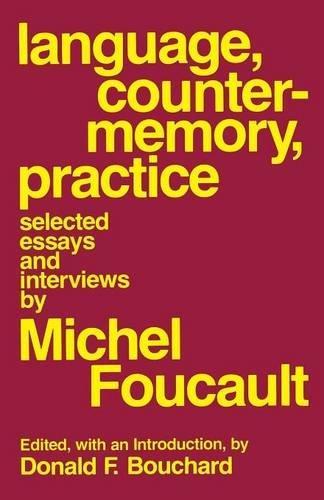
Because of their range, brilliance, and singularity, the ideas of the philosopher-critic-historian Michel Foucault have gained extraordinary currency throughout the intellectual community. This book offers a selection of seven of Foucault's most important published essays, translated from the French, with an introductory essay and notes by Donald F. Bouchard. Also included are a summary of a course given by Foucault at Collège de France, the transcript of a conversation between Foucault and Gilles Deleuze, and an interview with Foucault that appeared in the journal Actuel.

The definitive edition of Foucault's articles, interviews, and seminars.Few philosophers have had as strong an influence on the twentieth century as Michel Foucault. His work has affected the teaching of any number of disciplines and remains, twenty years after his death, critically important. This newly available edition is drawn from the complete collection of all of Foucault's courses, articles, and interviews, and brings his most important work to a new generation of readers.Aesthetics, Method and Epistemology surveys Foucault's diverse but sustained address of the historical forms and interplay of passion, experience, and truth.