
Judith Rich Harris
Judith Rich Harris was born February 10, 1938, and spent the first part of her childhood moving around with her family from one part of the country to another. Her parents eventually settled in Tucson, Arizona, where the climate permitted her father (invalided by an autoimmune disease called ankylosing spondylitis) to live in reasonable comfort. Harris graduated from Tucson High School and attended the University of Arizona and Brandeis University. She graduated magna cum laude from Brandeis in 1959 and was awarded the Lila Pearlman Prize in psychology. In 1961 she received a master's degree in psychology from Harvard University. Harris has been married since 1961 to Charles S. Harris; they have two daughters, born in 1966 and 1969, and four grandchildren, born in 1996, 1999, 2001, and 2004. Before her children were born, Harris worked as a teaching assistant in psychology at MIT (1961-1962), and as a research assistant at Bolt Beranek and Newman (1962-1963) and the University of Pennsylvania (1963-1965). Since 1977, Harris has suffered from a chronic autoimmune disorder called mixed connective tissue disease - an "overlap" combination of lupus and systemic sclerosis. This disorder can affect virtually any organ in the body. One of its more serious complications is a heart-lung condition known as pulmonary arterial hypertension. Harris was diagnosed with this condition in 2002. While bedridden for a period of time in the late 1970s, Harris worked out a mathematical model of visual search; this work was published in two articles in the journal Perception and Psychophysics (see publication list below). From 1981 to 1994 she was a writer of textbooks in developmental psychology. She is senior author of The Child (Prentice-Hall, 1984, 1987, 1991) and Infant and Child (1992). In 1994 Harris had begun work on a new development textbook, without a co-author this time, when she had an idea that led her to formulate a new theory of child development. She abandoned the textbook and instead wrote an article for the Psychological Review. Work on The Nurture Assumption began in 1995; the book was published three years later (Free Press, 1998). But the theory continued to evolve. The final version was presented in No Two Alike: Human Nature and Human Individuality (Norton, 2006). Harris is a member of the Association for Psychological Science and Phi Beta Kappa. In 1998 she received the George A. Miller Award from the American Psychological Association for her article entitled "Where Is the Child's Environment? A Group Socialization Theory of Development" (Psychological Review, 1995). This award is given to an outstanding article, particularly one that makes linkages between diverse fields of psychology. In 2007 she received the David Horrobin Prize for Medical Theory for her article "Parental selection: a third selection process in the evolution of human hairlessness and skin color" (Medical Hypotheses, 2006).
10 Books Written
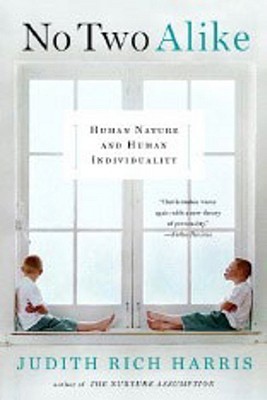
No Two Alike: Human Nature and Human Individuality
by Judith Rich Harris
Rating: 4.1 ⭐
• 3 recommendations ❤️
"A display of scientific courage and imagination." ―William Saletan, New York Times Book Review Why do people―even identical twins reared in the same home―differ so much in personality? Armed with an inquiring mind and insights from evolutionary psychology, Judith Rich Harris sets out to solve the mystery of human individuality. 12 illustrations

The Nurture Assumption: Why Children Turn Out the Way They Do, Revised and Updated
by Judith Rich Harris
Rating: 4.1 ⭐
• 2 recommendations ❤️
This groundbreaking book, a Pulitzer Prize finalist and New York Times notable pick, rattled the psychological establishment when it was first published in 1998 by claiming that parents have little impact on their children's development. In this tenth anniversary edition of The Nurture Assumption , Judith Harris has updated material throughout and provided a fresh introduction.Combining insights from psychology, sociology, anthropology, primatology, and evolutionary biology, she explains how and why the tendency of children to take cues from their peers works to their evolutionary advantage. This electrifying book explodes many of our unquestioned beliefs about children and parents and gives us a radically new view of childhood.

On child development from birth to adolescence.

Wie sich die Persönlichkeit des Menschen herausbildet, ist immer noch eines der großen Rätsel der Psychologie. Welchen Anteil hat Vererbung, welchen Erziehung? Warum unterscheiden sich eineiige Zwillinge voneinander, die doch dieselben Gene besitzen und in der Regel zusammen aufwachsen? Gelehrt, geistreich und mit Witz setzt sich die Psychologin Judith Rich Harris mit den existierenden Erklärungen psychologischer, biologischer sowie neurowissenschaftlicher Schulen auseinander und entwirft eine neue und originelle Theorie der Persönlichkeit auf der Basis evolutionspsychologischer Erkenntnisse.• Eine originelle Antwort auf die Frage nach dem, was Menschen voneinander unterscheidet• Eine wissenschaftliche Detektivgeschichte, im besten Sinne populär geschrieben

El mito de la educación: por qué los padres pueden influir muy poco en sus hijos
by Judith Rich Harris
Rating: 5.0 ⭐
Barcelona. 23 cm. 532 p. Encuadernación en tapa blanda de editorial ilustrada. Traducción de Mercedes Cernicharo y Dimas Más. Índice. Apéndices. Bibliografí p. 489-521. Educación de niños. Educación familiar .. Este libro es de segunda mano y tiene o puede tener marcas y señales de su anterior propietario. 8425335094

Kazdy inny
by Judith Rich Harris
W swojej najnowszej ksiazce Judith Rich Harris stara sie udzielic odpowiedzi na jedno z najwazniejszych pytan, nurtujacych czlowieka od poczatku jego istnienia - dlaczego kazdy z nas jest inny? Interesujace róznice miedzy ludzmi nie sa uwarunkowane przez geny ani przez zaden z innych czynników, które najszybciej przychodza do glowy na widok slowa ,,osobowosc". To dlatego ludzka indywidualnosc wciaz pozostaje tajemnica. Ksiazka Harris to - jak sama pisze - naukowa powiesc detektywistyczna. Jej celem jest rozwiazanie tej zagadki.Ksiazka zostala uznana za najlepsza ksiazke roku 2006 w kategorii ,,Nauka i technika" wedlug czasopisma ,,Library Journal".Wyjatki z ,,To znakomita ksiazka popularnonaukowa - bez watpienia jedna z najlepszych, które ukazaly sie w 2006 roku. Autorka w olsniewajacym stylu burzy ustalony porzadek psychologii akademickiej, kwestionujac podstawowe zalozenie, które przyjeto bez nalezytego sprawdzenia jego prawdziwosci - poglad, ze wychowanie wywiera wplyw na osobowosc. Czyni to w bardzo osobisty, przystepny sposób, odwolujac sie zarówno do badan naukowych, jak i do tradycyjnych powiesci kryminalnych".- Martin O'Brien, Popular Science

o mythos tis anatrofis / ο μύθος της ανατροφής
by Judith Rich Harris

Pourquoi nos enfants deviennent ce qu'ils sont
by Judith Rich Harris

The NURTURE ASSUMPTION: WHY CHILDREN TURN OUT THE WAY THEY DO by Judith Rich Harris
by Judith Rich Harris
Nurture Assumption: Why Children Turn Out the Way They Do
by Judith Rich Harris