
Paul N. Edwards
Paul N. Edwards is Professor in the School of Information and the Department of History at the University of Michigan. He is the author of The Closed World: Computers and the Politics of Discourse in Cold War America (1996) and a coeditor (with Clark Miller) of Changing the Atmosphere: Expert Knowledge and Environmental Governance (2001), both published by the MIT Press.
7 Books Written

A Vast Machine: Computer Models, Climate Data, and the Politics of Global Warming
by Paul N. Edwards
Rating: 3.9 ⭐
• 4 recommendations ❤️
Global warming skeptics often fall back on the argument that the scientific case for global warming is all model predictions, nothing but simulation; they warn us that we need to wait for real data, "sound science." In "A Vast Machine" Paul Edwards has news for these skeptics: without models, there are no data. Today, no collection of signals or observations -- even from satellites, which can "see" the whole planet with a single instrument -- becomes global in time and space without passing through a series of data models. Everything we know about the world's climate we know through models. Edwards offers an engaging and innovative history of how scientists learned to understand the atmosphere -- to measure it, trace its past, and model its future.

The Closed World: Computers and the Politics of Discourse in Cold War America
by Paul N. Edwards
Rating: 4.1 ⭐
The Closed World offers a radically new alternative to the canonical histories of computers and cognitive science. Arguing that we can make sense of computers as tools only when we simultaneously grasp their roles as metaphors and political icons, Paul Edwards shows how Cold War social and cultural contexts shaped emerging computer technology—and were transformed, in turn, by information machines. The Closed World explores three apparently disparate histories—the history of American global power, the history of computing machines, and the history of subjectivity in science and culture—through the lens of the American political imagination. In the process, it reveals intimate links between the military projects of the Cold War, the evolution of digital computers, and the origins of cybernetics, cognitive psychology, and artificial intelligence. Edwards begins by describing the emergence of a "closed-world discourse" of global surveillance and control through high-technology military power. The Cold War political goal of "containment" led to the SAGE continental air defense system, Rand Corporation studies of nuclear strategy, and the advanced technologies of the Vietnam War. These and other centralized, computerized military command and control projects—for containing world-scale conflicts—helped closed-world discourse dominate Cold War political decisions. Their apotheosis was the Reagan-era plan for a " Star Wars " space-based ballistic missile defense. Edwards then shows how these military projects helped computers become axial metaphors in psychological theory. Analyzing the Macy Conferences on cybernetics, the Harvard Psycho-Acoustic Laboratory, and the early history of artificial intelligence, he describes the formation of a "cyborg discourse." By constructing both human minds and artificial intelligences as information machines, cyborg discourse assisted in integrating people into the hyper-complex technological systems of the closed world. Finally, Edwards explores the cyborg as political identity in science fiction—from the disembodied, panoptic AI of 2001: A Space Odyssey , to the mechanical robots of Star Wars and the engineered biological androids of Blade Runner —where Information Age culture and subjectivity were both reflected and constructed. Inside Technology series

Un monde clos. L'ordinateur, la bombe et le discours politique de la Guerre froide
by Paul N. Edwards
Rating: 5.0 ⭐


The Al-Pac Review Hearings: A Case Study
by Paul N. Edwards
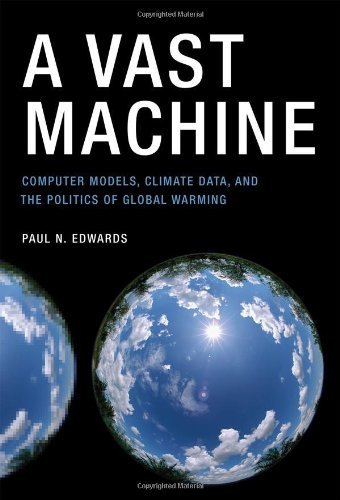
Vast Machine (Infrastructures) by Paul N. Edwards
by Paul N. Edwards

A Vast Machine
by Paul N. Edwards