
Tim Harford
Tim Harford is a member of the Financial Times editorial board. His column, “The Undercover Economist”, which reveals the economic ideas behind everyday experiences, is published in the Financial Times and syndicated around the world. He is also the only economist in the world to run a problem page, “Dear Economist”, in which FT readers’ personal problems are answered tongue-in-cheek with the latest economic theory. --from the author's website
30 Books Written

In this groundbreaking book, Tim Harford, the Undercover Economist, shows us a new and inspiring approach to solving the most pressing problems in our lives. When faced with complex situations, we have all become accustomed to looking to our leaders to set out a plan of action and blaze a path to success. Harford argues that today’s challenges simply cannot be tackled with ready-made solutions and expert opinion; the world has become far too unpredictable and profoundly complex. Instead, we must adapt. Deftly weaving together psychology, evolutionary biology, anthropology, physics, and economics, along with the compelling story of hard-won lessons learned in the field, Harford makes a passionate case for the importance of adaptive trial and error in tackling issues such as climate change, poverty, and financial crises—as well as in fostering innovation and creativity in our business and personal lives. Taking us from corporate boardrooms to the deserts of Iraq, Adapt clearly explains the necessary ingredients for turning failure into success. It is a breakthrough handbook for surviving—and prospering— in our complex and ever-shifting world.

Messy: The Power of Disorder to Transform Our Lives
by Tim Harford
Rating: 3.9 ⭐
• 2 recommendations ❤️
“Utterly fascinating. Tim Harford shows that if you want to be creative and resilient, you need a little more disorder in your world.” —Adam Grant, New York Times -bestselling author of Originals and Give and Take“Engrossing.” — New York TimesFrom the award-winning columnist and author of the national bestseller The Undercover Economist comes a provocative big idea book about the genuine benefits of being at home, at work, in the classroom, and beyond.Look out for Tim's next book, The Data Detective . The Power of Disorder to Transform Our Lives celebrates the benefits that messiness has in our why it’s important, why we resist it, and why we should embrace it instead. Using research from neuroscience, psychology, social science, as well as captivating examples of real people doing extraordinary things, Tim Harford explains that the human qualities we value – creativity, responsiveness, resilience – are integral to the disorder, confusion, and disarray that produce them.From the music studio of Brian Eno to the Lincoln Memorial with Martin Luther King, Jr., from the board room to the classroom, messiness lies at the core of how we innovate, how we achieve, how we reach each other – in short, how we succeed.In Messy , you’ll learn about the unexpected connections between creativity and mess; understand why unexpected changes of plans, unfamiliar people, and unforeseen events can help generate new ideas and opportunities as they make you anxious and angry; and come to appreciate that the human inclination for tidiness – in our personal and professional lives, online, even in children’s play – can mask deep and debilitating fragility that keep us from innovation.Stimulating and readable as it points exciting ways forward, Messy is an insightful exploration of the real advantages of mess in our lives.

Undercover Economist: Exposing Why the Rich Are Rich, the Poor Are Poor--and Why You Can Never Buy a Decent Used Car!
by Tim Harford
Rating: 3.8 ⭐
• 2 recommendations ❤️
With over one million copies sold, The Undercover Economist has been hailed worldwide as a fantastic guide to the fundamental principles of economics. An economist's version of The Way Things Work, this engaging volume is part Economics 101 and part expose of the economic principles lurking behind daily events, explaining everything from traffic jams to high coffee prices.New to this edition This revised edition, newly updated to consider the banking crisis and economic turbulence of the last four years, is essential for anyone who has wondered why the gap between rich and poor nations is so great, or why they can't seem to find a decent second-hand car, or how to outwit Starbucks. Senior columnist for the Financial Times Tim Harford brings his experience and insight as he ranges from Africa, Asia, Europe, and the United States to reveal how supermarkets, airlines, and coffee chains--to name just a few--are vacuuming money from our wallets. Harford punctures the myths surrounding some of today's biggest controversies, including the high cost of health-care; he reveals why certain environmental laws can put a smile on a landlord's face; and he explains why some industries can have high profits for innocent reasons, while in other industries something sinister is going on.Covering an array of economic concepts including scarce resources, market power, efficiency, price gouging, market failure, inside information, and game theory, Harford sheds light on how these forces shape our day-to-day lives, often without our knowing it. Showing us the world through the eyes of an economist, Tim Harford reveals that everyday events are intricate games of negotiations, contests of strength, and battles of wits. Written with a light touch and sly wit, The Undercover Economist turns "the dismal science" into a true delight.
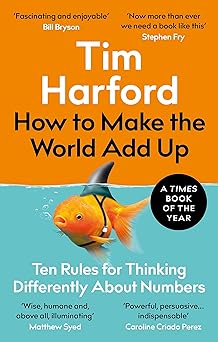
How to Make the World Add Up: Ten Rules for Thinking Differently About Numbers
by Tim Harford
Rating: 4.0 ⭐
When was the last time you read a grand statement, accompanied by a large number, and wondered whether it could really be true? Statistics are vital in helping us tell stories - we see them in the papers, on social media, and we hear them used in everyday conversation - and yet we doubt them more than ever.But numbers - in the right hands - have the power to change the world for the better. Contrary to popular belief, good statistics are not a trick, although they are a kind of magic. Good statistics are not smoke and mirrors; in fact, they help us see more clearly. Good statistics are like a telescope for an astronomer, a microscope for a bacteriologist, or an X-ray for a radiologist. If we are willing to let them, good statistics help us see things about the world around us and about ourselves - both large and small - that we would not be able to see in any other way.In How to Make the World Add Up, Tim Harford draws on his experience as both an economist and presenter of the BBC's radio show 'More or Less'. He takes us deep into the world of disinformation and obfuscation, bad research and misplaced motivation to find those priceless jewels of data and analysis that make communicating with numbers worthwhile. Harford's characters range from the art forger who conned the Nazis to the stripper who fell in love with the most powerful congressman in Washington, to famous data detectives such as John Maynard Keynes, Daniel Kahneman and Florence Nightingale. He reveals how we can evaluate the claims that surround us with confidence, curiosity and a healthy level of scepticism.Using ten simple rules for understanding numbers - plus one golden rule - this extraordinarily insightful book shows how if we keep our wits about us, thinking carefully about the way numbers are sourced and presented, we can look around us and see with crystal clarity how the world adds up.

Life sometimes seems illogical. Individuals do strange take drugs, have unprotected sex, mug each other. Love seems irrational, and so does divorce. On a larger scale, life seems no fairer or easier to Why do some neighborhoods thrive and others become ghettos? Why is racism so persistent? Why is your idiot boss paid a fortune for sitting behind a mahogany altar? Thorny questions–and you might be surprised to hear the answers coming from an economist.But Tim Harford, award-winning journalist and author of the bestseller T he Undercover Economist , likes to spring surprises. In this deftly reasoned book, Harford argues that life is logical after all. Under the surface of everyday insanity, hidden incentives are at work, and Harford shows these incentives emerging in the most unlikely places.Using tools ranging from animal experiments to supercomputer simulations, an ambitious new breed of economist is trying to unlock the secrets of society. The Logic of Life is the first book to map out the astonishing insights and frustrating blind spots of this new economics in a way that anyone can enjoy.The Logic of Life presents an X-ray image of human life, stripping away the surface to show us a picture that is revealing, enthralling, and sometimes disturbing. The stories that emerge are not about data or equations but about the athlete who survived a shocking murder attempt, the computer geek who beat the hard-bitten poker pros, the economist who defied Henry Kissinger and faked an invasion of Berlin, the king who tried to buy off a revolution.Once you’ve read this quotable and addictive book, life will never look the same again.

A lively history seen through the fifty inventions that shaped it most profoundly, by the bestselling author of The Undercover Economist and Messy. Who thought up paper money? What was the secret element that made the Gutenberg printing press possible? And what is the connection between The Da Vinci Code and the collapse of Lehman Brothers? Fifty Inventions That Shaped the Modern Economy paints an epic picture of change in an intimate way by telling the stories of the tools, people, and ideas that had far-reaching consequences for all of us. From the plough to artificial intelligence, from Gillette’s disposable razor to IKEA’s Billy bookcase, bestselling author and Financial Times columnist Tim Harford recounts each invention’s own curious, surprising, and memorable story. Invention by invention, Harford reflects on how we got here and where we might go next. He lays bare often unexpected connections: how the bar code undermined family corner stores, and why the gramophone widened inequality. In the process, he introduces characters who developed some of these inventions, profited from them, and were ruined by them, as he traces the principles that helped explain their transformative effects. The result is a wise and witty book of history, economics, and biography.

A provocative and lively exploration of the increasingly important world of macroeconomics, by the author of the bestselling The Undercover Economist. Thanks to the worldwide financial upheaval, economics is no longer a topic we can ignore. From politicians to hedge-fund managers to middle-class IRA holders, everyone must pay attention to how and why the global economy works the way it does. Enter Financial Times columnist and bestselling author Tim Harford. In this new book that demystifies macroeconomics, Harford strips away the spin, the hype, and the jargon to reveal the truth about how the world’s economy actually works. With the wit of a raconteur and the clear grasp of an expert, Harford explains what’s really happening beyond today’s headlines, why all of us should care, and what we can do about it to understand it better.

Dear Undercover Economist: Priceless Advice on Money, Work, Sex, Kids, and Life's Other Challenges
by Tim Harford
Rating: 3.6 ⭐
Look out for Tim's next book, The Data Detective .Throughout history, great philosophers have been answering profound questions about life. But do they know why your socks keep disappearing from the dryer, or how to choose the quickest line at the supermarket? Probably not, but Tim Harford does. . . .In Dear Undercover Economist , the first collection of his wildly popular Financial Times columns, Tim Harford offers witty, charming, and at times caustic answers to our most pressing concerns–all through the lens of economics. Does money buy happiness? Is “the one” really out there? Can cities be greener than farms? Can you really “dress for success”? When’s the best time to settle down? Harford provides brilliant, hilarious, unexpected, and wise answers to these and other questions. Arranged by topic, easy to read, and hard to put down, Dear Undercover Economist lends an outrageous, compassionate, and indispensable perspective on anything that may irk or ail you–a book well worth the investment.

In Fifty Things that Made the Modern Economy, the revolutionary, acclaimed book, radio series and podcast, bestselling economist Tim Harford introduced us to a selection of fifty radical inventions that changed the world. Along the way he entertained us with a myriad of great stories and revealed some of the most surprising landmarks in our history.Now, in this new book, Harford once again brings us an array of remarkable, memorable, curious and often unexpected 'things' - inventions that have significantly moved the needle on our journey to the complex world economy we live in today. From the brick, blockchain and the bicycle to fire, the factory and fundraising, and from Solar PV and the pencil to the postage stamp, this brilliant and enlightening collection resonates, fascinates and stimulates. It is a wonderful blend of insight and inspiration from one of Britain's finest non-fiction storytellers.

***'A book that all children should read' - Matthew Syed***-> Did you know that a toy spaceship can teach you about inflation?-> Or that a pooping cow can show you how to invest your pocket money?-> And that even the greatest detectives have been fooled by fake news and dancing fairies?The world is often full of bamboozling headlines and numbers that don't add up. But don't panic. Within these pages you will transform into a Truth Detective, hunting down the truth about the world around you. You will meet heroic truth detectives, such as Florence Nightingale who started a revolution with a pie chart. You will encounter dastardly villains who have tried to trip us up with dodgy data and misinformation. And you will learn how being smart and savvy with numbers, will help you be smart and savvy about everything else in life too.So grab your detective cap, pick up your magnifying glass and start seeing the world like never before.A must read for curious kids from presenter of BBC Radio 4's "More or Less", Tim Harford and with wonderful illustrations to enjoy by Ollie Mann.***LONGLISTED for the SLA's Information Book Awards 2024***

In Tim Harford’s new book The Undercover Economist Strikes Back, he sets out to explain how the whole world economy works. In this, the second chapter from the book, Harford shows what we can learn from one particular recession that began in the early 1970s and was entirely created on Capitol Hill, the heart of American government. Readers should note that this ebook is just one chapter from the new book. The full book will be released on August 29.A million readers bought The Undercover Economist to get the lowdown on how economics works on a small scale, in our everyday lives. Since then, economics has become big news. Crises, austerity, riots, bonuses – all are in the headlines all the time. But how does this large-scale economic world really work? Find out in The Undercover Economist Strikes Back.

In Tim Harford’s new book The Undercover Economist Strikes Back, he sets out to explain how the whole world economy works. In this, the ninth chapter from the book, Harford looks at the importance of management in how economies function.Readers should note that this ebook is just one chapter from the new book. The full book will be released on August 29.A million readers bought The Undercover Economist to get the lowdown on how economics works on a small scale, in our everyday lives. Since then, economics has become big news. Crises, austerity, riots, bonuses – all are in the headlines all the time. But how does this large-scale economic world really work? Find out in The Undercover Economist Strikes Back.

In Tim Harford’s new book The Undercover Economist Strikes Back, he sets out to explain how the whole world economy works. In this, the sixth chapter from the book, Harford shows what a recession in a prison camp can tell us about how classical economists think.Readers should note that this ebook is just one chapter from the new book. The full book will be released on August 29.A million readers bought The Undercover Economist to get the lowdown on how economics works on a small scale, in our everyday lives. Since then, economics has become big news. Crises, austerity, riots, bonuses – all are in the headlines all the time. But how does this large-scale economic world really work? Find out in The Undercover Economist Strikes Back.


Messy: The Power of Disorder to Transform Our Lives / How to Make the World Add Up
by Tim Harford
Rating: 4.3 ⭐
Please Note That The Following Individual Books As Per Original ISBN and Cover Image In this Listing shall be Dispatched How to Be Creative and Resilient in a Tidy-Minded World & How to Make the World Add Up By Tim Harford 2 Books Collection How to Be Creative and Resilient in a Tidy-Minded The urge to tidiness seems to be rooted deep in the human psyche. Many of us feel threatened by anything that is vague, unplanned, scattered around or hard to describe. We find comfort in having a script to rely on, a system to follow, in being able to categorise and file away.We all benefit from tidy organisation - up to a point. A large library needs a reference system. Global trade needs the shipping container. Scientific collaboration needs measurement units. But the forces of tidiness have marched too far. Corporate middle managers and government bureaucrats have long tended to insist that everything must have a label.How to Make the World Add In How to Make the World Add Up, Tim Harford draws on his experience as both an economist and presenter of the BBC's radio show 'More or Less'. He takes us deep into the world of disinformation and obfuscation, bad research and misplaced motivation to find those priceless jewels of data and analysis that make communicating with numbers worthwhile. Harford's characters range from the art forger who conned the Nazis to the stripper who fell in love with the most powerful congressman in Washington, to famous data detectives such as John Maynard Keynes, Daniel Kahneman and Florence Nightingale. He reveals how we can evaluate the claims that surround us with confidence, curiosity and a healthy level of scepticism.Product Description

How to Make the World Add Up / Fifty Things that Made the Modern Economy / The Undercover Economist / The Next Fifty Things that Made the Modern Economy / Messy
by Tim Harford
Rating: 4.0 ⭐

Please Note That The Following Individual Books As Per Original ISBN and Cover Image In this Listing shall be Dispatched Titles In This How to Make the World Add UpMessy [Hardcover]How to Make the World Add Up, Messy [Hardcover] 2 Books Collection Set By Tim How to Make the World Add In How to Make the World Add Up, Tim Harford draws on his experience as both an economist and presenter of the BBC's radio show 'More or Less' to take us deep into the world of disinformation and obfuscation, bad research and misplaced motivation to find those priceless jewels of data and analysis that make communicating with numbers so rewarding. Through vivid storytelling he reveals how we can evaluate the claims that surround us with confidence.Messy [Hardcover]: The Power of Disorder to Transform Our Lives celebrates the benefits that messiness has in our why it’s important, why we resist it, and why we should embrace it instead. Using research from neuroscience, psychology, social science, as well as captivating examples of real people doing extraordinary things, Tim Harford explains that the human qualities we value – creativity, responsiveness, resilience – are integral to the disorder, confusion, and disarray that produce them.


Messy / Fifty Things that Made the Modern Economy / Adapt: Why Success Always Starts with Failure
by Tim Harford
Rating: 3.5 ⭐
Please Note That The Following Individual Books As Per Original ISBN and Cover Image In this Listing shall be Dispatched Tim Harford Collection 3 Books In Messy, you'll learn about the unexpected connections between creativity and mess; understand why unexpected changes of plans, unfamiliar people, and unforeseen events can help generate new ideas and opportunities as they make you anxious and angry; and come to appreciate that the human inclination for tidiness - in our personal and professional lives, online, even in children's play - can mask deep and debilitating fragility that keep us from innovation.Fifty Things that Made the Modern The world economy defies comprehension. A continuously-changing system of immense complexity, it offers over ten billion distinct products and services, doubles in size every fifteen years, and links almost every one of the planet's seven billion people. It delivers astonishing luxury to hundreds of millions. It also leaves hundreds of millions behind, puts tremendous strains on the ecosystem, and has an alarming habit of stalling. Nobody is in charge of it. Indeed, no individual understands more than a fraction of what's going on.How can we make sense of this bewildering system on which our lives depend? Why Success Always Starts with In this groundbreaking new book, Tim Harford shows how the world's most complex and important problems - including terrorism, climate change, poverty, innovation, and the financial crisis - can only be solved from the bottom up by rapid experimenting and adapting.From a spaceport in the Mojave Desert to the street battles of Iraq, from a blazing offshore drilling rig to everyday decisions in our business and personal lives, this is a handbook for surviving - and prospering - in our complex and ever-shifting world.

Messy / Fifty Things that Made the Modern Economy / The Undercover Economist
by Tim Harford
Rating: 5.0 ⭐
Please Note That The Following Individual Books As Per Original ISBN Supplied Individually by Publisher and As Per Cover Image In this Listing shall be Dispatched Collectively :Tim Harford Collection 3 Books Set (Messy, Fifty Things that Made the Modern Economy, The Undercover Economist)Messy-How to Be Creative and Resilient in a Tidy-Minded World The urge to tidiness seems to be rooted deep in the human psyche. Many of us feel threatened by anything that is vague, unplanned, scattered around or hard to describe. We find comfort in having a script to rely on, a system to follow, in being able to categorise and file away.We all benefit from tidy organisation - up to a point. A large library needs a reference system.Fifty Things that Made the Modern Economy -defies comprehension. A continuously-changing system of immense complexity, it offers over ten billion distinct products and services, doubles in size every fifteen years, and links almost every one of the planet's seven billion people. It delivers astonishing luxury to hundreds of millions. It also leaves hundreds of millions behind, puts tremendous strains on the ecosystem, and has an alarming habit of stalling. Nobody is in charge of it.The Undercover Economist-Who makes most money from the demand for cappuccinos early in the morning at Waterloo Station? Why is it impossible to get a foot on the property ladder? How does the Mafia make money from laundries when street gangs pushing drugs don't? Who really benefits from immigration? How can China, in just fifty years, go from the world's worst famine to one of the greatest economic revolutions of all time, lifting a million people out of poverty a month?

The Undercover Economist / Messy How to Be Creative and Resilient in a Tidy-Minded World
by Tim Harford
Rating: 4.0 ⭐
Please Note That The Following Individual Books As Per Original ISBN and Cover Image In this Listing shall be Dispatched The Undercover Economist & Messy How to Be Creative and Resilient in a Tidy-Minded World By Tim Harford 2 Books Collection The Undercover "The economy [isn't] a bunch of rather dull statistics with names like GDP (gross domestic product)," notes Tim Harford, columnist and regular guest on NPR's Marketplace, "economics is about who gets what and why." In this acclaimed and riveting book-part exposé, part user's manual-the astute and entertaining columnist from the Financial Times demystifies the ways in which money works in the world. From why the coffee in your cup costs so much to why efficiency is not necessarily the answer to ensuring a fair society, from improving health care to curing crosstown traffic-all the dirty little secrets of dollars and cents are delightfully revealed by The Undercover Economist. Messy How to Be Creative and Resilient in a Tidy-Minded World [Hardcover]: The urge to tidiness seems to be rooted deep in the human psyche. Many of us feel threatened by anything that is vague, unplanned, scattered around or hard to describe. We find comfort in having a script to rely on, a system to follow, in being able to categorise and file away. We all benefit from tidy organisation - up to a point. A large library needs a reference system. Global trade needs the shipping container. Scientific collaboration needs measurement units. But the forces of tidiness have marched too far. Corporate middle managers and government bureaucrats have long tended to insist that everything must have a label, a number and a logical place in a logical system.

How to Make the World Add Up / The Undercover Economist / Fifty Things that Made the Modern Economy
by Tim Harford
Rating: 3.0 ⭐

卧底经济学(套装共4册)
by Tim Harford
本套装包含《卧底经济学家》、《亲爱的卧底经济学家》、《谁赚走了你的薪水》、《世界运行的真相》四本书。金融时报最好看的专栏 不骗你,经济学真的可以解决所有生活难题 一本让你笑到喷饭的书! 英国Financial Times超人气专栏,作者提姆.哈福特Tim Harford所主持的 金融时报《Dear Economist》专栏,多年来广受好评。 针对生活上的大小事--从爱情、工作、休闲、理财,甚至性, 都提出一针见血又非常实用的建议。 但是不要期待他跟其他主持读者信箱的夫人们一样有同情心; 他讲话很直、很没礼貌,可是很爆笑。 他不提供肩膀给失落者哭泣, 反而冷静的利用各种经济学工具, 将生活中最具挑战性的难题简化为经济模型, 献上最实在的理性线索与生活建议。 第一本:《卧底经济学家》 第二本:《亲爱的卧底经济学家》 第三本:《谁赚走了你的薪水》 第四本:《世界运行的真相》 蒂姆·哈福德 (Tim Harford),深受全球读者追捧的著名的卧底经济学家,被誉为“当前最幽默的生活经济学大师”。他主笔的“亲爱的经济学家”专栏已成为《金融时报》有史以来关注度最高的专栏之一,在专栏中,他用最新的经济学理论为读者五花八门的疑问和牢骚提供轻松诙谐的经济学解读。著有《卧底经济学》和《谁赚走了你的薪水》。 《卧底经济学》这本书已经被翻译为30种语言,在世界多国发行。他还曾在世界银行工作,担任牛津大学的经济学教授,为国际知名金融公司担任首席经济学家。目前他与妻子及两个孩子一起住在伦敦。

cincuenta innovaciones q/han cambiad
by Tim Harford



livro messy Ed. 2019
by Tim Harford
Libro usado en buenas condiciones, por su antiguedad podria contener señales normales de uso
The Logic of Life Signed
by Tim Harford