
Edwin Hutchins
4 Books Written
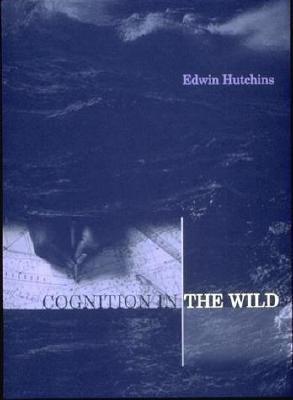
Edwin Hutchins combines his background as an anthropologist and an open ocean racing sailor and navigator in this account of how anthropological methods can be combined with cognitive theory to produce a new reading of cognitive science. His theoretical insights are grounded in an extended analysis of ship navigation -- its computational basis, its historical roots, its social organization, and the details of its implementation in actual practice aboard large ships. The result is an unusual interdisciplinary approach to cognition in culturally constituted activities outside the laboratory -- "in the wild."Hutchins examines a set of phenomena that have fallen in the cracks between the established disciplines of psychology and anthropology, bringing to light a new set of relationships between culture and cognition. The standard view is that culture affects the cognition of individuals. Hutchins argues instead that cultural activity systems have cognitive properties of their own that are different from the cognitive properties of the individuals who participate in them. Each action for bringing a large naval vessel into port, for example, is informed by culture: the navigation team can be seen as a cognitive and computational system.Introducing Navy life and work on the bridge, Hutchins makes a clear distinction between the cognitive properties of an individual and the cognitive properties of a system. In striking contrast to the usual laboratory tasks of research in cognitive science, he applies the principal metaphor of cognitive science -- cognition as computation (adopting David Marr's paradigm) -- to the navigation task. After comparing modern Western navigation with the method practiced in Micronesia, Hutchins explores the computational and cognitive properties of systems that are larger than an individual. He then turns to an analysis of learning or change in the organization of cognitive systems at several scales. Hutchins's conclusion illustrates the costs of ignoring the cultural nature of cognition, pointing to the ways in which contemporary cognitive science can be transformed by new meanings and interpretations. A Bradford Book

This book takes a major step in psychological anthropology by applying new analytic tools from cognitive science to one of the oldest and most vexing anthropological the nature of "primitive" thought. For a decade or more there has been broad agreement within anthropology that culture might be usefully viewed as a system of tacit rules that constrain the meaningful interpretation of events and serve as a guide to action. However, no one has made a serious attempt to write a cultural grammar that would make such rules explicit. In Culture and Inference Edwin Hutchins makes just such an attempt for one enormously instructive case, the Trobriand Islanders' system of land tenure. Using the propositional network notation developed by Rumeihart and Norman, Hutchins describes native knowledge about land tenure as a set of twelve propositions. Inferences are derived from these propositions by a set of transfer formulas that govern the way in which static knowledge about land tenure can be applied to new disputes. After deriving this descriptive system by extensive observation of the Trobrianders' land courts and by interrogation of litigants, Hutchins provides a test of his grammar by showing how it can be used to simulate decisions in new cases. What is most interesting about these simulations, generally, is that they require all the same logical operations that arise from a careful analysis of Western thought. Looking closely at "primitive" inference in a natural situation, Hutchins finds that Trobriand reasoning is no more primitive than our own.

Culture and Inference: A Trobriand Case Study
by Edwin Hutchins
This book takes a major step in psychological anthropology by applying new analytic tools from cognitive science to one of the oldest and most vexing anthropological problems: the nature of primitive thought. For a decade or more there has been broad agreement within anthropology that culture might be usefully viewed as a system of tacit rules that constrain the meaningful interpretation of events and serve as a guide to action. However, no one has made a serious attempt to write a cultural grammar that would make such rules explicit. In Culture and Inference Edwin Hutchins makes just such an attempt for one enormously instructive case, the Trobriand Islanders' system of land tenure. Using the propositional network notation developed by Rumeihart and Norman, Hutchins describes native knowledge about land tenure as a set of twelve propositions. Inferences are derived from these propositions by a set of transfer formulas that govern the way in which static knowledge about land tenure can be applied to new disputes. After deriving this descriptive system by extensive observation of the Trobrianders' land courts and by interrogation of litigants, Hutchins provides a test of his grammar by showing how it can be used to simulate decisions in new cases. What is most interesting about these simulations, generally, is that they require all the same logical operations that arise from a careful analysis of Western thought. Looking closely at primitive inference in a natural situation, Hutchins finds that Trobriand reasoning is no more primitive than our own.

Chalk Stream Management
by Edwin Hutchins