
James Curran
James Curran is Professor of Communications at Goldsmiths College, London. He has published over 18 books, including Culture Wars: The Media and British Left (with Ivor Gaber and Julian Petley) (Edinburgh University Press, 2005), Power without Responsibility (with Jean Seaton), 6th edition (Routledge, 2003), Mass Media and Society (ed. with Michael Gurevitch), 4th edition (Arnold, 2005) and Media and Power (Routledge, 2002).
23 Books Written
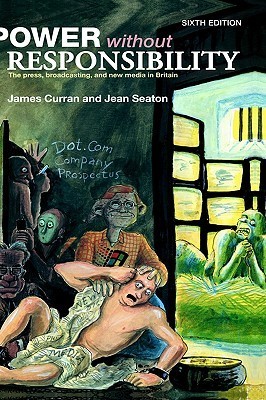
Power Without Responsibility: Press, Broadcasting and the Internet in Britain
by James Curran
Rating: 4.7 ⭐
• 2 recommendations ❤️
Widely regarded as the standard book on the British Media, this authoritative introduction to the history, sociology, theory and politics of media and communications studies has been substantially revised and updated to bring it up to date with developments in the media industry. Its three new chapters describe the battle for the soul of the internet, the impact of the internet on society and the rise of new media in Britain. In addition it examines the recuperation of the BBC, how international and European regulation is changing the British media and why Britain has the least trusted press in Europe.

The growth of the internet has been spectacular. There are now more 1.5 billion internet users across the globe, about one quarter of the world’s population. This is certainly a new phenomenon that is of enormous significance for the economic, political and social life of contemporary societies.However, much popular and academic writing about the internet takes a technologically deterministic view, assuming that the internet’s potential will be realised in essentially transformative ways. This was especially true in the euphoric moment of the mid-1990s, when many commentators wrote about the internet with awe and wonderment. While this moment may be over, its underlying technocentrism – the belief that technology determines outcomes – lingers on, and with it, a failure to understand the internet in its social, economic and political context.Misunderstanding the Internet is a short introduction, encompassing the history, sociology, politics and economics of the internet and its impact on society. The book has a simple three part structure:Part 1 looks at the history of the internet, and offers an overview of the internet’s place in societyPart 2 focuses on the control and economics of the internetPart 3 examines the internet’s political and cultural influenceMisunderstanding the Internet is a polemical, sociologically and historically informed textbook that aims to challenge both popular myths and existing academic orthodoxies around the internet.

Australia’s China Odyssey is the story of the complex and crucial relationship between Australia and China, charting its highs and lows through the prism of the prime ministers who have handled relations with Beijing since Whitlam in 1972.

Fighting with America: A Lowy Institute Paper: Penguin Special: Why saying ‘No’ to the US wouldn’t rupture the alliance
by James Curran
Rating: 4.0 ⭐
Australia has long been a reliable ally of the United States. But has it become too reliable? Sixty-five years after the signing of the ANZUS treaty, and at a time of great strategic change caused by the rise of China, it is time for a fresh look at the Australian–American alliance. In Fighting with America, historian James Curran argues that the current intensity in Canberra’s relations with Washington has led Americans and Australians to forget past disagreements between the two nations. As the alliance becomes more focused on Asia, Australian and American interests will sometimes coincide – other times they may clash.

The inside story of just how close Australia came to losing the US AllianceIn the early 1970s, two titans of Australian and American politics, Prime Minister Gough Whitlam and President Richard Nixon, clashed over the end of the Vietnam war and the shape of a new Asia. A relationship that had endured the heights of the Cold War veered dangerously off course and seemed headed for destruction. Never before—or since—has the alliance sunk to such depths.Drawing on sensational new evidence from once top-secret American and Australian records, this book portrays the bitter clash between these two leaders and their competing visions of the world.As the Nixon White House went increasingly on the defensive in early 1973, reeling from the lethal drip of the Watergate revelations, the first Labor prime minister in twenty-three years looked to redefine ANZUS and Australia's global stance. It was a heady brew, and not one the Americans were used to. The result was a fractured alliance, and an American president enraged, seemingly hell bent on tearing apart the fabric of a treaty that had become the first principle of Australian foreign policy.

The Unknown Nation is an illuminating history of Australia's putative 'search' for national identity.James Curran and Stuart Ward document how the receding ties of empire and Britishness posed an unprecedented dilemma as Australians lost their traditional ways of defining themselves as a people.With the sudden disappearance in the 1960s and 1970s of the familiar coordinates of the British world, Australians were cast into the realm of the unknown. The task of remodelling the national image touched every aspect of Australian life where identifiably British ideas, habits and symbols—from foreign relations to the national anthem—had grown obsolete. But how to celebrate Australia's past achievements and present aspirations became a source of public controversy as community leaders struggled to find the appropriate language and rhetoric to invoke a new era.

Our lives are more mediated than ever before. Adults in economically advanced countries spend, on average, over eight hours per day interacting with the media. The news and entertainment industries are being transformed by the shift to digital platforms. But how much is really changing in terms of what shapes media content? What are the impacts on our public and imaginative life? And is the Internet a democratising tool of social protest, or of state and commercial manipulation?Drawing on decades of research to examine these and other questions, Understanding Media interrogates claims about the Internet, explores how representations in TV and film may influence perceptions of self, and traces overarching trends while attending to crucial local context, from the United States to China, Norway to Malaysia, and Brazil to Britain. Understanding Media is an accessible and essential guide to the world's most influential force - the contemporary media.

Media and Democracy addresses key topics and themes in relation to democratic theory, media and technology, comparative media studies, media and history, and the evolution of media research. For example: Professor Curran’s response to these questions provides both a clear introduction to media research, written for university undergraduates studying in different countries, and an innovative analysis written by one of the field’s leading scholars.

Media and Power addresses three key questions about the relationship between media and society.*How much power do the media have?*Who really controls the media?*What is the relationship between media and power in society?In this major new book, James Curran reviews the different answers which have been given, before advancing original interpretations in a series of ground-breaking essays.This book also provides a guided tour of the major debates in media studies. What part did the media play in the making of modern society? How did 'new media' change society in the past? Will radical media research recover from its mid-life crisis? Is public service television the dying product of the nation in an age of globalization? Media and Power provides both a clear introduction to media research and an innovative analysis of media power.

Once hailed as the ‘Bradman of Rugby’, David Campese thrilled spectators both in Australia and overseas with his footloose, crazy-brave style of free running. This book tells the story of his rise from humble beginnings to the very top of a global sport.As a rugby player, David Campese seemed to operate on pure instinct, one that left many a defender clutching for him in vain, stranded in the slipstream of his audacity. He followed no straight path, observed no convention, and in so doing brought a whole swag of new supporters to the game. Hailed as the ‘Bradman of Rugby’ by former Wallaby coach Alan Jones, and the ‘Pele’ of Rugby by others, Campese was a match-winner. True, he could lose the odd game as well, but this was part of his unique allure: Campese took crowds to the edge of their seats … and their patience.The refrain ‘I saw Campese play’ now speaks to much more than wistful reminiscences about a player widely regarded as the most entertaining ever to play the game of Rugby Union. It has come to represent a state of chronic disbelief that the Wallaby ascendancy of Campese’s era — the style, panache, and winning ways of the Australian team in the 1980s and 1990s — has now been squandered by Rugby’s continuing struggle to adapting to the coming of professionalism.Campese occupies a unique intersection in the sport’s history: one of its last amateurs, and one of its first professionals. The rigid, robotic game of today appears incapable of accommodating a player of his dash and daring, or of replicating his teams’ successes.

The Power of Speech: Australian Prime Ministers Defining the National Image
by James Curran
Rating: 4.2 ⭐
The subjects of this book are five fascinating prime ministers—Gough Whitlam, Malcolm Fraser, Bob Hawke, Paul Keating and John Howard—and how they view Australia.Until the 1960s, our nation believed itself to be British. Then, during a decade of momentous change, this concept of our national identity collapsed. It was buried by the forces of cultural and political renewal; by disturbing and exciting developments in Asia; and by a dawning recognition that the global era of colonial power was over.The result was a crisis of national meaning reflected in public debates about multiculturalism, Australia's relationships with its Asian neighbours, the dispossession of indigenous Australians, and the nation's involvement with war. In recent years, our political leaders have played a conspicuous role in the controversy.In The Power of Speech, James Curran explores the end of the idea of British Australia, and how successive prime ministers have attempted to assert personal, and often competing, visions of Australian nationalism in its place. This highly original study of prime ministerial rhetoric exposes the sources of our most powerful leaders' beliefs about Australia.

Culture Wars charts the battle between two generations, one shaped by the immediate postwar period and the other by the cultural revolt of the 1960s. It was a clash that first exploded in the 1980s, when the conservative press and government ridiculed radical young politicians as the "loony left." However, the values and political agenda of the urban left made significant advances in the 1990s and 2000s when the sixties generation moved into positions of power. The book also explores how the media represents and influences social change.

Hardcover. A hint of wear to price-clipped jacket. Text is clear on sound, clean pages. Not ex-library. TS

Mass Media and Society is an established title, popular worldwide for its insightful and accessible essays from leading international academics on the most pertinent issues in the media field today.The book is organized into three key areas of media and society, media production and mediations. Each new edition of the book has sought to be a textbook that encompasses the field, including essays on political communication, media and feminism, media political economy, sociology of media organizations, media representations, media influence, Internet studies and more. New to this edition is an emphasis on film studies, an increasingly important area of media studies. What is judged to be the staple elements of the field has evolved over time, as well as becoming more international in orientation. Yet the overriding aim of the book - to be useful to students - has remained constant. This text is an essential resource for all media, communication and film studies students who want to broaden their knowledge and understanding of how the media operates and affects society across the globe.'An original contribution to media studies. Beautifully organized, well written and incisive.' - Professor James Carey, Colombia University, USA'Still the best collection of current thinking in the field.' - Professor Elihu Katz, Annenberg School for Communication at the University of Pennsylvania, USA, and Hebrew University of Jerusalem, Israel.

Australia’s relationship with China is one of the dominant geopolitical stories of our times. The need to understand the tectonic forces of history moving beneath the surface of these critical events has never been more pressing.In Australia’s China Odyssey, acclaimed historian James Curran explores this crucial and complicated relationship through the prism of the prime ministers who have handled relations with Beijing since Whitlam in 1972.Much recent analysis assumes that managing China has been difficult only since 2017. Yet this relationship has always been difficult. And while there have been moments of euphoria and uplift – moments, even, when some believed Australia could have a ‘special relationship’ with China – high anxiety and fear have often trailed closely in that slipstream. This book provides historical ballast to a debate so often mired in the parochialism of the present.The task of adjusting to China’s rise is the greatest challenge Australian diplomacy has faced since Japan’s revisionist attempts to remake East Asia in the 1930s. Ultimately, while China under Xi Jinping has indeed changed, and while there is justifiable alarm concerning the course of Beijing’s aggressive and authoritarian nationalism, Australia’s China Odyssey asks whether we have the courage to look in the mirror and see what this debate also reveals about Australia. Reflecting on the 2022 change in government in his postscript, Curran tackles an even harder the future of Australia’s China policy.‘A first-class historian who knows a good story, Curran raises the titillating question of Where will this lead Australia?’ — Jane Perlez‘Absorbing and compelling...written with flair and balance.’ — Peter Varghese‘A sharp analysis of contemporary events interwoven with a deep sense of the historical threads.’ — Dennis Richardson ‘Yes, you must read this.’ — John McCarthy

A peace march in Londonderry erupts in mayhem on Assumption Day, 1970, and the embattled Royal Ulster Constabulary summons Chief Inspector Jack Hamilton. In the aftermath he sees discovers the body of a young lady between riot-damaged cars. The victim in this march threatens an unstable truce. The inspector scrambles to find her killer before tensions burst between a Protestant militia and a Catholic rebellion willing to tear Northern Ireland apart.

John Curtin remains a venerated leader. His role as Labor's wartime supremo is etched deep into the national the man who put Australia first, locked horns with Churchill, forged the alliance with the United States and became the saviour of the nation in its darkest hour. Drawing on new archival material including sensitive and private correspondence from Curtin never before seen or quoted, Curtin's Empire shows that this British world vision was not imposed on him from abroad, rather it animated Curtin from deep within. Since entering politics Curtin had fought a bitter battle with his opponents - both inside and outside his party - over loyalty, identity and national security. At stake was how he and his party related to the defining idea of Australian politics for their Britishness.

México, D.F . 23 cm. 532 p. Encuadernación en tapa blanda de editorial ilustrada. Colección 'Sección de obras de sociología'. Traducción de Rodrigo Ruza. et al. Traducción Mass communication and society. Medios de comunicación social. Gurevitch, Michael. Woollacott, Janet .. Este libro es de segunda mano y tiene o puede tener marcas y señales de su anterior propietario. 9681608747


In this timely book, leading researchers consider how media inform democracy in six countries – the United States, the United Kingdom, Belgium, the Netherlands, Norway, and Sweden. Taking as their starting point the idea that citizens need to be briefed adequately with a full and intelligent coverage of public affairs so that they can make responsible, informed choices rather than act out of ignorance and misinformation, contributors use a comparative approach to examine the way in which the shifting media landscape is affecting and informing the democratic process across the globe. In particular, they This study combines a content analysis of press and television news with representative surveys in six nations. It makes an indispensable contribution to debates about media and democracy, and about changes in media systems. It is especially useful for media theory, comparative media, and political communication courses.

Researching the Small Enterprise
by James Curran
Although there are plenty of books devoted to small business and management research, few give much attention to the small enterprise. This book focuses systematically on researching the small firm, from basic issues of definition, to selecting topics and research designs, to fieldwork problems, data analysis and finally, writing and presenting results. The discussion is set in the wider context of issues and problems in business research. Quantitative and especially qualitative approaches are explored and illustrated by drawing in depth on a wide range of research on the small enterprise. The result is an extensive resource book for researchers at all levels to draw upon in planning and conducting effective research.

Media Organisations in Society
by James Curran
This widescreen approach to the study of media organizations in society combines a survey of current research with original case studies, providing an in-depth understanding of media industries and the processes of cultural production.

Two Worlds: volume 11 (Two worlds (light novels)
by James Curran