Loading genres...
Explore the best books about Mathematics genre.


The former head of the Sante Fe Institute, visionary physicist Geoffrey West is a pioneer in the field of complexity science, the science of emergent systems and networks. The term “complexity” can be misleading, however, because what makes West’s discoveries so beautiful is that he has found an underlying simplicity that unites the seemingly complex and diverse phenomena of living systems, including our bodies, our cities and our businesses. Fascinated by issues of aging and mortality, West applied the rigor of a physicist to the biological question of why we live as long as we do and no longer. The result was astonishing, and changed science, creating a new understanding of energy use and metabolism: West found that despite the riotous diversity in the sizes of mammals, they are all, to a large degree, scaled versions of each other. If you know the size of a mammal, you can use scaling laws to learn everything from how much food it eats per day, what its heart-rate is, how long it will take to mature, its lifespan, and so on. Furthermore, the efficiency of the mammal’s circulatory systems scales up precisely based on weight: if you compare a mouse, a human and an elephant on a logarithmic graph, you find with every doubling of average weight, a species gets 25% more efficient—and lives 25% longer. This speaks to everything from how long we can expect to live to how many hours of sleep we need. Fundamentally, he has proven, the issue has to do with the fractal geometry of the networks that supply energy and remove waste from the organism's body. West's work has been game-changing for biologists, but then he made the even bolder move of exploring his work's applicability to cities. Cities, too, are constellations of networks and laws of scalability relate with eerie precision to them. For every doubling in a city's size, the city needs 15% less road, electrical wire, and gas stations to support the same population. More amazingly, for every doubling in size, cities produce 15% more patents and more wealth, as well as 15% more crime and disease. This broad pattern lays the groundwork for a new science of cities. Recently, West has applied his revolutionary work on cities and biological life to the business world. This investigation has led to powerful insights into why some companies thrive while others fail. The implications of these discoveries are far-reaching, and are just beginning to be explored. Scale is a thrilling scientific adventure story about the elemental natural laws that bind us together in simple but profound ways. Through the brilliant mind of Geoffrey West, we can envision how cities, companies and biological life alike are dancing to the same simple, powerful tune, however diverse and unrelated they are to each other.From the Hardcover edition.

For David Deutsch, a young physicist of unusual originality, quantum theory contains our most fundamental knowledge of the physical world. Taken literally, it implies that there are many universes “parallel” to the one we see around us. This multiplicity of universes, according to Deutsch, turns out to be the key to achieving a new worldview, one which synthesizes the theories of evolution, computation, and knowledge with quantum physics. Considered jointly, these four strands of explanation reveal a unified fabric of reality that is both objective and comprehensible, the subject of this daring, challenging book. The Fabric of Reality explains and connects many topics at the leading edge of current research and thinking, such as quantum computers (which work by effectively collaborating with their counterparts in other universes), the physics of time travel, the comprehensibility of nature and the physical limits of virtual reality, the significance of human life, and the ultimate fate of the universe. Here, for scientist and layperson alike, for philosopher, science-fiction reader, biologist, and computer expert, is a startlingly complete and rational synthesis of disciplines, and a new, optimistic message about existence.

An introduction to a broad range of topics in deep learning, covering mathematical and conceptual background, deep learning techniques used in industry, and research perspectives.Deep learning is a form of machine learning that enables computers to learn from experience and understand the world in terms of a hierarchy of concepts. Because the computer gathers knowledge from experience, there is no need for a human computer operator to formally specify all the knowledge that the computer needs. The hierarchy of concepts allows the computer to learn complicated concepts by building them out of simpler ones; a graph of these hierarchies would be many layers deep. This book introduces a broad range of topics in deep learning.The text offers mathematical and conceptual background, covering relevant concepts in linear algebra, probability theory and information theory, numerical computation, and machine learning. It describes deep learning techniques used by practitioners in industry, including deep feedforward networks, regularization, optimization algorithms, convolutional networks, sequence modeling, and practical methodology; and it surveys such applications as natural language processing, speech recognition, computer vision, online recommendation systems, bioinformatics, and videogames. Finally, the book offers research perspectives, covering such theoretical topics as linear factor models, autoencoders, representation learning, structured probabilistic models, Monte Carlo methods, the partition function, approximate inference, and deep generative models.Deep Learning can be used by undergraduate or graduate students planning careers in either industry or research, and by software engineers who want to begin using deep learning in their products or platforms. A website offers supplementary material for both readers and instructors.

Gregory Zuckerman, the bestselling author of The Greatest Trade Ever and The Frackers, answers the question investors have been asking for decades: How did Jim Simons do it?Shortlisted for the Financial Times/McKinsey Business Book of the Year AwardJim Simons is the greatest money maker in modern financial history. No other investor--Warren Buffett, Peter Lynch, Ray Dalio, Steve Cohen, or George Soros--can touch his record. Since 1988, Renaissance's signature Medallion fund has generated average annual returns of 66 percent. The firm has earned profits of more than $100 billion; Simons is worth twenty-three billion dollars.Drawing on unprecedented access to Simons and dozens of current and former employees, Zuckerman, a veteran Wall Street Journal investigative reporter, tells the gripping story of how a world-class mathematician and former code breaker mastered the market. Simons pioneered a data-driven, algorithmic approach that's sweeping the world.As Renaissance became a market force, its executives began influencing the world beyond finance. Simons became a major figure in scientific research, education, and liberal politics. Senior executive Robert Mercer is more responsible than anyone else for the Trump presidency, placing Steve Bannon in the campaign and funding Trump's victorious 2016 effort. Mercer also impacted the campaign behind Brexit.The Man Who Solved the Market is a portrait of a modern-day Midas who remade markets in his own image, but failed to anticipate how his success would impact his firm and his country. It's also a story of what Simons's revolution means for the rest of us.

The landmark five-book series—all together in one ebook bundleThe Incerto is an investigation of opacity, luck, uncertainty, probability, human error, risk, and decision making when we don’t understand the world, expressed in the form of a personal essay with autobiographical sections, stories, parables, and philosophical, historical, and scientific discussions, in non-overlapping volumes that can be accessed in any order. The main thread is that while there is inordinate uncertainty about what is going on, there is great certainty as to what one should do about it.This ebook bundle FOOLED BY RANDOMNESSTHE BLACK SWANTHE BED OF PROCRUSTESANTIFRAGILESKIN IN THE GAME

With the stock market breaking records almost daily, leaving longtime market analysts shaking their heads and revising their forecasts, a study of the concept of risk seems quite timely. Peter Bernstein has written a comprehensive history of man's efforts to understand risk and probability, beginning with early gamblers in ancient Greece, continuing through the 17th-century French mathematicians Pascal and Fermat and up to modern chaos theory. Along the way he demonstrates that understanding risk underlies everything from game theory to bridge-building to winemaking.

NOW IN PAPERBACK"€"Starting from a collection of simple computer experiments"€"illustrated in the book by striking computer graphics"€"Stephen Wolfram shows how their unexpected results force a whole new way of looking at the operation of our universe.

Darrell Huff runs the gamut of every popularly used type of statistic, probes such things as the sample study, the tabulation method, the interview technique, or the way the results are derived from the figures, and points up the countless number of dodges which are used to fool rather than to inform.

Highly effective thinking is an art that engineers and scientists can be taught to develop. By presenting actual experiences and analyzing them as they are described, the author conveys the developmental thought processes employed and shows a style of thinking that leads to successful results is something that can be learned. Along with spectacular successes, the author also conveys how failures contributed to shaping the thought processes.Provides the reader with a style of thinking that will enhance a person's ability to function as a problem-solver of complex technical issues. Consists of a collection of stories about the author's participation in significant discoveries, relating how those discoveries came about and, most importantly, provides analysis about the thought processes and reasoning that took place as the author and his associates progressed through engineering problems.

In 1913, a young unschooled Indian clerk wrote a letter to G H Hardy, begging the pre-eminent English mathematician's opinion on several ideas he had about numbers. Realising the letter was the work of a genius, Hardy arranged for Srinivasa Ramanujan to come to England. Thus began one of the most improbable and productive collaborations ever chronicled. With a passion for rich and evocative detail, Robert Kanigel takes us from the temples and slums of Madras to the courts and chapels of Cambridge University, where the devout Hindu Ramanujan, 'the Prince of Intuition,' tested his brilliant theories alongside the sophisticated and eccentric Hardy, 'the Apostle of Proof'. In time, Ramanujan's creative intensity took its he died at the age of thirty-two and left behind a magical and inspired legacy that is still being plumbed for its secrets today.

The Freakonomics of math—a math-world superstar unveils the hidden beauty and logic of the world and puts its power in our handsThe math we learn in school can seem like a dull set of rules, laid down by the ancients and not to be questioned. In How Not to Be Wrong, Jordan Ellenberg shows us how terribly limiting this view is: Math isn’t confined to abstract incidents that never occur in real life, but rather touches everything we do—the whole world is shot through with it.Math allows us to see the hidden structures underneath the messy and chaotic surface of our world. It’s a science of not being wrong, hammered out by centuries of hard work and argument. Armed with the tools of mathematics, we can see through to the true meaning of information we take for granted: How early should you get to the airport? What does “public opinion” really represent? Why do tall parents have shorter children? Who really won Florida in 2000? And how likely are you, really, to develop cancer?How Not to Be Wrong presents the surprising revelations behind all of these questions and many more, using the mathematician’s method of analyzing life and exposing the hard-won insights of the academic community to the layman—minus the jargon. Ellenberg chases mathematical threads through a vast range of time and space, from the everyday to the cosmic, encountering, among other things, baseball, Reaganomics, daring lottery schemes, Voltaire, the replicability crisis in psychology, Italian Renaissance painting, artificial languages, the development of non-Euclidean geometry, the coming obesity apocalypse, Antonin Scalia’s views on crime and punishment, the psychology of slime molds, what Facebook can and can’t figure out about you, and the existence of God.Ellenberg pulls from history as well as from the latest theoretical developments to provide those not trained in math with the knowledge they need. Math, as Ellenberg says, is “an atomic-powered prosthesis that you attach to your common sense, vastly multiplying its reach and strength.” With the tools of mathematics in hand, you can understand the world in a deeper, more meaningful way. How Not to Be Wrong will show you how.

A Turing Award-winning computer scientist and statistician shows how understanding causality has revolutionized science and will revolutionize artificial intelligence"Correlation is not causation." This mantra, chanted by scientists for more than a century, has led to a virtual prohibition on causal talk. Today, that taboo is dead. The causal revolution, instigated by Judea Pearl and his colleagues, has cut through a century of confusion and established causality -- the study of cause and effect -- on a firm scientific basis. His work explains how we can know easy things, like whether it was rain or a sprinkler that made a sidewalk wet; and how to answer hard questions, like whether a drug cured an illness. Pearl's work enables us to know not just whether one thing causes another: it lets us explore the world that is and the worlds that could have been. It shows us the essence of human thought and key to artificial intelligence. Anyone who wants to understand either needs The Book of Why .

Secrets of lightning calculation and how to perform mind-boggling mental feats.

Green Lion Press has prepared a new one-volume edition of T.L. Heath's translation of the thirteen books of Euclid's Elements. In keeping with Green Lion's design commitment, diagrams have been placed on every spread for convenient reference while working through the proofs; running heads on every page indicate both Euclid's book number and proposition numbers for that page; and adequate space for notes is allowed between propositions and around diagrams. The all-new index has built into it a glossary of Euclid's Greek terms.Heath's translation has stood the test of time, and, as one done by a renowned scholar of ancient mathematics, it can be relied upon not to have inadvertantly introduced modern concepts or nomenclature. We have excised the voluminous historical and scholarly commentary that swells the Dover edition to three volumes and impedes classroom use of the original text. The single volume is not only more convenient, but less expensive as well.

Spacetime and Geometry is an introductory textbook on general relativity, specifically aimed at students. Using a lucid style, Carroll first covers the foundations of the theory and mathematical formalism, providing an approachable introduction to what can often be an intimidating subject. Three major applications of general relativity are then discussed: black holes, perturbation theory and gravitational waves, and cosmology. Students will learn the origin of how spacetime curves (the Einstein equation) and how matter moves through it (the geodesic equation). They will learn what black holes really are, how gravitational waves are generated and detected, and the modern view of the expansion of the universe. A brief introduction to quantum field theory in curved spacetime is also included. A student familiar with this book will be ready to tackle research-level problems in gravitational physics.

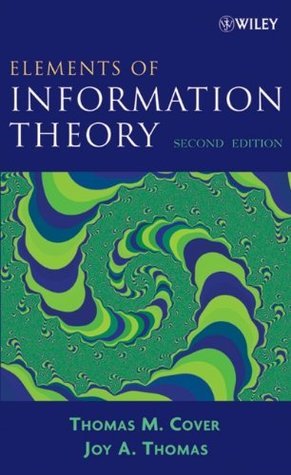
The latest edition of this classic is updated with new problem sets and material The Second Edition of this fundamental textbook maintains the book's tradition of clear, thought-provoking instruction. Readers are provided once again with an instructive mix of mathematics, physics, statistics, and information theory.All the essential topics in information theory are covered in detail, including entropy, data compression, channel capacity, rate distortion, network information theory, and hypothesis testing. The authors provide readers with a solid understanding of the underlying theory and applications. Problem sets and a telegraphic summary at the end of each chapter further assist readers. The historical notes that follow each chapter recap the main points.The Second Edition features: * Chapters reorganized to improve teaching * 200 new problems * New material on source coding, portfolio theory, and feedback capacity * Updated referencesNow current and enhanced, the Second Edition of Elements of Information Theory remains the ideal textbook for upper-level undergraduate and graduate courses in electrical engineering, statistics, and telecommunications.

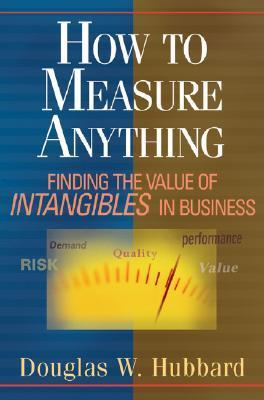
Praise for How to Measure Finding the Value of Intangibles in Business"I love this book. Douglas Hubbard helps us create a path to know the answer to almost any question in business, in science, or in life . . . Hubbard helps us by showing us that when we seek metrics to solve problems, we are really trying to know something better than we know it now. How to Measure Anything provides just the tools most of us need to measure anything better, to gain that insight, to make progress, and to succeed."-Peter Tippett, PhD, M.D.Chief Technology Officer at CyberTrustand inventor of the first antivirus software"Doug Hubbard has provided an easy-to-read, demystifying explanation of how managers can inform themselves to make less risky, more profitable business decisions. We encourage our clients to try his powerful, practical techniques."-Peter SchayEVP and COO ofThe Advisory Council"As a reader you soon realize that actually everything can be measured while learning how to measure only what matters. This book cuts through conventional clichés and business rhetoric and offers practical steps to using measurements as a tool for better decision making. Hubbard bridges the gaps to make college statistics relevant and valuable for business decisions."-Ray GilbertEVP Lucent"This book is remarkable in its range of measurement applications and its clarity of style. A must-read for every professional who has ever exclaimed, 'Sure, that concept is important, but can we measure it?'"-Dr. Jack StennerCofounder and CEO of MetraMetrics, Inc.

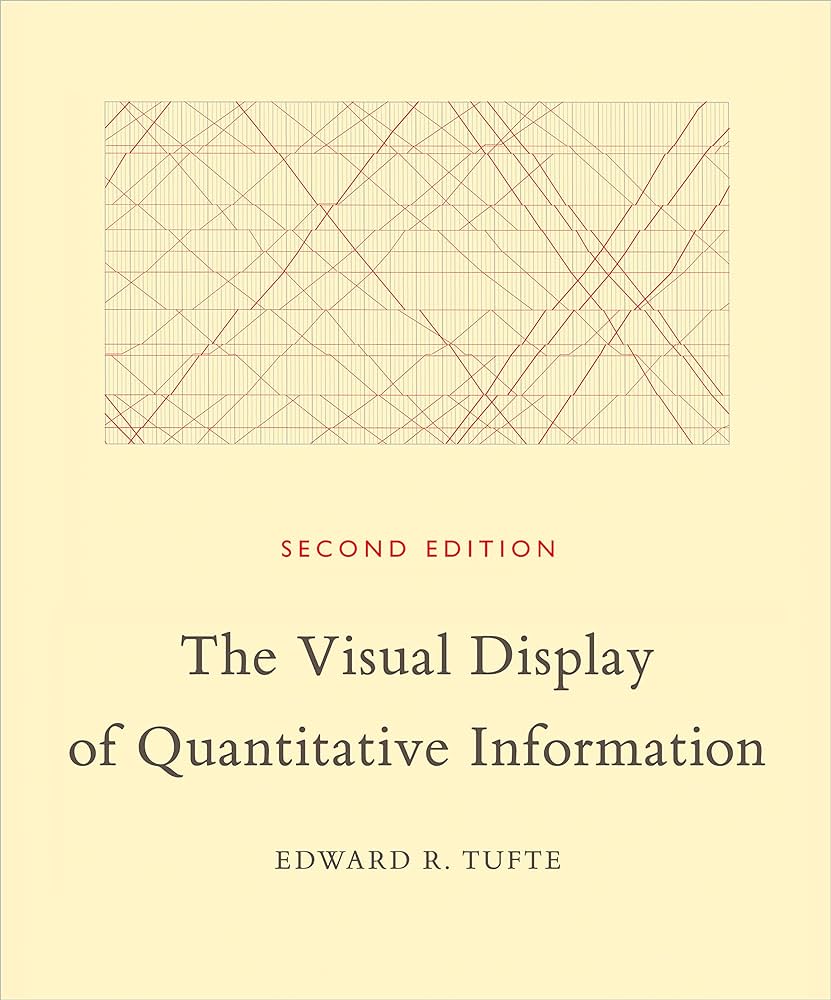
The classic book on statistical graphics, charts, tables. Theory and practice in the design of data graphics, 250 illustrations of the best (and a few of the worst) statistical graphics, with detailed analysis of how to display data for precise, effective, quick analysis. Design of the high-resolution displays, small multiples. Editing and improving graphics. The data-ink ratio. Time-series, relational graphics, data maps, multivariate designs. Detection of graphical deception: design variation vs. data variation. Sources of deception. Aesthetics and data graphical displays. This is the second edition of The Visual Display of Quantitative Information. Recently published, this new edition provides excellent color reproductions of the many graphics of William Playfair, adds color to other images, and includes all the changes and corrections accumulated during 17 printings of the first edition.

Benoit B. Mandelbrot, one of the century's most influential mathematicians, is world-famous for making mathematical sense of a fact everybody knows but that geometers from Euclid on down had never Clouds are not round, mountains are not cones, coastlines are not smooth. To these classic lines we can now add another Markets are not the safe bet your broker may claim. In his first book for a general audience, Mandelbrot, with co-author Richard L. Hudson, shows how the dominant way of thinking about the behavior of markets-a set of mathematical assumptions a century old and still learned by every MBA and financier in the world-simply does not work. As he did for the physical world in his classic The Fractal Geometry of Nature , Mandelbrot here uses fractal geometry to propose a new, more accurate way of describing market behavior. The complex gyrations of IBM's stock price and the dollar-euro exchange rate can now be reduced to straightforward formulae that yield a far better model of how risky they are. With his fractal tools, Mandelbrot has gotten to the bottom of how financial markets really work, and in doing so, he describes the volatile, dangerous (and strangely beautiful) properties that financial experts have never before accounted for. The result is no less than the foundation for a new science of finance.

This is a one-of-a-kind reference for anyone with a serious interest in mathematics. Edited by Timothy Gowers, a recipient of the Fields Medal, it presents nearly two hundred entries, written especially for this book by some of the world's leading mathematicians, that introduce basic mathematical tools and vocabulary; trace the development of modern mathematics; explain essential terms and concepts; examine core ideas in major areas of mathematics; describe the achievements of scores of famous mathematicians; explore the impact of mathematics on other disciplines such as biology, finance, and musi—and much, much more.Unparalleled in its depth of coverage, The Princeton Companion to Mathematics surveys the most active and exciting branches of pure mathematics. Accessible in style, this is an indispensable resource for undergraduate and graduate students in mathematics as well as for researchers and scholars seeking to understand areas outside their specialties.- Features nearly 200 entries, organized thematically and written by an international team of distinguished contributors- Presents major ideas and branches of pure mathematics in a clear, accessible style- Defines and explains important mathematical concepts, methods, theorems, and open problems- Introduces the language of mathematics and the goals of mathematical research- Covers number theory, algebra, analysis, geometry, logic, probability, and more- Traces the history and development of modern mathematics- Profiles more than ninety-five mathematicians who influenced those working today- Explores the influence of mathematics on other disciplines- Includes bibliographies, cross-references, and a comprehensive indexContributors include:Graham Allan, Noga Alon, George Andrews, Tom Archibald, Sir Michael Atiyah, David Aubin, Joan Bagaria, Keith Ball, June Barrow-Green, Alan Beardon, David D. Ben-Zvi, Vitaly Bergelson, Nicholas Bingham, Béla Bollobás, Henk Bos, Bodil Branner, Martin R. Bridson, John P. Burgess, Kevin Buzzard, Peter J. Cameron, Jean-Luc Chabert, Eugenia Cheng, Clifford C. Cocks, Alain Connes, Leo Corry, Wolfgang Coy, Tony Crilly, Serafina Cuomo, Mihalis Dafermos, Partha Dasgupta, Ingrid Daubechies, Joseph W. Dauben, John W. Dawson Jr., Francois de Gandt, Persi Diaconis, Jordan S. Ellenberg, Lawrence C. Evans, Florence Fasanelli, Anita Burdman Feferman, Solomon Feferman, Charles Fefferman, Della Fenster, José Ferreirós, David Fisher, Terry Gannon, A. Gardiner, Charles C. Gillispie, Oded Goldreich, Catherine Goldstein, Fernando Q. Gouvêa, Timothy Gowers, Andrew Granville, Ivor Grattan-Guinness, Jeremy Gray, Ben Green, Ian Grojnowski, Niccolò Guicciardini, Michael Harris, Ulf Hashagen, Nigel Higson, Andrew Hodges, F. E. A. Johnson, Mark Joshi, Kiran S. Kedlaya, Frank Kelly, Sergiu Klainerman, Jon Kleinberg, Israel Kleiner, Jacek Klinowski, Eberhard Knobloch, János Kollár, T. W. Körner, Michael Krivelevich, Peter D. Lax, Imre Leader, Jean-François Le Gall, W. B. R. Lickorish, Martin W. Liebeck, Jesper Lützen, Des MacHale, Alan L. Mackay, Shahn Majid, Lech Maligranda, David Marker, Jean Mawhin, Barry Mazur, Dusa McDuff, Colin McLarty, Bojan Mohar, Peter M. Neumann, Catherine Nolan, James Norris, Brian Osserman, Richard S. Palais, Marco Panza, Karen Hunger Parshall, Gabriel P. Paternain, Jeanne Peiffer, Carl Pomerance, Helmut Pulte, Bruce Reed, Michael C. Reed, Adrian Rice, Eleanor Robson, Igor Rodnianski, John Roe, Mark Ronan, Edward Sandifer, Tilman Sauer, Norbert Schappacher, Andrzej Schinzel, Erhard Scholz, Reinhard Siegmund-Schultze, Gordon Slade, David J. Spiegelhalter, Jacqueline Stedall, Arild Stubhaug, Madhu Sudan, Terence Tao, Jamie Tappenden, C. H. Taubes, Rüdiger Thiele, Burt Totaro, Lloyd N. Trefethen, Dirk van Dalen, Richard Weber, Dominic Welsh, Avi Wigderson, Herbert Wilf, David Wilkins, B. Yandell, Eric Zaslow, Doron Zeilberger

This book first covers exact and approximate analytical techniques (ordinary differential and difference equations, partial differential equations, variational principles, stochastic processes); numerical methods (finite differences for ODE's and PDE's, finite elements, cellular automata); model inference based on observations (function fitting, data transforms, network architectures, search techniques, density estimation); as well as the special role of time in modeling (filtering and state estimation, hidden Markov processes, linear and nonlinear time series). Each of the topics in the book would be the worthy subject of a dedicated text, but only by presenting the material in this way is it possible to make so much material accessible to so many people. Each chapter presents a concise summary of the core results in an area, providing an orientation to what they can (and cannot) do, enough background to use them to solve typical problems, and pointers to access the literature for particular applications.

Famous the world over for the creative brilliance of his insights into the physical world, Nobel Prize-winning physicist Richard Feynman also possessed an extraordinary talent for explaining difficult concepts to the nonscientist. QED--the edited version of four lectures on quantum electrodynamics that Feynman gave to the general public at UCLA as part of the Alix G. Mautner Memorial Lecture series--is perhaps the best example of his ability to communicate both the substance and the spirit of science to the layperson.The focus, as the title suggests, is quantum electrodynamics (QED), the part of the quantum theory of fields that describes the interactions of the quanta of the electromagnetic field-light, X rays, gamma rays--with matter and those of charged particles with one another. By extending the formalism developed by Dirac in 1933, which related quantum and classical descriptions of the motion of particles, Feynman revolutionized the quantum mechanical understanding of the nature of particles and waves. And, by incorporating his own readily visualizable formulation of quantum mechanics, Feynman created a diagrammatic version of QED that made calculations much simpler and also provided visual insights into the mechanisms of quantum electrodynamic processes.In this book, using everyday language, spatial concepts, visualizations, and his renowned "Feynman diagrams" instead of advanced mathematics, Feynman successfully provides a definitive introduction to QED for a lay readership without any distortion of the basic science. Characterized by Feynman's famously original clarity and humor, this popular book on QED has not been equaled since its publication.

'A monumental achievement - one of the great scientific biographies.' Michael FraynThe Strangest Man is the Costa Biography Award-winning account of Paul Dirac, the famous physicist sometimes called the British Einstein. He was one of the leading pioneers of the greatest revolution in twentieth-century science: quantum mechanics. The youngest theoretician ever to win the Nobel Prize for Physics, he was also pathologically reticent, strangely literal-minded and legendarily unable to communicate or empathize. Through his greatest period of productivity, his postcards home contained only remarks about the weather.Based on a previously undiscovered archive of family papers, Graham Farmelo celebrates Dirac's massive scientific achievement while drawing a compassionate portrait of his life and work. Farmelo shows a man who, while hopelessly socially inept, could manage to love and sustain close friendship.The Strangest Man is an extraordinary and moving human story, as well as a study of one of the most exciting times in scientific history.'A wonderful book . . . Moving, sometimes comic, sometimes infinitely sad, and goes to the roots of what we mean by truth in science.' Lord Waldegrave, Daily Telegraph

An ex-Wall Street trader improved on Moneyball 's famed sabermetrics to place bets that would beat the Vegas odds on Major League Baseball games--with a 41 percent return in his first year. Trading Bases explains how he did it.After the fall of Lehman Brothers, Joe Peta needed a new employer. He found a new job in New York City but lost that, too, when an ambulance mowed him down as he crossed the street on foot. In search of a way to cheer himself up while he recuperated in a wheelchair, Peta started watching baseball again, as he had growing up. That's when inspiration hit: Why not apply his outstanding risk-analysis skills to improve on sabermetrics, the method made famous by Moneyball --and beat the only market in town, the Vegas betting line? Why not treat MLB like the S&P 500?In Trading Bases , Peta shows how to subtract luck--in particular "cluster luck," as he puts it--from a team's statistics to best predict how it will perform in the next game and over the whole season. His baseball "hedge fund" returned an astounding 41 percent in 2011-- with daily volatility similar to funds he used to trade for. Peta takes readers to the ballpark in San Francisco, trading floors and baseball bars in New York, and sports books in Vegas, all while tracing the progress of his wagers. Far from writing a dry, do-it-yourself guidebook, Peta weaves a story that is often humorous, and occasionally touching; the topic may be "Big Data" but it's as entertaining as a Bill Simmons column. Trading Bases is all about the love of critical reasoning, trading cultures, risk management, and baseball. And not necessarily in that order.

In 2010, French mathematician Cédric Villani received the Fields Medal, the most coveted prize in mathematics, in recognition of a proof which he devised with his close collaborator Clément Mouhot to explain one of the most surprising theories in classical physics. Birth of a Theorem is Villani’s own account of the years leading up to the award. It invites readers inside the mind of a great mathematician as he wrestles with the most important work of his career.But you don’t have to understand nonlinear Landau damping to love Birth of a Theorem. It doesn’t simplify or overexplain; rather, it invites readers into collaboration. Villani’s diaries, emails, and musings enmesh you in the process of discovery. You join him in unproductive lulls and late-night breakthroughs. You’re privy to the dining-hall conversations at the world’s greatest research institutions. Villani shares his favorite songs, his love of manga, and the imaginative stories he tells his children. In mathematics, as in any creative work, it is the thinker’s whole life that propels discovery—and with Birth of a Theorem, Cédric Villani welcomes you into his.

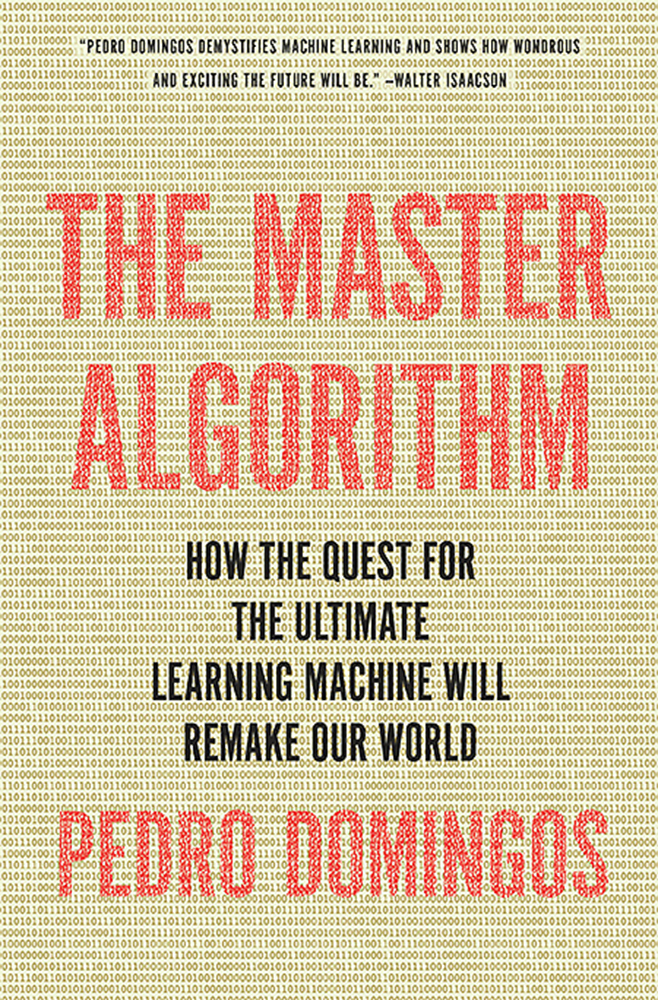
A thought-provoking and wide-ranging exploration of machine learning and the race to build computer intelligences as flexible as our ownIn the world's top research labs and universities, the race is on to invent the ultimate learning algorithm: one capable of discovering any knowledge from data, and doing anything we want, before we even ask. In The Master Algorithm , Pedro Domingos lifts the veil to give us a peek inside the learning machines that power Google, Amazon, and your smartphone. He assembles a blueprint for the future universal learner--the Master Algorithm--and discusses what it will mean for business, science, and society. If data-ism is today's philosophy, this book is its bible.

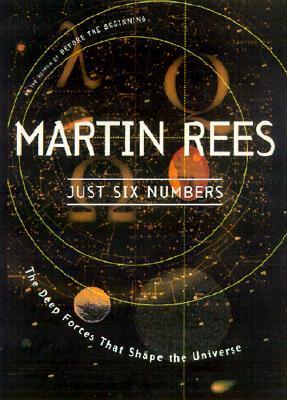
How did a single "genesis event" create billions of galaxies, black holes, stars and planets? How did atoms assemble -- here on earth, and perhaps on other worlds -- into living beings intricate enough to ponder their origins? What fundamental laws govern our universe?This book describes new discoveries and offers remarkable insights into these fundamental questions. There are deep connections between stars and atoms, between the cosmos and the microworld. Just six numbers, imprinted in the "big bang," determine the essential features of our entire physical world. Moreover, cosmic evolution is astonishingly sensitive to the values of these numbers. If any one of them were "untuned," there could be no stars and no life. This realization offers a radically new perspective on our universe, our place in it, and the nature of physical laws.

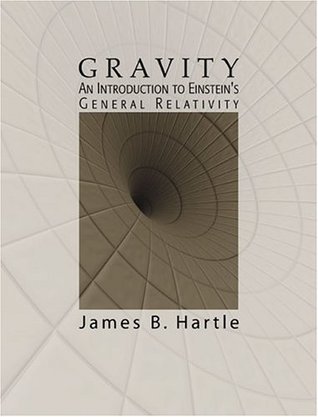
The aim of this groundbreaking new book is to bring general relativity into the undergraduate curriculum and make this fundamental theory accessible to all physics majors. Using a "physics first" approach to the subject, renowned relativist James B. Hartle provides a fluent and accessible introduction that uses a minimum of new mathematics and is illustrated with a wealth of exciting applications. The emphasis is on the exciting phenomena of gravitational physics and the growing connection between theory and observation. The Global Positioning System, black holes, X-ray sources, pulsars, quasars, gravitational waves, the Big Bang, and the large scale structure of the universe are used to illustrate the widespread role of how general relativity describes a wealth of everyday and exotic phenomena.

Called by some "the theory of everything," superstrings may solve a problem which has eluded physicists for the past 50 years -- the final unification of the two great theories of the twentieth century, general relativity and quantum field theory. This is a course-tested comprehensive introductory graduate text on superstrings which stresses the most current areas of interest, not covered in other presentation, including: string field theory, multi loops, Teichmueller spaces, conformal field theory, and four-dimensional strings. The book begins with a simple discussion of point particle theory, and uses the Feynman path integral technique to unify the presentation of superstrings. Prerequisites are an aquaintance with quantum mechanics and relativity. This second edition has been revised and updated throughout.

x^n + y^n = z^n, where n represents 3, 4, 5, ...no solution"I have discovered a truly marvelous demonstration of this proposition which this margin is too narrow to contain."With these words, the seventeenth-century French mathematician Pierre de Fermat threw down the gauntlet to future generations. What came to be known as Fermat's Last Theorem looked simple; proving it, however, became the Holy Grail of mathematics, baffling its finest minds for more than 350 years. In Fermat's Enigma--based on the author's award-winning documentary film, which aired on PBS's "Nova"--Simon Singh tells the astonishingly entertaining story of the pursuit of that grail, and the lives that were devoted to, sacrificed for, and saved by it. Here is a mesmerizing tale of heartbreak and mastery that will forever change your feelings about mathematics.

Einstein's General Theory of Relativity leads to two remarkable predictions: first, that the ultimate destiny of many massive stars is to undergo gravitational collapse and to disappear from view, leaving behind a 'black hole' in space; and secondly, that there will exist singularities in space-time itself. These singularities are places where space-time begins or ends, and the presently known laws of physics break down. They will occur inside black holes, and in the past are what might be construed as the beginning of the universe. To show how these predictions arise, the authors discuss the General Theory of Relativity in the large. Starting with a precise formulation of the theory and an account of the necessary background of differential geometry, the significance of space-time curvature is discussed and the global properties of a number of exact solutions of Einstein's field equations are examined. The theory of the causal structure of a general space-time is developed, and is used to study black holes and to prove a number of theorems establishing the inevitability of singualarities under certain conditions. A discussion of the Cauchy problem for General Relativity is also included in this 1973 book.

"A gem…An unforgettable account of one of the great moments in the history of human thought." —Steven PinkerProbing the life and work of Kurt Gödel, Incompleteness indelibly portrays the tortured genius whose vision rocked the stability of mathematical reasoning—and brought him to the edge of madness.

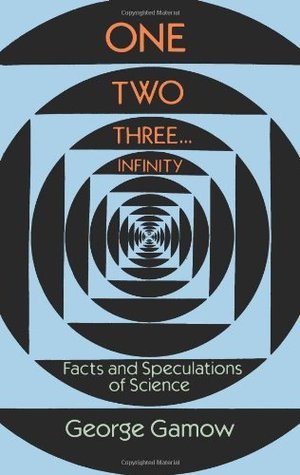
Whatever your level of scientific expertise, chances are you'll derive a great deal of pleasure, stimulation, and information from this unusual and imaginative book. It belongs in the library of anyone curious about the wonders of the scientific universe.One of the world's foremost nuclear physicists (celebrated for his theory of radioactive decay, among other accomplishments), George Gamow possessed the unique ability of making the world of science accessible to the general reader. He brings that ability to bear in this delightful expedition through the problems, pleasures, and puzzles of modern science.In the pages of this book readers grapple with such crucial matters as whether it is possible to bend space , why a rocket shrinks , the " end of the world problem ," excursions into the fourth dimension , and a host of other tantalizing topics for the scientifically curious Brimming with amusing anecdotes and provocative problems, One Two Three . . . Infinity also includes over 120 delightful pen-and-ink illustrations by the author , adding another dimension of good-natured charm to these wide-ranging explorations.". . . full of intellectual treats and tricks, of whimsy and deep scientific philosophy. It is highbrow entertainment at its best, a teasing challenge to all who aspire to think about the universe." — New York Herald TribuneDover publishes an impressive collection of popular science books including technology and invention, space and time, basic machines and computers, forces and fields, chaos, biographies of Einstein and Newton, and much more.

The first edition, published in 1973, has become a classic reference in the field. Now with the second edition, readers will find information on key new topics such as neural networks and statistical pattern recognition, the theory of machine learning, and the theory of invariances. Also included are worked examples, comparisons between different methods, extensive graphics, expanded exercises and computer project topics.An Instructor's Manual presenting detailed solutions to all the problems in the book is available from the Wiley editorial department.

The Ptolemaic system of the universe, with the earth at the center, had held sway since antiquity as authoritative in philosophy, science, and church teaching. Following his observations of the heavenly bodies, Nicolaus Copernicus (1473-1543) abandoned the geocentric system for a heliocentric model, with the sun at the center. His remarkable work, On the Revolutions of Heavenly Spheres, stands as one of the greatest intellectual revolutions of all time, and profoundly influenced, among others, Galileo and Sir Isaac Newton.

Anybody who is not shocked by quantum theory has not understood it. Niels Bohr's dictum bears witness to the bewildering impact of quantum theory, flying in the face of classical physics and dramatically transforming scientists' outlook on our relationship with the material world. In this book Paul Davies interviews eight physicists involved in debating and testing the theory, with radically different views of its significance.

Appropriate for senior and graduate level courses in Computer Science Theory, Automata, and Theory of Computation. This is the long awaited Second Edition of Lewis and Papadimitriou's best-selling theory of computation text. In this substantially modified edition, the authors have enhanced the clarity of their presentation by making the material more accessible to a broader undergraduate audience with no special mathematical experience.

Number is an eloquent, accessible tour de force that reveals how the concept of number evolved from prehistoric times through the twentieth century. Tobias Dantzig shows that the development of math—from the invention of counting to the discovery of infinity—is a profoundly human story that progressed by “trying and erring, by groping and stumbling.” He shows how commerce, war, and religion led to advances in math, and he recounts the stories of individuals whose breakthroughs expanded the concept of number and created the mathematics that we know today.

During the past decade there has been an explosion in computation and information technology. With it has come vast amounts of data in a variety of fields such as medicine, biology, finance, and marketing. The challenge of understanding these data has led to the development of new tools in the field of statistics, and spawned new areas such as data mining, machine learning, and bioinformatics. Many of these tools have common underpinnings but are often expressed with different terminology. This book describes the important ideas in these areas in a common conceptual framework. While the approach is statistical, the emphasis is on concepts rather than mathematics. Many examples are given, with a liberal use of color graphics. It should be a valuable resource for statisticians and anyone interested in data mining in science or industry. The book's coverage is broad, from supervised learning (prediction) to unsupervised learning. The many topics include neural networks, support vector machines, classification trees and boosting—the first comprehensive treatment of this topic in any book. Trevor Hastie, Robert Tibshirani, and Jerome Friedman are professors of statistics at Stanford University. They are prominent researchers in this area: Hastie and Tibshirani developed generalized additive models and wrote a popular book of that title. Hastie wrote much of the statistical modeling software in S-PLUS and invented principal curves and surfaces. Tibshirani proposed the Lasso and is co-author of the very successful An Introduction to the Bootstrap. Friedman is the co-inventor of many data-mining tools including CART, MARS, and projection pursuit.

FROM THE Please do NOT buy this original 1997 edition! I have created a new, greatly improved (and cheaper!) edition, which was published on February 28th, 2023:Visual Complex 25th Anniversary Edition (with a new Foreword by Roger Penrose)**************************************************************************************************This radical first course on complex analysis brings a beautiful and powerful subject to life by consistently using geometry (not calculation) as the means of explanation. Aimed at undergraduate students in mathematics, physics, and engineering, the book's intuitive explanations, lack of advanced prerequisites, and consciously user-friendly prose style will help students to master the subject more readily than was previously possible. The key to this is the book's use of new geometric arguments in place of the standard calculational ones. These geometric arguments are communicated with the aid of hundreds of diagrams of a standard seldom encountered in mathematical works. A new approach to a classical topic, this work will be of interest to students in mathematics, physics, and engineering, as well as to professionals in these fields.

A leading physicist delves into relativity and experimental applicationsGravitation and Cosmology: Principles and Applications of the General Theory of Relativity offers a Nobel laureate's perspectives on the wealth of data technological developments have brought to expand upon Einstein's theory. Unique in basing relativity on the Principle of Equivalence of Gravitation and Inertia over Riemannian geometry, this book explores relativity experiments and observational cosmology to provide a sound foundation upon which analyses can be made. Covering special and general relativity, tensor analysis, gravitation, curvature, and more, this book provides an engaging, insightful introduction to the forces that shape the universe.

The preeminent explicator of mathematical logic to non-mathematicians, John Allen Paulos is familiar to general readers not only from his bestselling books but also from his media appearances, including The David Letterman Show and National Public Radio's "Talk of the Nation" and "Science Friday," as well as articles in Newsweek, Nature, Discover, Business Week, the New York Times Book Review, The Nation, New York Review of Books, and The London Review of Books.Paulos originally wrote this charming little book on analytic logic, its mathematics, and its puzzles in 1985. And as in his later books, he uses jokes, stories, parables, and anecdotes to elucidate difficult concepts, in this case, some of the fundamental problems in modern philosophy.

A Guide to Econometrics has established itself as the first-choice text for teachers and students throughout the world who require an intuitive introduction to the subject without the notation and technical detail that characterize most textbooks. This overview has enabled students to make sense more easily of what instruct

This informally written text provides students with a clear introduction into the subject of linear algebra. Topics covered include matrix multiplication, row reduction, matrix inverse, orthogonality and computation. The self-teaching book is loaded with examples and graphics and provides a wide array of probing problems, accompanying solutions, and a glossary. Chapter 1: Introduction to Vectors; Chapter 2: Solving Linear Equations; Chapter 3: Vector Spaces and Subspaces; Chapter 4: Orthogonality; Chapter 5: Determinants; Chapter 6: Eigenvalues and Eigenvectors; Chapter 7: Linear Transformations; Chapter 8: Applications; Chapter 9: Numerical Linear Algebra; Chapter 10: Complex Vectors and Matrices; Solutions to Selected Exercises; Final Exam. Matrix Factorizations. Conceptual Questions for Review. Glossary: A Dictionary for Linear Algebra Index Teaching Codes Linear Algebra in a Nutshell.

Hofstadter's collection of quirky essays is unified by its primary concern: to examine the way people perceive and think.
![The Whole Shebang: A State-of-the-Universe[s] Report](https://m.media-amazon.com/images/S/compressed.photo.goodreads.com/books/1347278841i/310330.jpg)
From the prizewinning author who has been called "the greatest science writer in the world" comes this delightfully comprehensive and comprehensible report on how science today envisions the universe as a whole. Timothy Ferris provides a clear, elegantly written overview of current research and a forecast of where cosmological theory is likely to go in the twenty-first century. He explores the questions that have occurred to even casual readers -- who are curious about nature on the largest scales: What does it mean to say that the universe is "expanding," or that space is "curved"? -- and sheds light on the possibility that our universe is only one among many universes, each with its own physical laws and prospects for the emergence of life.

ONAG, as the book is commonly known, is one of those rare publications that sprang to life in a moment of creative energy and has remained influential for over a quarter of a century. Originally written to define the relation between the theories of transfinite numbers and mathematical games, the resulting work is a mathematically sophisticated but eminently enjoyable guide to game theory. By defining numbers as the strengths of positions in certain games, the author arrives at a new class, the surreal numbers, that includes both real numbers and ordinal numbers. These surreal numbers are applied in the author's mathematical analysis of game strategies. The additions to the Second Edition present recent developments in the area of mathematical game theory, with a concentration on surreal numbers and the additive theory of partizan games.

This textbook takes an innovative approach to the teaching of classical mechanics, emphasizing the development of general but practical intellectual tools to support the analysis of nonlinear Hamiltonian systems. The development is organized around a progressively more sophisticated analysis of particular natural systems and weaves examples throughout the presentation. Explorations of phenomena such as transitions to chaos, nonlinear resonances, and resonance overlap to help the student to develop appropriate analytic tools for understanding. Computational algorithms communicate methods used in the analysis of dynamical phenomena. Expressing the methods of mechanics in a computer language forces them to be unambiguous and computationally effective. Once formalized as a procedure, a mathematical idea also becomes a tool that can be used directly to compute results.The student actively explores the motion of systems through computer simulation and experiment. This active exploration is extended to the mathematics. The requirement that the computer be able to interpret any expression provides strict and immediate feedback as to whether an expression is correctly formulated. The interaction with the computer uncovers and corrects many deficiencies in understanding.

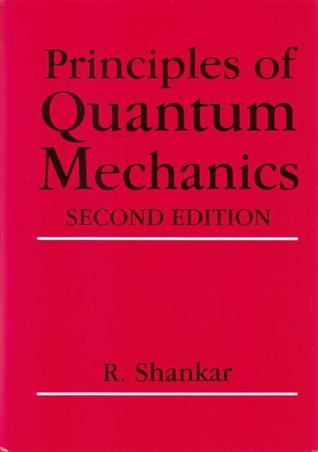
Reviews from the First Edition:"An excellent text ... The postulates of quantum mechanics and the mathematical underpinnings are discussed in a clear, succinct manner." (American Scientist)"No matter how gently one introduces students to the concept of Dirac's bras and kets, many are turned off. Shankar attacks the problem head-on in the first chapter, and in a very informal style suggests that there is nothing to be frightened of." (Physics Bulletin)Reviews of the Second Edition:"This massive text of 700 and odd pages has indeed an excellent get-up, is very verbal and expressive, and has extensively worked out calculational details---all just right for a first course. The style is conversational, more like a corridor talk or lecture notes, though arranged as a text. ... It would be particularly useful to beginning students and those in allied areas like quantum chemistry." (Mathematical Reviews)R. Shankar has introduced major additions and updated key presentations in this second edition of Principles of Quantum Mechanics. New features of this innovative text include an entirely rewritten mathematical introduction, a discussion of Time-reversal invariance, and extensive coverage of a variety of path integrals and their applications. Additional highlights include:- Clear, accessible treatment of underlying mathematics- A review of Newtonian, Lagrangian, and Hamiltonian mechanics- Student understanding of quantum theory is enhanced by separate treatment of mathematical theorems and physical postulates- Unsurpassed coverage of path integrals and their relevance in contemporary physicsThe requisite text for advanced undergraduate- and graduate-level students, Principles of Quantum Mechanics, Second Edition is fully referenced and is supported by many exercises and solutions. The book's self-contained chapters also make it suitable for independent study as well as for courses in applied disciplines.

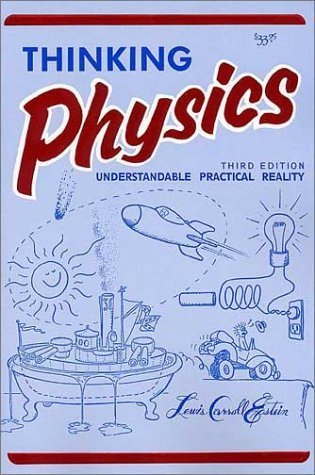
Lewis Carroll Epstein explains deep ideas in physics in an easy-to-understand way. Thinking Physics is a perfect beginner’s guide to an amazingly wide range of physics-related questions. The book targets topics that science teachers and students spend time wondering about, like wing lift. Epstein elucidates the familiar but misunderstood — such as how tides work — along with more obscure but fascinating phenomena like the “Bernoulli sub” and the “artificial aurora” created by hydrogen bombs. Broken into many short sections and peppered with Epstein’s own playful hand-drawn illustrations, the book does not simply give the right answer: It also goes into the answers that seem right but are wrong and shows why they are wrong — a rarity in science books. Thinking Physics is a rigorously correct, lighthearted, and cleverly designed Q and A book for physicists of all ages.

Most people are baffled by how computers work and assume that they will never understand them. What they don't realize—and what Daniel Hillis's short book brilliantly demonstrates—is that computers' seemingly complex operations can be broken down into a few simple parts that perform the same simple procedures over and over again.Computer wizard Hillis offers an easy-to-follow explanation of how data is processed that makes the operations of a computer seem as straightforward as those of a bicycle. Avoiding technobabble or discussions of advanced hardware, the lucid explanations and colorful anecdotes in The Pattern on the Stone go straight to the heart of what computers really do.Hillis proceeds from an outline of basic logic to clear descriptions of programming languages, algorithms, and memory. He then takes readers in simple steps up to the most exciting developments in computing today—quantum computing, parallel computing, neural networks, and self-organizing systems.Written clearly and succinctly by one of the world's leading computer scientists, The Pattern on the Stone is an indispensable guide to understanding the workings of that most ubiquitous and important of machines: the computer.

From terrorist attacks to big money jackpots, Struck by Lightning deconstructs the odds and oddities of chance, examining both the relevant and irreverent role of randomness in our everyday lives. Human beings have long been both fascinated and appalled by randomness. On the one hand, we love the thrill of a surprise party, the unpredictability of a budding romance, or the freedom of not knowing what tomorrow will bring. We are inexplicably delighted by strange coincidences and striking similarities. But we also hate uncertainty's dark side. From cancer to SARS, diseases strike with no apparent pattern. Terrorists attack, airplanes crash, bridges collapse, and we never know if we'll be that one in a million statistic. We are all constantly faced with situations and choices that involve randomness and uncertainty. A basic understanding of the rules of probability theory, applied to real-life circumstances, can help us to make sense of these situations, to avoid unnecessary fear, to seize the opportunities that randomness presents to us, and to actually enjoy the uncertainties we face. The reality is that when it comes to randomness, you can run, but you can't hide. So many aspects of our lives are governed by events that are simply not in our control. In this entertaining yet sophisticated look at the world of probabilities, author Jeffrey Rosenthal-an improbably talented math professor-explains the mechanics of randomness and teaches us how to develop an informed perspective on probability.

When J. D. Williams wrote this entertaining, witty introduction for the nonscientist, game theory was still a somewhat mysterious subject familiar to very few scientists beyond those researchers, like himself, working for the military. Now, over thirty years after its original publication as a Rand Corporation research study, his light-hearted though thoroughly effective primer is the recognized classic introduction to an increasingly applicable discipline. Used by amateurs, professionals, and students throughout the world in the classroom, on the job, and for personal amusement, the book has been through ten printings, and has been translated into at least five languages (including Russian and Japanese).Revised, updated, and available for the first time in an inexpensive paperback edition, The Compleat Strategyst is a highly entertaining text essential for anyone interested in this provocative and engaging area of modern mathematics. In fully illustrated chapters complete with everyday examples and word problems, Williams offers readers a working understanding of the possible methods for selecting strategies in a variety of situations, simple to complex. With just a basic understanding of arithmetic, anyone can grasp all necessary aspects of two-, three-, four-, and larger strategy games with two or more sets of inimical interests and a limitless array of zero-sum payoffs.As research and study continues not only in this new discipline but in the related areas of statistics, probability and behavioral science, understanding of games, decision making, and the development of strategies will be increasingly important. In the areas of economics, sociology, politics, and the military, game theory is sure to have an even wider impact. For students and amateurs fascinated by game theory's implications there is no better, immediately applicable, or more entertaining introduction to the subject than this engaging text by the late J. D. Williams, Professor of Mathematics at Princeton University and a member of the Research Council of The Rand Corporation.

A major scientific revolution has begun, a new paradigm that rivals Darwin's theory in importance. At its heart is the discovery of the order that lies deep within the most complex of systems, from the origin of life, to the workings of giant corporations, to the rise and fall of great civilizations. And more than anyone else, this revolution is the work of one man, Stuart Kauffman, a MacArthur Fellow and visionary pioneer of the new science of complexity. Now, in At Home in the Universe , Kauffman brilliantly weaves together the excitement of intellectual discovery and a fertile mix of insights to give the general reader a fascinating look at this new science--and at the forces for order that lie at the edge of chaos.We all know of instances of spontaneous order in nature--an oil droplet in water forms a sphere, snowflakes have a six-fold symmetry. What we are only now discovering, Kauffman says, is that the range of spontaneous order is enormously greater than we had supposed. Indeed, self-organization is a great undiscovered principle of nature. But how does this spontaneous order arise? Kauffman contends that complexity itself triggers self-organization, or what he calls "order for free," that if enough different molecules pass a certain threshold of complexity, they begin to self-organize into a new entity--a living cell. Kauffman uses the analogy of a thousand buttons on a rug--join two buttons randomly with thread, then another two, and so on. At first, you have isolated pairs; later, small clusters; but suddenly at around the 500th repetition, a remarkable transformation occurs--much like the phase transition when water abruptly turns to ice--and the buttons link up in one giant network.Likewise, life may have originated when the mix of different molecules in the primordial soup passed a certain level of complexity and self-organized into living entities (if so, then life is not a highly improbable chance event, but almost inevitable). Kauffman uses the basic insight of "order for free" to illuminate a staggering range of phenomena. We see how a single-celled embryo can grow to a highly complex organism with over two hundred different cell types. We learn how the science of complexity extends Darwin's theory of evolution by natural that self-organization, selection, and chance are the engines of the biosphere. And we gain insights into biotechnology, the stunning magic of the new frontier of genetic engineering--generating trillions of novel molecules to find new drugs, vaccines, enzymes, biosensors, and more. Indeed, Kauffman shows that ecosystems, economic systems, and even cultural systems may all evolve according to similar general laws, that tissuesand terra cotta evolve in similar ways. And finally, there is a profoundly spiritual element to Kauffman's thought. If, as he argues, life were bound to arise, not as an incalculably improbable accident, but as an expected fulfillment of the natural order, then we truly are at home in the universe.Kauffman's earlier volume, The Origins of Order , written for specialists, received lavish praise. Stephen Jay Gould called it "a landmark and a classic." And Nobel Laureate Philip Anderson wrote that "there are few people in this world who ever ask the right questions of science, and they are the ones who affect its future most profoundly. Stuart Kauffman is one of these." In At Home in the Universe , this visionary thinker takes you along as he explores new insights into the nature of life.

Man has within a single generation found himself sharing the world with a strange new the computers and computer-like machines. Neither history, nor philosophy, nor common sense will tell us how these machines will affect us, for they do not do "work" as did machines of the Industrial Revolution. Instead of dealing with materials or energy, we are told that they handle "control" and "information" and even "intellectual processes." There are very few individuals today who doubt that the computer and its relatives are developing rapidly in capability and complexity, and that these machines are destined to play important (though not as yet fully understood) roles in society's future. Though only some of us deal directly with computers, all of us are falling under the shadow of their ever-growing sphere of influence, and thus we all need to understand their capabilities and their limitations. It would indeed be reassuring to have a book that categorically and systematically described what all these machines can do and what they cannot do, giving sound theoretical or practical grounds for each judgment. However, although some books have purported to do this, it cannot be done for the following a) Computer-like devices are utterly unlike anything which science has ever considered---we still lack the tools necessary to fully analyze, synthesize, or even think about them; and b) The methods discovered so far are effective in certain areas, but are developing much too rapidly to allow a useful interpretation and interpolation of results. The abstract theory---as described in this book---tells us in no uncertain terms that the machines' potential range is enormous, and that its theoretical limitations are of the subtlest and most elusive sort. There is no reason to suppose machines have any limitations not shared by man.

This little book is especially concerned with those portions of ”advanced calculus” in which the subtlety of the concepts and methods makes rigor difficult to attain at an elementary level. The approach taken here uses elementary versions of modern methods found in sophisticated mathematics. The formal prerequisites include only a term of linear algebra, a nodding acquaintance with the notation of set theory, and a respectable first-year calculus course (one which at least mentions the least upper bound (sup) and greatest lower bound (inf) of a set of real numbers). Beyond this a certain (perhaps latent) rapport with abstract mathematics will be found almost essential.

“If you liked Chaos, you’ll love Complexity. Waldrop creates the most exciting intellectual adventure story of the year” (The Washington Post). In a rarified world of scientific research, a revolution has been brewing. Its activists are not anarchists, but rather Nobel Laureates in physics and economics and pony-tailed graduates, mathematicians, and computer scientists from all over the world. They have formed an iconoclastic think-tank and their radical idea is to create a new science: complexity. They want to know how a primordial soup of simple molecules managed to turn itself into the first living cell—and what the origin of life some four billion years ago can tell us about the process of technological innovation today. This book is their story—the story of how they have tried to forge what they like to call the science of the twenty-first century. “Lucidly shows physicists, biologists, computer scientists and economists swapping metaphors and reveling in the sense that epochal discoveries are just around the corner . . . [Waldrop] has a special talent for relaying the exhilaration of moments of intellectual insight.” —The New York Times Book Review “Where I enjoyed the book was when it dove into the actual question of complexity, talking about complex systems in economics, biology, genetics, computer modeling, and so on. Snippets of rare beauty here and there almost took your breath away.” —Medium “[Waldrop] provides a good grounding of what may indeed be the first flowering of a new science.” —Publishers Weekly

Q.E.D. presents some of the most famous mathematical proofs in a charming book that will appeal to nonmathematicians and math experts alike. Grasp in an instant why Pythagoras's theorem must be correct. Follow the ancient Chinese proof of the volume formula for the frustrating frustum, and Archimedes' method for finding the volume of a sphere. Discover the secrets of pi and why, contrary to popular belief, squaring the circle really is possible. Study the subtle art of mathematical domino tumbling, and find out how slicing cones helped save a city and put a man on the moon.

Western Europeans were among the first, if not the first, to invent mechanical clocks, geometrically precise maps, double-entry bookkeeping, precise algebraic and musical notations, and perspective painting. More people in Western Europe thought quantitatively in the sixteenth century than in any other part of the world, enabling them to become the world's leaders. With amusing detail and historical anecdote, Alfred Crosby discusses the shift from qualitative to quantitative perception that occurred during the late Middle Ages and Renaissance. Alfred W. Crosby is the author of five books, including the award-winning Ecological Imperialism: The Biological Expansion of Europe, 900-1900 (Cambridge, 1986)

The modern approach of this text recognizes that econometrics has moved from a specialized mathematical description of economics to an applied interpretation based on empirical research techniques. It bridges the gap between the mechanics of econometrics and modern applications of econometrics by employing a systematic approach motivated by the major problems facing applied researchers today. Throughout the text, the emphasis on examples gives a concrete reality to economic relationships and allows treatment of interesting policy questions in a realistic and accessible framework.

". . . Nothing less than a major contribution to the scientific culture of this world." — The New York Times Book ReviewThis major survey of mathematics, featuring the work of 18 outstanding Russian mathematicians and including material on both elementary and advanced levels, encompasses 20 prime subject areas in mathematics in terms of their simple origins and their subsequent sophisticated developement. As Professor Morris Kline of New York University noted, "This unique work presents the amazing panorama of mathematics proper. It is the best answer in print to what mathematics contains both on the elementary and advanced levels."Beginning with an overview and analysis of mathematics, the first of three major divisions of the book progresses to an exploration of analytic geometry, algebra, and ordinary differential equations. The second part introduces partial differential equations, along with theories of curves and surfaces, the calculus of variations, and functions of a complex variable. It furthur examines prime numbers, the theory of probability, approximations, and the role of computers in mathematics. The theory of functions of a real variable opens the final section, followed by discussions of linear algebra and nonEuclidian geometry, topology, functional analysis, and groups and other algebraic systems.Thorough, coherent explanations of each topic are further augumented by numerous illustrative figures, and every chapter concludes with a suggested reading list. Formerly issued as a three-volume set, this mathematical masterpiece is now available in a convenient and modestly priced one-volume edition, perfect for study or reference."This is a masterful English translation of a stupendous and formidable mathematical masterpiece . . ." — Social Science

Ptolemy's Almagest is one of the most influential scientific works in history. A masterpiece of technical exposition, it was the basic textbook of astronomy for more than a thousand years, and still is the main source for our knowledge of ancient astronomy. This translation, based on the standard Greek text of Heiberg, makes the work accessible to English readers in an intelligible and reliable form. It contains numerous corrections derived from medieval Arabic translations and extensive footnotes that take account of the great progress in understanding the work made in this century, due to the discovery of Babylonian records and other researches. It is designed to stand by itself as an interpretation of the original, but it will also be useful as an aid to reading the Greek text.

Brand New International Paper-back Edition Same as per description, **Economy edition, May have been printed in Asia with cover stating Not for sale in US. Legal to use despite any disclaimer on cover. Save Money. Contact us for any queries. Best Customer Support! All Orders shipped with Tracking Number

Kurt Goouml;del's Incompleteness Theorems sent shivers through Vienna's intellectual circles and directly challenged Ludwig Wittgenstein's dominant philosophy. AlanTuring's mathematical genius helped him break the Nazi Enigma Code during WWII. Though they never met, their lives strangely mirrored one another-both were brilliant, and both met with tragic ends.Here, a mysterious narrator intertwines these parallel lives into a double helix of genius and anguish, wonderfully capturing not only two radiant, fragile minds but also the zeitgeist of theera. "From the Trade Paperback edition."

The magnificent, unrivaled history of codes and ciphers—how they're made, how they're broken, and the many and fascinating roles they've played since the dawn of civilization in war, business, diplomacy, and espionage—updated with a new chapter on computer cryptography and the Ultra secret.Man has created codes to keep secrets and has broken codes to learn those secrets since the time of the Pharaohs. For 4,000 years, fierce battles have been waged between codemakers and codebreakers, and the story of these battles is civilization's secret history, the hidden account of how wars were won and lost, diplomatic intrigues foiled, business secrets stolen, governments ruined, computers hacked. From the XYZ Affair to the Dreyfus Affair, from the Gallic War to the Persian Gulf, from Druidic runes and the kaballah to outer space, from the Zimmermann telegram to Enigma to the Manhattan Project, codebreaking has shaped the course of human events to an extent beyond any easy reckoning. Once a government monopoly, cryptology today touches everybody. It secures the Internet, keeps e-mail private, maintains the integrity of cash machine transactions, and scrambles TV signals on unpaid-for channels. David Kahn's The Codebreakers takes the measure of what codes and codebreaking have meant in human history in a single comprehensive account, astonishing in its scope and enthralling in its execution. Hailed upon first publication as a book likely to become the definitive work of its kind, The Codebreakers has more than lived up to that it remains unsurpassed. With a brilliant new chapter that makes use of previously classified documents to bring the book thoroughly up to date, and to explore the myriad ways computer codes and their hackers are changing all of our lives, The Codebreakers is the skeleton key to a thousand thrilling true stories of intrigue, mystery, and adventure. It is a masterpiece of the historian's art.

In the 1930s, physics was in a crisis. There appeared to be no way to reconcile the new theory of quantum mechanics with Einstein's theory of relativity. Several approaches had been tried and had failed. In the post-World War II period, four eminent physicists rose to the challenge and developed a calculable version of quantum electrodynamics (QED), probably the most successful theory in physics. This formulation of QED was pioneered by Freeman Dyson, Richard Feynman, Julian Schwinger, and Sin-Itiro Tomonaga, three of whom won the Nobel Prize for their work. In this book, physicist and historian Silvan Schweber tells the story of these four physicists, blending discussions of their scientific work with fascinating biographical sketches.Setting the achievements of these four men in context, Schweber begins with an account of the early work done by physicists such as Dirac and Jordan, and describes the gathering of eminent theorists at Shelter Island in 1947, the meeting that heralded the new era of QED. The rest of his narrative comprises individual biographies of the four physicists, discussions of their major contributions, and the story of the scientific community in which they worked. Throughout, Schweber draws on his technical expertise to offer a lively and lucid explanation of how this theory was finally established as the appropriate way to describe the atomic and subatomic realms.

Over the past two decades, no field of scientific inquiry has had a more striking impact across a wide array of disciplines–from biology to physics, computing to meteorology–than that known as chaos and complexity, the study of complex systems. Now astrophysicist John Gribbin draws on his expertise to explore, in prose that communicates not only the wonder but the substance of cutting-edge science, the principles behind chaos and complexity. He reveals the remarkable ways these two revolutionary theories have been applied over the last twenty years to explain all sorts of phenomena–from weather patterns to mass extinctions.Grounding these paradigm-shifting ideas in their historical context, Gribbin also traces their development from Newton to Darwin to Lorenz, Prigogine, and Lovelock, demonstrating how–far from overturning all that has gone before–chaos and complexity are the triumphant extensions of simple scientific laws. Ultimately, Gribbin illustrates how chaos and complexity permeate the universe on every scale, governing the evolution of life and galaxies alike.

This landmark text offers a rigorous full-year graduate level course on gravitation physics, teaching students • Grasp the laws of physics in flat spacetime• Predict orders of magnitude• Calculate using the principal tools of modern geometry• Predict all levels of precision• Understand Einstein's geometric framework for physics• Explore applications, including pulsars and neutron stars, cosmology, the Schwarzschild geometry and gravitational collapse, and gravitational waves• Probe experimental tests of Einstein's theory• Tackle advanced topics such as superspace and quantum geometrodynamicsThe book offers a unique, alternating two-track pathway through the • In many chapters, material focusing on basic physical ideas is designated asTrack 1 . These sections together make an appropriate one-term advanced/graduate level course (mathematical vector analysis and simple partial-differential equations). The book is printed to make it easy for readers to identify these sections.• The remaining Track 2 material provides a wealth of advanced topics instructors can draw from to flesh out a two-term course, with Track 1 sections serving as prerequisites.

Six Easy Essentials of Physics Explained by Its Most Brilliant Teacher is a publishing first. This set couples a book containing the six easiest chapters from Richard P. Feynman's landmark work, Lectures on Physics —specifically designed for the general, non-scientist reader—with the actual recordings of the late, great physicist delivering the lectures on which the chapters are based. Nobel Laureate Feynman gave these lectures just once, to a group of Caltech undergraduates in 1961 and 1962, and these newly released recordings allow you to experience one of the Twentieth Century's greatest minds—as if you were right there in the classroom.

Over 100,000 copies of this spectacular journey have already been sold. In forty-two consecutive scenes, each at a different 'power of ten' level of magnification, readers are taken from the dimension of one billion light years to the realm of the atom. The text and other illustrations depict what we can perceive at each progressively smaller level of magnitude. "A brilliant pictorial and textual embodiment of a wonderful idea." Stephen Jay Gould Videos of Powers of Ten are available from: RITELtd. Cross Tree, Walton Street, Walton in Gordano, Clevedon, Avon BS21 7AW Tel: 01275-340279 Fax: 01275-340327

Calculus Made Easy by Silvanus P. Thompson and Martin Gardner has long been the most popular calculus primer.This major revision of the classic math text makes the subject at hand still more comprehensible to readers of all levels. With a new introduction, three new chapters, modernized language and methods throughout, and an appendix of challenging and enjoyable practice problems, Calculus Made Easy has been thoroughly updated for the modern reader.

Self-organized criticality, the spontaneous development of systems to a critical state, is the first general theory of complex systems with a firm mathematical basis. This theory describes how many seemingly desperate aspects of the world, from stock market crashes to mass extinctions, avalanches to solar flares, all share a set of simple, easily described properties."...a'must read'...Bak writes with such ease and lucidity, and his ideas are so intriguing...essential reading for those interested in complex systems...it will reward a sufficiently skeptical reader." -NATURE"...presents the theory (self-organized criticality) in a form easily absorbed by the non-mathematically inclined reader." -BOSTON BOOK REVIEW"I picture Bak as a kind of scientific musketeer; flamboyant, touchy, full of swagger and ready to join every fray... His book is written with panache. The style is brisk, the content stimulating. I recommend it as a bracing experience." -NEW SCIENTIST

The Book That Made Las Vegas Change the RulesOver 1,000,000 Copies in PrintEdward O. Thorp is the father of card counting, and in this classic guide he shares the revolutionary point system that has been successfully used by professional and amateur card players for generations. This book o an overview of the basic rules of the gameo proven winning strategies ranging from simple to advancedo methods to overcome casino counter measureso ways to spot cheating o charts and tables that clearly illustrate key conceptsA fascinating read and an indispensable resource for winning big, Beat the Dealer is the bible for players of this game of chance. **Bring these strategies into the Perforated cards included in the book**

The book offers step-by-step instructions, with explanatory, charts and tables, whereby anyone with 2000.00$ brokerage account can conduct his own investment program. Details are given of actual investments made by the authors, one of whom more then doubled $100,000 in five years.

This highly praised introductory treatment describes the parallels between statistical physics and finance - both those established in the 100-year long interaction between these disciplines, as well as new research results on financial markets. The random-walk technique, well known in physics, is also the basic model in finance, upon which are built, for example, the Black-Scholes theory of option pricing and hedging, plus methods of portfolio optimization. Here the underlying assumptions are assessed critically. Using empirical financial data and analogies to physical models such as fluid flows, turbulence, or superdiffusion, the book develops a more accurate description of financial markets based on random walks. With this approach, novel methods for derivative pricing and risk management can be formulated. Computer simulations of interacting-agent models provide insight into the mechanisms underlying unconventional price dynamics. It is shown that stock exchange crashes can be modelled in ways analogous to phase transitions and earthquakes, and sometimes have even been predicted successfully. This third edition of "The Statistical Mechanics of Financial Markets" especially stands apart from other treatments because it offers new chapters containing a practitioner's treatment of two important current topics in banking: the basic notions and tools of risk management and capital requirements for financial institutions, including an overview of the new Basel II capital framework which may well set the risk management standards in scores of countries for years to come.

In this book, the author convinces that Sir Arthur Stanley Eddington had things a little bit wrong, as least as far as physics is concerned. He explores the theory of groups and Lie algebras and their representations to use group representations as labor-saving tools.

"Still a joy to read." — Mathematical Gazette This classic by the famous mathematician defines the basic methodology and psychology of scientific discovery, particularly regarding mathematics and mathematical physics. Drawing on examples from many fields, it explains how scientists analyze and choose their working facts, and it explores the nature of experimentation, theory, and the mind. 1914 edition.

This is the first volume of a three-volume introduction to modern geometry which emphasizes applications to other areas of mathematics and theoretical physics. Topics covered include tensors and their differential calculus, the calculus of variations in one and several dimensions, and geometric field theory. This new edition offers substantial revisions, and the material is written in concrete language with terminology acceptable to physicists.

In the Messenger Lectures, originally delivered at Cornell University & recorded for TV by the BBC, Feynman offers an overview of selected physical laws & gathers their common features into one broad principle of invariance. He maintains at the outset that the importance of a physical law isn't "how clever we are to have found it out, but...how clever nature is to pay attention to it" & tends his discussions toward a final exposition of the elegance & simplicity of all scientific laws. Rather than an essay on the most significant achievements in modern science, The Character of Physical Law is a statement of what is most remarkable in nature. His enlightened approach, wit & enthusiasm make this a memorable exposition of the scientist's craft. The Law of Gravitation is the principal example. Relating the details of its discovery & stressing its mathematical character, he uses it to demonstrate the essential interaction of mathematics & physics. He views mathematics as the key to any system of scientific laws, suggesting that if it were possible to fill out the structure of scientific theory completely, the result would be an integrated set of axioms. The principles of conservation, symmetry & time-irreversibility are then considered in relation to developments in classical & modern physics. In his final lecture he develops his own analysis of the process & future of scientific discovery. Like any set of oral reflections, The Character of Physical Law has value as a demonstration of a mind in action. The reader is particularly lucky in Feynman. One of the most eminent & imaginative modern physicists, he was Professor of Theoretical Physics at the California Institute of Technology until his death in 1988. He's best known for work on the quantum theory of the electromagnetic field, as well as for later research in the field of low-temperature physics. In 1954 he received the Albert Einstein Award for an "outstanding contribution to knowledge in mathematical & physical sciences"; in 1965 he was appointed to Foreign Membership in the Royal Society & was awarded the Nobel Prize.

Developed from a first-year graduate course in algebraic topology, this text is an informal introduction to some of the main ideas of contemporary homotopy and cohomology theory. The materials are structured around four core areas: de Rham theory, the Cech-de Rham complex, spectral sequences, and characteristic classes. By using the de Rham theory of differential forms as a prototype of cohomology, the machineries of algebraic topology are made easier to assimilate. With its stress on concreteness, motivation, and readability, this book is equally suitable for self-study and as a one-semester course in topology.

This text fits any course with the word "Manifold" in the title. It is a graduate level book.

Describes how to use the text-preparation system to create documents, covering such topics as inputting text, symbols, and mathematics; how to include graphics; using LATEX with HTML and XML; and PDF outputing.

An authoritative introduction to "fuzzy logic" brings readers up to speed on the "smart" products and computers that will change all of our lives in the future.

G.H. Cambridge University FIRST First Edition Thus, 4th Printing (2000). Not price-clipped. Published by Cambridge University Press, 1992. Octavo. Paperback. Book is very good with light shelf wear. 100% positive feedback. 30 day money back guarantee. NEXT DAY SHIPPING! Excellent customer service. Please email with any questions. All books packed carefully and ship with free delivery confirmation/tracking. All books come with free bookmarks. Ships from Sag Harbor, New York.Seller 325952 Reference We Buy Books! Collections - Libraries - Estates - Individual Titles. Message us if you have books to sell!

Confronting us at every turn, flowing from every imaginable source, information defines our era--and yet what we don't know about it could--and does--fill a book. In this indispensable volume, a primer for the information age, Hans Christian von Baeyer presents a clear description of what information is, how concepts of its measurement, meaning, and transmission evolved, and what its ever-expanding presence portends for the future. Information is poised to replace matter as the primary stuff of the universe, von Baeyer suggests; it will provide a new basic framework for describing and predicting reality in the twenty-first century. Despite its revolutionary premise, von Baeyer's book is written simply in a straightforward fashion, offering a wonderfully accessible introduction to classical and quantum information. Enlivened with anecdotes from the lives of philosophers, mathematicians, and scientists who have contributed significantly to the field, Information conducts readers from questions of subjectivity inherent in classical information to the blurring of distinctions between computers and what they measure or store in our quantum age. A great advance in our efforts to define and describe the nature of information, the book also marks an important step forward in our ability to exploit information--and, ultimately, to transform the nature of our relationship with the physical universe. (20040301)

*** OVER 13 MILLION COPIES SOLD ***Time and again, the work performed at The Institutes for the Achievement of Human Potential has demonstrated that children from birth to age six are capable of learning better and faster than older children. How To Teach Your Baby To Read shows just how easy it is to teach a young child to read, while How To Teach Your Baby Math presents the simple steps for teaching mathematics through the development of thinking and reasoning skills. Both books explain how to begin and expand each program, how to make and organize necessary materials, and how to more fully develop your child’s reading and math potential.How to Give Your Baby Encyclopedic Knowledge shows how simple it is to develop a program that cultivates a young child’s awareness and understanding of the arts, science, and nature―to recognize the insects in the garden, to learn about the countries of the world, to discover the beauty of a Van Gogh painting, and much more. How To Multiply Your Baby’s Intelligence provides a comprehensive program for teaching your young child how to read, to understand mathematics, and to literally multiply his or her overall learning potential in preparation for a lifetime of success.The Gentle Revolution Series :The Institutes for the Achievement of Human Potential has been successfully serving children and teaching parents for five decades. Its goal has been to significantly improve the intellectual, physical, and social development of all children. The groundbreaking methods and techniques of The Institutes have set the standards in early childhood education. As a result, the books written by Glenn Doman, founder of this organization, have become the all-time best-selling parenting series in the United States and the world.
An outstanding feature of Mr. Porter's book is its depiction of the interrelationships between statistics and certain intellectual and social movements. . . . [The book] is unfailingly interesting -Morris Kline, New York Times Book Review "The Rise of Statistical Thinking avoids technicalities and concentrates on the flow of ideas between the natural and social sciences. It emphasizes the philosophical issues raised by novel statistical methods, and how they affected the subject's development" -Ian Stewart, Nature

This volume presents topics in probability theory covered during a first-year graduate course given at the Courant Institute of Mathematical Sciences, USA. The necessary background material in measure theory is developed, including the standard topics, such as extension theorem, construction of measures, integration, product spaces, Radon-Nikodym theorem, and conditional expectation.
Conceptual Physics, Tenth Edition helps readers connect physics to their everyday experiences and the world around them with additional help on solving more mathematical problems. Hewitt's text is famous for engaging readers with analogies and imagery from real-world situations that build a strong conceptual understanding of physical principles ranging from classical mechanics to modern physics. With this strong foundation, readers are better equipped to understand the equations and formulas of physics, and motivated to explore the thought-provoking exercises and fun projects in each chapter. Included in the package is the workbook. Mechanics, Properties of Matter, Heat, Sound, Electricity and Magnetism, Light, Atomic and Nuclear Physics, Relativity. For all readers interested in conceptual physics.
Before Pascal and Fermat's discovery of the mathematics of probability in 1654, how did we make reliable predictions? What methods in law, science, commerce, philosophy, and logic helped us to get at the truth in cases where certainty was not attainable? In this text, James Franklin examines how judges, witch inquisitors, and juries evaluated evidence; scientists weighed reasons for and against scientific theories; and merchants counted shipwrecks to determine insurance rates. Sometimes this type of reasoning avoided numbers entirely, as in the legal standard of proof beyond a reasonable doubt; at other times it involved rough numerical estimates, as in gambling odds or the level of risk in chance events.

Defines symmetry through a discussion of its many uses in a wide variety of fields both academic and natural.

In 1931 Kurt Gödel published his fundamental paper, "On Formally Undecidable Propositions of Principia Mathematica and Related Systems." This revolutionary paper challenged certain basic assumptions underlying much research in mathematics and logic. Gödel received public recognition of his work in 1951 when he was awarded the first Albert Einstein Award for achievement in the natural sciences--perhaps the highest award of its kind in the United States. The award committee described his work in mathematical logic as "one of the greatest contributions to the sciences in recent times."However, few mathematicians of the time were equipped to understand the young scholar's complex proof. Ernest Nagel and James Newman provide a readable and accessible explanation to both scholars and non-specialists of the main ideas and broad implications of Gödel's discovery. It offers every educated person with a taste for logic and philosophy the chance to understand a previously difficult and inaccessible subject.New York University Press is proud to publish this special edition of one of its bestselling books. With a new introduction by Douglas R. Hofstadter, this book will appeal to students, scholars, and professionals in the fields of mathematics, computer science, logic and philosophy, and science.

Contains graphs and diagrams, used to illustrate shapes of distributions. This book shows real data examples in various ways.

The authors who brought you the bestseller in game theory, Thinking Strategically , now provide the long-awaited sequel. Game theory means rigorous strategic thinking. It's the art of anticipating your opponent's next moves, knowing full well that your rival is trying to do the same thing to you. Though parts of game theory involve simple common sense, much is counterintuitive, and it can only be mastered by developing a new way of seeing the world. Using a diverse array of rich case studies―from pop culture, TV, movies, sports, politics, and history―the authors show how nearly every business and personal interaction has a game-theory component to it. Are the winners of reality-TV contests instinctive game theorists? Do big-time investors see things that most people miss? What do great poker players know that you don't? Mastering game theory will make you more successful in business and life, and this lively book is the key to that mastery.

What do we mean when we say “I”? Can thought arise out of matter? Can a self, a soul, a consciousness, an “I” arise out of mere matter? If it cannot, then how can you or I be here? I Am a Strange Loop argues that the key to understanding selves and consciousness is the “strange loop”—a special kind of abstract feedback loop inhabiting our brains. Deep down, a human brain is a chaotic seething soup of particles, on a higher level it is a jungle of neurons, and on a yet higher level it is a network of abstractions that we call “symbols.” The most central and complex symbol in your brain or mine is the one we both call “I.” The “I” is the nexus in our brain where the levels feed back into each other and flip causality upside down, with symbols seeming to have free will and to have gained the paradoxical ability to push particles around, rather than the reverse. For each human being, this “I” seems to be the realest thing in the world. But how can such a mysterious abstraction be real—or is our “I” merely a convenient fiction? Does an “I” exert genuine power over the particles in our brain, or is it helplessly pushed around by the all-powerful laws of physics? These are the mysteries tackled in I Am a Strange Loop, Douglas R. Hofstadter’s first book-length journey into philosophy since Gödel, Escher, Bach. Compulsively readable and endlessly thought-provoking, this is the book Hofstadter’s many readers have long been waiting for.