
M. Mitchell Waldrop
17 Books Written

Behind every great revolution is a vision and behind perhaps the greatest revolution of our time, personal computing, is the vision of J.C.R. Licklider. He did not design the first personal computers or write the software that ran on them, nor was he involved in the legendary early companies that brought them to the forefront of our everyday experience. He was instead a relentless visionary that saw the potential of the way individuals could interact with computers and software. At a time when computers were a short step removed from mechanical data processors, Licklider was writing treatises on "human-computer symbiosis", "computers as communication devices", and a now not-so-unfamiliar "Intergalactic Network." His ideas became so influential, his passion so contagious, that Waldrop called him "computing's Johnny Appleseed. In a simultaneously compelling personal narrative and comprehensive historical exposition, Waldrop tells the story of the man who not only instigated the work that led to the internet, but also shifted our understanding of what computers were and could be. Included in this edition are also the original texts of Licklider's three most influential writings: 'Man-computer symbiosis' (1960), which outlines the vision that inspired the personal computer revolution of the 1970s; his 'Intergalactic Network' memo (1963), which outlines the vision that inspired the internet; and "The computer as a communication device" (1968, co-authored with Robert Taylor), which amplifies his vision for what the network could become.
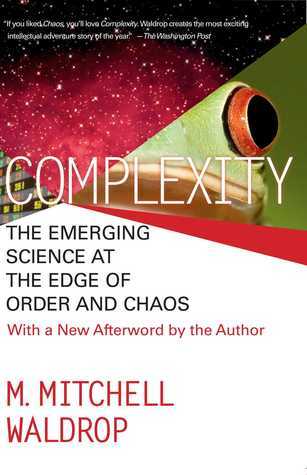
Complexity: The Emerging Science at the Edge of Order and Chaos
by M. Mitchell Waldrop
Rating: 4.0 ⭐
• 1 recommendation ❤️
Why did the stock market crash more than 500 points on a single Monday in 1987? Why do ancient species often remain stable in the fossil record for millions of years and then suddenly disappear? In a world where nice guys often finish last, why do humans value trust and cooperation? At first glance these questions don't appear to have anything in common, but in fact every one of these statements refers to a complex system. The science of complexity studies how single elements, such as a species or a stock, spontaneously organize into complicated structures like ecosystems and economies; stars become galaxies, and snowflakes avalanches almost as if these systems were obeying a hidden yearning for order.Drawing from diverse fields, scientific luminaries such as Nobel Laureates Murray Gell-Mann and Kenneth Arrow are studying complexity at a think tank called The Santa Fe Institute. The revolutionary new discoveries researchers have made there could change the face of every science from biology to cosmology to economics. M. Mitchell Waldrop's groundbreaking bestseller takes readers into the hearts and minds of these scientists to tell the story behind this scientific revolution as it unfolds.

Surveys current research in artificial intelligence, describes the difficulties of enabling computers to learn, understand, and reason, and examines ethical issues related to AI


這是一門跨越物理、數學、醫學、生物、生態、經濟學的整合性新科學;由經濟學家柯文創辦的「聖塔菲研究院」,集合了各路英雄,從諾貝爾物理大師、反叛傳統的經濟學家到電腦奇才……,作者生動地寫下他們過人的熱情、超凡的才智、敏銳的思維,讓讀者清楚看見一門嶄新、整合性的新思潮正帶領人類走向無限奧妙的新世界。作者簡介 沃德羅普 美國威斯康辛基本粒子物理博士,曾擔任《科學》雜誌編輯撰述十年,現為該雜誌特約撰述。另著有《人造的心靈》,是一本關於人工智慧的書。目前與妻子艾美住在華盛頓特區。

Returning to designs abandoned in the 1970s, start-ups are developing a new kind of reactor that promises to be much safer and cleaner than current ones.


Fukuzatsukei: Kagaku Kakumei No Shingenchi Santafe Kenkyūjo No Tensaitachi
by M. Mitchell Waldrop
Rating: 4.0 ⭐

Cosmic Origins: Science’s Long Quest to Understand How Our Universe Began
by M. Mitchell Waldrop
Rating: 4.0 ⭐
Cosmic Origins tells the story of how physicists and astronomers have struggled for more than a century to understand the beginnings of our universe, from its origins in the Big Bang to the modern day. The book will introduce the science as a narrative, by telling the story of the scientists who made each major discovery. It will also address and explain aspects of our theories that some cosmologists are still hesitant to accept, as well as gaps in our knowledge and even apparent inconsistencies in our measurements. Clearly written by a master of scientific exposition, this book will fascinate the curious general reader as well as providing essential background reading for college-level courses on physics and astronomy.

Cosmic Origins: Science’s Long Quest to Understand How Our Universe Began
by M. Mitchell Waldrop
Rating: 5.0 ⭐
Cosmic Origins tells the story of how physicists and astronomers have struggled for more than a century to understand the beginnings of our universe, from its origins in the Big Bang to the modern day. The book will introduce the science as a narrative, by telling the story of the scientists who made each major discovery. It will also address and explain aspects of our theories that some cosmologists are still hesitant to accept, as well as gaps in our knowledge and even apparent inconsistencies in our measurements. Clearly written by a master of scientific exposition, this book will fascinate the curious general reader as well as providing essential background reading for college-level courses on physics and astronomy.

Artificial retina implants: Polymers promise a more flexible artificial retina
by M. Mitchell Waldrop
Rating: 5.0 ⭐
Complexity: The Emerging Science at the Edge of Order and Chaos by M. Mitchell Waldrop
by M. Mitchell Waldrop
Rating: 3.0 ⭐
The Dream Machine
by M. Mitchell Waldrop
Behind every great revolution is a vision, and behind perhaps the greatest revolution of our time, personal computing, is the vision of J. C. R. Licklider. He did not design the first personal computers or write the software that ran on them, nor was he involved in the legendary early companies that brought them to the forefront of our everyday experience.

The Dream Machine DFHDH
by M. Mitchell Waldrop
Behind every great revolution is a vision, and behind perhaps the greatest revolution of our time, personal computing, is the vision of J. C. R. Licklider. He did not design the first personal computers or write the software that ran on them, nor was he involved in the legendary early companies that brought them to the forefront of our everyday experience.

The Dream Machine
by M. Mitchell Waldrop
Behind every great revolution is a vision, and behind perhaps the greatest revolution of our time, personal computing, is the vision of J. C. R. Licklider. He did not design the first personal computers or write the software that ran on them, nor was he involved in the legendary early companies that brought them to the forefront of our everyday experience.
Personal computers on campus
by M. Mitchell Waldrop