
Hermann Weyl
Hermann Klaus Hugo Weyl (9 November 1885 – 8 December 1955) was a German mathematician, theoretical physicist and philosopher. Although much of his working life was spent in Zürich, Switzerland and then Princeton, he is associated with the University of Göttingen tradition of mathematics, represented by David Hilbert and Hermann Minkowski. His research has had major significance for theoretical physics as well as purely mathematical disciplines including number theory. He was one of the most influential mathematicians of the twentieth century, and an important member of the Institute for Advanced Study during its early years. Weyl published technical and some general works on space, time, matter, philosophy, logic, symmetry and the history of mathematics. He was one of the first to conceive of combining general relativity with the laws of electromagnetism. While no mathematician of his generation aspired to the 'universalism' of Henri Poincaré or Hilbert, Weyl came as close as anyone. Michael Atiyah, in particular, has commented that whenever he examined a mathematical topic, he found that Weyl had preceded him (The Mathematical Intelligencer (1984), vol.6 no.1). Source: http://en.wikipedia.org/wiki/Hermann_...
30 Books Written

Symmetry is a classic study of symmetry in mathematics, the sciences, nature, and art from one of the twentieth century's greatest mathematicians. Hermann Weyl explores the concept of symmetry beginning with the idea that it represents a harmony of proportions, and gradually departs to examine its more abstract varieties and manifestations―as bilateral, translatory, rotational, ornamental, and crystallographic. Weyl investigates the general abstract mathematical idea underlying all these special forms, using a wealth of illustrations as support. Symmetry is a work of seminal relevance that explores the great variety of applications and importance of symmetry.

When mathematician Hermann Weyl decided to write a book on philosophy, he faced what he referred to as "conflicts of conscience"--the objective nature of science, he felt, did not mesh easily with the incredulous, uncertain nature of philosophy. Yet the two disciplines were already intertwined. In Philosophy of Mathematics and Natural Science , Weyl examines how advances in philosophy were led by scientific discoveries--the more humankind understood about the physical world, the more curious we became. The book is divided into two parts, one on mathematics and the other on the physical sciences. Drawing on work by Descartes, Galileo, Hume, Kant, Leibniz, and Newton, Weyl provides readers with a guide to understanding science through the lens of philosophy. This is a book that no one but Weyl could have written--and, indeed, no one has written anything quite like it since.

"The standard treatise on the general theory of relativity." — Nature"Whatever the future may bring, Professor Weyl's book will remain a classic of physics." — British Journal for Philosophy and ScienceReflecting the revolution in scientific and philosophic thought which accompanied the Einstein relativity theories, Dr. Weyl has probed deeply into the notions of space, time, and matter. A rigorous examination of the state of our knowledge of the world following these developments is undertaken with this guiding principle: that although further scientific thought may take us far beyond our present conception of the world, we may never again return to the previous narrow and restricted scheme.Although a degree of mathematical sophistication is presupposed, Dr. Weyl develops all the tensor calculus necessary to his exposition. He then proceeds to an analysis of the concept of Euclidean space and the spatial conceptions of Riemann. From this the nature of the amalgamation of space and time is derived. This leads to an exposition and examination of Einstein's general theory of relativity and the concomitant theory of gravitation. A detailed investigation follows devoted to gravitational waves, a rigorous solution of the problem of one body, laws of conservation, and the energy of gravitation. Dr. Weyl's introduction of the concept of tensor-density as a magnitude of quantity (contrasted with tensors which are considered to be magnitudes of intensity) is a major step toward a clearer understanding of the relationships among space, time, and matter.

This original anthology collects 10 of Weyl's less-technical writings that address the broader scope and implications of mathematics. Most have been long unavailable or not previously published in book form. Subjects include logic, topology, abstract algebra, relativity theory, and reflections on the work of Weyl's mentor, David Hilbert. 2012 edition.

This book is devoted to the consistent and systematic application of group theory to quantum mechanics. Beginning with a detailed introduction to the classical theory of groups, Dr. Weyl continues with an account of the fundamental results of quantum physics. There follows a rigorous investigation of the relations holding between the mathematical and physical theories.Topics covered unitary geometry, quantum theory (Schrödinger's wave equation, transition probabilities, directional quantization, collision phenomena, Zeeman and Stark effects); groups and their representations (sub-groups and conjugate classes, linear transformations, rotation and Lorentz groups, closed continuous groups, invariants and covariants, Lie's theory); applications of group theory to quantum mechanics (simple state and term analysis, the spinning electron, multiplet structure, energy and momentum, Pauli exclusion principle, problem of several bodies, Maxwell-Dirac field equations, etc.); the symmetric permutation group; and algebra of symmetric transformation (invariant sub-spaces in group and tensor space, sub-groups, Young's symmetry operators, spin and valence, group theoretic classification of atomic spectra, branching laws, etc).Throughout, Dr. Weyl emphasizes the "reciprocity" between representations of the symmetric permutation group and those of the complete linear group. His simplified treatment of "reciprocity," the Clebsch-Gordan series, and the Jordan-Hölder theorem and its analogues, has helped to clarity these and other complex topics.

Mind and Nature: Selected Writings on Philosophy, Mathematics, and Physics
by Hermann Weyl
Rating: 4.4 ⭐
Hermann Weyl (1885-1955) was one of the twentieth century's most important mathematicians, as well as a seminal figure in the development of quantum physics and general relativity. He was also an eloquent writer with a lifelong interest in the philosophical implications of the startling new scientific developments with which he was so involved. Mind and Nature is a collection of Weyl's most important general writings on philosophy, mathematics, and physics, including pieces that have never before been published in any language or translated into English, or that have long been out of print. Complete with Peter Pesic's introduction, notes, and bibliography, these writings reveal an unjustly neglected dimension of a complex and fascinating thinker. In addition, the book includes more than twenty photographs of Weyl and his family and colleagues, many of which are previously unpublished.Included here are Weyl's exposition of his important synthesis of electromagnetism and gravitation, which Einstein at first hailed as "a first-class stroke of genius"; two little-known letters by Weyl and Einstein from 1922 that give their contrasting views on the philosophical implications of modern physics; and an essay on time that contains Weyl's argument that the past is never completed and the present is not a point. Also included are two book-length series of lectures, The Open World (1932) and Mind and Nature (1934), each a masterly exposition of Weyl's views on a range of topics from modern physics and mathematics. Finally, four retrospective essays from Weyl's last decade give his final thoughts on the interrelations among mathematics, philosophy, and physics, intertwined with reflections on the course of his rich life.
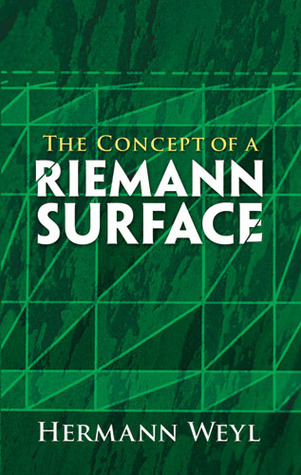
This classic on the general history of functions was written by one of the twentieth century's best-known mathematicians. Hermann Weyl, who worked with Einstein at Princeton, combined function theory and geometry in this high-level landmark work, forming a new branch of mathematics and the basis of the modern approach to analysis, geometry, and topology.The author intended this book not only to develop the basic ideas of Riemann's theory of algebraic functions and their integrals but also to examine the related ideas and theorems with an unprecedented degree of rigor. Weyl's two-part treatment begins by defining the concept and topology of Riemann surfaces and concludes with an exploration of functions of Riemann surfaces. His teachings illustrate the role of Riemann surfaces as not only devices for visualizing the values of analytic functions but also as indispensable components of the theory.

"The hard won power ... to assess correctly the continuum of the natural numbers grew out of titanic struggles in the realm of mathematical logic in which Hermann Weyl took a leading part." — John Archibald WheelerHermann Weyl (1885–1955) ranks among the most important mathematicians and physicists of this century. Though Weyl was not primarily a philosopher, his wide-ranging philosophical reflections on the formal and empirical sciences remain extremely valuable. Besides indicating clearly which results of classical analysis are invalidated by an important family of "non-circular" (predicative) theories, The Continuum wrestles with the problem of applying constructive mathematical models to cases of concrete physical and perceptual continuity. This new English edition features a personal reminiscence of Weyl written by John Archibald Wheeler.Originally published in German in 1918, the book consists of two chapters. Chapter One, entitled Set and Function, deals with property, relation and existence, the principles of the combination of judgments, logical inference, natural numbers, iteration of the mathematical process, and other topics. The main ideas are developed in this chapter in such a way that it forms a self-contained whole.In Chapter Two, The Concept of Numbers & The Continuum, Weyl systematically begins the construction of analysis and carries through its initial stages, taking up such matters as natural numbers and cardinalities, fractions and rational numbers, real numbers, continuous functions, curves and surfaces, and more.Written with Weyl's characteristic passion, lucidity, and wisdom, this advanced-level volume is a mathematical and philosophical landmark that will be welcomed by mathematicians, physicists, philosophers, and anyone interested in foundational analysis.


In this renowned volume, Hermann Weyl discusses the symmetric, full linear, orthogonal, and symplectic groups and determines their different invariants and representations. Using basic concepts from algebra, he examines the various properties of the groups. Analysis and topology are used wherever appropriate. The book also covers topics such as matrix algebras, semigroups, commutators, and spinors, which are of great importance in understanding the group-theoretic structure of quantum mechanics.Hermann Weyl was among the greatest mathematicians of the twentieth century. He made fundamental contributions to most branches of mathematics, but he is best remembered as one of the major developers of group theory, a powerful formal method for analyzing abstract and physical systems in which symmetry is present. In The Classical Groups , his most important book, Weyl provided a detailed introduction to the development of group theory, and he did it in a way that motivated and entertained his readers. Departing from most theoretical mathematics books of the time, he introduced historical events and people as well as theorems and proofs. One learned not only about the theory of invariants but also when and where they were originated, and by whom. He once said of his writing, "My work always tried to unite the truth with the beautiful, but when I had to choose one or the other, I usually chose the beautiful."Weyl believed in the overall unity of mathematics and that it should be integrated into other fields. He had serious interest in modern physics, especially quantum mechanics, a field to which The Classical Groups has proved important, as it has to quantum chemistry and other fields. Among the five books Weyl published with Princeton, Algebraic Theory of Numbers inaugurated the Annals of Mathematics Studies book series, a crucial and enduring foundation of Princeton's mathematics list and the most distinguished book series in mathematics.

Many of the earliest books, particularly those dating back to the 1900s and before, are now extremely scarce and increasingly expensive. We are republishing these classic works in affordable, high quality, modern editions, using the original text and artwork.

The description for this book, Meromorphic Functions and Analytic Curves. (AM-12), will be forthcoming.


This original anthology assembles ten accessible essays by a giant of modern mathematics. Hermann Weyl (1885–1955) made lasting contributions to number theory as well as theoretical physics, and he was associated with Princeton's Institute for Advanced Study, the University of Göttingen, and ETH Zurich. Spanning the 1930s–50s, these articles offer insights into logic and relativity theory in addition to reflections on the work of Weyl's mentor, David Hilbert. Subjects include "Topology and Abstract Algebra as Two Roads of Mathematical Comprehension," "The Mathematical Way of Thinking," "Relativity Theory as a Stimulus in Mathematical Research," and "Why is the World Four-Dimensional?" Historians of mathematics, advanced undergraduates, and graduate students will appreciate these writings, many of which have been long unavailable to English-language readers.
![Was ist materie? Zwei aufsätze zur naturphilosophie, von Hermann Weyl. Mit 7 abbildungen. 1924 [Leather Bound]](https://m.media-amazon.com/images/S/compressed.photo.goodreads.com/books/1699801957i/124363253.jpg)
Was ist materie? Zwei aufsätze zur naturphilosophie, von Hermann Weyl. Mit 7 abbildungen. 1924 [Leather Bound]
by Hermann Weyl
Leather Binding on Spine and Corners with Golden Leaf Printing on round Spine (extra customization on request like complete leather, Golden Screen printing in Front, Color Leather, Colored book etc.) Reprinted in 2022 with the help of original edition published long back [1924]. This book is printed in black & white, sewing binding for longer life, Printed on high quality Paper, re-sized as per Current standards, professionally processed without changing its contents. As these are old books, we processed each page manually and make them readable but in some cases some pages which are blur or missing or black spots. If it is multi volume set, then it is only single volume, if you wish to order a specific or all the volumes you may contact us. We expect that you will understand our compulsion in these books. We found this book important for the readers who want to know more about our old treasure so we brought it back to the shelves. Hope you will like it and give your comments and suggestions. - German, Pages 100. EXTRA 10 DAYS APART FROM THE NORMAL SHIPPING PERIOD WILL BE REQUIRED FOR LEATHER BOUND BOOKS. COMPLETE LEATHER WILL COST YOU EXTRA US$ 25 APART FROM THE LEATHER BOUND BOOKS. {FOLIO EDITION IS ALSO AVAILABLE.} Complete Was ist materie? Zwei aufsätze zur naturphilosophie, von Hermann Weyl. Mit 7 abbildungen. 1924 Weyl, Hermann, -.

Gruppentheorie und Quantenmechanik
by Hermann Weyl

La Révolution Nationale: Entre l'Art et le Temoignage...
by Hermann Weyl

空間・時間・物質 下
by Hermann Weyl

空間・時間・物質〈上〉
by Hermann Weyl

シンメトリー
by Hermann Weyl

Space-Time-Matter
by Hermann Weyl
This is a new publication of Hermann Weyl’s book Space-Time-Matter, which was first published in German in 1919 and the English translation was published in 1922.What makes Weyl’s book invaluable is that, in addition to his masterfully presented lectures on special and general relativity (starting with a helpful introduction to tensor analysis), he was the first (and essentially the only one so far) who tried to reconcile two seemingly unreconcilable facts - Minkowski’s discovery (deduced from the failed experiments to detect absolute motion) of the spacetime structure of the world (that it is a static four-dimensional world containing en bloc the entire history of the perceived by us three-dimensional world) and the inter-subjective fact that we are aware of ourselves and the world only at one single moment of time - the present moment (the moment now) - which constantly changes. Weyl reached the conclusion that it is our consciousness (somehow "traveling" in the four-dimensional world along our worldlines) which creates our feeling that time flows. Unfortunately, Weyl's reconciliation of the above facts has not been rigorously examined so far; the apparent contradiction that the consciousness "travels" in the "frozen" four-dimensional world - spacetime - is not an excuse because Weyl had surely been aware of it and nevertheless "went public" with his proposed resolution.

From the “The name of Hermann Weyl is enshrined in the history of mathematics. A thinker of exceptional depth, and a creator of ideas, Weyl possessed an intellect which ranged far and wide over the realm of mathematics, and beyond. His mind was sharp and quick, his vision clear and penetrating. Whatever he touched he adorned. His personality was suffused with humanity and compassion, and a keen aesthetic sensibility. Its fullness radiated charm. He was young at heart to the end. By precept and example, he inspired many mathematicians, and influenced their lives. The force of his ideas has affected the course of science. He ranks among the few universalists of our time. This collection of papers is a tribute to his genius. It is intended as a service to the mathematical community….These papers will no doubt be a source of inspirations to scholars through the ages.” Volume III comprises 52 articles written between 1926 and 1940.

From the “The name of Hermann Weyl is enshrined in the history of mathematics. A thinker of exceptional depth, and a creator of ideas, Weyl possessed an intellect which ranged far and wide over the realm of mathematics, and beyond. His mind was sharp and quick, his vision clear and penetrating. Whatever he touched he adorned. His personality was suffused with humanity and compassion, and a keen aesthetic sensibility. Its fullness radiated charm. He was young at heart to the end. By precept and example, he inspired many mathematicians, and influenced their lives. The force of his ideas has affected the course of science. He ranks among the few universalists of our time. This collection of papers is a tribute to his genius. It is intended as a service to the mathematical community….These papers will no doubt be a source of inspirations to scholars through the ages.” Volume II comprises 38 articles written between 1918 and 1926.

Was ist Materie?: Zwei Aufsätze zur Naturphilosophie
by Hermann Weyl
Dieser Buchtitel ist Teil des Digitalisierungsprojekts Springer Book Archives mit Publikationen, die seit den Anfängen des Verlags von 1842 erschienen sind. Der Verlag stellt mit diesem Archiv Quellen für die historische wie auch die disziplingeschichtliche Forschung zur Verfügung, die jeweils im historischen Kontext betrachtet werden müssen. Dieser Titel erschien in der Zeit vor 1945 und wird daher in seiner zeittypischen politisch-ideologischen Ausrichtung vom Verlag nicht beworben.
![MATHEMATISCHE ANALYSE DES RAUMPROBLEMS [VORLESUNGEN GEHALTEN IN BARCELONA UND MADRID]; WAS IST MATERIE? [ZWEI AUFSATZE ZUR NATURPHILOSOPHIE]](/placeholder.svg?height=400&width=300)
Dieser Buchtitel ist Teil des Digitalisierungsprojekts Springer Book Archives mit Publikationen, die seit den Anfängen des Verlags von 1842 erschienen sind. Der Verlag stellt mit diesem Archiv Quellen für die historische wie auch die disziplingeschichtliche Forschung zur Verfügung, die jeweils im historischen Kontext betrachtet werden müssen. Dieser Titel erschien in der Zeit vor 1945 und wird daher in seiner zeittypischen politisch-ideologischen Ausrichtung vom Verlag nicht beworben.

Riemanns geometrische Ideen, ihre Auswirkung und ihre Verknüpfung mit der Gruppentheorie
by Hermann Weyl
Ganz in Hermann Weyls bekannt klarer Darstellung geschrieben, gibt dieser Beitrag einen Bericht über die Entstehung der grundlegenden Ideen, die der modernen Geometrie zugrunde liegen. Diese Schrift spiegelt in einzigartiger Weise Weyls mathematische Persönlichkeit wider. Sie richtet sich an alle, die sich mit Fragen der Topologiegruppentheorie, Differentialgeometrie und mathematischer Physik beschäftigen. From the foreword of the editor K. "Written in Weyl's finest style, while he was rising forty, the article is an authentic report on the genesis and evolution of those fundamental ideas that underlie the modern conception of geometry. Part I is on the continuum, and deals with analysis situs, imbeddings, and coverings. Part II is on structure, and deals with infinitesimal geometry in its many aspects, metric, conformal, affine, and projective; with the question of homogeneity, homogeneous spaces from the group-theoretical standpoint, the role of the metric field theories in physics, and the related problems of group theory. It is hoped that this article will be of interest to all those concerned with the growth and development of topology, group theory, differential geometry, geometric function theory, and mathematical physics. It bears the unmistakable imprint of Weyl's mathematical personality, and of his remarkable capacity to capture and delineate the transmutation of some of the nascent into the dominant ideas of the mathematics of our time".
Shock waves in arbitrary fluids; a note submitted to the Applied Mathematics Panel, NDRC
by Hermann Weyl
This work has been selected by scholars as being culturally important, and is part of the knowledge base of civilization as we know it. This work was reproduced from the original artifact, and remains as true to the original work as possible. Therefore, you will see the original copyright references, library stamps (as most of these works have been housed in our most important libraries around the world), and other notations in the work. This work is in the public domain in the United States of America, and possibly other nations. Within the United States, you may freely copy and distribute this work, as no entity (individual or corporate) has a copyright on the body of the work.As a reproduction of a historical artifact, this work may contain missing or blurred pages, poor pictures, errant marks, etc. Scholars believe, and we concur, that this work is important enough to be preserved, reproduced, and made generally available to the public. We appreciate your support of the preservation process, and thank you for being an important part of keeping this knowledge alive and relevant.

Einführung in die Funktionentheorie
by Hermann Weyl
Das Buch gibt Hermann Weyls Vorlesung zur Funktionentheorie im Wintersemester 1910/11 an der Universität Göttingen wieder. Er hielt diese Vorlesung kurz vor der Entstehung seines einflussreichen Buches über Riemannsche Flächen. Diese bisher unveröffentlichte Transkription gibt einen Einblick in die frühe Ideenwelt Hermann Weyls, einem der wichtigsten Mathematiker des 20. Jahrhunderts, dessen Ideen und Sprache auch heute noch frisch klingen. Das Buch bietet eine gute Ergänzung zu einer herkömmlichen Vorlesung über die Funktionentheorie.

Algebraic Theory of Numbers
by Hermann Weyl
In this, one of the first books to appear in English on the theory of numbers, the eminent mathematician Hermann Weyl explores fundamental concepts in arithmetic. The book begins with the definitions and properties of algebraic fields, which are relied upon throughout. The theory of divisibility is then discussed, from an axiomatic viewpoint, rather than by the use of ideals. There follows an introduction to p -adic numbers and their uses, which are so important in modern number theory, and the book culminates with an extensive examination of algebraic number fields.Weyl's own modest hope, that the work "will be of some use," has more than been fulfilled, for the book's clarity, succinctness, and importance rank it as a masterpiece of mathematical exposition.

Gesammelte Abhandlungen I
by Hermann Weyl
From the The name of Hermann Weyl is enshrined in the history of mathematics. A thinker of exceptional depth, and a creator of ideas, Weyl possessed an intellect which ranged far and wide over the realm of mathematics, and beyond. His mind was sharp and quick, his vision clear and penetrating. Whatever he touched he adorned. His personality was suffused with humanity and compassion, and a keen aesthetic sensibility. Its fullness radiated charm. He was young at heart to the end. By precept and example, he inspired many mathematicians, and influenced their lives. The force of his ideas has affected the course of science. He ranks among the few universalists of our time. This collection of papers is a tribute to his genius. It is intended as a service to the mathematical community .These papers will no doubt be a source of inspirations to scholars through the ages.Volume I comprises 29 Articles written between 1908 and 1917."