
5 Books Written
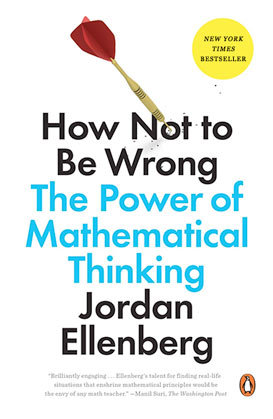
How Not to Be Wrong: The Power of Mathematical Thinking
by Jordan Ellenberg
Rating: 4.0 ⭐
• 6 recommendations ❤️
“Witty, compelling, and just plain fun to read . . ." — Evelyn Lamb, Scientific AmericanThe Freakonomics of math—a math-world superstar unveils the hidden beauty and logic of the world and puts its power in our handsThe math we learn in school can seem like a dull set of rules, laid down by the ancients and not to be questioned. In How Not to Be Wrong , Jordan Ellenberg shows us how terribly limiting this view is: Math isn’t confined to abstract incidents that never occur in real life, but rather touches everything we do—the whole world is shot through with it.Math allows us to see the hidden structures underneath the messy and chaotic surface of our world. It’s a science of not being wrong, hammered out by centuries of hard work and argument. Armed with the tools of mathematics, we can see through to the true meaning of information we take for granted: How early should you get to the airport? What does “public opinion” really represent? Why do tall parents have shorter children? Who really won Florida in 2000? And how likely are you, really, to develop cancer?How Not to Be Wrong presents the surprising revelations behind all of these questions and many more, using the mathematician’s method of analyzing life and exposing the hard-won insights of the academic community to the layman—minus the jargon. Ellenberg chases mathematical threads through a vast range of time and space, from the everyday to the cosmic, encountering, among other things, baseball, Reaganomics, daring lottery schemes, Voltaire, the replicability crisis in psychology, Italian Renaissance painting, artificial languages, the development of non-Euclidean geometry, the coming obesity apocalypse, Antonin Scalia’s views on crime and punishment, the psychology of slime molds, what Facebook can and can’t figure out about you, and the existence of God.Ellenberg pulls from history as well as from the latest theoretical developments to provide those not trained in math with the knowledge they need. Math, as Ellenberg says, is “an atomic-powered prosthesis that you attach to your common sense, vastly multiplying its reach and strength.” With the tools of mathematics in hand, you can understand the world in a deeper, more meaningful way. How Not to Be Wrong will show you how.

Shape: The Hidden Geometry of Information, Biology, Strategy, Democracy, and EverythingElse
by Jordan Ellenberg
Rating: 3.7 ⭐
From the New York Times-bestselling author of How Not to Be Wrong—himself a world-class geometer—a far-ranging exploration of the power of geometry, which turns out to help us think better about practically everything.How should a democracy choose its representatives? How can you stop a pandemic from sweeping the world? How do computers learn to play Go, and why is learning Go so much easier for them than learning to read a sentence? Can ancient Greek proportions predict the stock market? (Sorry, no.) What should your kids learn in school if they really want to learn to think? All these are questions about geometry. For real.If you're like most people, geometry is a sterile and dimly remembered exercise you gladly left behind in the dust of ninth grade, along with your braces and active romantic interest in pop singers. If you recall any of it, it's plodding through a series of miniscule steps only to prove some fact about triangles that was obvious to you in the first place. That's not geometry. Okay, it is geometry, but only a tiny part, which has as much to do with geometry in all its flush modern richness as conjugating a verb has to do with a great novel.Shape reveals the geometry underneath some of the most important scientific, political, and philosophical problems we face. Geometry Where are things? Which things are near each other? How can you get from one thing to another thing? Those are important questions. The word "geometry," from the Greek for "measuring the world." If anything, that's an undersell. Geometry doesn't just measure the world—it explains it. Shape shows us how.

Chandler State University is the one thing keeping the dusty, Western town of Chandler on the map. Now that its basketball program has fallen apart, CSU’s only claim to fame is its Gravinics Department, dedicated to the study of an obscure European country—its mythology, its extraordinarily difficult language, and especially its bizarre star poet, Henderson.Having discovered Henderson’s poetry in a trash bin, Stanley Higgs becomes the foremost scholar of the poet’s work, accepts a position at Chandler State University, achieves international academic fame, marries the Dean’s daughter, and abruptly stops talking. With all of academia convinced that Higgs is formulating a great truth, the university employs Orwellian techniques to record Higgs’s every potential utterance and to save its reputation. A feckless Gravinics language student, Samuel Grapearbor, together with his long-suffering girlfriend Julia, is hired to monitor Higgs during the day. Over endless games of checkers and shared sandwiches, a uniquely silent friendship develops. As one man struggles to grow up and the other grows old, The Grasshopper King, in all of his glory, emerges.In this debut novel about treachery, death, academia, marriage, mythology, history, and truly horrible poetry, Jordan Ellenberg creates a world complete with its own geography, obscene folklore, and absurdly endearing -characters—a world where arcane subjects flourish and the smallest swerve from convention can result in -immortality.Jordan Ellenberg was born in Potomac, Maryland in 1971. His brilliance as a mathematical prodigy led to a feature in The National Enquirer, an interview with Charlie Rose on CBS’s Nightwatch, and gold medals at the Math Olympiad in Cuba and Germany. He is now an Assistant Professor of Math at Princeton University and his column, "Do the Math," appears regularly in the online journal Slate. This is his first novel.
SUMMARY AND KEY ANALYSIS OF SHAPE BY JORDAN ELLENBERG: The Hidden Geometry of Information, Biology, Strategy, Democracy, and Everything Else
by Jordan Ellenberg
Rating: 3.7 ⭐

Formes: La géométrie cachée de l'information, de la biologie, de la stratégie, de la démocratie et d'absolument tout le reste
by Jordan Ellenberg
Rating: 2.7 ⭐