
30 Books Written

Starting from a collection of simple computer experiments—illustrated in the book by striking computer graphics—Stephen Wolfram shows how their unexpected results force a whole new way of looking at the operation of our universe.Wolfram uses his approach to tackle a remarkable array of fundamental problems in science, from the origins of apparent randomness in physical systems, to the development of complexity in biology, the ultimate scope and limitations of mathematics, the possibility of a truly fundamental theory of physics, the interplay between free will and determinism, and the character of intelligence in the universe.

Idea Makers: Personal Perspectives on the Lives & Ideas of Some Notable People
by Stephen Wolfram
Rating: 3.5 ⭐
This book of thoroughly engaging essays from one of today's most prodigious innovators provides a uniquely personal perspective on the lives and achievements of a selection of intriguing figures from the history of science and technology. Weaving together his immersive interest in people and history with insights gathered from his own experiences, Stephen Wolfram gives an ennobling look at some of the individuals whose ideas and creations have helped shape our world today.From his recollections about working with Richard Feynman to his insights about how Alan Turing's work has unleashed generations of innovation to the true role of Ada Lovelace in the history of computing, Wolfram takes the reader into the minds and lives of great thinkers and creators of the past few centuries and shows how great achievements can arise from dramatically different personalities and life trajectories.PrefaceRichard FeynmanKurt GödelAlan TuringJohn von NeumannGeorge BooleAda LovelaceGottfried LeibnizBenoit MandelbrotSteve JobsMarvin MinskyRussell TowleBertrand Russell and Alfred WhiteheadRichard CrandallSrinivasa RamanujanSolomon Golomb
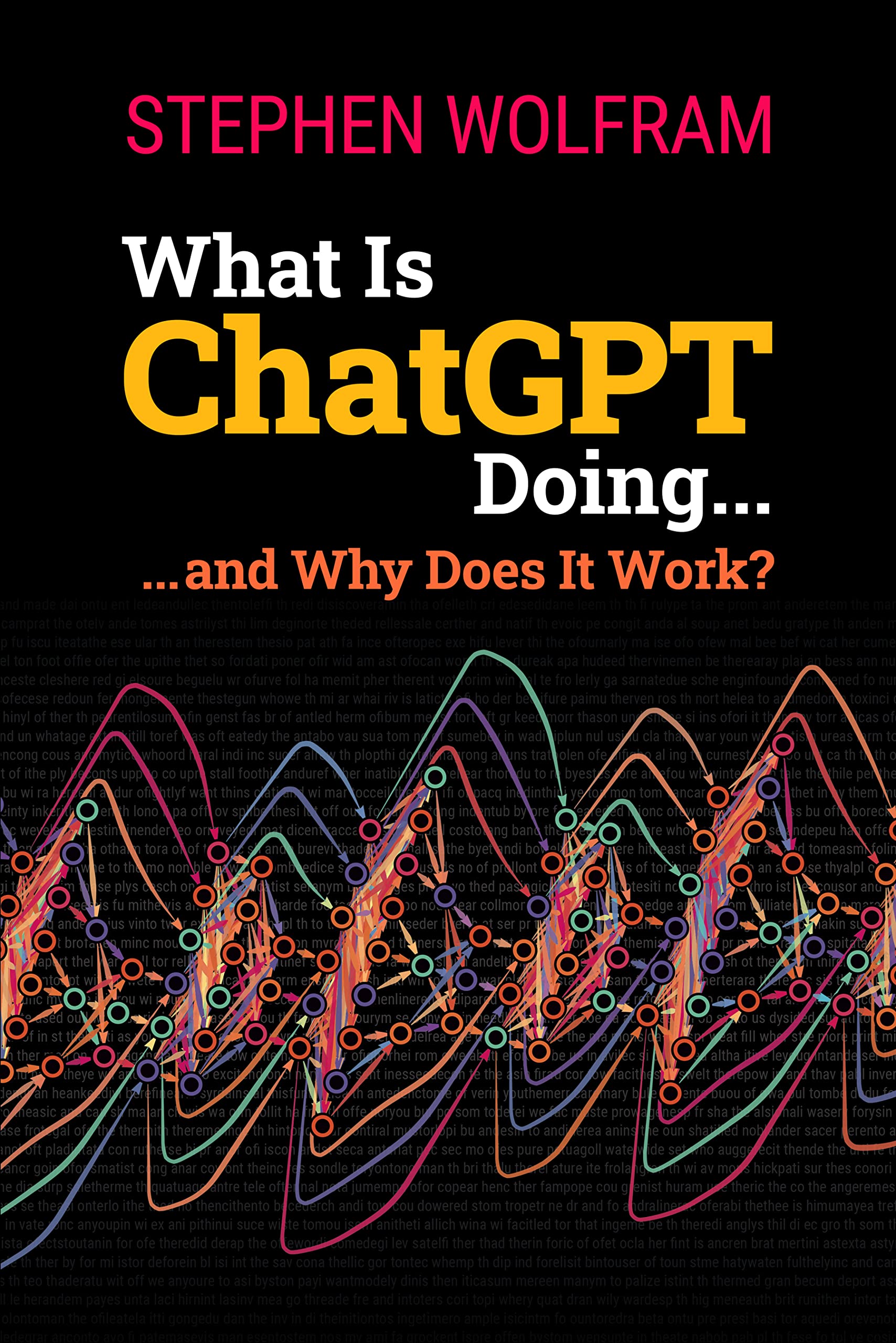
Nobody expected this—not even its creators: ChatGPT has burst onto the scene as an AI capable of writing at a convincingly human level. But how does it really work? What's going on inside its "AI mind"? In this short book, prominent scientist and computation pioneer Stephen Wolfram provides a readable and engaging explanation that draws on his decades-long unique experience at the frontiers of science and technology. Find out how the success of ChatGPT brings together the latest neural net technology with foundational questions about language and human thought posed by Aristotle more than two thousand years ago.
Through his pioneering work in science, technology and language design, Stephen Wolfram has developed his own signature way of thinking about an impressive range of subjects. In this lively book of essays, Wolfram takes the reader along on some of his most surprising and engaging intellectual adventures.From science consulting for a Hollywood movie, solving problems of AI ethics, hunting for the source of an unusual polyhedron, communicating with extraterrestrials, to finding the fundamental theory of physics and exploring the digits of pi, Adventures of a Computational Explorer captures the infectious energy and curiosity of one of the great pioneers of the computational world.
The Wolfram Language represents a major advance in programming languages that makes leading-edge computation accessible to everyone. Unique in its approach of building in vast knowledge and automation, the Wolfram Language scales from a single line of easy-to-understand interactive code to million-line production systems. This book provides an elementary introduction to the Wolfram Language and modern computational thinking. It assumes no prior knowledge of programming, and is suitable for both technical and non-technical college and high-school students, as well as anyone with an interest in the latest technology and its practical application.
Stephen Wolfram is the creator of Mathematica and Wolfram|Alpha and the author of A New Kind of Science and An Elementary Introduction to the Wolfram Language. In this short ebook, Dr. Wolfram dives into his theories of computation and the universe. Take a look at this short excerpt from the ebook Computation and the Future of the Human “In traditional engineering, one starts with some purpose in mind, then explicitly tries to construct a system that achieves that purpose.And typically at each step one insists on foreseeing what the system will do. With the result that the system must always be quite computationally reducible.But in the computational universe there are lots of systems that aren’t computationally reducible.So can we use these systems for technology?The answer is absolutely yes.Sometimes we look at the systems and realize that there’s some purpose for which they can be used.But more often, we first identify a purpose, and then start searching the computational universe for systems that can achieve that purpose.Things like this have been done a little in traditional engineering—even, say, with Edison searching for his light-bulb filaments.But it’s vastly more efficient and streamlined in the computational universe.
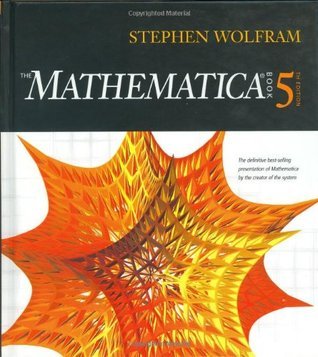
Mathematica has defined the state of the art in technical computing for nearly a decade, and has become a standard in many of the world's leading companies and universities. From simple calculator operations to large-scale programming and interactive document preparation, Mathematica is the tool of choice at the frontiers of scientific research, in engineering analysis and modeling, in technical education from high school to graduate school, and wherever quantitative methods are used.
Wolfram discusses the history of computation from its earliest beginnings to current applications and the emergence of computable knowledge. Notable figures include: Pythagoras, Archimedes, Isaac Newton, Galileo, Gottfried Leibniz, Carl Linnaeus, John von Neumann, and many others.
Released alongside the launch of the Wolfram Physics Project, this book provides a unique opportunity to learn about a historic initiative in science right as it is happening. The Wolfram Physics Project is a bold effort to use breakthrough new ideas and the latest in physics, mathematics and computation to find the fundamental theory of physics, often viewed as the ultimate goal in all of science. Written with Stephen Wolfram's characteristic expositional flair, the book includes both an accessible introduction to the project and its background, as well as core technical documents, and breathtaking visualizations that bring to life a dramatic new understanding of how our universe works.
In a world where jobs are continually being outsourced to machines and algorithms, the question of how best to educate the next generation becomes more important with every year. Stephen Wolfram, author of A New Kind of Science and Idea Makers and creator of Wolfram|Alpha, says the answer is computational thinking. Wolfram defines computational thinking as "formulating things with enough clarity that one can tell a computer how to do them." Computational thinking provides the most direct link possible between idea and implementation, without the repetitiveness and minutia of basic programming languages. Wolfram walks the reader through the basics of the Wolfram Language, encouraging young minds to embrace these concepts, while allowing them to creatively explore beautiful visualizations and actual working code. The Wolfram Language is free for anyone with a web browser to experiment with and use.
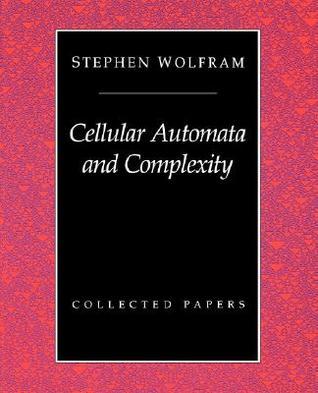
Are mathematical equations the best way to model nature? For many years it had been assumed that they were. But in the early 1980s, Stephen Wolfram made the radical proposal that one should instead build models that are based directly on simple computer programs. Wolfram made a detailed study of a class of such models known as cellular automata, and discovered a remarkable fact: that even when the underlying rules are very simple, the behavior they produce can be highly complex, and can mimic many features of what we see in nature. And based on this result, Wolfram began a program of research to develop what he called “A Science of Complexity.”The results of Wolfram’s work found many applications, from the so-called Wolfram Classification central to fields such as artificial life, to new ideas about cryptography and fluid dynamics. This book is a collection of Wolfram’s original papers on cellular automata and complexity. Some of these papers are widely known in the scientific community; others have never been published before. Together, the papers provide a highly readable account of what has become a major new field of science, with important implications for physics, biology, economics, computer science and many other areas.
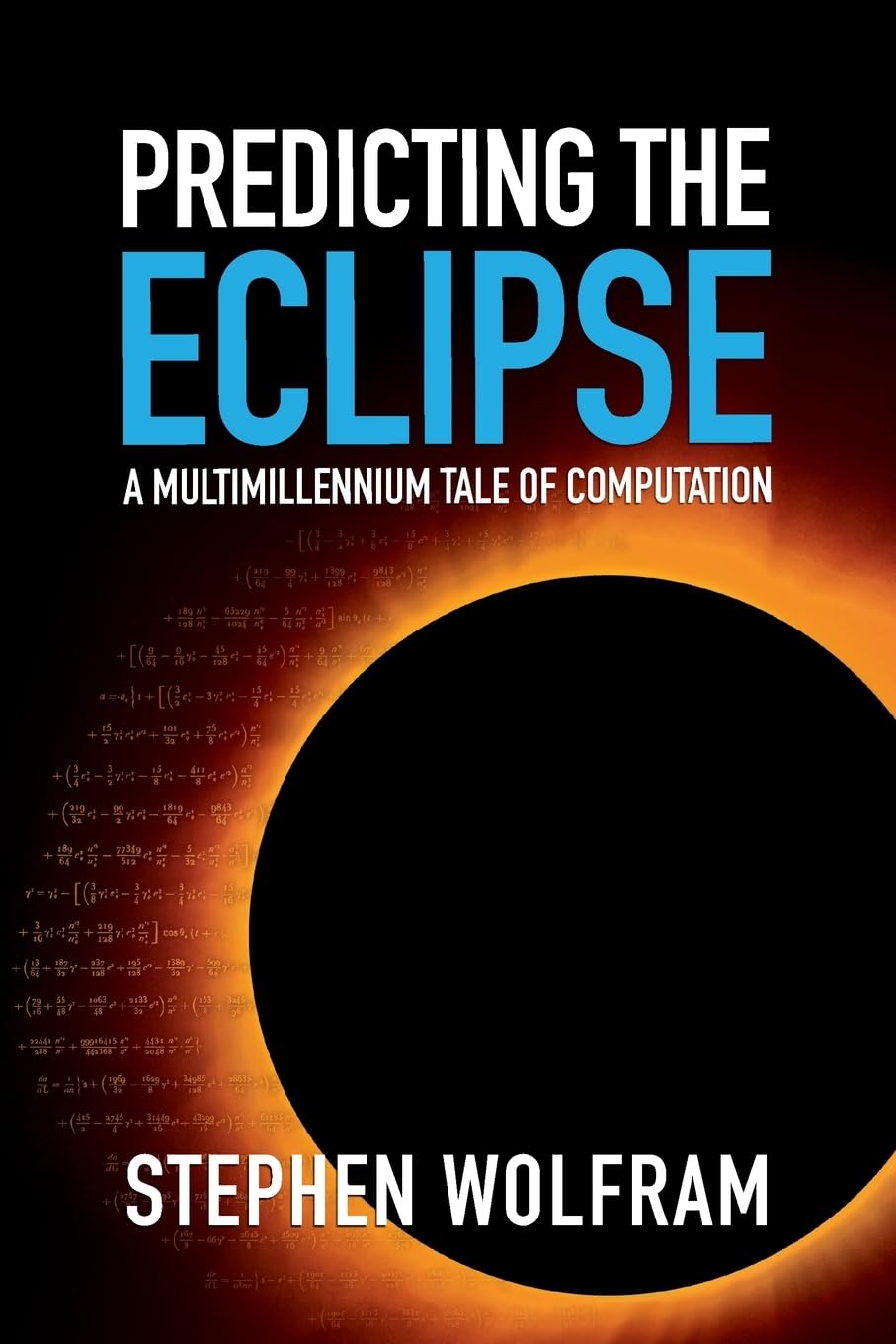
Total eclipses of the Sun are rare and dramatic—and on April 8, 2024, one will cross the US. But when exactly will it happen? In this short but richly illustrated book, prominent scientist and computation pioneer Stephen Wolfram tells the triumphant and hard-won story--spanning more than two thousand years--of how science, mathematics and computation have brought us to the point where we can now predict the time of the eclipse to within one second. Learn how the problem of eclipses brought us some of the earliest exact science, the first known computer, contributions from many of the all-time greats of mathematics and physics, and critical technology for the space program. See how all this provides a clear, modern understanding of a phenomenon that has surprised and amazed throughout human history.
This book will be released simultaneously with Release 2.0 of Mathematica and will cover all the new features of Release 2.0. This new edition maintains the format of the original book and is the single most important user guide and reference for Mathematica--all users of Mathematica will need this edition. Includes 16 pages of full-color graphics.

The Second Law: Resolving the Mystery of the Second Law of Thermodynamics
by Stephen Wolfram
Rating: 4.4 ⭐
Ever since it was first formulated a century and a half ago, the Second Law of thermodynamics (or "law of entropy increase") has had an air of mystery about it. Why is it true? Is it even always true? In this book, Stephen Wolfram builds on recent breakthroughs in the foundations of physics to finally provide a resolution to the mystery of the Second Law, elegantly showing how it emerges as a general feature of processes that can be described computationally as well as their interplay with our computational characteristics as observers. For Wolfram, the effort to understand the Second Law has been a 50-year quest, beginning when he was 12 years old. In the book, Wolfram tells the story of this quest as well as traces the whole remarkable history of the Second Law. Written with great clarity and richly illustrated with both striking modern diagrams and extensive historical material, this book will be of interest to anyone who wants to understand the foundations and origins of one of the most important and widely applied principles of modern science.PrefaceComputational Foundations for the Second Law of ThermodynamicsThe Mystery of the Second Law · The Core Phenomenon of the Second Law · The Road from Ordinary Thermodynamics · Reversibility, Irreversibility and Equilibrium · Ergodicity and Global Behavior · How Random Does It Get? · The Concept of Entropy · Why the Second Law Works · Textbook Thermodynamics · Towards a Formal Proof of the Second Law · Maxwell's Demon and the Character of Observers · The Heat Death of the Universe · Traces of Initial Conditions · When the Second Law Works, and When It Doesn't · The Second Law and Order in the Universe · Class 4 and the Mechanoidal Phase · The Mechanoidal Phase and Bulk Molecular Biology · The Thermodynamics of Spacetime · Quantum Mechanics · The Future of the Second Law · Thanks & NotesA 50-Year My Personal Journey with the Second Law of ThermodynamicsWhen I Was 12 Years Old... · Becoming a Physicist · Statistical Mechanics and Simple Programs · Computational Irreducibility and Rule 30 · Where Does Randomness Come From? · Hydrodynamics, and a Turbulent Tale · Getting to the Continuum · The Second Law in A New Kind of Science · The Physics Project—and the Second Law Again · Discovering Class 4 · The End of a 50-Year Journey · The Backstory of the Book Cover That Started It All · Notes & ThanksHow Did We Get Here? The Tangled History of the Second Law of ThermodynamicsThe Basic Arc of the Story · What Is Heat? · Heat Engines and the Beginnings of Thermodynamics · The Second Law Is Formulated · The Concept of Entropy · The Kinetic Theory of Gases · "Deriving" the Second Law from Molecular Dynamics · The Concept of Ergodicity · But What about Reversibility? · The Recurrence Objection · Ensembles, and an Effort to Make Things Rigorous · Maxwell's Demon · What Happened to Those People? · Coarse Graining and the "Modern Formulation" · Radiant Heat, the Second Law and Quantum Mechanics · Are Molecules Real? Continuous Versus Discrete · The Twentieth Century · What the Textbooks The Evolution of Certainty · So Where Does This Leave the Second Law? · NoteAnnotated BibliographyEarlier WorkUndecidability and Intractability in Theoretical Physics · Origins of Randomness in Physical Systems · Thermodynamics and Hydrodynamics with Cellular Automata · Cellular Automaton Fluids 1: Basic TheoryExcerpts from A New Kind of ScienceIndex
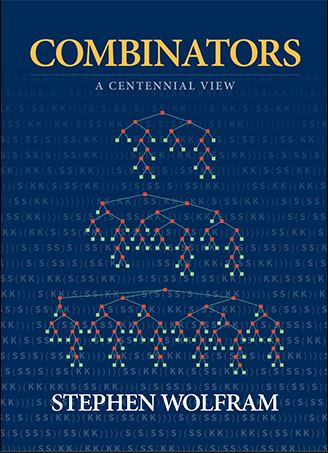
Combinators have inspired ideas about computation ever since they were first invented in 1920, and in this innovative book, Stephen Wolfram provides a modern view of combinators and their significance. Informed by his work on the computational universe of possible programs and on computational language design, Wolfram explains new and existing ideas about combinators with unique clarity and stunning visualizations, as well as provides insights on their historical connections and the curious story of Moses Schönfinkel, inventor of combinators. Though invented well before Turing machines, combinators have often been viewed as an inaccessibly abstract approach to computation. This book brings them to life as never before in a thought-provoking and broadly accessible exposition of interest across mathematics and computer science, as well as to those concerned with the foundations of formal and computational thinking, and with the history of ideas.

“What is mathematics?” is a question that has been debated since antiquity. This book presents a groundbreaking and surprising answer to the question—showing through the concept of the physicalization of metamathematics how both mathematics and physics as experienced by humans can be seen to emerge from the unique underlying computational structure of the recently formulated ruliad. Written with Stephen Wolfram's characteristic expositional flair and richly illustrated with remarkable algorithmic diagrams, the book takes the reader on an unprecedented intellectual journey to the center of some of the deepest questions about mathematics and its nature—and points the way to a new understanding of the foundations and future of mathematics, taking a major step beyond ideas from Plato, Kant, Hilbert, Gödel and others.ContentsPrefaceThe Physicalization of Metamathematics and Its Implications for the Foundations of MathematicsMathematics and Physics Have the Same Foundations · The Underlying Structure of Mathematics and Physics · The Metamodeling of Axiomatic Mathematics · Some Simple Examples with Mathematical Interpretations · Metamathematical Space · The Issue of Generated Variables · Rules Applied to Rules · Accumulative Evolution · Accumulative String Systems · The Case of Hypergraphs · Proofs in Accumulative Systems · Beyond Substitution: Cosubstitution and Bisubstitution · Some First Metamathematical Phenomenology · Relations to Automated Theorem Proving · Axiom Systems of Present-Day Mathematics · The Model-Theoretic Perspective · Axiom Systems in the Wild · The Topology of Proof Space · Time, Timelessness and Entailment Fabrics · The Notion of Truth · What Can Human Mathematics Be Like? · Going below Axiomatic Mathematics · The Physicalized Laws of Mathematics · Uniformity and Motion in Metamathematical Space · Gravitational and Relativistic Effects in Metamathematics · Empirical Metamathematics · Invented or Discovered? How Mathematics Relates to Humans · What Axioms Can There Be for Human Mathematics? · Counting the Emes of Mathematics and Physics · Some Historical (and Philosophical) Background · Implications for the Future of Mathematics · Some Personal History: The Evolution of These Ideas · Notes & Thanks · Graphical Key · Glossary · Annotated BibliographyThe Concept of the RuliadThe Entangled Limit of Everything · Experiencing the Ruliad · Observers Like Us · Living in Rulial Space · The View from Mathematics · The View from Computation Theory · What's beyond the Ruliad? · Communicating across Rulial Space · So Is There a Fundamental Theory of Physics? · Alien Views of the Ruliad · Conceptual Implications of the Ruliad · Appendix: The Case of the "Multiplicad" · Thanks & NoteThe Empirical Metamathematics of Euclid and BeyondTowards a Science of Metamathematics · The Most Famous Math Book in History · Basic Statistics of Euclid · The Interdependence of Theorems · The Graph of All Theorems · The Causal Graph Analogy · The Most Difficult Theorem in Euclid · The Most Popular Theorems in Euclid · What Really Depends on What? · The Machine Code of Euclid: All the Way Down to Axioms · Superaxioms, or What Are the Most Powerful Theorems? · Formalizing Euclid · All Possible Theorems · Math beyond Euclid · The Future of Empirical Metamathematics · Thanks · Note AddedImplications for Mathematics and Its Foundations, Section 12.9 from A New Kind of Science (2002)Index
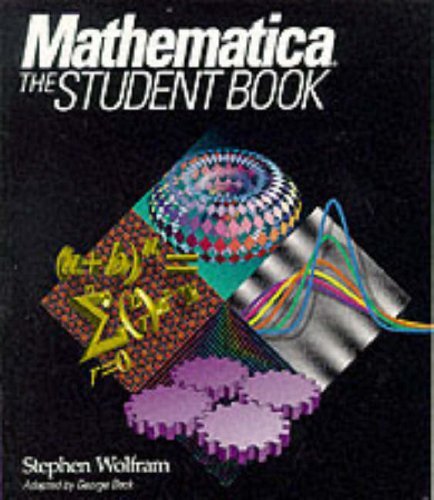
Adapted from Stephen Wolfram's definitive work A System for Doing Mathematics by Computer, 2nd Ed., this is the beginning student's ideal road map and guidebook to Mathematica. This adaptation addresses the student's need for more concise and accessible information. Beck has trimmed to book to half its original size, focusing on the functions and topics likely to be encountered by students.
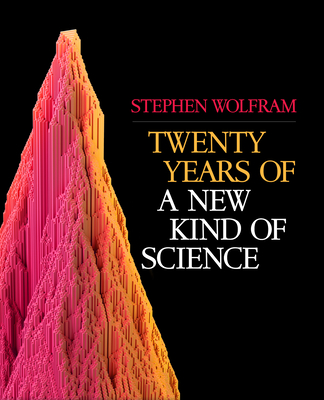
When Stephen Wolfram's groundbreaking A New Kind of Science was published in 2002, its exploration and analysis of the computational universe of simple programs launched a scientific revolution. Twenty years later, the ideas and results of the book have found countless applications across science, technology and elsewhere—including the recent Wolfram Physics Project and its breakthrough in fundamental physics—and the book has indeed spawned what can only be described as a new kind of science.Here Wolfram reflects on the first two decades of A New Kind of Science, discussing some of the major implications that have emerged so far, as well as his far-reaching new thinking building on the conceptual framework developed in A New Kind of Science. Written in Wolfram's popular and accessible style, the book provides a window into one of the most vibrant intellectual developments of our time.Recognizing A New Kind of Science's significance not only in science but also in the arts, the book includes a gallery of pieces created over the past 20 years by artists inspired by the book.

With over a million users around the world, the Mathematica ® software system created by Stephen Wolfram has defined the direction of technical computing for nearly a decade. With its major new document and computer language technology, the new version, Mathematica 3.0 takes the top-power capabilities of Mathematica and make them accessible to a vastly broader audience. This book presents this revolutionary new version of Mathematica. The Mathematica Book is a must-have purchase for anyone who wants to understand the revolutionary opportunities in science, technology, business and education made possible by Mathematica 3.0. This encompasses a broad audience of scientists and mathematicians; engineers; computer professionals; quantitative financial analysts; medical researchers; and students at high-school, college and graduate levels. Written by the creator of the system, The Mathematica Book includes both a tutorial introduction and complete reference information, and contains a comprehensive description of how to take advantage of Mathematica's ability to solve myriad technical computing problems and its powerful graphical and typesetting capabilities. Like previous editions, the book is sure to be found well-thumbed on the desks of many technical professionals and students around the world.

The Hidden Workings of Machine LearningWhy does machine learning work at all? Neural networks power everything from image recognition to language models, yet the science behind their success remains strangely elusive. In this essay, Stephen Wolfram strips machine learning down to its barest forms—minimal models built from simple rules—and shows that even at this level, systems can learn. What emerges is a surprising machine learning doesn't rely on carefully engineered structures but on the natural complexity of the computational universe.Seen this way, machine learning is less about hidden design and more about sampling complexity. Wolfram's exploration offers not only clarity about why AI works but also perspective on its limits—why some successes resist explanation, and why the field may never yield a simple unifying theory.

The MATHEMATICA® Book is the definitive guide to the built-in functions of Mathematica 3.0. Mathematica 3.0 Standard Add-on Packages describes the 1000+ additional functions distributed with the full versions of the software package. Both a tutorial and a reference, this book has a place in every Mathematica user's library. Created by the Wolfram Research technical staff, this book gives users at all levels the in-depth information needed to take full advantage of the diverse range of packages that come with Mathematica 3.0.



What is time, really—and why does it seem to flow?In this short essay, Stephen Wolfram explores time not as a coordinate or backdrop but as something generated by the ongoing computation of the universe itself. Drawing on ideas from his Physics Project, he explains how the passage of time—our experience of one moment giving way to the next—arises from the limits of what observers like us can compute. We can't see the future all at once; we have to compute it step by step.With clear explanations and real implications for physics and philosophy alike, On the Nature of Time shows how a computational perspective helps make sense of one of the most familiar and puzzling features of our reality.
This authoritative reference guide for Mathematica, Version 2 is designed for convenient reference while users work with the Mathematica program. Mathematicians, scientists, engineers, and programmers using Mathematica will find the reference easy to handle, easy to carry, and packed with essential information.
A Class of Models with the Potential to Represent Fundamental Physics
by Stephen Wolfram
Rating: 4.0 ⭐
![An Elementary Introduction to the Wolfram Language - Second Edition [4/1/2017] Stephen Wolfram](https://m.media-amazon.com/images/S/compressed.photo.goodreads.com/books/1695815185i/197838957.jpg)
An Elementary Introduction to the Wolfram Language - Second Edition [4/1/2017] Stephen Wolfram
by Stephen Wolfram
Rating: 4.0 ⭐
Mathematica has the most extensive collection of mathematical functions ever assembled. Often relying on original results and algorithms developed at Wolfram Research over the past two decades, each function supports a full range of symbolic operations, as well as efficient numerical evaluation to arbitrary precision, for all complex values of parameters. Topics covered in this collection include algebraic calculations and manipulation, linear algebra, calculus, series and limits, numerical operations, and mathematical functions.

A Metamodel for Foundations of MedicineWhat would a general theory of medicine look like? Stephen Wolfram proposes one grounded in computation. By evolving simple programs as model organisms, he shows how perturbations can stand in for disease and how counter-perturbations can mimic treatment, with genetic diversity reflected in variant rules. The results mirror core challenges of medical the wide range of outcomes, the difficulty of prognosis and the uneven success of treatments. The essay positions medicine alongside physics and evolution as a domain whose essential features can be captured in abstract computational form.This is not applied biomedicine but a research an invitation to study medicine's foundations with computation as the guiding principle. It points towards a future in which algorithmic models deepen our intuition for health, disease and healing.
A first look at Mathematica
by Stephen Wolfram