
Richard Hamming
Professor Richard Wesley Hamming, Ph.D. (University of Illinois at Urbana-Champaign, 1942; M.S., University of Nebraska, 1939; B.S., University of Chicago in 1937), was a mathematician whose work had many implications for computer science and telecommunications. His contributions include the Hamming code (which makes use of a Hamming matrix), the Hamming window (described in Section 5.8 of his book Digital Filters), Hamming numbers, sphere-packing (or hamming bound) and the Hamming distance. Hamming was a professor at the University of Louisville during World War II, and left to work on the Manhattan Project in 1945, programming one of the earliest electronic digital computers to calculate the solution to equations provided by the project's physicists. The objective of the program was to discover if the detonation of an atomic bomb would ignite the atmosphere. The result of the computation was that this would not occur, and so the United States used the bomb, first in a test in New Mexico, and then twice against Japan. Later, from 1946 to 1976, he worked at the Bell Telephone Laboratories, where he collaborated with Claude Shannon. During this period, he was an Adjunct Professor at the City College of New York, School of Engineering. On July 23, 1976 he moved to the Naval Postgraduate School, where he worked as an Adjunct Professor until 1997, when he became Professor Emeritus. He died a year later in 1998. He was a founder and president of the Association for Computing Machinery. His philosophy on scientific computing appears as preface to his 1962 book on numerical methods: The purpose of computing is insight, not numbers. Awards: Turing Award, Association for Computing Machinery, 1968. Fellow of the IEEE, 1968. IEEE Emanuel R. Piore Award, 1979. Member of the National Academy of Engineering, 1980. Harold Pender Award, University of Pennsylvania, 1981. IEEE Richard W. Hamming Medal, 1988. Fellow of the Association for Computing Machinery, 1994. Basic Research Award, Eduard Rhein Foundation, 1996. Certificate of Merit, Franklin Institute, 1996 The IEEE Richard W. Hamming Medal, named after him, is an award given annually by Institute of Electrical and Electronics Engineers (IEEE), for "exceptional contributions to information sciences, systems and technology", and he was the first recipient of this medal. Hamming discusses the use and potential of computers in the 1965 film Logic By Machine.
12 Books Written
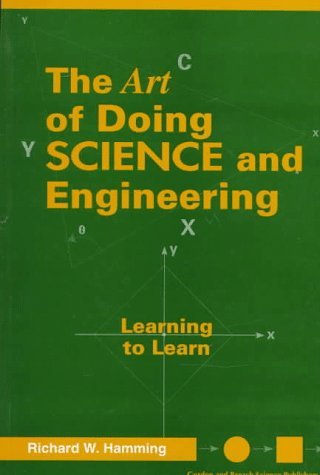
The Art of Doing Science and Engineering: Learning to Learn
by Richard Hamming
Rating: 4.1 ⭐
• 7 recommendations ❤️
Highly effective thinking is an art that engineers and scientists can be taught to develop. By presenting actual experiences and analyzing them as they are described, the author conveys the developmental thought processes employed and shows a style of thinking that leads to successful results is something that can be learned. Along with spectacular successes, the author also conveys how failures contributed to shaping the thought processes.Provides the reader with a style of thinking that will enhance a person's ability to function as a problem-solver of complex technical issues. Consists of a collection of stories about the author's participation in significant discoveries, relating how those discoveries came about and, most importantly, provides analysis about the thought processes and reasoning that took place as the author and his associates progressed through engineering problems.

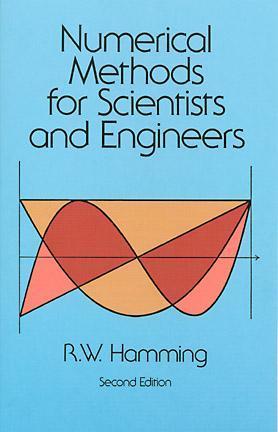
For this inexpensive paperback edition of a groundbreaking classic, the author has extensively rearranged, rewritten, and enlarged the material. Book is unique in its emphasis on the frequency approach and its use in the solution of problems. Contents include: Fundamentals and Algorithms; Polynomial Approximation — Classical Theory; Fourier Approximation — Modern Theory; and Exponential Approximation.

Digital signals occur in an increasing number of in telephone communications; in radio, television, and stereo sound systems; and in spacecraft transmissions, to name just a few. This introductory text examines digital filtering, the processes of smoothing, predicting, differentiating, integrating, and separating signals, as well as the removal of noise from a signal. The processes bear particular relevance to computer applications, one of the focuses of this book.Readers will find Hamming's analysis accessible and engaging, in recognition of the fact that many people with the strongest need for an understanding of digital filtering do not have a strong background in mathematics or electrical engineering. Thus, this book assumes only a knowledge of calculus and a smattering of statistics (reviewed in the text). Adopting the simplest, most direct mathematical tools, the author concentrates on linear signal processing; the main exceptions are the examination of round-off effects and a brief mention of Kalman filters.This updated edition includes more material on the z-transform as well as additional examples and exercises for further reinforcement of each chapter's content. The result is an accessible, highly useful resource for the broad range of people working in the field of digital signal processing.

Offering accessible and nuanced coverage, Richard W. Hamming discusses theories of probability with unique clarity and depth. Topics covered include the basic philosophical assumptions, the nature of stochastic methods, and Shannon entropy. One of the best introductions to the topic, The Art of Probability is filled with unique insights and tricks worth knowing.
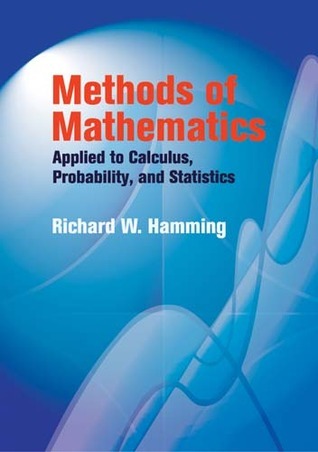
Methods of Mathematics Applied to Calculus, Probability, and Statistics
by Richard Hamming
Rating: 4.2 ⭐
Understanding calculus is vital to the creative applications of mathematics in numerous areas. This text focuses on the most widely used applications of mathematical methods, including those related to other important fields such as probability and statistics. The four-part treatment begins with algebra and analytic geometry and proceeds to an exploration of the calculus of algebraic functions and transcendental functions and applications. In addition to three helpful appendixes, the text features answers to some of the exercises. Appropriate for advanced undergraduates and graduate students, it is also a practical reference for professionals. 1985 edition. 310 figures. 18 tables.
Chpt 1-Intro, Chpt 2-Error-Detecting Codes, Chpt 3- Error Correcting Codes, Chpt 4-Variable-Length Huffman, Chpt 5-Miscellaneous Codes, Chpt 6-Entropy and Shannon's first Theorem, Chpt 7- Channel and Mutual Information, Chpt 8- Channel Capacity, Chpt 9- Some Mathematical Preliminaries, Chpt 10- Shannon's Main Theorem, Chpt 11- Algebraic Coding, Appendix Bandwidth and the Sample Theorem, Appendix Some tables for Entropy Calculations.
Hamming's response to Eugene Wigner's article entitled "The Unreasonable Effectiveness of Mathematics in the Natural Sciences", published in 1960. This response was originally published as part of the American Mathematical Monthly, Vol. 87, No. 2, Feb., 1980. Hamming expands on Wigner's ideas, tackling on the question implied on the title of the response, although doing so loosely as to leave the question open.
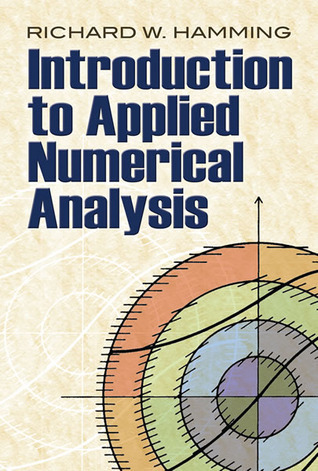
This book by a prominent mathematician is appropriate for a single-semester course in applied numerical analysis for computer science majors and other upper-level undergraduate and graduate students. Although it does not cover actual programming, it focuses on the applied topics most pertinent to science and engineering professionals.An extensive range of topics includes round-off and function evaluation, real zeros of a function, simultaneous linear equations and matrices, interpolation and roundoff estimation, integration, and ordinary differential equations. Additional subjects include optimization, least squares, orthogonal functions, Fourier series, Chebyshev approximation, and random processes. The author stresses the teaching of mathematical concepts through visual aids, and numerous diagrams and illustrations complement the text.
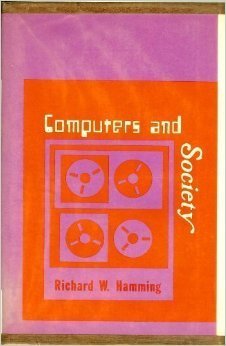
1972--McGraw Hill Inc.---Softcover

EOU Numerical Methods for Scientists and Engineers
by Richard Hamming
munerical Methods for Scientists and Engineers
by Richard Hamming