
Gilbert Strang
William Gilbert Strang (born November 27, 1934), usually known as simply Gilbert Strang or Gil Strang, is an American mathematician, with contributions to finite element theory, the calculus of variations, wavelet analysis and linear algebra. He has made many contributions to mathematics education, including publishing seven mathematics textbooks and one monograph. Strang is the MathWorks Professor of Mathematics at the Massachusetts Institute of Technology. He teaches Introduction to Linear Algebra and Computational Science and Engineering and his lectures are freely available through MIT OpenCourseWare.
30 Books Written
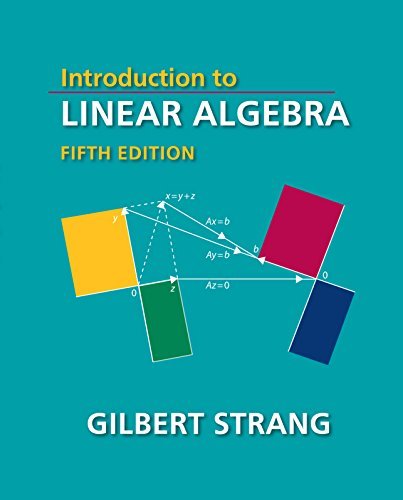
Linear algebra is something all mathematics undergraduates and many other students, in subjects ranging from engineering to economics, have to learn. The fifth edition of this hugely successful textbook retains all the qualities of earlier editions, while at the same time seeing numerous minor improvements and major additions. The latter include: - A new chapter on singular values and singular vectors, including ways to analyze a matrix of data - A revised chapter on computing in linear algebra, with professional-level algorithms and code that can be downloaded for a variety of languages - A new section on linear algebra and cryptography - A new chapter on linear algebra in probability and statistics. A dedicated and active website also offers solutions to exercises as well as new exercises from many different sources (including practice problems, exams, and development of textbook examples), plus codes in MATLAB(R), Julia, and Python.
Renowned professor and author Gilbert Strang demonstrates that linear algebra is a fascinating subject by showing both its beauty and value. While the mathematics is there, the effort is not all concentrated on proofs. Strang's emphasis is on understanding. He explains concepts, rather than deduces. This book is written in an informal and personal style and teaches real mathematics. The gears change in Chapter 2 as students reach the introduction of vector spaces. Throughout the book, the theory is motivated and reinforced by genuine applications, allowing pure mathematicians to teach applied mathematics.
Gilbert Strang's Calculus textbook is ideal both as a course companion and for self study. The author has a direct style. His book presents detailed and intensive explanations. Many diagrams and key examples are used to aid understanding, as well as the application of calculus to physics and engineering and economics. The text is well organized, and it covers single variable and multivariable calculus in depth. An instructor's manual and student guide are available online at
Student Solutions Manual for Strang's Linear Algebra and Its Applications, 4th Edition
by Gilbert Strang
Rating: 3.9 ⭐
Includes detailed step-by-step solutions to selected odd-numbered problems.
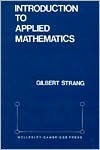
Renowned applied mathematician Gilbert Strang teaches applied mathematics with the clear explanations, examples and insights of an experienced teacher. This book progresses steadily through a range of topics from symmetric linear systems to differential equations to least squares and Kalman filtering and optimization. It clearly demonstrates the power of matrix algebra in engineering problem solving. This is an ideal book (beloved by many readers) for a first course on applied mathematics and a reference for more advanced applied mathematicians. The only prerequisite is a basic course in linear algebra.

Linear algebra and the foundations of deep learning, together at last! From Professor Gilbert Strang, acclaimed author of Introduction to Linear Algebra, comes Linear Algebra and Learning from Data, the first textbook that teaches linear algebra together with deep learning and neural nets. This readable yet rigorous textbook contains a complete course in the linear algebra and related mathematics that students need to know to get to grips with learning from data. Included are: the four fundamental subspaces, singular value decompositions, special matrices, large matrix computation techniques, compressed sensing, probability and statistics, optimization, the architecture of neural nets, stochastic gradient descent and backpropagation.
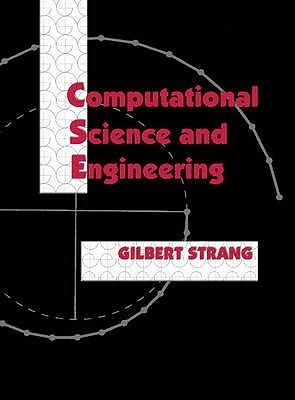
Encompasses the full range of computational science and engineering from modelling to solution, both analytical and numerical. It develops a framework for the equations and numerical methods of applied mathematics. Gilbert Strang has taught this material to thousands of engineers and scientists (and many more on MIT's OpenCourseWare 18.085-6). His experience is seen in his clear explanations, wide range of examples, and teaching method. The book is solution-based and not formula-based: it integrates analysis and algorithms and MATLAB codes to explain each topic as effectively as possible. The topics include applied linear algebra and fast solvers, differential equations with finite differences and finite elements, Fourier analysis and optimization. This book also serves as a reference for the whole community of computational scientists and engineers. Supporting resources, including MATLAB codes, problem solutions and video lectures from Gilbert Strang's 18.085 courses at MIT, are provided at math.mit.edu/cse.

Calculus is designed for the typical two- or three-semester general calculus course, incorporating innovative features to enhance student learning. The book guides students through the core concepts of calculus and helps them understand how those concepts apply to their lives and the world around them. Due to the comprehensive nature of the material, we are offering the book in three volumes for flexibility and efficiency. Volume 2 covers integration, differential equations, sequences and series, and parametric equations and polar coordinates..

Calculus is designed for the typical two- or three-semester general calculus course, incorporating innovative features to enhance student learning. The book guides students through the core concepts of calculus and helps them understand how those concepts apply to their lives and the world around them. Due to the comprehensive nature of the material, we are offering the book in three volumes for flexibility and efficiency. Volume 1 covers functions, limits, derivatives, and integration.Please note that this title is published under a CC BY-NC-SA 4.0 license, which means that you are free to use and adapt, but not for commercial purposes. Changes you make need to be shared using this license.

This book explains wavelets to both engineers and mathematicians. It approaches the subject with a major emphasis on the filter structures attached to wavelets. Those filters are the key to algorithmic efficiency and they are well developed throughout signal processing. Now they make possible major achievements in data analysis and compression. The explanations of difficult topics are direct, rigorous and very approachable. Many practical applications are discussed. The book is ideal as an introduction to the principles of wavelets and as a reference for the analysis and applications. Also included in Wavelets and Filter Banks are many examples to make effective use of the MATLAB Wavelet Toolbox.

Calculus is designed for the typical two- or three-semester general calculus course, incorporating innovative features to enhance student learning. The book guides students through the core concepts of calculus and helps them understand how those concepts apply to their lives and the world around them. Due to the comprehensive nature of the material, we are offering the book in three volumes for flexibility and efficiency. Volume 3 covers parametric equations and polar coordinates, vectors, functions of several variables, multiple integration, and second-order differential equations.
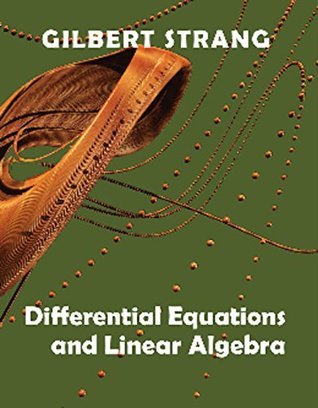
Differential equations and linear algebra are two central topics in the undergraduate mathematics curriculum. This innovative textbook allows the two subjects to be developed either separately or together, illuminating the connections between two fundamental topics, and giving increased flexibility to instructors. It can be used either as a semester-long course in differential equations, or as a one-year course in differential equations, linear algebra, and applications. Beginning with the basics of differential equations, it covers first and second order equations, graphical and numerical methods, and matrix equations. The book goes on to present the fundamentals of vector spaces, followed by eigenvalues and eigenvectors, positive definiteness, integral transform methods and applications to PDEs. The exposition illuminates the natural correspondence between solution methods for systems of equations in discrete and continuous settings. The topics draw on the physical sciences, engineering and economics, reflecting the author's distinguished career as an applied mathematician and expositor.
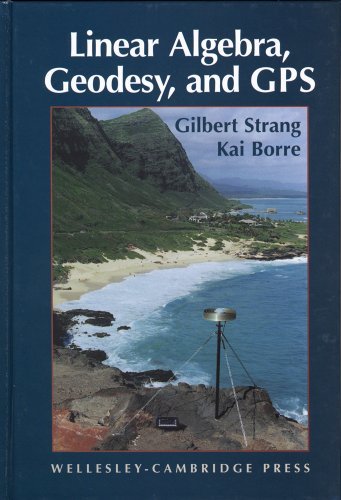
Linear Algebra, Geodesy and GPS discusses algorithms, generally expressed in MATLAB, for geodesy and global positioning. Three parts cover basic linear algebra, the application to the (linear and also nonlinear) science of measurement, and the GPS system and its applications. This book has many strengths. It offers a variety of points of view. It is complete, helpful, and you may find an explanation that appeals to you. .A popular article from (June 1997) "The Mathematics of GPS" is included as an introduction. Annotation c. by Book News, Inc., Portland, Or. Part I: Linear Algebra. Chapter 1: Vectors and Matrices; Chapter 2: Solving Linear Equations; Chapter 3: Vector Spaces and Subspaces; Chapter 4: Orthogonality; Chapter 5: Determinants; Chapter 6: Eigenvalues and Eigenvectors; Chapter 7: Linear Transformations. Part II: Geodesy. Chapter 8: Leveling Networks; Chapter 9: Random Variables and Covariance Matrices; Chapter 10: Nonlinear Problems; Chapter 11: Linear Algebra for Weighted Least Squares; Chapter 12: Constraints for Singular Normal Equations; Chapter 13: Problems with Explicit Solutions. Part III: Global Positioning System (GPS). Chapter 14: Global Positioning System; Chapter 15: Processing of GPS Data; Chapter 16: Random Processes; Chapter 17: Kalman Filters.
This second edition has two parts. The first part is the complete classic by Gilbert Strang and George Fix, first published in 1973. The original book demonstrates the solid mathematical foundation of the finite element idea, and the reasons for its success. The second part is a new textbook by Strang. It provides examples, codes, and exercises to connect the theory of the Finite Element Method directly to the applications. The reader will learn how to assemble the stiffness matrix K and solve the finite element equations KU=F. Discontinuous Galerkin methods with a numerical flux function are now included. Strang's approach is direct and focuses on learning finite elements by using them.

Linear algebra has become the subject to know for people in quantitative disciplines of all kinds. No longer the exclusive domain of mathematicians and engineers, it is now used everywhere there is data and everybody who works with data needs to know more. This new book from Professor Gilbert Strang, author of the acclaimed Introduction to Linear Algebra, now in its fifth edition, makes linear algebra accessible to everybody, not just those with a strong background in mathematics. It takes a more active start, beginning by finding independent columns of small matrices, leading to the key concepts of linear combinations and rank and column space. From there it passes on to the classical topics of solving linear equations, orthogonality, linear transformations and subspaces, all clearly explained with many examples and exercises. The last major topics are eigenvalues and the important singular value decomposition, illustrated with applications to differential equations and image compression. A final optional chapter explores the ideas behind deep learning.

Diese Einführung in die lineare Algebra bietet einen sehr anschaulichen Zugang zum Thema. Die englische Originalausgabe wurde rasch zum Standardwerk in den Anfängerkursen des Massachusetts Institute of Technology sowie in vielen anderen nordamerikanischen Universitäten. Auch hierzulande ist dieses Buch als Grundstudiumsvorlesung für alle Studenten hervorragend lesbar. Darüber hinaus gibt es neue Impulse in der Mathematikausbildung und folgt dem Trend hin zu Anwendungen und Interdisziplinarität. Inhaltlich umfasst das Werk die Grundkenntnisse und die wichtigsten Anwendungen der linearen Algebra und eignet sich hervorragend für Studierende der Ingenieurwissenschaften, Naturwissenschaften, Mathematik und Informatik, die einen modernen Zugang zum Einsatz der linearen Algebra suchen. Ganz klar liegt hierbei der Schwerpunkt auf den Anwendungen, ohne dabei die mathematische Strenge zu vernachlässigen. Im Buch wird die jeweils zugrundeliegende Theorie mit zahlreichen Beispielen aus der Elektrotechnik, der Informatik, der Physik, Biologie und den Wirtschaftswissenschaften direkt verknüpft. Zahlreiche Aufgaben mit Lösungen runden das Werk ab.

The renowned mathematician and educator Gilbert Strang presents a collection of expository papers on the theory and applications of linear algebra, accompanied by video lectures on The essays are diverse in scope and range from purely theoretical studies on deep fundamental principles of matrix algebra to discussions on the teaching of calculus and an examination of the mathematical foundations of aspects of computational engineering. One thing these essays have in common is the way that they express both the importance and the beauty of the subject, as well as the author's passion for mathematics. This text will be of practical use to students and researchers across a whole spectrum of numerate disciplines. Furthermore, this collection provides a unique perspective on mathematics and the communication thereof as a human endeavour, complemented as these essays are by commentary from the author regarding their provenance and the reaction to them.

Das Ziel des nun auch in deutscher Übersetzung erhältlichen Buches ist es, angewandte Mathematik und Ingenieurmathematik so darzustellen, wie sie heutzutage Anwendung findet. Das Buch basiert auf dem Kurs „Wissenschaftliches Rechnen" des Massachusetts Institute of Technology und versucht, Konzepte und Algorithmen zusammenzuführen. Beginnend mit der angewandten linearen Algebra entwickeln die Autoren die Methoden der finiten Differenzen und finiten Elemente – stets in Verbindung mit Anwendungen in zahlreichen Wissensgebieten.
The emergence of satellite technology has changed the lives of millions of people. In particular, GPS has brought an unprecedented level of accuracy to the field of geodesy. This text is a guide to the algorithms and mathematical principles that account for the success of GPS technology and replaces the authors' previous work, Linear Algebra, Geodesy, and GPS (1997). An initial discussion of the basic concepts, characteristics and technical aspects of different satellite systems is followed by the necessary mathematical content which is presented in a detailed and self-contained fashion. At the heart of the matter are the positioning algorithms on which GPS technology relies, the discussion of which will affirm the mathematical contents of the previous chapters. Numerous ready-to-use MATLAB codes are included for the reader. This comprehensive guide will be invaluable for engineers and academic researchers who wish to master the theory and practical application of GPS technology.

ウェーブレット解析とフィルタバンク〈1〉入門編
by Gilbert Strang

ウェーブレット解析とフィルタバンク〈2〉応用編
by Gilbert Strang

Giải tích của ngài Gilbert Strang (Tập Một: Vi phân Hàm Một Biến)
by Gilbert Strang
This first volume in Huy Bui's exceptional series of Vietnamese translations of the English works Calculus in the mathematical science is a comprehensive, elementary introduction to differentiation of functions of one variable by one faculty member from Massachusetts Institute of Technology. It is ideal both as a course companion and for self-study.

Strain differential calculus
by Gilbert Strang
Strain differential calculusb A book to help students understand differential calculus successfully bMathematics is not a formula, a calculation, a proof, but an idea!Gilbert, a mathematics professor at Massachusetts Institute of Technology This book by Strang is for students in natural sciences and engineering who need mathematics as an applied discipline. Rather than focusing on the formulas and calculations of derivatives and integrals, it explains key ideas that can be understood and applied to real cases. It provides a wealth of key examples and exercises that apply calculus to a variety of fields such as physics, engineering, medicine, and economics, helping to understand using a variety of diagrams and charts. This allows us to develop not only mathematical thinking and insight, but also application.

Linear Algebra and Its Applications
by Gilbert Strang
Linear algebra and its applications
by Gilbert Strang
Linear algebra and its applicationsThis "Linear Algebra and Its Applications, Fourth Edition" is a full translation of Gilbert Strangs "Linear Algebra and Its Applications, fourth edition". The author has written this book to reflect a new view of linear algebra, as revealed in the introduction to Chapter 7. While the underlying theory is almost intact, it emphasizes diverse applications and applications compared to other textbooks that deal abstractly with linear algebra.

Calculus
by Gilbert Strang
Lineĭnar algebra i ee primenenii¸ a¸¡
by Gilbert Strang
[Essays in Linear Algebra] [By: Strang, Gilbert] [February, 2012]
by Gilbert Strang