
Edward R. Tufte
Edward Rolf Tufte (born 1942 in Kansas City, Missouri to Virginia and Edward E. Tufte), a professor emeritus of statistics, graphic design, and political economy at Yale University has been described by The New York Times as "the Leonardo da Vinci of Data". He is an expert in the presentation of informational graphics such as charts and diagrams, and is a fellow of the American Statistical Association. Tufte has held fellowships from the Guggenheim Foundation and the Center for Advanced Studies in Behavioral Sciences. Tufte currently resides in Cheshire, Connecticut. He periodically travels around the United States to offer one-day workshops on data presentation and information graphics. Note: Some books by this author have been published under the name Edward Tufte.
14 Books Written

The celebrated design professor here tackles the question of how best to communicate real-life experience in a two-degree format, whether on the printed page or the computer screen. The Whole Earth Review called Envisioning Information a "passionate, elegant revelation."
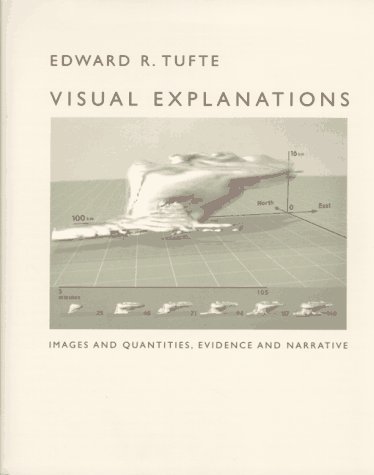
Visual Explanations: Images and Quantities, Evidence and Narrative
by Edward R. Tufte
Rating: 4.3 ⭐
• 4 recommendations ❤️
Few would disagree: Life in the information age can be overwhelming. Through computers, the Internet, the media, and even our daily newspapers, we are awash in a seemingly endless stream of charts, maps, infographics, diagrams, and data. Visual Explanations is a navigational guide through this turbulent sea of information. The book is an essential reference for anyone involved in graphic, web, or multimedia design, as well as for educators and lecturers who use graphics in presentations or classes.Jacket design: Dmitry Krasny.Other artwork by Bonnie Scranton, Dmitry Krasny, and Weilin Wu.
The classic book on statistical graphics, charts, tables. Theory and practice in the design of data graphics, 250 illustrations of the best (and a few of the worst) statistical graphics, with detailed analysis of how to display data for precise, effective, quick analysis. Design of the high-resolution displays, small multiples. Editing and improving graphics. The data-ink ratio. Time-series, relational graphics, data maps, multivariate designs. Detection of graphical deception: design variation vs. data variation. Sources of deception. Aesthetics and data graphical displays. This is the second edition of The Visual Display of Quantitative Information. Recently published, this new edition provides excellent color reproductions of the many graphics of William Playfair, adds color to other images, and includes all the changes and corrections accumulated during 17 printings of the first edition.

Science and art have in common intense seeing, the wide-eyed observing that generates visual information. Beautiful Evidence is about how seeing turns into showing, how data and evidence turn into explanation. The book identifies excellent and effective methods for showing nearly every kind of information, suggests many new designs (including sparklines), and provides analytical tools for assessing the credibility of evidence presentations (which are seen from both sides: how to produce and how to consume presentations). For alert consumers of presentations, there are chapters on diagnosing evidence corruption and PowerPoint pitches. Beautiful Evidence concludes with two chapters that leave the world of pixel and paper flatland representations - and move onto seeing and thinking in space land, the real-land of three-space and time.

Describes how to improve PowerPoint presentations.
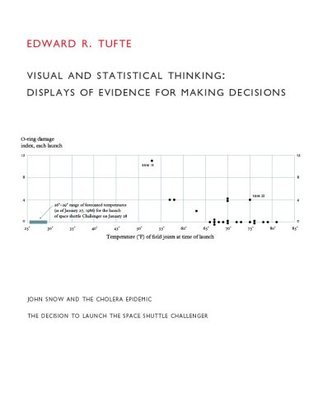
Visual and Statistical Thinking: Displays of Evidence for Making Decisions
by Edward R. Tufte
Rating: 4.3 ⭐
This booklet reprints chapter 2 of Visual Explanations by the same author, analyzing a cholera epidemic in London in 1854 and the evidence used to decide to launch the space shuttle Challenger in 1986. Topics include cause and effect, data errors and credibility, evidence selection, and statistical graphics. For teaching data analysis and evidence in excision making.

The Thinking Eye 4. 1 Meaning And See With Fresh Eyes, Question Everything, Remodel Conventional Models 6. 2 Content-Responsive Typography, Redesigning Sentences, Paragraphs, Labels 49. 3 Graphical Nouns And Verbs, Structure And Function 64. 4 Data Analysis When Truth On The Relationship Between Evidence And Conclusions. Remodeling Statistical Practice And Teaching 81. 5 Explanatory Words, Numbers, Graphics, Images, Organized By Content-Responsive Local Grids. Is Thinking Just Annotating The World? 121. 6 Instructions At Point Of Need 131. 7 Theory And Practice 141. 8 Smarter And Shorter Remodeling Nonfiction Presentations 150. 9 A Visual Index, A Quilt Of Sources And Remodeling The Back-Matter In Books 162.

Speculations about the effects of politics on economic life have a long and vital tradition, but few efforts have been made to determine the precise relationship between them. Edward Tufte, a political scientist who covered the 1976 Presidential election for Newsweek , seeks to do just that. His sharp analyses and astute observations lead to an eye-opening view of the impact of political life on the national economy of America and other capitalist democracies.The analysis demonstrates how politicians, political parties, and voters decide who gets what, when, and how in the economic arena. A nation's politics, it is argued, shape the most important aspects of economic life--inflation, unemployment, income redistribution, the growth of government, and the extent of central economic control. Both statistical data and case studies (based on interviews and Presidential documents) are brought to bear on four topics. They 1) the political manipulation of the economy in election years, 2) the new international electoral-economic cycle, 3) the decisive role of political leaders and parties in shaping macroeconomic outcomes, and 4) the response of the electorate to changing economic conditions. Finally, the book clarifies a central question in political How can national economic policy be conducted in both a democratic and a competent fashion?

Visual Design of the User Interface
by Edward R. Tufte
Information especially prepared for the IBM design program by Edward R. Tufte in 1989.A multiple-GIF version of this publication is available on the Edward Tufte forum (on the author's website, edwardtufte . com), under the name ET booklet: Visual Design of the User Interface.

The Visual Display of Quantitative Information
by Edward R. Tufte
The Visual Display of Quantitative Information by Edward R. Tufte
by Edward R. Tufte
Visual and Statistical Thinking: Displays of Evidence for Making Decisions by Edward R. Tufte
by Edward R. Tufte