
Ptolemy
Geocentric model of Greek astronomer and geographer Ptolemy, who flourished in 2nd century at Alexandria, for the universe dominated cosmological theory until the Renaissance. Ptolemy compiled Almagest , a comprehensive treatise on astronomy, geography, and mathematics, about 150. The Ptolemaic system dominated medieval cosmology until Nicolaus Copernicus contradicted it. Claudius Ptolemy (circa 90 – circa 168), a Roman citizen of Egypt, wrote. As a poet, he composed a single epigram in the Anthology. He lived in Egypt under Roman rule. Theodore Meliteniotes proposed possibly correct but late and unsupported birthplace in the town of Ptolemais Hermiou in the Thebaid circa 1360. No reason exists to suppose that he ever lived anywhere else. Ptolemy authored at least three works of continuing importance to later Islamic and European science. People first knew originally Μαθηματικὴ Σύνταξις, "Mathematical Treatise"). The second Geography thoroughly discusses the knowledge of the Roman world. In the third, known sometimes as the Apotelesmatika (Ἀποτελεσματικά), more commonly as the Tetrabiblos (Τετράβιβλος, and in Latin as the Quadripartitum or four books, he attempted to adapt horoscopes to the Aristotelian natural philosophy of his day.
28 Books Written

The Almagest: Introduction to the Mathematics of the Heavens
by Ptolemy
Rating: 3.7 ⭐
• 2 recommendations ❤️
The Almagest is by far the greatest work in astronomy in ancient times. In a massive series of thirteen books, Ptolemy shows how every detail of the motions of the sun, moon, planets, and stars can be expressed using geometrical models that can be used to compute celestial positions with remarkable accuracy The present selection covers all the essential features of Ptolemy s treatment of the heavens, omitting only more difficult and abstruse matters such as the moon s motion and the calculation of eclipses. In the interest of conciseness, development of planetary theories is restricted to two planets, one inferior (Venus) and one superior (Mars). Ptolemy s text is accompanied by extensive notes and introductions that are aimed at making the book accessible to students encountering Ptolemy for the first time. This edition is designed to provide everything needed for a one-semester course, or it can be a component of a more general course on planetary theory or history of astronomy."

The "Tetrabiblos" of the famous astronomer, astrologer, and geographer Claudius Ptolemaeus (c. 100-178 CE) of Egypt consists of four books. The title given in some manuscripts meaning 'Mathematical Treatise in Four Books', in others 'The Prognostics addressed to Syrus'. The subject of the work is astrology, which in Ptolemy's time as down to the Renaissance was fused as a respectable science with astronomy. Translations and commentaries of the "Tetrabiblos" are few, and only three Greek texts had been printed (all in the 16th century) before the present text, begun by F. Boll and finished by Emilie Boer in 1940.

Second-century classic of civilization listed over 8,000 places in Europe, Africa and Asia, tabulated according to latitude and longitude. Excellent reproduction of the rare first and definitive English translation, published in a limited edition of 250 copies by the New York Public Library. Included are 27 maps.
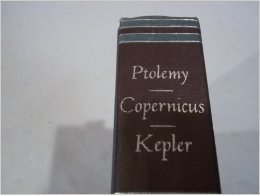
Ptolemy (C. 100-C. 178) The Almagest Copernicus (1473–1543) On the Revolutions of the Heavenly Spheres Kepler (1571-1630) Epitome of Copernican IV – V The Harmonies of the V

Ptolemy's Geography is the only book on cartography to have survived from the classical period and one of the most influential scientific works of all time. Written in the second century AD, for more than fifteen centuries it was the most detailed topography of Europe and Asia available and the best reference on how to gather data and draw maps. Ptolemy championed the use of astronomical observation and applied mathematics in determining geographical locations. But more importantly, he introduced the practice of writing down coordinates of latitude and longitude for every feature drawn on a world map, so that someone else possessing only the text of the Geography could reproduce Ptolemy's map at any time, in whole or in part, at any scale.Here Berggren and Jones render an exemplary translation of the Geography and provide a thorough introduction, which treats the historical and technical background of Ptolemy's work, the contents of the Geography, and the later history of the work.

Ptolemy's work in ancient times laid the foundations for our modern understanding of the universe. Now in a digestible, pocket format for the modern reader.Ptolemy’s great astronomical work, which we know as The Almagest , brought together the ideas of Greek Antiquity, based on Aristotle some 400 years earlier, that the sun and planets revolved around the earth. This geocentric view which was inherited by Byzantine and Islamic scholars until Copernicus’ observations 1400 years later, placed the sun at the focal point of the solar system. For centuries Ptolemy’s methods were sufficient to predict solar and lunar eclipses and his work was translated into Latin in the 12th century, spreading its use across western Europe. This new, accessible edition brings the learning of the past to readers of today.The FLAME TREE Foundations series features core publications which together have shaped the cultural landscape of the modern world, with cutting-edge research distilled into pocket guides designed to be both accessible and informative.

Tetrabiblos 'four books', also known in Greek as Apotelesmatika "Effects," and in Latin as Quadripartitum "Four Parts," is a text on the philosophy and practice of astrology, written in the 2nd century AD by the Alexandrian scholar Claudius Ptolemy (c. AD 90-c. AD 168).

Die Bibliotheca Teubneriana, established in 1849, has evolved into the world's most venerable and extensive series of editions of Greek and Latin literature, ranging from classical to Neo-Latin texts. Some 4-5 new editions are published every year. A team of renowned scholars in the field of Classical Philology acts as advisory board: Gian Biagio Conte (Scuola Normale Superiore di Pisa)James Diggle (University of Cambridge)Donald J. Mastronarde (University of California, Berkeley)Franco Montanari (Universit� di Genova)Heinz-G�nther Nesselrath (Georg-August-Universit�t G�ttingen)Dirk Obbink (University of Oxford)Oliver Primavesi (Ludwig-Maximilians Universit�t M�nchen)Michael D. Reeve (University of Cambridge)Richard J. Tarrant (Harvard University) Formerly out-of-print editions are offered as print-on-demand reprints. Furthermore, all new books in the Bibliotheca Teubneriana series are published as eBooks. The older volumes of the series are being successively digitized and made available as eBooks.If you are interested in ordering an out-of-print edition, which hasn't been yet made available as print-on-demand reprint, please contact us: Kerstin.Haensch@degruyter.com All editions of Latin texts published in the Bibliotheca Teubneriana are collected in the online database BTL Online.

This book is a work of geography, astronomy and artwork of historical significance. Ptolemy was cartographer of the 2nd Century, and this work represent a scientific compilation of the body of western civilization's knowledge of the geography of the earth at that point in time. He regarded the earth as the center of the universe and locations on the map were derived via astronomy. This is a large, handsome "coffee table" display book.

Best known for his 1906 discovery of lost texts in the Archimedes Palimpsest, Danish scholar Johan Ludvig Heiberg (1854 1928), professor of classical philology at Copenhagen, published numerous editions of ancient mathematicians, including Archimedes and Apollonius of Perga (also reissued in this series). Between 1898 and 1907, he published in three parts the extant astronomical works of Ptolemy, active in second-century Alexandria. The Ptolemaic system, his geocentric model of the universe, prevailed in the Islamic world and in medieval Europe until the time of Copernicus. This first part of Volume 1, published in 1898, contains a brief Latin preface and the Greek text of Books 1-6 of Ptolemy's major astronomical treatise, known as the Almagest. It demonstrates how to use astronomical observations to construct cosmological models and includes tables that make it possible for celestial phenomena to be calculated for arbitrary dates.

Excerpt from Ptolemy's Tetrabiblos, or QuadripartiteThe arcana of Astrology constituted a main feature in the doctrines of the Persian Magi; and it further appears, by Newton's Chronology, p. 347, that Zoroaster (although the aera of his life has been erroneously assigned to various remoter periods) lived in the reign of Darius Hystaspis, about 520 b.c., and assisted Hystaspes, the father of Darius, in reforming the Magi, of whom the said Hystaspes was Master. Newton adds, p. 352, that about the same time with Hystaspes and Zoroaster, lived also Ostanes, another eminent Magus Pliny places him under Darius Hystaspis, and Suidas makes him the follower of Zoroaster he came into Greece with Xerxes about 480 b.c., and seems to be the Otanes of Herodotus. In his book, called the Octateuchus, he taught the same doctrine of the Deity as Zoroaster....

Excerpt from Claudii Ptolemaei Geographia
Leather Binding on Spine and Corners with Golden leaf printing on spine. This book is printed in black & white, Sewing binding for longer life, where the book block is actually sewn (smythe sewn/section sewn) with thread before binding which results in a more durable type of binding. Reprinted in 2022 with the help of original edition published long back 1885. As this book is reprinted from a very old book, there could be some missing or flawed pages. If it is multi vo Resized as per current standards. We expect that you will understand our compulsion with such books. 399 Ancient India as Described by Ptolemy Being a Translation of the Chapters which Describe India and Central and Eastern Asia in the Treatise on Geography Written by Klaudios Ptolemaios, the Celebrated Astronomer : with Introduction, Commentary, Map of India According to Ptolemy, and a Very Copious Index 1885 Ptolemy

Geographia Cosmographia by Ptolemy
by Ptolemy
The Geography (Greek: Γεωγραφικὴ Ὑφήγησις, Geōgraphikḕ Hyphḗgēsis, lit. "Geographical Guidance"), also known by its Latin names as the Geographia and the Cosmographia, is a gazetteer, an atlas, and a treatise on cartography, compiling the geographical knowledge of the 2nd-century Roman Empire. Originally written by Claudius Ptolemy in Greek at Alexandria around AD 150, the work was a revision of a now-lost atlas by Marinus of Tyre using additional Roman and Persian gazetteers and new principles.[1] Its translation into Arabic in the 9th century and Latin in 1406 was highly influential on the geographical knowledge and cartographic traditions of the medieval Caliphate and Renaissance Europe.

Excerpt from Claudii Ptolemaei Opera Quae Exstant OmniaV. Ptolemaios Hegi xgnngz'ov xaì 7)yep ovmofi und die Stoa, Wien. Stud. 39 (1918) 249  258. Eine neue Quelle fur die Philo sophie der mittleren Stoa I. Ebda. 41 (1920) 113  121, II. 42 34  46. Zur Erkenntnislehre der spà teren Stoa, Herrn. 57 (1922) 171  188. Nuper accessit Hellonistische Medizin bei Ptolemaios und Nemesios. Ein Beitrag zur Geschichte der christ lichen Anthropologie, Philol. 94 (1940) 125  141.

Excerpt from Ptolemy’s Tetrabiblos, or Being Four Books of the Influence of the StarsOF all sciences, whether true or false, which have at any time engaged the attention of the world, there is not one of which the real or assumed principles are less generally known, in the present age, than those of As trology. The whole doctrine of this science is com monly understood to have been completely overturned.About the PublisherForgotten Books publishes hundreds of thousands of rare and classic books. Find more at www.forgottenbooks.comThis book is a reproduction of an important historical work. Forgotten Books uses state-of-the-art technology to digitally reconstruct the work, preserving the original format whilst repairing imperfections present in the aged copy. In rare cases, an imperfection in the original, such as a blemish or missing page, may be replicated in our edition. We do, however, repair the vast majority of imperfections successfully; any imperfections that remain are intentionally left to preserve the state of such historical works.

The Guide To Astrology: Containing A New And Complete System Of Directions In Genethiacal Astrology
by Ptolemy
This work has been selected by scholars as being culturally important, and is part of the knowledge base of civilization as we know it. This work was reproduced from the original artifact, and remains as true to the original work as possible. Therefore, you will see the original copyright references, library stamps (as most of these works have been housed in our most important libraries around the world), and other notations in the work.This work is in the public domain in the United States of America, and possibly other nations. Within the United States, you may freely copy and distribute this work, as no entity (individual or corporate) has a copyright on the body of the work.As a reproduction of a historical artifact, this work may contain missing or blurred pages, poor pictures, errant marks, etc. Scholars believe, and we concur, that this work is important enough to be preserved, reproduced, and made generally available to the public. We appreciate your support of the preservation process, and thank you for being an important part of keeping this knowledge alive and relevant.

This work has been selected by scholars as being culturally important, and is part of the knowledge base of civilization as we know it. This work was reproduced from the original artifact, and remains as true to the original work as possible. Therefore, you will see the original copyright references, library stamps (as most of these works have been housed in our most important libraries around the world), and other notations in the work.This work is in the public domain in the United States of America, and possibly other nations. Within the United States, you may freely copy and distribute this work, as no entity (individual or corporate) has a copyright on the body of the work.As a reproduction of a historical artifact, this work may contain missing or blurred pages, poor pictures, errant marks, etc. Scholars believe, and we concur, that this work is important enough to be preserved, reproduced, and made generally available to the public. We appreciate your support of the preservation process, and thank you for being an important part of keeping this knowledge alive and relevant.
Almagest, Part 1
by Ptolemy
Claudii Ptolemaei Opera Quae Exstant Omnia: Volume 1, Syntaxis Mathematica, Part 1, Libros I-VI
by Ptolemy
Best known for his 1906 discovery of lost texts in the Archimedes Palimpsest, Danish scholar Johan Ludvig Heiberg (1854-1928), professor of classical philology at Copenhagen, published numerous editions of ancient mathematicians, including Archimedes and Apollonius of Perga (also reissued in this series). Between 1898 and 1907, he published in three parts the extant astronomical works of Ptolemy, active in second-century Alexandria. The Ptolemaic system, his geocentric model of the universe, prevailed in the Islamic world and in medieval Europe until the time of Copernicus. This first part of Volume 1, published in 1898, contains a brief Latin preface and the Greek text of Books 1-6 of Ptolemy's major astronomical treatise, known as the Almagest. It demonstrates how to use astronomical observations to construct cosmological models and includes tables that make it possible for celestial phenomena to be calculated for arbitrary dates.

Aclaració Amazon no incluye en la ficha técnica de los libros publicados mediante Createspace el gramaje de las páginas (80 gramos), papel blanco común. Pero sí deja claro que la cubierta es del tipo blanda (Papperback) que es barnizada o mate.La impresión en estas condiciones no es responsabilidad del Editor/Autor sino de CreateSapce, subempresa de Amazon. Aún así, millones de personas del mundo entero compran libros en Amazon editados por Createspace con estas mismas condiciones. También el coste del libro, al ser a todo color, está determinado por Createspace de Amazon, que apenas deja un margen de beneficios de unos 3 Euros para el Autor/Editor como en este caso. En cualquier caso, Amazon siempre acepta devoluciones, si el usuario queda descontento con un producto que haya comprado. CODICE HISPANO DE PTOLEMEO Claudii Ptolomaei Alexandrini CosmographiaIacobvs Angelvs interprete (1401-1500) Edición facsímil Códice en pergamino de 110 folios (56 x 41 cm.) a 2 columnas de 47 líneas.Se conserva en los archivos de la Biblioteca Nacional de España (Signatura Res/255).En el folio 1, orla de estilo humanístico florentino, de entramado vegetal, salteado de aves y angelotes.Capital con el Papa Alejandro acompañado por tres cardenales, recibiendo el manuscrito que le entrega Iacobo Angelo.En el folio 2, gran capital con el autor sosteniendo la esfera.Abundantes capitales iluminadas con decoración vegetal.En el Lib. VIII (a partir del folio 111), 27 mapas a doble página y a página entera coloreadas, títulos en negro y rojo, y puntos de oro para las ciudades importantes.Mapas de Iberia (folio 119-120).

The Library of Alexandria is an independent small business publisher. We specialize in bringing back to live rare, historical and ancient books. This includes manuscripts such classical fiction, philosophy, science, religion, folklore, mythology, history, literature, politics and sacred texts, in addition to secret and esoteric subjects, such occult, freemasonry, alchemy, hermetic, shamanism and ancient knowledge. Our books are available in both print and as digital books.All of our books have been revived by being scanned by people who have passion for knowledge, so there might be some minor formatting imperfections, but we are doing our best to cure them within the spirit of being loyal to the old manuscripts. By purchasing this book you are helping restoring a piece of history for many generations to come to enjoy the fine ancient knowledge that is made available through our modern technology. We sincerely hope you enjoy these treasures in the form of digital books.
Des Claudius Ptolem
by Ptolemy

Opera Quae Exstant Omnia, Vol CB
by Ptolemy
PTOLOMEO, OPERA QUAE EXSTANT FASC. 2: PERI KRITERIU KAI HEGEMONIKIU ED. FR. LAMMER - E. BOER [HARDBACK] . LEIPZIG, 1961, xxxiv 70 p. tablas.Encuadernacion original. Nuevo.

Claudii Ptolemaei Geographia, Volumen I
by Ptolemy
This is a reproduction of a book published before 1923. This book may have occasional imperfections such as missing or blurred pages, poor pictures, errant marks, etc. that were either part of the original artifact, or were introduced by the scanning process. We believe this work is culturally important, and despite the imperfections, have elected to bring it back into print as part of our continuing commitment to the preservation of printed works worldwide. We appreciate your understanding of the imperfections in the preservation process, and hope you enjoy this valuable book.

French, Latin
English, Greek (translation)
Written primarily in Greek, 1961 edition.