
B.A. Dubrovin
14 Books Written
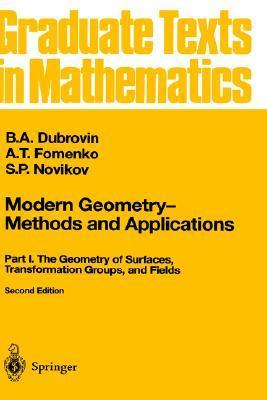
Modern Geometry ― Methods and Applications: Part I: The Geometry of Surfaces, Transformation Groups, and Fields
by B.A. Dubrovin
Rating: 4.5 ⭐
• 2 recommendations ❤️
This is the first volume of a three-volume introduction to modern geometry which emphasizes applications to other areas of mathematics and theoretical physics. Topics covered include tensors and their differential calculus, the calculus of variations in one and several dimensions, and geometric field theory. This new edition offers substantial revisions, and the material is written in concrete language with terminology acceptable to physicists.

Modern Geometry―Methods and Applications: Part III: Introduction to Homology Theory
by B.A. Dubrovin
Rating: 4.0 ⭐
Libro usado en buenas condiciones, por su antiguedad podria contener señales normales de uso

Modern Geometry― Methods and Applications: Part II: The Geometry and Topology of Manifolds
by B.A. Dubrovin
Rating: 4.0 ⭐
Up until recently, Riemannian geometry and basic topology were not included, even by departments or faculties of mathematics, as compulsory subjects in a university-level mathematical education. The standard courses in the classical differential geometry of curves and surfaces which were given instead (and still are given in some places) have come gradually to be viewed as anachronisms. However, there has been hitherto no unanimous agreement as to exactly how such courses should be brought up to date, that is to say, which parts of modern geometry should be regarded as absolutely essential to a modern mathematical education, and what might be the appropriate level of abstractness of their exposition. The task of designing a modernized course in geometry was begun in 1971 in the mechanics division of the Faculty of Mechanics and Mathematics of Moscow State University. The subject-matter and level of abstractness of its exposition were dictated by the view that, in addition to the geometry of curves and surfaces, the following topics are certainly useful in the various areas of application of mathematics (especially in elasticity and relativity, to name but two), and are therefore essential: the theory of tensors (including covariant differentiation of them); Riemannian curvature; geodesics and the calculus of variations (including the conservation laws and Hamiltonian formalism); the particular case of skew-symmetric tensors (i. e.
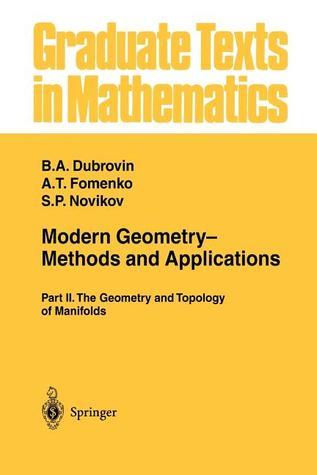
Modern Geometry— Methods and Applications: Part II: The Geometry and Topology of Manifolds
by B.A. Dubrovin
Rating: 3.0 ⭐
Up until recently, Riemannian geometry and basic topology were not included, even by departments or faculties of mathematics, as compulsory subjects in a university-level mathematical education. The standard courses in the classical differential geometry of curves and surfaces which were given instead (and still are given in some places) have come gradually to be viewed as anachronisms. However, there has been hitherto no unanimous agreement as to exactly how such courses should be brought up to date, that is to say, which parts of modern geometry should be regarded as absolutely essential to a modern mathematical education, and what might be the appropriate level of abstractness of their exposition. The task of designing a modernized course in geometry was begun in 1971 in the mechanics division of the Faculty of Mechanics and Mathematics of Moscow State University. The subject-matter and level of abstractness of its exposition were dictated by the view that, in addition to the geometry of curves and surfaces, the following topics are certainly useful in the various areas of application of mathematics (especially in elasticity and relativity, to name but two), and are therefore the theory of tensors (including covariant differentiation of them); Riemannian curvature; geodesics and the calculus of variations (including the conservation laws and Hamiltonian formalism); the particular case of skew-symmetric tensors (i. e.

1 Examples of Manifolds.- §1. The concept of a manifold.- 1.1. Definition of a manifold.- 1.2. Mappings of manifolds; tensors on manifolds.- 1.3. Embeddings and immersions of manifolds. Manifolds with boundary.- §2. The simplest examples of manifolds.- 2.1. Surfaces in Euclidean space. Transformation groups as manifolds.- 2.2. Projective spaces.- 2.3. Exercises.- §3. Essential facts from the theory of Lie groups.- 3.1. The structure of a neighbourhood of the identity of a Lie group. The Lie algebra of a Lie group. Semisimplicity.- 3.2. The concept of a linear representation. An example of a non-matrix Lie group.- §4. Complex manifolds.- 4.1. Definitions and examples.- 4.2. Riemann surfaces as manifolds.- §5. The simplest homogeneous spaces.- 5.1. Action of a group on a manifold.- 5.2. Examples of homogeneous spaces.- 5.3. Exercises.- §6. Spaces of constant curvature (symmetric spaces).- 6.1. The concept of a symmetric space.- 6.2. The isometry group of a manifold. Properties of its Lie algebra.- 6.3. Symmetric spaces of the first and second types.- 6.4. Lie groups as symmetric spaces.- 6.5. Constructing symmetric spaces. Examples.- 6.6. Exercises.- §7. Vector bundles on a manifold.- 7.1. Constructions involving tangent vectors.- 7.2. The normal vector bundle on a submanifold.- 2 Foundational Questions. Essential Facts Concerning Functions on a Manifold. Typical Smooth Mappings.- §8. Partitions of unity and their applications.- 8.1. Partitions of unity.- 8.2. The simplest applications of partitions of unity. Integrals over a manifold and the general Stokes formula.- 8.3. Invariant metrics.- §9. The realization of compact manifolds as surfaces in ?N.- §10. Various properties of smooth maps of manifolds.- 10.1. Approximation of continuous mappings by smooth ones.- 10.2. Sard's theorem.- 10.3. Transversal regularity.- 10.4. Morse functions 86 §.- 11. Applications of Sard's theorem.- 11.1. The existence of embeddings and immersions.- 11.2. The construction of Morse functions as height functions.- 11.3. Focal points.- 3 The Degree of a Mapping. The Intersection Index of Submanifolds. Applications.- §12. The concept of homotopy.- 12.1. Definition of homotopy. Approximation of continuous maps and homotopies by smooth ones.- 12.2. Relative homotopies.- §13. The degree of a map.- 13.1. Definition of degree.- 13.2. Generalizations of the concept of degree.- 13.3. Classification of homotopy classes of maps from an arbitrary manifold to a sphere.- 13.4. The simplest examples.- §14. Applications of the degree of a mapping.- 14.1. The relationship between degree and integral.- 14.2. The degree of a vector field on a hypersurface.- 14.3. The Whitney number. The Gauss-Bonnet formula.- 14.4. The index of a singular point of a vector field.- 14.5. Transverse surfaces of a vector field. The Poincaré-Bendixson theorem.- §15. The intersection index and applications.- 15.1. Definition of the intersection index.- 15.2. The total index of a vector field.- 15.3. The signed number of fixed points of a self-map (the Lefschetz number). The Brouwer fixed-point theorem.- 15.4. The linking coefficient.- 4 Orientability of Manifolds. The Fundamental Group. Covering Spaces (Fibre Bundles with Discrete Fibre).- §16. Orientability and homotopies of closed paths.- 16.1. Transporting an orientation along a path.- 16.2. Examples of non-orientable manifolds.- §17. The fundamental group.- 17.1. Definition of the fundamental group.- 17.2. The dependence on the base point.- 17.3. Free homotopy classes of maps of the circle.- 17.4. Homotopic equivalence.- 17.5. Examples.- 17.6. The fundamental group and orientability.- §18. Covering maps and covering homotopies.- 18.1. The definition and basic properties of covering spaces.- 18.2. The simplest examples. The universal covering.- 18.3. Branched coverings. Riemann surfaces.- 18.4. Covering maps and discrete groups of transformations.- §19. Covering maps and the fundamental group. Computation of the fu
Modern Geometry - Methods and Applications, Part 3: Introduction to Homology Theory
by B.A. Dubrovin
Rating: 3.5 ⭐

Книга включает геометрию пространств Евклида и Минковского, их труппы преобразований, классическую геометрию кривых и поверхностей, тензорный анализ и риманову геометрию, вариационное исчисление и теорию поля, основы теории относительности, геометрию и топологию многообразий, в том числе основы теории гомотопий и расслоений, некоторые их приложения, в частности, к теории калибровочных полей.Основная часть книги рассчитана на студентов --- математиков, механиков, физиков-теоретиков, начиная со 2-го курса университета, и обеспечивает курсы геометрии, читаемые на 2---3 годах обучения. Более сложные разделы книги будут полезны также студентам старших курсов, аспирантам и научным работникам --- математикам, механикам и физикам-теоретикам.

Topological and Algebraic Geometry Methods in Contemporary Mathematical Physics
by B.A. Dubrovin
Rating: 4.0 ⭐

Modern Geometry - Methods and Applications: Part 3: Introduction to Homology Theory
by B.A. Dubrovin
Rating: 4.0 ⭐


Modern geometry--methods and applications
by B.A. Dubrovin

Modern Geometry: Methods and Applications: The Geometry of Surfaces, Transformation Groups, and Fields
by B.A. Dubrovin

Modern Geometry - Methods and Applications: Part I. The Geometry of Surfaces, Transformation Groups, and Fields
by B.A. Dubrovin