
Marvin Minsky
Marvin Lee Minsky (born August 9, 1927) was an American cognitive scientist in the field of artificial intelligence (AI), co-founder of Massachusetts Institute of Technology's AI laboratory, and author of several texts on AI and philosophy. Marvin Lee Minsky was born in New York City to an eye surgeon and a Jewish activist, where he attended The Fieldston School and the Bronx High School of Science. He later attended Phillips Academy in Andover, Massachusetts. He served in the US Navy from 1944 to 1945. He holds a BA in Mathematics from Harvard (1950) and a PhD in mathematics from Princeton (1954). He has been on the MIT faculty since 1958. In 1959 he and John McCarthy founded what is now known as the MIT Computer Science and Artificial Intelligence Laboratory. He is currently the Toshiba Professor of Media Arts and Sciences, and Professor of electrical engineering and computer science.
10 Books Written
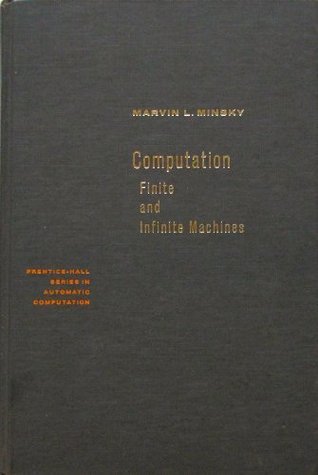
Man has within a single generation found himself sharing the world with a strange new the computers and computer-like machines. Neither history, nor philosophy, nor common sense will tell us how these machines will affect us, for they do not do "work" as did machines of the Industrial Revolution. Instead of dealing with materials or energy, we are told that they handle "control" and "information" and even "intellectual processes." There are very few individuals today who doubt that the computer and its relatives are developing rapidly in capability and complexity, and that these machines are destined to play important (though not as yet fully understood) roles in society's future. Though only some of us deal directly with computers, all of us are falling under the shadow of their ever-growing sphere of influence, and thus we all need to understand their capabilities and their limitations. It would indeed be reassuring to have a book that categorically and systematically described what all these machines can do and what they cannot do, giving sound theoretical or practical grounds for each judgment. However, although some books have purported to do this, it cannot be done for the following a) Computer-like devices are utterly unlike anything which science has ever considered---we still lack the tools necessary to fully analyze, synthesize, or even think about them; and b) The methods discovered so far are effective in certain areas, but are developing much too rapidly to allow a useful interpretation and interpolation of results. The abstract theory---as described in this book---tells us in no uncertain terms that the machines' potential range is enormous, and that its theoretical limitations are of the subtlest and most elusive sort. There is no reason to suppose machines have any limitations not shared by man.
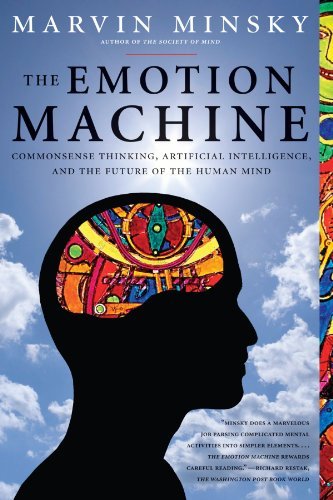
The Emotion Machine: Commonsense Thinking, Artificial Intelligence, and the Future of the Human Mind
by Marvin Minsky
Rating: 3.8 ⭐
• 1 recommendation ❤️
In this mind-expanding book, scientific pioneer Marvin Minsky continues his groundbreaking research, offering a fascinating new model for how our minds work. He argues persuasively that emotions, intuitions, and feelings are not distinct things, but different ways of thinking.By examining these different forms of mind activity, Minsky says, we can explain why our thought sometimes takes the form of carefully reasoned analysis and at other times turns to emotion. He shows how our minds progress from simple, instinctive kinds of thought to more complex forms, such as consciousness or self-awareness. And he argues that because we tend to see our thinking as fragmented, we fail to appreciate what powerful thinkers we really are. Indeed, says Minsky, if thinking can be understood as the step-by-step process that it is, then we can build machines -- artificial intelligences -- that not only can assist with our thinking by thinking as we do but have the potential to be as conscious as we are.Eloquently written, The Emotion Machine is an intriguing look into a future where more powerful artificial intelligences await.

Marvin Minsky -- one of the fathers of computer science and cofounder of the Artificial Intelligence Laboratory at MIT -- gives a revolutionary answer to the age-old "How does the mind work?"Minsky brilliantly portrays the mind as a "society" of tiny components that are themselves mindless. Mirroring his theory, Minsky boldly casts The Society of Mind as an intellectual puzzle whose pieces are assembled along the way. Each chapter -- on a self-contained page -- corresponds to a piece in the puzzle. As the pages turn, a unified theory of the mind emerges, like a mosaic. Ingenious, amusing, and easy to read, The Society of Mind is an adventure in imagination.
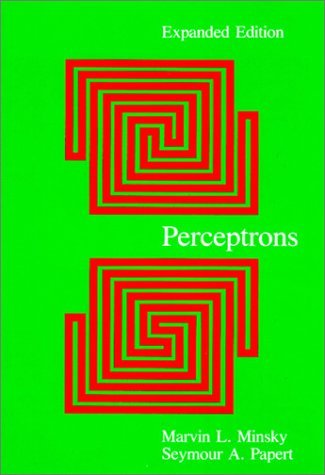
Perceptrons - the first systematic study of parallelism in computation - has remained a classical work on threshold automata networks for nearly two decades. It marked a historical turn in artificial intelligence, and it is required reading for anyone who wants to understand the connectionist counterrevolution that is going on today.Artificial-intelligence research, which for a time concentrated on the programming of ton Neumann computers, is swinging back to the idea that intelligence might emerge from the activity of networks of neuronlike entities. Minsky and Papert's book was the first example of a mathematical analysis carried far enough to show the exact limitations of a class of computing machines that could seriously be considered as models of the brain. Now the new developments in mathematical tools, the recent interest of physicists in the theory of disordered matter, the new insights into and psychological models of how the brain works, and the evolution of fast computers that can simulate networks of automata have given Perceptrons new importance.Witnessing the swing of the intellectual pendulum, Minsky and Papert have added a new chapter in which they discuss the current state of parallel computers, review developments since the appearance of the 1972 edition, and identify new research directions related to connectionism. They note a central theoretical challenge facing connectionism: the challenge to reach a deeper understanding of how "objects" or "agents" with individuality can emerge in a network. Progress in this area would link connectionism with what the authors have called "society theories of mind."

Six essays by artificial intelligence pioneer Marvin Minsky on how education can foster inventiveness, paired with commentary by Minsky's former colleagues and students.Marvin Minsky was a pioneering researcher in artificial intelligence whose work led to both theoretical and practical advances. His work was motivated not only by technological advancement but also by the desire to understand the workings of our own minds. Minsky's insights about the mind provide fresh perspectives on education and how children learn. This book collects for the first time six essays by Minsky on children, learning, and the potential of computers in school to enrich children's development. In these essays Minsky discusses the shortcomings of conventional education (particularly in mathematics) and considers alternative approaches; reflects on the role of mentors; describes higher-level strategies for thinking across domains; and suggests projects for children to pursue. Each essay is paired with commentary by one of Minsky's former colleagues or students, which identifies Minsky's key ideas and connects his writings to current research. Minsky once observed that in traditional teaching, "instead of promoting inventiveness, we focus on preventing mistakes." These essays offer Minsky's unique insights into how education can foster inventiveness.Commentary by Hal Abelson, Walter Bender, Alan Kay, Margaret Minsky, Brian Silverman, Gary Stager, Mike Travers, Patrick Henry Winston

"A group of experiments directed toward making intelligent machines are collected in this book. Each of the programs described here demonstrates some aspects of behavior that anyone except a professional skeptic, would agree require some intelligence."

Robotics: The First Authoritative Report from the Ultimate High-Tech Frontier
by Marvin Minsky
Rating: 3.3 ⭐
Looks at the prospects for robots used in heavy industry, as house servants and aids for the handicapped, and speculates on what life with androids will be like

В книге описывается новый подход к решению проблемы представления знаний в системах искусственного интеллекта. В основе его лежит система фреймов — особых структур данных для понятийного представления стереотипных ситуаций в рамках общего контекста знаний о мире. С этих позиций дается описание механизмов человеческого мышления, распознавания образов, восприятия зрительной и слуховой информации, а также проблемы лингвистики, обучения и методы решения задач. Автор книги — известный американский ученый, специалист по искусственному интеллекту.Книга предназначена для широкого круга научных и инженерно-технических работников, интересующихся созданием искусственного интеллекта. Она может служить хорошим пособием для студентов, специализирующихся в этой области.

Kniha Konštrukcia mysle je zostavená Jozefom Kelemenom z prednášok a rozhovorov filozofa a kognitívneho vedca, Marvina Minského (1927-2016).Obsah:Budúce spojenie vedy, umenia a psychológie (Tento text vznikol podľa improvizovanej prednášky M. Minského z 9. 9. 1990 na Ars Electronica '90 v Linzi. V angličtine bol publikovaný v časopise Applied Artificial Inteligence 7 (1993) pod názvom The future merging of science, art and psychology).Rozhovor o hudbe (Úryvky z rozhovoru Otta Laskeho s Marvinom Minským, ktorý sa uskutočnil 23. 1. 1991 v Minského dome v Brooklyne, Massachusetts. Celý je uverejnený v predslove knihy Understanding Music with AI: Perspectives on Music Cognition. Tu uverejnená časť je prekladom z jesenného čísla časopisu Americkej asociácie pre umelú inteligenciu The AI Magazine z roku 1992).Rozhovor o agentoch (Rozhovor M. Minského s D. Rieckenom uskutočnený v Minského dome v Brooklyne, Mass., 11. 3. 1993. Pôvodne bol publikovaný v 7. čísle Communications of the Association for Computing Machinery 37 (1993)).