
Avinash K. Dixit
Avinash Kamalakar Dixit (born August 6, 1944 in Bombay, India) is an Indian-American economist. He is currently John J. F. Sherrerd '52 University Professor of Economics Emeritus at Princeton University, Distinguished Adjunct Professor of Economics at Lingnan University (Hong Kong) and Senior Research Fellow at Nuffield College, Oxford. Dixit received a B.Sc. from Bombay University in 1963 in Mathematics and Physics, a B.A. from Cambridge University in 1965 in Mathematics (Corpus Christi College, First Class), and a Ph.D. in 1968 from the Massachusetts Institute of Technology in Economics. Dixit has been the John J. F. Sherrerd '52 University Professor of Economics at Princeton University since July 1989. He is also Distinguished Adjunct Professor of Economics at Lingnan University (Hong Kong) and Senior Research Fellow at Nuffield College, Oxford. He previously taught at Massachusetts Institute of Technology, at the University of California, Berkeley, at Balliol College, Oxford and at the University of Warwick. In 1994 Dixit received the first-ever CES Fellow Award from the Center for Economic Studies at the University of Munich. Dixit has also held visiting scholar positions at the International Monetary Fund and the Russell Sage Foundation. He was President of the Econometric Society in 2001, and was Vice-President (2002) and President (2008) of the American Economic Association. He was elected to the American Academy of Arts and Sciences in 1992 and the National Academy of Sciences in 2005. With Robert Pindyck he is author of “Investment Under Uncertainty” (Princeton University Press, 1994; ISBN 0691034109), the first text-book exclusively about the real options approach to investments, and described as “a born-classic” in view of its importance to the theory. (from Wikipedia)
22 Books Written

The Art of Strategy: A Game Theorist's Guide to Success in Business and Life
by Avinash K. Dixit
Rating: 3.9 ⭐
• 1 recommendation ❤️
“I am hard pressed to think of another book that can match the combination of practical insights and reading enjoyment.”—Steven LevittGame theory means rigorous strategic thinking. It’s the art of anticipating your opponent’s next moves, knowing full well that your rival is trying to do the same thing to you. Though parts of game theory involve simple common sense, much is counterintuitive, and it can only be mastered by developing a new way of seeing the world. Using a diverse array of rich case studies—from pop culture, TV, movies, sports, politics, and history—the authors show how nearly every business and personal interaction has a game-theory component to it. Mastering game theory will make you more successful in business and life, and this lively book is the key to that mastery.
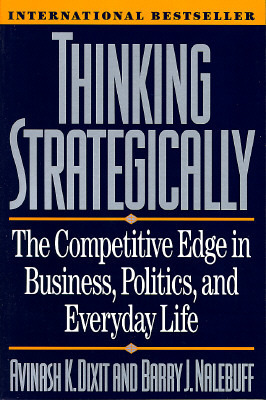
Thinking Strategically: The Competitive Edge in Business, Politics, and Everyday Life
by Avinash K. Dixit
Rating: 3.9 ⭐
The international bestseller — don't compete without it! A major bestseller in Japan, Financial Times Top Ten book of the year, Book-of-the-Month Club bestseller, and required reading at the best business schools, Thinking Strategically is a crash course in outmaneauvering any rival. This entertaining guide builds on scores of case studies taken from business, sports, the movies, politics, and gambling. It outlines the basics of good strategy making and then shows how you can apply them in any area of your life.

All introductory textbooks begin by attempting to convince the student readers that the subject is of great importance in the world, and therefore merits their attention. The physical sciences and engineering claim to be the basis of modern technology and therefore of modern life; the social sciences discuss big issues of governance, for example, democracy and taxation; the humanities claim that they revive your soul after it has been deadened by exposure to the physical and social sciences and to engineering. Where does the subject "games of strategy," often also called game theory, fit into this picture, and why should you study it? Dixit and Skeath's Games of Strategy offers a practical motivation much more individual and closer to your personal concerns than most other subjects. You play games of strategy all the time: with your parents, siblings, friends, enemies, even with your professors. You have probably acquired a lot of instinctive expertise, and we hope you will recognize in what follows some of the lessons you have already learned. This book's authors will build on this experience, systematize it, and develop it to the point where you will be able to improve your strategic skills and use them more methodically. Opportunities for such uses will appear throughout the rest of your life; you will go on playing such games with your employers, employees, spouses, children, and even strangers. Not that the subject lacks wider importance. Similar games are played in business, politics, diplomacy, wars--in fact, whenever people interact to strike mutually agreeable deals or to resolve conflicts. Being able to recognize such games will enrich your understanding of the world around you, and will make you a better participant in all its affairs.

Microeconomics - individuals' choices of where to live and work, how much to save, what to buy, and firms' decisions about location, hiring, firing, and investment - involves issues that concern us on a daily basis. But when people think about economics, they tend to place importance on the bigger picture - macroeconomics - including issues such as unemployment, inflation, and the competitiveness of nations.In this Very Short Introduction , Avinash Dixit argues that the microeconomy has a large impact on the economic world, arguably as much as the issues of macroeconomics.Dixit steers a clear path through the huge number of issues related to microeconomics, explaining what happens when things go well, as well as showing how they fail, why that happens, and what can be done about it. Using real-life examples from around the world, using a minimum of mathematics and including simple graphs, he provides insights into economics from psychology and sociology to explain economic behavior and rational choice.About the Oxford's Very Short Introductions series offers concise and original introductions to a wide range of subjects--from Islam to Sociology, Politics to Classics, Literary Theory to History, and Archaeology to the Bible. Not simply a textbook of definitions, each volume in this series provides trenchant and provocative--yet always balanced and complete--discussions of the central issues in a given discipline or field. Every Very Short Introduction gives a readable evolution of the subject in question, demonstrating how the subject has developed and how it has influenced society. Eventually, the series will encompass every major academic discipline, offering all students an accessible and abundant reference library. Whatever the area of study that one deems important or appealing, whatever the topic that fascinates the general reader, the Very Short Introductions series has a handy and affordable guide that will likely prove indispensable.
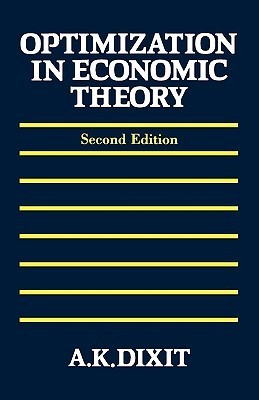
Building on a base of simple economic theory and elementary linear algebra and calculus, this broad treatment of static and dynamic optimization methods discusses the importance of shadow prices, and reviews functions defined by solutions of optimization problems. Recently revised and expanded, the second edition will be a valuable resource for upper level undergraduate and graduate students.

How should firms decide whether and when to invest in new capital equipment, additions to their workforce, or the development of new products? Why have traditional economic models of investment failed to explain the behavior of investment spending in the United States and other countries? In this book, Avinash Dixit and Robert Pindyck provide the first detailed exposition of a new theoretical approach to the capital investment decisions of firms, stressing the irreversibility of most investment decisions, and the ongoing uncertainty of the economic environment in which these decisions are made. In so doing, they answer important questions about investment decisions and the behavior of investment spending.This new approach to investment recognizes the option value of waiting for better (but never complete) information. It exploits an analogy with the theory of options in financial markets, which permits a much richer dynamic framework than was possible with the traditional theory of investment. The authors present the new theory in a clear and systematic way, and consolidate, synthesize, and extend the various strands of research that have come out of the theory. Their book shows the importance of the theory for understanding investment behavior of firms; develops the implications of this theory for industry dynamics and for government policy concerning investment; and shows how the theory can be applied to specific industries and to a wide variety of business problems.

How can property rights be protected and contracts be enforced in countries where the rule of law is ineffective or absent? How can firms from advanced market economies do business in such circumstances? In Lawlessness and Economics, Avinash Dixit examines the theory of private institutions that transcend or supplement weak economic governance from the state.In much of the world and through much of history, private mechanisms--such as long-term relationships, arbitration, social networks to disseminate information and norms to impose sanctions, and for-profit enforcement services--have grown up in place of formal, state-governed institutions. Even in countries with strong legal systems, many of these mechanisms continue under the shadow of the law. Numerous case studies and empirical investigations have demonstrated the variety, importance, and merits, and drawbacks of such institutions.This book builds on these studies and constructs a toolkit of theoretical models to analyze them. The models shed new conceptual light on the different modes of governance, and deepen our understanding of the interaction of the alternative institutions with each other and with the government's law. For example, one model explains the limit on the size of social networks and illuminates problems in the transition to more formal legal systems as economies grow beyond this limit. Other models explain why for-profit enforcement is inefficient. The models also help us understand why state law dovetails with some non-state institutions and collides with others. This can help less-developed countries and transition economies devise better processes for the introduction or reform of their formal legal systems.

The Making of Economic Policy: A Transaction Cost Politics Perspective
by Avinash K. Dixit
Rating: 3.5 ⭐
The Making of Economic Policy begins by observing that most countries' trade policies are so blatantly contrary to all the prescriptions of the economist that there is no way to understand this discrepancy except by delving into the politics. The same is true for many other dimensions of economic policy. Avinash Dixit looks for an improved understanding of the politics of economic policy-making from a transaction cost perspective. Such costs of planning, implementing, and monitoring an exchange have proved critical to explaining many phenomena in industrial organization. Dixit discusses the variety of similar transaction costs encountered in the political process of making economic policy and how these costs affect the operation of different institutions and policies.Dixit organizes a burgeoning body of research in political economy in this framework. He uses U.S. fiscal policy and the General Agreement on Tariffs and Trade (GATT) as two examples that illustrate the framework, and show how policy often deviates from the economist's ideal of efficiency. The approach reveals, however, that some seemingly inefficient practices are quite creditable attempts to cope with transaction costs such as opportunism and asymmetric information.Copublished with the Center for Economic Studies and the Ifo Institute

This book expounds trade theory emphasizing that a trading equilibrium is general rather than partial, and is often best modelled using dual or envelope functions. This yields a compact treatment of standard theory, clarifies some errors and confusions, and produces some new departures. In particular, the book (i) gives unified treatments of comparative statics and welfare, (ii) sheds new light on the factor-price equalization issue, (iii) treats the modern specific-factor model in parallel with the usual Heckscher-Ohlin one, (iv) analyses the balance of payments in general equilibrium with flexible and fixed prices, (v) studies imperfect competition and intra-industry trade.

A volume in the Section on Stochastic Methods in Economic AnalysisThis book aims to widen the understanding and use of stochastic dynamic choice and equilibrium models. It offers a simplified and heuristic exposition of the theory of Brownian motion and its control or regulation, rendering such methods more accessible to economists who do not require a detailed, rigorous mathematical treatment of the subject.The main mathematical ideas are presented in a context with which economists will be familiar. Using a binomial approximation to Brownian motion, the mathematics is reduced to simple algebra, progressing to some equally simple limits. The starting point of the calculus of Brownian motion -- "Ito's Lemma" -- emerges by analogy with the economics of risk-aversion. Conditions for the optimal regulation of Brownian motion, including the important, but often mysterious "smooth pasting" condition, are derived in a similar way. Each theoretical derivation is illustrated by developing a significant economic application, drawn mainly from recent research in macroeconomics and international economics.--back cover

A arte da estratégia
by Avinash K. Dixit
Todos os negócios e interações pessoais têm um componente estraté empresários precisam de um bom planejamento para guiar suas atividades; políticos, de planos para ser eleitos e pôr em prática seus projetos; técnicos de futebol, de táticas para vencer as partidas; pais, de métodos para incutir um bom comportamento em seus filhos. Gostemos ou não, somos todos estrategistas. Precisamos, porém, aprimorar essa nossa habilidade para descobrir e utilizar estratégias cada vez mais eficientes. E a estratégia é a arte que fornece meios para antecipar os próximos movimentos de seu oponente, sabendo que ele está tentando fazer o mesmo com você.Ancorado na teoria dos jogos, emergente ramo da ciência que estuda a tomada estratégica de decisões, A arte da estratégia ensina, por meio de linguagem simples, exemplos ilustrativos e estudos de caso, como prever e influenciar a ação de seus pares, a despeito da própria ocupação e campo de interesse. Guiado por dois renomados professores, o leitor aprenderá como pensar estrategicamente e traduzir esses pensamentos em ações no dia-a-dia, para alcançar o sucesso na vida e nos negócios.
![BY Dixit, Avinash K. ( Author ) [{ Lawlessness and Economics: Alternative Modes of Governance By Dixit, Avinash K. ( Author ) May - 01- 2007 ( Paperback ) } ]](/placeholder.svg?height=400&width=300)
BY Dixit, Avinash K. ( Author ) [{ Lawlessness and Economics: Alternative Modes of Governance By Dixit, Avinash K. ( Author ) May - 01- 2007 ( Paperback ) } ]
by Avinash K. Dixit
BY Dixit, Avinash K. ( Author ) [{ Lawlessness and Alternative Modes of Governance By Dixit, Avinash K. ( Author ) May - 01- 2007 ( Paperback ) } ]

The Making of Economic Policy: A Transaction-Cost Politics Perspective
by Avinash K. Dixit
The Making of Economic Policy begins by observing that most countries' trade policies are so blatantly contrary to all the prescriptions of the economist that there is no way to understand this discrepancy except by delving into the politics. The same is true for many other dimensions of economic policy.Avinash Dixit looks for an improved understanding of the politics of economic policy-making from a transaction cost perspective. Such costs of planning, implementing, and monitoring an exchange have proved critical to explaining many phenomena in industrial organization. Dixit discusses the variety of similar transaction costs encountered in the political process of making economic policy and how these costs affect the operation of different institutions and policies.Dixit organizes a burgeoning body of research in political economy in this framework. He uses U.S. fiscal policy and the General Agreement on Tariffs and Trade (GATT) as two examples that illustrate the framework, and show how policy often deviates from the economist's ideal of efficiency. The approach reveals, however, that some seemingly inefficient practices are quite creditable attempts to cope with transaction costs such as opportunism and asymmetric information.The Munich Lectures

Spieltheorie fur Einsteinger Strategisches Know-how for Gewinner
by Avinash K. Dixit

Games of Strategy 3th (third) edition
by Avinash K. Dixit
The book is in new condition. Satisfaction guaranteed.
Tu Duy Chien Luoc
by Avinash K. Dixit
Monopolistic competition and optimum product diversity
by Avinash K. Dixit

Games of Strategy
by Avinash K. Dixit

Stratejik Dusunme
by Avinash K. Dixit
pos na skeptesthe stratigika / πώς να σκέπτεσθε στρατηγικά
by Avinash K. Dixit

Außenhandelstheorie.
by Avinash K. Dixit

The Theory of Equilibrium Growth
by Avinash K. Dixit
This book aims to bridge the gap between elementary and advanced textbooks on growth theory, and to highlight and clarify the framework of intertemporal equilibrium that underlies much of growth theory.