
Pedro Domingos
I'm a professor emeritus of computer science and engineering at the University of Washington and the author of 2040 and The Master Algorithm. I'm a winner of the SIGKDD Innovation Award and the IJCAI John McCarthy Award, two of the highest honors in data science and AI. I'm a Fellow of the AAAS and AAAI, and I've received an NSF CAREER Award, a Sloan Fellowship, a Fulbright Scholarship, an IBM Faculty Award, several best paper awards, and other distinctions. I received an undergraduate degree (1988) and M.S. in Electrical Engineering and Computer Science (1992) from IST, in Lisbon, and an M.S. (1994) and Ph.D. (1997) in Information and Computer Science from the University of California at Irvine. I'm the author or co-author of over 200 technical publications in machine learning, data science, and other areas. I'm a member of the editorial board of the Machine Learning journal, co-founder of the International Machine Learning Society, and past associate editor of JAIR. I was program co-chair of KDD-2003 and SRL-2009, and I've served on the program committees of AAAI, ICML, IJCAI, KDD, NIPS, SIGMOD, UAI, WWW, and others. I've written for the Wall Street Journal, Spectator, Scientific American, Wired, and others. I helped start the fields of statistical relational AI, data stream mining, adversarial learning, machine learning for information integration, and influence maximization in social networks.
8 Books Written
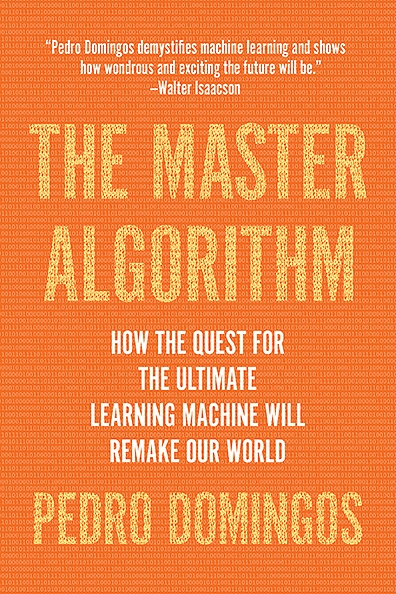
The Master Algorithm: How the Quest for the Ultimate Learning Machine Will Remake Our World
by Pedro Domingos
Rating: 3.8 ⭐
• 4 recommendations ❤️
Recommended by Bill GatesA thought-provoking and wide-ranging exploration of machine learning and the race to build computer intelligences as flexible as our own In the world's top research labs and universities, the race is on to invent the ultimate learning one capable of discovering any knowledge from data, and doing anything we want, before we even ask. In The Master Algorithm , Pedro Domingos lifts the veil to give us a peek inside the learning machines that power Google, Amazon, and your smartphone. He assembles a blueprint for the future universal learner--the Master Algorithm--and discusses what it will mean for business, science, and society. If data-ism is today's philosophy, this book is its bible.

"I told you not to read books like this." —Your MomWhen AI and the culture wars collide, hilarity ensues.The 2040 presidential election is unlike any in US history. The Republican candidate is an AI named PresiBot, created by a tech startup, KumbAI, who are in deeply over their heads. The Democratic candidate is a fake Native American chief seeking to abolish the United States. What could go wrong?With PresiBot plummeting in the polls and tech giants like Happinet scheming to take over, KumbAI's brash CEO Ethan Burnswagger and reluctant CTO Arvind Subramanian struggle to keep their company, their friendship—and their lives—under control. But the center cannot hold, and KumbAI, the campaign and America careen inexorably toward disaster.Fast-paced and dialogue-driven, as befits our ADHD age, 2040 is a scathing critique of the current state of America—from the tech giants' all encompassing empires and the fear and hype surrounding AI to the invasion of the mainstream by ever-kookier political ideas. Set in a dystopian San Francisco in a near future we can all too easily anticipate, it features characters, entities and incidents whose resemblance to actual ones may or may not be purely coincidental.If you want to have wicked fun while discovering what AI really is, how the tech industry works, where our deepening polarization might lead us, and—most important—how to break out of this cycle, this is the book for you.

Most subfields of computer science have an interface layer via which applications communicate with the infrastructure, and this is key to their success (e.g., the Internet in networking, the relational model in databases, etc.). So far this interface layer has been missing in AI. First-order logic and probabilistic graphical models each have some of the necessary features, but a viable interface layer requires combining both. Markov logic is a powerful new language that accomplishes this by attaching weights to first-order formulas and treating them as templates for features of Markov random fields. Most statistical models in wide use are special cases of Markov logic, and first-order logic is its infinite-weight limit. Inference algorithms for Markov logic combine ideas from satisfiability, Markov chain Monte Carlo, belief propagation, and resolution. Learning algorithms make use of conditional likelihood, convex optimization, and inductive logic programming. Markov logic has been successfully applied to problems in information extraction and integration, natural language processing, robot mapping, social networks, computational biology, and others, and is the basis of the open-source Alchemy system.

Brand New Deliver In 6-18 Working Days

Alguma vez lhe aconteceu falar sobre um telemóvel e, mais tarde, ver esse mesmo modelo num anúncio nas redes sociais? Ou começar uma mensagem e sugerirem-lhe o que escrever a seguir? E como sabe a Netflix que gosta de séries de crime? E o Spotify conhece assim tão bem os seus gostos musicais? O Google Maps sabe exatamente para onde quer ir agora?A resposta está numa palavrinha má algoritmos. É muito provável que saiba exatamente do que estamos a falar, uma vez que uma determinada combinação de algoritmos é o tema mais quente da falamos da Inteligência Artificial, a maior revolução tecnológica dos últimos tempos. Acabada de chegar ao grande público, já está a mudar a forma como trabalhamos, comunicamos, nos entretemos ou até fazemos arte.Neste livro, recomendado por Bill Gates e aclamado pela crítica americana, Pedro Domingos, professor de Ciências da Computação na Universidade de Washington, leva-nos em busca do Algoritmo-Mestre, a última coisa que teremos de inventar porque, assim que o deixarmos à solta, ele tratará de tudo o resto. O rei dos algoritmos já é o algoritmo que está dentro dos nossos cérebros. Agora só falta descobrir como aplicar isso às máquinas - e já esteve mais longe.Ou será que o futuro é agora?

Juventude e desenvolvimento: por uma nova ordem global
by Pedro Domingos
Os dilemas, os desafios, as mazelas, as inquietações, as perspectivas e a força social da juventude são temas recorrentes na música, na literatura, na mídia, nas reuniões comunitárias, nas igrejas e escolas, nas diferentes esferas do poder público, em ensaios acadêmicos, e por aí vai. Afinal, os jovens representam cerca de 1/3 da população brasileira; tornaram- se um significativo segmento do mercado consumidor; representam emergente força política e podem votar a partir dos 16 anos; ganharam influência junto à opinião pública, notadamente pela sua maciça presença nas redes sociais via internet; e, eventualmente, estão presentes em campanhas e movimentos com efetiva repercussão na sociedade. Eis que, quando julgamos o tema razoavelmente esgotado, surgem cenários de novidades práticas e teóricas, lançando novos focos de luz sobre a questão. Pois, nesta presente obra, dois jovens estudantes da Universidade Federal do Espírito Santo – Pedro Luiz Teixeira de Andrade Domingos e Max Dias Gonçalves – se propõem a apresentar uma reflexão de conteúdo consequente sobre o papel da juventude no mundo atual; a sua inserção no desenvolvimento social e econômico; bem como os desafios do poder público para contemplar essa massa populacional, não raro dispersa e excluída. Não é tarefa fácil tratar do assunto de modo assertivo, instigante, sem ser repetitivo, no sentido de buscar agregar novas experiências ao processo de aperfeiçoamento desta realidade. Este desafio é aqui enfrentado de forma clara, direta, objetiva, fundamentada, crítica e propositiva.

A Alma que Angola esconde
by Pedro Domingos
Nascido na periferia de Luanda, um jovem cresce sem conhecer o pai e decide partir em busca da sua verdade.A viagem transforma-se em uma travessia pelas feridas abertas de Angola, um país onde a esperança luta para sobreviver entre a pobreza, o medo e a corrupção. A coragem de procurar respostas, porém, tem um preço o jovem é silenciado pelas mãos do próprio regime que deveria protegê-lo.Em A Alma que Angola esconde, temos uma história sobre identidade, injustiça e resistência, o retrato cru de um povo que ainda tenta reencontrar a sua alma perdida.