
Benoît B. Mandelbrot
Benoît B. Mandelbrot, O.L.H., Ph.D. (Mathematical Sciences, University of Paris, 1952; M.S., Aeronautics, California Institute of Technology, 1949) was a mathematician best known as the father of fractal geometry. He was Sterling Professor Emeritus of Mathematical Sciences at Yale University; IBM Fellow Emeritus at the Thomas J. Watson Research Center; and Battelle Fellow at the Pacific Northwest National Laboratory. Mandelbrot was born in Poland, but his family moved to France when he was a child; he was a dual French and American citizen and was educated in France. He has been awarded with numerous honors, including induction into the Legion d'honneur, as well as the 1986 Franklin Medal for Physics, the 1993 Wolf Prize for Physics, the 2000 Lewis Fry Richardson Medal of the European Geophysical Society, and the 2003 Japan Prize "for the creation of universal concepts in complex systems."
17 Books Written

The (Mis)Behaviour of Markets: A Fractal View of Risk, Ruin and Reward
by Benoît B. Mandelbrot
Rating: 4.1 ⭐
• 4 recommendations ❤️
This international bestseller, which foreshadowed a market crash, explains why it could happen again if we don't act now. Fractal geometry is the mathematics of roughness: how to reduce the outline of a jagged leaf or static in a computer connection to a few simple mathematical properties. With his fractal tools, Mandelbrot has got to the bottom of how financial markets really work. He finds they have a shifting sense of time and wild behaviour that makes them volatile, dangerous - and beautiful. In his models, the complex gyrations of the FTSE 100 and exchange rates can be reduced to straightforward formulae that yield a much more accurate description of the risks involved.
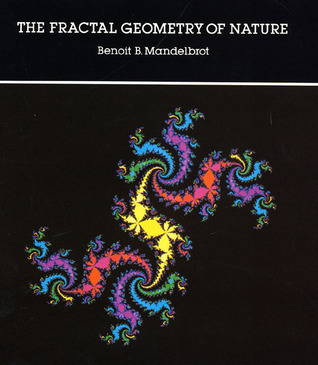
Clouds are not spheres, mountains are not cones, and lightning does not travel in a straight line. The complexity of nature's shapes differs in kind, not merely degree, from that of the shapes of ordinary geometry, the geometry of fractal shapes.Now that the field has expanded greatly with many active researchers, Mandelbrot presents the definitive overview of the origins of his ideas and their new applications. The Fractal Geometry of Nature is based on his highly acclaimed earlier work, but has much broader and deeper coverage and more extensive illustrations.

A fascinating memoir from the man who revitalized visual geometry, and whose ideas about fractals have changed how we look at both the natural world and the financial world.Benoit Mandelbrot, the creator of fractal geometry, has significantly improved our understanding of, among other things, financial variability and erratic physical phenomena. In The Fractalist, Mandelbrot recounts the high points of his life with exuberance and an eloquent fluency, deepening our understanding of the evolution of his extraordinary mind. We begin with his early born in Warsaw in 1924 to a Lithuanian Jewish family, Mandelbrot moved with his family to Paris in the 1930s, where he was mentored by an eminent mathematician uncle. During World War II, as he stayed barely one step ahead of the Nazis until France was liberated, he studied geometry on his own and dreamed of using it to solve fresh, real-world problems. We observe his unusually broad education in Europe, and later at Caltech, Princeton, and MIT. We learn about his thirty-five-year affiliation with IBM’s Thomas J. Watson Research Center and his association with Harvard and Yale. An outsider to mainstream scientific research, he managed to do what others had thought develop a new geometry that combines revelatory beauty with a radical way of unfolding formerly hidden laws governing utter roughness, turbulence, and chaos.Here is a remarkable story of both the man’s life and his unparalleled contributions to science, mathematics, and the arts.
an informal mathematical treatment
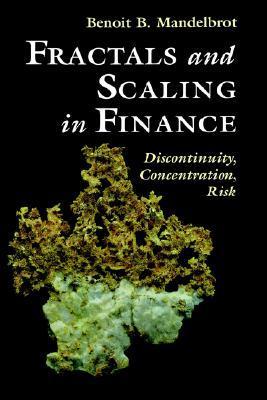
Fractals and Scaling in Finance: Discontinuity, Concentration, Risk. Selecta Volume E
by Benoît B. Mandelbrot
Rating: 3.9 ⭐
IN 1959-61, while the huge Saarinen-designed research laboratory at Yorktown Heights was being built, much of IBM's Research was housed nearby. My group occupied one of the many little houses on the Lamb Estate complex which had been a sanatorium housing wealthy alcoholics. The picture below was taken about 1960. It shows from right to left, T. e. Hu, now at the University of California, Santa Barbara. I am next, staring at a network I have just written on the blackboard. Then comes Paul Gilmore, late of the University of British Columbia, then (seated) Richard Levitan, now retired, and at the left is Benoit Mandelbrot. x FOREWORD EF Even in a Lamb Estate populated exclusively with bright research- oriented people, Benoit always stood out. His thinking was always fresh, and I enjoyed talking with him about any subject, whether technical, poli- tical, or historical. He introduced me to the idea that distributions having infinite second moments could be more than a mathematical curiosity and a source of counter-examples. This was a foretaste of the line of thought that eventually led to fractals and to the notion that major pieces of the physical world could be, and in fact could only be, modeled by distrib- utions and sets that had fractional dimensions. Usually these distributions and sets were known to mathematicians, as they were known to me, as curiosities and counter-intuitive examples used to show graduate students the need for rigor in their proofs.
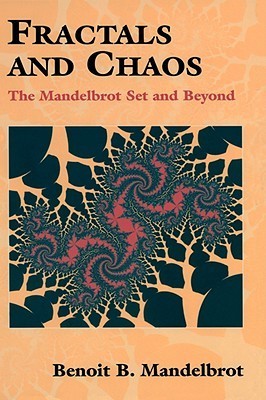
Just 23 years ago Benoit Mandelbrot published his famous picture of the Mandelbrot set, but that picture has changed our view of the mathematical and physical universe. In this text, Mandelbrot offers 25 papers from the past 25 years, many related to the famous inkblot figure. Of historical interest are some early images of this fractal object produced with a crude dot-matrix printer. The text includes some items not previously published.
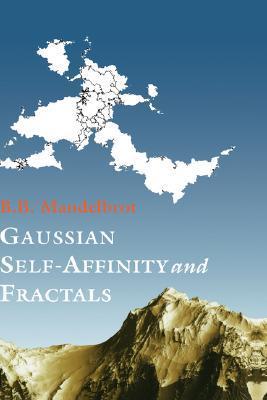
Gaussian Self-Affinity and Fractals: Globality, The Earth, 1/f Noise, and R/S
by Benoît B. Mandelbrot
Rating: 4.3 ⭐
This third volume of the Selected Works focusses on a detailed study of fraction Brownian motions. The fractal themes of "self-affinity" and "globality" are presented, while extensive introductory material, written especially for this book, precedes the papers and presents a number of striking new observations and conjectures. The mathematical tools so discussed will be valuable to diverse scientific communities.

In questo libro Benoit Mandelbrot ci racconta l’iter che, dalla semplice capacità di rappresentare le forme e dallo studio delle stesse in natura, lo ha condotto allo sviluppo dei frattali e alla loro applicazione non solo in matematica, ma anche in altri campi del sapere.

Mathematical Association of America Notes, Series Number 58Fractal Geometry is a recent edition to the collection of mathematical tools for describing nature, and is the first to focus on roughness. Fractal geometry also appears in art, music and literature, most often without being consciously included by the artist. Consequently, through this we may uncover connections between the arts and sciences, uncommon for students to see in maths and science classes. This book will appeal to teachers who have wanted to include fractals in their mathematics and science classes, to scientists familiar with fractal geometry who want to teach a course on fractals, and to anyone who thinks general scientific literacy is an issue important enough to warrant new approaches.

Certain noises, many aspects of turbulence, and almost all aspects of finance exhibit a level of temporal and spatial variability whose "wildness" impressed itself vividly upon the author, Benoit Mandelbrot, in the early 1960's. He soon realized that those phenomena cannot be described by simply adapting the statistical techniques of earlier physics, or even extending those techniques slightly. It appeared that the study of finance and turbulence could not move forward without the recognition that those phenomena represented a new second stage of indeterminism. Altogether new mathematical tools were needed. The papers in this Selecta volume reflect that realization and the work that Dr. Mandelbrot did toward the development of those new tools.

Dazzling computer animation combined with the genius of Benoît Mandelbrot and Edward Lorenz present a captivating discussion of fractals and the fundamental concepts of fractal geometryself-similarity and chaos. Mandelbrot uses a simple head of broccoli to demonstrate the complexity of fractals. Narrating over the three-dimensional animations, Mandelbrot discusses how fractals serve as an excellent model of irregular natural forms, such as coastlines, and how they relieve the scientist of the necessity of describing nature with simple geometric formsclouds are not spheres, mountains are not cones. The world of fractals is revealed, from the depths of the Mandelbrot set, to the Lorenz attractor. (63 minutes)


LES FRACTALS. HASARDS ET TOURBILLONS
by Benoît B. Mandelbrot
TOWARDS A REVIVAL OF THE STATISTICAL LAW OF PARETO
by Benoît B. Mandelbrot

Multifractals and 1/ƒ Noise: Wild Self-Affinity in Physics
by Benoît B. Mandelbrot
Certain noises, many aspects of turbulence, and almost all aspects of finance exhibit a level of temporal and spatial variability whose "wildness" impressed itself vividly upon the author, Benoit Mandelbrot, in the early 1960's. He soon realized that those phenomena cannot be described by simply adapting the statistical techniques of earlier physics, or even extending those techniques slightly. It appeared that the study of finance and turbulence could not move forward without the recognition that those phenomena represented a new second stage of indeterminism. Altogether new mathematical tools were needed. The papers in this Selecta volume reflect that realization and the work that Dr. Mandelbrot did toward the development of those new tools.
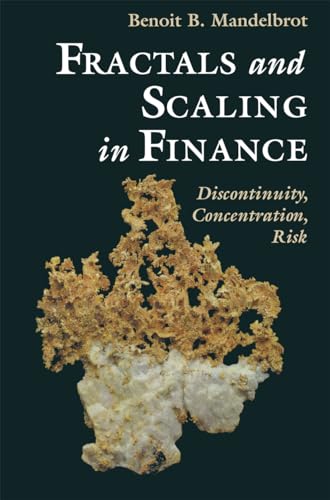
Fractals and Scaling in Finance: Discontinuity, Concentration, Risk. Selecta Volume E
by Benoît B. Mandelbrot
IN 1959-61, while the huge Saarinen-designed research laboratory at Yorktown Heights was being built, much of IBM's Research was housed nearby. My group occupied one of the many little houses on the Lamb Estate complex which had been a sanatorium housing wealthy alcoholics. The picture below was taken about 1960. It shows from right to left, T. e. Hu, now at the University of California, Santa Barbara. I am next, staring at a network I have just written on the blackboard. Then comes Paul Gilmore, late of the University of British Columbia, then (seated) Richard Levitan, now retired, and at the left is Benoit Mandelbrot. x FOREWORD EF Even in a Lamb Estate populated exclusively with bright research oriented people, Benoit always stood out. His thinking was always fresh, and I enjoyed talking with him about any subject, whether technical, poli tical, or historical. He introduced me to the idea that distributions having infinite second moments could be more than a mathematical curiosity and a source of counter-examples. This was a foretaste of the line of thought that eventually led to fractals and to the notion that major pieces of the physical world could be, and in fact could only be, modeled by distrib utions and sets that had fractional dimensions. Usually these distributions and sets were known to mathematicians, as they were known to me, as curiosities and counter-intuitive examples used to show graduate students the need for rigor in their proofs.