Loading themes...
Explore the best books about Popular Science theme.

For David Deutsch, a young physicist of unusual originality, quantum theory contains our most fundamental knowledge of the physical world. Taken literally, it implies that there are many universes “parallel” to the one we see around us. This multiplicity of universes, according to Deutsch, turns out to be the key to achieving a new worldview, one which synthesizes the theories of evolution, computation, and knowledge with quantum physics. Considered jointly, these four strands of explanation reveal a unified fabric of reality that is both objective and comprehensible, the subject of this daring, challenging book. The Fabric of Reality explains and connects many topics at the leading edge of current research and thinking, such as quantum computers (which work by effectively collaborating with their counterparts in other universes), the physics of time travel, the comprehensibility of nature and the physical limits of virtual reality, the significance of human life, and the ultimate fate of the universe. Here, for scientist and layperson alike, for philosopher, science-fiction reader, biologist, and computer expert, is a startlingly complete and rational synthesis of disciplines, and a new, optimistic message about existence.


Bill Bryson describes himself as a reluctant traveller, but even when he stays safely at home he can't contain his curiosity about the world around him. "A Short History of Nearly Everything" is his quest to understand everything that has happened from the Big Bang to the rise of civilisation - how we got from there, being nothing at all, to here, being us. The ultimate eye-opening journey through time and space, revealing the world in a way most of us have never seen it before.

By identifying the structure of DNA, the molecule of life, Francis Crick and James Watson revolutionized biochemistry & won themselves a Nobel Prize. At the time, Watson was only 24, a young scientist hungry to make his mark. His uncompromisingly honest account of the heady days of their thrilling sprint against other world-class researchers to solve one of science's greatest mysteries gives a dazzlingly clear picture of a world of brilliant scientists with great gifts, very human ambitions & bitter rivalries. With humility unspoiled by false modesty, Watson relates his & Crick's desperate efforts to beat Linus Pauling to the Holy Grail of life sciences, the identification of the basic building block of life. Never has a scientist been so truthful in capturing in words the flavor of his work.
The Red Queen compels us to rethink everything from the persistence of sexism to the endurance of romantic love.Referring to Lewis Carroll's Red Queen from Through the Looking-Glass, a character who has to keep running to stay in the same place, Matt Ridley demonstrates why sex is humanity's best strategy for outwitting its constantly mutating internal predators. The Red Queen answers dozens of other riddles of human nature and culture—including why men propose marriage, the method behind our maddening notions of beauty, and the disquieting fact that a woman is more likely to conceive a child by an adulterous lover than by her husband. The Red Queen offers an extraordinary new way of interpreting the human condition and how it has evolved.

“Ridley leaps from chromosome to chromosome in a handy summation of our ever increasing understanding of the roles that genes play in disease, behavior, sexual differences, and even intelligence. . . . . He addresses not only the ethical quandaries faced by contemporary scientists but the reductionist danger in equating inheritability with inevitability.” — The New Yorker The genome's been mapped. But what does it mean? Matt Ridley’s Genome is the book that explains it what it is, how it works, and what it portends for the future Arguably the most significant scientific discovery of the new century, the mapping of the twenty-three pairs of chromosomes that make up the human genome raises almost as many questions as it answers. Questions that will profoundly impact the way we think about disease, about longevity, and about free will. Questions that will affect the rest of your life. Genome offers extraordinary insight into the ramifications of this incredible breakthrough. By picking one newly discovered gene from each pair of chromosomes and telling its story, Matt Ridley recounts the history of our species and its ancestors from the dawn of life to the brink of future medicine. From Huntington's disease to cancer, from the applications of gene therapy to the horrors of eugenics, Ridley probes the scientific, philosophical, and moral issues arising as a result of the mapping of the genome. It will help you understand what this scientific milestone means for you, for your children, and for humankind.

An alternative cover edition for this ISBN can be found here and here.The Emperor of All Maladies is a magnificent, profoundly humane “biography” of cancer - from its first documented appearances thousands of years ago through the epic battles in the twentieth century to cure, control, and conquer it to a radical new understanding of its essence. Physician, researcher, and award-winning science writer, Siddhartha Mukherjee examines cancer with a cellular biologist’s precision, a historian’s perspective, and a biographer’s passion. The result is an astonishingly lucid and eloquent chronicle of a disease humans have lived with - and perished from - for more than five thousand years. The story of cancer is a story of human ingenuity, resilience, and perseverance, but also of hubris, paternalism, and misperception. Mukherjee recounts centuries of discoveries, setbacks, victories, and deaths, told through the eyes of his predecessors and peers, training their wits against an infinitely resourceful adversary that, just three decades ago, was thought to be easily vanquished in an all-out “war against cancer.” The book reads like a literary thriller with cancer as the protagonist. From the Persian Queen Atossa, whose Greek slave cut off her malignant breast, to the nineteenth-century recipients of primitive radiation and chemotherapy to Mukherjee’s own leukemia patient, Carla, The Emperor of All Maladies is about the people who have soldiered through fiercely demanding regimens in order to survive—and to increase our understanding of this iconic disease. Riveting, urgent, and surprising, The Emperor of All Maladies provides a fascinating glimpse into the future of cancer treatments. It is an illuminating book that provides hope and clarity to those seeking to demystify cancer.

The Earth teems with life: in its oceans, forests, skies and cities. Yet there’s a black hole at the heart of biology. We do not know why complex life is the way it is, or, for that matter, how life first began. In The Vital Question, award-winning author and biochemist Nick Lane radically reframes evolutionary history, putting forward a solution to conundrums that have puzzled generations of scientists.For two and a half billion years, from the very origins of life, single-celled organisms such as bacteria evolved without changing their basic form. Then, on just one occasion in four billion years, they made the jump to complexity. All complex life, from mushrooms to man, shares puzzling features, such as sex, which are unknown in bacteria. How and why did this radical transformation happen?The answer, Lane argues, lies in energy: all life on Earth lives off a voltage with the strength of a lightning bolt. Building on the pillars of evolutionary theory, Lane’s hypothesis draws on cutting-edge research into the link between energy and cell biology, in order to deliver a compelling account of evolution from the very origins of life to the emergence of multicellular organisms, while offering deep insights into our own lives and deaths.Both rigorous and enchanting, The Vital Question provides a solution to life’s vital question: why are we as we are, and indeed, why are we here at all?

Spanning the globe and several centuries, The Gene is the story of the quest to decipher the master-code that makes and defines humans, that governs our form and function.The story of the gene begins in an obscure Augustinian abbey in Moravia in 1856 where a monk stumbles on the idea of a ‘unit of heredity’. It intersects with Darwin’s theory of evolution, and collides with the horrors of Nazi eugenics in the 1940s. The gene transforms post-war biology. It reorganizes our understanding of sexuality, temperament, choice and free will. This is a story driven by human ingenuity and obsessive minds – from Charles Darwin and Gregor Mendel to Francis Crick, James Watson and Rosalind Franklin, and the thousands of scientists still working to understand the code of codes.This is an epic, moving history of a scientific idea coming to life, by the author of The Emperor of All Maladies. But woven through The Gene, like a red line, is also an intimate history – the story of Mukherjee’s own family and its recurring pattern of mental illness, reminding us that genetics is vitally relevant to everyday lives. These concerns reverberate even more urgently today as we learn to “read” and “write” the human genome – unleashing the potential to change the fates and identities of our children.Majestic in its ambition, and unflinching in its honesty, The Gene gives us a definitive account of the fundamental unit of heredity – and a vision of both humanity’s past and future.

NOW IN PAPERBACK"€"Starting from a collection of simple computer experiments"€"illustrated in the book by striking computer graphics"€"Stephen Wolfram shows how their unexpected results force a whole new way of looking at the operation of our universe.

Robert Lanza is one of the most respected scientists in the world—a US News & World Report cover story called him a "genius" and a "renegade thinker," even likening him to Einstein. Lanza has teamed with Bob Berman, the most widely read astronomer in the world, to produce Biocentrism, a revolutionary new view of the universe.Every now and then a simple yet radical idea shakes the very foundations of knowledge. The startling discovery that the world was not flat challenged and ultimately changed the way people perceived themselves and their relationship with the world. For most humans of the 15th century, the notion of Earth as ball of rock was nonsense. The whole of Western, natural philosophy is undergoing a sea change again, increasingly being forced upon us by the experimental findings of quantum theory, and at the same time, towards doubt and uncertainty in the physical explanations of the universe’s genesis and structure. Biocentrism completes this shift in worldview, turning the planet upside down again with the revolutionary view that life creates the universe instead of the other way around.In this paradigm, life is not an accidental byproduct of the laws of physics. Biocentrism takes the reader on a seemingly improbable but ultimately inescapable journey through a foreign universe—our own—from the viewpoints of an acclaimed biologist and a leading astronomer. Switching perspective from physics to biology unlocks the cages in which Western science has unwittingly managed to confine itself. Biocentrism will shatter the reader’s ideas of life—time and space, and even death. At the same time it will release us from the dull worldview of life being merely the activity of an admixture of carbon and a few other elements; it suggests the exhilarating possibility that life is fundamentally immortal.The 21st century is predicted to be the Century of Biology, a shift from the previous century dominated by physics. It seems fitting, then, to begin the century by turning the universe outside-in and unifying the foundations of science with a simple idea discovered by one of the leading life-scientists of our age. Biocentrism awakens in readers a new sense of possibility, and is full of so many shocking new perspectives that the reader will never see reality the same way again.

Imagine, if you can, the world in the year 2100.In Physics of the Future, Michio Kaku—the New York Times bestselling author of Physics of the Impossible—gives us a stunning, provocative, and exhilarating vision of the coming century based on interviews with over three hundred of the world's top scientists who are already inventing the future in their labs. The result is the most authoritative and scientifically accurate description of the revolutionary developments taking place in medicine, computers, artificial intelligence, nanotechnology, energy production, and astronautics.In all likelihood, by 2100 we will control computers via tiny brain sensors and, like magicians, move objects around with the power of our minds. Artificial intelligence will be dispersed throughout the environment, and Internet-enabled contact lenses will allow us to access the world's information base or conjure up any image we desire in the blink of an eye.Meanwhile, cars will drive themselves using GPS, and if room-temperature superconductors are discovered, vehicles will effortlessly fly on a cushion of air, coasting on powerful magnetic fields and ushering in the age of magnetism.Using molecular medicine, scientists will be able to grow almost every organ of the body and cure genetic diseases. Millions of tiny DNA sensors and nanoparticles patrolling our blood cells will silently scan our bodies for the first sign of illness, while rapid advances in genetic research will enable us to slow down or maybe even reverse the aging process, allowing human life spans to increase dramatically.In space, radically new ships—needle-sized vessels using laser propulsion—could replace the expensive chemical rockets of today and perhaps visit nearby stars. Advances in nanotechnology may lead to the fabled space elevator, which would propel humans hundreds of miles above the earth's atmosphere at the push of a button.But these astonishing revelations are only the tip of the iceberg. Kaku also discusses emotional robots, antimatter rockets, X-ray vision, and the ability to create new life-forms, and he considers the development of the world economy. He addresses the key questions: Who are the winner and losers of the future? Who will have jobs, and which nations will prosper?All the while, Kaku illuminates the rigorous scientific principles, examining the rate at which certain technologies are likely to mature, how far they can advance, and what their ultimate limitations and hazards are. Synthesizing a vast amount of information to construct an exciting look at the years leading up to 2100, Physics of the Future is a thrilling, wondrous ride through the next 100 years of breathtaking scientific revolution. (From the Hardcover Edition)(Duration: 15:39:15)

An adventure deep inside the everyday materials that surround us, packed with surprising stories and fascinating science. Why is glass see-through? What makes elastic stretchy? Why does a paper clip bend? Why does any material look and behave the way it does? These are the sorts of questions that Mark Miodownik a globally-renowned materials scientist has spent his life exploring In this book he examines the materials he encounters in a typical morning, from the steel in his razor and the graphite in his pencil to the foam in his sneakers and the concrete in a nearby skyscraper.

How did we come to have minds? For centuries, poets, philosophers, psychologists, and physicists have wondered how the human mind developed its unrivaled abilities. Disciples of Darwin have explained how natural selection produced plants, but what about the human mind?In From Bacteria to Bach and Back, Daniel C. Dennett builds on recent discoveries from biology and computer science to show, step by step, how a comprehending mind could in fact have arisen from a mindless process of natural selection. A crucial shift occurred when humans developed the ability to share memes, or ways of doing things not based in genetic instinct. Competition among memes produced thinking tools powerful enough that our minds don’t just perceive and react, they create and comprehend.An agenda-setting book for a new generation of philosophers and scientists, From Bacteria to Bach and Back will delight and entertain all those curious about how the mind works.

One of our greatest scientists—and the winner of two Pulitzer Prizes for On Human Nature and The Ants—gives us a work of visionary importance that may be the crowning achievement of his career. In Consilience (a word that originally meant "jumping together"), Edward O. Wilson renews the Enlightenment's search for a unified theory of knowledge in disciplines that range from physics to biology, the social sciences and the humanities.Using the natural sciences as his model, Wilson forges dramatic links between fields. He explores the chemistry of the mind and the genetic bases of culture. He postulates the biological principles underlying works of art from cave-drawings to Lolita. Presenting the latest findings in prose of wonderful clarity and oratorical eloquence, and synthesizing it into a dazzling whole, Consilience is science in the path-clearing traditions of Newton, Einstein, and Richard Feynman.

In a 1950 conversation at Los Alamos, four world-class scientists generally agreed, given the size of the Universe, that advanced extraterrestrial civilizations must be present. But one of the four, Enrico Fermi, asked, "If these civilizations do exist, where is everybody?" Given the fact that there are perhaps 400 million stars in our Galaxy alone, and perhaps 400 million galaxies in the Universe, it stands to reason that somewhere out there, in the 14 billion-year-old cosmos, there is or once was a civilization at least as advanced as our own. Webb discusses in detail the 50 most cogent and intriguing solutions to Fermi's famous paradox.

An illuminating portrayal of Richard Feynman—a giant of twentieth century physics—from his childhood tinkering with radios, to his vital work on the Manhattan Project and beyond Raised in Depression-era Rockaway Beach, physicist Richard Feynman was irreverent, eccentric, and childishly enthusiastic—a new kind of scientist in a field that was in its infancy. His quick mastery of quantum mechanics earned him a place at Los Alamos working on the Manhattan Project under J. Robert Oppenheimer, where the giddy young man held his own among the nation’s greatest minds. There, Feynman turned theory into practice, culminating in the Trinity test, on July 16, 1945, when the Atomic Age was born. He was only twenty-seven. And he was just getting started. In this sweeping biography, James Gleick captures the forceful personality of a great man, integrating Feynman’s work and life in a way that is accessible to laymen and fascinating for the scientists who follow in his footsteps.

For over twenty years, psychologist Professor Richard Wiseman has examined the quirky science of everyday life. In Quirkology , he navigates the backwaters of human behavior, discovering the tell-tale signs that give away a liar, the secret science behind speed-dating and personal ads, and what a person's sense of humor reveals about the innermost workings of their mind- all along paying tribute to others who have carried out similarly weird and wonderful work. Wiseman's research has involved secretly observing people as they go about their daily business, conducting unusual experiments in art exhibitions and music concerts, and even staging fake séances in allegedly haunted buildings. With thousands of research subjects from all over the world, including enamored couples, unwitting pedestrians, and guileless dinner guests, Wiseman presents a fun, clever, and unexpected picture of the human mind.

From cyborgs, starships, UFOs, aliens and antimatter to telepathy, invisibility, psychokinesis and precognition, Michio Kaku's Physics of the Impossible is an exciting look at how science fiction could soon become science fact.Albert Einstein said, 'If at first an idea does not sound absurd, there is no hope for it.' Physics of the Impossible shows how our most far-fetched ideas today - from Star Trek's phasers and teleportation to time travel as envisioned by Back to the Future - are destined to become tomorrow's reality.Michio Kaku, bestselling science author and one of the world's most acclaimed physicists, looks at the technologies of the future and explains what's just around the corner, what we might have to wait a few millennia to get our hands on and how surprisingly little of it is truly impossible.'A brilliant, provocative, freewheeling tour around the exotic shores of physics' Independent'A rich compendium of jaw-dropping reality checks' The Times'One of the world's most distinguished physicists ... takes the reader on a journey to the frontiers of science and beyond' Guardian'After reading Kaku's boundless enthusiasm for the future, what you wouldn't give for a real-life time machine to travel forwards and see just how accurate his predictions are' Sunday TelegraphMichio Kaku is a leading theoretical physicist and one of the founders of string theory, widely regarded as the strongest candidate for the 'theory of everything'. He is also one of the most gifted popularizers of science of his generation. His books published by Penguin include Parallel Worlds, The Physics of the Future and The Physics of the Impossible. He holds the Henry Semat Professorship in Theoretical Physics at the City University of New York, where he has taught for over twenty-five years.

Here is a multidimensional playland of ideas from the world's most eccentric Nobel-Prize winning scientist. Kary Mullis is legendary for his invention of PCR, which redefined the world of DNA, genetics, and forensic science. He is also a surfer, a veteran of Berkeley in the sixties, and perhaps the only Nobel laureate to describe a possible encounter with aliens. A scientist of boundless curiosity, he refuses to accept any proposition based on secondhand or hearsay evidence, and always looks for the "money trail" when scientists make announcements.Mullis writes with passion and humor about a wide range of from global warming to the O. J. Simpson trial, from poisonous spiders to HIV, from scientific method to astrology. Dancing Naked in the Mind Field challenges us to question the authority of scientific dogma even as it reveals the workings of an uncannily original scientific mind.

Lauded by critics and devoured by countless readers as a companion to the acclaimed PBS series, this work traces the development of science as an expression of the special gifts that characterize man and make him preeminent among animals. Bronowski's exciting, splendidly illustrated investigation offers a new perspective not just on science, but on civilization itself. Photographs.
A landmark volume in science writing by one of the great minds of our time, Stephen Hawking’s book explores such profound questions as: How did the universe begin—and what made its start possible? Does time always flow forward? Is the universe unending—or are there boundaries? Are there other dimensions in space? What will happen when it all ends?Told in language we all can understand, A Brief History of Time plunges into the exotic realms of black holes and quarks, of antimatter and “arrows of time,” of the big bang and a bigger God—where the possibilities are wondrous and unexpected. With exciting images and profound imagination, Stephen Hawking brings us closer to the ultimate secrets at the very heart of creation.

Famous the world over for the creative brilliance of his insights into the physical world, Nobel Prize-winning physicist Richard Feynman also possessed an extraordinary talent for explaining difficult concepts to the nonscientist. QED--the edited version of four lectures on quantum electrodynamics that Feynman gave to the general public at UCLA as part of the Alix G. Mautner Memorial Lecture series--is perhaps the best example of his ability to communicate both the substance and the spirit of science to the layperson.The focus, as the title suggests, is quantum electrodynamics (QED), the part of the quantum theory of fields that describes the interactions of the quanta of the electromagnetic field-light, X rays, gamma rays--with matter and those of charged particles with one another. By extending the formalism developed by Dirac in 1933, which related quantum and classical descriptions of the motion of particles, Feynman revolutionized the quantum mechanical understanding of the nature of particles and waves. And, by incorporating his own readily visualizable formulation of quantum mechanics, Feynman created a diagrammatic version of QED that made calculations much simpler and also provided visual insights into the mechanisms of quantum electrodynamic processes.In this book, using everyday language, spatial concepts, visualizations, and his renowned "Feynman diagrams" instead of advanced mathematics, Feynman successfully provides a definitive introduction to QED for a lay readership without any distortion of the basic science. Characterized by Feynman's famously original clarity and humor, this popular book on QED has not been equaled since its publication.

'A monumental achievement - one of the great scientific biographies.' Michael FraynThe Strangest Man is the Costa Biography Award-winning account of Paul Dirac, the famous physicist sometimes called the British Einstein. He was one of the leading pioneers of the greatest revolution in twentieth-century science: quantum mechanics. The youngest theoretician ever to win the Nobel Prize for Physics, he was also pathologically reticent, strangely literal-minded and legendarily unable to communicate or empathize. Through his greatest period of productivity, his postcards home contained only remarks about the weather.Based on a previously undiscovered archive of family papers, Graham Farmelo celebrates Dirac's massive scientific achievement while drawing a compassionate portrait of his life and work. Farmelo shows a man who, while hopelessly socially inept, could manage to love and sustain close friendship.The Strangest Man is an extraordinary and moving human story, as well as a study of one of the most exciting times in scientific history.'A wonderful book . . . Moving, sometimes comic, sometimes infinitely sad, and goes to the roots of what we mean by truth in science.' Lord Waldegrave, Daily Telegraph

A renowned biochemist draws on cutting-edge scientific findings to construct the mosaic of life’s astounding history.How did life invent itself? Where did DNA come from? How did consciousness develop? Powerful new research methods are providing vivid insights into the makeup of life. Comparing gene sequences, examining atomic structures of proteins, and looking into the geochemistry of rocks have helped explain evolution in more detail than ever before. Nick Lane expertly reconstructs the history of life by describing the ten greatest inventions of evolution (including DNA, photosynthesis, sex, and sight), based on their historical impact, role in organisms today, and relevance to current controversies. Who would have guessed that eyes started off as light-sensitive spots used to calibrate photosynthesis in algae? Or that DNA’s building blocks form spontaneously in hydrothermal vents? Lane gives a gripping, lucid account of nature’s ingenuity, and the result is a work of essential reading for anyone who has ever pondered or questioned the science underlying evolution’s greatest gifts to man.

Bestselling author and acclaimed physicist Lawrence Krauss offers a paradigm-shifting view of how everything that exists came to be in the first place.“Where did the universe come from? What was there before it? What will the future bring? And finally, why is there something rather than nothing?”One of the few prominent scientists today to have crossed the chasm between science and popular culture, Krauss describes the staggeringly beautiful experimental observations and mind-bending new theories that demonstrate not only can something arise from nothing, something will always arise from nothing. With a new preface about the significance of the discovery of the Higgs particle, A Universe from Nothing uses Krauss’s characteristic wry humor and wonderfully clear explanations to take us back to the beginning of the beginning, presenting the most recent evidence for how our universe evolved—and the implications for how it’s going to end. Provocative, challenging, and delightfully readable, this is a game-changing look at the most basic underpinning of existence and a powerful antidote to outmoded philosophical, religious, and scientific thinking.

In 2010, French mathematician Cédric Villani received the Fields Medal, the most coveted prize in mathematics, in recognition of a proof which he devised with his close collaborator Clément Mouhot to explain one of the most surprising theories in classical physics. Birth of a Theorem is Villani’s own account of the years leading up to the award. It invites readers inside the mind of a great mathematician as he wrestles with the most important work of his career.But you don’t have to understand nonlinear Landau damping to love Birth of a Theorem. It doesn’t simplify or overexplain; rather, it invites readers into collaboration. Villani’s diaries, emails, and musings enmesh you in the process of discovery. You join him in unproductive lulls and late-night breakthroughs. You’re privy to the dining-hall conversations at the world’s greatest research institutions. Villani shares his favorite songs, his love of manga, and the imaginative stories he tells his children. In mathematics, as in any creative work, it is the thinker’s whole life that propels discovery—and with Birth of a Theorem, Cédric Villani welcomes you into his.

Fans of the xkcd comic ask Munroe a lot of strange questions: What if you tried to hit a baseball pitched at 90 percent the speed of light? How fast can you hit a speed bump while driving and live? If there was a robot apocalypse, how long would humanity last? What if everyone only had one soulmate? What would happen if the moon went away?In pursuit of answers, Munroe runs computer simulations, pores over stacks of declassified military research memos, solves differential equations, and consults with nuclear reactor operators. His responses are masterpieces of clarity and hilarity, complemented by his signature xkcd comics. (They often predict the complete annihilation of humankind, or at least a really big explosion.)In celebration of 10 years of unusual insight, Randall Munroe has revised his classic blockbuster to ask what if? x 10. The result is 10x the adventure of scientific inquiry. Featuring brand-new 2-color annotations and illustrations, this special anniversary edition is far more than a book for geeks, What If? explains the laws of science in operation in a way that every intelligent reader will enjoy and feel much smarter for having read.

From the acclaimed author of The Information and Chaos, a mind-bending exploration of time travel: its subversive origins, its evolution in literature and science, and its influence on our understanding of time itself. Gleick's story begins at the turn of the twentieth century with the young H. G. Wells writing and rewriting the fantastic tale that became his first book, an international sensation, The Time Machine. A host of forces were converging to transmute the human understanding of time, some philosophical and some technological the electric telegraph, the steam railroad, the discovery of buried civilizations, and the perfection of clocks. Gleick tracks the evolution of time travel as an idea in the culture from Marcel Proust to Doctor Who, from Woody Allen to Jorge Luis Borges. He explores the inevitable looping paradoxes and examines the porous boundary between pulp fiction and modern physics. Finally, he delves into a temporal shift that is unsettling our own moment: the instantaneous wired world, with its all-consuming present and vanishing future.

What is the nature of space and time? How do we fit within the universe? How does the universe fit within us? There’s no better guide through these mind-expanding questions than acclaimed astrophysicist and best-selling author Neil deGrasse Tyson.But today, few of us have time to contemplate the cosmos. So Tyson brings the universe down to Earth succinctly and clearly, with sparkling wit, in tasty chapters consumable anytime and anywhere in your busy day.

One of the world's top behavioural geneticists argues that we need a radical rethink about what makes us who we are The blueprint for our individuality lies in the 1% of DNA that differs between people. Our intellectual capacity, our introversion or extraversion, our vulnerability to mental illness, even whether we are a morning person - all of these aspects of our personality are profoundly shaped by our inherited DNA differences. In Blueprint, Robert Plomin, a pioneer in the field of behavioural genetics, draws on a lifetime's worth of research to make the case that DNA is the most important factor shaping who we are. Our families, schools and the environment around us are important, but they are not as influential as our genes. This is why, he argues, teachers and parents should accept children for who they are, rather than trying to mould them in certain directions. Even the environments we choose and the signal events that impact our lives, from divorce to addiction, are influenced by our genetic predispositions. Now, thanks to the DNA revolution, it is becoming possible to predict who we will become, at birth, from our DNA alone. As Plomin shows us, these developments have sweeping implications for how we think about parenting, education, and social mobility. A game-changing book by a leader in the field, Blueprint shows how the DNA present in the single cell with which we all begin our lives can impact our behaviour as adults.

As you read these words, copies of you are being created. Sean Carroll, theoretical physicist and one of this world’s most celebrated writers on science, rewrites the history of 20th century physics. Already hailed as a masterpiece, Something Deeply Hidden shows for the first time that facing up to the essential puzzle of quantum mechanics utterly transforms how we think about space and time. His reconciling of quantum mechanics with Einstein’s theory of relativity changes, well, everything. Most physicists haven’t even recognized the uncomfortable truth: physics has been in crisis since 1927. Quantum mechanics has always had obvious gaps—which have come to be simply ignored. Science popularizers keep telling us how weird it is, how impossible it is to understand. Academics discourage students from working on the "dead end" of quantum foundations. Putting his professional reputation on the line with this audacious yet entirely reasonable book, Carroll says that the crisis can now come to an end. We just have to accept that there is more than one of us in the universe. There are many, many Sean Carrolls. Many of every one of us. Copies of you are generated thousands of times per second. The "many worlds theory" of quantum behavior says that every time there is a quantum event, a world splits off with everything in it the same, except in that other world the quantum event didn't happen. Step by step in Carroll's uniquely lucid way, he tackles the major objections to this otherworldly revelation until his case is inescapably established. Rarely does a book so fully reorganize how we think about our place in the universe. We are on the threshold of a new understanding—of where we are in the cosmos, and what we are made of.

NEW YORK TIMES BESTSELLER"If you’ve ever wondered how you have the capacity to wonder, some fascinating insights await you in these pages.” —Adam Grant, New York Times bestselling author of OriginalsAs concise and enlightening as Seven Brief Lessons on Physics and Astrophysics for People in a Hurry, this mind-expanding dive into the mystery of consciousness is an illuminating meditation on the self, free will, and felt experience.What is consciousness? How does it arise? And why does it exist? We take our experience of being in the world for granted. But the very existence of consciousness raises profound questions: Why would any collection of matter in the universe be conscious? How are we able to think about this? And why should we?In this wonderfully accessible book, Annaka Harris guides us through the evolving definitions, philosophies, and scientific findings that probe our limited understanding of consciousness. Where does it reside, and what gives rise to it? Could it be an illusion, or a universal property of all matter? As we try to understand consciousness, we must grapple with how to define it and, in the age of artificial intelligence, who or what might possess it. Conscious offers lively and challenging arguments that alter our ideas about consciousness—allowing us to think freely about it for ourselves, if indeed we can.

A gorgeously illustrated deep dive into the immune system that will forever change how you think about your body, from the creator of the popular science YouTube channel Kurzgesagt—In a NutshellYou wake up and feel a tickle in your throat. Your head hurts. You're mildly annoyed as you get the kids ready for school and dress for work yourself. Meanwhile, an epic war is being fought, just below your skin. Millions are fighting and dying for you to be able to complain as you head out the door.So what, exactly, is your immune system?Second only to the human brain in its complexity, it is one of the oldest and most critical facets of life on Earth. Without it, you would die within days. In Immune, Philipp Dettmer, the brains behind the most popular science channel on YouTube, takes readers on a journey through the fortress of the human body and its defenses. There is a constant battle of staggering scale raging within us, full of stories of invasion, strategy, defeat, and noble self-sacrifice. In fact, in the time you've been reading this, your immune system has probably identified and eradicated a cancer cell that started to grow in your body.Each chapter delves into an element of the immune system, including defenses like antibodies and inflammation as well as threats like bacteria, allergies, and cancer, as Dettmer reveals why boosting your immune system is actually nonsense, how parasites sneak their way past your body's defenses, how viruses work, and what goes on in your wounds when you cut yourself.Enlivened by engaging graphics and immersive descriptions, Immune turns one of the most intricate, interconnected, and confusing subjects—immunology—into a gripping adventure through an astonishing alien landscape. Immune is a vital and remarkably fun crash course in what is arguably, and increasingly, the most important system in the body.

How did a single "genesis event" create billions of galaxies, black holes, stars and planets? How did atoms assemble -- here on earth, and perhaps on other worlds -- into living beings intricate enough to ponder their origins? What fundamental laws govern our universe?This book describes new discoveries and offers remarkable insights into these fundamental questions. There are deep connections between stars and atoms, between the cosmos and the microworld. Just six numbers, imprinted in the "big bang," determine the essential features of our entire physical world. Moreover, cosmic evolution is astonishingly sensitive to the values of these numbers. If any one of them were "untuned," there could be no stars and no life. This realization offers a radically new perspective on our universe, our place in it, and the nature of physical laws.

In a book that is both groundbreaking and accessible, Daniel C. Dennett, whom Chet Raymo of The Boston Globe calls "one of the most provocative thinkers on the planet," focuses his unerringly logical mind on the theory of natural selection, showing how Darwin's great idea transforms and illuminates our traditional view of humanity's place in the universe. Dennett vividly describes the theory itself and then extends Darwin's vision with impeccable arguments to their often surprising conclusions, challenging the views of some of the most famous scientists of our day.

Neuroscientist V.S. Ramachandran is internationally renowned for uncovering answers to the deep and quirky questions of human nature that few scientists have dared to address. His bold insights about the brain are matched only by the stunning simplicity of his experiments -- using such low-tech tools as cotton swabs, glasses of water and dime-store mirrors. In Phantoms in the Brain, Dr. Ramachandran recounts how his work with patients who have bizarre neurological disorders has shed new light on the deep architecture of the brain, and what these findings tell us about who we are, how we construct our body image, why we laugh or become depressed, why we may believe in God, how we make decisions, deceive ourselves and dream, perhaps even why we're so clever at philosophy, music and art. Some of his most notable cases:A woman paralyzed on the left side of her body who believes she is lifting a tray of drinks with both hands offers a unique opportunity to test Freud's theory of denial.A man who insists he is talking with God challenges us to ask: Could we be "wired" for religious experience?A woman who hallucinates cartoon characters illustrates how, in a sense, we are all hallucinating, all the time.Dr. Ramachandran's inspired medical detective work pushes the boundaries of medicine's last great frontier -- the human mind -- yielding new and provocative insights into the "big questions" about consciousness and the self.

PULITZER PRIZE WINNER • A dramatic story of groundbreaking scientific research of Darwin's discovery of evolution that "spark[s] not just the intellect, but the imagination" ( Washington Post Book World). “Admirable and much-needed.... Weiner’s triumph is to reveal how evolution and science work, and to let them speak clearly for themselves.”— The New York Times Book ReviewOn a desert island in the heart of the Galapagos archipelago, where Darwin received his first inklings of the theory of evolution, two scientists, Peter and Rosemary Grant, have spent twenty years proving that Darwin did not know the strength of his own theory. For among the finches of Daphne Major, natural selection is neither rare nor slow: it is taking place by the hour, and we can watch.In this remarkable story, Jonathan Weiner follows these scientists as they watch Darwin's finches and come up with a new understanding of life itself. The Beak of the Finch is an elegantly written and compelling masterpiece of theory and explication in the tradition of Stephen Jay Gould.

"One of the towering figures of twentieth-century science, Richard Feynman possessed a curiosity that was the stuff of legend. Even before he won the Nobel Prize in 1965, his unorthodox and spellbinding lectures on physics secured his reputation amongst students and seekers around the world. It was his outsized love for life, however, that earned him the status of an American cultural icon - here was an extraordinary intellect devoted to the proposition that the thrill of discovery was matched only by the joy of communicating it to others." In this career-spanning collection of letters, many published here for the first time, we are able to see this side of Feynman like never before. Perfectly Reasonable Deviations from the Beaten Track covers a dazzling array of topics and themes, scientific developments and personal histories. With missives to and from scientific luminaries, as well as letters to and from fans, family, students, crackpots, as well as everyday people eager for Feynman's wisdom and counsel, the result is a de facto guide to life, and eloquent testimony to the human quest for knowledge at all levels.Published in the UK as Don't You Have Time to Think?

The period between 1867 and 1914 remains the greatest watershed in human history since the emergence of settled agricultural the time when an expansive civilization based on synergy of fuels, science, and technical innovation was born. At its beginnings in the 1870s were dynamite, the telephone, photographic film, and the first light bulbs. Its peak decade - the astonishing 1880s - brought electricity - generating plants, electric motors, steam turbines, the gramophone, cars, aluminum production, air-filled rubber tires, and prestressed concrete. And its post-1900 period saw the first airplanes, tractors, radio signals and plastics, neon lights and assembly line production. This book is a systematic interdisciplinary account of the history of this outpouring of European and American intellect and of its truly epochal consequences. It takes a close look at four fundamental classes of these epoch-making formation, diffusion, and standardization of electricsystems; invention and rapid adoption of internal combustion engines; the unprecedented pace of new chemical syntheses and material substitutions; and the birth of a new information age. These chapters are followed by an evaluation of the lasting impact these advances had on the 20th century, that is, the creation of high-energy societies engaged in mass production aimed at improving standards of living.

Thought-provoking essays on science as an integral part of the culture of our age from a leader in the scientific humanism movement. "A profoundly moving, brilliantly perceptive essay by a truly civilized man."-- Scientific American

x^n + y^n = z^n, where n represents 3, 4, 5, ...no solution"I have discovered a truly marvelous demonstration of this proposition which this margin is too narrow to contain."With these words, the seventeenth-century French mathematician Pierre de Fermat threw down the gauntlet to future generations. What came to be known as Fermat's Last Theorem looked simple; proving it, however, became the Holy Grail of mathematics, baffling its finest minds for more than 350 years. In Fermat's Enigma--based on the author's award-winning documentary film, which aired on PBS's "Nova"--Simon Singh tells the astonishingly entertaining story of the pursuit of that grail, and the lives that were devoted to, sacrificed for, and saved by it. Here is a mesmerizing tale of heartbreak and mastery that will forever change your feelings about mathematics.

Asimov tells the stories behind the science: the men and women who made the important discoveries and how they did it. Ranging from Galilei, Achimedes, Newton and Einstein, he takes the most complex concepts and explains it in such a way that a first-time reader on the subject feels confident on his/her understanding.

"A gem…An unforgettable account of one of the great moments in the history of human thought." —Steven PinkerProbing the life and work of Kurt Gödel, Incompleteness indelibly portrays the tortured genius whose vision rocked the stability of mathematical reasoning—and brought him to the edge of madness.

Whatever your level of scientific expertise, chances are you'll derive a great deal of pleasure, stimulation, and information from this unusual and imaginative book. It belongs in the library of anyone curious about the wonders of the scientific universe.One of the world's foremost nuclear physicists (celebrated for his theory of radioactive decay, among other accomplishments), George Gamow possessed the unique ability of making the world of science accessible to the general reader. He brings that ability to bear in this delightful expedition through the problems, pleasures, and puzzles of modern science.In the pages of this book readers grapple with such crucial matters as whether it is possible to bend space , why a rocket shrinks , the " end of the world problem ," excursions into the fourth dimension , and a host of other tantalizing topics for the scientifically curious Brimming with amusing anecdotes and provocative problems, One Two Three . . . Infinity also includes over 120 delightful pen-and-ink illustrations by the author , adding another dimension of good-natured charm to these wide-ranging explorations.". . . full of intellectual treats and tricks, of whimsy and deep scientific philosophy. It is highbrow entertainment at its best, a teasing challenge to all who aspire to think about the universe." — New York Herald TribuneDover publishes an impressive collection of popular science books including technology and invention, space and time, basic machines and computers, forces and fields, chaos, biographies of Einstein and Newton, and much more.

People commonly view evolution as a process of competition between individuals—known as “survival of the fittest”—with the individual representing the “unit of selection.” Richard Dawkins offers a controversial reinterpretation of that idea in The Extended Phenotype, now being reissued to coincide with the publication of the second edition of his highly-acclaimed The Selfish Gene. He proposes that we look at evolution as a battle between genes instead of between whole organisms. We can then view changes in phenotypes—the end products of genes, like eye color or leaf shape, which are usually considered to increase the fitness of an individual—as serving the evolutionary interests of genes.Dawkins makes a convincing case that considering one’s body, personality, and environment as a field of combat in a kind of “arms race” between genes fighting to express themselves on a strand of DNA can clarify and extend the idea of survival of the fittest. This influential and controversial book illuminates the complex world of genetics in an engaging, lively manner.

Qu'est-ce qui est scientifique et qu'est-ce qui ne l'est pas ? Comment vérifier une théorie ? Qu'est-ce qu'une hypothèse scientifique ? Comment la connaissance progresse-t-elle ? Chef-d'œuvre de Karl Popper, ce livre puissant défend l'idée que pour être scientifique une théorie doit être réfutable par l'expérience. Le célèbre philosophe y discute Einstein ou Bernoulli, Heisenberg ou Schrödinger, mais aussi Russell ou Wittgenstein ; il déploie plusieurs concepts cruciaux, tels ceux de corroboration, de falsifiabilité, ou de critère de démarcation, sur lequel repose toute connaissance scientifique ; et il aborde des thèmes comme la simplicité, l'incertitude, le hasard et la probabilité, les rapports entre théorie et expérience, entre science et métaphysique. Sir Karl R. Popper (1902-1994) est l'une des figures majeures de la philosophie du XX e siècle. Il est également l'auteur, aux Éditions Payot, de Conjectures et réfutations .

A fascinating account of vaccination's miraculous, inflammatory past and its uncertain future.In 1796, as smallpox ravaged Europe, Edward Jenner injected a child with a benign version of the disease, then exposed the child to the deadly virus itself. The boy proved resistant to smallpox, and Jenner's risky experiment produced the earliest vaccination. In this deftly written account, journalist Arthur Allen reveals a history of vaccination that is both illuminated with hope and shrouded by controversy—from Jenner's discovery to Pasteur's vaccines for rabies and cholera, to those that safeguarded the children of the twentieth century, and finally to the tumult currently surrounding vaccination.Faced with threats from anthrax to AIDS, we are a vulnerable population and can no longer depend on vaccines; numerous studies have linked childhood vaccination with various neurological disorders, and our pharmaceutical companies are more attracted to the profits of treatment than to the prevention of disease. With narrative grace and investigative journalism, Allen explores our shifting understanding of vaccination since its creation. 16 pages of illustrations.

Anybody who is not shocked by quantum theory has not understood it. Niels Bohr's dictum bears witness to the bewildering impact of quantum theory, flying in the face of classical physics and dramatically transforming scientists' outlook on our relationship with the material world. In this book Paul Davies interviews eight physicists involved in debating and testing the theory, with radically different views of its significance.

Number is an eloquent, accessible tour de force that reveals how the concept of number evolved from prehistoric times through the twentieth century. Tobias Dantzig shows that the development of math—from the invention of counting to the discovery of infinity—is a profoundly human story that progressed by “trying and erring, by groping and stumbling.” He shows how commerce, war, and religion led to advances in math, and he recounts the stories of individuals whose breakthroughs expanded the concept of number and created the mathematics that we know today.

What Is Life? is a 1944 non-fiction science book written for the lay reader by physicist Erwin Schrödinger. The book was based on a course of public lectures delivered by Schrödinger in February 1943 at Trinity College, Dublin. Schrödinger's lecture focused on one important question: "how can the events in space and time which take place within the spatial boundary of a living organism be accounted for by physics and chemistry?" In the book, Schrödinger introduced the idea of an "aperiodic crystal" that contained genetic information in its configuration of covalent chemical bonds. In the 1950s, this idea stimulated enthusiasm for discovering the genetic molecule and would give both Francis Crick and James Watson initial inspiration in their research.
![The Whole Shebang: A State-of-the-Universe[s] Report](https://m.media-amazon.com/images/S/compressed.photo.goodreads.com/books/1347278841i/310330.jpg)
From the prizewinning author who has been called "the greatest science writer in the world" comes this delightfully comprehensive and comprehensible report on how science today envisions the universe as a whole. Timothy Ferris provides a clear, elegantly written overview of current research and a forecast of where cosmological theory is likely to go in the twenty-first century. He explores the questions that have occurred to even casual readers -- who are curious about nature on the largest scales: What does it mean to say that the universe is "expanding," or that space is "curved"? -- and sheds light on the possibility that our universe is only one among many universes, each with its own physical laws and prospects for the emergence of life.

"The last great mystery for science," consciousness has become a controversial topic. Consciousness: A Very Short Introduction challenges readers to reconsider key concepts such as personality, free will, and the soul. How can a physical brain create our experience of the world? What creates our identity? Do we really have free will? Could consciousness itself be an illusion? Exciting new developments in brain science are opening up these debates, and the field has now expanded to include biologists, neuroscientists, psychologists, and philosophers. This book clarifies the potentially confusing arguments and clearly describes the major theories, with illustrations and lively cartoons to help explain the experiments. Topics include vision and attention, theories of self, experiments on action and awareness, altered states of consciousness, and the effects of brain damage and drugs. This lively, engaging, and authoritative book provides a clear overview of the subject that combines the perspectives of philosophy, psychology, and neuroscience--and serves as a much-needed launch pad for further exploration of this complicated and unsolved issue.About the Series: Combining authority with wit, accessibility, and style, Very Short Introductions offer an introduction to some of life's most interesting topics. Written by experts for the newcomer, they demonstrate the finest contemporary thinking about the central problems and issues in hundreds of key topics, from philosophy to Freud, quantum theory to Islam.

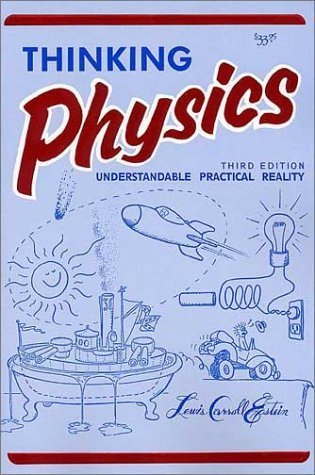
Lewis Carroll Epstein explains deep ideas in physics in an easy-to-understand way. Thinking Physics is a perfect beginner’s guide to an amazingly wide range of physics-related questions. The book targets topics that science teachers and students spend time wondering about, like wing lift. Epstein elucidates the familiar but misunderstood — such as how tides work — along with more obscure but fascinating phenomena like the “Bernoulli sub” and the “artificial aurora” created by hydrogen bombs. Broken into many short sections and peppered with Epstein’s own playful hand-drawn illustrations, the book does not simply give the right answer: It also goes into the answers that seem right but are wrong and shows why they are wrong — a rarity in science books. Thinking Physics is a rigorously correct, lighthearted, and cleverly designed Q and A book for physicists of all ages.

Most people are baffled by how computers work and assume that they will never understand them. What they don't realize—and what Daniel Hillis's short book brilliantly demonstrates—is that computers' seemingly complex operations can be broken down into a few simple parts that perform the same simple procedures over and over again.Computer wizard Hillis offers an easy-to-follow explanation of how data is processed that makes the operations of a computer seem as straightforward as those of a bicycle. Avoiding technobabble or discussions of advanced hardware, the lucid explanations and colorful anecdotes in The Pattern on the Stone go straight to the heart of what computers really do.Hillis proceeds from an outline of basic logic to clear descriptions of programming languages, algorithms, and memory. He then takes readers in simple steps up to the most exciting developments in computing today—quantum computing, parallel computing, neural networks, and self-organizing systems.Written clearly and succinctly by one of the world's leading computer scientists, The Pattern on the Stone is an indispensable guide to understanding the workings of that most ubiquitous and important of machines: the computer.

From terrorist attacks to big money jackpots, Struck by Lightning deconstructs the odds and oddities of chance, examining both the relevant and irreverent role of randomness in our everyday lives. Human beings have long been both fascinated and appalled by randomness. On the one hand, we love the thrill of a surprise party, the unpredictability of a budding romance, or the freedom of not knowing what tomorrow will bring. We are inexplicably delighted by strange coincidences and striking similarities. But we also hate uncertainty's dark side. From cancer to SARS, diseases strike with no apparent pattern. Terrorists attack, airplanes crash, bridges collapse, and we never know if we'll be that one in a million statistic. We are all constantly faced with situations and choices that involve randomness and uncertainty. A basic understanding of the rules of probability theory, applied to real-life circumstances, can help us to make sense of these situations, to avoid unnecessary fear, to seize the opportunities that randomness presents to us, and to actually enjoy the uncertainties we face. The reality is that when it comes to randomness, you can run, but you can't hide. So many aspects of our lives are governed by events that are simply not in our control. In this entertaining yet sophisticated look at the world of probabilities, author Jeffrey Rosenthal-an improbably talented math professor-explains the mechanics of randomness and teaches us how to develop an informed perspective on probability.

A major scientific revolution has begun, a new paradigm that rivals Darwin's theory in importance. At its heart is the discovery of the order that lies deep within the most complex of systems, from the origin of life, to the workings of giant corporations, to the rise and fall of great civilizations. And more than anyone else, this revolution is the work of one man, Stuart Kauffman, a MacArthur Fellow and visionary pioneer of the new science of complexity. Now, in At Home in the Universe , Kauffman brilliantly weaves together the excitement of intellectual discovery and a fertile mix of insights to give the general reader a fascinating look at this new science--and at the forces for order that lie at the edge of chaos.We all know of instances of spontaneous order in nature--an oil droplet in water forms a sphere, snowflakes have a six-fold symmetry. What we are only now discovering, Kauffman says, is that the range of spontaneous order is enormously greater than we had supposed. Indeed, self-organization is a great undiscovered principle of nature. But how does this spontaneous order arise? Kauffman contends that complexity itself triggers self-organization, or what he calls "order for free," that if enough different molecules pass a certain threshold of complexity, they begin to self-organize into a new entity--a living cell. Kauffman uses the analogy of a thousand buttons on a rug--join two buttons randomly with thread, then another two, and so on. At first, you have isolated pairs; later, small clusters; but suddenly at around the 500th repetition, a remarkable transformation occurs--much like the phase transition when water abruptly turns to ice--and the buttons link up in one giant network.Likewise, life may have originated when the mix of different molecules in the primordial soup passed a certain level of complexity and self-organized into living entities (if so, then life is not a highly improbable chance event, but almost inevitable). Kauffman uses the basic insight of "order for free" to illuminate a staggering range of phenomena. We see how a single-celled embryo can grow to a highly complex organism with over two hundred different cell types. We learn how the science of complexity extends Darwin's theory of evolution by natural that self-organization, selection, and chance are the engines of the biosphere. And we gain insights into biotechnology, the stunning magic of the new frontier of genetic engineering--generating trillions of novel molecules to find new drugs, vaccines, enzymes, biosensors, and more. Indeed, Kauffman shows that ecosystems, economic systems, and even cultural systems may all evolve according to similar general laws, that tissuesand terra cotta evolve in similar ways. And finally, there is a profoundly spiritual element to Kauffman's thought. If, as he argues, life were bound to arise, not as an incalculably improbable accident, but as an expected fulfillment of the natural order, then we truly are at home in the universe.Kauffman's earlier volume, The Origins of Order , written for specialists, received lavish praise. Stephen Jay Gould called it "a landmark and a classic." And Nobel Laureate Philip Anderson wrote that "there are few people in this world who ever ask the right questions of science, and they are the ones who affect its future most profoundly. Stuart Kauffman is one of these." In At Home in the Universe , this visionary thinker takes you along as he explores new insights into the nature of life.

Infinite in All Directions is a popularized science at its best. In Dyson's view, science and religion are two windows through which we can look out at the world around us. The book is a revised version of a series of the Gifford Lectures under the title "In Praise of Diversity" given at Aberdeen, Scotland. They allowed Dyson the license to express everything in the universe, which he divided into two parts in polished focusing on the diversity of the natural world as the first, and the diversity of human reactions as the second half. Chapter 1 is a brief explanation of Dyson's attitudes toward religion and science. Chapter 2 is a one–hour tour of the universe that emphasizes the diversity of viewpoints from which the universe can be encountered as well as the diversity of objects which it contains. Chapter 3 is concerned with the history of science and describes two contrasting styles in one welcoming diversity and the other deploring it. He uses the cities of Manchester and Athens as symbols of these two ways of approaching science. Chapter 4, concerned with the origin of life, describes the ideas of six illustrious scientists who have struggled to understand the nature of life from various points of view. Chapter 5 continues the discussion of the nature and evolution of life. The question of why life characteristically tends toward extremes of diversity remains central in all attempts to understand life's place in the universe. Chapter 6 is an exercise in eschatology, trying to define possible futures for life and for the universe, from here to infinity. In this chapter, Dyson crosses the border between science and science fiction and he frames his speculations in a slightly theological context.

Beyond Einstein takes readers on an exciting excursion into the discoveries that have led scientists to the brightest new prospect in theoretical physics today -- superstring theory. What is superstring theory and why is it important? This revolutionary breakthrough may well be the fulfillment of Albert Einstein's lifelong dream of a Theory of Everything, uniting the laws of physics into a single description explaining all the known forces in the universe. Co-authored by one of the leading pioneers in superstrings, Michio Kaku, and completely revised and updated with the newest groundbreaking research, the book approaches scientific questions with the excitement of a detective story, offering a fascinating look at the new science that may make the impossible possible.

“If you liked Chaos, you’ll love Complexity. Waldrop creates the most exciting intellectual adventure story of the year” (The Washington Post). In a rarified world of scientific research, a revolution has been brewing. Its activists are not anarchists, but rather Nobel Laureates in physics and economics and pony-tailed graduates, mathematicians, and computer scientists from all over the world. They have formed an iconoclastic think-tank and their radical idea is to create a new science: complexity. They want to know how a primordial soup of simple molecules managed to turn itself into the first living cell—and what the origin of life some four billion years ago can tell us about the process of technological innovation today. This book is their story—the story of how they have tried to forge what they like to call the science of the twenty-first century. “Lucidly shows physicists, biologists, computer scientists and economists swapping metaphors and reveling in the sense that epochal discoveries are just around the corner . . . [Waldrop] has a special talent for relaying the exhilaration of moments of intellectual insight.” —The New York Times Book Review “Where I enjoyed the book was when it dove into the actual question of complexity, talking about complex systems in economics, biology, genetics, computer modeling, and so on. Snippets of rare beauty here and there almost took your breath away.” —Medium “[Waldrop] provides a good grounding of what may indeed be the first flowering of a new science.” —Publishers Weekly

What is a meme? First coined by Richard Dawkins in 'The Selfish Gene', a meme is any idea, behavior, or skill that can be transferred from one person to another by imitation: stories, fashions, inventions, recipes, songs, ways of plowing a field or throwing a baseball or making a sculpture. The meme is also one of the most important--and controversial--concepts to emerge since 'The Origin of the Species' appeared nearly 150 years ago.In 'The Meme Machine' Susan Blackmore boldly asserts: "Just as the design of our bodies can be understood only in terms of natural selection, so the design of our minds can be understood only in terms of memetic selection." Indeed, Blackmore shows that once our distant ancestors acquired the crucial ability to imitate, a second kind of natural selection began, a survival of the fittest amongst competing ideas and behaviors. Ideas and behaviors that proved most adaptive - making tools, for example, or using language--survived and flourished, replicating themselves in as many minds as possible. These memes then passed themselves on from generation to generation by helping to ensure that the genes of those who acquired them also survived and reproduced. Applying this theory to many aspects of human life, Blackmore offers brilliant explanations for why we live in cities, why we talk so much, why we can't stop thinking, why we behave altruistically, how we choose our mates, and much more.With controversial implications for our religious beliefs, our free will, our very sense of "self," 'The Meme Machine' offers a provocative theory everyone will soon be talking about.

Acclaimed author Matt Ridley's thrilling follow-up to his bestseller Genome. Armed with the extraordinary new discoveries about our genes, Ridley turns his attention to the nature versus nurture debate to bring the first popular account of the roots of human behaviour. What makes us who we are? In February 2001 it was announced that the genome contains not 100,000 genes as originally expected but only 30,000. This startling revision led some scientists to conclude that there are simply not enough human genes to account for all the different ways people behave: we must be made by nurture, not nature. Matt Ridley argues that the emerging truth is far more interesting than this myth. Nurture depends on genes, too, and genes need nurture. Genes not only predetermine the broad structure of the brain; they also absorb formative experiences, react to social cues and even run memory. They are consequences as well as causes of the will. Published fifty years after the discovery of the double helix of DNA, Nature via Nurture chronicles a new revolution in our understanding of genes. Ridley recounts the hundred years' war between the partisans of nature and nurture to explain how this paradoxical creature, the human being, can be simultaneously free-willed and motivated by instinct and culture. Nature via Nurture is an enthralling, up-to-the-minute account of how genes build brains to absorb experience.

This radical book by Nobel laureate Monod is an important intellectual event. Chance and Necessity is a philosophical statement whose intention is to sweep away as both false and dangerous the animist conception of man that has dominated virtually all Western worldviews from primitive cultures to those of dialectical materialists. He bases his argument on the evidence of modern biology, which indisputably shows, that man is the product of chance genetic mutation. With the unrelenting logic of the scientist, he draws upon what we now know (and can theorize) of genetic structure to suggest an new way of looking at ourselves. He argues that objective scientific knowledge, the only reliable knowledge, denies the concepts of destiny or evolutionary purpose that underlie traditional philosophies. He contends that the persistence of those concepts is responsible for the intensifying schizophrenia of a world that accepts, and lives by, the fruits of science while refusing to face its moral implications. Dismissing as "animist" not only Plato, Hegel, Bergson and Teilhard de Chardin but Spencer and Marx as well, he calls for a new ethic that will recognize the distinction between objective knowledge and the realm of values--an ethic of knowledge that can, perhaps, save us from our deepening spiritual malaise, from the new age of darkness he sees coming.PrefaceOf strange objects Vitalisms and animisms Maxwell's demons Microscopic cyberneticsMolecular ontogenesis Invariance and perturbationsEvolution The frontiers The kingdom and the darknessAppendixes
A Nobel Prize-winning physicist explains what happened at the very beginning of the universe, and how we know, in this popular science classic.Our universe has been growing for nearly 14 billion years. But almost everything about it, from the elements that forged stars, planets, and lifeforms, to the fundamental forces of physics, can be traced back to what happened in just the first three minutes of its life.In this book, Nobel Laureate Steven Weinberg describes in wonderful detail what happened in these first three minutes. It is an exhilarating journey that begins with the Planck Epoch - the earliest period of time in the history of the universe - and goes through Einstein's Theory of Relativity, the Hubble Red Shift, and the detection of the Cosmic Microwave Background. These incredible discoveries all form the foundation for what we now understand as the "standard model" of the origin of the universe. The First Three Minutes examines not only what this model looks like, but also tells the exciting story of the bold thinkers who put it together.Clearly and accessibly written, The First Three Minutes is a modern-day classic, an unsurpassed explanation of where it is we really come from.

Over the past two decades, no field of scientific inquiry has had a more striking impact across a wide array of disciplines–from biology to physics, computing to meteorology–than that known as chaos and complexity, the study of complex systems. Now astrophysicist John Gribbin draws on his expertise to explore, in prose that communicates not only the wonder but the substance of cutting-edge science, the principles behind chaos and complexity. He reveals the remarkable ways these two revolutionary theories have been applied over the last twenty years to explain all sorts of phenomena–from weather patterns to mass extinctions.Grounding these paradigm-shifting ideas in their historical context, Gribbin also traces their development from Newton to Darwin to Lorenz, Prigogine, and Lovelock, demonstrating how–far from overturning all that has gone before–chaos and complexity are the triumphant extensions of simple scientific laws. Ultimately, Gribbin illustrates how chaos and complexity permeate the universe on every scale, governing the evolution of life and galaxies alike.

Based on a series of lectures given at Cambridge University, Professor Hawking's work introduced "the history of ideas about the universe" as well as today's most important scientific theories about time, space, and the cosmos in a clear, easy-to-understand way. "The Theory of Everything" presents the most complex theories, both past and present, of physics; yet it remains clear and accessible. It will enlighten readers and expose them to the rich history of scientific thought and the complexities of the universe in which we live.

A wonderfully readable account of scientific development over the past five hundred years, focusing on the lives and achievements of individual scientists, by the bestselling author of In Search of Schrödinger’s CatIn this ambitious new book, John Gribbin tells the stories of the people who have made science, and of the times in which they lived and worked. He begins with Copernicus, during the Renaissance, when science replaced mysticism as a means of explaining the workings of the world, and he continues through the centuries, creating an unbroken genealogy of not only the greatest but also the more obscure names of Western science, a dot-to-dot line linking amateur to genius, and accidental discovery to brilliant deduction.By focusing on the scientists themselves, Gribbin has written an anecdotal narrative enlivened with stories of personal drama, success and failure. A bestselling science writer with an international reputation, Gribbin is among the few authors who could even attempt a work of this magnitude. Praised as “a sequence of witty, information-packed tales” and “a terrific read” by The Times upon its recent British publication, The Scientists breathes new life into such venerable icons as Galileo, Isaac Newton, Albert Einstein and Linus Pauling, as well as lesser lights whose stories have been undeservedly neglected. Filled with pioneers, visionaries, eccentrics and madmen, this is the history of science as it has never been told before.

Six Easy Essentials of Physics Explained by Its Most Brilliant Teacher is a publishing first. This set couples a book containing the six easiest chapters from Richard P. Feynman's landmark work, Lectures on Physics —specifically designed for the general, non-scientist reader—with the actual recordings of the late, great physicist delivering the lectures on which the chapters are based. Nobel Laureate Feynman gave these lectures just once, to a group of Caltech undergraduates in 1961 and 1962, and these newly released recordings allow you to experience one of the Twentieth Century's greatest minds—as if you were right there in the classroom.

For centuries, parasites have lived in nightmares, horror stories, and in the darkest shadows of science. Now award-winning writer Carl Zimmer takes us on a fantastic voyage into the secret parasite universe we actually live in but haven't recognized. He reveals not only that parasites are the most successful life-forms on Earth, but that they triggered the development of sex, shape ecosystems, and have driven the engine of evolution. In mapping the parasite universe, Zimmer makes the astonishing observation that most species are parasites, and that almost every animal, including humans, will at one time or another become the home of a parasite. Zimmer shows how highly evolved parasites are and describes the frightening and amazing ingenuity these commando invaders use to devour their hosts from the inside and control their behavior. The sinister Sacculina carcini makes its home in an unlucky crab and proceeds to eat everything but what the crab needs to put food in its mouth, which Sacculina then consumes. When Sacculina finally reproduces, it places its young precisely where the crab would nurture its own progeny, and then has the crab nurture the foster family members. Single-celled Toxoplasma gondi has an even more insidious role, for it can invade the human brain. There it makes men distrustful and less willing to submit to social mores. Women become more outgoing and warm-hearted. Why would a parasite cause these particular personality changes? It seems Toxoplasma wants its host to be less afraid, to be more prone to danger and a violent end -- so that, in the carnage, it will be able to move on to another host. From the steamy jungles of Costa Rica to the fetid parasite heaven of rebel-held southern Sudan, Zimmer tracks the genius of parasitic life and its impact on humanity. We hosts have developed remarkable defenses against the indomitable parasite: our mighty immune system, our culturally enforced habit of keeping clean, and, perhaps most intriguingly, sex. But this is not merely a book about the evil power of parasitism and how we must defend against it. On the contrary, Zimmer concludes that humankind itself is a new kind of parasite, one that preys on the entire Earth. If we are to achieve the sophistication of the parasites on display here in vivid detail, if we are to promote the flourishing of life in all its diversity as they do, we must learn the ways nature lives with itself, the laws of Parasite Rex.

How is it that nobody―except maybe scientists―sees science for what it is? In this entertaining and provocative book, Lewis Wolpert draws on the entire history of science, from Thales of Miletus to Watson and Crick, from the study of eugenics to the discovery of the double helix. The result is a scientist’s view of the culture of science, authoritative and informed and at the same time mercifully accessible to those who find cohabiting with this culture a puzzling experience.Science is arguably the defining feature of our age. For anyone who hopes to understand its nature, this lively and thoughtful book provides the perfect starting point.

In the tradition of Being Digital and The Tipping Point, Steven Johnson, acclaimed as a "cultural critic with a poet's heart" (The Village Voice), takes readers on an eye-opening journey through emergence theory and its applications. Explaining why the whole is sometimes smarter than the sum of its parts, Johnson presents surprising examples of feedback, self-organization, and adaptive learning. How does a lively neighborhood evolve out of a disconnected group of shopkeepers, bartenders, and real estate developers? How does a media event take on a life of its own? How will new software programs create an intelligent World Wide Web? In the coming years, the power of self-organization -- coupled with the connective technology of the Internet -- will usher in a revolution every bit as significant as the introduction of electricity. Provocative and engaging, Emergence puts you on the front lines of this exciting upheaval in science and thought.

Few of the great stories of medicine are as palpably dramatic as the invention of open-heart surgery, yet, until now, no journalist has ever brought all of the thrilling specifics of this triumph to life.This is the story of the surgeon many call the father of open-heart surgery, Dr. C. Walton Lillehei, who, along with colleagues at University Hospital in Minneapolis and a small band of pioneers elsewhere, accomplished what many experts considered to be an impossible feat: He opened the heart, repaired fatal defects, and made the miraculous routine.Acclaimed author G. Wayne Miller draws on archival research and exclusive interviews with Lillehei and legendary pioneers such as Michael DeBakey and Christiaan Barnard, taking readers into the lives of these doctors and their patients as they progress toward their landmark achievement. In the tradition of works by Richard Rhodes and Tracy Kidder, King of Hearts tells the story of an important and gripping piece of forgotten science history.

How did the replication bomb we call ”life” begin and where in the world, or rather, in the universe, is it heading? Writing with characteristic wit and an ability to clarify complex phenomena (the New York Times described his style as ”the sort of science writing that makes the reader feel like a genius”), Richard Dawkins confronts this ancient mystery.

In the Messenger Lectures, originally delivered at Cornell University & recorded for TV by the BBC, Feynman offers an overview of selected physical laws & gathers their common features into one broad principle of invariance. He maintains at the outset that the importance of a physical law isn't "how clever we are to have found it out, but...how clever nature is to pay attention to it" & tends his discussions toward a final exposition of the elegance & simplicity of all scientific laws. Rather than an essay on the most significant achievements in modern science, The Character of Physical Law is a statement of what is most remarkable in nature. His enlightened approach, wit & enthusiasm make this a memorable exposition of the scientist's craft. The Law of Gravitation is the principal example. Relating the details of its discovery & stressing its mathematical character, he uses it to demonstrate the essential interaction of mathematics & physics. He views mathematics as the key to any system of scientific laws, suggesting that if it were possible to fill out the structure of scientific theory completely, the result would be an integrated set of axioms. The principles of conservation, symmetry & time-irreversibility are then considered in relation to developments in classical & modern physics. In his final lecture he develops his own analysis of the process & future of scientific discovery. Like any set of oral reflections, The Character of Physical Law has value as a demonstration of a mind in action. The reader is particularly lucky in Feynman. One of the most eminent & imaginative modern physicists, he was Professor of Theoretical Physics at the California Institute of Technology until his death in 1988. He's best known for work on the quantum theory of the electromagnetic field, as well as for later research in the field of low-temperature physics. In 1954 he received the Albert Einstein Award for an "outstanding contribution to knowledge in mathematical & physical sciences"; in 1965 he was appointed to Foreign Membership in the Royal Society & was awarded the Nobel Prize.

The Pleasure of Finding Things Out is a magnificent treasury of the best short works of Richard P. Feynman,from interviews and speeches to lectures and printed articles. A sweeping, wide-ranging collection, it presents an intimate and fascinating view of a life in science-a life like no other. From his ruminations on science in our culture to his Nobel Prize acceptance speech, this book will fascinate anyone interested in the world of ideas.El placer de descubrir permite acceder al mundo personal, social y cientíco de Richard Feynman, por ejemplo, a sus aventuras mientras participó en el Proyecto Manhattan, cuando se divertía —y escandalizaba— descifrando las claves de cajas fuertes, o a cómo se inició, siendo un niño, en el estudio de la naturaleza (en el «placer de descubrir»), que terminaría ocupando toda su vida. Podemos, asimismo, conocer sus pioneras ideas sobre las computadoras del futuro, su opinión acerca del valor de la ciencia o la explicación, tan sencilla como profunda, que dio al desastre de la lanzadera espacial Challenger. Es este, sin duda, un libro tan fascinante como su autor.

Dr. Carl Sagan takes us on a great reading adventure, offering his vivid and startling insight into the brain of man and beast, the origin of human intelligence, the function of our most haunting legends—and their amazing links to recent discoveries.

An authoritative introduction to "fuzzy logic" brings readers up to speed on the "smart" products and computers that will change all of our lives in the future.

This work has become a benchmark of popular anthropology and psychology.Zoologist Desmond Morris considers humans as being simply another animal species in this classic book first published in 1967. Here is the Naked Ape at his most primal in love, at work, at war. Meet man as he really is: relative to the apes, stripped of his veneer as we see him courting, making love, sleeping, socializing, grooming, playing. The Naked Ape takes its place alongside Darwin’s Origin of the Species, presenting man not as a fallen angel, but as a risen ape, remarkable in his resilience, energy and imagination, yet an animal nonetheless, in danger of forgetting his origins. With its penetrating insights on man's beginnings, sex life, habits and our astonishing bonds to the animal kingdom, The Naked Ape is a landmark, at once provocative, compelling and timeless.

Jared Diamond meets Stephen Hawking in a book that fits human history into the history of the universe, by an American Book Award winner.An epic for our time, Big History begins when the universe is no more than a single point the size of an atom, squeezed together in unimaginable density, and ends with a twenty-first-century planet inhabited by 6.1 billion people. It's a story that takes in prehistoric geology, human evolution, the agrarian age, the Black Death, the voyages of Columbus, the industrial revolution, and global warming. Historian Cynthia Brown visits the Vikings, the Mayas and Aztecs, the Incas, the Mongol empire, and the Islamic heartlands. Along the way she considers topics as varied as cell formation, population growth, global disparities, and illiteracy, creating a stunning synthesis of historical and scientific knowledge of humanity and the earth we inhabit.Big History represents a new kind of history, one that skillfully interweaves historical knowledge and cutting-edge science. In an age of global warming, when the fate of the earth hangs in the balance, scientific advances permit us to see the universe as never before, grasping the timescales that allow us to understand the history of mankind in the context of its ecological impact on the planet. Cynthia Brown's lucid, accessible narrative is the first popularization of this innovative new field of study, as thrilling as it is ambitious.

Confronting us at every turn, flowing from every imaginable source, information defines our era--and yet what we don't know about it could--and does--fill a book. In this indispensable volume, a primer for the information age, Hans Christian von Baeyer presents a clear description of what information is, how concepts of its measurement, meaning, and transmission evolved, and what its ever-expanding presence portends for the future. Information is poised to replace matter as the primary stuff of the universe, von Baeyer suggests; it will provide a new basic framework for describing and predicting reality in the twenty-first century. Despite its revolutionary premise, von Baeyer's book is written simply in a straightforward fashion, offering a wonderfully accessible introduction to classical and quantum information. Enlivened with anecdotes from the lives of philosophers, mathematicians, and scientists who have contributed significantly to the field, Information conducts readers from questions of subjectivity inherent in classical information to the blurring of distinctions between computers and what they measure or store in our quantum age. A great advance in our efforts to define and describe the nature of information, the book also marks an important step forward in our ability to exploit information--and, ultimately, to transform the nature of our relationship with the physical universe. (20040301)

“It manages to delight, and frequently to entrance, old and new readers [and] continues to engage our hearts and minds today with an indescribably brand of affectionate sympathy.”—F. Gonzalez-Crussi, from the IntroductionAn international bestseller, translated into eighteen languages, Paul de Kruif’s classic account of the first scientists to see and learn about the microscopic world continues to fascinate new readers. This is a timeless dramatization of the scientists, bacteriologists, doctors, and medical technicians who discovered the microbes and invented the vaccines to counter them. De Kruif writes about how seemingly simple but really fundamental discovers of science—for instance, how a microbe was first viewed in a clear drop of rain water, and when, for the first time, Louis Pasteur discovered that a simple vaccine could save a man from the ravages of rabies by attacking the microbes that cause it.

Many appreciate Richard P. Feynman's contributions to twentieth-century physics, but few realize how engaged he was with the world around him -- how deeply and thoughtfully he considered the religious, political, and social issues of his day. Now, a wonderful book -- based on a previously unpublished, three-part public lecture he gave at the University of Washington in 1963 -- shows us this other side of Feynman, as he expounds on the inherent conflict between science and religion, people's distrust of politicians, and our universal fascination with flying saucers, faith healing, and mental telepathy. Here we see Feynman in top form: nearly bursting into a Navajo war chant, then pressing for an overhaul of the English language (if you want to know why Johnny can't read, just look at the spelling of "friend"); and, finally, ruminating on the death of his first wife from tuberculosis. This is quintessential Feynman -- reflective, amusing, and ever enlightening.

In this extraordinary bestseller, Steven Pinker, one of the world's leading cognitive scientists, does for the rest of the mind what he did for language in his 1994 book, The Language Instinct. He explains what the mind is, how it evolved, and how it allows us to see, think, feel, laugh, interact, enjoy the arts, and ponder the mysteries of life. And he does it with the wit that prompted Mark Ridley to write in the New York Times Book Review, "No other science writer makes me laugh so much. . . . [Pinker] deserves the superlatives that are lavished on him." The arguments in the book are as bold as its title. Pinker rehabilitates some unfashionable ideas, such as that the mind is a computer and that human nature was shaped by natural selection, and challenges fashionable ones, such as that passionate emotions are irrational, that parents socialize their children, and that nature is good and modern society corrupting. Winner of the Los Angeles Times Book Prize A New York Times Notable Book of the Year and Publishers Weekly Best Book of 1997 Featured in Time magazine, the New York Times Magazine, The New Yorker, Nature, Science, Lingua Franca, and Science Times Front-page reviews in the Washington Post Book World, the Boston Globe Book Section, and the San Diego Union Book Review

In 1931 Kurt Gödel published his fundamental paper, "On Formally Undecidable Propositions of Principia Mathematica and Related Systems." This revolutionary paper challenged certain basic assumptions underlying much research in mathematics and logic. Gödel received public recognition of his work in 1951 when he was awarded the first Albert Einstein Award for achievement in the natural sciences--perhaps the highest award of its kind in the United States. The award committee described his work in mathematical logic as "one of the greatest contributions to the sciences in recent times."However, few mathematicians of the time were equipped to understand the young scholar's complex proof. Ernest Nagel and James Newman provide a readable and accessible explanation to both scholars and non-specialists of the main ideas and broad implications of Gödel's discovery. It offers every educated person with a taste for logic and philosophy the chance to understand a previously difficult and inaccessible subject.New York University Press is proud to publish this special edition of one of its bestselling books. With a new introduction by Douglas R. Hofstadter, this book will appeal to students, scholars, and professionals in the fields of mathematics, computer science, logic and philosophy, and science.

A global catastrophic risk is one with the potential to wreak death and destruction on a global scale. In human history, wars and plagues have done so on more than one occasion, and misguided ideologies and totalitarian regimes have darkened an entire era or a region. Advances in technologyare adding dangers of a new kind. It could happen again.In Global Catastrophic Risks 25 leading experts look at the gravest risks facing humanity in the 21st century, including asteroid impacts, gamma-ray bursts, Earth-based natural catastrophes, nuclear war, terrorism, global warming, biological weapons, totalitarianism, advanced nanotechnology, generalartificial intelligence, and social collapse. The book also addresses over-arching issues - policy responses and methods for predicting and managing catastrophes.This is invaluable reading for anyone interested in the big issues of our time; for students focusing on science, society, technology, and public policy; and for academics, policy-makers, and professionals working in these acutely important fields.

One of the most dramatic stories of genetic discovery since James Watson's The Double Helix—a work whose scientific and cultural reverberations will be discussed for years to come.In 1994 Professor Bryan Sykes, a leading world authority on DNA and human evolution, was called in to examine the frozen remains of a man trapped in glacial ice in northern Italy. News of both the Ice Man's discovery and his age, which was put at over five thousand years, fascinated scientists and newspapers throughout the world. But what made Sykes's story particularly revelatory was his successful identification of a genetic descendant of the Ice Man, a woman living in Great Britain today. How was Sykes able to locate a living relative of a man who died thousands of years ago?In The Seven Daughters of Eve, he gives us a firsthand account of his research into a remarkable gene, which passes undiluted from generation to generation through the maternal line. After plotting thousands of DNA sequences from all over the world, Sykes found that they clustered around a handful of distinct groups. Among Europeans and North American Caucasians, there are, in fact, only seven. This conclusion was almost everyone of native European descent, wherever they may live throughout the world, can trace their ancestry back to one of seven women, the Seven Daughters of Eve.Naming them Ursula, Xenia, Helena, Velda, Tara, Katrine, and Jasmine, Sykes has created portraits of their disparate worlds by mapping the migratory patterns followed by millions of their ancestors. In reading the stories of these seven women, we learn exactly how our origins can be traced, how and where our ancient genetic ancestors lived, and how we are each living proof of the almost indestructible strands of DNA, which have survived over so many thousands of years. Indeed, The Seven Daughters of Eve is filled with dramatic from Sykes's identification, using DNA samples from two living relatives, of the remains of Tsar Nicholas and Tsaress Alexandra, to the Caribbean woman whose family had been sold into slavery centuries before and whose ancestry Sykes was able to trace back to the Eastern coast of central Africa. Ultimately, Sykes's investigation reveals that, as a race, what humans have in common is more deeply embedded than what separates us.

Mr. Tompkins is back! The mild-mannered bank clerk with the short attention span and vivid imagination has inspired, charmed, and informed young and old alike since the publication of the hugely successful Mr Tompkins in Paperback (by George Gamow) in 1965. Now, this highly affable character returns to embark on a set of adventures that explore the extreme edges of the universe--the smallest, the largest, the fastest, and the farthest. Just by following the experiences and dreams of Mr. Tompkins, readers discover and come to know the merry dance of cosmic mysteries, including: Einstein's theory of relativity, bizarre effects near light-speed, the birth and death of the universe, black holes, quarks, space warps and antimatter, the fuzzy world of the quantum, and that ultimate cosmic mystery--love. The story of Mr. Tompkins' journey to the frontiers of modern physics will delight and inform all readers. Russell Stannard is a best-selling popular science writer and the author of the critically acclaimed Uncle Albert series of science books for children.

The revised and updated edition includes three completely new chapters on the prediction and control of chaotic systems. It also incorporates new information regarding the solar system and an account of complexity theory. This witty, lucid and engaging book makes the complex mathematics of chaos accessible and entertaining. Presents complex mathematics in an accessible style. Includes three new chapters on prediction in chaotic systems, control of chaotic systems, and on the concept of chaos. Provides a discussion of complexity theory.

Richard Holmes presents an entertaining study of the extraordinary figures that changed the face of science.This edition features many illuminating newly researched images: diagrams of galvanism show the effects of electricity on a severed ox’s head, and ‘Sadak in Search of the Waters of Oblivion’ poignantly illustrates the bravery of the lone traveller. In her introduction, the acclaimed writer Jenny Uglow shares her enthusiasm for a book that encourages us to ‘make our own imaginative flights’.The Age of Wonder reveals the fascinating cast of the era: William Herschel, whose explorations of the stars led to the discovery of Uranus, and the chemist Humphry Davy, who frequently endangered his own life in his experiments. Their devotion to discovery inspired a generation of romantic poets, including Coleridge, who would attend Davy’s lectures and write essays on his work. As well as these key figures, Holmes demonstrates the breadth of scientific and artistic endeavour: from the ballooning craze that consumed Europe in 1783, to Mary Shelly’s nightmarish Frankenstein, he sweeps the reader along in an infectious race for greater understanding.

What enables individually simple insects like ants to act with such precision and purpose as a group? How do trillions of neurons produce something as extraordinarily complex as consciousness? In this remarkably clear and companionable book, leading complex systems scientist Melanie Mitchell provides an intimate tour of the sciences of complexity, a broad set of efforts that seek to explain how large-scale complex, organized, and adaptive behavior can emerge from simple interactions among myriad individuals. Based on her work at the Santa Fe Institute and drawing on its interdisciplinary strategies, Mitchell brings clarity to the workings of complexity across a broad range of biological, technological, and social phenomena, seeking out the general principles or laws that apply to all of them. Richly illustrated, Complexity: A Guided Tour--winner of the 2010 Phi Beta Kappa Book Award in Science--offers a wide-ranging overview of the ideas underlying complex systems science, the current research at the forefront of this field, and the prospects for its contribution to solving some of the most important scientific questions of our time.

With more than 1 million copies sold worldwide, The Elements is the most entertaining, comprehensive, and visually arresting book on all 118 elements in the periodic table.Includes a poster of Theodore Gray's iconic photographic periodic table of the elements!Based on seven years of research and photography by Theodore Gray and Nick Mann, The Elements presents the most complete and visually arresting representation available to the naked eye of every atom in the universe. Organized sequentially by atomic number, every element is visualized by a big beautiful photograph that most closely represents it in its purest form. Several additional photographs show each element in slightly altered forms or as used in various practical ways. Also included are fascinating stories of the elements, told in Theo Grays inimitable style, as well as data on the properties of each, including atomic number, atomic symbol, atomic weight, density, atomic radius, as well as scales for electron filling order, state of matter, and an atomic emission spectrum.This work of solid science and stunning artistic photographs is the perfect gift book for every sentient creature in the universe.

“YOU HAVE CHANGED MY LIFE” is a common refrain in the emails Walter Lewin receives daily from fans who have been enthralled by his world-famous video lectures about the wonders of physics. “I walk with a new spring in my step and I look at life through physics-colored eyes,” wrote one such fan. When Lewin’s lectures were made available online, he became an instant YouTube celebrity, and The New York Times declared, “Walter Lewin delivers his lectures with the panache of Julia Child bringing French cooking to amateurs and the zany theatricality of YouTube’s greatest hits.” For more than thirty years as a beloved professor at the Massachusetts Institute of Technology, Lewin honed his singular craft of making physics not only accessible but truly fun, whether putting his head in the path of a wrecking ball, supercharging himself with three hundred thousand volts of electricity, or demonstrating why the sky is blue and why clouds are white. Now, as Carl Sagan did for astronomy and Brian Green did for cosmology, Lewin takes readers on a marvelous journey in For the Love of Physics, opening our eyes as never before to the amazing beauty and power with which physics can reveal the hidden workings of the world all around us. “I introduce people to their own world,” writes Lewin, “the world they live in and are familiar with but don’t approach like a physicist—yet.” Could it be true that we are shorter standing up than lying down? Why can we snorkel no deeper than about one foot below the surface? Why are the colors of a rainbow always in the same order, and would it be possible to put our hand out and touch one? Whether introducing why the air smells so fresh after a lightning storm, why we briefly lose (and gain) weight when we ride in an elevator, or what the big bang would have sounded like had anyone existed to hear it, Lewin never ceases to surprise and delight with the extraordinary ability of physics to answer even the most elusive questions. Recounting his own exciting discoveries as a pioneer in the field of X-ray astronomy—arriving at MIT right at the start of an astonishing revolution in astronomy—he also brings to life the power of physics to reach into the vastness of space and unveil exotic uncharted territories, from the marvels of a supernova explosion in the Large Magellanic Cloud to the unseeable depths of black holes. “For me,” Lewin writes, “physics is a way of seeing—the spectacular and the mundane, the immense and the minute—as a beautiful, thrillingly interwoven whole.” His wonderfully inventive and vivid ways of introducing us to the revelations of physics impart to us a new appreciation of the remarkable beauty and intricate harmonies of the forces that govern our lives.

James Gleick, the author of the best sellers Chaos and Genius, now brings us a work just as astonishing and masterly: a revelatory chronicle and meditation that shows how information has become the modern era's defining quality—the blood, the fuel, the vital principle of our world. The story of information begins in a time profoundly unlike our own, when every thought and utterance vanishes as soon as it is born. From the invention of scripts and alphabets to the long-misunderstood talking drums of Africa, Gleick tells the story of information technologies that changed the very nature of human consciousness. He provides portraits of the key figures contributing to the inexorable development of our modern understanding of information: Charles Babbage, the idiosyncratic inventor of the first great mechanical computer; Ada Byron, the brilliant and doomed daughter of the poet, who became the first true programmer; pivotal figures like Samuel Morse and Alan Turing; and Claude Shannon, the creator of information theory itself. And then the information age arrives. Citizens of this world become experts willy-nilly: aficionados of bits and bytes. And we sometimes feel we are drowning, swept by a deluge of signs and signals, news and images, blogs and tweets. The Information is the story of how we got here and where we are heading.

Professor Richard Wiseman is clear about one thing: paranormal phenomena don't exist. But in the same way that the science of space travel transforms our everyday lives, so research into telepathy, fortune-telling and out-of-body experiences produces remarkable insights into our brains, behaviour and beliefs. Paranormality embarks on a wild ghost chase into this new science of the supernatural and is packed with activities that allow you to experience the impossible. So throw away your crystals, ditch your lucky charms and cancel your subscription to Reincarnation Weekly. It is time to discover the real secrets of the paranormal. Learn how to control your dreams -- and leave your body behind Convince complete strangers that you know all about them Unleash the power of your unconscious mind.

Viruses are the smallest living things known to science, yet they hold the entire planet in their sway. We are most familiar with the viruses that give us colds or the flu, but viruses also cause a vast range of other diseases, including one disorder that makes people sprout branch-like growths as if they were trees. Viruses have been a part of our lives for so long, in fact, that we are actually part virus: the human genome contains more DNA from viruses than our own genes. Meanwhile, scientists are discovering viruses everywhere they look: in the soil, in the ocean, even in caves miles underground.This fascinating book explores the hidden world of viruses—a world that we all inhabit. Here Carl Zimmer, popular science writer and author of Discover magazine’s award-winning blog The Loom, presents the latest research on how viruses hold sway over our lives and our biosphere, how viruses helped give rise to the first life-forms, how viruses are producing new diseases, how we can harness viruses for our own ends, and how viruses will continue to control our fate for years to come. In this eye-opening tour of the frontiers of biology, where scientists are expanding our understanding of life as we know it, we learn that some treatments for the common cold do more harm than good; that the world’s oceans are home to an astonishing number of viruses; and that the evolution of HIV is now in overdrive, spawning more mutated strains than we care to imagine.The New York Times Book Review calls Carl Zimmer “as fine a science essayist as we have.” A Planet of Viruses is sure to please his many fans and further enhance his reputation as one of America’s most respected and admired science journalists.

Magic takes many forms. Supernatural magic is what our ancestors used in order to explain the world before they developed the scientific method. The ancient Egyptians explained the night by suggesting the goddess Nut swallowed the sun. The Vikings believed a rainbow was the gods’ bridge to earth. The Japanese used to explain earthquakes by conjuring a gigantic catfish that carried the world on its back—earthquakes occurred each time it flipped its tail. These are magical, extraordinary tales. But there is another kind of magic, and it lies in the exhilaration of discovering the real answers to these questions. It is the magic of reality—science.Packed with clever thought experiments, dazzling illustrations and jaw-dropping facts, The Magic of Reality explains a stunningly wide range of natural phenomena. What is stuff made of? How old is the universe? Why do the continents look like disconnected pieces of a puzzle? What causes tsunamis? Why are there so many kinds of plants and animals? Who was the first man, or woman? This is a page-turning, graphic detective story that not only mines all the sciences for its clues but primes the reader to think like a scientist as well.Richard Dawkins, the world’s most famous evolutionary biologist and one of science education’s most passionate advocates, has spent his career elucidating the wonders of science for adult readers. But now, in a dramatic departure, he has teamed up with acclaimed artist Dave McKean and used his unrivaled explanatory powers to share the magic of science with readers of all ages. This is a treasure trove for anyone who has ever wondered how the world works. Dawkins and McKean have created an illustrated guide to the secrets of our world—and the universe beyond—that will entertain and inform for years to come.