
Paul de Kruif
Paul Henry de Kruif was an American microbiologist and author of Dutch descent. Publishing as Paul de Kruif, he is most noted for his 1926 book, Microbe Hunters. This book was not only a bestseller for a lengthy period after publication, it has remained high on lists of recommended reading for science and has been an inspiration for many aspiring physicians and scientists. He graduated from the University of Michigan with a Bachelor's degree (1912) and remained to obtain a Ph.D. (1916). He immediately entered service as a Private in Mexico on the Pancho Villa Expedition and afterwards served as a Lieutenant and a Captain in World War I in France. Because of his service in the Sanitary Corps, he had occasional contacts with leading French biologists of the period. After returning to the University of Michigan as an Assistant Professor, De Kruif briefly worked for the Rockefeller Institute (for Medical Research). He then became a full-time writer. De Kruif assisted Sinclair Lewis with his Pulitzer Prize-winning novel Arrowsmith (1925) by providing the scientific and medical information required by the plot, along with character sketches. Even though Lewis was listed as the sole author, De Kruif's contribution was significant, and he received 25 percent of the royalties. Many believe the characters in the novel represent people known to De Kruif, with Martin Arrowsmith (a physician, unlike de Kruif) possibly representing himself. Some of his writings created problems for him. Some essays written while working for the Rockefeller Institute led to his dismissal. Ronald Ross, one of the scientists featured in Microbe Hunters, took exception to how he was described, so the British edition deleted that chapter to avoid a libel suit. De Kruif was a staff writer for the Ladies' Home Journal, Country Gentleman, and the Readers Digest, contributing articles on Science and Medicine. He also served on commissions to promote research into Infantile Paralysis. The Sweeping Wind, his last book, is his autobiography.
28 Books Written
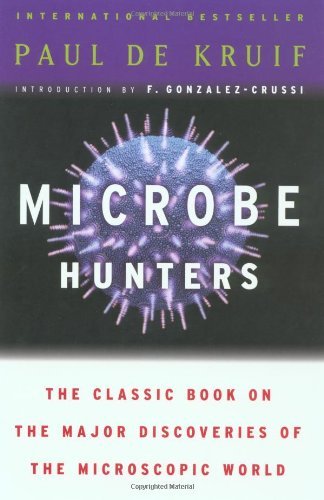
“It manages to delight, and frequently to entrance, old and new readers [and] continues to engage our hearts and minds today with an indescribably brand of affectionate sympathy.”—F. Gonzalez-Crussi, from the IntroductionAn international bestseller, translated into eighteen languages, Paul de Kruif’s classic account of the first scientists to see and learn about the microscopic world continues to fascinate new readers. This is a timeless dramatization of the scientists, bacteriologists, doctors, and medical technicians who discovered the microbes and invented the vaccines to counter them. De Kruif writes about how seemingly simple but really fundamental discovers of science—for instance, how a microbe was first viewed in a clear drop of rain water, and when, for the first time, Louis Pasteur discovered that a simple vaccine could save a man from the ravages of rabies by attacking the microbes that cause it.

A Man Against Insanity — a recently rediscovered 1957 book by Paul De Kruif — describes the remarkable life and career of Dr. John (Jack) Ferguson, who began his medical career late in life with the goal of being a simple country doctor, only to become a pioneer in modern psycho-pharmacology.

In the tradition of great American rags to riches stories, Seven Iron Men weaves together the history of how the seven Merritt brothers discovered iron ore on the Mesabi Range. In 1890 they were poised to become one of the wealthiest families in America but lost it all to industrialist John D. Rockefeller. “The tale of their long and furious quest makes for one of the most melodramatic stories in American history. . . . The Merritts leap from the chronicle in all the colors of life—especially Lon, the king of them all, with his maudlin poetizing, his childlike faith in mankind, and his incredible tropical hat. It is a tale full of thrills, shot with sardonic humors.” —H. L. Mencken, The Nation “Certainly it is no small contribution to the history of the American people to unfold the tale of the discovery and development of those huge iron deposits of the Mesabi Range flanking much of Lake Superior. To these perhaps quite as much as to any other one factor the country owes its industrial supremacy in the ago of steel.” —New York Herald Tribune Paul de Kruif (1890–1971) was a microbiologist, served as a contributing editor to Reader’s Digest, and was the best-selling author of Microbe Hunters.

1928. This book contains eleven essays relating to the fight against hunger and the people responsible behind this movement. wheat dreamer, Carleton; wheat finders, Mackay and others more eminent; scientific Bolshevik, Dorset; man for fundamentals, Mohler; automatic man, Francis; maize finders, ancient and anonymous; maize breeder, Shull; new soil from old, Hoffer; Hidden finder of the hidden hunger, Babcock; sun trapper, Steenbock; soft spoken desperado, Goldberger.

http://www.archive.org/details/sweepi...http://jama.ama-assn.org/content/181/...The Sweeping Wind: A Memoir by P. de Kruif. Pp. 270. Harcourt, NY, 1962. John H. Raach, PhD, MDSince this article doesn't have an abstract, we provide the 1st 150 words of the text:In his memoir, Paul de Kruif gives us an autobiography which ranks with the best of these rare forms of literature. In his lifetime he has been in close touch with great events in 20th century medicine & has counted some of the great personages of the American scene among his intimate friends. The manner in which he recounts short anecdotes about many of these people is fascinating. Private conversations & letters, which always intrigue a reader, abound in his story & make it far better reading as a result.For those who have enjoyed de Kruif's novels & articles, this memoir will be a welcome addition to their library of "de Kruifiana." The inimitable style which he has developed is at its best in the 1st portion of the book. The latter portion is less a story & more a mere recounting of experiences with people & committees.

In this thrilling scientific detective story Paul de Kruif tells of the male hormone's rise from its original sexual dis-reputability to its present promise of lifting the total vitality of mankind. The male hormone discloses magic far beyond the merely sexual. It boosts muscle power. It banishes mental fatigue. It eases heart pain. It even restores the sanity of men in midlife who suffer from male hormone hunger. Just as chemicals renew worn-out soil, so the male hormone seems to renew the tissues of aging men. The book is elaborately documented with numerous case histories, dramatic, touching and humorous. These hormone hunters are shown by Paul de Kruif as a new breed of men against death, fighting not physical demise but the far sadder living death of premature old age.

Excerpt from Our Medicine MenA part of these essays has appeared in The Century Magazine, and their publication has aroused the profound displeasure of many serious and possibly important persons. The pieces have been variously denounced as destructive, igno rant, rotten, wrong-headed, and detrimental to progress. This writer deplores these criticisms, for, while it is true that he had no intention to moralize or to improve the world, he did attempt to recount in a fair and restrained manner the reactions which twelve years of contact with medicine men have called forth in him.

"How our doctors are combining new scientific miracles with the religion of the good Samaritan, bringing great hope to mankind. Paul de Kruif's own story in summing up an era in medicine -- an autobiography and a personal philosophy on life, and perhaps de Kruif's major work."https://www.amazon.com/Life-among-Doc...

Children and disease, hunger and poverty
Madrid. 22 cm. XII, 2 h., 319 p. lám. Encuadernación en tapa blanda de editorial. Colección 'Biblioteca de Iniciación Científica'. Traducción del inglés por Federico Portillo. Microbiología. Historia .. Este libro es de segunda mano y tiene o puede tener marcas y señales de su anterior propietario. 8403790023
Das Mannliche Hormon Jugendliche Spannkraft Bis Ins Hohe Alter
by Paul de Kruif
The Primary Toxicity of Normal Serum 1917 [Leather Bound]
by Paul de Kruif
Leather Binding on Spine and Corners with Golden leaf printing on spine. This book is printed in black & white, Sewing binding for longer life, where the book block is actually sewn (smythe sewn/section sewn) with thread before binding which results in a more durable type of binding. Reprinted in 2022 with the help of original edition published long back 1917. As this book is reprinted from a very old book, there could be some missing or flawed pages. If it is multi vo Resized as per current standards. We expect that you will understand our compulsion with such books. 72 The primary toxicity of normal serum 1917 Paul De Kruif
Seven Iron Men
by Paul de Kruif
Our Medicine Men, by Paul H. De Kruif 1922 [Leather Bound]
by Paul de Kruif
Leather Binding on Spine and Corners with Golden leaf printing on spine. This book is printed in black & white, Sewing binding for longer life, where the book block is actually sewn (smythe sewn/section sewn) with thread before binding which results in a more durable type of binding. Reprinted in 2022 with the help of original edition published long back 1922. As this book is reprinted from a very old book, there could be some missing or flawed pages. If it is multi vo Resized as per current standards. We expect that you will understand our compulsion with such books. 260 Our medicine men, by Paul H. De Kruif 1922 Paul De Kruif
Microbe Hunters 1926 [Leather Bound]
by Paul de Kruif
Leather Binding on Spine and Corners with Golden leaf printing on spine. This book is printed in black & white, Sewing binding for longer life, where the book block is actually sewn (smythe sewn/section sewn) with thread before binding which results in a more durable type of binding. Reprinted in 2022 with the help of original edition published long back 1926. As this book is reprinted from a very old book, there could be some missing or flawed pages. If it is multi vo Resized as per current standards. We expect that you will understand our compulsion with such books. 402 microbe hunters 1926 paul de kruif
Why the National Foundation for Infantile Paralysis
by Paul de Kruif
Hunger fighters
by Paul de Kruif
This science classic by Paul de Kruif chronicles the pioneering bacteriological work of the first scientists to see and learn from the microscopic world.Paul de Kruif's Microbe Hunters is a timeless dramatization of the scientists, bacteriologists, doctors, and medical technicians who discovered microbes and invented the vaccines to counter them. De Kruif reveals the now seemingly simple but really fundamental discoveries of science - for instance, how a microbe was first viewed in a clear drop of rain water, and when, for the first time ever, Louis Pasteur discovered that a simple vaccine could save a man from the ravages of rabies by attacking the microbes that cause it.

Hunger Fighters
by Paul de Kruif
Hunger Fighters by Paul de Kruif takes readers on a compelling journey through eleven essays that spotlight the relentless efforts of pioneers in the fight against hunger. From wheat dreamer Carleton to maize breeder Shull, and from the hidden hunger detective Babcock to the sun trapper Steenbock, these essays vividly portray the unsung heroes who transformed agriculture, nutrition, and food production.Though the writing occasionally strays into an overly impassioned tone, de Kruif’s dedication to these remarkable figures shines through. If you're captivated by the history of science and the groundbreaking achievements of those who endured personal sacrifices to revolutionize how we combat hunger, this book offers a unique and dramatic portrayal. A must-read for those fascinated by the intertwined tales of innovation, perseverance, and the quest for nourishment in a changing world.
Mikrobenjager
by Paul de Kruif
1927. 350 pages. No dust jacket. Beige cloth. Printed in German. Pages are lightly tanned and thumbed at the edges, with light foxing. Binding has remained firm. Boards are a little rub worn, slight shelf wear to corners, spine and edges. Corners are a little bumped. Spine ends are mildly crushed. Light tanning to spine and edges. Boards are slightly bowed. Slight forward lean to text block.
Strijders voor het leven
by Paul de Kruif
/ / Medicine / Nederlands / Dutch / Néerlandais / Niederländisch / hard cover / 14 x 21 cm / 284 .pp /
A New Hope for Prolonging Man's Prime of Life, the Male Hormone
by Paul de Kruif

La guerre contre les microbes
by Paul de Kruif

Health is Wealth
by Paul de Kruif
2 Volumes: The Hunger Fighters and Men Against Death
by Paul de Kruif
Boss Kettering
by Paul de Kruif