
V.S. Ramachandran
Vilayanur S. "Rama" Ramachandran is a neurologist best known for his work in the fields of behavioral neurology and psychophysics. He is currently the Director of the Center for Brain and Cognition, Professor in the Psychology Department and Neurosciences Program at the University of California, San Diego, and Adjunct Professor of Biology at the Salk Institute for Biological Studies. Ramachandran initially obtained an M.D. at Stanley Medical College in Madras, India, and subsequently obtained a Ph.D. from Trinity College at the University of Cambridge. Ramachandran’s early work was on visual perception but he is best known for his experiments in behavioral neurology which, despite their apparent simplicity, have had a profound impact on the way we think about the brain. Ramachandran has been elected to fellowships at All Souls College, Oxford, and the Royal Institution, London (which also awarded him the Henry Dale Medal). He gave the 2003 BBC Reith Lectures and was conferred the title of Padma Bhushan by the President of India in 2007. He has been called “The Marco Polo of neuroscience” by Richard Dawkins and "the modern Paul Broca" by Eric Kandel. Newsweek magazine named him a member of "The Century Club", one of the "hundred most prominent people to watch" in the 21st century. -http://en.wikipedia.org/wiki/Vilayanu...
19 Books Written

Phantoms in the Brain: Probing the Mysteries of the Human Mind
by V.S. Ramachandran
Rating: 4.3 ⭐
• 2 recommendations ❤️
Neuroscientist V.S. Ramachandran is internationally renowned for uncovering answers to the deep and quirky questions of human nature that few scientists have dared to address. His bold insights about the brain are matched only by the stunning simplicity of his experiments -- using such low-tech tools as cotton swabs, glasses of water and dime-store mirrors. In Phantoms in the Brain, Dr. Ramachandran recounts how his work with patients who have bizarre neurological disorders has shed new light on the deep architecture of the brain, and what these findings tell us about who we are, how we construct our body image, why we laugh or become depressed, why we may believe in God, how we make decisions, deceive ourselves and dream, perhaps even why we're so clever at philosophy, music and art. Some of his most notable cases:A woman paralyzed on the left side of her body who believes she is lifting a tray of drinks with both hands offers a unique opportunity to test Freud's theory of denial.A man who insists he is talking with God challenges us to ask: Could we be "wired" for religious experience?A woman who hallucinates cartoon characters illustrates how, in a sense, we are all hallucinating, all the time.Dr. Ramachandran's inspired medical detective work pushes the boundaries of medicine's last great frontier -- the human mind -- yielding new and provocative insights into the "big questions" about consciousness and the self.

The Tell-Tale Brain: A Neuroscientist's Quest for What Makes Us Human
by V.S. Ramachandran
Rating: 4.1 ⭐
V. S. Ramachandran is at the forefront of his field-so much so that Richard Dawkins dubbed him the "Marco Polo of neuroscience." Now, in a major new work, Ramachandran sets his sights on the mystery of human uniqueness. Taking us to the frontiers of neurology, he reveals what baffling and extreme case studies can teach us about normal brain function and how it evolved. Synesthesia becomes a window into the brain mechanisms that make some of us more creative than others. And autism--for which Ramachandran opens a new direction for treatment--gives us a glimpse of the aspect of being human that we understand least: self-awareness. Ramachandran tackles the most exciting and controversial topics in neurology with a storyteller's eye for compelling case studies and a researcher's flair for new approaches to age-old questions. Tracing the strange links between neurology and behavior, this book unveils a wealth of clues into the deepest mysteries of the human brain.

A Brief Tour of Human Consciousness: From Impostor Poodles to Purple Numbers
by V.S. Ramachandran
Rating: 4.0 ⭐
How can some people come to believe that their poodle is an impostor? Or see colors in numbers? Internationally acclaimed neuroscientist, V.S. Ramachandran, now shares his unique insight into human consciousness in an entertaining, inspiring, and intellectually dazzling brief tour of the ultimate frontier—the thoughts in our heads. A Brief Tour of Human Consciousness is made up of five investigations of the greatest mysteries of the brain. The first chapter shows how amputees feel pain in limbs they no longer have as it introduces the great revolution of our neuroscience. The second chapter walks through the way what we see determines our thoughts, and demonstrates the counterintuitive point that believing is in fact seeing. The third chapter takes a leap beyond cutting edge science to audaciously set out a general theory of beauty, explaining why, the world over, cultures have fundamentally similar notions of what is attractive. The fourth chapter explores the bizarre world of synesthetes, people who see colors in numbers, textures in smells, sounds in sights, and flavors in sounds. Finally, V. S. Ramachandran one of the foremost brain researchers in the world today, sums up the implications of the revolution in our understanding of consciousness, to make a fascinating argument about our essential sense of self and its distributed nature.

A scintillating introduction to the latest thinking on the brain and the mind by the world's leading expert. Neuroscience can now begin to unlock the key to the self. Our knowledge of the brain has progressed so rapidly that it will change the way we think of ourselves as human beings. It will change our notion of understanding. This is a revolution which will have impact on all our lives. Neuroscientists are gathering new empirical evidence about consciousness and human nature; they are picking up where the great earlier thinkers like Freud, Darwin, Charcot and others began. This evidence begins to give substance to some of the grand statements and intuitive leaps made in the nineteenth and early twentieth century about the nature of the self.

The Man with the Phantom Twin: Adventures in Neuroscience of the Human Brain
by V.S. Ramachandran
Rating: 4.0 ⭐
Oliver Sacks meets Steven Pinker in a fascinating exploration of what makes humans and their brains uniqueawith revelations about the cutting-edge science of mirror neurons. What makes humans different from other beings? Can science explain the nature of human creativity and empathy? While Darwinian science explains how humans evolved just as animals did, modern neuroscience is now unlocking the keys to those less tangible traits that set humans apart. Internationally renowned physician and neuroscientist V. S. Ramachandran now gives us twenty-first-century answers to these age-old questions, showcasing the most current researcha much of it his ownainto physical mechanisms in the brain, including the mysterious mirror neurons. Just as Oliver Sacks has entertained a generation of readers with fascinating patient stories, "The Man with the Phantom Twin" features incredible case studies of bizarre behavior, such as a patient who becomes progressively demented yet creates beautiful paintings of extraordinary realism; a woman who suffers from a paranoid terror of the strangers who live in mirrors; a stroke victim who can no longer understand metaphors; and a patient who sees each number as being tinged with a color. Revealing a stunning new approach to the intersection of science and creativity, "The Man with the Phantom Twin" will forever change the way you think about what makes you beautiful and special.

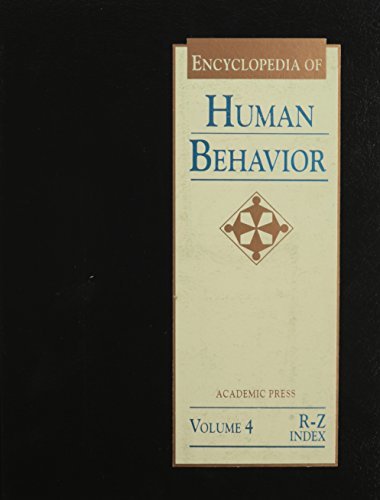
Volume 4 contains entries from R- to Z- and the index for the four-volume set.The Encyclopedia of Human Behavior is a comprehensive four-volume reference source on human action and reaction, and the thoughts, feelings, and physiological functions behind those actions. Presented alphabetically by title, 250 articles probe both enduring and exciting new topics in physiological psychology, perception, personality, abnormal and clinical psychology, cognition and learning, social psychology, developmental psychology, language, and applied contexts. Written by leading scientists in these disciplines, every article has been peer-reviewed to establish clarity, accuracy, and comprehensiveness. The first reference source to provide both depth and breadth to the study of human behavior, the encyclopedia promises to be a much used reference source. This set appeals to public, corporate, university and college libraries, libraries in two-year colleges and some secondary schools. Key Features* Comprehensive250 signed articles across disciplines in education, psychology, gerontology, physiology, and anthropology* 2500 pages* 15000 index entries* 275 figures and 50 Tables* 2000 glossary entries* 2000 bibliographic entries* Accurate* Written by established experts, every article has been peer-reviewed* Truly international collection of contributors from U.S.A., Australia, Belgium, Canada, France, Germany, Ireland, Israel, Japan, Sweden, and the United Kingdom* User-Friendly* More than 1200 cross-references to other entries, each article notes related articles for additional reading* Each article contains a table of contents, glossary, definition of topic, and bibliography


This unique biographical work describes the eccentric, weird, paradoxical, and unusual lifestyles of famous personalities from all walks of life who have lived in the past 2000 years. The biography includes a description, in a concise manner, the contributions and private lifestyles of scientists, royals, politicians, inventors, sportsmen, explorers, musicians, artists, and others. The book is a must-have for historians, students, scientists, general public, teachers, and artists.

Since the publication of the first edition ten years ago, significant developments have occurred in the use of admixtures in concrete. Eight new chapters and a full update of the preceding ten chapters bring this book up to date; reflecting the relative advances made in the science and technology of different groups of admixtures. The increased role and development of admixtures in concrete technology is evidenced by a number of conferences, publications, and novel admixtures available in the market place.These developments in the field caused the modification of many chapters in the first edition in order to reflect the advances. Although individual chapters refer to standards and specifications of admixtures, those only interested in the standards or techniques used in investigating admixtures will find the second chapter (Research Technologies, Standards, and Specifications) useful. Admixtures are not as inert as may be presumed. They may chemically interact with the constituents of concrete and affect the properties of the fresh and hardened concrete and its durability. The third chapter deals with these aspects. It was important to devote a chapter to recent attempts in developing new admixtures.

Volume 1 contains entries from A- to Con-.The Encyclopedia of Human Behavior is a comprehensive four-volume reference source on human action and reaction, and the thoughts, feelings, and physiological functions behind those actions. Presented alphabetically by title, 250 articles probe both enduring and exciting new topics in physiological psychology, perception, personality, abnormal and clinical psychology, cognition and learning, social psychology, developmental psychology, language, and applied contexts. Written by leading scientists in these disciplines, every article has been peer-reviewed to establish clarity, accuracy, and comprehensiveness. The first reference source to provide both depth and breadth to the study of human behavior, the encyclopedia promises to be a much used reference source. This set appeals to public, corporate, university and college libraries, libraries in two-year colleges and some secondary schools. Key Features* Comprehensive250 signed articles across disciplines in education, psychology, gerontology, physiology, and anthropology* 2500 pages* 15000 index entries* 275 figures and 50 Tables* 2000 glossary entries* 2000 bibliographic entries* Accurate* Written by established experts, every article has been peer-reviewed* Truly international collection of contributors from U.S.A., Australia, Belgium, Canada, France, Germany, Ireland, Israel, Japan, Sweden, and the United Kingdom* User-Friendly* More than 1200 cross-references to other entries, each article notes related articles for additional reading* Each article contains a table of contents, glossary, definition of topic, and bibliography

Scientific American Mind February/March 2006
by V.S. Ramachandran
One Person, One Neuron? By Katja Gaschler Nerve cells devoted exclusively to recognizing Halle Berry or Bill Clinton? Absurd. That's what most neuroscientists thought, until recently. Train Your Brain By Ulrich Kraft Mental exercises with neurofeedback may ease symptoms of attention-deficit disorder, epilepsy and depression--and even boost cognition in healthy brains Picture This By Thomas Grüter How the brain creates images in our minds may well determine how we think Mindful of Symbols By Judy S. DeLoache Before they learn that one item can represent another, young children conflate real objects and their symbols. The errors show how difficult it is to start thinking symbolically Mastery of Emotions By David Dobbs Joseph E. LeDoux discovered how fear arises. Now he is showing that the biology of emotions is what gives life meaning Science Probes Spirituality By Jamie Talan Discovering how meditation expels negativity could lead to drugs that bring us peace Freud Returns By Mark Solms Neuroscientists are finding that their biological descriptions of the brain may fit together best when integrated by psychological theories Freud sketched a century ago Do Animals Have Feelings? By Klaus Wilhelm Animal lovers insist their fellow creatures experience joy, sympathy, fear and grief, but scientifically, it is hard to say Combating Stress in Iraq By Bret A. Moore and Greg M. Reger Psychologists on the battlefield are helping soldiers stay mentally fit during long and frightful tours of duty Do Gays Have a Choice? By Robert Epstein Science offers a clear and surprising answer to a controversial question Fighting Parkinson's By Konrad Schmidt and Wolfgang Oertel The disease remains incurable, but research advances point to better treatments for this increasingly common disorder
Neural Basis of Motion Perception
by V.S. Ramachandran
![Ghosts among the brain, mechanism of heart Revealed again (2005) ISBN: 4047915017 [Japanese Import]](https://m.media-amazon.com/images/S/compressed.photo.goodreads.com/books/1678238525i/77660102.jpg)
Ghosts among the brain, mechanism of heart Revealed again (2005) ISBN: 4047915017 [Japanese Import]
by V.S. Ramachandran
La donna che mori dal ridere
by V.S. Ramachandran

Application of Differential Thermal Analysis in Cement Chemistry
by V.S. Ramachandran
Preface ix - Acknowledgments xiii - Abbreviations xv - I. Differential Thermal Analysis Technique - II. Theory and Typical Applications 28 - II.l Theoretical Considerations 28 - II.2 Typical Applications 34 - III. Formation of Portland Cement Clinker and Polymorphism of C3S and C2S 54 - III.1 Formation of Portland Cement Clinker 54 - 111.2 Polymorphism of C3S 71 - III.3 Polymorphism of C2S 75 - IV. Hydration of Portland Cement 81 - IV.l Systems Containing CaO, AI20 a, Si02, and H20 at Ordinary Temperatures 81 - IV.2 Hydration of Portland Cement 88 V. Hydration of Individual Phases in Portland Cement 111 - V.l Hydration of C3A 111 - V.2 Hydration of C3S and B-C2S 127 - V.3 Hydration of the Ferrite Phase 135 - VI. Hydration of C3A in Presence of Salts 139 - VI.1 Hydration of C3A in Presence of Gypsum 139 - VI.2 Hydration of C3A in Presence of Lignosulfonate 155 - VI. 3 Hydration of C3A in Presence of Calcium Chloride 159 - VI.4 Hydration of C3A in Presence of Calcium Carbonate 160 - VII. Autoclaved Cementitious Products 165 - VIII. Non-Portland Cements Based on Silicates and Aluminates 196 - VIII.1 Slags and Slag Cements 196 - VIII.2 High Alumina Cement 206 - VIII.3 Pozzolanas and Pozzolanic Cements 213 - VIII.4 Oil Well Cement 222 - VIII.5 Hydraulic Lime 223 - VIlI.6 Expanding Cement 227 - VIII.7 Acid-Proof Cement 230 - IX. Other Non-Portland Cements 231 - IX.l Magnesium Oxychloride and Oxysulfate Cement 231 - IX.2 Gypsum Plaster 251 - IX.3 Sand-Lime Mortar 271 - IX.4 Phosphate Cement 275 - X. Aggregates 276 - Subject Index 297 - Author Index 303 -
Encyclopedia of the Human Brain volume 4, Pi-Z
by V.S. Ramachandran
In the past decade, enormous strides have been made in understanding the human brain. The advent of sophisticated new imaging techniques (e.g. PET, MRI, MEG, etc.) and new behavioral testing procedures have revolutionized our understanding of the brain, and we now know more about the anatomy, functions, and development of this organ than ever before. However, much of this knowledge is scattered across scientific journals and books in a diverse group of psychology, neuroscience, medicine, etc. The Encyclopedia of the Human Brain places all information in a single source and contains clearly written summaries on what is known of the human brain.Covering anatomy, physiology, neuropsychology, clinical neurology, neuropharmacology, evolutionary biology, genetics, and behavioral science, this four-volume encyclopedia contains over 200 peer reviewed signed articles from experts around the world. The Encyclopedia articles range in size from 5-30 printed pages each, and contain a definition paragraph, glossary, outline, and suggested readings, in addition to the body of the article. Lavishly illustrated, the Encyclopedia includes over 1000 figures, many in full color. Managing both breadth and depth, the Encyclopedia is a must-have reference work for life science libraries and researchers investigating the human brain.

Encyclopedia of Human Behavior, Volume 2: Cop-I
by V.S. Ramachandran
Volume 2 contains entries from Cop- to I-.The Encyclopedia of Human Behavior is a comprehensive four-volume reference source on human action and reaction, and the thoughts, feelings, and physiological functions behind those actions. Presented alphabetically by title, 250 articles probe both enduring and exciting new topics in physiological psychology, perception, personality, abnormal and clinical psychology, cognition and learning, social psychology, developmental psychology, language, and applied contexts. Written by leading scientists in these disciplines, every article has been peer-reviewed to establish clarity, accuracy, and comprehensiveness. The first reference source to provide both depth and breadth to the study of human behavior, the encyclopedia promises to be a much used reference source. This set appeals to public, corporate, university and college libraries, libraries in two-year colleges and some secondary schools. Key Features* Comprehensive250 signed articles across disciplines in education, psychology, gerontology, physiology, and anthropology* 2500 pages* 15000 index entries* 275 figures and 50 Tables* 2000 glossary entries* 2000 bibliographic entries* Accurate* Written by established experts, every article has been peer-reviewed* Truly international collection of contributors from U.S.A., Australia, Belgium, Canada, France, Germany, Ireland, Israel, Japan, Sweden, and the United Kingdom* User-Friendly* More than 1200 cross-references to other entries, each article notes related articles for additional reading* Each article contains a table of contents, glossary, definition of topic, and bibliography

Handbook of Thermal Analysis of Construction Materials
by V.S. Ramachandran
This guide discusses both classical and modern techniques of thermo analytic techniques, with the majority of the book dedicated to the different types of building materials and their reactions to different analytical techniques. Covers Portland cement, concrete, accelerating, and super plasticizing admixtures, gypsum and clay-based products.